
Dutch · c. 1200–1500
Transcribe Middle Dutch manuscripts line by line
Middle Dutch book hands pack minims so tightly that minne, mijn and niene can look like the same row of strokes, and one scribe may write y, ij and ii for the same sound on a single page. Evidano reads textualis and hybrida folios from the Lancelot compilation to late prayer books, keeps the abbreviations and rubrics you ask it to keep, and puts each line beside the page so you can check it.
Sample pages
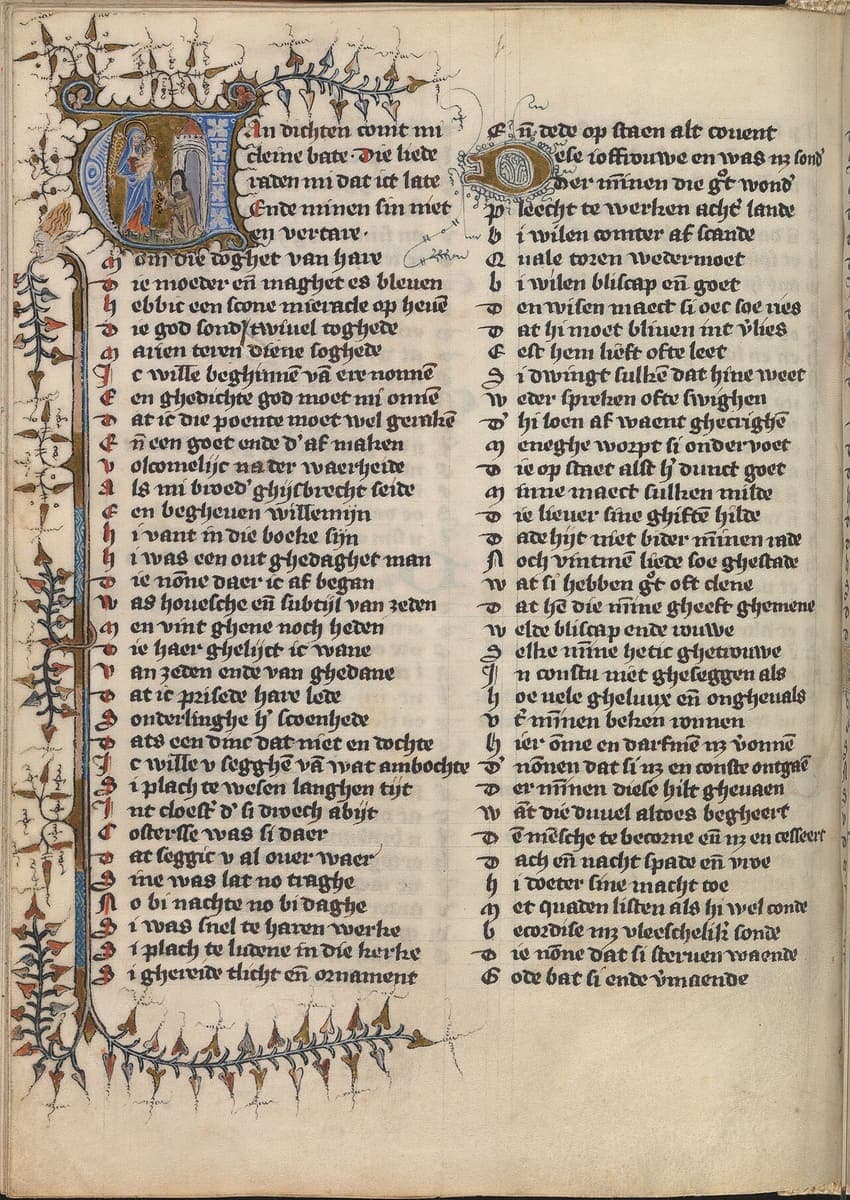
KB, National Library of the Netherlands, KW 76 E 5, f. 47v, c. 1374 · Source · Public domain
Evidano Transcription
Lines 1–72 of the poem, the whole folio (left column ll. 1–35, right column ll. 36–72), in the normalised reading text of Project Laurens Jz Coster as published on Wikisource: u/v and i/j are regularised, capitals and punctuation are editorial, and abbreviations are expanded silently.
Van dichten comt mi cleine bate.
Die liede raden mi dat ict late
Ende minen sin niet en vertare.
Maer om die doghet van hare
Die moeder ende maghet es bleven,
Hebbic een scone mieracle op heven,
Die God sonder twivel toghede
Marien teren, dien soghede.
Ic wille beghinnen van ere nonnen
Een ghedichte. God moet mi onnen
Dat ic die poente moet wel geraken
Ende een goet ende daer af maken
Volcomelijc na die waerheide
Als mi broeder Ghijsbrecht seide,
Een begheven willemijn.
Hi vant in de boeke sijn;
Hi was een out ghedaghet man.
Die nonne daer ic af began,
Was hovesche ende subtijl van zeden;
Men vint ghene noch heden
Die haer ghelijct, ic wane,
Van zeden ende van ghedane.
Dat ic prisede hare lede,
Sonderlinghe haer scoenhede,
Dat een dinc dat niet en dochte.
Ic wille u segghen van wat ambochte
Si plach te wesen langhen tijt
Int cloester daer si droech abijt:
Costersse was si daer,
Dat seggic u al over waer,
Sine was lat no traghe
No bi nachte, no bi daghe.
Si was snel te haren werke;
Si plach te ludene, in die kerke,
Si ghereide tlicht ende ornament
Ende dede op staen alt covent.
Dese ioffrouwe en was niet sonder
Der minnen, die groet wonder
Pleecht te werken achter lande.
Bij wilen comter af scande,
Quale, toren, wedermoet;
Bij wilen bliscap ende goet.
Den wisen maect si oec soe ries
Dat hi moet bliven int verlies,
Eest hem lieft ofte leet.
Si dwingt sulken, dat hine weet
Weder spreken ofte swighen
Daer hi loen af waent ghecrighen.
Meneghe worpt si ondervoet,
Die op staet als haer dunct goed.
Minne maect sulken milde
Die liever sine ghiften hilde,
Dade hijt niet bider minnen rade.
Noch vintmen liede soe ghestade:
Wat si hebben groet oft clene,
Dat hen die minne gheeft ghemene,
Welde, bliscap ende rouwe.
Selke minne hetic ghetrouwe.
In constu niet gheseggen als
Hoe vele gheluux ende onghevals
Uter minnen beken ronnen.
Hier omme en darfmen niet veronnen
Der nonnen, dat si niet en conste ontgaen
Der minnen diese hilt ghevaen,
Want die duvel altoes begheert
Den mensche te becorne ende niet en cesseert
Dach ende nacht, spade ende vroe
Hi doeter sine macht toe,
Met quaden listen, als hi wel conde,
Becordise met vleeschliker sonde,
Die nonne, dat si sterven waende.
Gode bat si ende vermaende
Source: Beatrijs, ll. 1–72, Project Laurens Jz Coster reading text, via Wikisource (Public domain).
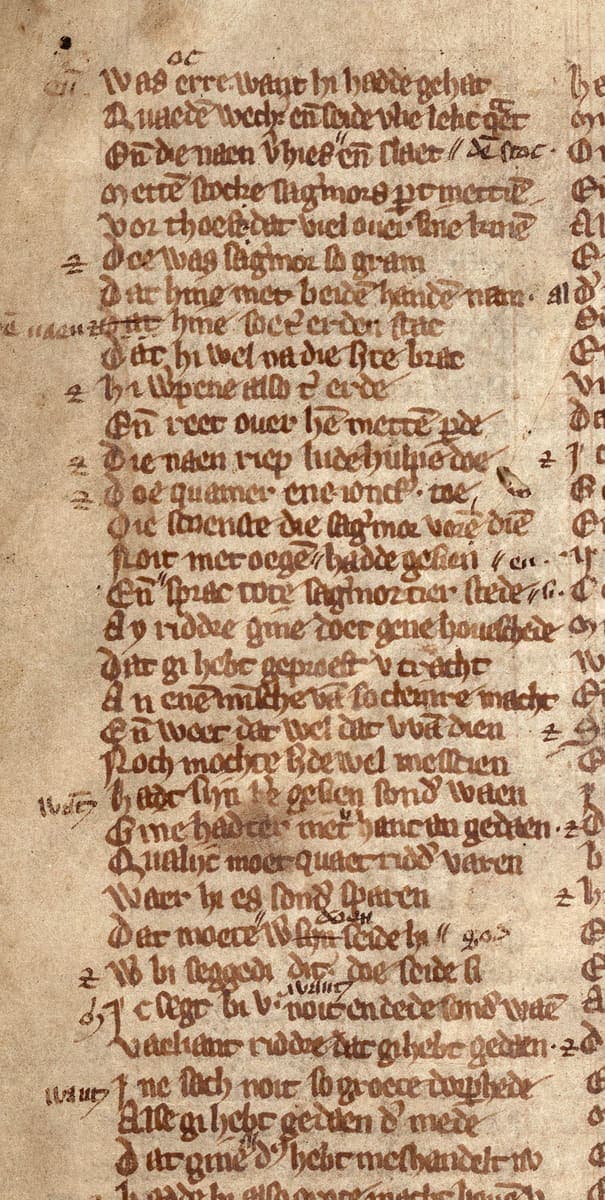
KB, National Library of the Netherlands, KW 129 A 10, f. 2v, c. 1320–1325 · Source · Public domain
Evidano Transcription
Book II, ll. 542–573 of Jonckbloet’s edition, the thirty-two lines of column a shown in the crop (Sagrimor and the dwarf); Jonckbloet edits this manuscript, expands abbreviations silently and adds punctuation and guillemets for speech. Ordinary letters garbled by the Internet Archive OCR (b for h, c for e) have been restored against the page; the corrector’s marginal marks are not printed.
Was erre, want hi hadde gehat
Quaeden wech, ende seide: «Vlie, lelic quaet!»
Ende die naen verhief ende slaet
Metten stocke Sagrimors pert mettien
Vor thoeft dat viel duer sine knien.
Doe was Sagrimor so gram,
Dat hine met beide handen nam,
Dat hine soe ter erden stac,
Dat hi wel na die herte brac.
Hi warpene also ter erde
Ende reet over hem metten perde.
Die naen riep lude hulpe doe.
Doe quamer ene ioncvrouwe toe,
Die scoenste die Sagrimor voren dien
Noit met oegen hadde gesien,
Ende sprac tote Sagrimorre tier stede:
«Ay riddre, gine doet gene hoveschede
Dat gi hebt geproeft u cracht
An enen mensche van so cleinre macht;
Ende weet dat wel, dat u van dien
Noch mochte herde wel messcien.
Hadt mijn here gesien, sonder waen,
Gine hadter niet hant an gedaen.
Qualijc moet quaet ridder varen
Waer hi es, sonder sparen.»
— «Dat moete waer sijn,» seide hi,
«Waer bi seggedi dat?» Doe seide si:
«Ic segt bi u, noit en dede, sonder waen,
Vaeliant riddre dat gi hebt gedaen.
Ine sach noit so groete dorperhede
Alse gi hebt gedaen daer mede,
Dat gine dus hebt meshandelt nu.
Source: Roman van Lancelot (XIIIe eeuw), ed. W. J. A. Jonckbloet, vol. 1 (The Hague, 1846), Book II, ll. 542–573, via Internet Archive (Public domain).
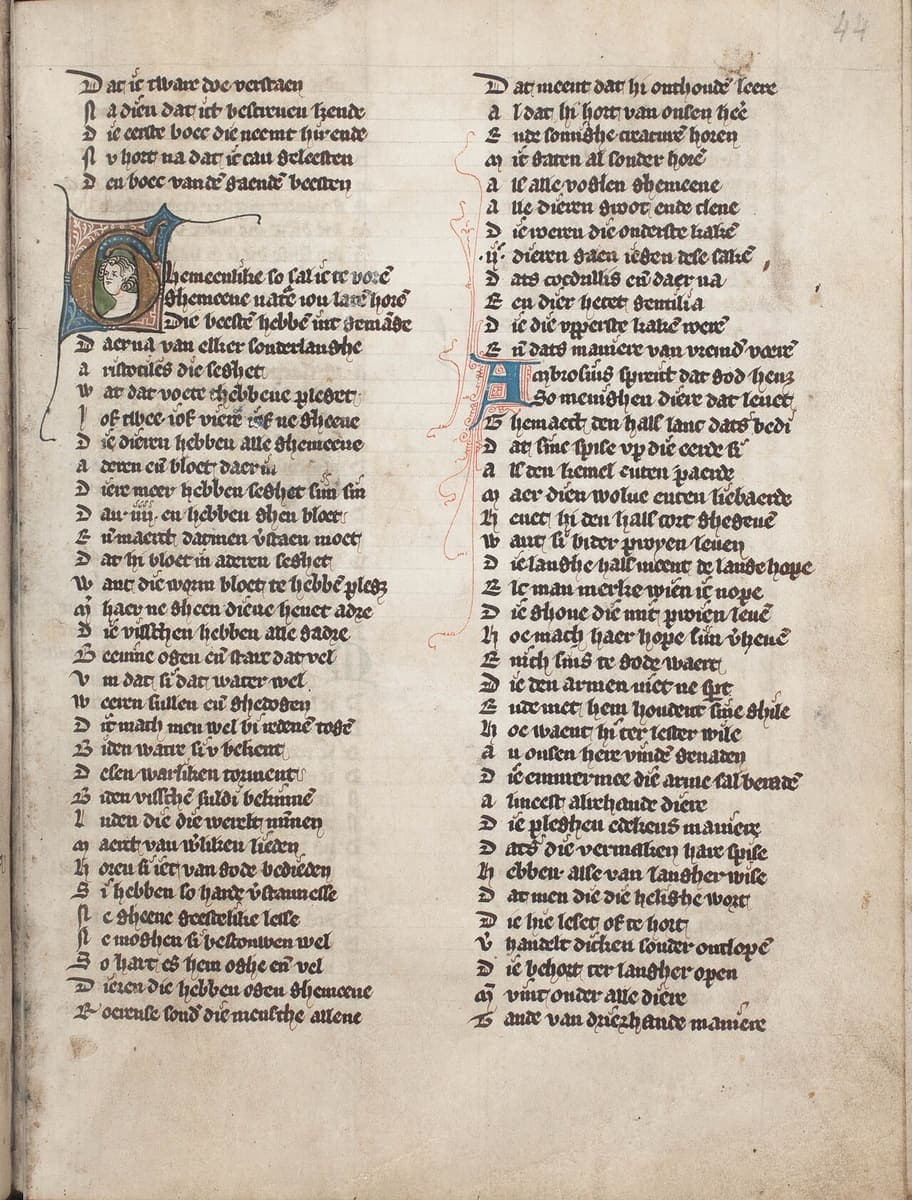
KB, National Library of the Netherlands, KW KA 16, f. 44r, c. 1340–1350 · Source · Public domain
Evidano Transcription
Dat ic tware doe verstaen
Na dien dat ict bescriuen[?] vende
Die eerste boec die neemt hi[er] ende
Nu hort na dat ic can gelecsten[?]
Den boec vande[n] gaende[n] beesten
Ghemeenlike so sal ic te vore[n]
Ghemeene nat[ur]e [illegible] hore[n]
Die beeste[n] hebbe[n] int gemaste[?]
Daerna van elker sonderlanghe
Aristotiles die seghet
Wat dat voete[n] thebbene pleghet
Of twee iof viere iof ne gheene
Die dieren hebben alle ghemeene
Aderen en[de] bloet daer in
Diere meer hebben seghet sin[?] sin[?]
Dan iiij. en hebben ghen bloet
En[de] maect[?] datmen v[er]staen moet
Dat hi bloet in aderen seghet
Want die worm bloet te hebbe[n] pleg[et]
Maer haer ne gheen diene heuet adre
Die visschen hebben alle gadre
Beenine[?] oghen en[de] starc[?] dat vel
Om dat si dat water wel
Weeren sullen en[de] ghedoghen
Dit mach men wel bi redene[n] toghe[n]
Biden warne[?] si v[er] bekent
Delen warliken torment
Biden vissche[n] suldi bekinne[n]
Luden die die werelt minnen
Maent[?] van w[er]liken lieden
Horen si iet van gode bedieden
Si hebben so harde v[er]stannesse
Ne gheene geestelike lesse
Ne moghen si verstouwen wel
So hart es hem oghe en[de] vel
Dieren die hebben oghen ghemeene
[?] sond[er] die mensche allene
Dat meent dat hi onthoude[n] leere
Al dat hi hort van onsen hee[re]
Ende sommighe creature[n] horen
M[?]it gaten al sonder hore[n]
Als alle voglen ghemeene
Alle dieren grot ende clene
Die weren die onderste kake[n]
ij. dieren gaen iegen dese sake[n]
Dats cocdrillis[?] en[de] daer na
Een dier hetet gemilia[?]
Die die upperste kake[n] were[n]
En[de] dats maniere van vremd[er][?] vare[n]
Ambrosius spreect dat god heu[et]
So menighen dier dat leuet
Ghemaect den hals lanc dats bedi
Dat sine spise up die eerde [?]
Al den kemel enten paerde
Maer dien wolue enten liebaerde
Heuet hi den hals cort ghegheue[n]
Want si bider proyen leuen
Die langhe hals meent de langhe hope
Die man merke wien ic nope
Die ghone die met proien leue[n]
Hoe mach haer hope sijn v[er]heue[n]
Enich sins te gode waert
Die den armen niet ne [?]
Ende niet hem houden sine [?]
Hoe waent hi ter lester wile
An onsen here vinde[n] genaden
Die emmer mee die arme sal berade[n]
Almeest[?] alrehande diere
Die pleghen ed[er]kens[?] maniere
Dats die vermalen haer spise
Hebben alle van langher wise
Dat men die die helishe[?] wort
Die hine leset of te hort
[?]handelt dicken sonder ontlope[n]
Die behort ter langher open
Men vint onder alle diere
[?]ande van driezhande[?] maniere
Generated by Evidano’s advanced model; not yet checked against a published edition.
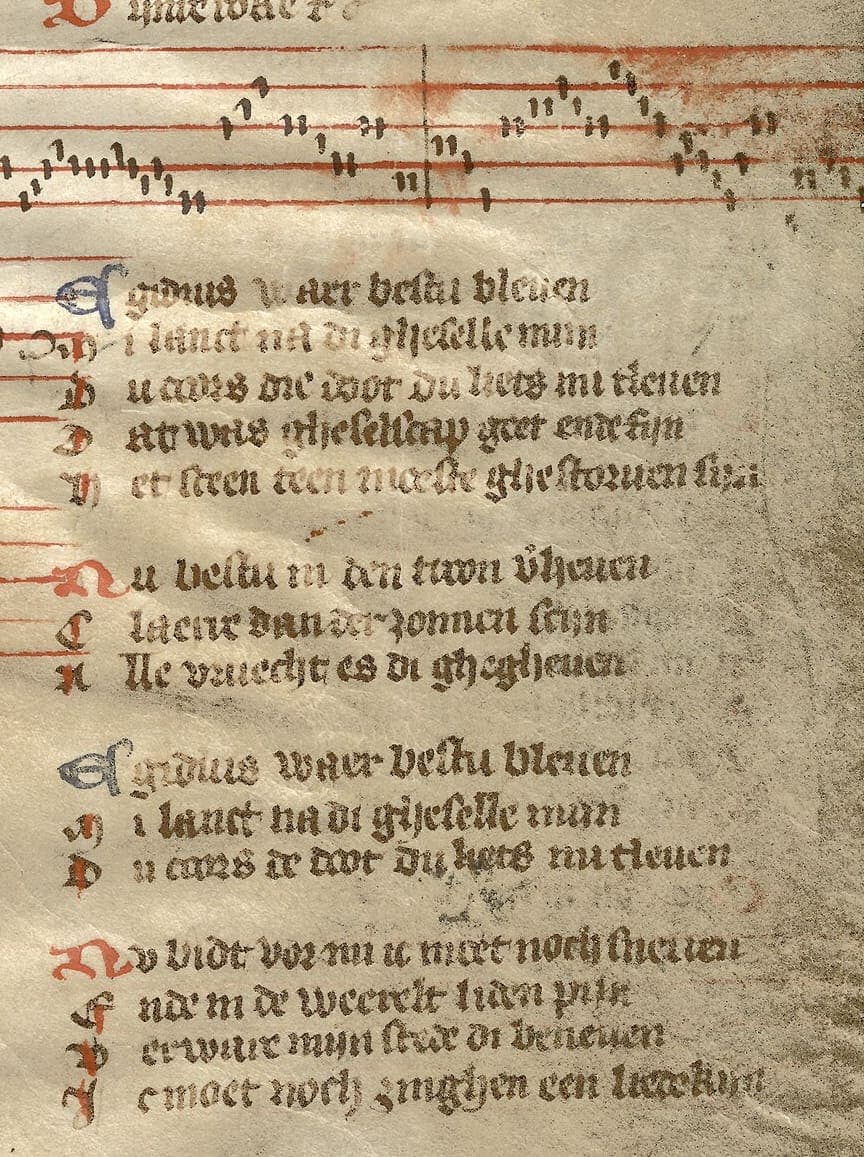
KB, National Library of the Netherlands, KW 79 K 10, f. 28r, c. 1395–1408 · Source · Public domain
Evidano Transcription
The fifteen lines of the Egidiuslied on f. 28r, from the blue initial to the foot of the page, as printed on Wikisource from the DBNL text; the song’s last line (Nochtan moet emmer ghestorven sijn) and the repeat of the refrain stand on the following leaf. Abbreviations are expanded silently and no punctuation is added.
Egidius waer bestu bleven
Mi lanct na di gheselle mijn
Du coors die doot du liets mi tleven
Dat was gheselscap goet ende fijn
Het sceen teen moeste ghestorven sijn
Nu bestu in den troon verheven
Claerre dan der zonnen scijn
Alle vruecht es di ghegheven
Egidius waer bestu bleven
Mi lanct na di gheselle mijn
Du coors die doot du liets mi tleven
Nu bidt vor mi ic moet noch sneven
Ende in de weerelt liden pijn
Verware mijn stede di beneven
Ic moet noch zinghen een liedekijn
Source: Egidius waer bestu bleven (Gruuthuse manuscript, c. 1400), via Wikisource (Public domain).
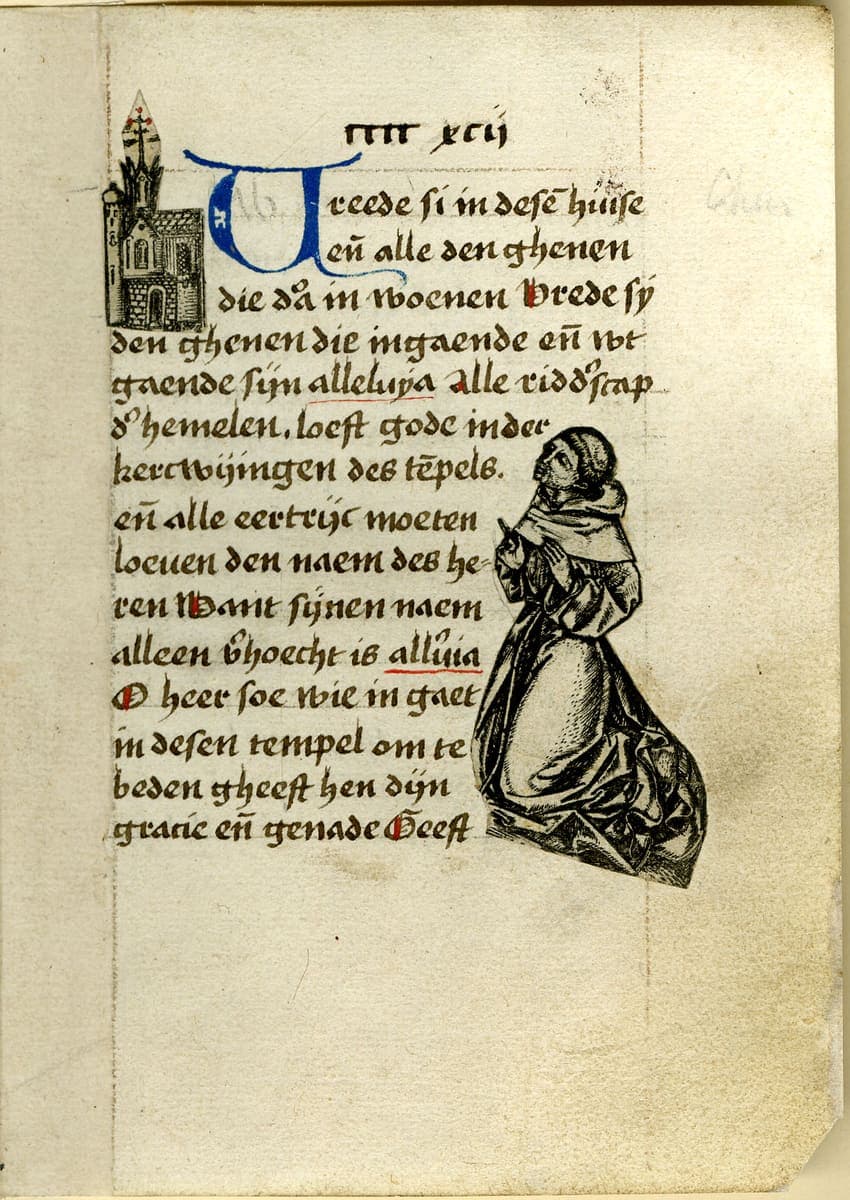
British Museum, P&D 1861,1109.686 (from BL Add MS 24332), c. 1490–1500 · Source · Public domain
Evidano Transcription
iiii xcij
Vreede si in dese[n] huise
en[de] alle den ghenen
die da[er] in woenen Vrede sy
den ghenen die ingaende en[de] wt
gaende sijn alleluya alle ridd[er]scap
d[er] hemelen. loeft gode inder
kercwijingen des te[m]pels.
en[de] alle eertrijc moeten
loeuen den naem des he
ren Want sijnen naem
alleen v[er]hoecht is all[elu]ia
O heer soe wie in gaet
in desen tempel om te
beden gheeft hen dijn
gracie en[de] genade Geeft
Generated by Evidano’s advanced model; not yet checked against a published edition.
What a Middle Dutch page looks like
Dutch became a written literary language in the thirteenth century, first in Flanders and Brabant, then in Holland, Limburg and the eastern provinces. Its scribes used the same Gothic family of scripts as their Latin neighbours. The great verse manuscripts of Jacob van Maerlant, the Lancelot compilation and the Beatrijs codex are in littera textualis, an upright hand with broken arches, feet on the minims and letters that bite into one another. Compilation manuscripts squeeze the same script into three columns of sixty lines. From the late fourteenth century the devotional prose of the Modern Devotion, songbooks such as the Gruuthuse manuscript, and chronicles move to hybrida and cursiva: looped ascenders, a single-compartment a and a long f and s that plunge below the line.
The letters that cause most trouble are the ones built from identical strokes. i has no dot, only sometimes a hairline flick, so u, n, m, i and their combinations are counted rather than read; ij and y are the same sign, with or without two dots; c and t differ by a hairline; the round r rotunda follows o, p and b and looks like a 2; long s stands inside words while a round or trailing s closes them. Abbreviation is borrowed wholesale from Latin: a bar over a vowel for a missing m or n, superscript letters for -er and -re, the Tironian ⁊ for ende, and contractions such as ihs and xps in religious prose. Dutch spelling was not yet fixed, so oe, ou and u, or gh and g, alternate within a text.
Layout carries information that generic OCR throws away. Rhymed couplets are written one line each, with the first letter of every line set apart in its own narrow column and picked out in red or blue, so a naive reading produces a column of capitals followed by headless words. Paraph marks and rubrics in red divide chapters; prose uses the punctus and the punctus elevatus rather than modern stops. Many manuscripts also carry a second layer: the corrector of the Lancelot compilation squeezed reading aids into the margins, the Gruuthuse scribe wrote stroke notation on red staves between the stanzas, and the Maastricht prayer book has engravings pasted over its written lines.
Why ordinary OCR struggles here
Minim strings and the y/ij problem
A sequence of eight vertical strokes could be minnen, mimen or minuen. The reader resolves it from the rhyme and the sense, not from the shapes, and then has to decide whether the scribe’s dotted y should be printed as y or as ij. Print-trained OCR simply guesses, and guesses differently on every line.
Abbreviations inherited from Latin
The nasal bar, the ⁊ for ende, the superscript r and the suspended -us are frequent, and the same bar can mean m or n. Expanding them correctly means knowing the word; keeping a record of what was expanded means marking each expansion in the output, which most tools cannot do.
Detached capitals and column order
Because the first letter of every verse line stands in a separate column, a text-block detector reads it as a stray character or as part of the previous line. Two- and three-column layouts also need the columns read top to bottom in order, so that a couplet is not stitched across the gutter.
Corrections, staves and pasted prints
Marginal reading marks, interlinear corrections, musical notation and engravings glued onto the page all sit next to the main text. A transcription for scholarly use has to keep the scribe’s text, the corrector’s additions and everything decorative in separate layers rather than merging them into one stream.
Who works with this material
Editors of Middle Dutch texts
Anyone preparing a diplomatic or critical edition of a verse romance, a saint’s life or a mystical treatise needs a first transcript that respects the manuscript’s spellings, minim readings and abbreviations instead of silently modernising them, so that variants between witnesses can be collated from the transcript itself.
Literary historians and students
Readers who work from the reading editions on DBNL often want to go back to the folio. A line-by-line transcript keyed to the manuscript lets them compare an edition’s regularised u, v and ij with what the scribe wrote and check a disputed reading without a research trip.
Lexicographers and corpus builders
Historical dictionaries and diachronic corpora need consistent treatment of abbreviations and spelling variants across thousands of lines. Setting the expansion rule once in the prompt gives the same policy on every folio and marks uncertain readings for review.
Musicologists and codicologists
Songbooks such as the Gruuthuse manuscript, and prayer books with pasted-in prints or later foliation, need the text separated cleanly from notation, images and additions so that each layer can be described on its own.
Getting the best transcription
Fix the rules for u, v, i, j and ij
Decide before you start whether the transcript keeps the scribe’s u for v and i for j, whether the dotted y is written as y or ij, and whether long s is kept as ſ. State the rule in the prompt; it is applied identically on every page and can be reversed later, whereas a mixed policy cannot.
Choose how abbreviations appear
Ask for the Tironian ⁊, the nasal bar and superscript letters to be expanded silently, expanded in brackets or kept as written. For an edition the bracketed form is usually right, because the apparatus can then be built from the transcript.
Keep the verse line and rejoin the capital
Tell the model that each manuscript line is one verse and that the detached coloured letter at the left belongs to the first word. Columns should be read in order, left to right, top to bottom, so that the output can be checked against the folio couplet by couplet.
Test on a corrected or cluttered page
Run a folio with marginal corrections, notation or pasted prints before the clean ones. If the corrector’s notes come out as a separate layer and the staves are ignored there, the plain two-column pages will present no difficulty.
Further reading on this hand
The palaeography guides the in-app selector points to for this domain, if you want to check a transcription against the standard references.
- Wat staat daer? Uitleg
This Dutch archival training project explains how historical Dutch handwriting is transcribed and read. It addresses punctuation, line-end word division, abbreviations, letter distinctions, and the treatment of y and ij in manuscript texts. The site supplements its explanations with exercises drawn from documents preserved by participating archives. Its conventions and examples are useful for recognizing continuities between late medieval writing and later Dutch documentary practice.
Frequently asked questions
- Does it keep u for v and i for j, or normalise like the reading editions?
- Either, but you choose once. The default is diplomatic: what the scribe wrote is what you get, including uu for w and the undotted i. If you want the regularised spelling of the Coster or DBNL texts for searching, say so and the conversion is made consistently.
- How is the dotted y handled when it stands for ij?
- The sign is recognised as the scribe’s y/ij and printed according to your rule, y by default. Because ij, y and ii were interchangeable for the scribes, the transcript can note where the form differs from the one you expect, which matters for dialect studies.
- Can the corrector’s notes in the Lancelot compilation be kept apart?
- Yes. Marginal and interlinear additions in a different ink or hand are transcribed as a separate layer with their position noted, so the scribe’s text and the corrector’s reading aids are not run together.
- What happens on a Gruuthuse page with musical notation?
- The staves and stroke notation are recognised as notation and skipped, with their position recorded, while the stanzas are transcribed in order. The output does not attempt to encode the music.
- Will Latin rubrics and prayers in a Dutch prayer book be transcribed?
- Yes, in reading order, and the language switch can be labelled. Red rubrics and headings are marked as such, so a Dutch prayer and its Latin incipit or alleluia are kept distinct in the output.
Related scripts and pages
Transcribe your Middle Dutch folios
Upload a scan, choose Middle Dutch Gothic Book Hands as the domain, and try one two-column verse page before running the manuscript.