
Dutch · c. 1700–1900
Read Dutch registers, deeds and letters, 1700 to 1900
A birth entry of 1887 is half printed and half written, and the written half runs across ruled lines in a hand that swells every capital in a surname into a flourish. Evidano transcribes church registers, civil-status certificates, notarial deeds and private letters from these two centuries, keeps the printed formula and the clerk’s insertions apart, and returns the names, dates and occupations as separate fields you can index.
Sample pages
Nationaal Archief, The Hague, 9 December 1806 · Source · Public domain
Evidano Transcription
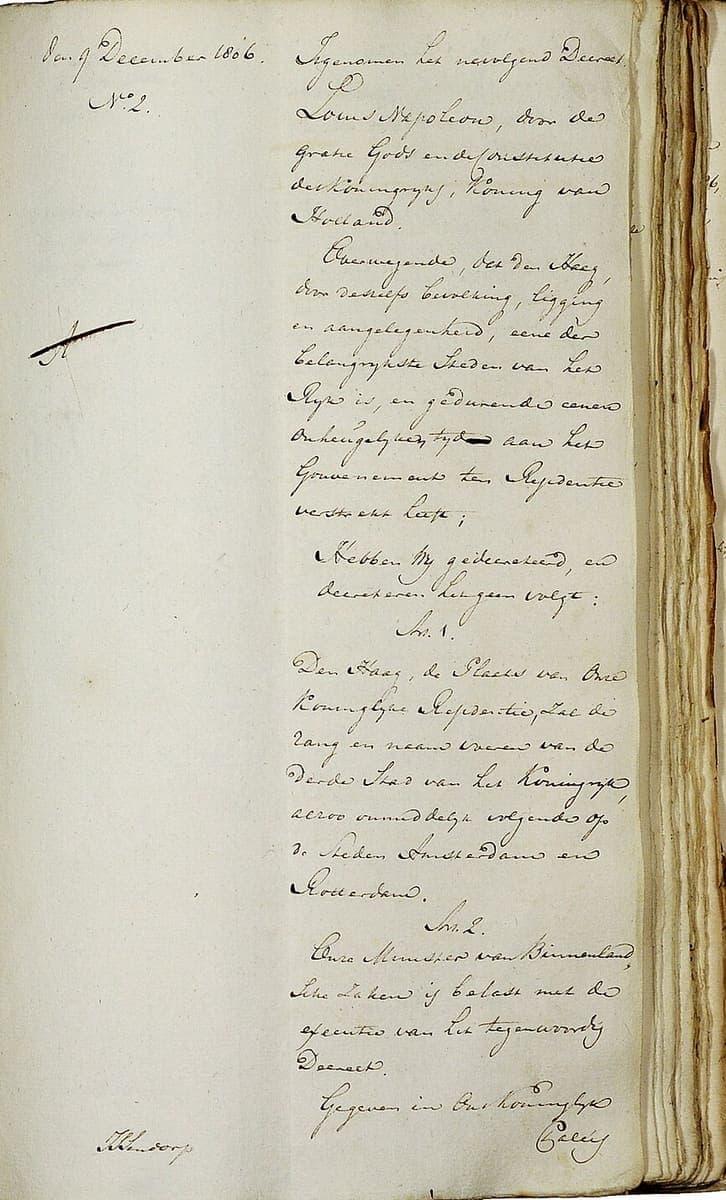
The whole entry, running across both pages of the opening, as transcribed by the Nationaal Archief and published on the Wikimedia Commons file page. It is given paragraph by paragraph rather than by manuscript line, and the clerk’s bracketed notes on the signatures — (getekend), (Onder Stond) — are kept.
Ingekomen het navolgend Decreet.
Louis Napoleon, door de gratie Gods ende Constitutie des Koningrijks, Koning van Holland.
Overwegende dat den Haag door deszelfs bevolking, ligging en aangelegenheid, eene der belangrijkste Steden van het Rijk is, en gedurende eenen onheugelijken tijd aan het Gouvernement ten Residentie verstrekt heeft;
Hebben wij gedecreteerd, en decreteren hetgeen volgt:
Art. 1. Den Haag, de Plaats van Onze Koninglijke Residentie, zal de rang en naam voeren van de derde Stad van het Koningrijk, alzoo onmiddelijk volgende op de Steden Amsterdam en Rotterdam.
Art. 2. Onze Minister van Binnenlandsche Zaken is belast met de executie van het tegenwoordig Decreet.
Gegeven in Ons Koninglijk Paleis in Den Haag, den 9 December van het jaar 1806 en van Onze Regeering het Eerste.
(getekend) Louis
(Onder Stond) Wegens den Koning
De Minister-Secretaris van Staat
(Getekend) W.F. Röell
Zullende een Afschrift van dit decreet aan den Minister van Binnenlandsche Zaken worden gegeven.
Source: Nationaal Archief transcription of the minute of 9 December 1806, on the Wikimedia Commons file page (CC BY-SA 4.0).
Nationaal Archief, The Hague, 8 October 1874 · Source · Public domain
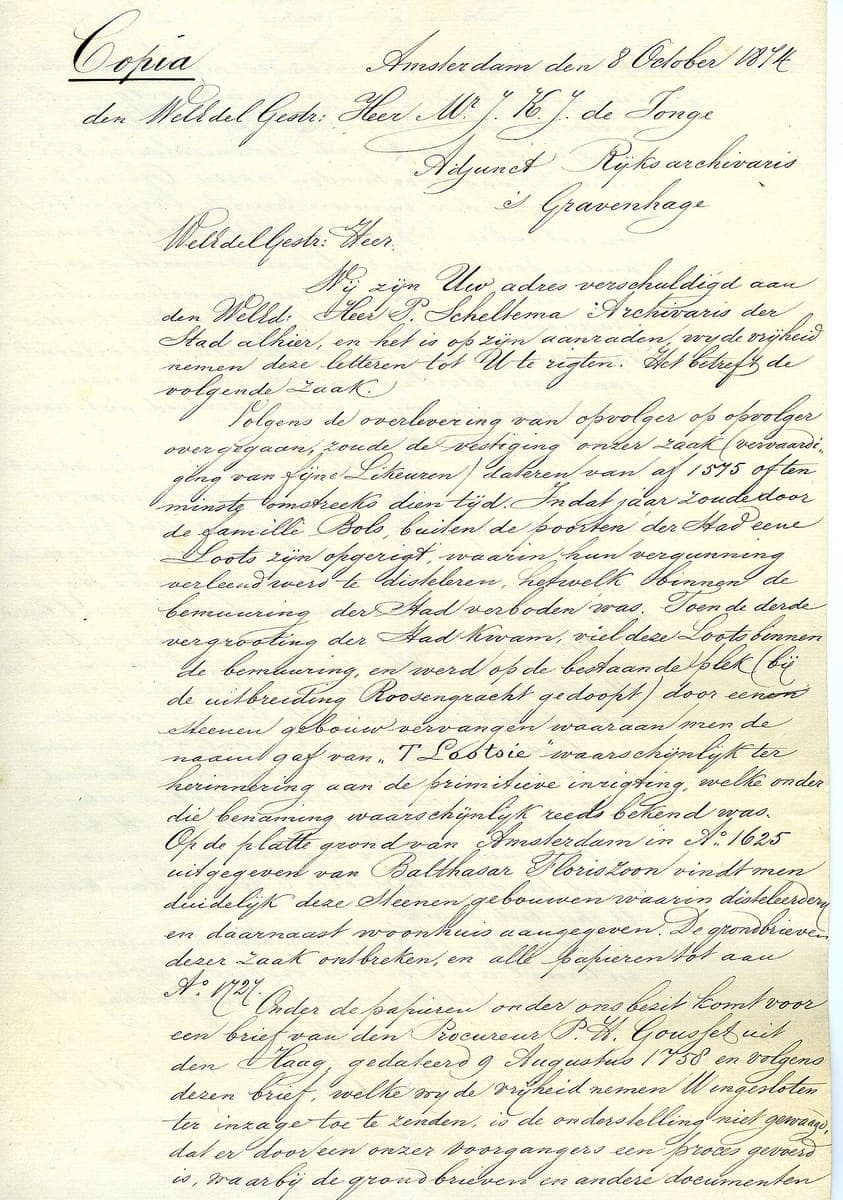
Evidano Transcription
Copia
Amsterdam den 8 October 1874
den WelEdel Gestr: Heer M[eeste]r J. K. J. de Jonge
Adjunct Rijksarchivaris
's Gravenhage
WelEdelGestr: Heer.
Wij zijn Uw adres verschuldigd aan
den WelEd: Heer P. Scheltema Archivaris der
Stad alhier, en het is op zijn aanraden, wy de vrijheid
nemen deze letteren tot U te rigten. Het betreft de
volgende zaak.
Volgens de overlevering van opvolger op opvolger
overgegaan, zoude de vestiging onzer zaak (vervaardi-
ging van fijne Likeuren) dateren van af 1575 of ten
minste omstreeks dien tijd. In dat jaar zoude door
de familie Bols, buiten de poorten der Stad eene
Loots zijn opgerigt, waarin hun vergunning
verleend werd te disteleren, hetwelk binnen de
bemuuring der Stad verboden was. Toen de derde
vergrooting der Stad kwam, viel deze Loots binnen
de bemuuring, en werd op de bestaande plek (bij
de uitbreiding Roosengracht gedoopt) door eenen
steenen gebouw vervangen waaraan men de
naam gaf van ,,T Lootsie" waarschijnlijk ter
herinnering aan de primitieve inrigting, welke onder
die benaming waarschijnlijk reeds bekend was.
Op de platte grond van Amsterdam in A[nn]o 1625
uitgegeven van Balthasar FlorisZoon vindt men
duidelijk deze steenen gebouwen waarin disteleerdery
en daarnaast woonhuis aangegeven. De grondbrieven
dezer zaak ontbreken, en alle papieren tot aan
A[nn]o 1727.
Onder de papieren onder ons bezit komt voor
een brief van den Procureur P. H. Gousset uit
den Haag, gedateerd 9 Augustus 1758 en volgens
dezen brief, welke wy de vrijheid nemen U ingesloten
ter inzage toe te zenden, is de onderstelling niet gewaagd,
dat er door een onzer voorgangers een proces gevoerd
is, waarbij de grondbrieven en andere documenten
Generated by Evidano’s advanced model; not yet checked against a published edition.
Van Gogh Museum, Amsterdam, 9 April 1885 · Source · Public domain
Evidano Transcription
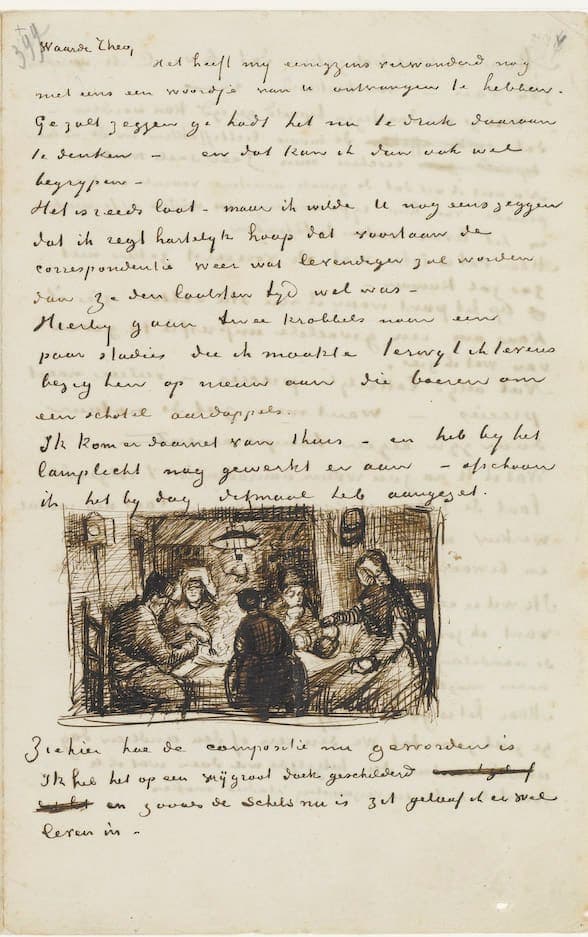
The page shown, from Waarde Theo to the sentence about the large canvas, in the first collected edition of the letters, prepared by the painter’s sister-in-law. Its paragraphing is kept; the editor’s cross-reference (Zie pag. 474) marks the point where the sketch stands on the manuscript page, and two words split by the Internet Archive OCR of the 1914 volume have been closed up. The letter continues on the other half of the sheet.
Waarde Theo
Het heeft mij eenigszins verwonderd nog niet eens een woordje van U ontvangen te hebben.
Ge zult zeggen ge hadt het nu te druk daaraan te denken, en dat kan ik dan ook wel begrijpen.
Het is reeds laat, maar ik wilde U nog eens zeggen dat ik recht hartelijk hoop dat voortaan de correspondentie weer wat levendiger zal worden dan ze den laatsten tijd wel was.
Hierbij gaan twee krabbels naar een paar studies, die ik maakte, terwijl ik tevens bezig ben opnieuw aan die boeren om een schotel aardappels.
Ik kom daar net van thuis, en heb bij het lamplicht nog gewerkt er aan, ofschoon ik het bij dag ditmaal heb aangezet.
Ziehier hoe de compositie nu geworden is. (Zie pag. 474).
Ik heb het op een vrij groot doek geschilderd, en zooals de schets nu is, zit geloof ik er wel leven in.
Source: Vincent van Gogh, Brieven aan zijn broeder, ed. J. van Gogh-Bonger, vol. 2 (Amsterdam, 1914), letter of 9 April 1885, via Internet Archive (Public domain).
Het Utrechts Archief, 7 December 1887 · Source · Public domain
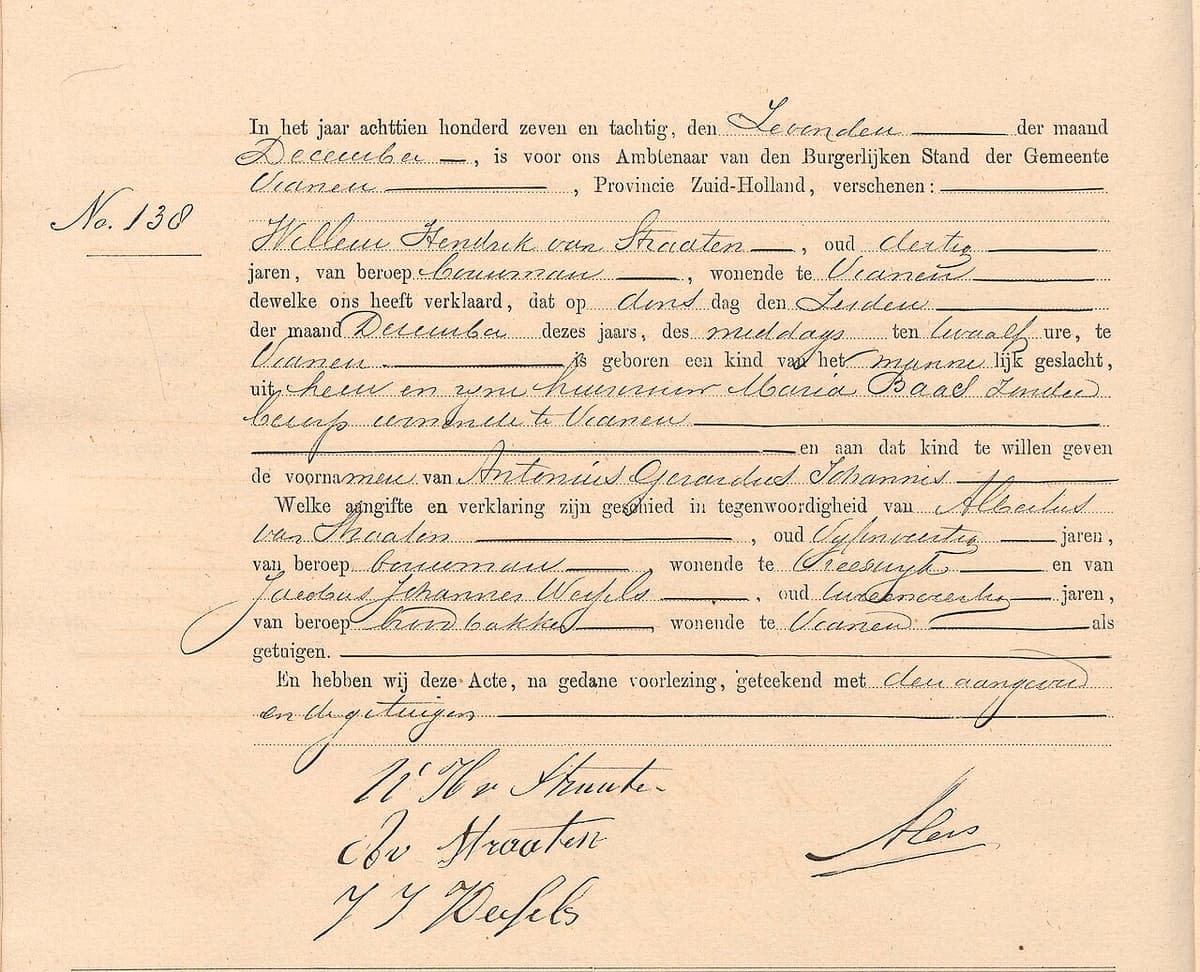
Evidano Transcription
No. 138
In het jaar achttien honderd zeven en tachtig, den Zevenden der maand
December, is voor ons Ambtenaar van den Burgerlijken Stand der Gemeente
Vianen, Provincie Zuid-Holland, verschenen:
Willem Hendrik van Straaten, oud dertig
jaren, van beroep bouwman, wonende te Vianen
dewelke ons heeft verklaard, dat op dins dag den Zesden
der maand December dezes jaars, des middags ten twaalf ure, te
Vianen is geboren een kind van het mannelijk geslacht,
uit hem en zijne huisvrouw Maria Baas zonder
beroep wonende te Vianen
en aan dat kind te willen geven
de voornamen van Antonius Gerardus Johannes
Welke aangifte en verklaring zijn geschied in tegenwoordigheid van Albertus
van Straaten, oud vijfenveertig jaren,
van beroep bouwman, wonende te Vreeswijk en van
Jacobus Johannes Wessels, oud tweeenveertig [?] jaren,
van beroep broodbakker, wonende te Vianen als
getuigen.
En hebben wij deze Acte, na gedane voorlezing, geteekend met den aangever
en de getuigen
W H v Straaten
A v Straaten
J J Wessels
Alers
Generated by Evidano’s advanced model; not yet checked against a published edition.
Two centuries, two scripts, one paper trail
Until 1811 births, marriages and burials in the Netherlands were entered in church registers — the doop-, trouw- en begraafboeken kept by minister, priest or sexton — alongside the deeds drawn up by notaries and the acts of local magistrates. The French annexation brought the burgerlijke stand: a registrar in every municipality, a printed form for every birth, marriage and death, and a duplicate for the court. Population registers followed from 1850, notarial protocols continued unbroken, and beside all of it lies the private paper of the same households: letters, copybooks, account notes and albums. It is the best-documented population in Europe, and almost all of it is handwritten.
The script changes in the middle of the period. Eighteenth-century writers still use a Dutch late-Gothic cursive: long ſ inside words, a looped d, e and c hard to tell apart, ij with or without dots, and heavy contraction in dates and kinship terms. From the early nineteenth century the schools teach a round, upright Latin-based hand — the schoonschrift of the copybooks — with flourished capitals reserved for names, occupations and place names. The two overlap for decades: an elderly notary in 1830 writes shapes his grandfather would recognise, while a village registrar of the same year fills his form in the new round letters, and printed headings keep older spellings long after the writing has changed.
The forms themselves shape the reading. A civil-status certificate prints its formula and rules a line where the clerk must write, so a single line alternates between type and ink: In het jaar achttien honderd zeven en tachtig, den — zevenden — der maand — December. Numbers are spelled out in words, ages and occupations sit in fixed slots, and the entry closes with the signatures of the declarant, two witnesses and the registrar, or with the note that one of them could not write. Margins carry later references — a kantmelding linking a birth to a marriage or a death decades afterwards — and registers repeat a value with a ditto rather than writing it again.
Why ordinary OCR struggles here
Print and handwriting on the same line
The formula is typeset and the facts are written into gaps between rules, often overrunning them. A transcript that merges the two produces sentences no one wrote; a useful one keeps the printed frame and the inserted words distinguishable, because only the inserted words are data.
Two generations of script in one volume
A register kept for forty years by two clerks can change hand halfway through, and an eighteenth-century entry may sit opposite a nineteenth-century marginal note. Long ſ, the older looped d and the new round letters then have to be read side by side rather than by one fixed model.
Names dressed up in flourishes
Surnames, occupations and place names are exactly the words a clerk decorated: a capital V or S may be three loops wide, and the same family appears as Straaten, van Straaten and v. Straaten within one page. These are the words a genealogist searches on, so a plausible guess is worse than a flagged uncertainty.
Marginal references added long afterwards
A kantmelding written in 1932 beside an entry of 1887, in a different ink and a different hand, records a marriage or a death and is often the link between two records. It belongs to the entry but is not part of it, and merging the two makes the certificate say something false.
Who works with this material
Genealogists working the Dutch registers
A single line of research runs from a civil certificate back through a church register to a notarial deed. What the researcher needs is the name as the clerk wrote it, the exact date, the occupation and the witnesses, and a clear signal where the reading is doubtful rather than a tidy guess.
Archives indexing civil registration at scale
Regional archives publish scans of the burgerlijke stand by the hundred thousand and index them with volunteers. A machine pass that reads the filled-in fields of a known form, and leaves the printed frame alone, turns that work into checking a table.
House, land and probate researchers
Transport deeds, mortgages, wills and estate divisions in the notarial protocols carry the descriptions and boundaries that a house history depends on. These need the full text, including the formulaic parts, because the formula is where the legal effect sits.
Editors of letters and family papers
Correspondence, diaries and copybooks are edited for publication or for a museum’s website. Here the point is a faithful text with the writer’s own spelling, deletions and underlinings preserved, and with drawings or enclosures noted in their place.
Getting the best transcription
Describe the form before you send the scan
For civil-status certificates, name the type and the year: the printed formula hardly changes between municipalities, so telling the model which fields exist lets it return declarant, age, occupation, place, hour and forenames as fields instead of one paragraph.
Ask for print and hand to be labelled
Request that typeset words and handwritten insertions are marked differently. It costs nothing and it makes the output usable: the printed frame can then be dropped from an index, and the inserted words checked on their own.
Set the rule for names and for numbers in words
State that surnames and place names are never to be normalised, and that a number written out — zeven en tachtig, ten twaalf ure — should be kept as words with a numeric reading alongside. Both are needed: the words for the transcript, the figures for the index.
Test on an entry with a marginal note
Pick a certificate that carries a kantmelding added decades later. If the marginal note comes back as its own dated element and the body of the entry is untouched, the rest of the register can be run with confidence.
Further reading on this hand
The palaeography guides the in-app selector points to for this domain, if you want to check a transcription against the standard references.
- Introduction to Dutch Paleography
This Brigham Young University guide is designed for reading Dutch genealogical and administrative records. It combines handwriting instruction with record vocabulary, formats, alphabet charts, and examples of historical variation. The resource supports recognition of names, dates, occupations, relationships, abbreviations, and changes between Gothic and Latin-based cursive. It is therefore useful for parish, civil-registration, and notarial documents of the eighteenth and nineteenth centuries.
Frequently asked questions
- Can it tell the printed formula from what the registrar wrote?
- Yes, and it is worth asking for explicitly. On a birth or marriage certificate the typeset words are the same in every entry, so labelling them separately leaves you with only the variable text — names, dates, ages, occupations — which is what an index needs.
- Which of these records still use the old Gothic cursive?
- Broadly, church registers and notarial protocols before about 1800, and older writers well into the nineteenth century. Long ſ inside words is the quickest signal; where it appears, expect the older shapes for d, e and c as well, and say so in the prompt.
- Are marginal references picked up?
- They are returned as separate elements with the position and, where legible, the date and hand. That keeps a note about a later marriage or death from being read as part of the original entry, while still attaching it to the right record.
- How are numbers written out in words handled?
- They are transcribed as words and, if you ask, given a numeric reading beside them. Dutch registers spell out the year, the day and even the hour, and the words are frequently divided across a printed rule, which is where a naive reading goes wrong.
- Does it work as well on private letters as on registers?
- Yes, and letters are usually easier: there is no printed frame and little abbreviation, though the writing slopes and runs on. Deletions, underlinings and sketches drawn into the text can be marked in place rather than dropped.
Related scripts and pages
Transcribe your registers, deeds and family letters
Upload a certificate, a notarial deed or a nineteenth-century letter and get the names, dates and occupations back as fields.