
Dutch · c. 1600–1800
Read VOC dispatches, journals and colonial registers
A bookkeeper in Batavia and a clerk at the Cape wrote the same Dutch cursive, but filled it with Malay, Portuguese, Japanese, Khoi and Lenape names that no two writers spelled alike, and with weights and coins from half the world. Evidano transcribes ship journals, letters, council minutes and cargo lists from the Dutch overseas archives, keeps names exactly as written instead of tidying them into something familiar, and holds the date column of a journal apart from the entry beside it.
Sample pages
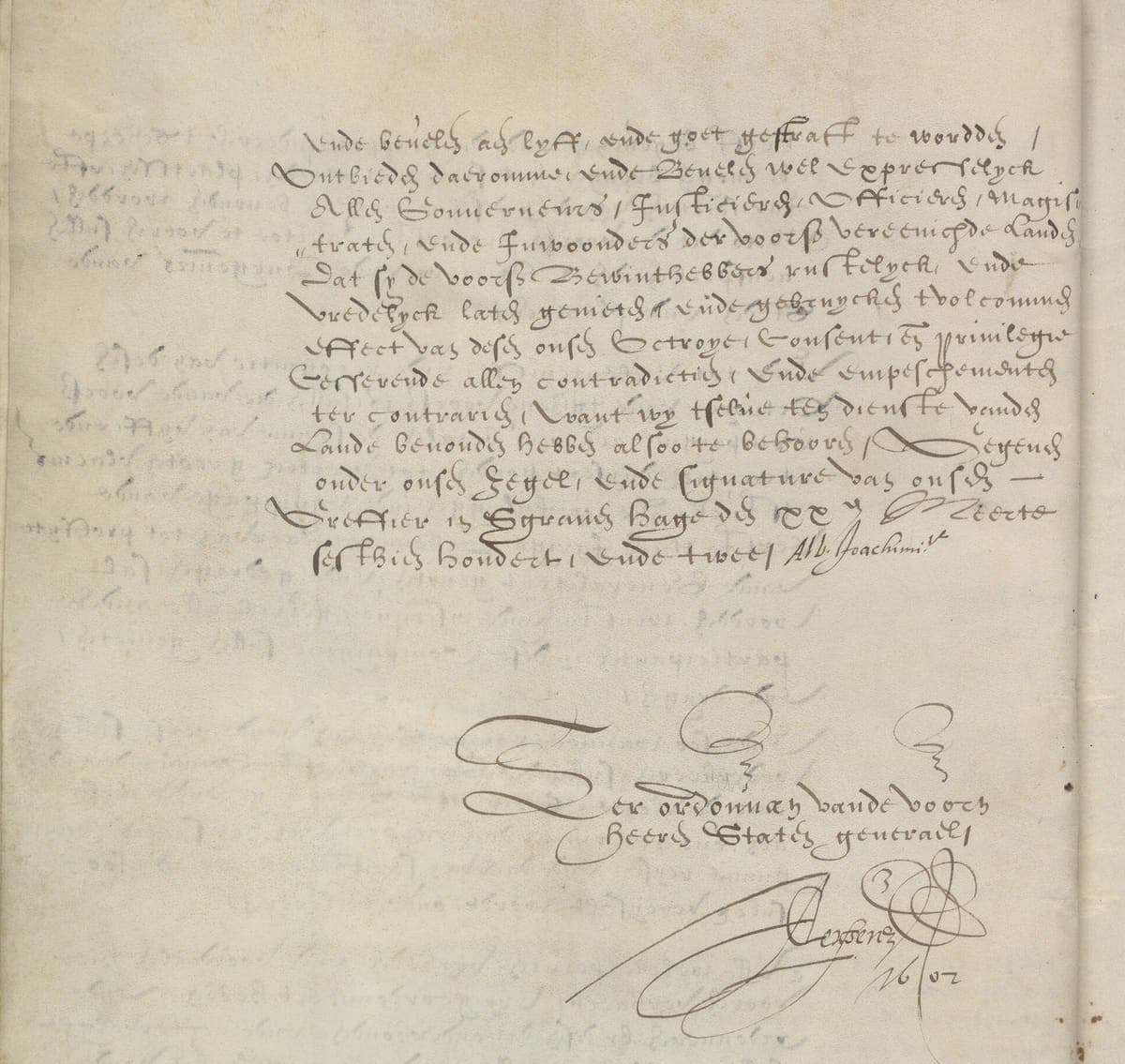
Nationaal Archief, The Hague, 1.04.02, inv. no. 1, 20 March 1602 · Source · Public domain
Evidano Transcription
ende beuelen aen lyff, ende goet geſtraft te worden /
Ontbieden daeromme, ende Beuelen wel expreſſelyck
Allen Gouuerneurs / Juſticieren, Officieren, Magiſ=
=traten, ende Inwoonders der voorſ[chreven] vereenichde Landen
Dat ſy de voorſ[chreven] Bewinthebbers ruſtelyck, ende
vredelyck laten genieten ende gebruycken tvolcommen
effect van deſen onſen Octroye, Conſent, en[de] privilegie
Ceſſerende allen contradictien, ende empeſchementen
ter contrarien, want wy tſelue ten dienſte vanden
Lande beuonden hebben alſoo te behooren / Gegeuen
onder onſen Zegel, ende ſignature van onſen —
Greffier in ſGrauen Hage den xx[en] Maerte
Seſthien hondert, ende twee / Alb. Joachimi vt.
Ter ordonnan[tie] vande voorſ[chreven]
Heeren Staten generail
C Aerssens
1602
Generated by Evidano’s advanced model; not yet checked against a published edition.
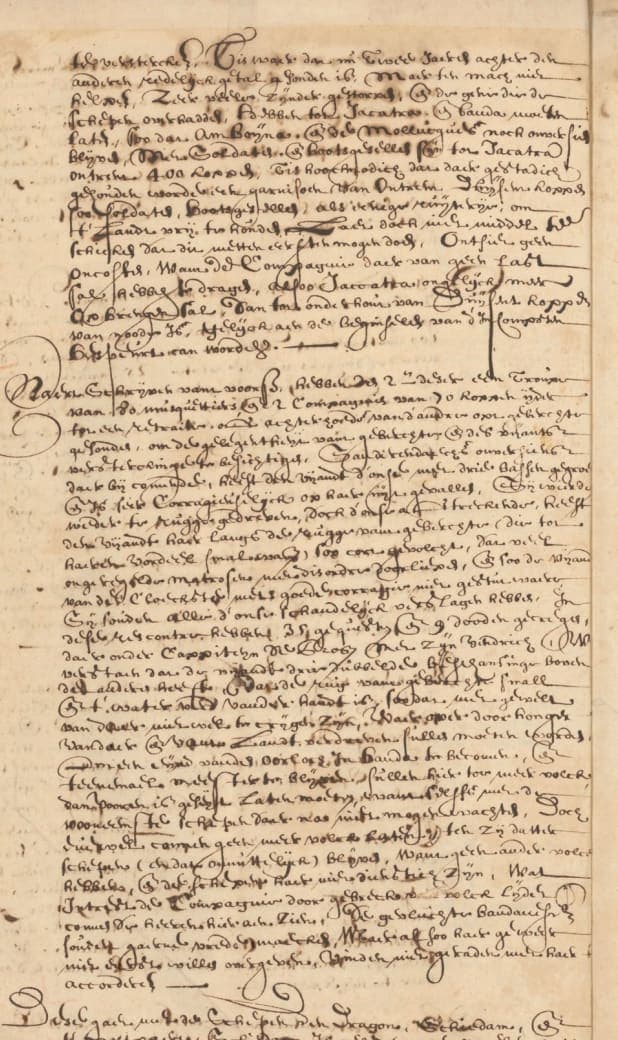
Nationaal Archief, The Hague, 1.04.02, inv. no. 1073, 1621 · Source · Public domain
Evidano Transcription
selve vertrecken, — Tis waer dat in Twee Jaeren achter den
anderen redelijck getal gesonden is, Maer [illegible] mach[?] niet
hoe veel, Zeer veele Zijnder gestorven, & [illegible]
schepen ontbraecken[?], hebben tot Jacatra, & Banda moeten
laten, soo dat Amboyna, & de Molucques noch onvoorsien
blijven, Met Soldaten, & Bootsgesellen sijn tot Jacatra
ontrent 400 koppen, Tis nootwendich dat daer gestadich
gehouden worde eene garnisoen van ontrent [illegible] koppen
soo soldaten, Bootsgesellen, als inwoonders[?], om
t' Landt vrij te houden, Laet doch [illegible] middel der
schepen dat die metten eersten mogen doen, Ontsiet geen
oncosten, Want de Compagnie daer van geen last
sal hebben te dragen, alsoo Jacatra ongelijck meer
opbrengen sal, dan tot onderhout van [illegible] koppen
van noode is, t'gelijck aen de beginselen van d'incompsten
bespeurt can worden. —
Naeder schrijven van voorsz. hebben den 2en deser een Troupe
van 80 musquettiers & 2 Compagnies van 70 koppen [illegible]
tot een retraite, [illegible]
gesonden, om de gelegentheijt van gebergten & des vijandts
[illegible] te besichtigen, [illegible] onversiens
daer bij comende, heeft den vijandt d'onse met drie bassen gegroet
& sijn seer couragieuselijck op haer ingevallen, [illegible]
weder te rugge gedreven, doch d'onse [illegible], heeft
den vijandt haer langs den rugge van 't gebergte (die tot
haerder voordeel smal was) soo [illegible] gevolcht, dat onse
ongeoeffende matrosen in disordre [illegible], & soo de vijand
van den [illegible] met goede couragie niet gestuijt waere
Sij souden alle d'onse schandelijck [illegible] hebben, In
desen recontre hebben 35 gequetsten & 9 dooden gecregen,
daer onder Cappiteyn [illegible] met zijn vaendrich [illegible]
[remaining lines illegible]
Generated by Evidano’s advanced model; not yet checked against a published edition.
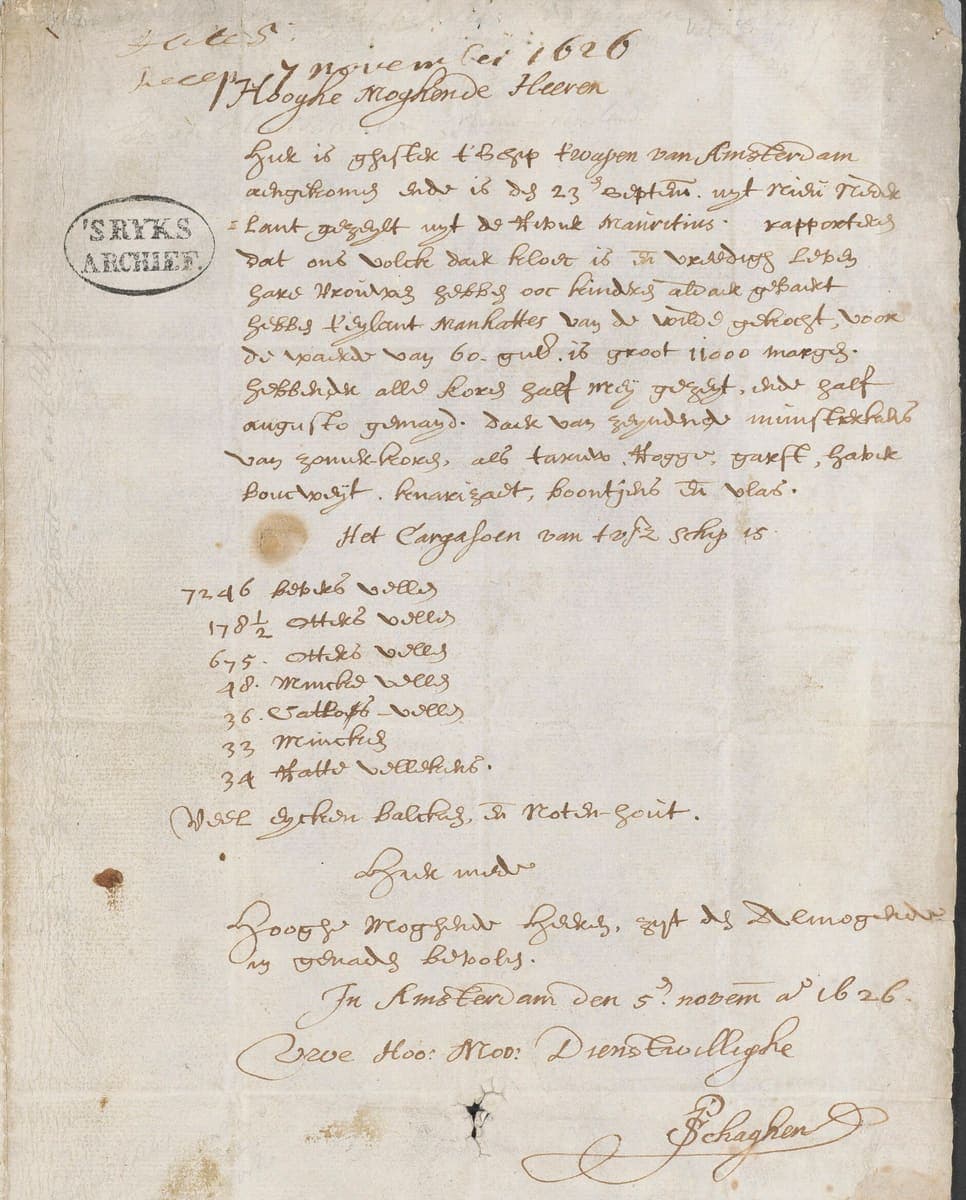
Nationaal Archief, The Hague, 1.01.02, inv. no. 5751B, 5 November 1626 · Source · Public domain
Evidano Transcription
The text of the letter as transcribed by the Nationaal Archief and published on the Wikimedia Commons file page, keeping the line breaks marked there. Letters supplied for the writer’s contractions stand in round brackets, as v(oor)s(eijde) and morge(n); the dorsal address and the note Met nul empechement, which are on the half of the sheet not shown here, are omitted.
Dates recep.: 7 november 1626.
Hooghe moghende heeren,
Hier (in Amsterdam) is ghister 't schip 't Wapen van Amsterdam
aengekome(n) ende is de(n) 23en septem(ber) uyt Nieu(w) Neder-
lant gezeylt uyt de rivier Mauritius. Rapportere(n)
dat ons volck daer kloec is en(de) vreedigh leven.
Hare vrouwe(n) hebbe(n) ooc kindere(n) aldaer gebaert.
Hebben 't eylant Manhattes van de wilde gekocht, voor
de waerde van 60 gul(den). Is groot 11.000 morge(n).
Hebbende alle kore(n) half meij gezeyt ende half
augusto gemayd. Daer van zeynde de munsterkens
van zomerkore(n), als tarues, rogge, garst, haver,
boucweijt, knarizaet, boontjens en(de) vlas.
Het cargasoen van 't v(oor)s(eijde) schip is:
7246 bevers velle(n)
178½ otters velle(n)
675 otters velle(n)
48 mincke velle(n)
36 cattos velle(n)
33 mincke(n)
34 ratte vellekens
Veel eycken balcke(n) en(de) noten-hout.
Hier mede, hooghe moghende heere(n), zyt de(n) Almogende in genade(n) bevole(n).
In Amsterdam, den 5en novem(ber) a(nn)o 1626.
Uwe hoo(gh) moo(ghende) dienstwillighe,
P(ieter) Schaghen
Source: Nationaal Archief transcription of the Schaghen letter, on the Wikimedia Commons file page (CC BY-SA 4.0).
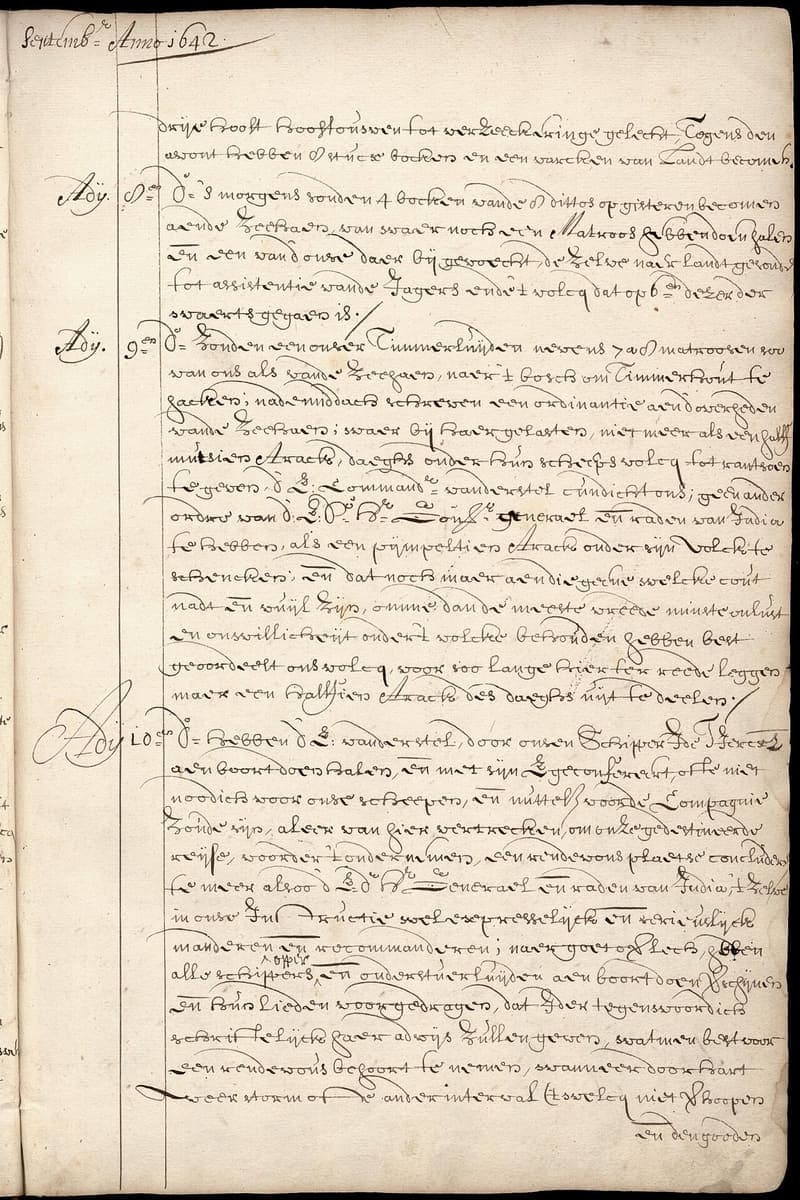
Nationaal Archief, The Hague, 1.11.01.01, inv. no. 121, September 1642 · Source · Public domain
Evidano Transcription
The top of the page — the close of the entry for 7 September and the entries for the eighth and ninth — from the Linschoten-Vereeniging edition of the journals, whose line breaks are kept. The excerpt breaks off in the middle of the entry for 9 September, before the passage on the commander Van der Stel; the ff-ligature that the Internet Archive scan of the 1919 volume rendered as fif has been restored against the manuscript.
drije hooftouwen tot verzeeckeringe gelecht, Tegens den avont hebben 8
stucx boeken en een vareken van Landt becomen,
Adij. 8en d° 's morgens sonden 4 boeken vande 8 dittos op gisteren be-
comen aende Zeehaen, van waer noch een Matroos hebben doen ha-
len ende een van d'onse daer bij gevoecht, de Zelve naer landt ge-
sonde tot assistentie vande Jagers ende 't volcq dat op 6en dezer der
waerts gegaen is.
Adij. 9en d° Zonden een onser Timmerluijden nevens 7 a 8 matroosen soo
van ons als vande Zeehaen, naar t bosch om Timmerhout te hacken;
nade middach schreven een ordinantie aen d'overheden vande Zee-
haen; waer bij haer gelasten, niet meer als een halff mutsien Arack,
daeghs onder hun scheepsvolcq tot rantsoen te geven, …
Source: R. Posthumus Meyjes (ed.), De reizen van Abel Janszoon Tasman en Franchoys Jacobszoon Visscher (The Hague, 1919), via Internet Archive (Public domain).
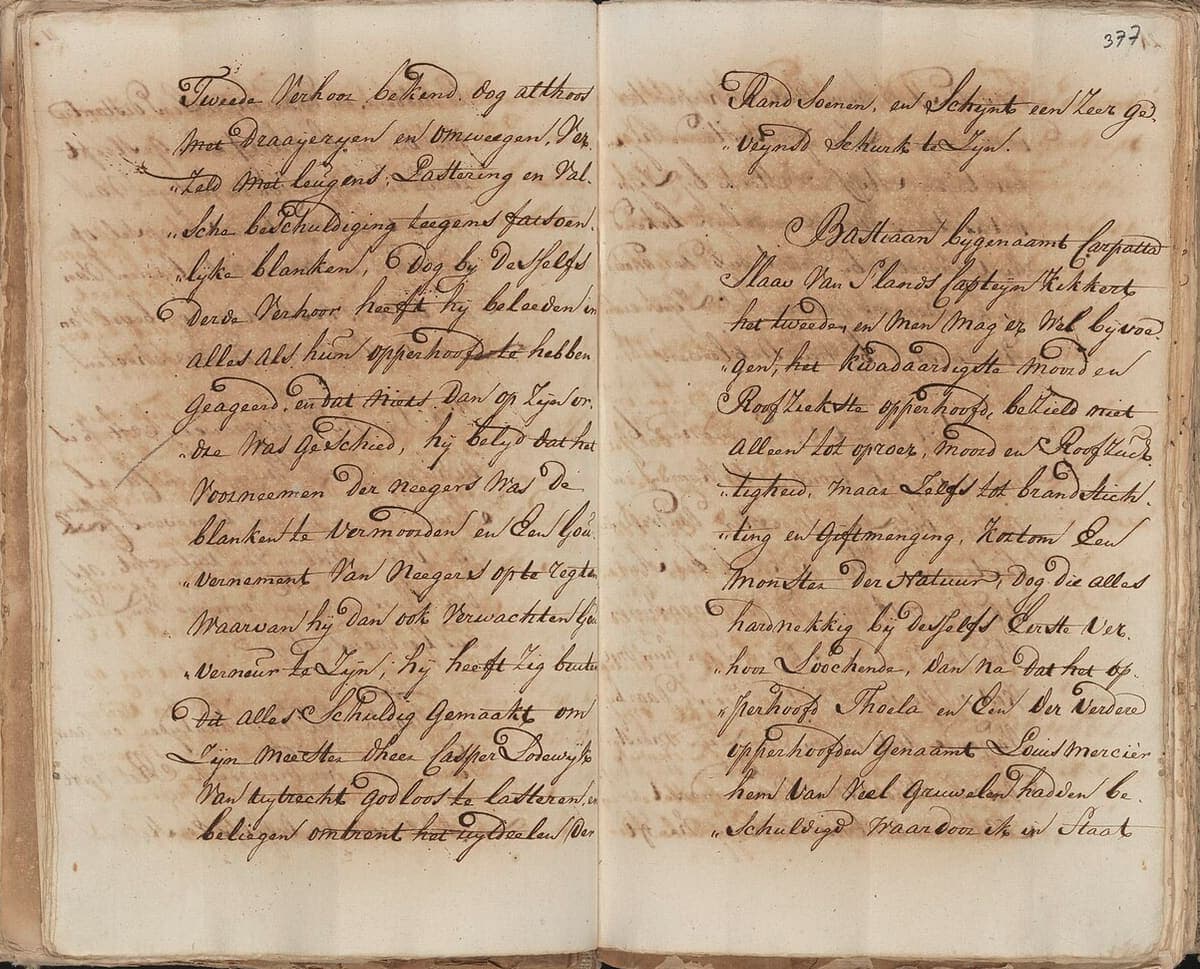
Nationaal Archief, The Hague, 1.05.12.01, inv. no. 121, fol. 377, 2 October 1795 · Source · Public domain
Evidano Transcription
The passage on Tula that fills the left-hand page and runs onto the first two lines of the right, as transcribed by the Nationaal Archief and published on the Wikimedia Commons file page. It is given there as continuous text with modern quotation marks rather than line by line, and the entry on Bastiaan Carpata that fills the rest of the right-hand page is not covered.
“Thoela het hoofd, aanlijder en aanvoerder van het moordzieke rot heeft zulks reeds bij desselfs eerste en tweede verhoor bekend, dog althoos met draaijerijen en omweegen, verzeld met leugens, lastering en valsche beschuldiging teegens fatsoenlijke blanken, dog bij desselfs derde verhoor heeft hij beleeden in alles als hun opperhoofd te hebben geageerd en dat niets dan op zijn ordre was geschied, hij belijd dat het voorneemen der neegers was de blanken te vermoorden en een Gouvernement van neegers op te regten waarvan hij dan ook verwachten Gouverneur te zijn, hij heeft zig buiten dit alles schuldig gemaakt om zijn meester de heer Casper Lodewijk van Uytrecht godloos te lasteren, en beliegen omtrent het uijtdeelen der randsoenen, en schijnt een zeer geveijnsd schurk te zijn.”
Source: Nationaal Archief transcription of the Curaçao council minutes of 2 October 1795, on the Wikimedia Commons file page (CC BY-SA 4.0).
A world archive written in one cursive
The archives of the two chartered companies and the colonial governments that grew out of them run from the charter of 1602 to the liquidation of the VOC at the end of the eighteenth century, and they were written in Amsterdam, Batavia, Colombo, Nagasaki, Table Bay, Fort Amsterdam on Manhattan, Elmina, Paramaribo and Willemstad. The genres are few and repeated endlessly: outgoing and incoming letters bound as overgekomen brieven en papieren, ship journals kept watch by watch, daily registers of a factory, resolutions of a council, muster and pay rolls, invoices of cargo. The writing is the secretary cursive of the Republic carried overseas by clerks trained at home; over the eighteenth century it loosens into the rounder, more upright Latin-based hand that a Curaçao council secretary was using by 1795.
What makes the material distinctive is not the letterforms but the vocabulary poured into them. Place and personal names arrive through Portuguese, Malay, Japanese, Sinhala, Tamil, Khoi or Algonquian ears and are written phonetically, so the same island, ship or person appears under three spellings in three paragraphs. Commodities and weights come from the trade itself — nagelen, foelie, noten, peper, bahar, picol, catty, legger — and money runs in guilders and stuivers beside rijksdaalders, reals of eight, rupees and taels. Numbers are written half in words and half in figures, dates appear as Adij 8en d° in the margin of a journal, and repeated values are carried down the page with dittos.
The physical record adds its own layers. A dispatch was copied before it sailed, so the same text survives in several hands with the copyist’s certification at the end; a letter received in The Hague carries a receipt note across the top and a routing endorsement on the outside. Journals rule a narrow left column for the day and a wide one for the entry. Council minutes carry a keyword in the margin and quotation marks down the left edge of a quoted passage. Nineteenth- and twentieth-century archivists added folio numbers in pencil and ink, and iron-gall ink, damp and sea water have eaten holes through many leaves.
Why ordinary OCR struggles here
Names that are never spelled twice the same
A model that tidies unfamiliar strings towards familiar ones is worse than useless here, because the variant spellings are the evidence. Thoela and Tula, Jacatra and Jakarta, Manhattes and Manhattans have to come out as written, with the reading flagged rather than corrected.
Weights, coins and quantities from several systems
One invoice can carry picols, catties, leggers, guilders, stuivers, rijksdaalders and reals, with fractions written as superscripts and totals in Roman numerals. Reading them as ordinary numbers loses the unit, and the unit is what makes the figure mean anything.
Column layouts and running dates
In a ship journal the date sits in its own ruled column and the entry runs beside it, sometimes for a page; in an invoice the columns are numeric. Flattening either into prose destroys the link between a day and what happened on it, or between a commodity and its weight.
Copies, endorsements and damage
The same dispatch exists as a draft, a signed original and one or more clerks’ copies, each with its own abbreviations and its own errors, and all of them carry routing notes and later archival numbering. Ink corrosion and water damage then remove words in the middle of a clause, which a transcript should mark rather than fill in.
Who works with this material
Archives opening the colonial record
National and regional archives in the Netherlands, Indonesia, South Africa, Sri Lanka, Suriname and the Caribbean hold shelf-kilometres of this material and are under real pressure to make it searchable. A first machine pass that keeps names as written gives them an index they can correct, rather than a clean text they cannot trust.
Family historians on four continents
Muster rolls, pay ledgers, baptismal entries in a factory register and council minutes are often the only written trace of a sailor, a soldier or an enslaved person. What a researcher needs is the name in the form the clerk wrote it, with the date, the ship and the place attached.
Maritime and economic historians
Journals, invoices and resolutions carry the raw series — sailing dates, cargo weights, prices, mortality on board. They only become a dataset when the numbers stay attached to their units and their dates, which is the part a bare text dump gets wrong.
Researchers working on slavery and its aftermath
Registers, court records and council minutes name people who were enslaved, usually with a single name and a place or an owner. Transcribing these entries carefully, with every spelling variant preserved and nothing normalised away, is the precondition for linking a person across records.
Getting the best transcription
Hand over your glossary first
Give the model the ships, places, offices and personal names you already expect in the volume. It cuts the error rate on exactly the words a Dutch spelling model would otherwise mangle, and it lets the output flag a name that is not on your list as something new to check.
Forbid tidying of names
Say that names must be transcribed as written and never regularised to a modern form. Ask for a separate list of every name occurrence with its spelling, so that Thoela and Tula, or Jacatra and Jaccatra, can be linked deliberately rather than merged by accident.
Ask for the columns as fields
For journals, request the date column and the entry as separate fields; for invoices and pay rolls, one row per line with quantity, unit and value kept apart, and dittos either resolved or marked. The structure is what turns a page into something you can query.
Start with a damaged copy
Test on a leaf where the ink has eaten through, or on a clerk’s copy with routing notes across the head. If losses come back marked as illegible rather than silently filled, and the endorsements stay outside the body, the rest of the volume can be trusted to the same settings.
Further reading on this hand
The palaeography guides the in-app selector points to for this domain, if you want to check a transcription against the standard references.
- Wat staat daer? Uitleg
This Dutch archival training resource explains transcription choices for historical handwriting preserved in Dutch collections. It covers letter distinctions, punctuation, abbreviations, line-end hyphenation, and the handling of y and ij. Its manuscript exercises develop the comparison skills needed for names, formulas, and repeated terms in difficult cursive. Those methods are useful for colonial and maritime records containing multilingual vocabulary and dense administrative notation.
Frequently asked questions
- Do eighteenth-century colonial hands read differently from seventeenth-century ones?
- They do, and both are supported. The seventeenth-century clerk writes a sloping, tightly joined secretary cursive; his successor in the 1790s writes a rounder, more upright hand with far fewer contractions but a fondness for flourished capitals in names and offices.
- How are Malay, Portuguese or Indigenous names handled?
- They are transcribed letter by letter as written, not matched to a modern spelling. Because the same name may be written differently on the same page, the output can list each occurrence separately so you can see the variation instead of losing it.
- Can it keep picols, catties, guilders and reals straight?
- Amounts are returned with their unit attached and their fractions intact, and no conversion is attempted unless you ask for one. Where a figure is written partly in words and partly in numerals, both are preserved as they stand.
- What happens to receipt notes, routing endorsements and pencil foliation?
- They are returned as separate elements with their position on the leaf, so a note added in The Hague on arrival, an endorsement written at sea and a folio number added by an archivist in 1900 are never mixed into the clerk’s text.
- Is it any use on a leaf eaten by iron-gall ink?
- Partly. Where the ink has burned through, letters are marked as lost rather than guessed, and surviving stems are reported as uncertain. That is more useful than a confident reading, because it tells an editor exactly which words still need the original.
Related scripts and pages
Transcribe your VOC and colonial records
Upload a journal opening, a dispatch or a council register and get a transcript that keeps the names, the units and the columns as the clerk left them.