
Portuguese · c. 1550–1900
Read the parish books and colonial paperwork
From the later sixteenth century the Portuguese-speaking world ran on paper: a baptism entered in a parish book in Porto, an alvará signed at the Ajuda palace, a dispatch written in Rio de Janeiro. The writing is italic at its base but never pure, and the hardest parts are the superscript contractions of titles and sacraments and the personal names, carried into these books from Africa, Brazil and Asia and spelled by ear.
Sample pages
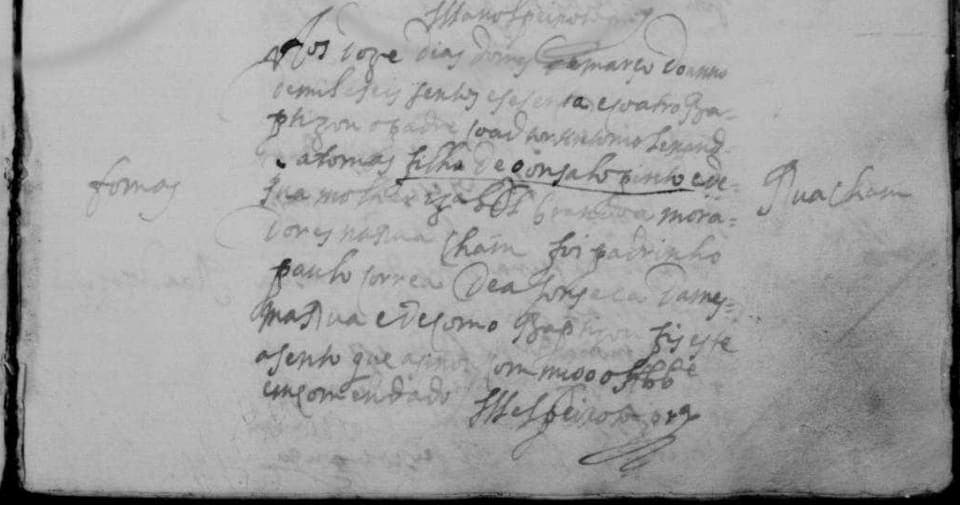
Arquivo Distrital do Porto, Paróquia da Sé, registos de baptismos 1663–1665, 12 March 1664 · Source · Public domain
Evidano Transcription
Manoel peixoto[?] vig[ari]o
Aos doze dias do mes [cancelled: illegible] de março do anno
de mil e seis sentos e sesenta e cvatro Bap=
tizou o padre Joaõ fortunato[?] de mand[ad]o
a tomas filha de gonsalo pinto e de
sua molher izabel [illegible] mora=
dores na rua Cham foi padrinho
paulo Correa de afonseca e a dame=
ma sua e de como passou[?] fis este
asento que asinou com migo o p[adr]e
encomendado
M[ano]el peixoto vig[ari]o
tomas
Rua cham
Generated by Evidano’s advanced model; not yet checked against a published edition.
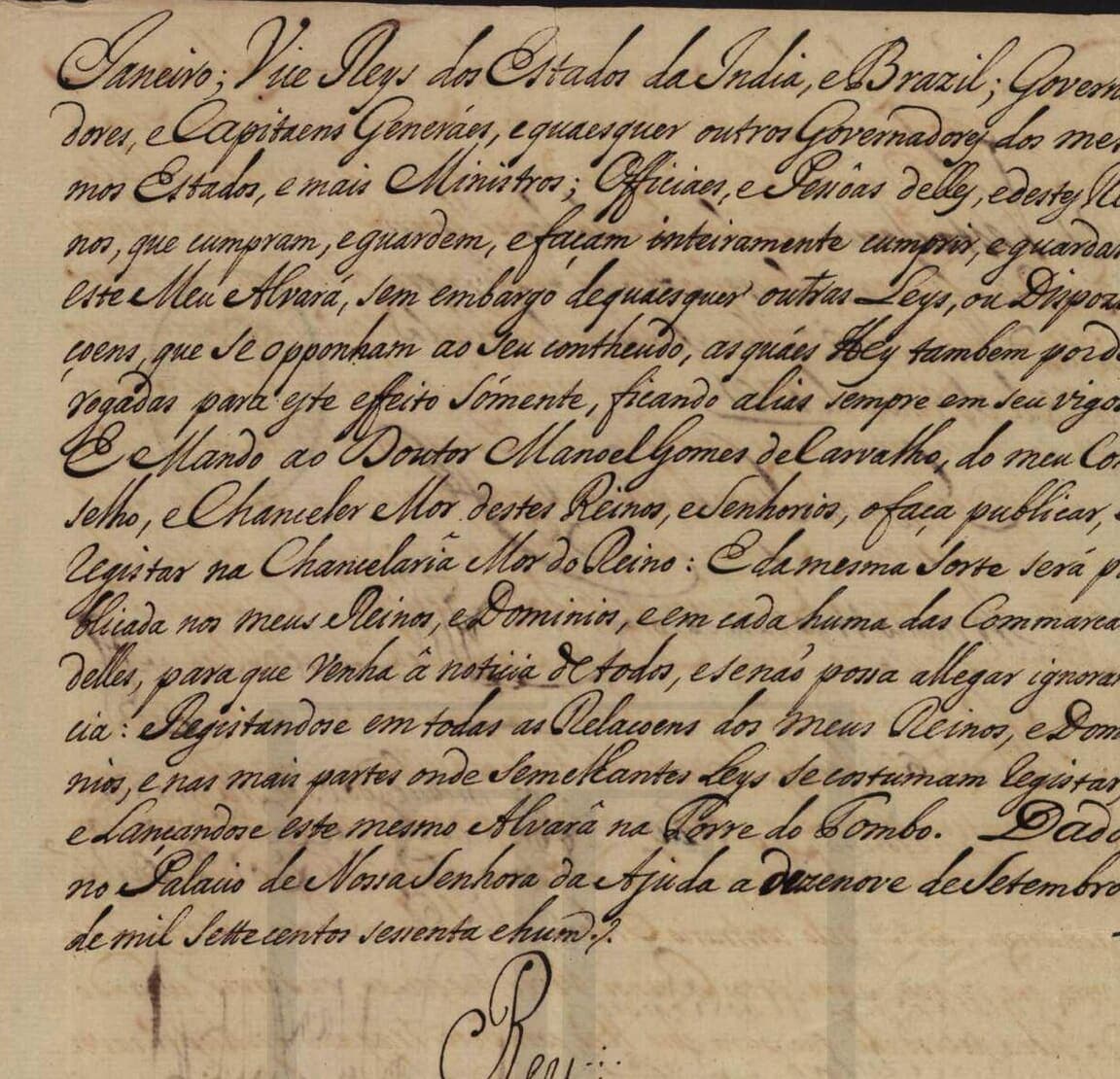
Arquivo Nacional da Torre do Tombo, 19 September 1761 · Source · Public domain
Evidano Transcription
Janeiro; Vice Reys dos Estados da India, e Brazil; Governa
dores, e Capitaens Generáes, e quaesquer outros Governadores dos mes
mos Estados, e mais Ministros; Officiaes, e Pessoas delles, e destes Rei
nos, que cumpram, e guardem, e facam inteiramente cumprir, e guardar
este Meu Alvará, sem embargo de quaesquer outras Leys, ou Dispozi
coens, que se opponham ao seu contheudo, as quaes Hey tambem por de
rogadas para este effeito sómente, ficando aliàs sempre em seu vigor.
E Mando ao Doutor Manoel Gomes de Carvalho, do meu Con
selho, e Chanceler Mor destes Reinos, e Senhorios, o faca publicar, e
Regiſtar na Chancelaria Mor do Reino: E da mesma Sorte será pu
blicada nos meus Reinos, e Dominios, e em cada huma das Commarcas
delles, para que venha â noticia de todos, e senão possa allegar ignoran
cia: Regiſtandose em todas as Relacoens dos meus Reinos, e Domi
nios, e nas mais partes onde Semelhantes Leys se costumam Regiſtar,
e Lancandose este mesmo Alvará na Torre do Tombo. Dado
no Palacio de Nossa Senhora da Ajuda a dezenove de Setembro
de mil Sette centos sessenta e hum.
Rey
Generated by Evidano’s advanced model; not yet checked against a published edition.
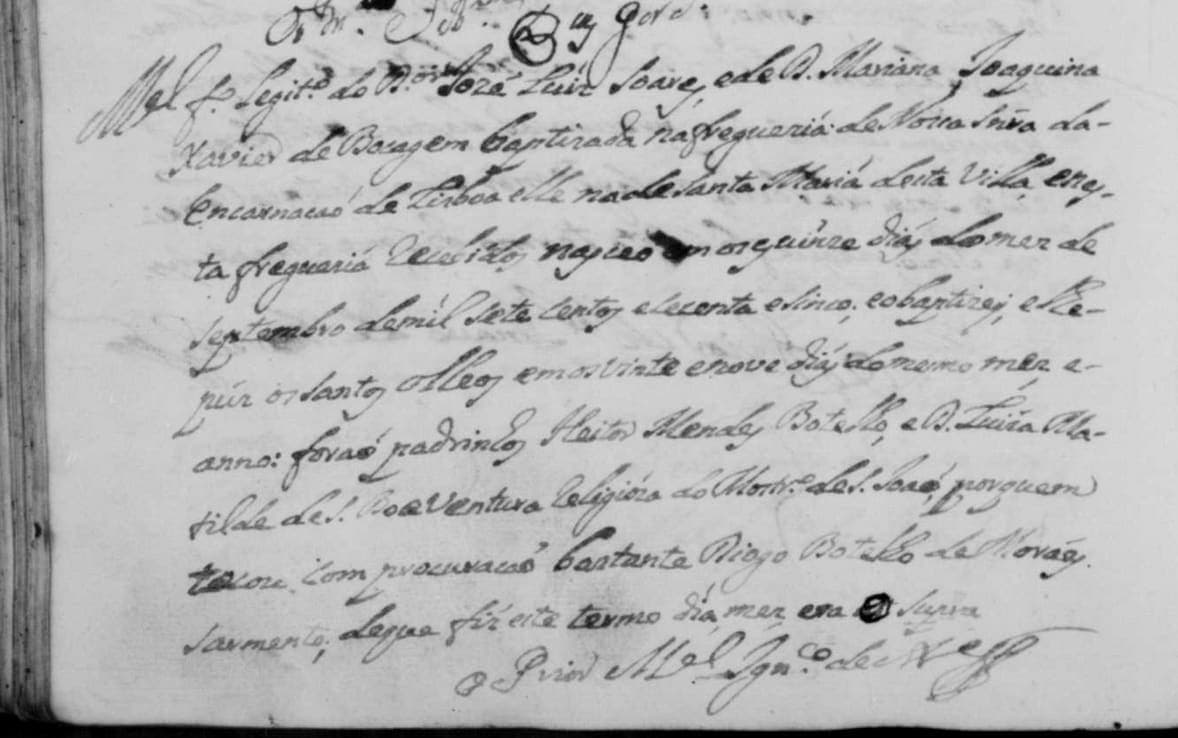
Arquivo Distrital de Setúbal, Paróquia de São Sebastião, registos de baptismos, 29 September 1765 · Source · Public domain
Evidano Transcription
The entry as transcribed on the Wikimedia Commons file page, which keeps the manuscript’s line breaks, including the words broken at the end of a line, and marks the abbreviations by their raised endings; those raised letters are given on the line here (M.el, f.o, legit.o, D.or, Sñra., Most.ro).
M.el, f.o legit.o do D.or Jozé Luiz Soares, e de D. Mariana Joaquina
Xavier de Bocagem baptizada na freguezia de Nossa Sñra. da
Encarnacão de Lisboa elle na de Santa Maria desta Villa, e nes-
ta freguezia Recebidos nasceo em os quinze dias do mez de
Septembro de mil sete centos e cecenta e sinco; e o baptizey, e lhe
puz os Santos olleos em os vinte e nove dias do mesmo mez, e
anno: forão padrinhos Heitor Mendes Botelho, e D. Luiza Ma-
tilde de S. BoaVentura Religioza do Most.ro de S. João, por quem
tocou com procuracão bastante Diogo Botelho de Moraes
Sarmento; de que fiz este termo dia, mez, era ut supra.
O Prior, Manuel Ignacio de Arouche
Source: Transcription on the Wikimedia Commons file page, from the register digitised by the Arquivo Distrital de Setúbal (CC BY-SA 4.0).
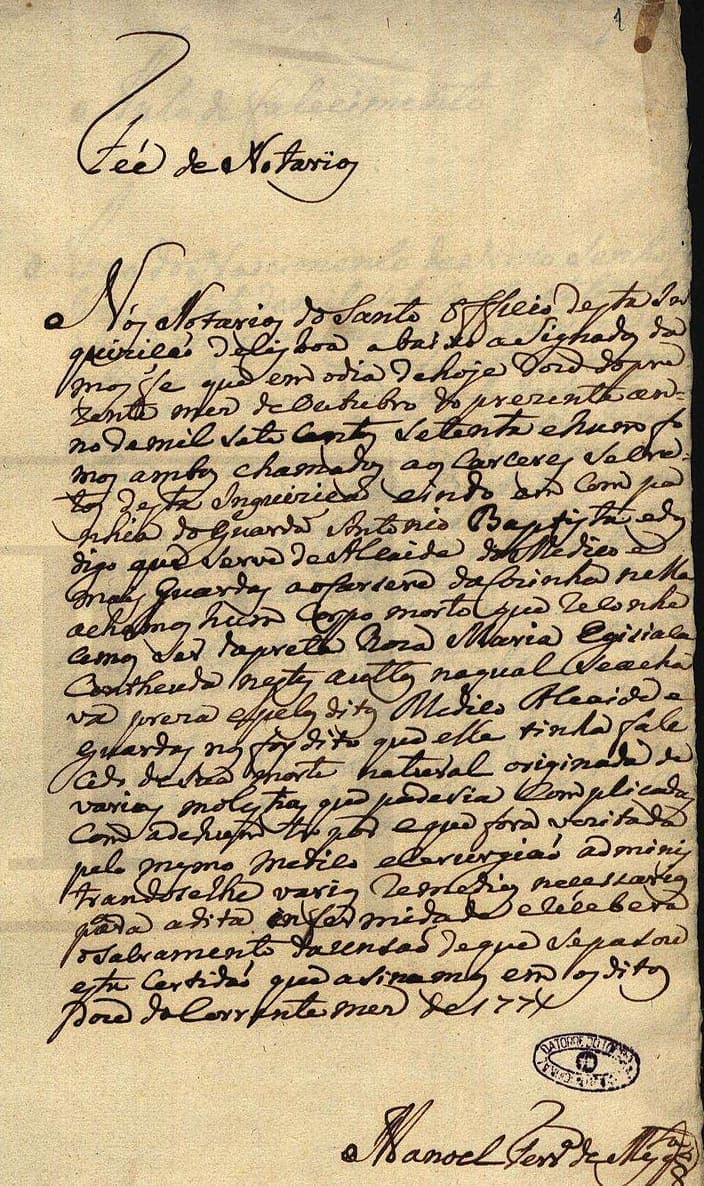
Arquivo Nacional da Torre do Tombo, PT/TT/TSO-IL/028/18078, 13 October 1771 · Source · Public domain
Evidano Transcription
1
Fé de falecimento[?]
Fée de Notarios
Nós Notarios do Santo Officio desta In=
quiziçaõ de Lixboa abaixo asignados da=
mos fé que em o dia de hoje doze do pre=
zente mes de Outubro do prezente an=
no de mil sete centos setenta e hum fo=
mos ambos chamados aos Carceres Secre=
tos desta Inquiziçaõ e indo em Com pa=
nhia do Guarda Antonio Baptista e do
digo que serve de Alcaide do Medico e
mais Guardas ao Carcere da Cozinha nella
achamos hum Corpo morto que reconhe=
cemos ser da preta Roza Maria Egipciaca
contheuda nestes autos na qual se acha=
va preza e pelos ditos Medico Alcaide e
Guardas nos foy dito que ella tinha fale=
cido de sua morte natural originada de
varias molestias que padecia Complicadas
com a de hum flato e que fora vezitada
pelo mesmo Medico e Cirurgiaõ adminis=
trandose lhe varios remedios necessarios
para a dita enfermidade e recebera
o Sacramento da Penitencia[?] de que se passou
esta Certidaõ que asinamos em os ditos
doze do Corrente mes de 1771
[stamp]
Manoel Ferr[eir]a de M[at]os
Generated by Evidano’s advanced model; not yet checked against a published edition.
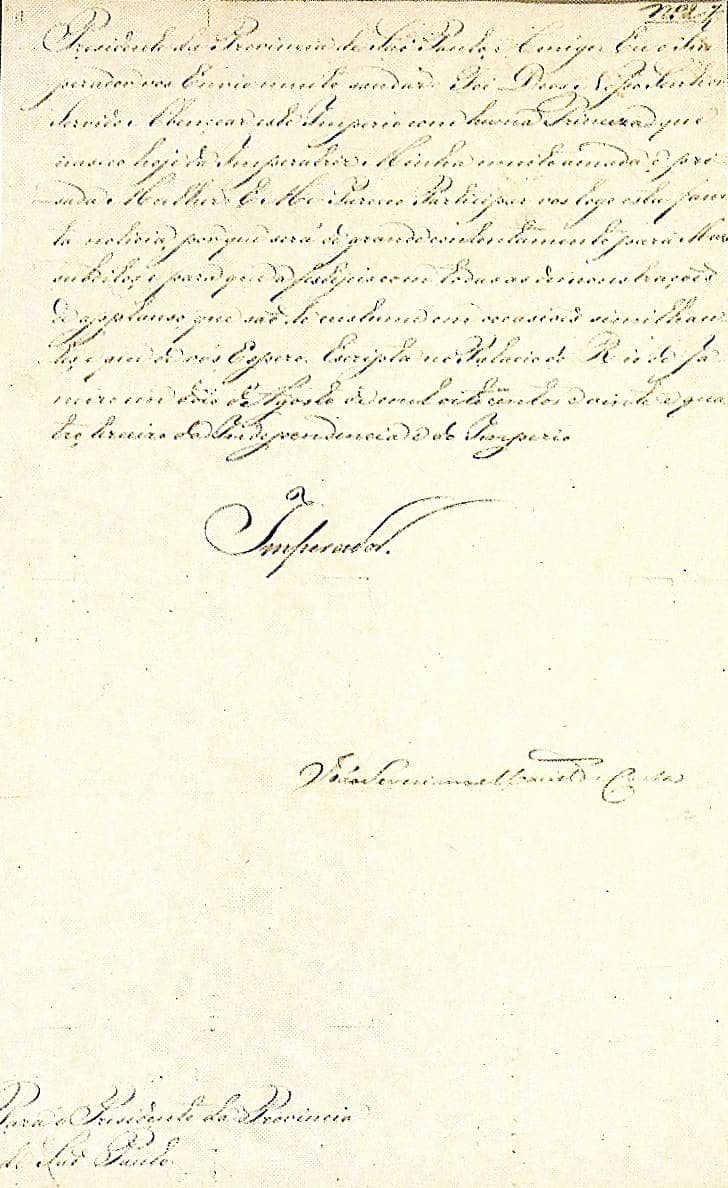
Museu Paulista, Universidade de São Paulo, 2 August 1824 · Source · Public domain
Evidano Transcription
The full text of the dispatch as transcribed on the Wikimedia Commons file page. The transcription runs continuously; the signature, the countersignature and the address written at the foot of the sheet are set on their own lines here, and the apostrophe is given as ’.
Presidente da Província de São Paulo, Amigo: Eu o Imperador vos Envio muito saudar. Foi Deos Nosso Senhor servido Abençoar este Imperio com huma Princeza que nasceo hoje da Imperatriz Minha muito amada e presada Mulher: E Me Pareceo Participarvos logo esta fausta noticia, porque sera de grande contentamento para Meus subditos, e para que a festejeis com todas as demonstrações de applauso que são de custume em occasiões similhantes, e que de vós Espero. Escripta no Palacio do Rio de Janeiro em dois d’Agosto de mil oitocentos e vinte e quatro, terceiro da Independência e do Imperio.
Imperador
João Severiano Maciel da Costa
Para o Presidente da Provincia de São Paulo
Source: Transcription on the Wikimedia Commons file page, from the Museu Paulista original (CC BY-SA 4.0).
Italic, with everything the clerk kept from the old hand
Humanistic italic reaches Portugal in the sixteenth century through printing and the writing masters, and by the seventeenth it is the ordinary hand of educated writers. It never fully drives out what came before: parish priests trained on older models keep processual loops and suspensions, so one register can run from an almost unreadable seventeenth-century entry to a wide, evenly slanted nineteenth-century one. Official writing moves faster than parochial writing: by the reign of José I the secretaries of state produce a broad, upright italic, generously spaced and rhythmically regular, while parish books of the same decade still look a century older.
The letters are largely modern, with three traps. Long ſ survives inside words into the nineteenth century and is read as f; capitals carry flourishes that make I, J and T interchangeable at a glance; and u and v, i and j remain positional variants. Abbreviation moves from the medieval bar to the superscript ending, so offices and honorifics appear as Ill.mo, Ex.mo, R.do, V. S.a, S.to, N. S.a, and family vocabulary as f.o for filho, leg.mo for legítimo, m.to for muito. Dates are written out in words, sums counted in réis with the cifrão, quantities in alqueires, arrobas and léguas.
The shape of the page depends on the office. A parish entry is one paragraph in a ruled book with the child’s name in the margin and the priest’s signature at the end, often annotated years later with a marriage or a death in different ink. A royal alvará closes with the publication clause, the place and date, the royal Rey, a secretary of state’s countersignature and a docket summarising the act. An ofício keeps a wide left margin and puts the address at the foot. Colonial books add their own vocabulary — engenho, feitoria, capitania, aldeia — and names in Kimbundu, Yoruba, Tupi, Konkani or Chinese, written as the clerk heard them and rarely twice the same way.
Why ordinary OCR struggles here
One book, several generations of handwriting
A parish register kept for two hundred years passes through a dozen hands, some still writing in the old chained manner and some in a copybook italic, so settings that suit one folio fail twenty pages later. Treating each hand as its own problem, and saying which century an opening belongs to, is what keeps accuracy even across a long series.
Honorifics and sacraments in two letters
Ill.mo e Ex.mo Snr., R.do P.e, N. S.a do Rozario, S.tos Oleos: the recurring vocabulary of church and administration shrinks to an initial and a raised ending. Ignore the superscript and only the initial survives, which destroys the sense; expand it silently and what the clerk wrote is hidden. Both forms should be available, and the choice recorded.
Names written by ear
These books record people from Angola, the Mina coast, Brazil, Goa and Macau, whose names the clerk spelled as he heard them and sometimes replaced with a baptismal name. No dictionary will confirm them, so they have to be read letter by letter, compared with other entries in the same book, and flagged where uncertain rather than normalised into something familiar.
Later hands, printed forms and damage
Marginal annotations are added decades after the entry they belong to, nineteenth-century registers combine a printed frame with handwriting that crosses it, and damp and ink burn take out whole words. A useful transcription separates printed matter from what was written into it, dates the additions where it can, and marks losses instead of inventing across them.
Who works with this material
Parish-register indexing projects
Portuguese and Brazilian dioceses have digitised millions of baptism, marriage and burial entries. What an index needs from each is small and fixed — date, names, parents, godparents, priest — and a transcription that keeps the marginal name and the later annotations attached to the right entry makes the book searchable.
Researchers on slavery and the Atlantic world
Baptisms of enslaved people, manumission deeds, ships’ papers and inventories record origins, ages and prices found nowhere else. Since one name may be written three ways in a single volume, the value of a transcription lies in keeping every spelling rather than settling on one.
Archives and museums with mixed holdings
A repository holding royal decrees, dispatches and family papers wants one treatment for all of them: date, writer, addressee and docket pulled out, body text left as written, so catalogue entries and full text come from the same pass.
Historians of administration in the empire
Instructions from Lisbon and replies from Salvador, Luanda, Goa or Macau follow a strict epistolary form. Marking the address, the register mark and the signature separately turns a bundle of letters into a correspondence that can be sorted and counted.
Getting the best transcription
Date the hand before you transcribe it
Tell the model roughly when the document was written and that the writing is italic with survivals from the older Portuguese hands. A seventeenth-century parish entry and an 1824 dispatch need different expectations, and saying so is quicker than correcting the output twice.
Hand over the abbreviation list
Give the superscript forms your series uses — Ill.mo, Ex.mo, R.do, V. S.a, f.o, leg.mo, m.to — and say whether raised letters should be printed on the line, kept raised or expanded. Add that long ſ is an s, or every other word comes back with an f in it.
Ask for names to be left alone
Instruct the model to transcribe personal and place-names exactly as spelled, with no correction towards a modern form, and to flag what it cannot read rather than choose a plausible name. For African, Tupi and Asian names that is the difference between evidence and invention.
Separate the layers of the page
Ask for the marginal name, the entry, later annotations and any printed matter as distinct fields with their dates where visible. Test on a page where a nineteenth-century hand has annotated an eighteenth-century entry, since that is where layers get merged.
Further reading on this hand
The palaeography guides the in-app selector points to for this domain, if you want to check a transcription against the standard references.
- Portuguese Abbreviations
This Brigham Young University resource explains abbreviations commonly encountered in Portuguese historical records. It emphasizes that personal names and recurring record terms are frequently shortened and supplies examples for practical identification. The page forms part of a larger Portuguese handwriting site containing alphabets, record vocabulary, and document-reading tools. It is useful for colonial parish and administrative sources because their repetitive names, titles, offices, and formulas are often heavily abbreviated.
Frequently asked questions
- How are the superscript abbreviations handled?
- They can be returned as written with the raised letters printed on the line, as in f.o and Ill.mo, or expanded to filho and Ilustríssimo. Consistency across the series is what matters: an index in which the same office is sometimes abbreviated will not group correctly.
- What about the names of enslaved and indigenous people?
- They are transcribed exactly as the clerk wrote them, including the ethnic labels attached to them such as Angola, Mina or da terra, and marked as uncertain where the reading is not sure. Regularising them erases the variation researchers use to trace individuals between documents.
- Can nineteenth-century printed forms filled in by hand be read?
- Yes, and it is worth asking for the printed and the handwritten parts to be distinguished. The printed frame repeats on every leaf, so once identified the handwritten insertions can be pulled out as fields, which is what a civil-registration index needs.
- How are marginal notes added later treated?
- They are transcribed separately and attached to the entry they annotate. A baptism may carry a note of a marriage forty years later and of a death forty years after that, each in a different hand and ink; merging them into the original paragraph makes the record useless for genealogy.
- Do sums of money and measures come out reliably?
- Amounts in réis with the cifrão, and measures in alqueires, arrobas or canadas, are transcribed as written rather than converted, and flagged where the figure is ambiguous, since a misread thousands mark in an inventory changes the value a thousandfold.
Related scripts and pages
Index your parish books and colonial files
Run a seventeenth-century entry, an eighteenth-century decree and a nineteenth-century dispatch through Portuguese Colonial Italic and Mixed Hands before setting a whole series going.