
French · c. 1500–1650
Read the mixed hands of Renaissance France
Between the ordinance of Villers-Cotterêts and the age of Richelieu, a French page can carry three scripts at once: a rapid secretary hand for the body, a rounder italic for names and quotations, and a display alphabet for the first line. Spelling is unstable, the tilde is doing the work of a missing n, and the writer may be adding a clause between two printed lines. Evidano transcribes all of it and marks where the script changes.
Sample pages
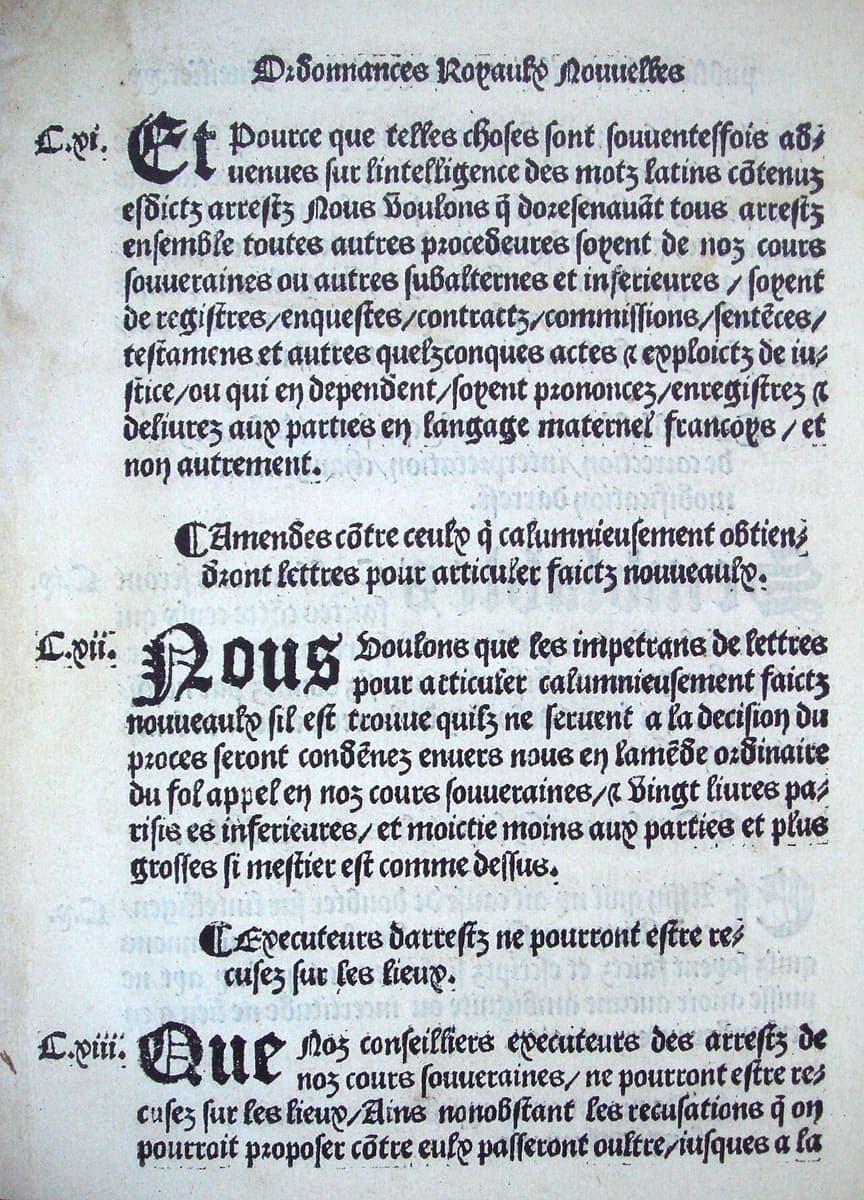
Archives nationales (France), August 1539 · Source · Public domain
Evidano Transcription
Articles 111 and 112, the first two complete articles on the page, in the text printed by Isambert; article 113 begins at the foot of the page and is not included, and the marginal rubrics of the 1539 edition are not part of the edited text. The editor’s spelling is lightly modernised against the sixteenth-century print, and one obvious misprint in the Internet Archive scan has been corrected against the page.
111. Et pour ce que telles choses sont souvent advenues sur l’intelligence des mots latins contenus esdits arrests, nous voulons d’oresnavant que tous arrests, ensemble toutes autres procédures, soient de nos cours souveraines et autres subalternes et inférieures, soient de registres, enquestes, contrats, commissions, sentences, testaments, et autres quelconques, actes et exploicts de justice, ou qui en dépendent, soient prononcés, enregistrés et délivrés aux parties en langage maternel françois et non autrement.
112. Nous voulons que les impétrans de lettres, pour articuler calomnieusement faicts nouveaux, s’il est trouvé qu’ils ne servent à la décision du procez, seront condamnés envers nous en l’amende ordinaire du fol appel en nos cours souveraines, et vingt livres parisis ès-inférieures, et moitié moins aux parties, et plus grosses si métier est comme dessus.
Source: F.-A. Isambert et al. (eds), Recueil général des anciennes lois françaises, tome XII (Paris, 1828), ordonnance d’août 1539, arts. 111–112, via Internet Archive (Public domain).
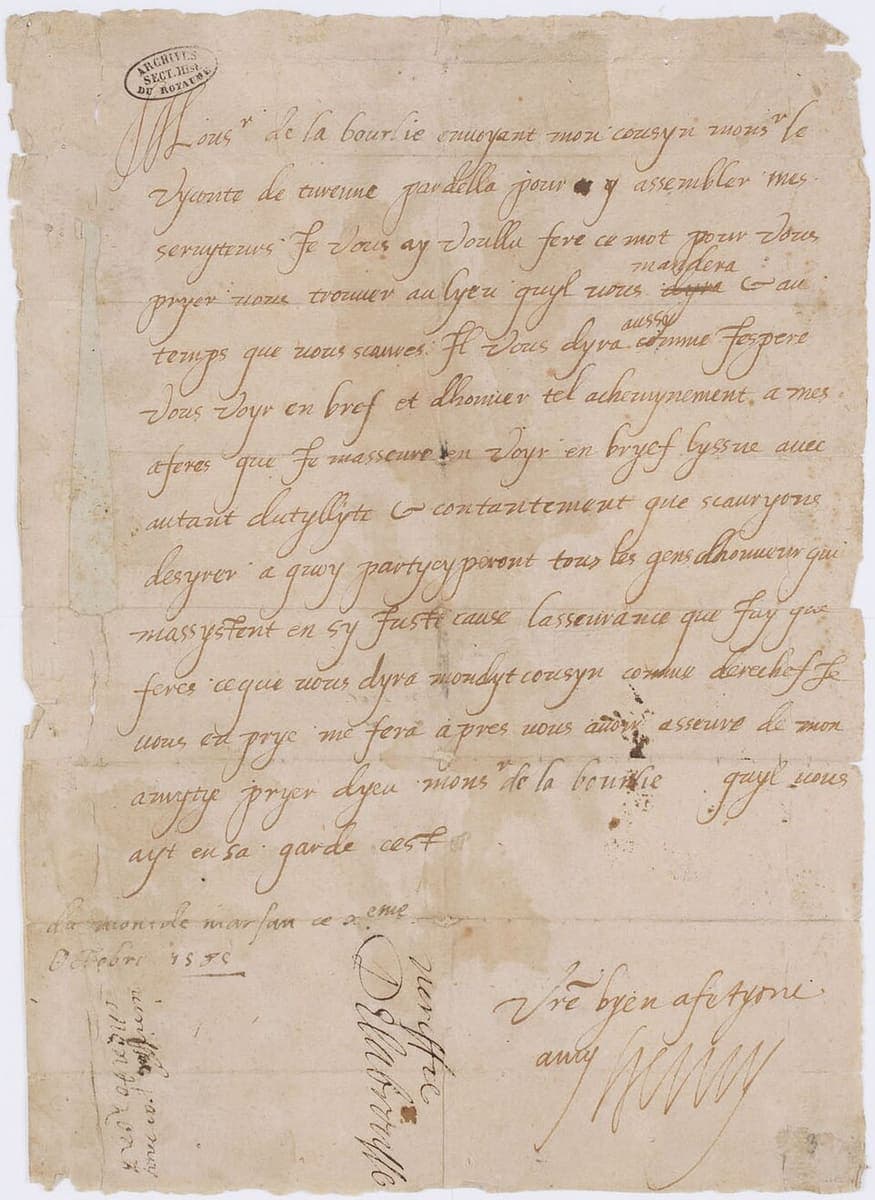
Archives nationales (France), AE II 727, 10 October 1585 · Source · Public domain
Evidano Transcription
The whole letter, the subscription and the date, in Berger de Xivrey’s edition of the autograph. The editor regularises the king’s idiosyncratic spelling — he writes voullu, fere, dyra, quy — supplies accents and punctuation, and prints the honorific with a superscript r; the two words added above the line are absorbed into the text without comment.
Mons.r de la Bourlie, Envoyant mon cousin, mons.r le vicomte de Turenne, par delà pour y assembler mes serviteurs, je vous ay voulu faire ce mot pour vous prier vous trouver au lieu qu’il vous mandera et au temps que vous sçaurez. Il vous dira aussi comme j’espère vous voir en bref, et donner tel acheminement à mes affaires, que je m’asseure y voir en brief l’issue, avec autant d’utilité et contentement que sçaurions désirer ; à quoy participeront tous les gens d’honneur qui m’assistent en si juste cause. L’asseurance que j’ay que ferés ce que vous dira mon dict cousin, comme de rechef je vous en prie, me fera, après vous avoir asseuré de mon amitié, prier Dieu, Mons.r de la Bourlie, qu’il vous ait en sa saincte garde. C’est
Vostre bien affectionné,
HENRY.
Du Mont de Marsan, ce xe octobre 1585.
Source: M. Berger de Xivrey (ed.), Recueil des lettres missives de Henri IV, tome II (Paris, 1843), pp. 135–136, via Internet Archive (Public domain).
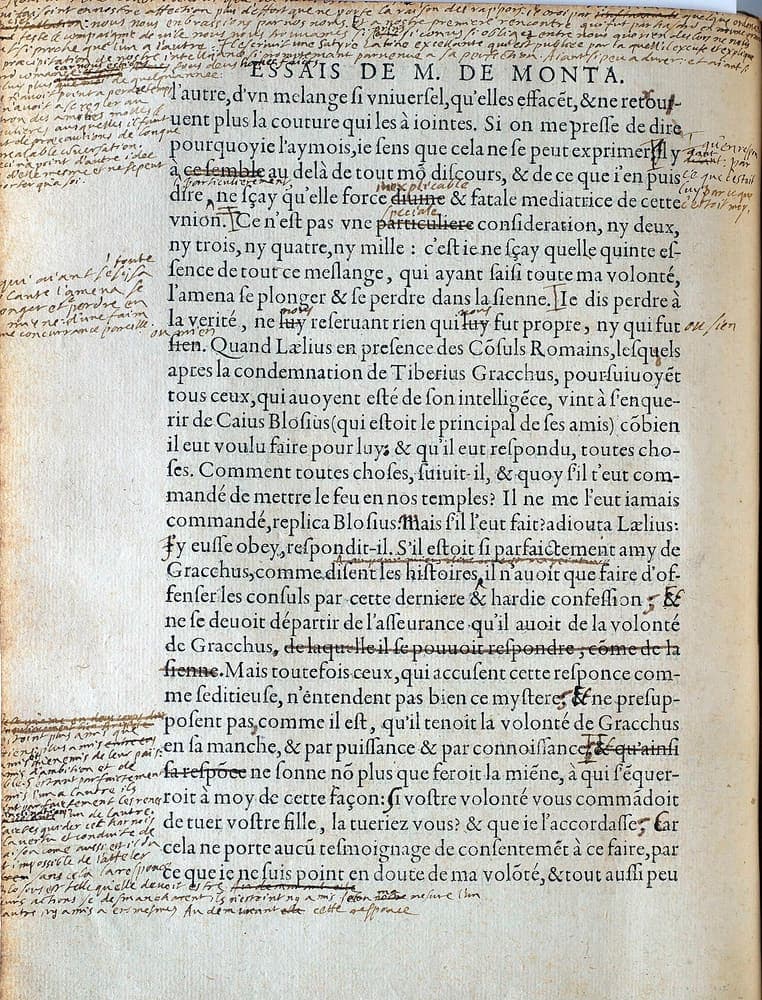
Bibliothèque municipale de Bordeaux, S 1238 Rés., printed 1588, annotated c. 1588–1592 · Source · Public domain
Evidano Transcription
The whole leaf, printed text and manuscript additions together, in the reading text of the Bordeaux copy published on French Wikisource. The passages Montaigne added by hand are enclosed here in square brackets; everything outside them is the 1588 print, with the words he struck out omitted. The edition regularises u/v and i/j, expands the ampersand and supplies punctuation, so it is a reading text rather than a diplomatic one, and the arbitrary line breaks of the source have been joined into continuous prose.
l’autre, d’un melange si universel, qu’elles effacent et ne retrouvent plus la couture qui les a jointes. Si on me presse de dire pourquoy je l’aymois, je sens que cela ne se peut exprimer, [qu’en respondant : Par ce que c’estoit luy ; par ce que c’estoit moy.] Il y a, au delà de tout mon discours, et de ce que j’en puis dire particulierement, ne sçay quelle force inexplicable et fatale, mediatrice de cette union. [Nous nous cherchions avant que de nous estre veus, et par des rapports que nous oyïons l’un de l’autre, qui faisoient en nostre affection plus d’effort que ne porte la raison des rapports, je croy par quelque ordonnance du ciel : nous nous embrassions par noz noms. Et à nostre premiere rencontre, qui fut par hazard en une grande feste et compagnie de ville, nous nous trouvasmes si prins, si cognus, si obligez entre nous, que rien des lors ne nous fut si proche que l’un à l’autre. Il escrivit une Satyre Latine excellente, qui est publiée, par laquelle il excuse et explique la precipitation de nostre intelligence, si promptement parvenue à sa perfection. Ayant si peu à durer, et ayant si tard commencé, car nous estions tous deux hommes faicts, et luy plus de quelque année, elle n’avoit point à perdre temps, et à se regler au patron des amitiez molles et regulieres, ausquelles il faut tant de precautions de longue et preallable conversation. Cette cy n’a point d’autre idée que d’elle mesme, et ne se peut rapporter qu’à soy.] Ce n’est pas une speciale consideration, ny deux, ny trois, ny quatre, ny mille : c’est je ne sçay quelle quinte essence de tout ce meslange, qui, ayant saisi toute ma volonté, l’amena se plonger et se perdre dans la sienne ; [qui, ayant saisi toute sa volonté, l’amena se plonger et se perdre en la mienne, d’une faim, d’une concurrence pareille.] Je dis perdre, à la verité, ne nous reservant rien qui nous fut propre, ny qui fut ou sien ou mien. Quand Laelius, en presence des Consuls Romains, lesquels, apres la condemnation de Tiberius Gracchus, poursuivoyent tous ceux qui avoyent esté de son intelligence, vint à s’enquerir de Caius Blosius (qui estoit le principal de ses amis) combien il eut voulu faire pour luy, et qu’il eut respondu : Toutes choses ; — Comment, toutes choses ? suivit-il. Et quoy s’il t’eut commandé de mettre le feu en nos temples ? — Il ne me l’eut jamais commandé, replica Blosius. — Mais s’il l’eut fait ? adjouta Laelius. — J’y eusse obey, respondit-il. S’il estoit si parfaictement amy de Gracchus, comme disent les histoires, il n’avoit que faire d’offenser les consuls par cette dernière et hardie confession ; et ne se devoit départir de l’asseurance qu’il avoit de la volonté de Gracchus. Mais, toutefois, ceux qui accusent cette responce comme seditieuse, n’entendent pas bien ce mystere, et ne presupposent pas, comme il est, qu’il tenoit la volonté de Gracchus en sa manche, et par puissance et par connoissance. [Ils estoient plus amis que citoyens, plus amis qu’amis et qu’ennemis de leur païs, qu’amis d’ambition et de trouble. S’estans parfaittement commis l’un à l’autre, ils tenoient parfaittement les renes de l’inclination l’un de l’autre ; et faictes guider cet harnois par la vertu et conduitte de la raison (comme aussi est-il du tout impossible de l’atteler sans cela), la responce de Blosius est telle qu’elle devoit estre. Si leurs actions se demancharent, ils n’estoient ny amis selon ma mesure l’un de l’autre, ny amis à eux mesmes. Au demeurant] cette responce ne sonne non plus que feroit la mienne, à qui s’enquerroit à moy de cette façon : Si vostre volonté vous commandoit de tuer vostre fille, la tueriez vous ? et que je l’accordasse. Car cela ne porte aucun tesmoignage de consentement à ce faire, par ce que je ne suis point en doute de ma volonté, et tout aussi peu
Source: Montaigne, Essais, édition de Bordeaux, transcription of the annotated leaf on French Wikisource (CC BY-SA 4.0).
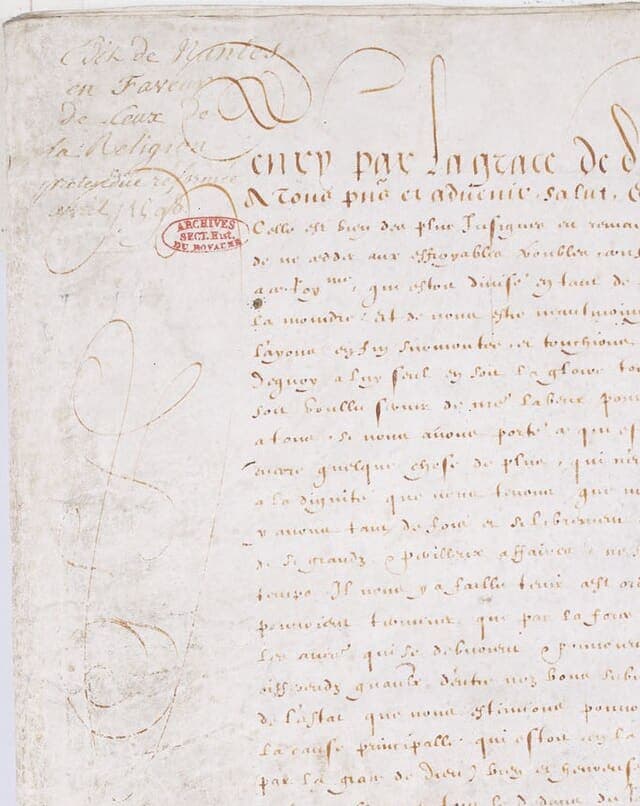
Archives nationales (France), AE II 763, April 1598 · Source · Public domain
Evidano Transcription
The opening of the preamble, in the text printed by Isambert; the sheet continues well beyond the passage given here. The editor abbreviates the royal style at the head to Henry, etc., so the display first line of the manuscript is not represented; his spelling keeps sixteenth-century forms such as nostre and estat but modernises the accents and punctuation.
Entre les grâces infinies qu’il a pleu à Dieu de nous départir, celle ci est bien des plus insignes et remarquables, de nous avoir donné la vertu et la force de ne céder aux effroyables troubles, confusions et désordres, qui se trouvèrent à nostre advénement à ce royaume, qui estoit divisé en tant de partis et de factions que la plus légitime en estoit quasi la moindre, et de nous estre néantmoins tellement roidis contre ceste tourmente, que nous l’ayons enfin surmontée, et touchions maintenant le port de salut et repos de cet estat ; de quoy à lui seul en soit la gloire toute entière, et à nous la grâce et obligation qu’il se soit voulu servir de nostre labeur pour parfaire ce bon œuvre, auquel il a esté visible à tous si nous avons porté ce qui estoit non seulement de nostre devoir et pouvoir, mais quelque chose de plus qui n’eust peut estre pas esté en autre temps bien convenable à la dignité que nous tenons, que nous n’avons plus eu crainte d’y exposer, puisque nous y avons tant de fois et si librement exposé nostre propre vie.
Source: F.-A. Isambert et al. (eds), Recueil général des anciennes lois françaises, tome XV (Paris, 1829), no. 124, édit de pacification dit de Nantes, via Internet Archive (Public domain).
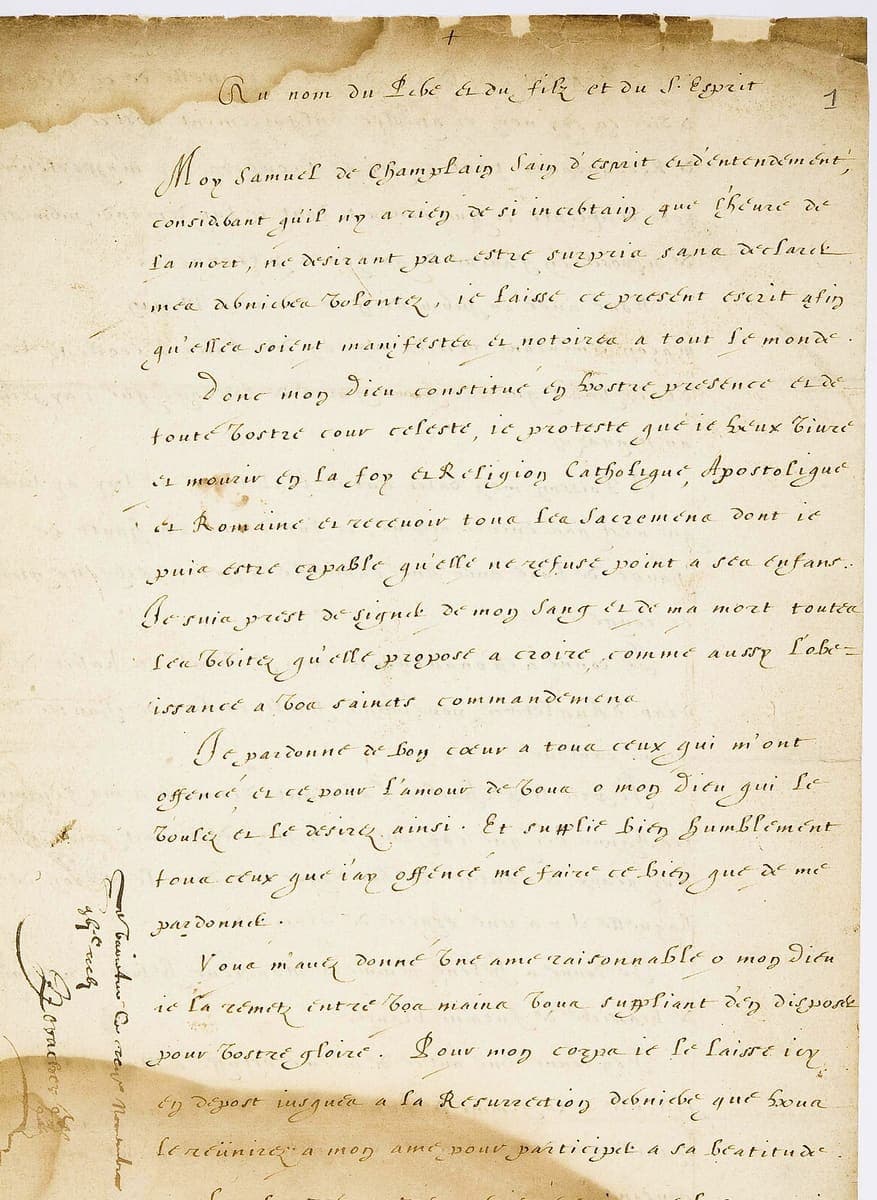
Archives nationales (France), Minutier central, ET/LXII/138, 17 November 1635 · Source · Public domain
Evidano Transcription
- Au nom du Pere et du filz et du S. Esprit 1
Moy Samuel de Champlain Sain d'esprit et d'entendement,
considerant qu'il ny a rien de si incertain que l'heure de
la mort, ne desirant pas estre surpris sans declarer
mes dernieres volontez, ie laisse ce present escrit afin
qu'elles soient manifestées et notoires a tout le monde.
Donc mon Dieu constitué en vostre presence et de
toute vostre cour celeste, ie proteste que ie veux viure
et mourir en la foy et Religion Catholique, Apostolique
et Romaine et receuoir tous les Sacremens dont ie
puis estre capable qu'elle ne refuse point a ses enfans.
Je suis prest de signer de mon sang et de ma mort toutes
les veritez qu'elle propose a croire comme aussy l'obe=
issance a vos saincts commandemens
Je pardonne de bon cœur a tous ceux qui m'ont
offencé et ce pour l'amour de vous o mon Dieu qui le
voulez et le desirez ainsi. Et supplie bien humblement
tous ceux que i'ay offencé me faire ce bien que de me
pardonner.
Vous m'auez donné vne ame raisonnable o mon Dieu
ie la remets entre vos mains vous suppliant d'en disposer
pour vostre gloire. Pour mon corps ie le laisse icy
en depost iusques a la Resurrection derniere que vous
le reunirez a mon ame pour participer a sa beatitude.
[cut off]
[left margin, sideways:] [illegible] Nouembre
[illegible]
[signature]
Generated by Evidano’s advanced model; not yet checked against a published edition.
Secretary, italic and everything between
The French secretary hand of the sixteenth century descends from the bâtarde but is written with a narrower nib and far more speed. Its e is a closed loop that can pass for c, its h and l carry tall looped ascenders, its final s is a long descending stroke, and c, t and r are distinguished by little more than the angle of a short bar. Alongside it, humanistic minuscule and its cursive form, italic, arrive from Italy and are used first for Latin, then for anything the writer wants to set apart: a proper name, a quotation, a heading, an address. Many writers use both within a sentence, so the change of script is itself information.
Abbreviation thins out but does not disappear. A tilde still marks a dropped n or m (cōme, bō); superscript letters carry the endings of honorifics and offices (mons.r, m.re, s.r, tres humbleᵗ); ordinary legal contractions survive for ledit, ladite, lesdits, nostredit; and an apostrophe-like sign marks elision inconsistently. Numbers move between roman and arabic in the same document, dates are given both by the Roman calendar of saints’ days and by the day of the month, and money is still counted in livres, sous and deniers tournois or parisis.
Print and manuscript now share a page. Royal ordinances circulate in gothic bâtarde type with virgules for commas and a tilde over a vowel exactly as in a manuscript; a scholar buys a printed book and fills its margins with a running hand, as Montaigne did in his own copy of the Essais; a chancery act keeps a display first line drawn with the pen while the body is written at speed. The layout habits that go with these — an address written on the fold, a signature with a paraph that fills a quarter of the sheet, a notary’s stamp in the margin — are as much a part of the document as the words.
Why ordinary OCR struggles here
Two scripts in one sentence
A writer drops into italic for a name, a Latin tag or an address and returns to secretary for the rest. An engine trained on one alphabet reads the other as noise, and the change of script — which often marks a quotation or a proper noun — is lost even when the letters are guessed right.
Spelling that has not settled
Henri IV writes voullu, fere and quy; a notary three streets away writes voulu, faire and qui. Any model that leans on a modern lexicon will quietly regularise these forms and erase the evidence of who wrote the document and where.
Additions in the margins of print
Annotated books like Montaigne’s working copy put a manuscript layer around a printed one, with insertion marks, deletions and text running up the side of the page. Reading order has to be reconstructed from carets and rules, not from the page geometry.
Signatures, paraphs and stamps
A subscription can be larger than the text it signs, and notarial minutes carry stamps, initials and marginal registrations. Layout analysis tends either to swallow them into the last line or to hallucinate letters out of the flourish.
Who works with this material
Editors of Renaissance correspondence
Letter-books and princely correspondence survive in thousands of autographs and secretarial copies. Distinguishing the two, and recording what a writer added in his own hand, is the point of the edition and needs a transcription that notes the change of hand.
Historians of law and administration
Ordinances, edicts and their registrations exist as parchment originals, chancery copies and printed editions that differ in wording. Comparing them requires a faithful reading of each, including the clauses added at registration.
Textual scholars working on annotated books
A printed book with an author’s or reader’s manuscript additions is two documents at once. Keeping the print and the hand as separate layers is what makes the annotations usable for a genetic edition.
Notarial and probate researchers
Wills, inventories and marriage contracts from the Minutier central and its provincial equivalents are the backbone of social history. Names, sums and legal formulas have to come out reliably before anything can be counted.
Getting the best transcription
Ask for the script to be labelled, not just read
Request a note wherever the hand shifts from secretary to italic or from print to manuscript. That single instruction preserves the distinction between the body of a letter, the names in it and the clerk’s later endorsement.
Freeze the spelling
Say explicitly that the writer’s orthography is to be kept, including doubled consonants, y for i and missing accents. If you also want a modernised version, ask for it as a second column rather than as a replacement.
Handle insertions as insertions
For an annotated page, ask for added passages to be marked and placed where the caret sends them, and for struck-out words to be recorded rather than dropped. A bracket convention agreed in advance is easier to process later than a footnote.
Start with the signature page
Run a first pass on a sheet that ends in a paraph, a notarial stamp or a registration note. If those come out as labelled fields instead of garbled text, the plain sheets in the same bundle will need almost no correction.
Further reading on this hand
The palaeography guides the in-app selector points to for this domain, if you want to check a transcription against the standard references.
- French Renaissance Paleography
This Newberry Library project is devoted to French manuscripts produced between 1300 and 1700. It combines high-resolution manuscript images with scholarly transcriptions, historical introductions, and interactive exercises. The collection demonstrates secretary, humanistic, italic, and mixed hands together with period abbreviations, punctuation, orthography, and document genres. Its sixteenth- and early seventeenth-century examples directly support transcription of French Renaissance correspondence and records.
Frequently asked questions
- Can it tell an autograph letter from a secretary’s fair copy?
- The transcription records where the hand changes, which is usually enough: a fair copy written by a clerk and signed by the sender shows one hand for the body and another for the subscription. Attribution itself stays with the historian, but the evidence is put in front of you.
- How are superscript abbreviations such as mons.r or m.re treated?
- They can be kept with the superscript letters as written, expanded silently, or expanded with the supplied letters in brackets. Whichever you choose is applied consistently, so a run of letters can be searched for a title without missing the abbreviated forms.
- What happens to words the writer crossed out?
- Deletions are recorded as deletions rather than dropped, because in drafts and annotated books what was removed is often the point. They can be suppressed in a clean reading text once the full version has been produced.
- Does a faded chancery hand on parchment stand a chance?
- Faded iron-gall ink on a large sheet is one of the harder cases, and the honest answer is that some lines will be uncertain. Asking for uncertain readings to be flagged, rather than smoothed over, is what makes the output usable for an edition.
- Can the printed and handwritten layers of an annotated book be kept apart?
- Yes. The print and the manuscript additions are transcribed as separate streams and then interleaved in reading order, so you can produce either the 1588 text, the additions alone, or the combined text that later editions print.
Related scripts and pages
Transcribe your Renaissance French papers
Upload a letter, an edict or an annotated book page, choose French Renaissance Secretary and Humanistic Hands, and check one sheet before the rest.