
German · c. 1050–1400
Transcribe Middle High German the way the book was set
By 1200, German had its own literature, and scribes wrote it in the same compressed Gothic Textualis used for Latin service books: minims packed edge to edge, r and s reshaped at the end of a word, and long s easily mistaken for f. Evidano reads these two-column pages folio by folio, keeping the manuscript’s own letterforms and line breaks intact.
Sample pages
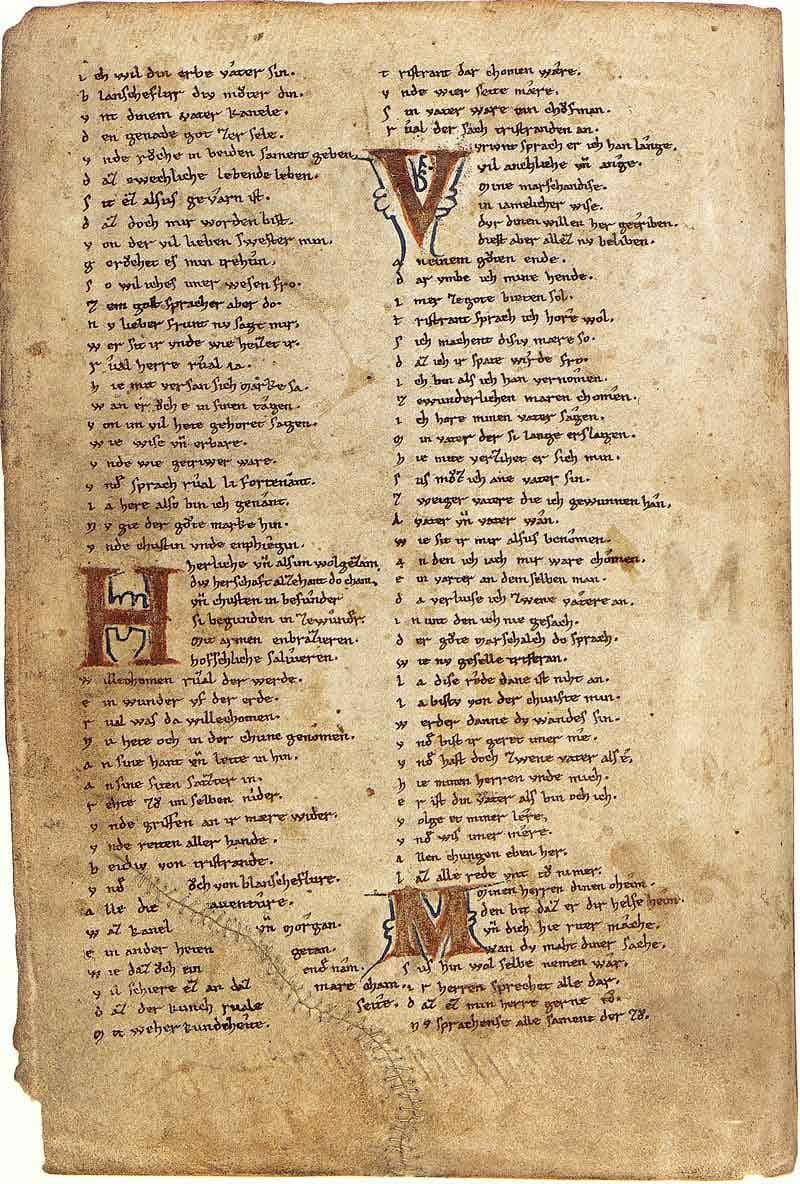
Bayerische Staatsbibliothek, Munich, Cgm 51, c. 1240–1250 · Source · Public domain
Evidano Transcription
ich wil din erbe vater ſin.
blanſcheflur div mvter din.
vnt dinem vater kanele.
den genade got der ſele.
vnde rvche in beiden ſament geben.
daz ewechliche lebende leben.
ſit ez alſuſ gevarn iſt.
daz doch mir worden biſt.
von der vil lieben ſweſter min.
gedehet eſ min gehvn.
ſo wil icheſ imer weſen fro.
Zem gaſt ſprach er aber do.
nv lieber frunt nv ſage mir.
wer ſit ir vnde wie heizet ir.
rval herre rval ia.
hie mit verſan ſich marke ſa.
wan er hete in ſinen tagen.
von im vil hete gehoret ſagen.
wie wiſe vn[d] erbare.
vnde wie getriwer ware.
vnt ſprach rval li fortenant.
ia here alſo bin ich genant.
nv gie der gvte marke hin.
vnde chuſtin vnde enphiegin.
Herliche vn[d] alſim wolgezam.
div herſchaft alzehant do cham.
vn[d] chuſten in beſunder.
ſi begunden in zewunder.
mit armen enbrazieren.
hofſchliche[?] ſaluieren.
willechomen rval der werde.
ein wunder vf der erde.
rval waſ da willechomen.
in hete och in der chunc genomen.
an ſine hant vn[d] leitte in hin.
an ſine ſiten ſazter in.
ſezte[?] tr[?] im ſelben nider.
vnde griffen an ir mere wider.
vnde retten aller hande.
beidiv von triſtrande.
vnt och von blanſcheflure.
alle die auentvre.
waz kanel vn morgan.
ein ander heten getan.
wie daz ſich ein end nam.
vil ſchiere ez an daz mare cham.
daz der kunch rvale ſeite.
mit weher zundeheite.
triſtrant dar chomen wære.
vnde wie ſette[?] mære.
ſin vater wære ein chofman.
rval der ſach triſtranden an.
Vriunt ſprach er ich han lange.
vil anehliche vn ange.
mine marſchandiſe.
in iamelicher wiſe.
dur dinen willen her getriben.
dieſt aber allez nv beliben.
an einem gvten ende.
dar vmbe ich mine hende.
imir[?] zegote bieten ſol.
triſtrant ſprach ich hore wol.
ſich machent diſiv mære ſo.
daz ich ir ſpate wirde fro.
ich bin alſ ich han vernomen.
zewunderlichen maren chomen.
ich hore minen vater ſagen.
min vater der ſi lange erſlagen.
hie mite verzihet er ſich min.
ſuſ mvz ich ane vater ſin.
zweier vatere die ich gewunnen han.
d[?] vater vn[d] vater wan.
wie ſit ir mir alſuſ benomen.
an den ich ich[?] mir ware chomen.
ein vater an dem ſelben man.
da verluſe ich zwene vatere an.
in vnt den ich nie geſach.
der gvte marſchalch do ſprach.
wie nv geſelle triſtran.
ia diſe rede danc iſt niht an.
ia biſtv von der chunſte min.
werder danne dv wandeſ ſin.
vnt biſt ir geret imer me.
vnt haſt doch zwene vater alſe.
hie minen herren vnde mich.
er iſt din vater alſ bin och ich.
volge nv miner lere.
vnt wiſ imer mere.
allen chungen eben her.
laz alle rede vnt tv nimer[?].
Minen herren dinen ohein.
den bit daz er dir helfe heim.
vn[d] dich hie riter mache.
wan dv maht diner ſache.
ſuſ hin wol ſelbe nemen war.
ir herren ſprechet alle dar.
daz ez min herre gerne tv.
nv ſprachen ſe alle ſament der zv.
Generated by Evidano’s advanced model; not yet checked against a published edition.
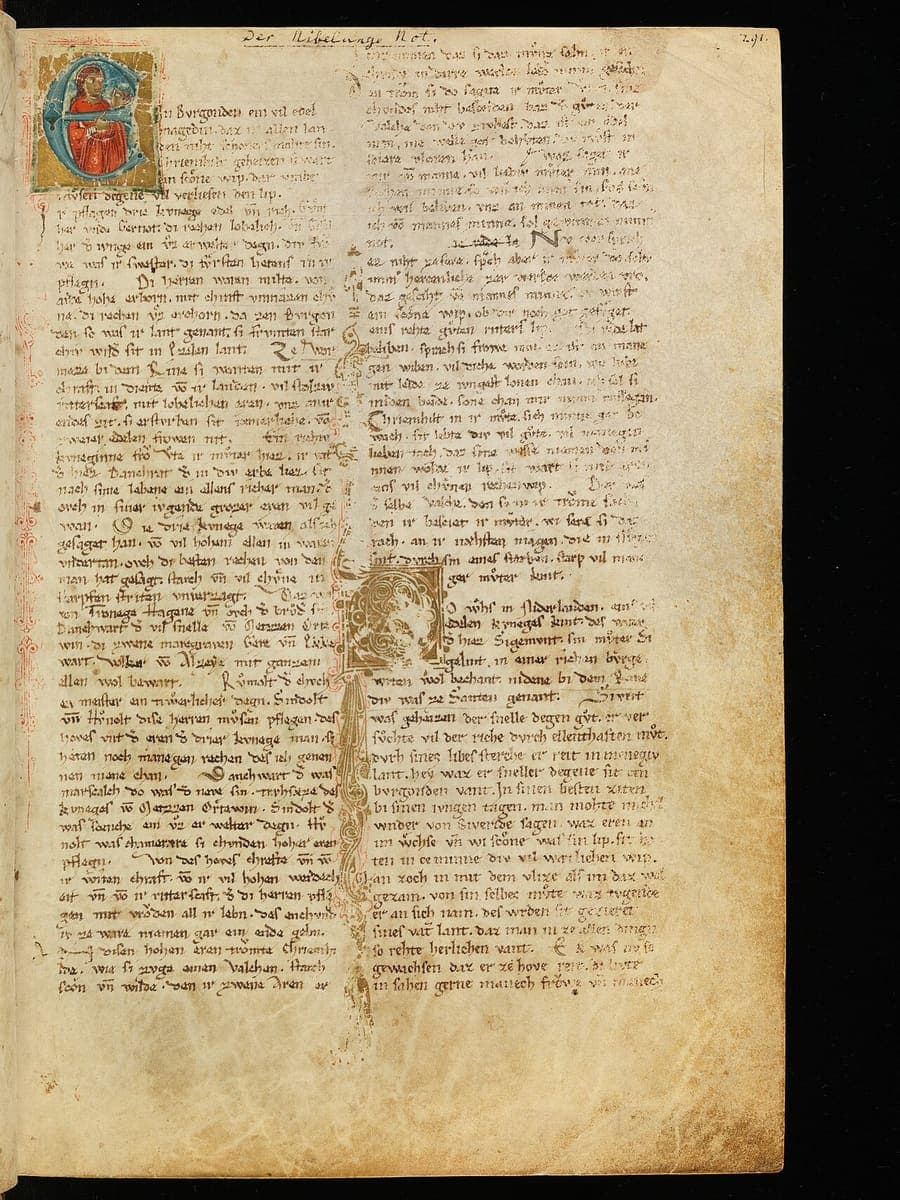
Stiftsbibliothek St Gallen, Cod. Sang. 857, p. 291, c. 1250 · Source · CC BY-SA 4.0
Evidano Transcription
Der Nibelunge Not. 291.
E[illegible] in Bvrgonden ein vil edel
magedin. daz in allen lan
den niht [illegible] mohte sin.
Chriemhilt geheizen si wart
ein scone wip. dar vmbe
mvsen degene vil verliesen den lip.
Ir pflagen drie kvnege[?] edel vn[d] rich. Gvnt
her vnde Gernot. di rechen lobelich. vn[d] Gisel
her d[er] ivnge ein vz erwelter degen. div fro
[remaining lines illegible]
[illegible]
Generated by Evidano’s advanced model; not yet checked against a published edition.
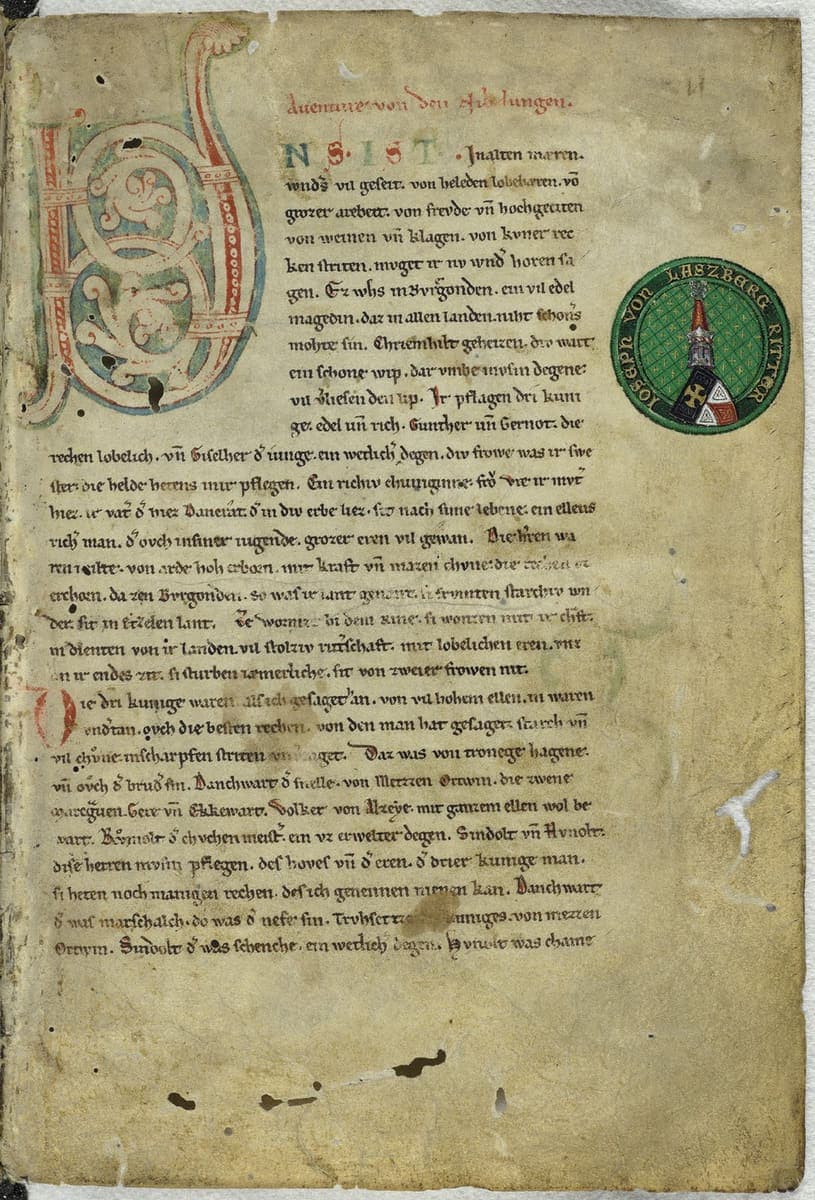
Badische Landesbibliothek, Karlsruhe, Cod. Donaueschingen 63, f. 1r, c. 1220–1250 · Source · Public domain
Evidano Transcription
Auenture[?] von den [Nib]elungen.
VNS · IST · In alten mæren.
wnd[er]s vil geseit. von heleden lobebæren. vo[n]
grozer arebeit. von frevde vn[d] hochgeciten
von weinen vn[d] klagen. von kvner rec
ken striten. mvget ir nv wnd[er] horen sa
gen. Ez whs in Bvrgonden. ein vil edel
magedin. daz in allen landen. niht schon[er]s
mohte sin. Chriemhilt geheizen. div wart
ein schone wip. dar vmbe mvsin degene.
vil vliesen den lip. Ir pflagen dri kuni
ge. edel vn[d] rich. Gunther vn[d] Gernot. die
rechen lobelich. vn[d] Giselher d[er] ivnge. ein werlich degen. div frowe was ir swe
ster. die helde hetens mit pflegen. Ein richiv chuniginne. fro Vte ir mvt[er]
hiez. ir vat[er] d[er] hiez Dancrat. d[er] in div erbe liez. sit nach sime lebene. ein ellens
rich[er] man. d[er] ovch in siner ivgende. grozer eren vil gewan. Die h[er]ren wa
ren milte. von arde hoh erborn. mit kraft vn[d] mazen chvne. die rechen vz
erchorn. da zen Bvrgonden. so was ir lant genant. si frvmten starchiv wn
der. sit in Etzelen lant. Ze wormze bi dem rine. si wonten mit ir chraft.
in dienten von ir landen. vil stolziv ritt[er]schaft. mit lobelichen eren. vnz
an ir endes zit. si sturben iæmerliche. sit von zweier frowen nit.
Die dri kunige waren. als ich gesaget han. von vil hohem ellen. in waren
vnd[er]tan. ovch die besten rechen. von den man hat gesaget. starch vn[d]
vil chvne. in scharpfen striten vnverzaget[?]. Daz was von tronege hagene.
vn[d] ovch d[er] brud[er] sin. Danchwart d[er] snelle. von Metzen Ortwin. die zwene
marcgrauen. Gere vn[d] Ekkewart. Volker von Alzeye. mit ganzem ellen wol be
wart. Rvmolt d[er] chvchen meist[er]. ein vz erwelter degen. Sindolt vn[d] Hvnolt.
dise herren mvsin pflegen. des houes vn[d] d[er] eren. d[er] drier kunige man.
si heten noch manigen rechen. des ich genennen niemen kan. Danchwart
d[er] was marschalch. do was d[er] nefe sin. Trvhsetze [illegible] kuniges. von metzen
Ortwin. Sindolt d[er] was schenche. ein werlich degen. Hvnolt was chame
[stamp: JOSEPH VON LASZBERG RITTER]
Generated by Evidano’s advanced model; not yet checked against a published edition.
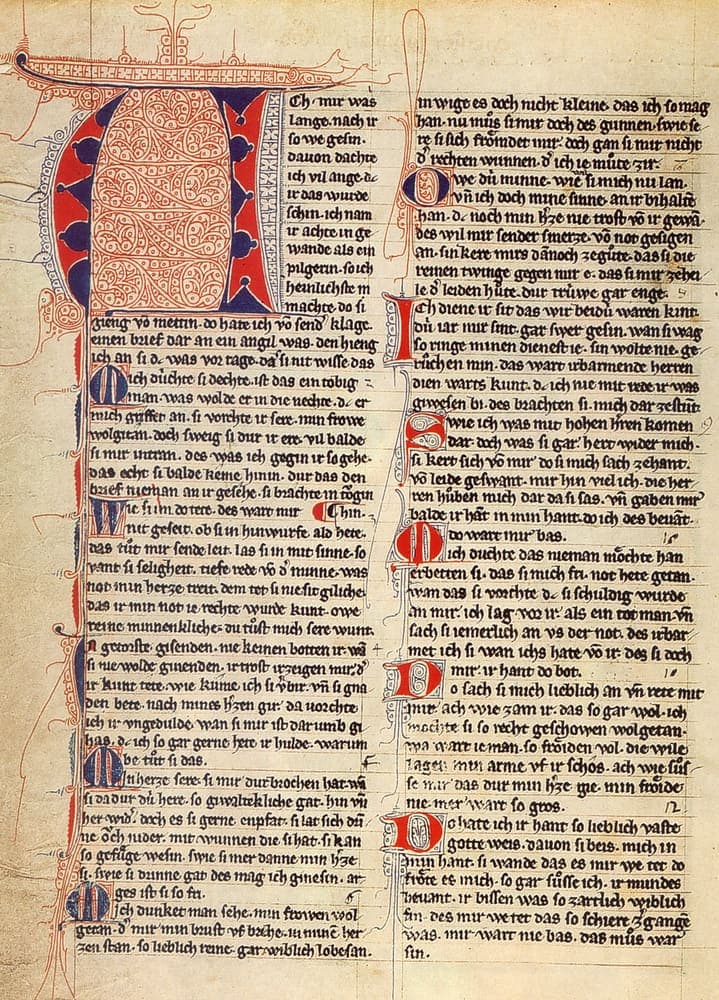
Universitätsbibliothek Heidelberg, Cod. Pal. germ. 848, f. 371v, 1305–1340 · Source · Public domain
Evidano Transcription
The first strophe of “Ach mir was lange”, in a diplomatic transcription proofread on German Wikisource that keeps the manuscript’s own letterforms and abbreviation marks, including r rotunda and the nasal bar.
ACh mir was lange
nach ir so we gesin
davon dachte ich vil ange
daz ir das wurde schin
ich nam ir achte
in gewande als ein pilgerin
so ich heinlichste machte
do si gieng von mettin
do hate ich vor sender klage
einen brief dar an ein angil was
den hieng ich an si daz was vor tage
daz si nit wisse das
Source: “Ach mir was lange”, Johannes Hadlaub, via German Wikisource (diplomatic transcription of Codex Manesse, f. 371v) (CC BY-SA 3.0).
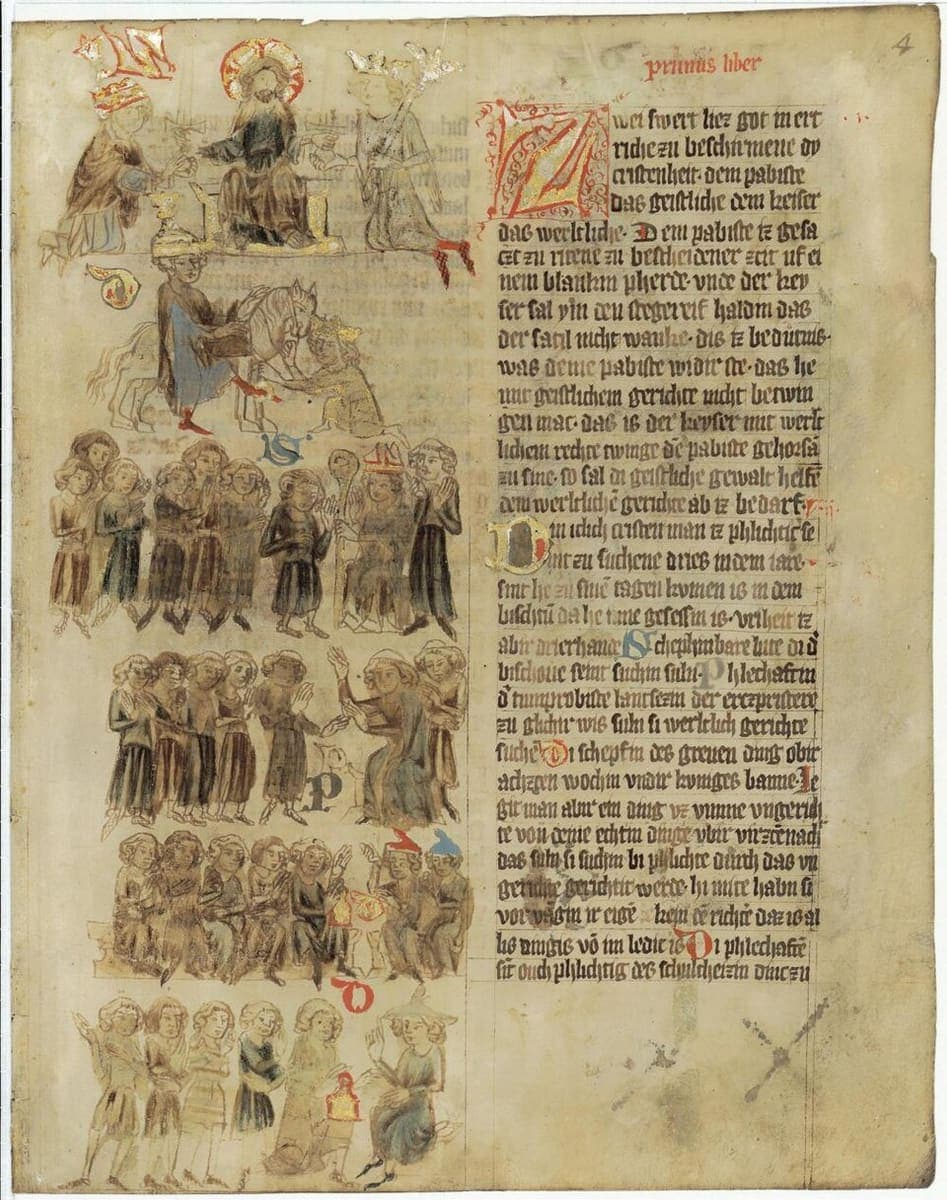
Sächsische Landesbibliothek, Dresden, Mscr. Dresd. M. 32, f. 4, c. 1350 · Source · Public domain
Evidano Transcription
4
primus liber
Zwei ſwert liez got in ert
riche zu beſchirmene dy
criſtenheit· dem pabiſte
das geiſtliche dem keiſer
das werltliche· Dem pabiſte is geſa
ct zu ritene zu beſcheidener zcit uf ei
nem blankin pherte· vnde der key
ſer ſal ym den ſtegereif haldin das
der ſatil nicht wanke· dis is bedutnis·
was deme pabiſte widir ſte· das he
mit geiſtlichem gerichte nicht betwin
gen mac· das is der keyſer mit werlt
lichem rechte twinge de[n] pabiſte gehorſa[m]
zu ſine· ſo ſal di geiſtliche gewalt helfi[n]
dem werltliche[n] gerichte ab is bedarf·
Din ichlich criſten man is phlichtic ſe
nt zu ſuchene dries in dem iare·
ſint he zu ſine[n] tagen kvmen is in dem
biſchtu[m] da he inne geſeſſin is· vrlihet is
abir derchant[?]· Schephinbare lute di d[er]
biſchoue ſent ſuchin ſuln· Phlechaftin
d[er] tumprobiſte lantſezin der erczpriſtere
zu glichir wis ſuln ſi werltlich gerichte
ſuche[n]· Di ſchepfin des greuen dings obir
achtzen wochin vndir kvniges banne· Ie
ſit man abir ein ding vz vmme vngerich
te von deme echtin dinge vbir virzenacht
das ſuln ſi ſuchin bi phlichte durch das vn
gerichte gerichtet werde· hi mite habn ſi
vor vaſin[?] ir eige[n] kein de[n] richter daz is al
les dingis vo[n] im ledic is· Di phlechafti[n]
ſint ouch phlichtig des ſchultheizin dinc zu
Generated by Evidano’s advanced model; not yet checked against a published edition.
What a Middle High German book page looks like
Between roughly 1050 and 1400, German literary and legal texts began to be copied in dedicated manuscripts rather than scattered through Latin codices. The great courtly epics and romances — the Nibelungenlied, Wolfram von Eschenbach’s Parzival, Gottfried von Straßburg’s Tristan — survive in dozens of manuscripts copied across two centuries, each in the regional Gothic book hand of its scriptorium. Song manuscripts such as the Codex Manesse preserve Minnesang lyric in a similarly formal hand, often with a portrait of the poet above the text. Legal compilations such as the Sachsenspiegel were copied both as plain text and, in the Dresden and Heidelberg picture-books, alongside miniatures illustrating each clause.
The script itself is Gothic Textualis: a book hand built from straight strokes and sharp angles rather than the rounder Caroline letters of the earlier period, with minims (the short vertical strokes of i, m, n and u) packed so closely that counting them, not just shaping them, becomes part of reading the line. Long s and f differ only in whether the crossbar goes all the way through; round s appears only at the end of a word; r takes a distinct rounded form, r rotunda, after certain letters. Superscript vowels mark umlaut where the base letter alone would be ambiguous, and a scribe copying an older exemplar sometimes keeps that exemplar’s spelling even where local usage had already changed.
Verse is set two columns to the page with the metrical line matching the manuscript line — unlike Old English, Middle High German scribes generally did give each line of verse its own ruled line — and stanza or strophe breaks are marked with a coloured initial (a Lombardic capital, alternating red and blue) rather than a blank line. Legal and prose texts run margin to margin, sometimes in a single column beside an illustration, and abbreviation follows the Latin-derived system: a bar over a vowel for a missing nasal, a hook for -us or -er, a crossed l for a common ending.
Why ordinary OCR struggles here
Minims that all look the same
i, m, n and u are built from the same short vertical stroke, and a tightly spaced Gothic hand gives few cues to tell them apart beyond counting strokes and knowing the word. A model that reads shape by shape rather than word by word will misplace a minim on almost every dense line.
Long s, f and r rotunda
Long s and f are distinguished only by a crossbar that may or may not reach the shaft; r rotunda, used after rounded letters, does not look like the ordinary r at all. Confusing any of these turns a legible word into a different one.
One poem, many manuscripts, many spellings
The Nibelungenlied alone survives in over thirty manuscripts, none identical in wording or orthography. A transcription pinned to one manuscript has to resist silently correcting it toward a more familiar, edited reading.
Text and picture sharing a page
A Sachsenspiegel picture-book puts a miniature and a column of glossed legal text on the same folio; a Codex Manesse page sets an author portrait above the poem. Reading order and the boundary between image and text both need to be handled correctly.
Who works with this material
Editors of Middle High German literary texts
Preparing a manuscript-based edition of an epic or romance means transcribing one specific witness accurately before comparing it with others. A diplomatic first pass that keeps the manuscript’s own spelling gives an editor a reliable base text to collate.
Legal historians working with the Sachsenspiegel
The Sachsenspiegel survives in dozens of manuscripts with real differences in wording between regions. A transcription tied to one specific witness, with its own text kept separate from the accompanying miniatures, supports comparison across copies.
Musicologists and literary historians of Minnesang
Song manuscripts such as the Codex Manesse need their lyric text separated cleanly from decoration and author portraits, so that stanza structure and rhyme can be checked against the melody or against other song manuscripts.
Digital humanities projects building manuscript corpora
Comparing spelling and dialect across dozens of Nibelungenlied or Parzival manuscripts requires consistent, manuscript-specific transcription rather than a text silently pulled toward a standard edition.
Getting the best transcription
Say which manuscript, not just which text
Name the specific witness (Cgm 34, Cod. Sang. 857, and so on) in the prompt, and ask the model to transcribe exactly what is on the page rather than the poem as generally known — the wording and spelling genuinely differ between copies.
Decide how to treat r rotunda and long s
Ask for r rotunda to be rendered as r and long s as s, unless you specifically want the manuscript’s own glyphs preserved for a palaeographical study. Setting this once avoids inconsistent results across a long manuscript.
Test on a page with an initial and a miniature
A page combining a decorated initial, a miniature and dense text, as in the Sachsenspiegel, is the hardest case. If the model separates image from text and keeps the reading order correct there, plain text pages will go smoothly.
Keep the manuscript’s line breaks for verse
Because Middle High German scribes generally gave each metrical line its own manuscript line, transcribing line for line preserves the verse structure automatically, unlike continuous prose transcription of earlier vernacular poetry.
Further reading on this hand
The palaeography guides the in-app selector points to for this domain, if you want to check a transcription against the standard references.
- Latin Paleography
This Hill Museum & Manuscript Library (HMML) course introduces Gothic Textualis and related medieval book scripts through dated manuscript examples. The lessons demonstrate angular letter construction, biting curves, minim sequences, r rotunda, long s, ligatures, abbreviations, and punctus-based punctuation. These are the same broad Latin-script conventions adapted by scribes copying Middle High German literary and devotional texts. The course is consequently useful for establishing the script grammar needed before resolving vernacular spellings.
Frequently asked questions
- How does the transcription tell long s from f in Gothic Textualis?
- It reads the crossbar: long s carries only a short bar or none at all on the left side of the stroke, while f’s crossbar goes all the way through. You can ask for either glyph to be normalised to modern s and f, or kept as written.
- Can it transcribe one specific manuscript rather than a standard edition of the text?
- Yes, and that is the default. Naming the manuscript in the prompt makes clear that the aim is this witness’s own wording and spelling, not the reading familiar from a printed edition.
- How are Lombardic capitals and stanza breaks in Minnesang or epic verse handled?
- A coloured initial marking a new stanza or fitt is recognised as a structural break and can be flagged in the transcription, separate from ordinary decorated capitals used purely for display.
- What about pages like the Sachsenspiegel, where text sits beside a miniature?
- The transcription follows the page’s own layout and transcribes only the written text, describing where a miniature interrupts a column rather than guessing at the image’s content as if it were text.
- Does it distinguish minims accurately in tightly spaced words?
- It reads minim clusters as whole words rather than stroke by stroke, which is how a trained reader resolves i, m, n and u in dense Gothic script; genuinely ambiguous clusters are flagged rather than guessed.
Related scripts and pages
Transcribe your Gothic-hand German manuscript
Upload a scan, choose Middle High German Gothic Book Hands, and test the prompt on a page with a decorated initial first.