
English · c. 700–1066
Read Old English the way the scribe wrote it
Insular minuscule uses letters the modern alphabet never had, treats p, ƿ and þ as three different sounds, and runs verse together as prose. Evidano transcribes Anglo-Saxon folios letter for letter, keeps the abbreviations you ask it to keep, and lets you check every line against the page before you export.
Sample pages
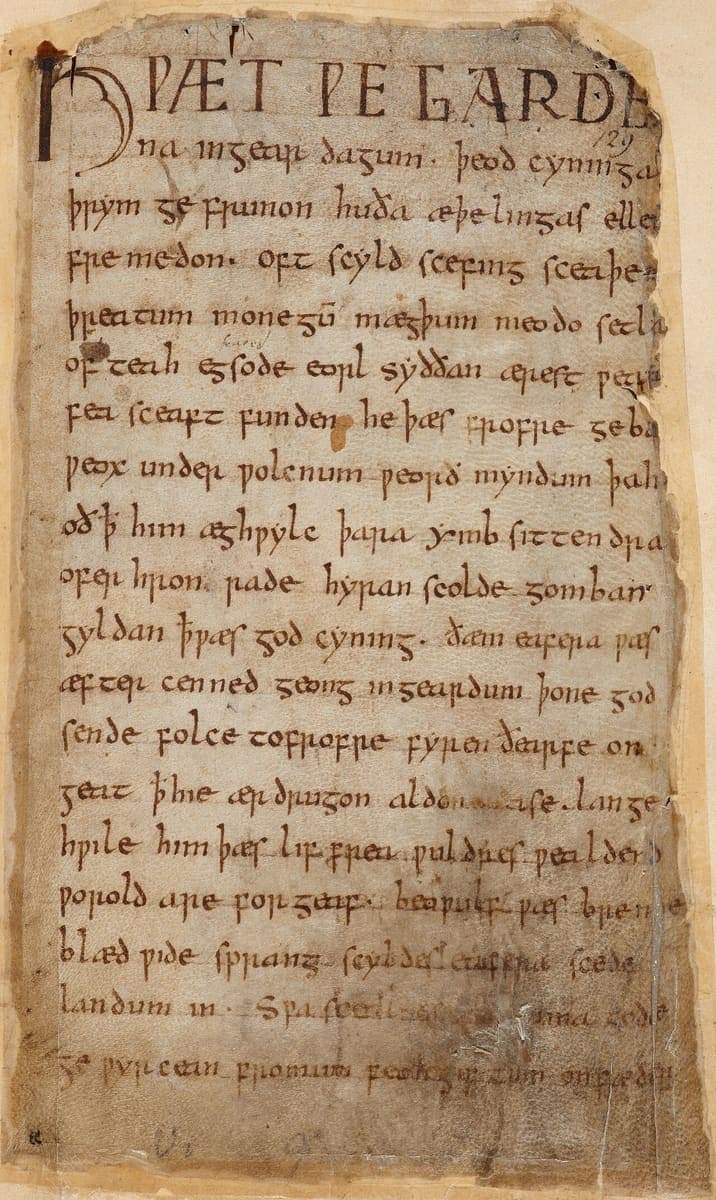
British Library, Cotton MS Vitellius A XV, f. 132r, c. 975–1025 · Source · Public domain
Evidano Transcription
Lines 1–21a of the poem, the whole of f. 132r, in A. J. Wyatt’s edition (Cambridge, 1894): a normalised text with editorial vowel-length marks, hyphens and punctuation; wynn is printed as w and letters supplied by the editor stand in square brackets.
Hwæt! wē Gār-Dena in gēar-dagum
þēod-cyninga þrym gefrūnon,
hū ðā æþelingas ellen fremedon.
Oft Scyld Scēfing sceaþena þrēatum,
monegum mǣgþum meodo-setla oftēah.
Egsode eorl, syððan ǣrest wearð
fēa-sceaft funden; hē þæs frōfre gebād,
wēox under wolcnum, weorð-myndum þāh,
oð þæt him ǣghwylc þāra ymb-sittendra
ofer hron-rāde hȳran scolde,
gomban gyldan; þæt wæs gōd cyning.
Ðǣm eafera wæs æfter cenned
geong in geardum, þone God sende
folce tō frōfre; fyren-ðearfe ongeat,
þæt hīe ǣr drugon aldor-[lē]ase
lange hwīle. Him þæs Līf-frēa,
wuldres Wealdend, worold-āre forgeaf;
Bēowulf wæs brēme (blǣd wīde sprang),
Scyldes eafera Scede-landum in.
Swā sceal [geong g]uma gōde gewyrcean,
fromum feoh-giftum on fæder
Source: Beowulf, ed. A. J. Wyatt (Cambridge University Press, 1894), Prelude, via Wikisource (Public domain).
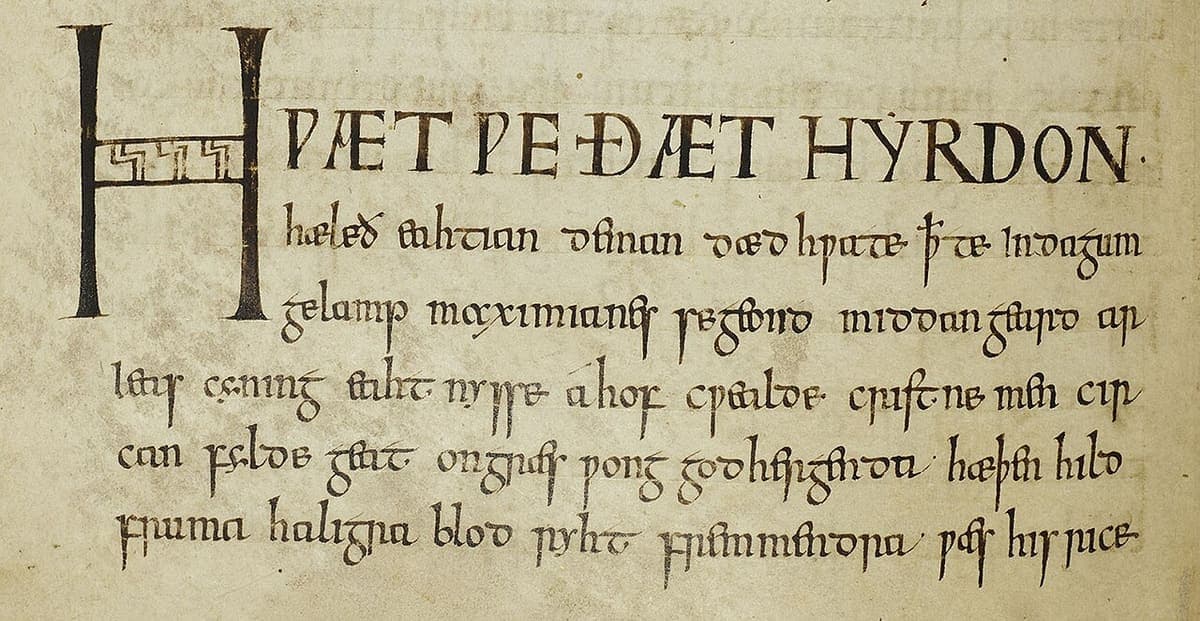
Exeter Cathedral Library, MS 3501, f. 65v, c. 960–990 · Source · Public domain
Evidano Transcription
Lines 1–8a of the poem, the seven manuscript lines shown, in Israel Gollancz’s edition (Early English Text Society, 1895), which keeps the manuscript’s points and hyphenates compounds; æ, ð and þ restored from the Internet Archive OCR against the page image. The bracketed r is the editor’s.
HWÆT WE ÐÆT HYRDON · hæleð eahtian
deman dæd-hwate þætte in dagum gelamp
maximianes se geond middan-geard
arleas cyning eahtnysse ahof
cwealde cristne men circan fylde
geat on græs-wong god-hergend[r]a
hæþen hild-fruma haligra blod
ryht-fremmendra wæs his rice
Source: The Exeter Book, Part I, ed. Israel Gollancz, EETS o.s. 104 (London, 1895), p. 242, via Internet Archive (Public domain).
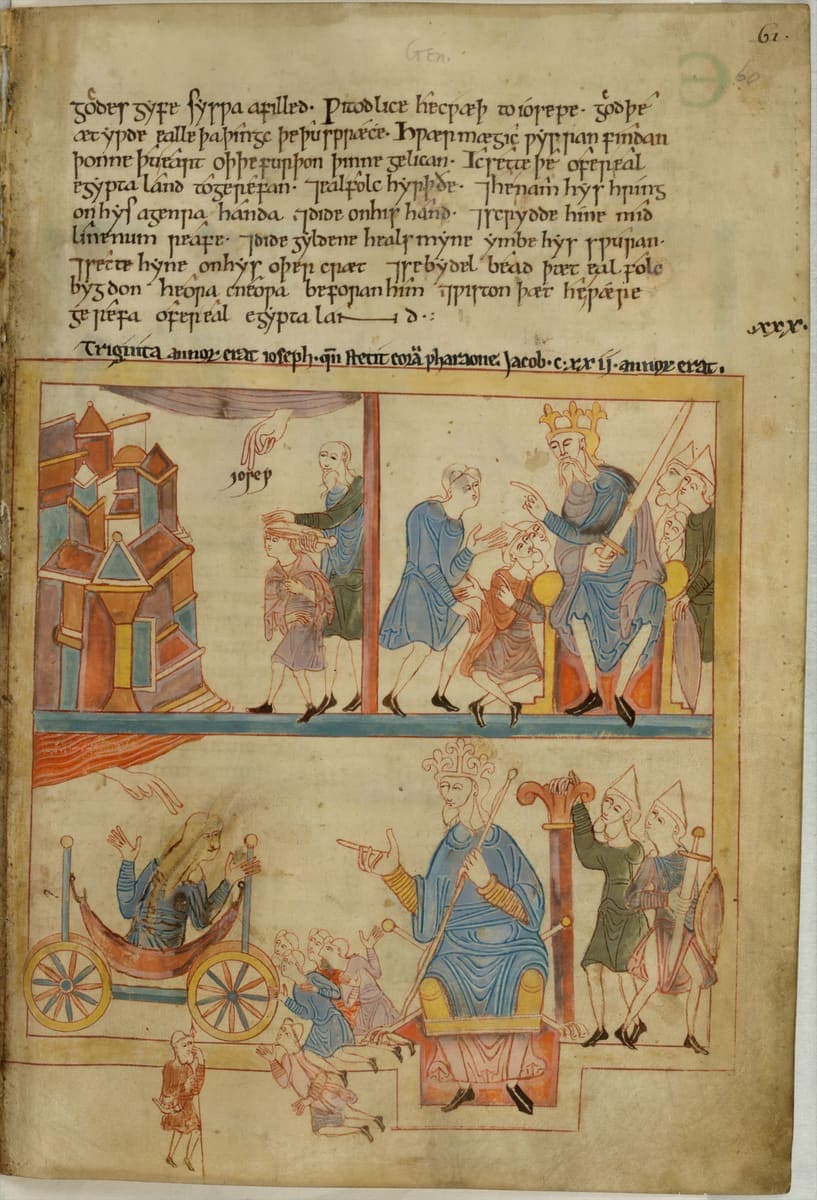
British Library, Cotton MS Claudius B IV, f. 60r, c. 1025–1050 · Source · Public domain
Evidano Transcription
The Old English block above the miniature: Genesis 41:38–43 in Ælfric’s translation, from S. J. Crawford’s edition, for which Claudius B.iv is the base manuscript. The folio opens mid-sentence at “Godes gyfe”; verse numbers are the editor’s, and þ, ð, æ and ⁊ have been restored from the Internet Archive OCR against the page. The Latin rubric squeezed in above the picture is a later addition and is not part of the edited text.
38. … Godes gyfe sy swa afilled?
39. Witodlice he cwæþ to Iosepe: God þe ætywde ealle þa þinge, þe þu spræce; hwær mæg ic wysran findan þonne þu eart, oþþe furþon þinne gelican?
41. Ic sette þe ofer eal Egypta land to gerefan ⁊ eal folc hyrþ ðe.
42. ⁊ he nam hys hring on hys agenra handa ⁊ dide on his hand, ⁊ scrydde hine mid linenum reafe ⁊ dide gyldene healsmyne ymbe hys swuran,
43. ⁊ sette hyne on hys oþer cræt ⁊ se bydel bead þæt eal folc bygdon heora cneowa beforan him ⁊ wiston þæt he wære gerefa ofer eal Egypta land.
Source: The Old English Version of the Heptateuch, ed. S. J. Crawford, EETS o.s. 160 (London, 1922), Genesis XLI, via Internet Archive (Public domain).
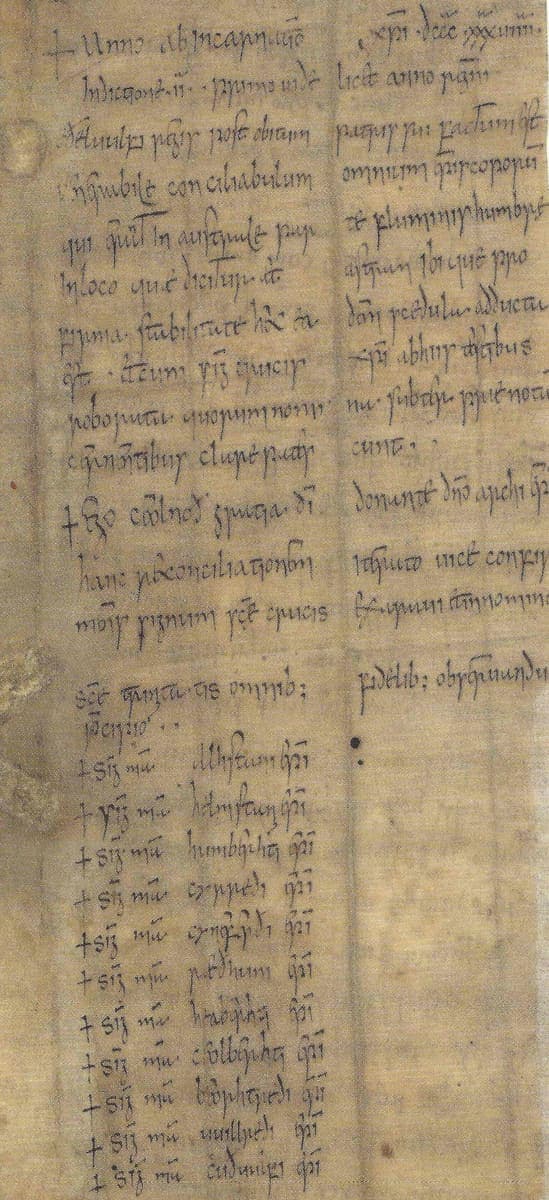
British Library, Cotton MS Augustus II 20, 838 · Source · Public domain
Evidano Transcription
BIBL. COTTON. AUG. II. 20.
- Ego [illegible] gratia di [illegible] hanc [illegible]
[illegible] Cum signo sce cru[cis] [illegible] - Ego [illegible] pr. ab. conf ⁊ sub.
Ego [illegible] pr. ab. conf ⁊ sub. - Ego [illegible] pr. conf ⁊ sub
- Ego [illegible] pr. conf ⁊ sub
- [illegible] pr. conf ⁊ sub
[illegible] conf ⁊ sub - Ego beornnod [?] pr. conf ⁊ sub
- Ego osmund pr. conf ⁊ sub
- Ego heahberht diac. conf ⁊ sub
- Ego badanoð diac. conf ⁊ sub
- Ego uuealhhere diac. conf ⁊ sub
- Ego nodulf [?] diac. conf ⁊ sub
- Ego ceolulf diac. conf ⁊ sub
pro ampliore tali q[ue] confirmatione testium
adducta est haec scedula coram æthelwulfo rege
et optimatibus suis in villa regali qui appellatur
uuiltun his testibus consentientibus et subscribentibus
quorum nomina subtus caraxata s[unt].
- Ego ædeluulf rex conf et sub.
- Ego alhstan epīsc conf ⁊ sub
- Ego eadhun epīsc conf ⁊ sub
- sīgnū mā uulfhardi prb̄
- sīg mā ædeluulfi prb̄
- sīg mā biornulfi [?] prb̄
- sīg mā ealdberhti diac̄
- sīg mā æthelheardi mīnr̄ [?]
- sīg mā [illegible]berhti mīnr̄ [?]
- sīg mā alhstani mīnr̄ [?]
- sīg mā osmundi mīnr̄ [?]
- sīg mā hudan mīnr̄ [?]
- sīg mā osrici ministri [?]
- sīg mā ceol[illegible]di mīnr̄ [?]
- sīg mā uulf[illegible] mīnr̄ [?]
filius
Ecgbt [?] ⁊ aðulf rex ceolnodo arcepo ad op[us] ecclie
xpi p[er] abaldredo rege data ⁊ p[ost]ea ablata
reddidert melliges [?] sit cū cōditiōe [?] firme pacis
int[er] illos ⁊ ipsū ⁊ successores eor[um].
[illegible]
- Anno ab incarnatione xpi dccc xxx viii.
Indictione .i. . primo uidelicet anno [illegible]
Ætheluulfi regis post obitum patris sui [illegible]
venerabile conciliabulum omnium episcoporum
qui sunt in [illegible] ⁊ [illegible]
in loco qui dicitur æt [illegible] ibi que pro
[illegible] stabilitate [illegible] pesula [?] adducta
[illegible] abhinc testibus
roborata quorum nomina [illegible] subtus prenotata
[illegible] clupeis [?] [illegible] sunt. - Ego ceolnoð gratia di donante dno archiepiscopus
hanc reconciliationem [illegible] testimonio mei confirm[avi]
[illegible] signum sce crucis [illegible]
[illegible] omnib[us] [illegible] fidelib[us] observandum
[illegible] - sīg mā alhstani epī
- sīg mā helmstani epī
- sīg mā humberhti epī
- sīg mā cynredi epī
- sīg mā cynferði epī
- sīg mā [illegible] epī
- sīg mā [illegible] epī
- sīg mā ceolberhti epī
- sīg mā [illegible] epī
- sīg mā [illegible] epī
- sīg mā [illegible] epī
Generated by Evidano’s advanced model; not yet checked against a published edition.
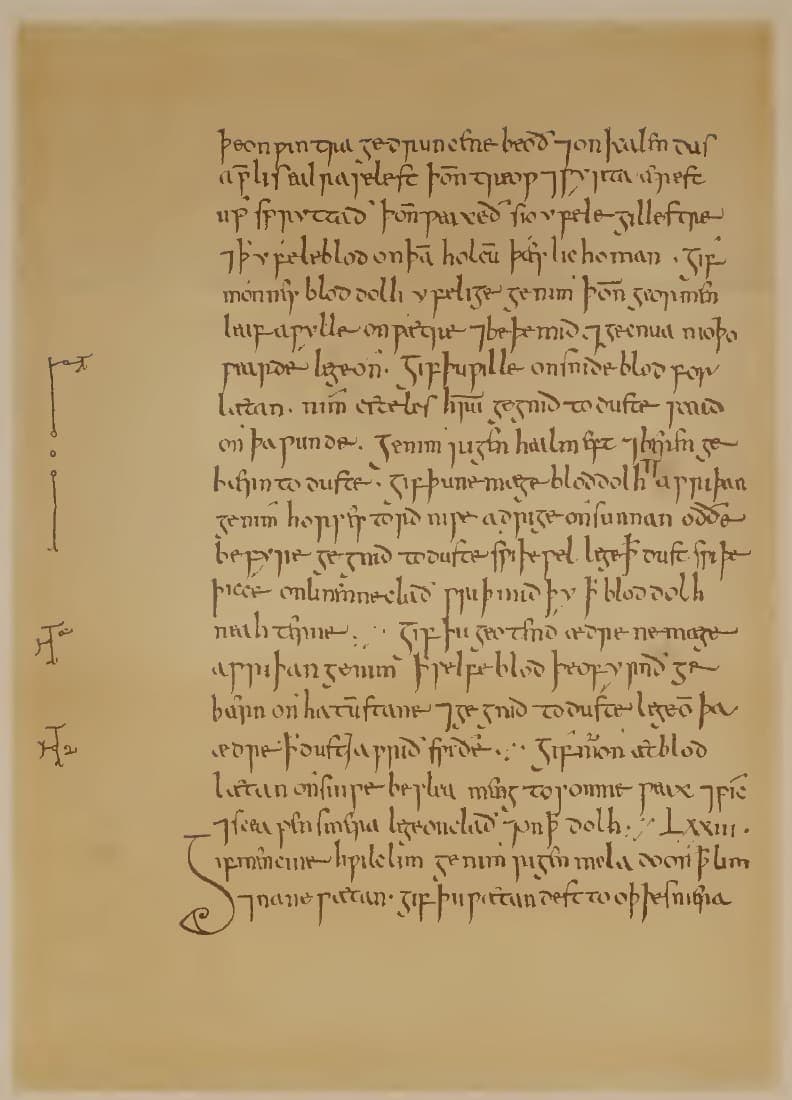
British Library, Royal MS 12 D XVII (facsimile), c. 950 (facsimile 1865) · Source · Public domain
Evidano Transcription
þeon[?] [illegible] ᵹedruncne beoð ⁊ on [illegible] duſ
aſliſað þa ᵹeleſe þon[ne] [illegible] aþeſe[?]
up ſprytað þon[ne] ƿaxeð ſio yfele ᵹilleſtre
⁊ þ[æt] yfele blod on þa[m] holu[m] þæſ lichoman . ᵹif
monniſ[?] blod dolh yfeliᵹe ᵹenim þon[ne] ᵹeƿynden[?]
leaf aƿylle on ƿætre ⁊ beþe mid ⁊ ᵹecnua nioþo
ƿearde leᵹe on . ᵹif þu ƿille on ſnide blod for
lætan . nim ealdeſ [illegible] ᵹeᵹnid to duſte [illegible]
on þa ƿunde . ᵹenim ryᵹen[?] halm [illegible] ⁊ [illegible] ᵹe
bærn to duſte . ᵹif þu ne mæᵹe blod dolh aƿriþan
ᵹenim [illegible] niƿe adriᵹe on ſunnan oððe
be fyre ᵹeᵹnid to duſte ſife[?] ƿel . leᵹe þ[æt] duſt ſƿiþe
þicce on linnene clað ƿriþ mid þy þ[æt] blod dolh
[illegible] . ᵹif þu ᵹeotend[?] ædre ne mæᵹe
aƿriþan ᵹenim þ[æt] ylce blod þe of yrnð ᵹe
bærn on hatu[m] ſtane ⁊ ᵹeᵹnid to duſte leᵹe on þa
ædre þ[æt] duſt [illegible] aƿriþ ſƿiþe[?] . ᵹif mon æt blod
lætan on [illegible] mænᵹ to ſomne ƿeax ⁊ pic
⁊ ſceap ſmeru ſmyra leᵹe on clað ⁊ on þ[æt] dolh . Lxxiii .
[illegible] ᵹenim [illegible] þ[æt] lim
⁊ nane ƿætan . ᵹif þu ƿætan [illegible]
Generated by Evidano’s advanced model; not yet checked against a published edition.
What an Old English page looks like
Between the eighth century and the Norman Conquest, English was written in scripts developed in Ireland and Northumbria rather than the Roman-derived Caroline hand used on the Continent. The grand gospel books of around 700, such as the Lindisfarne Gospels, use Insular majuscule: broad, rounded letters with wedge-shaped serifs. Most Old English prose and poetry survives in the later Insular minuscule and its tenth-century refinement, Anglo-Saxon square minuscule, which is the hand of the Exeter Book, the Beowulf manuscript and the Old English Hexateuch. From the mid-tenth century scribes learned Caroline minuscule for Latin but kept the Insular forms for the vernacular, so a bilingual page can switch alphabets mid-line.
The letters that trip up modern readers are the ones borrowed from runes or shaped differently: wynn (ƿ) for w, which looks like a p with a shorter bowl; thorn (þ) and eth (ð), used interchangeably for th; ash (æ); the flat-topped Insular g (ᵹ) that resembles a modern z or y; the long s (ſ) that resembles f; and an r whose descender drops below the line like a p. The Tironian sign (⁊) stands for ond, and a barred þ (þ̄) for þæt. Scribes hung a stroke over vowels to drop a following m or n, wrote -um as a hooked u, and separated words by syllable and stress rather than by our dictionary boundaries, so a compound may be split and a preposition glued to its noun.
Layout carries meaning too. Poetry is copied continuously across the line like prose, with a raised point or a capital marking a half-line or a new fitt. Rubrics and chapter numbers may be in Latin, in red, or added by a later hand. Many of the most important manuscripts are damaged: the edges of the Beowulf folios crumbled after the Cotton Library fire of 1731, and pages were later mounted in paper frames whose margins can be mistaken for text.
Why ordinary OCR struggles here
Three letters that look like p
Wynn, thorn and p share a bowl and a descender and differ only in the height and openness of the loop. Ordinary OCR, trained on printed Latin type, collapses them into p, turning ƿæs into pæs and þæt into pæt. A model that knows the script keeps the distinction and can output either the original glyph or its modern equivalent.
Abbreviations and suspension strokes
A single horizontal bar can mean a missing m, a missing n or the whole word þæt. The Tironian ⁊ looks like a 7 and is often read as one. Expanding these correctly means reading the word as a whole, not just the shapes, and keeping a record of what was expanded.
Verse hidden in prose lines
The metrical lines of Beowulf or Juliana never sit on their own ruled line. Recovering the verse structure means noticing pointing and capitals, or accepting a line-per-manuscript-line transcription and lineating later. Generic OCR does neither and silently merges half-lines.
Fire, glue and later hands
Charred edges, offset ink from the facing page, sixteenth-century annotations by Laurence Nowell or John Joscelyn, and modern pencil foliation all sit on the same page. The transcription has to keep the main text separate from everything added later.
Who works with this material
Editors and Anglo-Saxonists
Anyone preparing a diplomatic transcription of a homily, a poem or a glossary needs a first pass that respects the manuscript’s letterforms and word division rather than silently normalising them. The output can be compared line by line with the folio and with earlier editions.
Charter and place-name historians
Boundary clauses in Old English hide inside Latin diplomas. A transcription that keeps the Insular letters and marks the switch between languages makes the bounds searchable and the personal names comparable across the Sawyer corpus.
Dictionary, corpus and glossing projects
Lexicographers and corpus linguists need consistent handling of abbreviations and of variant spellings. Setting the expansion rule once in the prompt gives the same treatment across hundreds of pages, with uncertain readings flagged for review.
Teachers of palaeography
A transcription beside the image is a teaching tool: students can cover one side, attempt the other, and see immediately where an r was read as n or a ƿ as p.
Getting the best transcription
Say how you want the special letters handled
Decide whether wynn should stay as ƿ or become w, whether þ and ð should be kept as written, and whether the Tironian sign should be printed as ⁊ or expanded to ond. Put the rule in the prompt and it will be applied on every page.
Choose an expansion policy
Ask for abbreviations to be expanded silently, expanded with the supplied letters in brackets, or left unexpanded. For an edition you will usually want the bracketed form so the apparatus can be built from the transcription itself.
Test on the hardest page first
Before running a whole manuscript, sample a damaged or heavily corrected folio. If the model marks the illegible stretches and separates later annotations from the main text there, it will handle the clean pages easily.
Keep the manuscript lineation, then lineate the verse
Transcribe line for line so that every reading can be located on the page. Verse can be relineated afterwards with the pointing and capitals as a guide, which is far easier than reversing a transcription that has already been rearranged.
Further reading on this hand
The palaeography guides the in-app selector points to for this domain, if you want to check a transcription against the standard references.
- Latin Paleography
This Hill Museum & Manuscript Library (HMML) course surveys the principal scripts used for Latin manuscripts from antiquity through the Renaissance. Its medieval modules include Insular majuscule and minuscule, with dated examples and exercises based on manuscript images. The course demonstrates changing letterforms, ligatures, abbreviations, punctuation, and distinctions between book and documentary hands. Its Insular material provides a strong comparative basis for identifying the scripts and graphical conventions found in Old English codices.
Frequently asked questions
- Does the transcription keep wynn, thorn, eth and Insular g?
- Yes, if you ask for them. The default is a diplomatic transcription that reproduces ƿ, þ, ð, æ and ᵹ as they stand on the page. If you would rather have w and modern g for searching, say so in the prompt and the letters are converted consistently.
- How are the Tironian ⁊ and the barred þ for þæt treated?
- They are recognised as abbreviations rather than as a 7 or a p. You choose whether they are printed as the sign itself, expanded silently to ond and þæt, or expanded with the added letters in brackets so a reader can see what the scribe actually wrote.
- Can it transcribe Old English poetry as verse lines?
- It transcribes the manuscript line by line, which is what an editor needs to check readings. Because the scribes wrote verse continuously, relineation into metrical lines is a separate step; the transcription keeps the points and capitals that guide it.
- What happens with burnt or faded edges, as in the Beowulf manuscript?
- Letters that cannot be read are marked rather than guessed, and partial letters are given with a note where the reading is uncertain. Text supplied from an earlier transcript, such as the Thorkelin copies, can then be added by the editor.
- Will Latin rubrics and Old English text be kept apart?
- Yes. Where a page mixes languages the transcription follows the reading order and can label each stretch, and later additions such as sixteenth-century annotations or modern foliation are separated from the medieval text.
Related scripts and pages
Transcribe your Old English folios
Upload a scan, choose Old English Insular Manuscripts as the domain, and test the prompt on one page before running the rest.