
Latin · c. 650–1100
Tell three regional Latin hands apart, then transcribe them
After Rome, Latin split into distinct regional scripts that look nothing alike: rounded Insular writing in Ireland and Britain, angular Visigothic in Spain, and the boxy, overlapping Beneventan of southern Italy. Evidano identifies which regional system a page belongs to before reading a single letter, because the same shape can mean something different in each.
Sample pages
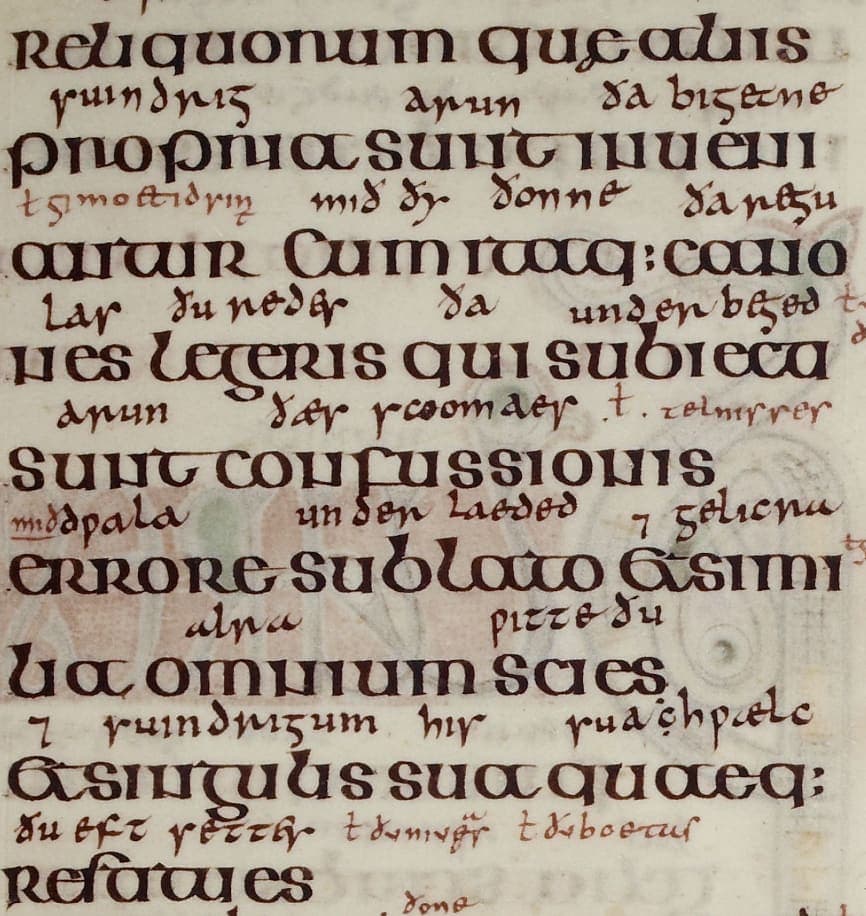
British Library, Cotton MS Nero D.iv, c. 700 (gloss added 10th century) · Source · Public domain
Evidano Transcription
The Latin of the nine lines shown, which begins and ends in mid-sentence; Aldred’s interlinear Old English is not transcribed. The wording follows Tischendorf’s 1854 edition of the same preface in the Codex Amiatinus, so the Lindisfarne page’s own spellings – quę with a hooked e, confussionis with two s, subiecta for subiecti – are not reproduced here.
… et ceteris reliquorum quae aliis propria sunt inveniantur. Cum itaque canones legeris qui subiecti sunt, confusionis errore sublato et similia omnium scies et singulis sua quaeque restitues.
Source: Jerome, Epistula ad Damasum, in Codex Amiatinus: Novum Testamentum Latine, ed. Constantin von Tischendorf (Leipzig, 1854), via Latin Wikisource (Public domain).
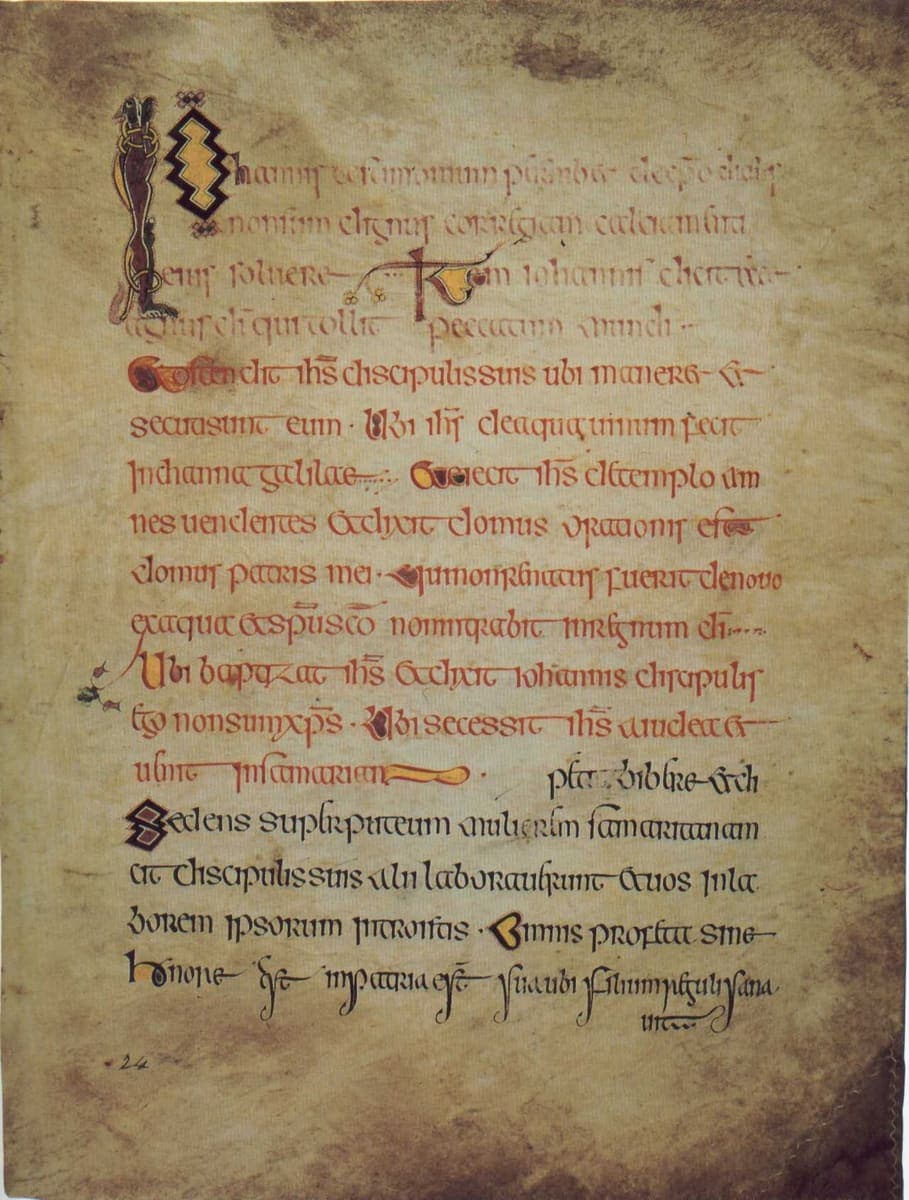
Trinity College Dublin, MS 58, f. 24r, c. 800 · Source · Public domain
Evidano Transcription
Iohannis testimoniu[m] p[er]hibens de xp[ist]o dicit
nonsum dignus corrigiam calceamenti[?]
eius soluere . Item iohannis dicit ec-
ce agnus d[e]i qui tollit peccatum mundi .
Ostendit ih[esu]s discipulis suis ubi maneret . &
secutisu[n]t eum . Ubi ih[esu]s de aqua uinum fecit
In channa galilae . Eiecit ih[esu]s de templo om
nes uendentes & dixit domus orationis est
domus patris mei . Qui non renatus fuerit denouo
ex aqua & sp[irit]u s[an]c[t]o non intrabit in regnum d[e]i .
Ubi baptizat ih[esu]s & dixit iohannis discipulis
ego nonsum xp[istu]s . Ubi secessit ih[esu]s a iudea &
uenit in samariam . p[e]t[it][?] sibi bibere & ch
Sedens super puteum mulierem samaritanam
ait discipulis suis alii laborauerunt & uos in la
borem ipsorum introistis . Omnis profeta sine
honore est in patria est sua ubi filium reguli sana
uit .
Generated by Evidano’s advanced model; not yet checked against a published edition.
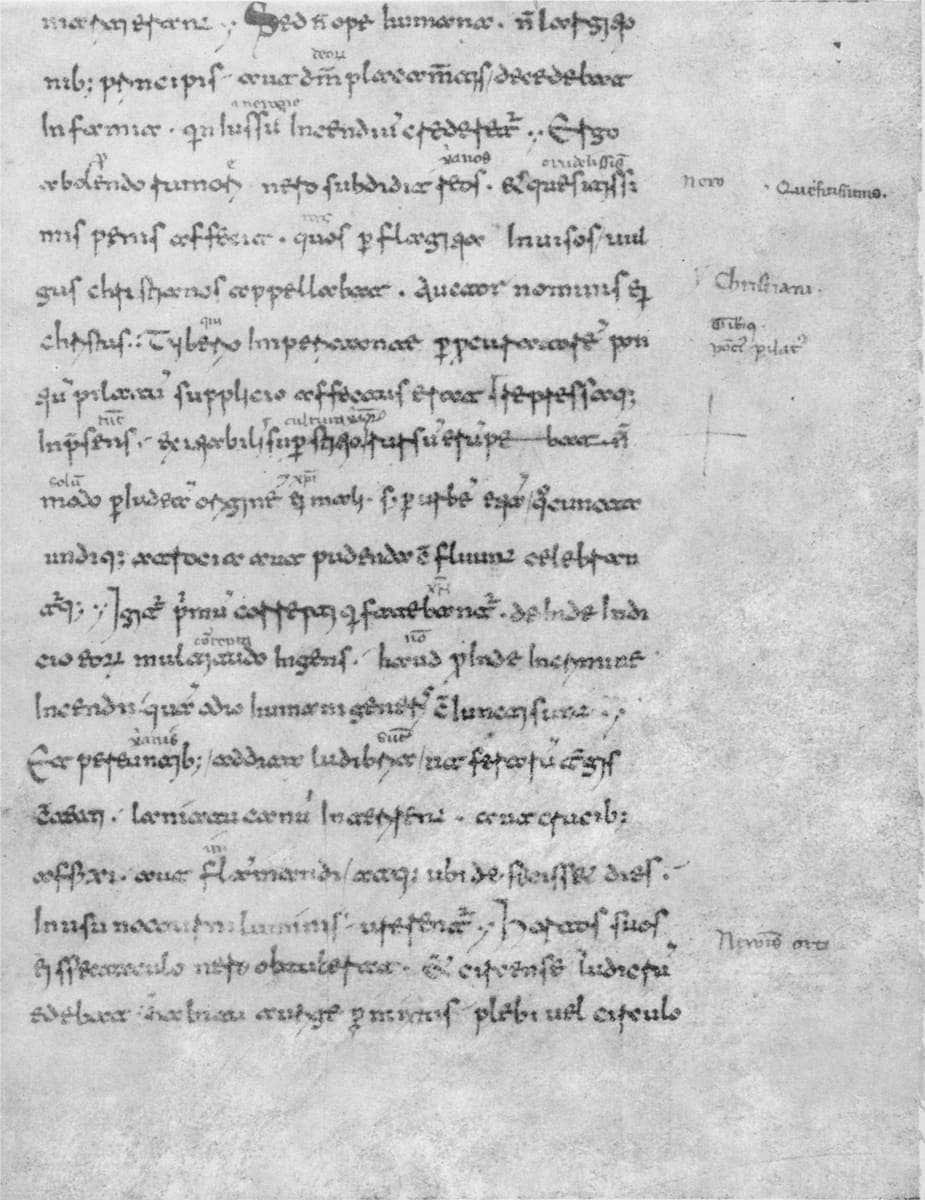
Biblioteca Medicea Laurenziana, Florence, Plut. 68.2, fol. 38r, 11th century (phototype facsimile published 1902) · Source · Public domain
Evidano Transcription
Annals 15.44.2–5, the passage shown on this part of the page, from “Sed non ope humana” to “vel curriculo insistens”. The edition keeps the form “Chrestianos”, which the page shows altered by a corrector, prints lower-case sentence openings, and marks editorial supplements with square brackets; two evident typing slips in the source text (“Tibero”, “exitiablilis”) are given here as Tiberio and exitiabilis, which the page confirms.
Sed non ope humana, non largitionibus principis aut deum placamentis decedebat infamia, quin iussum incendium crederetur. ergo abolendo rumori Nero subdidit reos et quaesitissimis poenis adfecit, quos per flagitia invisos vulgus Chrestianos appellabat. auctor nominis eius Christus Tiberio imperitante per procuratorem Pontium Pilatum supplicio adfectus erat; repressaque in praesens exitiabilis superstitio rursum erumpebat, non modo per Iudaeam, originem eius mali, sed per urbem etiam, quo cuncta undique atrocia aut pudenda confluunt celebranturque. igitur primum correpti qui fatebantur, deinde indicio eorum multitudo ingens haud proinde in crimine incendii quam odio humani generis convicti sunt. et pereuntibus addita ludibria, ut ferarum tergis contecti laniatu canum interirent aut crucibus adfixi [aut flammandi atque], ubi defecisset dies, in usu[m] nocturni luminis urerentur. hortos suos ei spectaculo Nero obtulerat, et circense ludicrum edebat, habitu aurigae permixtus plebi vel curriculo insistens.
Source: Tacitus, Ab excessu divi Augusti (Annales), Liber XV, via Latin Wikisource (Public domain).
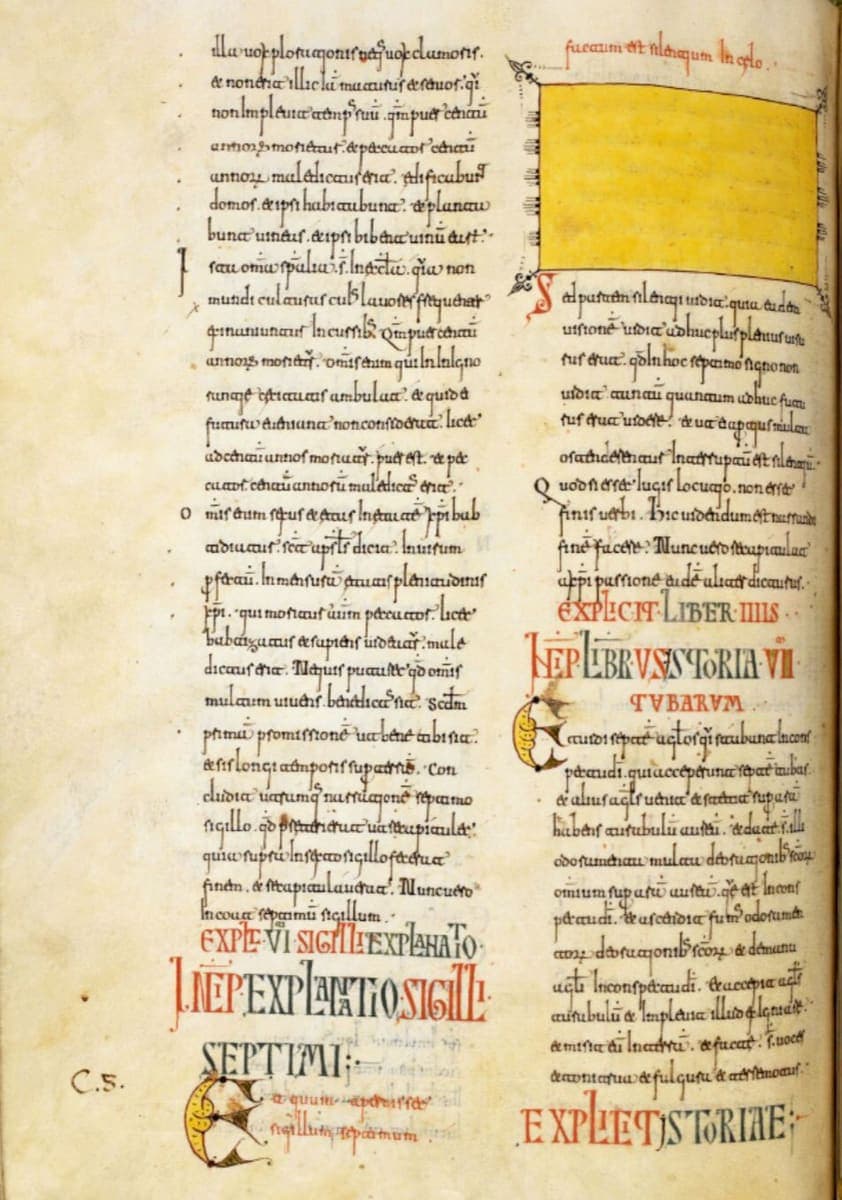
British Library, 1091–1109 · Source · Public domain
Evidano Transcription
illa uox ploracionis neq[ue] uox clamoris.
& non erit illic [illegible] & senex[?]. q[u]i
non impleat te[m]p[us] suu[m]. q[u]ia puer centu[m]
annor[um] morietur. & peccator centu[m]
annor[um] maledictus erit. & edificabu[n]t
domos. & ipsi habitabunt. & planta
bunt uineas. & ipsi bibent uinu[m] earu[m].
[illegible] om[n]is sp[irit]ualis. s[cilicet] in eccl[esi]a. q[u]ia non
mundi culturis [illegible]
q[u]e inueniunt[ur] in [illegible]. Q[u]ia puer centu[m]
annor[um] moriet[ur]. om[n]is eni[m] qui in ligno
[illegible] cruciatus ambulat. & quide[m]
futuru[m] [illegible] non considerat. licet
ad centu[m] annos moriat[ur]. puer est. & pec
cator centu[m] annoru[m] maledictus erit.
Om[n]is eni[m] sexus & etas in eccl[esi]a x[prist]i bab
[illegible]. s[e]c[un]d[u]m ap[osto]l[i] dicta[?]. in uiru[m]
p[er]fectu[m]. in mensura[m] etatis plenitudinis
x[prist]i. qui moriat[ur] aut[em] peccator. licet
babtizatus & sapiens uideat[ur]. male
dictus erit. Ne quis putauerit[?] q[u]od om[n]is
multum uiuens. b[e]n[e]dictus sit. s[e]c[un]d[u]m
prima[m] promissione[m] ut b[e]n[e] tibi sit.
& sis longi te[m]poris sup[er] terra[m]. Con
cludit utru[m]q[ue] narratione[m] septimo
sigillo. q[u]od [illegible] ut recapitulet.
quia sup[er]ius in sexto sigillo fecerat
fine[m]. & recapitula[illegible]. Nunc uero
incohat septimu[m] sigillum.
EXPL VI SIGILLI EXPLANATIO
INC EXPLANATIO SIGILLI SEPTIMI :
Et cum aperuisset
sigillum septimum
factum est silentium in celo .
Sed partem silentii uidit. quia [illegible]
uisione[m] uidit. adhuc plus plenius uisu
rus erat. q[uo]d in hoc septimo signo non
uidit. tantu[m] quantum adhuc futu
rus erat uidere. [illegible]
[illegible] rupta est silenti[um].
Quod si esset lucis locutio. non esset
finis uerbi. Hic [illegible]
fine[m] facere. Nunc uero recapitulat
a[d] [illegible] dicturus.
EXPLICIT LIBER IIII
INC LIBER V STORIA VII
TUBARUM
Et uidi septe[m] angelos qui stabunt[?] in cons
pectu dei. qui acceperunt septe[m] tubas.
& alius angelus uenit & stetit sup[er] ara[m]
habens turibulu[m] aureu[m]. & data [illegible] illi
odoramenta multa de orationib[us] s[an]c[t]oru[m]
omnium sup[er] ara[m] aurea[m] q[ua]e e[st] in cons
pectu dei. & ascendit fum[us] odoramen
toru[m] de orationib[us] s[an]c[t]oru[m] & de manu
angeli in conspectu dei. & accepit ang[elu]s
turibulu[m] & impleuit illud de igne alt[ari]s.
& misit eu[m] in terra[m]. & facta s[un]t uoces
& tonitrua & fulgura & terremotus[?].
EXPLICIT ISTORIAE ;
Generated by Evidano’s advanced model; not yet checked against a published edition.
Three scripts, one language
Insular script developed in Irish monasteries from the seventh century and spread to Northumbria, producing grand majuscule gospel books like the Book of Kells and a more compact Insular minuscule and half-uncial for everyday copying, seen in the Lindisfarne Gospels. Distinctive features include a flat-topped g, a tall or looped s, wedge-shaped serifs, and the Tironian sign (⁊) for “and”. Visigothic script emerged in Spain around the same time and, remarkably, survived at conservative houses like the monastery of Silos into the twelfth century, long after most of the peninsula had adopted Caroline minuscule; it favours an open a and its own distinctive ligatures, and is the script of Beatus of Liébana’s widely copied Commentary on the Apocalypse. Beneventan script, centred on Monte Cassino and the cities of Benevento and Bari, was in use from the eighth century into the thirteenth for the Rule of St Benedict itself and the wider output of southern Italian monasteries.
Beneventan is the most visually distinctive of the three: its letters are compressed, angular and boxy, with tall serifs that end in a small hook, and certain letter pairs deliberately overlap, or “bite”, into a single compound shape rather than standing apart. Visigothic hands are more rounded than Beneventan but sharper than Insular, with a characteristic treatment of the combination ti that distinguishes a hard from a soft sound, something no other Latin script bothers to mark. Insular hands range from the large, decorated majuscule of a display gospel book to a small, current minuscule used for glosses and working copies, but keep their rounded bowls and distinctive g in either register.
All three traditions share features that set them apart from the Caroline minuscule that eventually replaced most of them: heavier and more idiosyncratic abbreviation, regional preferences for shortening common words like qui and que, and punctuation systems that do not map cleanly onto later conventions. Because Insular gospel books remained in active use for centuries, many later gained interlinear glosses in the vernacular – Old English at Lindisfarne – written by a different, much later hand between the original Latin lines.
Why ordinary OCR struggles here
Same letter, three different shapes
g, r, t and common ligatures are built differently in each tradition. A model trained on one regional system misreads the other two, because the shapes are not variations on a theme but genuinely separate solutions to the same letter.
Regional abbreviation marks and forms of qui and que
Each tradition has its own preferred shorthand for extremely common words like qui and que, plus its own use of the Tironian ⁊. Recognising the mark requires already knowing which regional system is on the page.
Overlapping “biting” letters, especially in Beneventan
Certain letter pairs share a single stroke rather than standing apart, a deliberate feature of the script rather than damage or a ligature in the ordinary sense. Segmenting these into separate letters needs a model that has actually seen Beneventan.
Later glosses layered onto an older text
Insular gospel books often gained an interlinear vernacular gloss centuries after they were written, in a visibly different and later hand. Separating the original Latin from the addition needs explicit handling, not a single reading pass.
Who works with this material
Editors of Insular gospel books and glossed texts
Anyone preparing an edition of an Insular manuscript needs the Latin and any later interlinear vernacular gloss kept apart, letter for letter, rather than merged into a single reading.
Hispanists working on early medieval Spain
Visigothic-script cartularies and biblical commentaries from houses like Silos and León need a transcription that recognises the script has nothing to do with the Caroline hands used everywhere else in western Europe by that date.
Historians of Monte Cassino and southern Italian monasticism
Beneventan charters and liturgical books need a tool that has actually been shown the script’s overlapping letters, rather than a generic “medieval Latin” model that treats them as damage.
Palaeography students learning to date manuscripts by script
Checking a claimed regional attribution against an actual line-by-line transcription is a direct test of the skill a palaeography course is trying to teach.
Getting the best transcription
Name the regional script before you upload
Say whether the manuscript is Insular, Visigothic or Beneventan. A general “medieval Latin” prompt defaults to assumptions built for Caroline minuscule that fit none of the three.
Choose how to treat the Tironian sign and regional forms of qui and que
Decide whether these should be kept as written or expanded, and apply that choice consistently across the manuscript rather than deciding page by page.
Separate any later gloss from the main text
Where a page carries an interlinear or marginal addition in a different language or a visibly later hand, ask for it to be transcribed as its own layer rather than merged into the main reading order.
Test on a page with a rubric or colophon first
Red-ink section headings and closing notes often name the scribe, house or date, and reading one correctly is a fast check that the model has recognised the right script before you run a whole manuscript.
Further reading on this hand
The palaeography guides the in-app selector points to for this domain, if you want to check a transcription against the standard references.
- Latin Paleography
This Hill Museum & Manuscript Library (HMML) course presents the principal regional scripts that developed after the Roman period. Separate modules introduce Insular, Visigothic, and Beneventan writing through manuscript specimens and guided transcription exercises. The material highlights diagnostic letterforms, regional ligatures, abbreviations, punctuation, and relationships between script and place of production. It is useful for avoiding false equivalence among three visually distinctive early medieval Latin traditions.
Frequently asked questions
- How does it know which of the three scripts it is looking at?
- From the letterforms themselves, and from anything you tell it about the manuscript’s known origin. Insular, Visigothic and Beneventan use unrelated shapes for the same letters, so getting this right first matters more than it does for closely related hands.
- Can it separate a Latin gospel text from a later vernacular gloss?
- Yes, if you ask for it. An interlinear or marginal addition in another language, or in a visibly later hand, can be transcribed as a layer of its own rather than folded into the main text.
- Does it recognise the Tironian sign and regional forms of qui and que?
- Yes, and you can choose whether they are kept as written or expanded, with the same choice applied consistently across the whole manuscript.
- How does it handle Beneventan’s overlapping “biting” letters?
- As a deliberate feature of the script, not as damage. Two letters sharing a single stroke in Beneventan is where an Insular or Visigothic scribe would keep them apart, and the transcription reflects that difference.
- Will it flag a manuscript that mixes more than one regional script?
- Yes, if you ask it to. Composite manuscripts, and later additions written in a different regional hand from the main text, are common, and it is worth flagging that rather than transcribing the whole thing as if it were uniform.
Related scripts and pages
Transcribe your Insular, Visigothic or Beneventan manuscript
Upload a folio, choose Insular, Visigothic, and Beneventan Latin as the domain, and name the regional script before you run the rest.