
English · c. 1060–1220
Read the books England made after the Conquest
For a century and a half English scribes wrote a Continental alphabet with four letters it did not contain, so þ, ð, ƿ and the Tironian sign sit inside words otherwise formed like Norman Latin. Beside them stands the compressed Latin of Domesday, where almost every word is cut short by a stroke or a hook. Evidano works through both, keeps the vernacular and the Latin apart, and shows you the folio next to the reading.
Sample pages
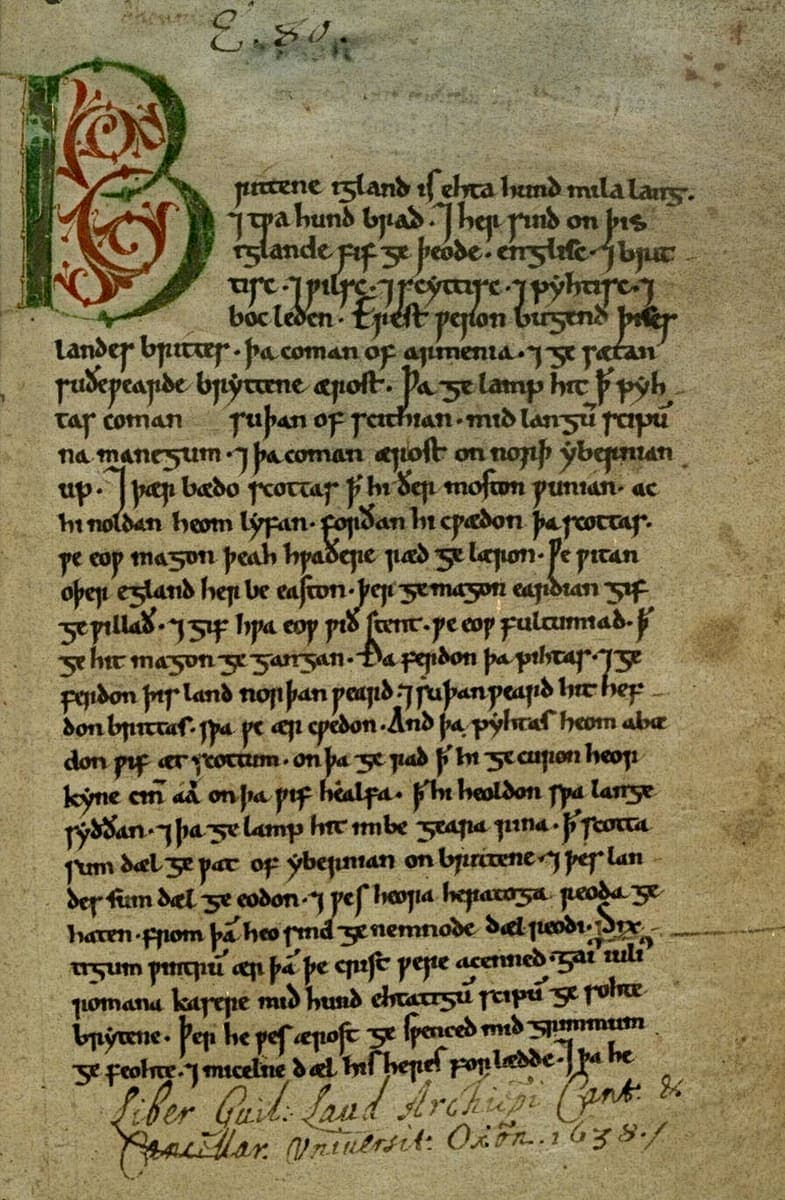
Bodleian Library, Oxford, MS Laud Misc. 636, f. 1r, c. 1121 · Source · Public domain
Evidano Transcription
The whole of f. 1r: the Chronicle’s preface on Britain and the annal for 60 BC, from the Laud (E) column of Earle and Plummer’s parallel edition, whose marginal folio mark confirms that the page ends at “⁊ þa he”. Square brackets are Plummer’s, supplying from MS D a clause the Peterborough scribe skipped by eyeskip. Thorn, eth, ash, the Tironian sign and the barred þ for þæt have been restored from the Internet Archive OCR against the folio; the edition’s prose is broken here at its own sentence stops.
Brittene igland is ehta hund mila lang. ⁊ twa hund brad. ⁊ her sind on þis iglande fif ge þeode. Englisc. ⁊ Brittisc. ⁊ Wilsc. ⁊ Scyttisc. ⁊ Pyhtisc. ⁊ Boc Leden.
Erest weron bugend þises landes Brittes. þa coman of Armenia. ⁊ ge sætan suðewearde Bryttene ærost.
Þa ge lamp hit ꝥ Pyhtas coman suþan of Scithian. mid langum scipum na manegum. ⁊ þa coman ærost on norþ Ybernian up. ⁊ þær bædo[n] Scottas ꝥ hi ðer moston wunian.
Ac hi noldan heom lyfan. forðan hi [cwædon ꝥ hi ne mihton ealle ætgædere gewunian þær, ⁊ þa] cwædon þa Scottas. we eow magon þeah hwaðere ræd ge læron.
We witan oþer egland her be easton. þer ge magon eardian gif ge willað. ⁊ gif hwa eow wið stent, we eow fultumiað ꝥ ge hit magon ge gangan.
Ða ferdon þa Pihtas. ⁊ geferdon þis land norþan weard. ⁊ suþan weard hit hefdon Brittas. swa we ær cwedon.
And þa Pyhtas heom abædon wif æt Scottum. on þa ge rad ꝥ hi gecuron heora kyne cinn aa on þa wif healfa. ꝥ hi heoldon swa lange syððan.
⁊ þa gelamp hit imbe geara rina. ꝥ Scotta sumdæl gewat of Ybernian on Brittene. ⁊ þes landes sum dæl ge eodon. ⁊ wes heora heratoga Reoda gehaten. from þam heo sind ge nemnode Dæl Reodi.
Sixtigum wintrum ær þam þe Crist were acenned. Gaius Iulius Romana Kasere mid hund ehtatigum scipum gesohte Brytene. þer he wes ærost ge swenced mid grimmum ge feohte. ⁊ micelne dæl his heres forlædde. ⁊ þa he
Source: Two of the Saxon Chronicles Parallel, ed. John Earle, rev. Charles Plummer, vol. I (Oxford: Clarendon Press, 1892), pp. 3–5, via Internet Archive (Public domain).
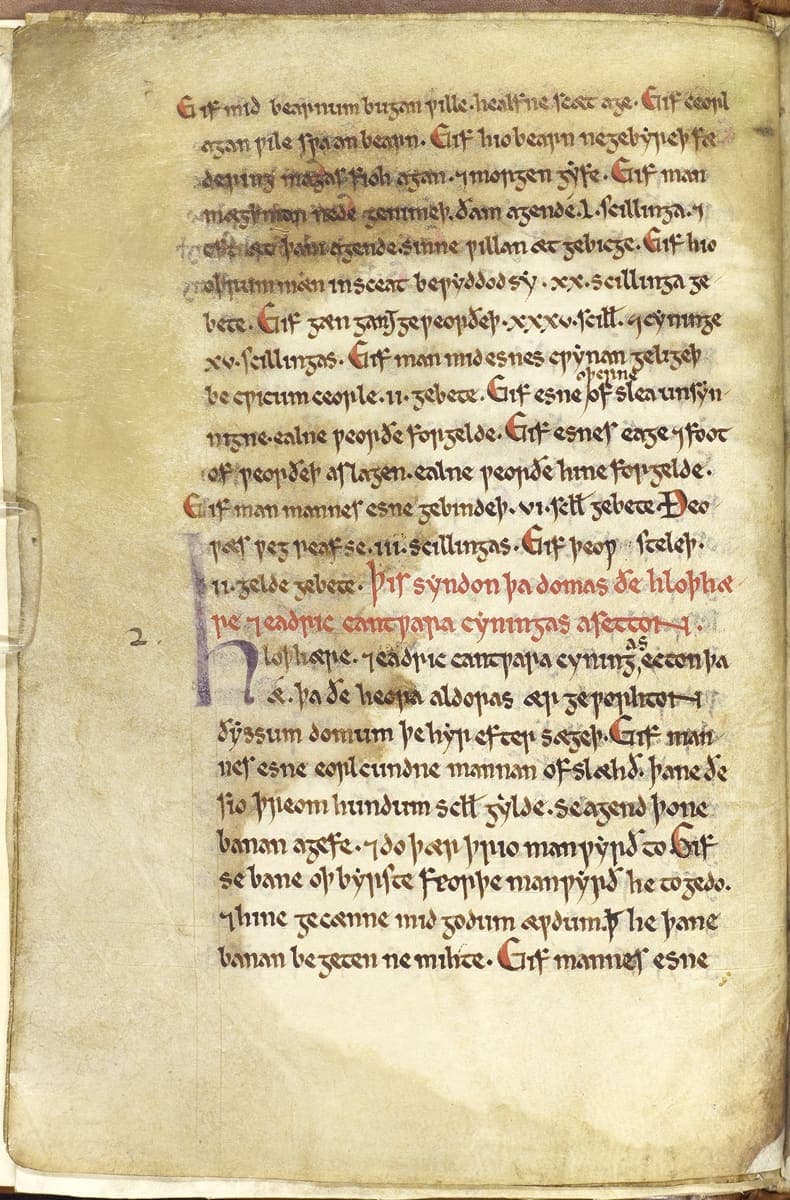
Medway Archives and Local Studies Centre, Strood, Rochester Cathedral Library MS A.3.5 (DRc/R1), f. 3v, c. 1123 · Source · Public domain
Evidano Transcription
The full folio: Æthelberht cc. 79–90, the rubric, and the prologue and first two clauses of Hlothhere and Eadric, in F. L. Attenborough’s semi-diplomatic Old English text, which prints scill’ for the shilling abbreviation and marks earlier editors’ emendations in his notes. Thorn, eth, ash and the Tironian sign are restored from the Internet Archive OCR against the folio, and roman numerals are given in lower case as the manuscript writes them. The page ends part-way into clause 3, at the words “Gif mannes esne”.
79. Gif mid bearnum bugan wille, healfne scæt age.
80. Gif ceorl agan wile, swa an bearn.
81. Gif hio bearn ne gebyreþ, fæderingmagas fioh agan ⁊ morgengyfe.
82. Gif man mægþmon nede genimeþ: ðam agende l scillinga ⁊ eft æt þam agende sinne willan ætgebicge.
83. Gif hio oþrum mæn in sceat bewyddod sy, xx scillinga gebete.
84. Gif gængang geweorðeþ, xxxv scill’ ⁊ cyninge xv scillingas.
85. Gif man mid esnes cwynan geligeþ be cwicum ceorle, ii gebete.
86. Gif esne oþerne ofslea unsynnigne, ealne weorðe forgelde.
87. Gif esnes eage ⁊ foot of weorðeþ aslagen, ealne weorþe hine forgelde.
88. Gif man mannes esne gebindeþ, vi scill’ gebete.
89. Ðeowæs wegreaf se iii scillingas.
90. Gif þeow steleþ, ii gelde gebete.
Þis syndon þa domas ðe Hloþhære ⁊ Eadric, Cantwara cyningas, asetton.
Hloþhære ⁊ Eadric, Cantwara cyningas, ecton þa æ, þa ðe heora aldoras ær geworhton, ðyssum domum þe hyr efter sægeþ.
1. Gif mannes esne eorlcundne mannan ofslæhð þane ðe sio þreom hundum scill’ gylde, se agend þone banan agefe ⁊ do þær þrio manwyrð to.
2. Gif se bana oþbyrste, feorþe manwyrð he to gedo ⁊ hine gecænne mid godum æwdum þæt he þane banan begeten ne mihte.
Source: F. L. Attenborough, The Laws of the Earliest English Kings (Cambridge University Press, 1922), pp. 14–18, via Internet Archive (Public domain).
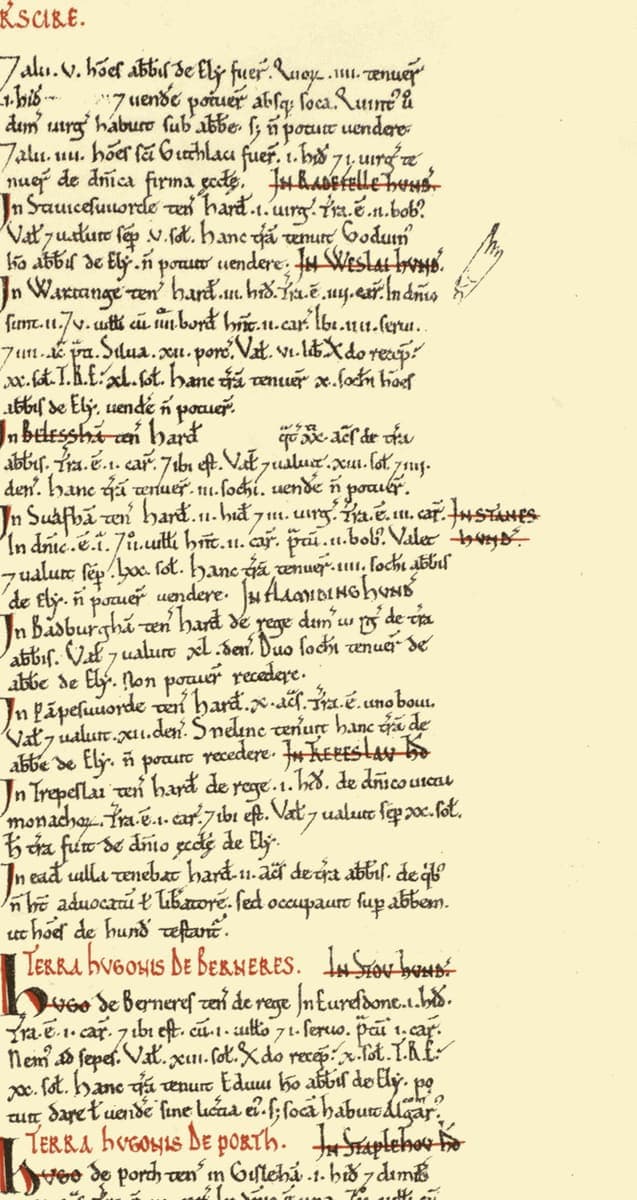
The National Archives, Kew, E 31/2 (Great Domesday), Cambridgeshire, 1086 · Source · Public domain · Facsimile image via Open Domesday (Anna Powell-Smith and J. J. N. Palmer)
Evidano Transcription
RSCIRE.
7 alii .v. ho[min]es abb[at]is de Ely fuer[unt]. Quor[um] .iiii. tenuer[unt]
.i. hid[am] 7 uende[re] potuer[unt] absq[ue] soca. Quint[us] u[ero]
dim[idiam] uirg[atam] habuit sub abb[at]e . s[ed] n[on] potuit uendere.
7 alii .iii. ho[min]es s[an]c[t]i Guthlaci fuer[unt] .i. hid[am] 7 .i. uirg[atam] te
nuer[unt] de d[omi]nica firma eccl[esi]ę. [cancelled: In Radefelle hund[ret]]
In Sauicesuuorde ten[et] hard[uinus] .i. uirg[atam]. T[er]ra .e[st] .ii. bob[us].
Val[et] 7 ualuit sep[er] .v. sol[idos]. Hanc t[er]ra[m] tenuit Goduin[us]
ho[mo] abb[at]is de Ely . n[on] potuit uendere. [cancelled: In Weslai hund[ret]]
In Wartange ten[et] hard[uinus] .iii. hid[as]. T[er]ra .e[st] .iiii. car[ucis]. In d[omi]nio
sunt .ii. 7 v. uilli cu[m] .iiii. bord[ariis] h[abe]nt .ii. car[ucas]. Ibi .iiii. serui.
7 iiii . ac[re] p[ra]ti. Silua . xii . porc[is]. Val[et] .vi. lib[ras]. Q[uan]do recep[it]
xx. sol[idos]. T.R.E. xl. sol[idos]. Hanc t[er]ra[m] tenuer[unt] .x. sochi ho[min]es
abb[at]is de Ely . uende[re] n[on] potuer[unt].
In belessha[m] ten[et] hard[uinus] q[ua]t[er] .xx. ac[ras] de t[er]ra
abb[at]is. T[er]ra .e[st] .i. car[ucae]. 7 ibi est. Val[et] 7 ualuit .xiii. sol[idos] 7 iiii.
den[arios]. Hanc t[er]ra[m] tenuer[unt] .iii. sochi . uende[re] n[on] potuer[unt].
In Suafha[m] ten[et] hard[uinus] .ii. hid[as] 7 iii. uirg[atas]. T[er]ra .e[st] .iii. car[ucis]. [margin, cancelled: In Stanes hund[ret]]
In d[omi]nio .e[st] .i. 7 ii. uilli h[abe]nt .ii. car[ucas]. p[ra]tu[m] .ii. bob[us]. Valet
7 ualuit sep[er] .lxx. sol[idos]. Hanc t[er]ra[m] tenuer[unt] .iiii. sochi abb[at]is
de Ely . n[on] potuer[unt] uendere. In Flamding hund[ret]
In Badburgha[m] ten[et] hard[uinus] de rege dim[idiam] u[ir]g[atam] de t[er]ra
abb[at]is. Val[et] 7 ualuit xl . den[arios]. Duo sochi tenuer[unt] de
abb[at]e de Ely . Non potuer[unt] recedere.
In Papesuuorde ten[et] hard[uinus] .x. ac[ras]. T[er]ra .e[st] uno boui.
Val[et] 7 ualuit .xii. den[arios]. Snelinc tenuit hanc t[er]ra[m] de
abb[at]e de Ely . n[on] potuit recedere. [cancelled: In Keeslau h[un]d[ret]]
In Trepeslai ten[et] hard[uinus] de rege .i. hid[am]. de d[omi]nico uictu
monachor[um]. T[er]ra .e[st] .i. car[ucae]. 7 ibi est. Val[et] 7 ualuit sep[er] xx. sol[idos].
H[ec] t[er]ra fuit de d[omi]nio eccl[esi]ę de Ely.
In ead[em] uilla tenebat hard[uinus] .ii. ac[ras] de t[er]ra abb[at]is . de q[ui]b[us]
n[on] h[ab]et aduocatu[m] v[e]l lib[er]atore[m]. sed occupauit sup[er] abb[at]em.
ut ho[min]es de hund[ret] testant[ur].
TERRA HVGONIS DE BERNERES. [cancelled: In Stou hund[ret]]
HVgo de Berneres ten[et] de rege In Euresdone .i. hid[am].
T[er]ra .e[st] .i. car[ucae]. 7 ibi est. cu[m] .i. uillo 7 i. seruo. p[ra]tu[m] .i. car[ucae].
Nem[us] ad sepes. Val[et] .xiii. sol[idos]. Q[uan]do recep[it] : x. sol[idos]. T.R.E.
xx. sol[idos]. Hanc t[er]ra[m] tenuit Eduui ho[mo] abb[at]is de Ely . po
tuit dare v[e]l uende[re] sine lic[en]tia ei[us]. s[ed] soca[m] habuit Algar[us].
TERRA HVGONIS DE PORTH. [cancelled: In Staplehou h[un]d[ret]]
HVgo de porth ten[et] in Gisleha[m] .i. hid[am] 7 dimid[iam].
T[er]ra .e[st] .iii. car[ucis]. In d[omi]nio .e[st] una 7 ii. uilli cu[m] [cut off]
Generated by Evidano’s advanced model; not yet checked against a published edition.
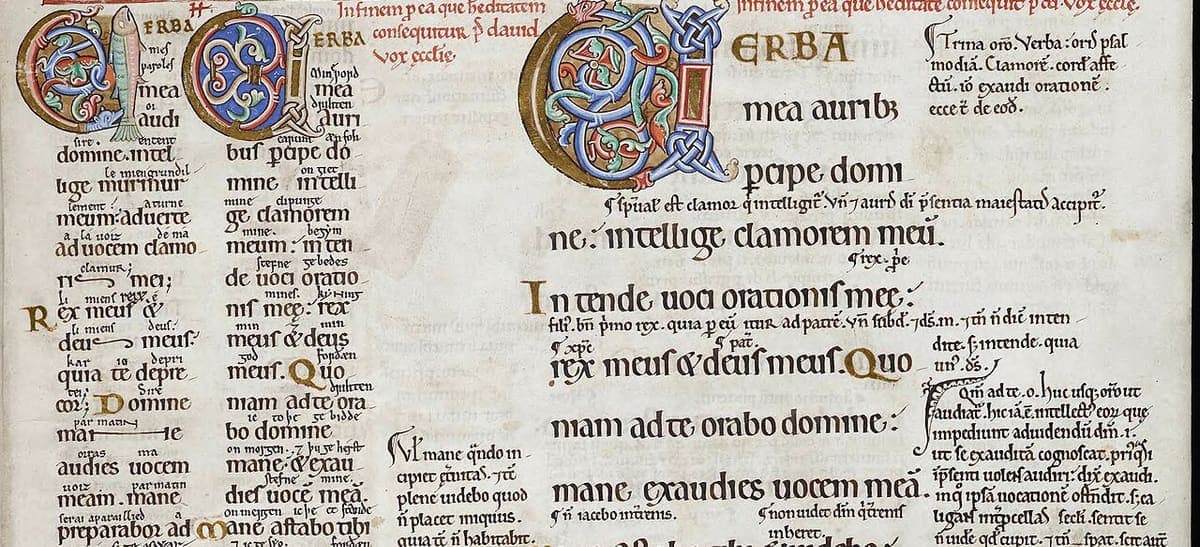
Trinity College, Cambridge, MS R.17.1, f. 10r, c. 1155–1160 · Source · Public domain
Evidano Transcription
VERBA
mea
audi
domine. intel
lige murmur
meum: aduerte
ad uocem clamo
ri[s] mei;
Rex meus &
deu[s] meus:
quia te depre
cor; Domine
ma ne
audies uocem
meam. mane
preparabor ad
[cut off]
In finem p[ro] ea que he[re]ditatem
consequitur p[salmus] dauid
vox eccl[esi]e
VERBA
mea
auri
bus p[er]cipe do
mine intelli
ge clamorem
meum: inten
de uoci oratio
nis mee: rex
meus & deus
meus. Quo
niam ad te ora
bo domine
mane. & exau
dies uoce[m] mea[m].
Mane astabo tibi
[cut off]
V[e]l mane q[ua]ndo in-
cipiet c[ar]itas. t[un]c
plene uidebo quod
n[on] placet iniquus.
quia t[?] n[on] habitabit.
In finem p[ro] ea que he[re]ditate[m] consequit[ur] p[salmus] [illegible] vox eccl[esi]e.
Trina or[ati]o. Verba: oris psal
modia. Clamore[m]: cordis affe
ctu[m]. i[de]o exaudi oratione[m].
ecce t[er] de eod[em].
VERBA
mea aurib[us]
p[er]cipe domi
Sp[irit]ual[is] est clamor q[ui] intelligit[ur]. Vn[de] 7 auris d[e]i p[re]sentia maiestatis accipit[ur].
ne: intellige clamorem meu[m].
Intende uoci orationis mee:
rex meus & deus meus. Quo
niam ad te orabo domine:
mane exaudies uocem mea[m].
[interlinear French and Old English glosses and the smaller Latin commentary not transcribed]
Generated by Evidano’s advanced model; not yet checked against a published edition.
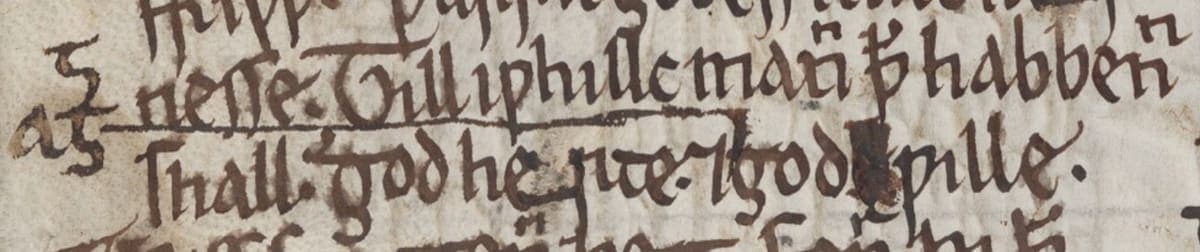
Bodleian Library, Oxford, MS Junius 1, f. 35v, c. 1170–1185 · Source · Public domain
Evidano Transcription
The two complete lines in the detail, letter for letter as given on the Wikimedia Commons file page: superscript abbreviation letters, the closed Insular g and the barred þ are reproduced with their own characters, and the half brackets mark a word Orm subpuncted and wrote over.
[...]nesse. Till iƿhille manᷠ ꝥ habbennᷠ shall? Ꟑod herte ⁊ ⸤aᵹᫌ⸥ ꟑode ƿille.
Source: Wikimedia Commons file page for Ormulum 35v1 32-33.png (Public domain).
What the hands of 1060–1220 look like
The Conquest did not stop English being written; it changed the alphabet around it. Latin had been copied in Caroline minuscule in reformed English houses since the tenth century, and after 1066 that hand spread to the vernacular as well. The Peterborough copy of the Anglo-Saxon Chronicle, written out at a stretch in about 1121 and continued to 1154, shows the result: rounded Caroline letters, a single-compartment a, an upright d beside the round Continental one, and Insular þ, ð, ƿ and ⁊ retained because the language needs them. By about 1180 the strokes are being broken and compressed towards the Gothic manner, ascenders are shortened, and adjacent bows begin to bite into one another.
Abbreviation is where these pages differ most from an Old English book. Latin brings a full contraction system: a bar for a missing m or n, a superscript hook for -us and another for -ur, crossed p for per and pro, the 9-shaped sign for con- and -us, nomina sacra such as dñs and scī, and -que written as q with a semicolon. Vernacular scribes borrow the machinery, so a barred þ stands for þæt and a barred ƿ for wiþ. Domesday takes the habit to its limit: car., hid., uill., bord., T.R.E. and a wall of roman numerals with medial points, so that an entry of thirty words fills two lines.
Layout is equally telling. Chronicles run as continuous annals with the year number written into the line or thrown into the margin, and successive continuators leave visible seams where the ink, the pen angle and the spelling all change. Domesday sets two ruled columns to a page, rubricates the tenant-in-chief headings in red, and strikes hundred names through in red as a finding aid. Glossed psalters such as the Eadwine Psalter give three Latin versions in parallel columns with a word-for-word Old English gloss written small above one and an Anglo-Norman French gloss above another, so a single ruled line carries two languages at two sizes.
Why ordinary OCR struggles here
Two alphabets in one word
A twelfth-century scribe forms most letters the Continental way but reaches for Insular þ, ð and ƿ, and for a yogh-shaped g in English words while writing a Caroline g in Latin ones. Layout analysis trained on printed roman type has no category for that mixture and quietly replaces the odd letters with p, y or b.
Latin cut to the bone
In Domesday and in charters the abbreviation is not decorative but systematic: the same stroke means a different letter over a vowel and over a consonant, and identical hooks resolve as -us, -ur or nothing at all. Getting these right needs the vocabulary of the record, not just the shapes on the parchment.
Glosses written between the lines
Interlinear vernacular glosses are half the size of the text they sit above and belong to a different language and often a different word order. A reading engine that follows the ruled lines will splice gloss and text into one nonsense sentence unless it is told to separate the layers.
Continuations, erasures and later readers
The Peterborough annals were extended by several hands over thirty years, charters were interpolated, and thirteenth-century readers such as the tremulous Worcester scribe glossed obsolete English words. Every one of those layers is on the same folio, and the transcription has to say which is which.
Who works with this material
Editors of chronicles and law codes
Anyone re-editing the Peterborough continuations, the Rochester law book or a twelfth-century cartulary needs a transcription that reproduces spelling as written, because the spellings are the evidence for when and where the copy was made.
Domesday and manorial historians
Land studies depend on the numbers: hides, ploughlands, villagers, values before and after 1066. A pass that keeps each abbreviated term with its numeral, and keeps the entry boundaries, turns a folio into rows that can be joined to a database.
Historians of the English language
The shift from Old to Middle English is documented in these very manuscripts, in inflectional endings that level to -e and in scribes who write ƿ one year and w the next. That evidence survives only in a transcription that has not been normalised.
Manuscript cataloguers and codicologists
Descriptions of books of this period record how many hands worked on a volume, where a stint ends and what later readers added. Transcribing the seams, the added rubrics and the interlinear glosses gives the description its evidence.
Getting the best transcription
Name the languages on the page
Say whether you expect English, Latin, Anglo-Norman French or all three, and ask for each stretch to be labelled. On a glossed psalter this alone stops the gloss being merged into the psalm text.
Fix the abbreviation policy before the first folio
Decide whether contracted Latin should be expanded silently, expanded in brackets or left as written, and give the model the record’s own vocabulary — carucata, hida, villanus, bordarius — so that a hooked car. is resolved rather than guessed.
Ask for interlinear and marginal text separately
Request the main text line by line, then the gloss above it, then anything in the margin, each tagged. Reassembling those layers afterwards is straightforward; untangling them from a single flat stream is not.
Test where the hand changes
Run a folio that contains a seam between scribes or a later interpolation first. If the model reports the change of hand and does not carry one scribe’s spellings into the next, the uniform folios will look after themselves.
Further reading on this hand
The palaeography guides the in-app selector points to for this domain, if you want to check a transcription against the standard references.
- The Production and Use of English Manuscripts 1060–1220: Principles of Description
This Stanford University resource documents manuscripts containing English written between 1060 and 1220 and explains the descriptive and transcription principles used by the project. It addresses word division, punctuation, lineation, accents, abbreviations, additions, and characters including wyn, thorn, eth, ash, and the Tironian sign. Its palaeographical descriptions distinguish Caroline Minuscule, English Vernacular Minuscule, and Gothic scripts while recording significant individual letterforms. It is directly useful for the transitional writing practices of late Old English and early Middle English manuscripts.
Frequently asked questions
- Do twelfth-century English books still use wynn and thorn?
- Thorn and eth stay in use throughout the period and beyond; wynn is still normal in the earlier twelfth century and gives way to w during the thirteenth. The transcription reproduces whichever the scribe wrote, so you can date and localise a hand by the choice.
- Can Domesday entries be output as structured rows?
- Yes. Ask for one record per entry with the place name, the holder, the hides, ploughlands, population categories and the values at three dates as separate fields. The Latin can be kept beside the fields so that every number can be checked against the parchment.
- How are the red rubrics and struck-through hundred names treated?
- They are read as part of the apparatus, not as sentences. Chapter headings can be tagged as headings, and hundred names ruled through in red can be kept as the location markers they are rather than being dropped as deletions.
- What about the Old English and French glosses in psalters?
- They are transcribed as their own layer, aligned to the Latin word each stands over where the alignment is clear. That keeps the gloss usable as a lexical source instead of turning it into noise between the psalm verses.
- Will it notice where one scribe stops and another starts?
- Changes of pen, ink and letterform can be flagged as a note in the output. The judgement is still yours, but having the suspected seams marked saves a first pass over a long chronicle or cartulary.
Related scripts and pages
Put your twelfth-century folios into text
Upload a chronicle, cartulary or glossed psalter, choose English Manuscripts 1060–1220, and check the first folio line by line.