
Estonian
Estonian read from Gothic type to õ
Estonian’s oldest printed books were set in German Fraktur type and spelled by German-speaking pastors according to rules built for German, not Estonian, sounds, and the records naming the Estonian peasants those pastors served are themselves usually written in German. Modern Estonian solved that mismatch with õ, a letter with no equivalent in German, Finnish or any neighbouring language, which generic OCR routinely mistakes for o or ö. Evidano reads Estonian across Gothic print, German-language administration and modern text, and keeps the source image next to every line.
Sample pages
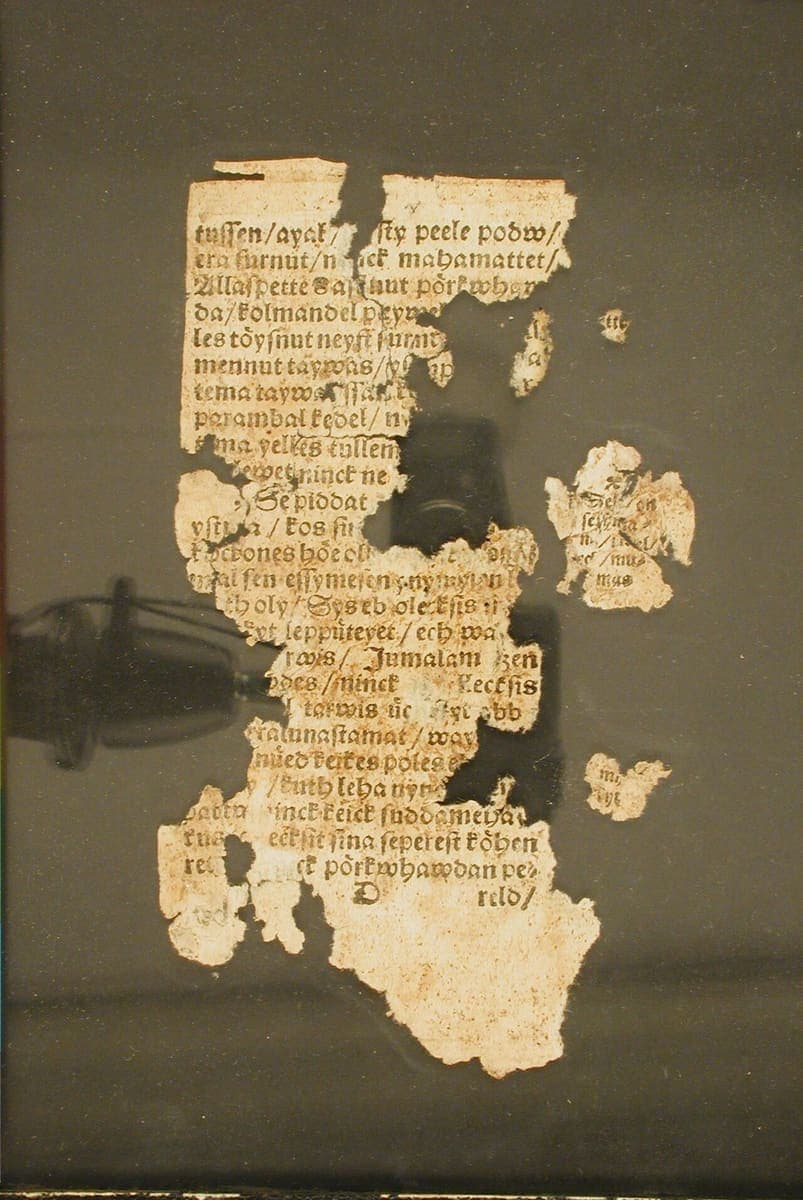
Source · Public domain · Tallinn City Archives
Evidano Transcription
tuſſen/ayak/ [...] ſty peele podw/
era ſurnut/n[...]ck mahamattet/
Allaſpette Saſ[...]nut pörkwher[...]
da/kolmandel peyw[...]
les töyſnut neyſt ſurn[...]
mennut taywas/ [...]
tema taywa[...] Iſan[...]
perambal kedel/ n[...]
[...]ma yelles tullem[...]
[...]ewet ninck ne[...]
Se piddat
vſt[...]a / kos ſu[...]
[...]chones höech[...]
[...]al ſen eſſymeſen[...] nyn[...]
[...]th oly/ Syseb [?] oleckſis [...]
[...]yt lepputeyet/ ech wa[...]
[...]rawis/ Jumalam [...]zen
[...]poes/ ninck [...] keckſis
[...] tarwis üc [...] ebb
[...]ralunaſtamat/ way[...]
[...]nued keick poles e[...]
[...]/ Euth leha nyn[...]
[...]atta [...]inck keick ſuddameya[...]
[...] eck ſit ſina ſepereſt köhen
re[...]ck pörkwhawdan pe[...]
D[...] reld/
[small detached fragments illegible]
Generated by Evidano’s advanced model; not yet checked against a published edition.
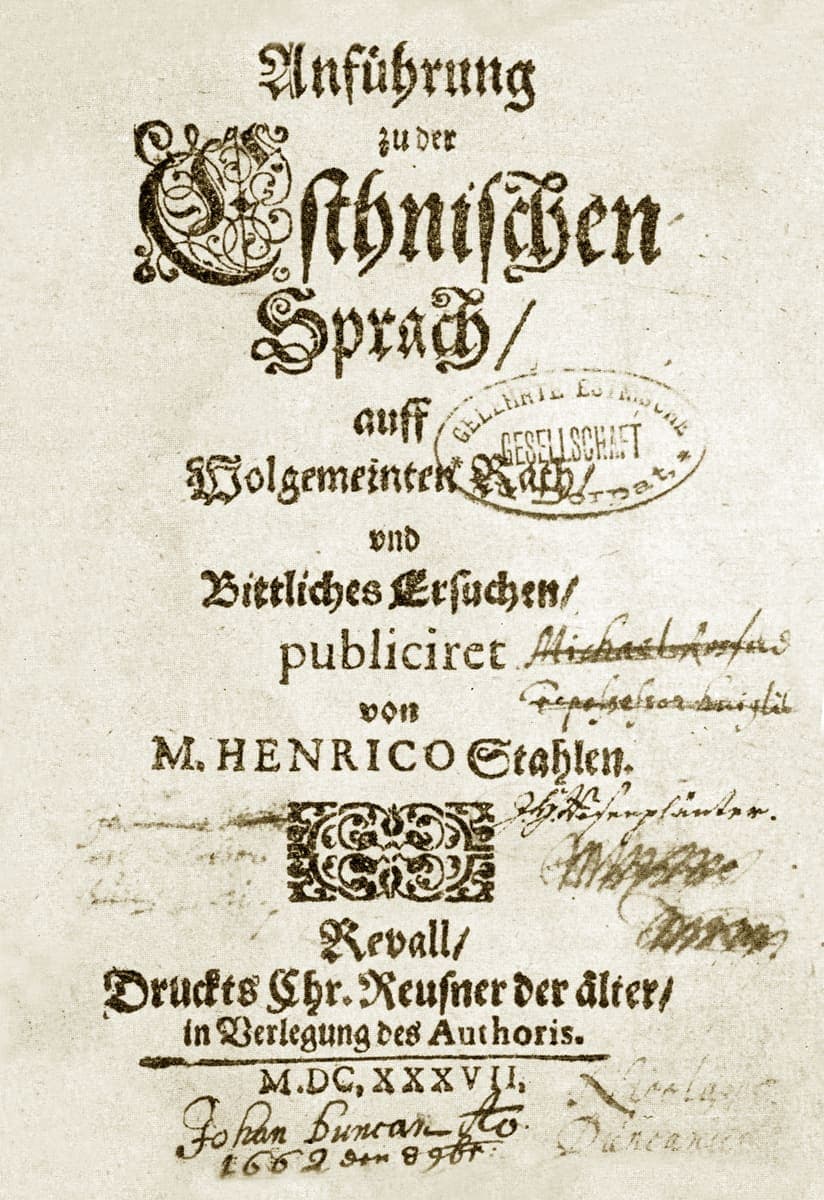
Source · Public domain · Reproduced in Juhan Libe, Eesti rahva ajalugu (Tartu: Loodus, 1932)
Evidano Transcription
Anführung
zu der
Esthnischen
Sprach/
auff GELEHRTE ESTNISCHE
Wolgemeinten Rath/ GESELLSCHAFT
vnd * Dorpat *
Bittliches Ersuchen/
publiciret Michael [illegible]
von [illegible]
M. HENRICO Stahlen.
[illegible]
[illegible]
Revall/ [illegible]
Druckts Chr. Reusner der älter/
in Verlegung des Authoris.
M. DC. XXXVII.
Johan Duncan Ao. [illegible]
1662 den 8 9br.
Generated by Evidano’s advanced model; not yet checked against a published edition.
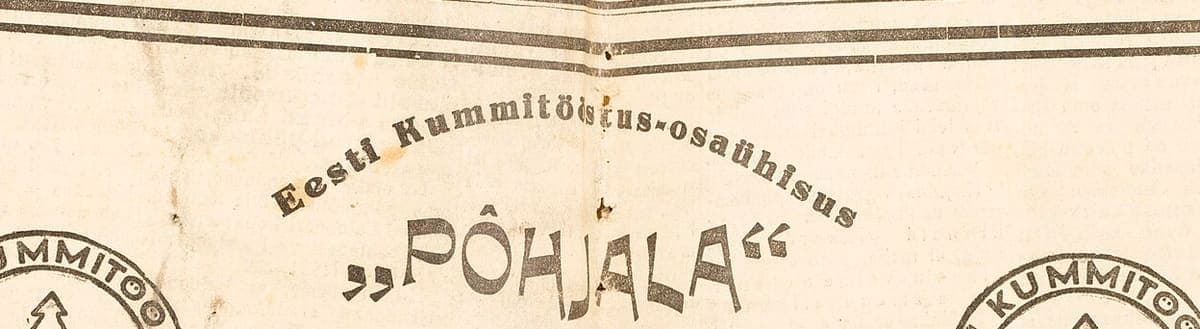
Source · Public domain · Estonian War of Independence Veterans’ League, via the Estonian Museum Information System (MUIS)
Evidano Transcription
Eesti Kummitööstus-osaühisus
UMMITÖÖ „PÔHJALA“ KUMMITÖ
Generated by Evidano’s advanced model; not yet checked against a published edition.
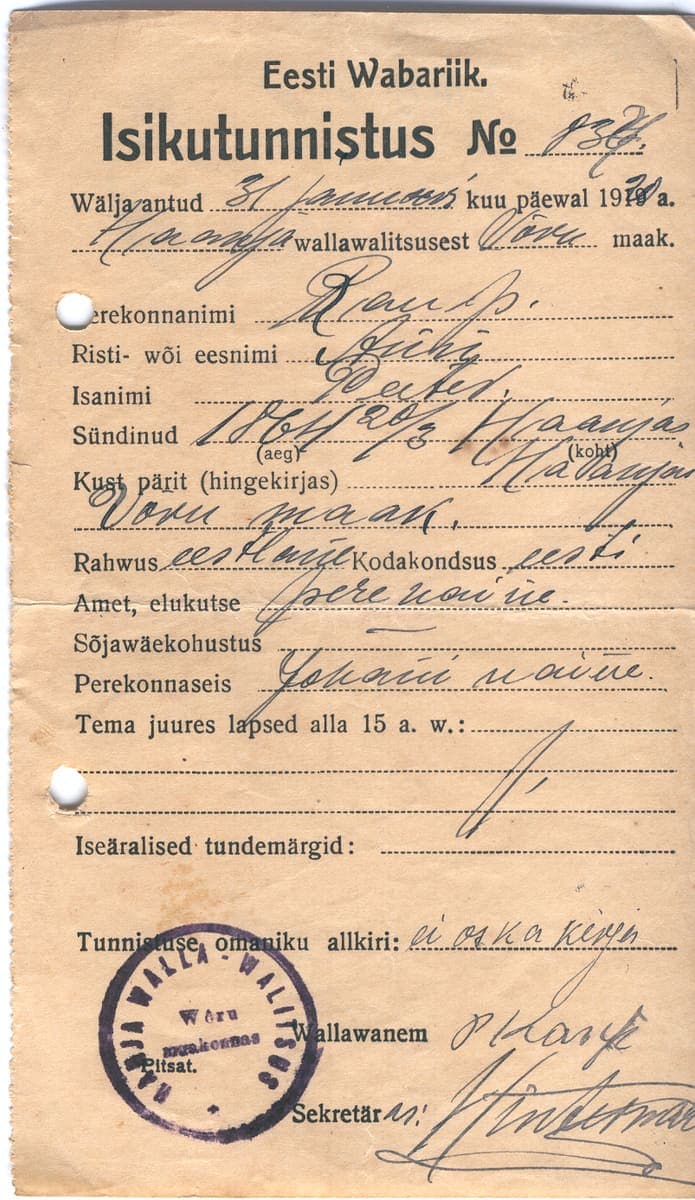
Source · Public domain · Võru County Museum, via the Estonian Museum Information System (MUIS)
Evidano Transcription
Eesti Wabariik.
Isikutunnistus № 837 [?]
Wälja antud 31 jaanuari kuu päewal 1920 a.
Haanja wallawalitsusest Wõru maak.
Perekonnanimi Raup.
Risti- wõi eesnimi Anni [?]
Isanimi Peter.
Sündinud 1864 20/3 Haanjas
(aeg) (koht)
Kust pärit (hingekirjas) Haanja [?]
Wõru maak.
Rahwus eestlane Kodakondsus eesti
Amet, elukutse pere naine.
Sõjawäekohustus —
Perekonnaseis Johani naine.
Tema juures lapsed alla 15 a. w.: —
Iseäralised tundemärgid:
Tunnistuse omaniku allkiri: ei oska kirja
[stamp: HAANJA WALLA-WALITSUS Wõru maakonnas] Pitsat.
Wallawanem [signature]
Sekretär [signature]
Generated by Evidano’s advanced model; not yet checked against a published edition.
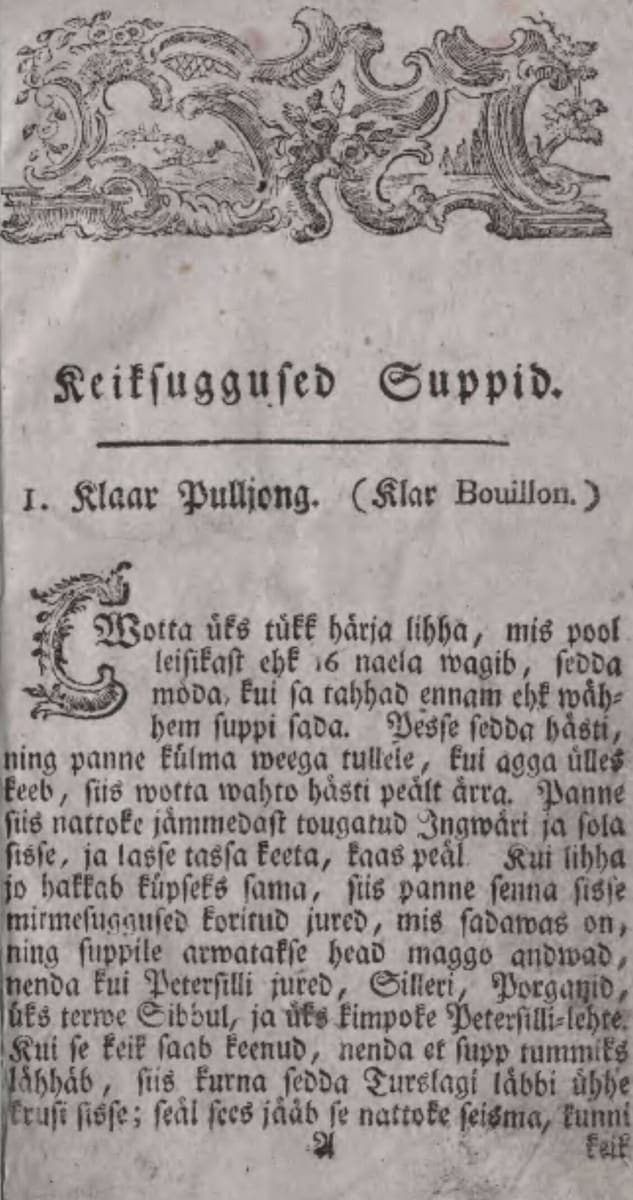
Source · Public domain · Translated by Johann Lithander from Cajsa Warg; scan via DIGAR and EEVA
Evidano Transcription
The whole printed page: the chapter heading, the first recipe’s title with its bracketed German gloss, and the single paragraph that runs to the foot and breaks off mid-sentence at "kunni". The Estonian Wikisource text is a proofread reading transcription — it keeps the 1781 spelling as printed, with w for v and doubled vowels, but sets the long ſ as an ordinary s and leaves out the signature letter A and the catchword keik below the last line.
Keiksuggused Suppid.
1. Klaar Pulljong. (Klar Bouillon.)
Wotta üks tükk härja lihha, mis pool leisikast ehk 16 naela wagib, sedda möda, kui sa tahhad ennam ehk wähhem suppi sada. Pesse sedda hästi, ning panne külma weega tullele, kui agga ülles keeb, siis wotta wahto hästi peält ärra. Panne siis nattoke jämmedast tougatud Ingwäri ja sola sisse, ja lasse tassa keeta, kaas peäl. Kui lihha jo hakkab küpseks sama, siis panne senna sisse mitmesuggused koritud jured, mis sadawas on, ning suppile arwatakse head maggo andwad, nenda kui Petersilli jured, Silleri, Porganid, üks terwe Sibbul, ja üks kimpoke Petersilli-lehte. Kui se keik saab keenud, nenda et supp tummiks lähhäb, siis kurna sedda Turslagi läbbi ühhe krusi sisse; seäl sees jääb se nattoke seisma, kunni
Source: Köki ja Kokka Ramat (1781), Lehekülg 18, proofread text via Estonian Wikisource (CC BY-SA 4.0).
What Estonian writing looks like across five centuries
The earliest known printed Estonian survives only as a fragment: eleven leaves of a Lutheran catechism by Simon Wanradt and Johann Koell, printed in Wittenberg in 1535 and rediscovered in 1929 inside the binding of another book, where they had been reused as waste paper. Like the grammars, catechisms and hymnals that followed it over the next three centuries, the fragment is set in Fraktur, the German blackletter type, with a long ſ and the double-letter and diacritic conventions of German printing bent to fit Estonian sounds. Fraktur remained the ordinary type for Estonian religious books into the nineteenth century, so a rural parish’s hymnal can be a full three hundred years newer than the Wanradt-Koell fragment and still share its typeface.
For most of that print history, Estonian was written and administered by others. Baltic German pastors and scholars such as Heinrich Stahl, whose 1637 grammar of “the Ehstnian language” was printed for the benefit of German clergy rather than Estonian readers, devised the spelling system now called the older orthography, which used German letter combinations, such as doubled vowels for length and w for v, to approximate sounds German did not distinguish. The manors and parishes that these pastors served were run by a Baltic German landowning class through the nineteenth century, so a church register naming Estonian peasants is very often written in German, with the peasants’ own names Germanised or garbled on the page they appear on.
The newer orthography, developed from the 1870s and standardised after Estonian independence in 1918, replaced the older system’s workarounds with letters closer to the sounds they represent, chief among them õ, which stands for a vowel Estonian shares with only a few neighbouring Finnic and Baltic varieties and marks it as clearly distinct from o and ö. Even after the spelling reform, transitional habits lingered: identity papers from the 1920s still write Vabariik as Wabariik, and it took another decade or two for w to disappear from ordinary print. A twentieth-century Estonian newspaper or form can therefore carry either the old or the new orthography depending on exactly when it was set.
Why ordinary OCR struggles here
õ is not a variant of o or ö
Õ represents a vowel unfamiliar to most training data and visually close to o and ö, so generic OCR built for German, Finnish or Swedish text regularly substitutes one of those two rather than reading õ as the separate letter it is, changing the word it appears in.
German-run records naming Estonian people
A parish register or manor account book can be entirely in German while every name inside it belongs to an Estonian peasant, sometimes with that name Germanised, garbled or spelled inconsistently by a clerk who did not speak Estonian. Reading the record means recognising both languages correctly and not assuming that a German-language document has nothing Estonian in it worth transcribing carefully.
Fraktur type with no equivalent in modern Estonian print
The long ſ, the German-style doubling conventions and the general letterforms of Fraktur-set Estonian books share almost nothing with the roman type Estonian has used since the nineteenth century. A model trained only on modern Estonian has no basis for recognising these shapes and will guess from context rather than read them.
Older orthography spellings that look like errors
Pre-reform Estonian, including much twentieth-century material printed before the shift was complete, spells v as w and marks vowel length with doubled letters in patterns a modern speller does not recognise. A process that silently corrects these to modern spelling destroys the evidence a historian needs to date the document.
Who works with this material
Genealogists tracing Estonian ancestry
Family research into the manor and parish era usually means reading a German-language register for an Estonian ancestor’s name, which may be spelled two or three different ways across different entries. Getting both the German administrative text and the Estonian name right is what lets those entries be connected to the same person.
Editors and linguists working with early Estonian print
Scholars studying the Wanradt-Koell fragment, Stahl’s grammar or other older-orthography texts need a diplomatic transcription that keeps the German-influenced spelling exactly as printed, since the spelling itself is primary evidence for how the orthography developed.
Archives and libraries digitising Estonian newspapers
Estonian newspaper archives span the older and newer orthographies within the same run, and a search index that cannot handle both w and v spellings, or that drops õ, will fail to surface a large share of pre-1930s material.
Local historians reading manor and municipal records
Village and parish administration in the young Republic of Estonia still mixed handwritten Estonian with older spelling habits, as in an identity certificate that writes Wabariik for Vabariik; recognising the transitional spelling correctly helps date a document without secondary sources.
Getting the best transcription
Say whether the source is German, Estonian, or both
Flag a manor or parish record as German-language before transcription if that is what it is, and ask for any Estonian names inside it to be read and flagged separately rather than treated as German words to be normalised.
Keep õ distinct from o and ö
Ask explicitly for õ to be preserved as its own letter rather than corrected to whichever of its look-alikes seems more familiar, particularly in names and place names.
Flag Fraktur and older-orthography material up front
Telling the model that a source is Fraktur-set, or spelled in the pre-reform system with w for v and doubled vowels, lets it apply the right letterforms and spelling conventions from the first line.
Keep older spellings rather than silently modernising them
Ask for a diplomatic transcription that reproduces Wabariik, doubled vowels and other older-orthography habits as written, since normalising them to modern spelling erases evidence useful for dating the document.
Frequently asked questions
- Is õ read as its own letter rather than o or ö?
- Yes, õ is recognised as a distinct letter with its own sound, not as a variant spelling of o or ö, which matters most in names and place names where the difference changes the word.
- Can it read German-language parish and manor records that name Estonian people?
- Yes, the German administrative text is transcribed as German, and Estonian personal and place names inside it can be flagged separately so they are not silently Germanised or normalised.
- Can it read Fraktur-printed Estonian, such as the Wanradt-Koell catechism or Stahl’s grammar?
- Yes, Fraktur is recognised as its own typeface, including the long ſ, rather than approximated from modern Estonian roman type.
- Does it keep older-orthography spellings like Wabariik instead of correcting them to Vabariik?
- Yes, if you ask for a diplomatic transcription; the older w-for-v spelling and doubled-vowel length marking are kept as written rather than modernised, which preserves the document’s own dating evidence.
- What about damaged or fragmentary pages, like the Wanradt-Koell catechism?
- Illegible or missing letters are marked rather than guessed, so a fragmentary early page comes back with its gaps honestly shown instead of a plausible-looking but invented reading.
Related scripts and pages
Turn your Estonian documents into text
Upload a Fraktur-printed book, a German-language parish record or a handwritten form, and check the Estonian and German reading against the image line by line.