
Latvian
Latvian before and after its spelling reform
A Latvian page printed before the 1920s reform is set in German Fraktur type and spelled by German habit, w for v and sch for š, so it barely resembles the ā-and-ķ-marked Latvian taught today. Evidano reads both spellings, keeps the macrons and cedillas a generic model drops, and tells Latvian apart from the German it shared a page with for centuries.
Sample pages
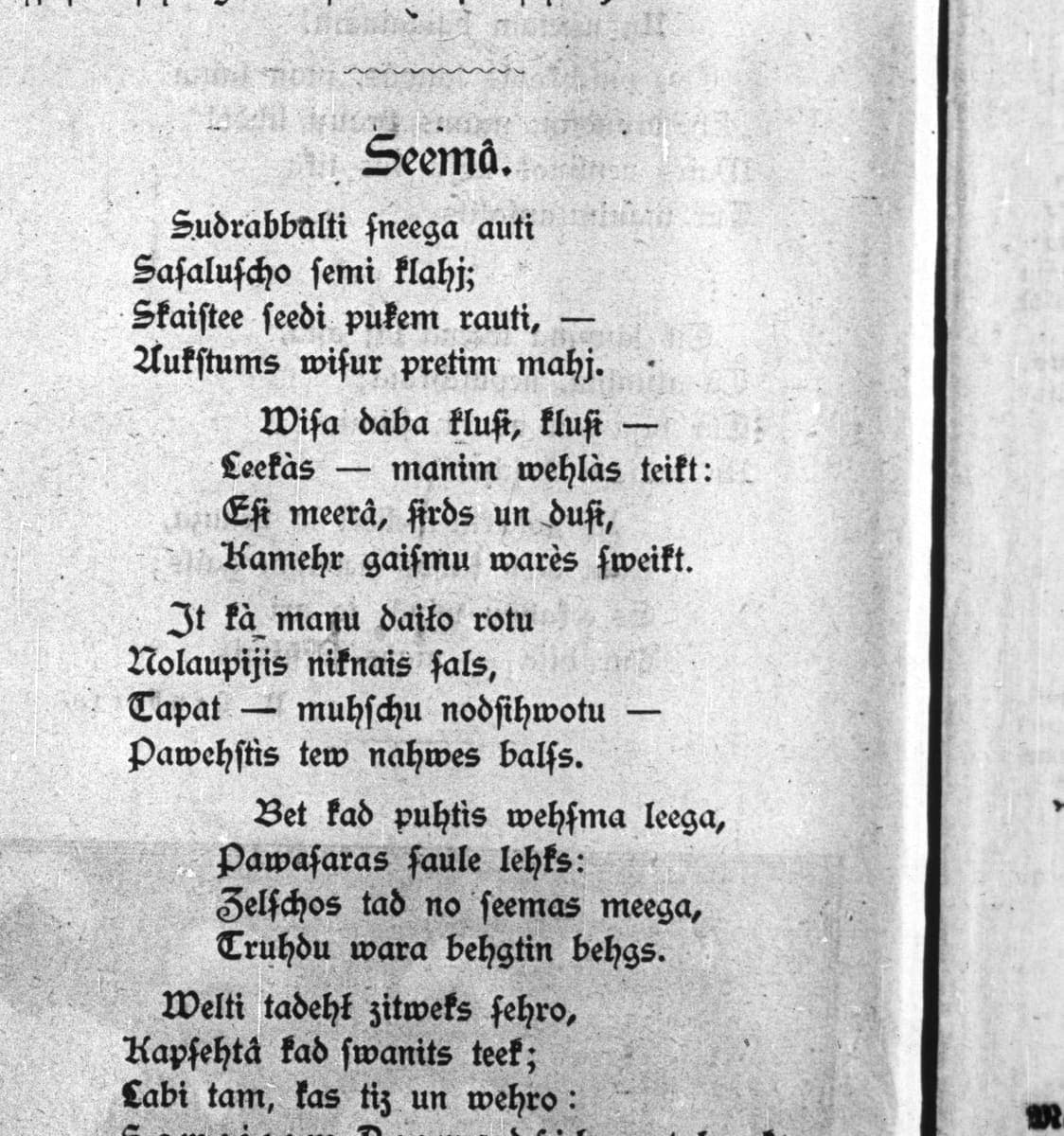
Internet Archive, digitised from microfilm (source IA40329920-20), January 1907 · Source · Public domain
Evidano Transcription
Seemâ.
Sudrabbalti ſneega auti
Saſaluſcho ſemi klahj;
Skaiſtee ſeedi pukem rauti, —
Aukſtums wiſur pretim mahj.
Wiſa daba kluſi, kluſi —
Leekàs — manim wehlàs teikt:
Eſi meerâ, ſirds un duſi,
Kamehr gaiſmu warès ſweikt.
It kà manu daiło rotu
Nolaupijis niknais ſals,
Tapat — muhſchu nodſihwotu —
Pawehſtis tew nahwes balſs.
Bet kad puhtis wehſma leega,
Pawaſaras ſaule lehks:
Zelſchos tad no ſeemas meega,
Truhdu wara behgtin behgs.
Welti tadehł ziłweks ſehro,
Kapſehtâ kad ſwanits teek;
Labi tam, kas tiz un wehro:
[cut off]
Generated by Evidano’s advanced model; not yet checked against a published edition.
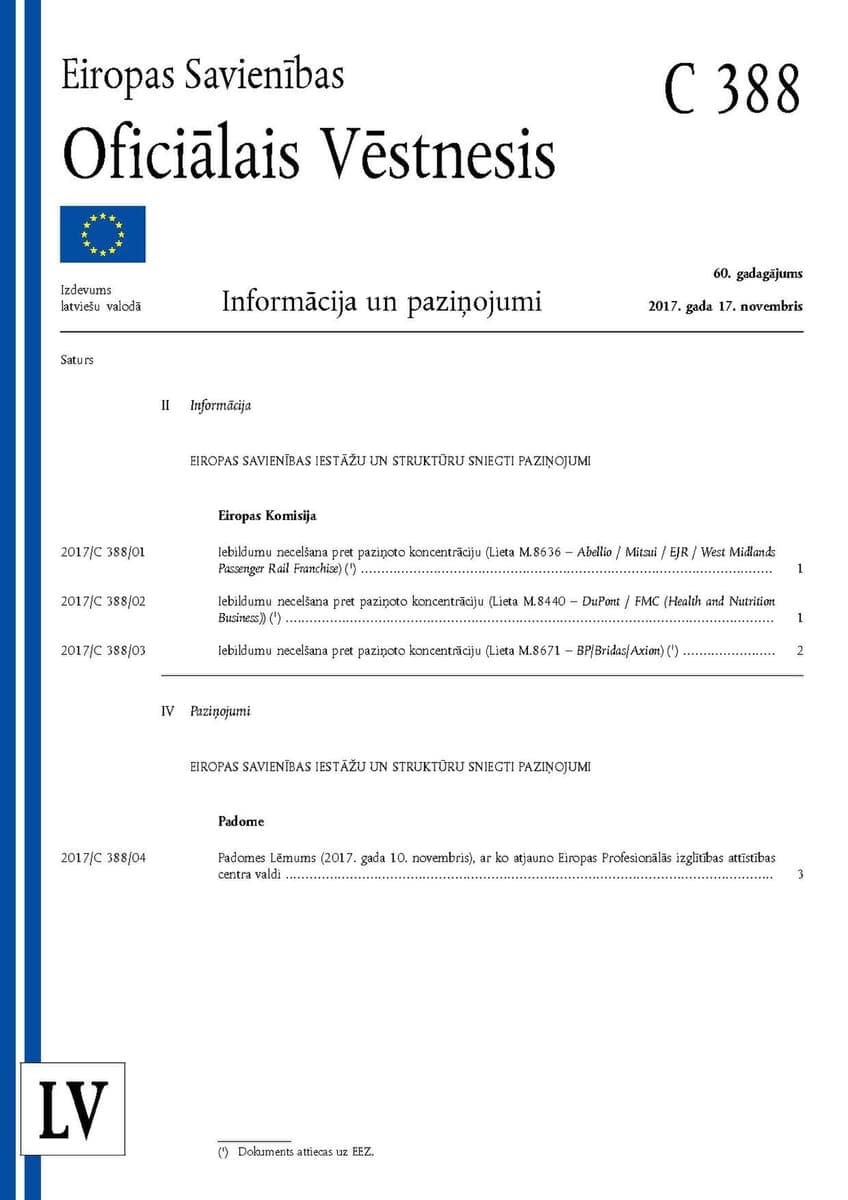
Publications Office of the European Union, 17 November 2017 · Source · Public domain
Evidano Transcription
The cover and table of contents shown, checked word for word against the same issue’s official text on EUR-Lex; the dot-leaders before each page number are omitted here.
Eiropas Savienības Oficiālais Vēstnesis
C 388
Izdevums latviešu valodā | Informācija un paziņojumi | 60. gadagājums | 2017. gada 17. novembris
Saturs
II Informācija
EIROPAS SAVIENĪBAS IESTĀŽU UN STRUKTŪRU SNIEGTI PAZIŅOJUMI
Eiropas Komisija
2017/C 388/01 Iebildumu necelšana pret paziņoto koncentrāciju (Lieta M.8636 – Abellio / Mitsui / EJR / West Midlands Passenger Rail Franchise) (¹) 1
2017/C 388/02 Iebildumu necelšana pret paziņoto koncentrāciju (Lieta M.8440 – DuPont / FMC (Health and Nutrition Business)) (¹) 1
2017/C 388/03 Iebildumu necelšana pret paziņoto koncentrāciju (Lieta M.8671 – BP/Bridas/Axion) (¹) 2
IV Paziņojumi
EIROPAS SAVIENĪBAS IESTĀŽU UN STRUKTŪRU SNIEGTI PAZIŅOJUMI
Padome
2017/C 388/04 Padomes Lēmums (2017. gada 10. novembris), ar ko atjauno Eiropas Profesionālās izglītības attīstības centra valdi 3
(¹) Dokuments attiecas uz EEZ.
Source: Official Journal of the European Union, C 388, 17 November 2017 (LV), via EUR-Lex (Public domain).
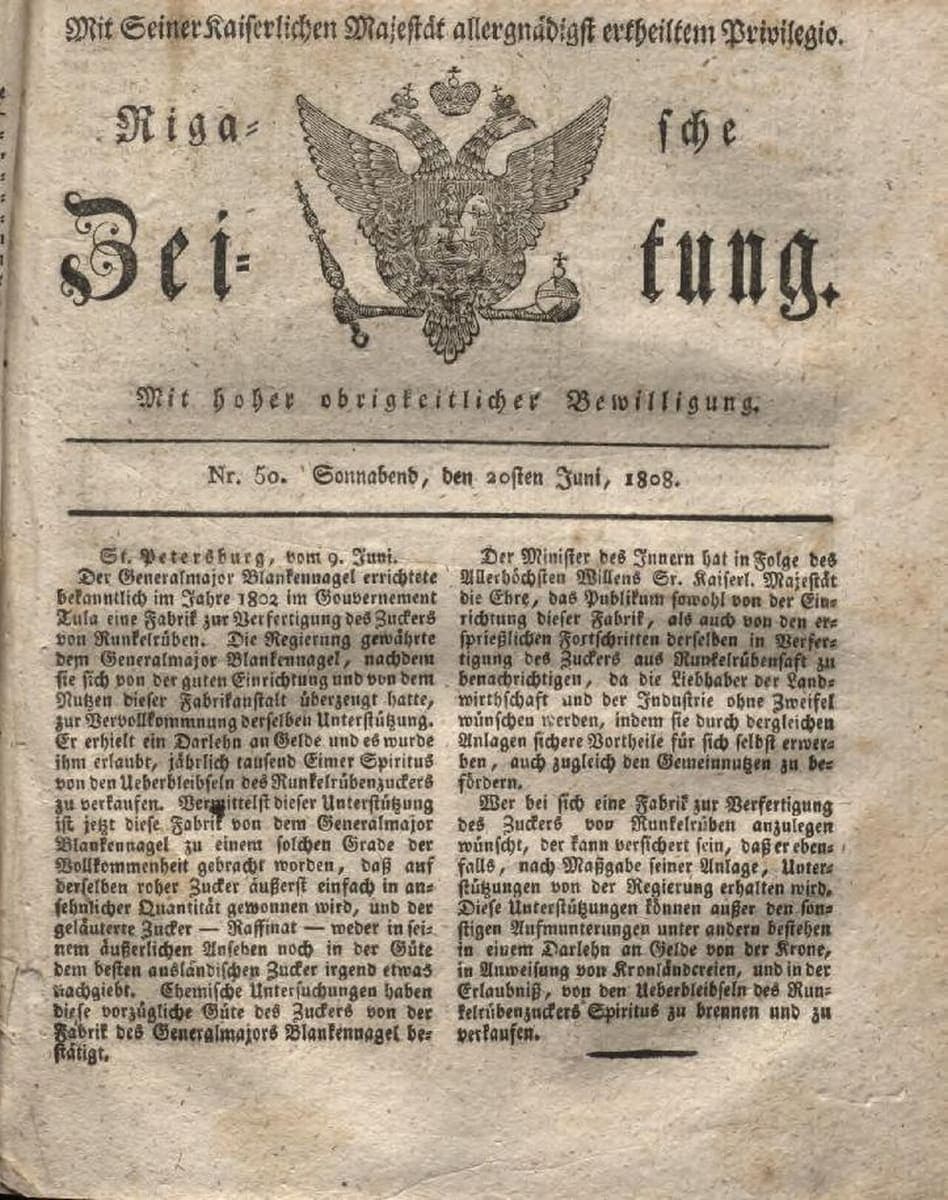
Latvijas Nacionālā digitālā bibliotēka (National Digital Library of Latvia), 20 June 1808 · Source · Public domain
Evidano Transcription
Mit Seiner Kaiserlichen Majestät allergnädigst ertheiltem Privilegio.
Riga= sche
Zei= tung.
Mit hoher obrigkeitlicher Bewilligung.
Nr. 50. Sonnabend, den 20sten Juni, 1808.
St. Petersburg, vom 9. Juni.
Der Generalmajor Blankennagel errichtete
bekanntlich im Jahre 1802 im Gouvernement
Tula eine Fabrik zur Verfertigung des Zuckers
von Runkelrüben. Die Regierung gewährte
dem Generalmajor Blankennagel, nachdem
sie sich von der guten Einrichtung und von dem
Nutzen dieser Fabrikanstalt überzeugt hatte,
zur Vervollkommnung derselben Unterstützung.
Er erhielt ein Darlehn an Gelde und es wurde
ihm erlaubt, jährlich tausend Eimer Spiritus
von den Ueberbleibseln des Runkelrübenzuckers
zu verkaufen. Vermittelst dieser Unterstützung
ist jetzt diese Fabrik von dem Generalmajor
Blankennagel zu einem solchen Grade der
Vollkommenheit gebracht worden, daß auf
derselben roher Zucker äußerst einfach in an=
sehnlicher Quantität gewonnen wird, und der
geläuterte Zucker — Raffinat — weder in sei=
nem äußerlichen Ansehen noch in der Güte
dem besten ausländischen Zucker irgend etwas
nachgiebt. Chemische Untersuchungen haben
diese vorzügliche Güte des Zuckers von der
Fabrik des Generalmajors Blankennagel be=
stätigt.
Der Minister des Innern hat in Folge des
Allerhöchsten Willens Sr. Kaiserl. Majestät
die Ehre, das Publikum sowohl von der Ein=
richtung dieser Fabrik, als auch von den er=
sprießlichen Fortschritten derselben in Verfer=
tigung des Zuckers aus Runkelrübensaft zu
benachrichtigen, da die Liebhaber der Land=
wirthschaft und der Industrie ohne Zweifel
wünschen werden, indem sie durch dergleichen
Anlagen sichere Vortheile für sich selbst erwer=
ben, auch zugleich den Gemeinnutzen zu be=
fördern.
Wer bei sich eine Fabrik zur Verfertigung
des Zuckers vov Runkelrüben anzulegen
wünscht, der kann versichert sein, daß er eben=
falls, nach Maßgabe seiner Anlage, Unter=
stützungen von der Regierung erhalten wird.
Diese Unterstützungen können außer den son=
stigen Aufmunterungen unter andern bestehen
in einem Darlehn an Gelde von der Krone,
in Anweisung von Kronländereien, und in der
Erlaubniß, von den Ueberbleibseln des Run=
kelrübenzuckers Spiritus zu brennen und zu
verkaufen.
Generated by Evidano’s advanced model; not yet checked against a published edition.
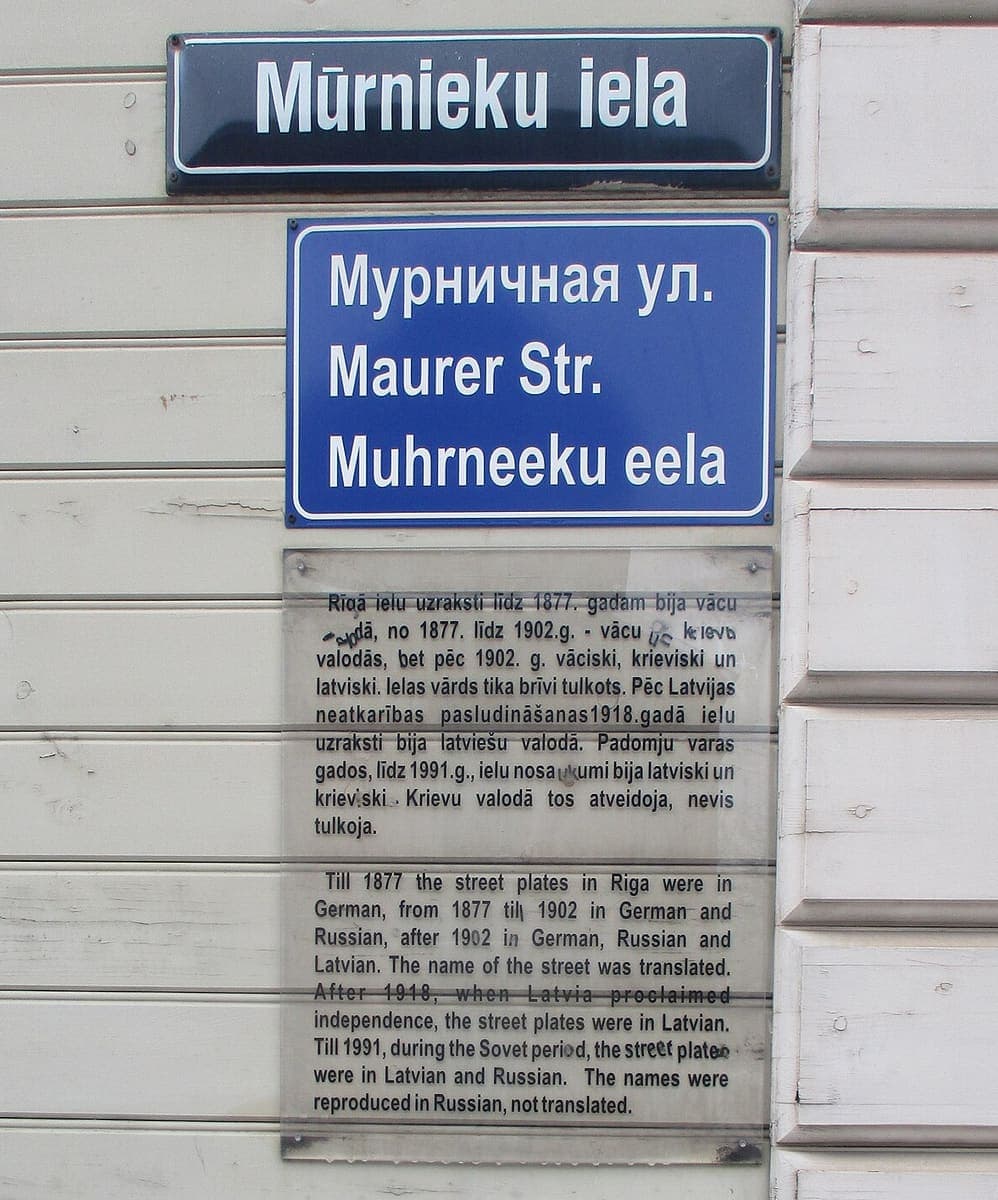
Source · CC BY-SA 4.0 · Photograph by Turaids
Evidano Transcription
Mūrnieku iela
Мурничная ул.
Maurer Str.
Muhrneeku eela
Rīgā ielu uzraksti līdz 1877. gadam bija vācu
valodā, no 1877. līdz 1902.g. - vācu un krievu
valodās, bet pēc 1902. g. vāciski, krieviski un
latviski. Ielas vārds tika brīvi tulkots. Pēc Latvijas
neatkarības pasludināšanas1918.gadā ielu
uzraksti bija latviešu valodā. Padomju varas
gados, līdz 1991.g., ielu nosaukumi bija latviski un
krieviski. Krievu valodā tos atveidoja, nevis
tulkoja.
Till 1877 the street plates in Riga were in
German, from 1877 till 1902 in German and
Russian, after 1902 in German, Russian and
Latvian. The name of the street was translated.
After 1918, when Latvia proclaimed
independence, the street plates were in Latvian.
Till 1991, during the Sovet period, the street plates
were in Latvian and Russian. The names were
reproduced in Russian, not translated.
Generated by Evidano’s advanced model; not yet checked against a published edition.
Two orthographies, and the German beside both
Written Latvian was first codified in the sixteenth century by German-speaking Lutheran pastors and printers working in the Baltic provinces, and for more than three centuries it stayed inside German typographic and spelling habits: books and newspapers were set in German Fraktur type, v was written w, š was written sch, and long vowels were marked, inconsistently, with a trailing h or not marked at all. Linguists led by Kārlis Mīlenbahs and Jānis Endzelīns worked out a phonemic Latin-based spelling in the early 1900s, and the new Republic of Latvia adopted it as the school and official norm through the 1920s: Fraktur gave way to ordinary roman type, w became v, sch became š, and vowel length was marked with a macron instead of a trailing h. A pre-reform book and a post-reform one can look like two different languages at a glance.
The reformed alphabet is exact where the old one was approximate. A macron over a, e, i or u marks a genuinely long vowel, so kazas (of the goat) and kāzas (a wedding) are different words rather than spelling variants of one, and a cedilla under g, k, l or n marks a palatalised consonant that changes the word again. Both marks sit above or below letters a generic OCR model already treats as complete on their own, and a system tuned on unmarked Latin script, or on Lithuanian or Polish diacritics that look similar but are not the same mark, drops them, merges them into the base letter, or substitutes the wrong accent.
German did not disappear when the spelling reformed; it had run alongside Latvian in administration, trade and the church since the Middle Ages, and Riga still carries the evidence on its walls. City street plates were German-only until 1877, German and Russian until 1902, and German, Russian and Latvian together until Latvia’s 1918 independence, after which they became Latvian alone, then Latvian and Russian again under Soviet rule until 1991. A single building can still show several of those languages at once, alongside a newspaper masthead, a merchant’s ledger or a church register kept in German for a congregation that spoke Latvian.
Why ordinary OCR struggles here
German spelling habits misread as Latvian
Pre-reform Latvian spells the German way: w for v, sch for š, and vowel length shown by a trailing h rather than a macron. A model trained on modern Latvian reads this as a foreign or misspelled language and is tempted to silently correct it to today’s spelling rather than transcribe what the page actually says.
Fraktur’s confusable letters
Fraktur sets long s (ſ) so it looks like f, merges f and s into ligatures that read as one shape, and gives r, n and u strokes thin enough to blur together on a worn scan. These are exactly the confusions a model trained on roman type has never had to resolve.
Macrons and cedillas that vanish
A macron on ā, ē, ī or ū and a cedilla under ģ, ķ, ļ or ņ carry real grammatical and lexical weight, but both are thin marks that a low-resolution scan, or a model tuned on unaccented text, drops without noticing, turning one word into a different one.
German, Russian and Latvian on the same object
A street plate, a church register or a shop sign can carry two or three languages at once, each with its own spelling system and sometimes its own period, and a transcription that assumes one language for the whole image will misread whichever language it did not expect.
Who works with this material
Editors of pre-reform Latvian texts
Reprinting nineteenth-century sermons, almanacs and early newspapers means reading German-style Fraktur spelling accurately rather than silently modernising it, since the old spelling is itself the evidence for when and by whom a text was written.
Genealogists and parish-register researchers
Latvian parish books were often kept in German well into the nineteenth century, and civil registers afterwards mix German, Russian and Latvian by decade. A transcription that keeps each register’s own language, spelling and macrons intact is what lets a name be traced across the change.
Heritage and municipal signage projects
Riga and other Latvian towns still display, or are recreating, the layered German-Russian-Latvian street signage of the last two centuries. Digitising these plates for an archive or a walking-tour app means transcribing each language and each spelling era as its own layer, not merging them into one modern label.
Students and scholars of Baltic history
Coursework on the Baltic German community, the 1920s language reform, or the Soviet period draws on primary sources in three languages and at least two Latvian spelling systems side by side. The comparison only works if the transcription preserves what each source actually says.
Getting the best transcription
Say which spelling era to expect
Tell the prompt whether a page predates the 1920s reform, and if so to keep w, sch and h-marked vowels as printed rather than convert them to v, š and macrons. The same instruction the other way round keeps a modern page from being mistaken for old-fashioned.
Ask for macrons and cedillas to be checked, not assumed
List ā, ē, ī, ū, ģ, ķ, ļ and ņ explicitly and ask for a second pass on any word where one might be missing. Because the marks are thin, this is the single step most likely to change the accuracy of a modern Latvian transcription.
Separate the languages on a mixed object
For a street sign, register or ledger that carries German, Russian and Latvian together, ask for each language to be transcribed and labelled as its own block rather than run together as one paragraph.
Test on the oldest or most mixed item first
Start a batch with whatever page is hardest, a Fraktur periodical or a trilingual sign, rather than the cleanest modern form. If the spelling era and the languages come back correctly separated there, the rest of the batch needs only a spot check.
Frequently asked questions
- Will pre-reform Latvian be corrected to modern spelling?
- Not unless you ask for it. The default keeps w, sch and h-marked vowels as the page prints them, since the old spelling is what dates the document; a modernised version alongside it can be requested as a separate pass.
- Are the macrons on ā, ē, ī and ū kept?
- Yes, they are treated as marking a different vowel rather than as an accent that can be dropped, and the same applies to the cedilla under ģ, ķ, ļ and ņ.
- Can it read Fraktur-set Latvian periodicals?
- Yes. Fraktur’s long s, ligatures and doubled letters are recognised as the Latin letters they stand for, and the pre-reform spelling is transcribed as printed rather than converted.
- What happens with a German-language document from the Baltic provinces?
- It is transcribed as German, not treated as a broken or misspelled Latvian text, and where German and Latvian appear on the same page or object each is kept in its own language.
- Can a trilingual street sign or plaque be transcribed as separate blocks?
- Yes, if you ask for the languages to be separated. Each line or plate can be labelled by language rather than merged into a single undifferentiated block of text.
Related scripts and pages
Transcribe your Latvian documents
Upload a pre-reform periodical, a modern form or a photographed sign, say which spelling era to expect, and check the first page before running the rest.