
Finnish
Finnish read with every doubled letter intact
Finnish tells tuli (fire) apart from tuuli (wind) and tule (come) apart from tulle (to have come) by a single doubled letter, so a transcription that drops or adds one changes the word rather than just its spelling. The language also builds words by stringing parts together into compounds long enough to break an ordinary line, and its oldest printed books are set in Fraktur type that shares almost no letterforms with the print Finnish uses today. Evidano reads Finnish letter by letter, doubled vowels and consonants included, and keeps the source image next to every line.
Sample pages
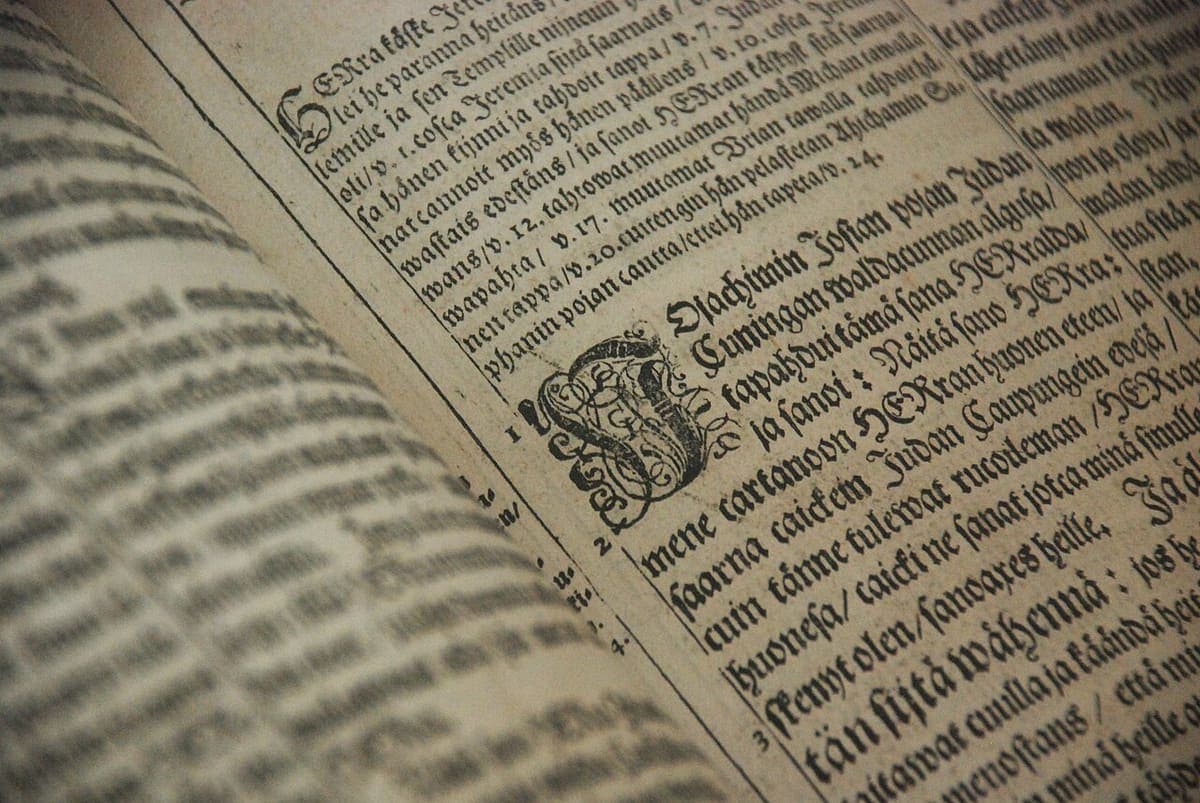
Source · CC BY-SA 4.0 · Phyrexian
Evidano Transcription
HERra käske Jere [cut off]
lei he paranna heitäns [cut off]
lemille ja sen Templille nijncuin [cut off]
oli / v. 1. cosca Jeremia sijtä saarnais / [cut off]
sa hänen kijnni ja tahdoit tappa / v. 7. Juda [cut off]
nat cannoit myös hänen päällens / v. 10. cosca Jere [cut off]
wastais edestäns / ja sanoi HERran käskyst sitä saarna-
wans / v. 12. tahtowat muutamat händä Michan tawalla
wapahta / v. 17. muutamat Urian tawalla tahdoit hä-
nen tappa / v. 20. cuitengin hän pelastetan Ahichamin Sa-
phanin pojan cautta / ettei hän tapeta / v. 24.
1 JOjachimin Josian pojan Judan
Cuningan waldacunnan algusa /
tapahdui tämä sana HERralda /
ja sanoi : Näitä sano HERra :
2 mene cartanoon HERran huonen eteen / ja
saarna caickein Judan Caupungein edesä /
cuin tänne tulewat rucoileman / HERran
huonesa / caicki ne sanat jotca minä sinulle [cut off]
käskenyt olen / sanoaxes heille. Ja ä [cut off]
tän sijtä wähennä : jos he [cut off]
3 taitawat cuulla ja käändä hei [cut off]
[cut off] menostans / että mi [cut off]
[cut off] minä heille o [cut off]
[cut off]
[right column cut off at the image edge and out of focus; only fragments visible]
le ja caick [cut off]
[illegible]
saarnaman tätä huon [cut off]
ta wastan. Nijn [cut off]
non ja olen / ja [cut off]
malan äänd [cut off]
[illegible]
Generated by Evidano’s advanced model; not yet checked against a published edition.
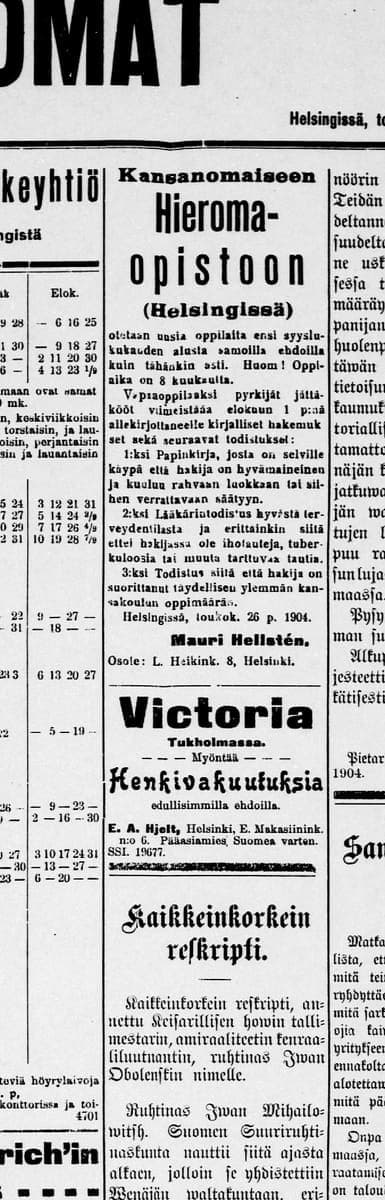
Source · Public domain · Scan from the National Library of Finland’s Finnish Historical Newspaper Library
Evidano Transcription
OMAT
Helsingissä, to
Vasen palsta
keyhtiö
ngistä
| ak | Elok. |
|---|---|
| 9 28 | - 6 16 25 |
| 1 30 | - 9 18 27 |
| 3 - | 2 11 20 30 |
| 6 - | 4 13 23 1/9 |
maan ovat samat
0 mk.
n, keskiviikkoisin
torstaisin, ja lau-
oisin, perjantaisin
sin ja lauantaisin
5 24 3 12 21 31
7 27 5 14 24 2/9
0 29 7 17 26 4/9
2 31 10 19 28 7/9
- 22 9 - 27 -
- 31 - 18 - -
23 3 6 13 20 27
2 - 5 - 19 -
26 - 9 - 23 -
0 - 2 - 16 - 30
0 27 3 10 17 24 31 - 30 - 13 - 27 -
23 - 6 - 20 - -
teviä höyrylaivoja
. p.
konttorissa ja toi-
4701
rich'in
Keskipalsta
Kansanomaiseen
Hieroma-
opistoon
(Helsingissä)
otetaan uusia oppilaita ensi syyslu-
kukauden alusta samoilla ehdoilla
kuin tähänkin asti. Huom! Oppi-
aika on 8 kuukautta.
Vapaaoppilaaksi pyrkijät jättä-
kööt viimeistään elokuun 1 p:nä
allekirjoittaneelle kirjalliset hakemuk
set sekä seuraavat todistukset:
1:ksi Papinkirja, josta on selville
käypä että hakija on hyvämaineinen
ja kuuluu rahvaan luokkaan tai sii-
hen verrattavaan säätyyn.
2:ksi Lääkärintodistus hyvästä ter-
veydentilasta ja erittäinkin siitä
ettei hakijassa ole ihotauteja, tuber-
kuloosia tai muuta tarttuvaa tautia.
3:ksi Todistus siitä että hakija on
suorittanut täydellisen ylemmän kan-
sakoulun oppimäärän.
Helsingissä, toukok. 26 p. 1904.
Mauri Hellstén,
Osoite: L. Heikink. 8, Helsinki.
Victoria
Tukholmassa.
- Myöntää - - -
Henkivakuutuksia
edullisimmilla ehdoilla.
E. A. Hjelt, Helsinki, E. Makasiinink.
n:o 6. Pääasiamies Suomea varten.
SSI. 19677.
- Myöntää - - -
Kaikkeinkorkein
reskripti.
Kaikkeinkorkein reskripti, an-
nettu Keisarillisen howin talli-
mestarin, amiraaliteetin kenraa-
liluutnantin, ruhtinas Iwan
Obolenskin nimelle.
Ruhtinas Iwan Mihailo-
witsh. Suomen Suuriruhti-
naskunta nauttii siitä ajasta
alkaen, jolloin se yhdistettiin
Wenäjän waltakuntaan, eri-
Oikea palsta
nöörin
Teidän
deltann
suudelta
ne usk
sessa t
määräy
panijan
huolenp
täwän
tietoisuu
kaumuk
toriallis
tamatto
näjän k
jatkuwa
jän wa
tujen l
puu ra
sunluja
maassa.
Pysy
man su
Alkup
jesteetti
kätisesti
Pietar
1904.
San
Matka
lista, ett
mitä tein
ryhdyttäe
mitä sark
ojia kaiw
yritykseen
ennakolta
alotettan
mitä pä
maan.
Onpa
maassa,
raatamise
on talou
Generated by Evidano’s advanced model; not yet checked against a published edition.
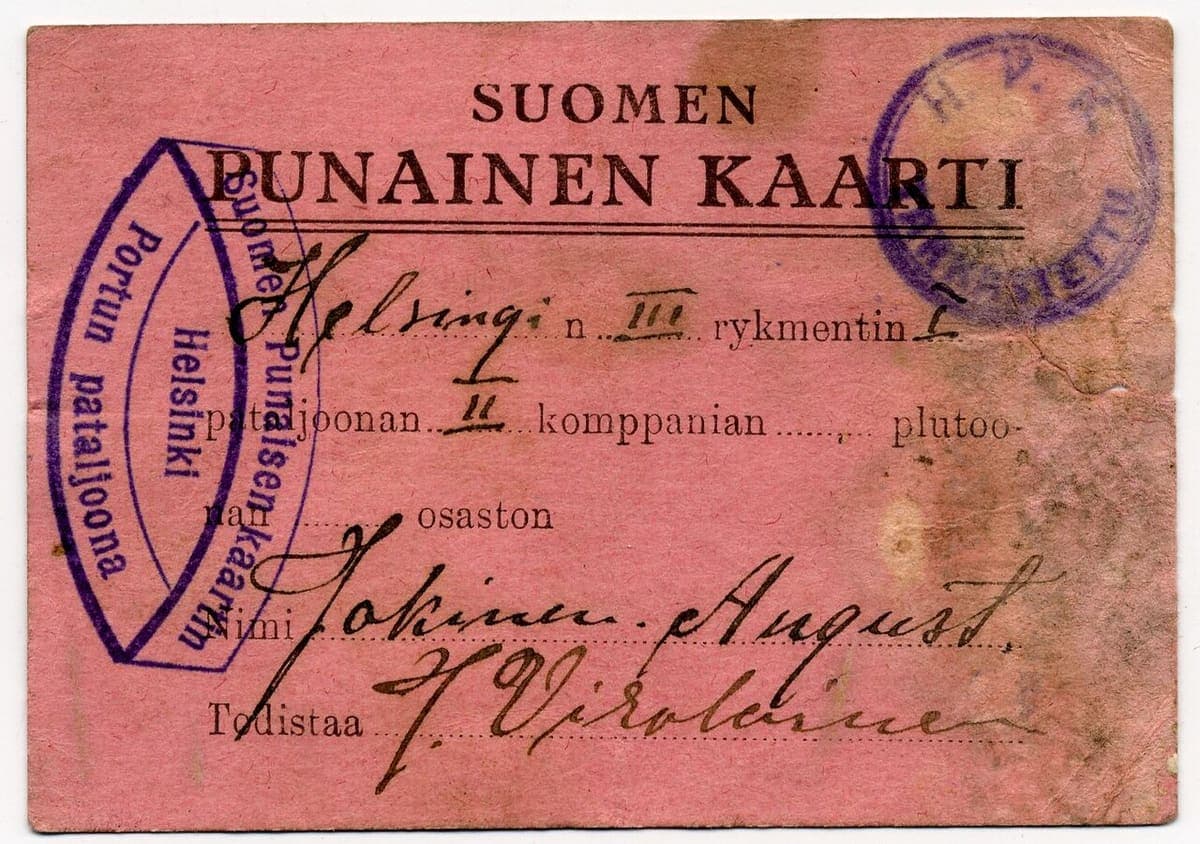
Source · Public domain · Finnish Labour Museum Werstas
Evidano Transcription
SUOMEN
PUNAINEN KAARTI
Helsingin III rykmentin I
pataljoonan II komppanian ........ plutoo-
nan ........ osaston
Nimi Jokinen. August.
Todistaa H. Virolainen
H. P. K.
Suomen Punaisen kaartin
Portun pataljoona
Helsinki
TARKASTETTU
Generated by Evidano’s advanced model; not yet checked against a published edition.
Evidano Transcription
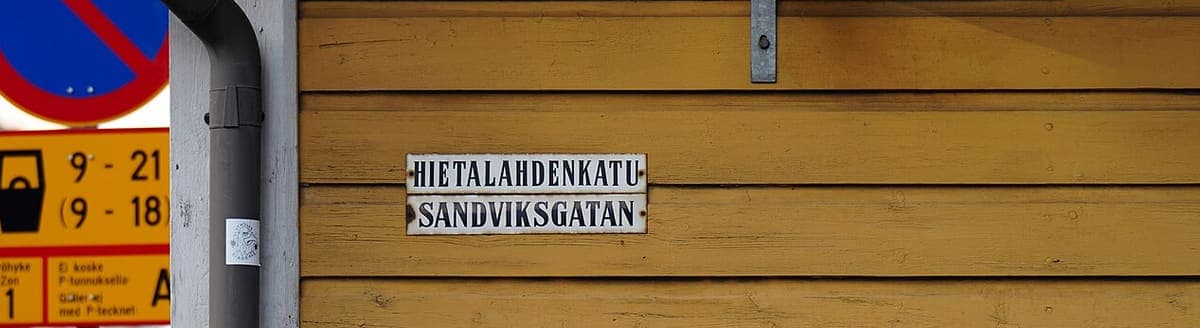
A plain reading of both name plates, matching the wording given in the Commons file title and description; this is not a published scholarly transcription, only a check of the short, unambiguous text against the photograph and the file’s own description.
HIETALAHDENKATU
SANDVIKSGATAN
Source: Wikimedia Commons file page for Bilingual street sign of Hietalahdenkatu in Helsinki, Finland, 2020.jpg (CC BY 2.0).
What Finnish writing looks like on the page
Finnish spelling is close to phonetic, which makes vowel and consonant length the main thing a transcription has to get right rather than an afterthought. Short and long sounds are written as one letter or two: kuka (who) against kukka (flower), tuli against tuuli, kisa (contest) against kissa (cat). Because both members of each pair are ordinary words, a single dropped or doubled letter does not produce an obvious error, it produces a different, equally plausible word, which is what makes this the single most consequential trap in reading Finnish. Ä and ö are separate letters from a and o, not accented forms of them, sorted at the end of the alphabet after z, and a transcription that treats västä as vasta or ödine as odine has simply misread the word.
Finnish also builds meaning by agglutination, adding case endings and joining words into compounds rather than using separate prepositions, so a single word can run to twenty or more letters: lentokonesuihkuturbiinimoottori (jet turbine aircraft engine) is the standard example, and ordinary street names and institutional names reach similar lengths without anyone treating them as unusual. A layout process built around English-length words wraps, hyphenates or truncates these compounds in places that break the word rather than a natural syllable boundary, and a search index that does not know Finnish case endings will fail to match a word to its dictionary form.
The oldest printed Finnish, beginning with Mikael Agricola’s catechism and New Testament in the 1540s and continuing through the first complete Finnish Bible of 1642, was set in Fraktur, the German blackletter typeface, with a long ſ, doubled consonants marked with a stroke and abbreviations that a reader of modern Finnish print has never had to parse. Fraktur remained the ordinary typeface for Finnish books and Bibles well into the nineteenth century, decades after Finland’s administrative language shifted from Swedish to Finnish, so a nineteenth-century parish Bible or hymnal can still be set in a face that looks nothing like the roman type of a newspaper from the very same decade.
Why ordinary OCR struggles here
A doubled letter that changes the word, not just the spelling
Because Finnish uses doubling to mark vowel and consonant length, tuli and tuuli, or kisa and kissa, are both real words rather than one being a typo of the other. Generic OCR trained on languages where doubling is rare or decorative has no reason to preserve it exactly, and a single missed or added letter produces a wrong but perfectly plausible reading.
Compounds long enough to break a line
Finnish compounds run far longer than anything English layout assumptions expect, and a transcription process that wraps, hyphenates or truncates text by character count rather than by Finnish word structure can break a single word across two lines or cut it mid-stem. Search and matching against a compound also fails if the case ending on the end of it is not recognised as part of the same word.
Fraktur letterforms with no equivalent in modern Finnish print
The long ſ, the Fraktur r and the doubling marks of sixteenth- to nineteenth-century Finnish printing share almost no shapes with the roman type used in Finnish print since. A model trained only on modern Finnish text has nothing to match these letterforms against and will guess from context rather than recognise them.
Administrative vocabulary in handwritten fill-ins
Filled-in forms, membership cards and registers mix printed headings with handwritten answers that use compact administrative words such as pataljoona (battalion) or komppania (company); reading the handwriting correctly depends on recognising the doubled letters in these specific terms rather than guessing at an unfamiliar shape.
Who works with this material
Genealogists and local historians
Finnish parish registers, membership cards and population records mix printed forms with handwritten entries, often in administrative vocabulary particular to the period, such as a Civil War-era militia card. Getting the doubled letters and case endings right is what makes a name or place searchable against later records.
Libraries digitising historical Finnish print
Collections spanning Fraktur-set Bibles and hymnals through nineteenth-century roman-type newspapers need a transcription process that recognises both typefaces on their own terms, since treating an early Fraktur page as garbled modern print produces unusable output.
Search and language-technology teams
Any system indexing Finnish text has to treat a word’s case-marked and compounded form as equivalent to its dictionary entry, and has to preserve vowel and consonant length exactly, or matching and full-text search will silently miss a large share of real hits.
Translators and terminology specialists
Long compounds carry precise technical or institutional meaning that a translator needs intact and correctly segmented, and a transcription that mangles a doubled letter inside a compound can turn a recognisable term into one that does not exist in any dictionary.
Getting the best transcription
Ask for vowel and consonant length to be checked, not assumed
Tell the model that doubled letters are meaningful in Finnish and that it should read length carefully rather than normalising to whichever spelling looks more familiar.
Say the source is Fraktur when it is
Flagging an early Finnish Bible or hymnal as Fraktur-set before transcription lets the model apply the right letterforms from the first line rather than trying to read them as modern roman type.
Let long compounds run on as single words
Ask for compounds to be transcribed as the single unbroken words they are, with hyphenation only where the source itself hyphenates, so the output matches how the word would appear in a Finnish dictionary.
Test on a page with handwritten fill-ins first
Run a filled-in form or register page before a full batch, and check that administrative terms with doubled letters, such as pataljoona or komppania, come back correctly rather than as an unfamiliar near-miss.
Frequently asked questions
- Does it distinguish short and long vowels and consonants, such as tuli versus tuuli?
- Yes, doubled letters are read as the meaningful length markers they are in Finnish, rather than being treated as a likely typo and corrected away.
- Are ä and ö kept separate from a and o?
- Yes, they are transcribed as their own letters, which matters both for correct reading and for sorting Finnish word lists in the right alphabetical order.
- Can it handle very long compound words without breaking them?
- Yes, a long compound is transcribed as the single word it is; hyphenation is only added where the source document itself hyphenates the word across a line.
- Can it read Fraktur-printed Finnish, such as the 1642 Bible?
- Yes, Fraktur is recognised as its own typeface rather than approximated from modern Finnish roman type, and the long ſ and period doubling marks are read correctly.
- What about handwritten entries on old Finnish forms and membership cards?
- Handwritten fill-ins are read alongside the printed template, with attention to the specific administrative vocabulary of the period so a term like pataljoona is not misread as a similar-looking but different word.
Related scripts and pages
Turn your Finnish documents into text
Upload a Fraktur-printed Bible page, a period newspaper or a handwritten form, and check every doubled letter against the image line by line.