
German · c. 750–1050
Read the earliest written German on its own page
Before German had settled spelling or its own script, monks wrote it in the Latin hands of Fulda, St Gallen and Freising, often squeezed between the lines of a gospel or glossary they were really copying for its Latin. Evidano keeps the German separate from the Latin around it and reads the Caroline and Insular letterforms that shape both.
Sample pages
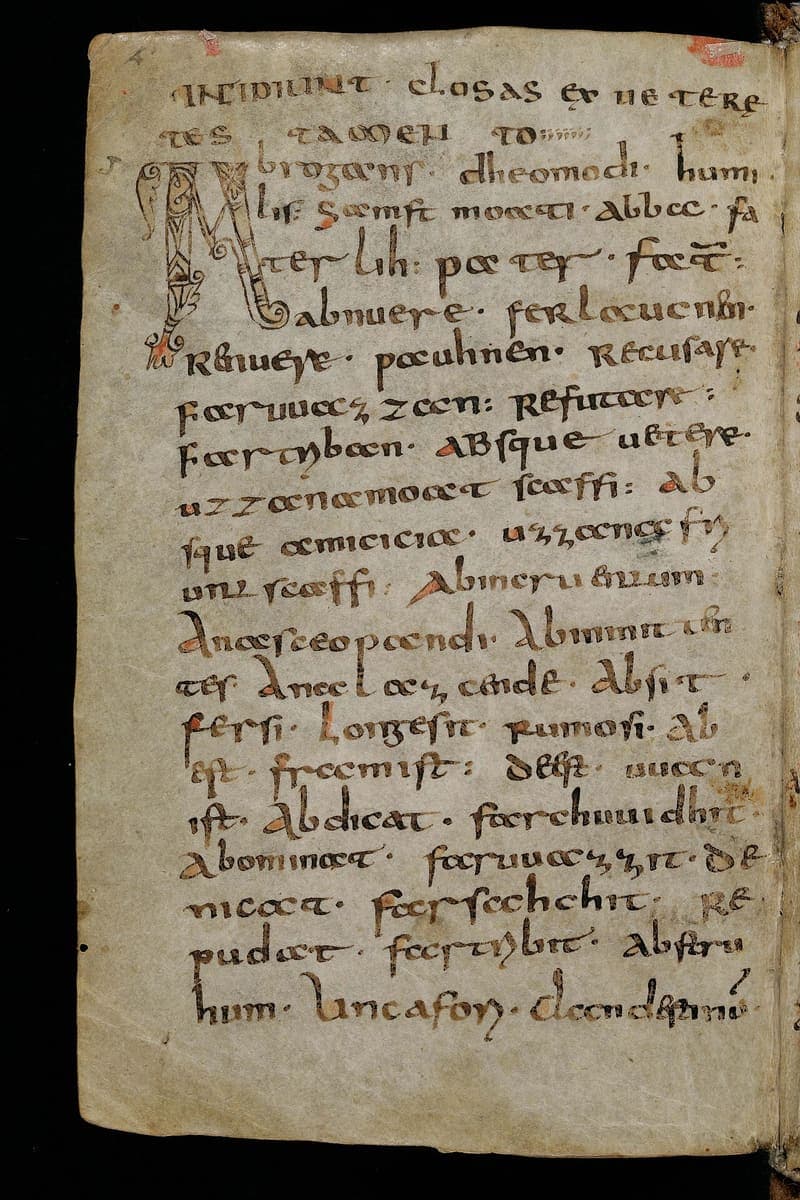
Stiftsbibliothek St Gallen, Cod. Sang. 911, c. 790 · Source · Public domain
Evidano Transcription
INCIPIUNT · closas ex uetere
tes tamen to :::::
Abrogans · dheomodi · humi
lis samft moati · abba · fa
ter lih : pater · fat[er] :
Abnuere · ferlaucnan[?] ·
Renuere · pauhnen · Recusare ·
faruuazzan : Refutare :
fartriban · ABsque ubere ·
uzzanamoat scaffi : ab
sque amicitia · uzzanec fri
unt scaffi · Abincru hum[?] :
anasceopandi · Abministra[?]
ter anaclaezande · Absit ·
ferri · longe sit · rumori · ab
est · freemist : deest · uuan
ist · Abdicat · farchuuidhit ·
Abominat · faruuazzit · de
nicat · farsechchit · Re
pudiat · fartribit · abstru
hum · uncafon · clendarni[?] :
Generated by Evidano’s advanced model; not yet checked against a published edition.
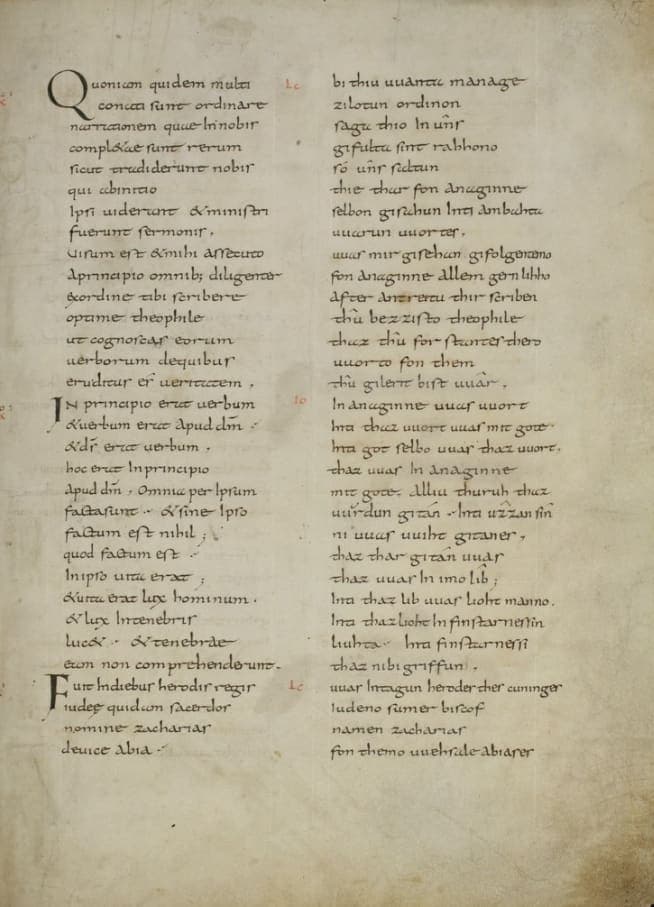
Stiftsbibliothek St Gallen, Cod. Sang. 56, c. 830 · Source · Public domain
Evidano Transcription
The Latin preface and John 1:1–4 in the right-hand German column, from Eduard Sievers’s edition; a Fraktur-typeset 1872 printing whose OCR long-s and u/n confusions have been corrected against the standard reading and checked against the letterforms on the page.
Quoniam quidem multi conati sunt ordinare narrationem quae in nobis conpletae sunt rerum, sicut tradiderunt nobis qui ab initio ipsi viderunt et ministri fuerunt sermonis, visum est et mihi adsecuto a principio omnibus diligenter ex ordine tibi scribere, optime Theophile, ut cognoscas eorum verborum de quibus eruditus es veritatem.
Bithiu uuanta managu zilotun ordinon saga thiu in uns gifultu sint rahhono, sie uns santun thie thar fon anaginne selbon gisahun inti ambahta uuarun uuortes, uuas mir gisehan gifolgentemo fon anaginne allem gerno after antreitu thir scriben, thu bezzisto Theophile, thaz thu forstantes thero uuorto so thu gilerit bist uuar.
In principio erat verbum et verbum erat apud deum et deus erat verbum. Hoc erat in principio apud deum. Omnia per ipsum facta sunt et sine ipso factum est nihil; in ipso vita erat et vita erat lux hominum.
In anaginne uuas uuort inti thaz uuort uuas mit gote inti got selbo uuas thaz uuort. Thaz uuas in anaginne mit gote. Allu thuruh thaz uurdun gitan inti uzzan sin ni uuas uuiht gitanes thaz thar gitan uuas; thaz uuas in imu lib inti thaz lib uuas lioht manno.
Source: Tatian: lateinisch und altdeutsch, ed. Eduard Sievers (Bibliothek der ältesten deutschen Litteraturdenkmäler V, Paderborn, 1872), Caput I, via Internet Archive (Public domain).
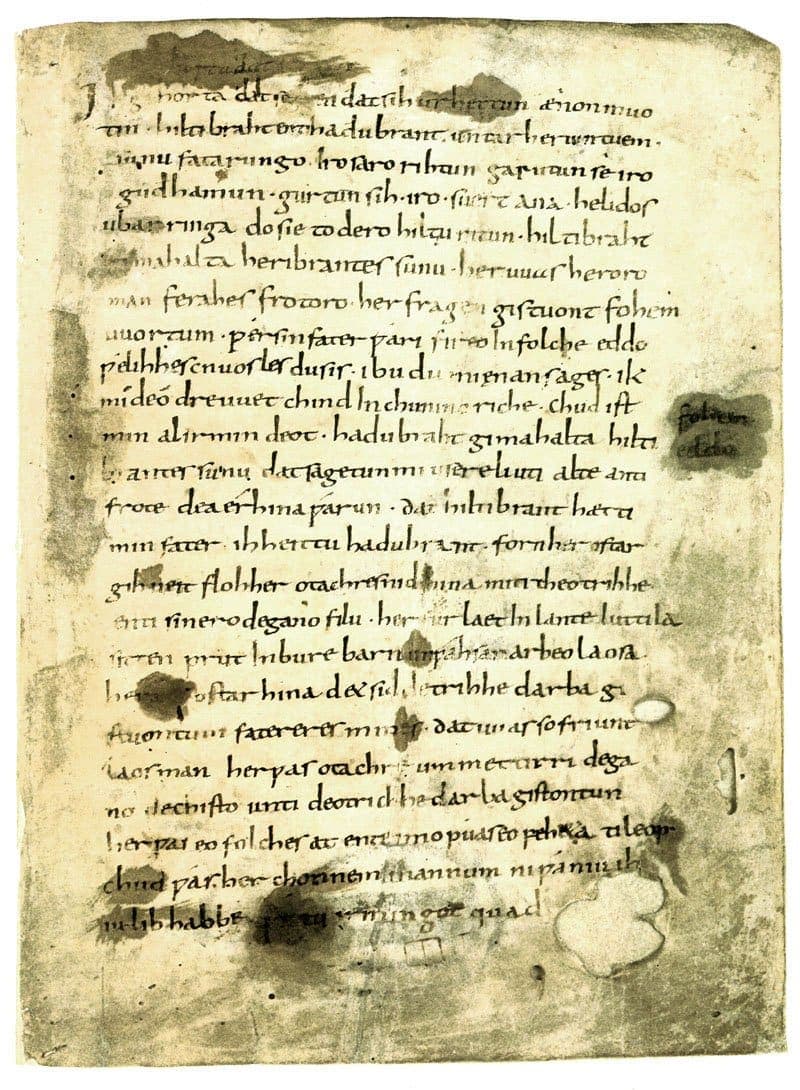
Universitätsbibliothek Kassel, 2° Ms. theol. 54, c. 830–840 · Source · Public domain
Evidano Transcription
The opening 30 lines of the poem, corresponding to this leaf, as proofread on German Wikisource: a diplomatic transcription that keeps the manuscript’s wynn (ƿ), long s and word division, with the scribe’s line breaks marked.
Ik gihorta dat seggen
dat sih urhettun ænon muotin
hiltibrant enti hadubrant untar heriun tuem
sunu fatarungo iro saro rihtun
garutun se iro gudhamun gurtun sih iro suert ana
helidos ubar ringa do sie to dero hiltiu ritun
hiltibrant gimahalta heribrantes sunu her uuas heroro man
ferahes frotoro her fragen gistuont
fohem uuortum wer sin fater wari
fireo in folche … eddo welihhes cnuosles du sis
ibu du mi enan sages ik mi de odre uuet
chind in chunincriche chud ist mir al irmindeot
hadubrant gimahalta hiltibrantes sunu
dat sagetun mi usere liuti
alte anti frote dea erhina warun
dat hiltibrant hætti min fater ih heittu hadubrant
forn her ostar giweit floh her otachres nid
hina miti theotrihhe enti sinero degano filu
Source: Hildebrandslied, transcribed by Arnd Grossmann, via German Wikisource (CC BY-SA 3.0).
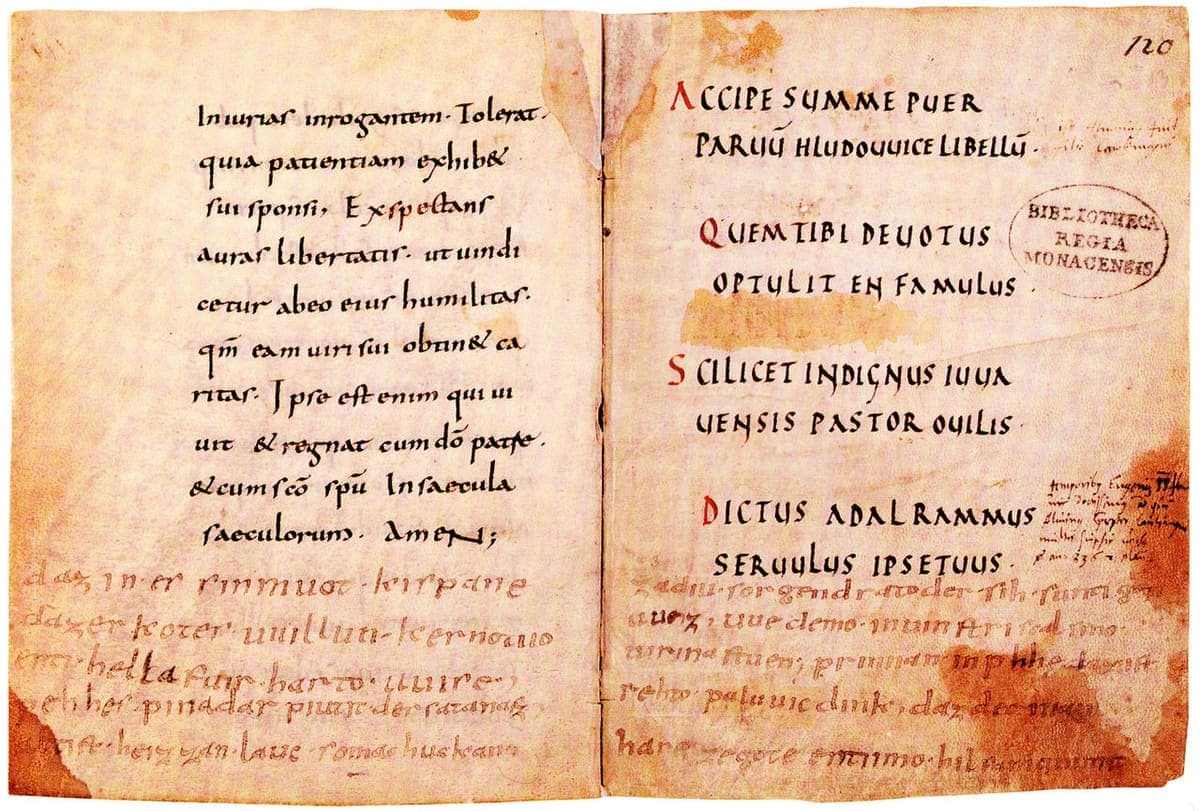
Bayerische Staatsbibliothek, Munich, Clm 14098, ff. 119v–120r, main text c. 830; poem added c. 870 · Source · Public domain
Evidano Transcription
Iniurias inrogantem · Tolerat ·
quia patientiam exhib&
sui sponsi · Exspectans
auras libertatis · ut uindi
cetur abeo eius humilitas ·
q[uonia]m eam uiri sui obtin& ca
ritas · Ipse est enim qui ui
uit & regnat cum d[e]o patre ·
& cum s[an]c[t]o sp[irit]u In saecula
saeculorum · Amen;
daz in es sin muot · kispane
daz er kotes · uuillun · kerno tuo
enti hella fuir · harto · uuise ·
pehhes · pina dar piuit der satanas
altist · heizzan · lauc · so mac huckan
120
ACCIPE SUMME PUER
PARUU[M] HLUDOUUICE LIBELLU[M] ·
QUEM TIBI DEUOTUS
OPTULIT EN FAMULUS ·
SCILICET INDIGNUS IUUA
UENSIS PASTOR OUILIS ·
DICTUS ADALRAMMUS
SERUULUS IPSE TUUS ·
za diu · sorgen drato der sih · suntigen
uueiz · uue demo · in uinstri scal sino
uurina stuen · prinnan in pehhe · daz ist[?]
rehto · paluuic dink · daz der man[?]
haret ze gote enti imo · hil[fa ni][?] quimit
[stamp: BIBLIOTHECA REGIA MONACENSIS]
[later marginal notes illegible]
Generated by Evidano’s advanced model; not yet checked against a published edition.
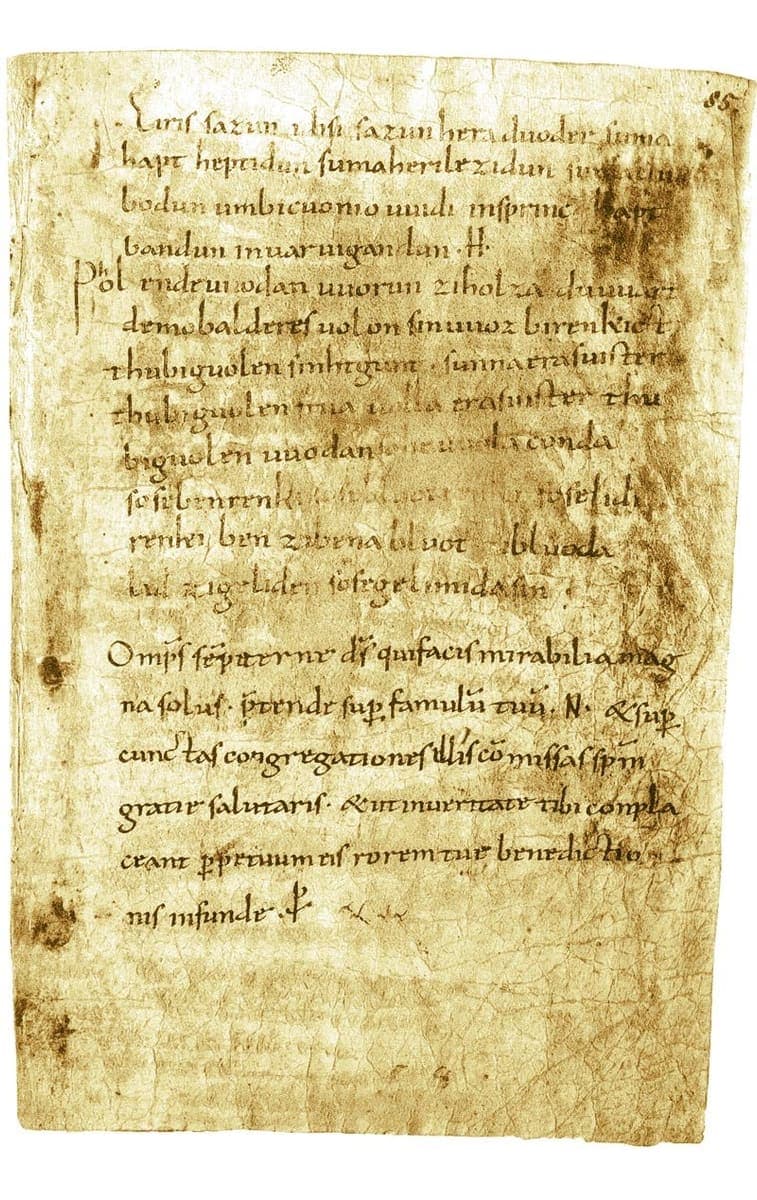
Domstiftsbibliothek Merseburg, Cod. 136, f. 85r, c. 900–950 · Source · Public domain
Evidano Transcription
Both charms, transcribed line for line as they stand on the folio, from the diplomatic edition on German Wikisource; word division and letterforms follow the manuscript, with no expansion of the scribe’s continuous script.
Eiris sazun idisi sazun hera duoder
suma hapt heptidun suma heri lezidun
suma clubodun umbi cuoniouuidi
insprinc haptbandun invar uigandun

Phol ende uuodan uuorun zi holza
du uuart demo balderes uolon sin uuoz birenkict
thu biguolen sinhtgunt sunna era suister
thu biguolen friia uolla era suister
thu biguolen uuodan so he uuola conda
sose benrenki sose bluotrenki
sose lidirenki ben zi bena bluot zi bluoda
lid zi geliden sose gelimida sin
Source: Merseburger Zaubersprüche, via German Wikisource (CC BY-SA 3.0).
What an Old High German page looks like
Old High German covers roughly 750 to 1050, the period before the vernacular had its own literature and its own script. Almost everything that survives from these three centuries is bound into Latin manuscripts: a bilingual glossary such as the Abrogans, a gospel harmony such as Tatian with Latin and German in parallel columns, short poems copied onto spare leaves (the Hildebrandslied, the Merseburg charms), or a vernacular stanza dropped beneath an unrelated Latin text, as happens in the Muspilli manuscript. The hand is whatever the scriptorium used for Latin at the time: Caroline minuscule at centres such as St Gallen and Fulda, an older, more angular Insular-influenced minuscule in earlier or more conservative houses.
Because German had no agreed orthography, the same sound can appear spelled three or four different ways within a single text, and a scribe trained to write Latin reaches for Latin letter values that do not quite fit German phonology. Long s and round s alternate without a rule; u and v, i and j are not yet distinct letters; the digraphs used for the new High German consonant shift (hh, ck, zz) are inconsistent from one copy to the next. Abbreviation strokes borrowed wholesale from Latin scribal practice mark a missing nasal or a common ending, and a scribe glossing a Latin word will often abbreviate the German gloss the same way, so the mark has to be read against the word it sits over.
Layout tells you what kind of text you are looking at. Interlinear glosses are written smaller, above the Latin word they explain, with an insertion mark tying gloss to lemma; marginal glosses run down the edge of the page; a poem like Muspilli is added in a different, less practised hand below a Latin text with no formal connection to it. Many of the key witnesses are damaged or displaced: the Merseburg charms survive only because a later binder used a spare leaf as a flyleaf in an unrelated manuscript, and several glossaries are known only from single, imperfect copies.
Why ordinary OCR struggles here
Spelling with no fixed rule
A word can be spelled several ways across a single glossary because no standard orthography existed yet. A model trained on modern German normalises silently and erases exactly the variation a linguist needs to see; the transcription has to keep the scribe’s own letters.
Glosses hiding inside Latin
The German word is often a single interlinear addition above a Latin lemma, in smaller script, tied to it by a caret or a matching sign. Recognising that a mark belongs to the gloss and not the main text, and keeping the two languages apart, is not something generic OCR is built to do.
One page, two languages, one script
Tatian sets Latin and Old High German in parallel columns of the same hand; Muspilli drops a German poem below an unconnected Latin text in a rougher hand. A transcription has to follow the reading order the page actually uses, not assume the whole page is in one language.
Survival by accident
The Merseburg charms exist because a monastery reused a blank leaf; other glossaries survive in a single, damaged exemplar. Faded ink, trimmed margins and later foliation sit next to the ninth-century hand, and the transcription needs to separate what the scribe wrote from what later hands or bindings added.
Who works with this material
Editors of glosses and glossaries
A diplomatic edition of a bilingual glossary needs every Latin headword paired with its German gloss exactly as the scribe wrote it, abbreviation and all. A transcription that keeps the two languages distinct saves an editor the first, most error-prone pass by hand.
Historical linguists building sound-change corpora
Tracking the High German consonant shift or early umlaut spellings requires letter-by-letter consistency across manuscripts from different scriptoria. Normalising away spelling variation, which generic tools do automatically, removes the evidence the corpus is built to hold.
Manuscript and library curators
Cataloguing a codex that mixes Latin and vernacular content means describing exactly where the German text sits, how much of it there is, and which hand added it. A page-level transcription with language tagged makes that description quick to check.
Teachers of early Germanic philology
Students learning to read Caroline and Insular hands benefit from a transcription set beside the image: they can test their own reading of an abbreviation or a variant spelling against a checked text before moving to an unfamiliar page.
Getting the best transcription
Mark which language each line belongs to
Tell the model to tag Latin and Old High German separately, especially on a page like Tatian’s where the two run in parallel columns, or Muspilli’s, where the vernacular sits below an unrelated Latin text in a different hand.
Ask for the scribe’s spelling, not a normalised one
Say explicitly that variant spellings, doubled consonants and inconsistent u/v or i/j should be kept as written. A model left to guess will quietly regularise the spelling, which erases the evidence a philologist needs.
Start with a bilingual or interlinear page
Test the prompt on a page where Latin and German are visibly mixed, such as an interlinear gloss or the Tatian harmony. If the model separates the two languages correctly there, it will handle a single-language page easily.
Flag insertion marks and later additions separately
Ask for carets, insertion signs and anything added by a later hand to be noted rather than folded into the main text, so an editor can see at a glance what belongs to the original scribe.
Further reading on this hand
The palaeography guides the in-app selector points to for this domain, if you want to check a transcription against the standard references.
- Latin Paleography
This Hill Museum & Manuscript Library (HMML) course teaches the Insular and Caroline scripts used by the scribes of early medieval Latin codices. It supplies manuscript examples, alphabets, and exercises covering letterforms, ligatures, abbreviations, punctuation, and additions. Old High German survives extensively as glosses and short vernacular passages within codices produced in these same script traditions. The course therefore supports identification of the graphical systems surrounding early German material even though its primary instructional language is Latin.
Frequently asked questions
- Does the transcription keep the scribe’s own spelling, or does it normalise it?
- It keeps the manuscript’s own spelling by default, including the variant forms of the same word that are common in this period. Normalised German can be added as a second layer if you ask for it, but the diplomatic reading comes first.
- How are interlinear glosses distinguished from the Latin they explain?
- The transcription follows the page’s own layout, marking a gloss as a separate, smaller addition tied to its Latin word, rather than merging it into the main text as continuous prose.
- Can it handle a page like Tatian, where Latin and German run side by side?
- Yes. You can ask for the two columns to be transcribed separately and aligned, or run together in reading order; either way the two languages are kept distinct rather than blended.
- What happens with damaged or illegible sections, as in the Merseburg charms leaf?
- Letters that cannot be read are marked as uncertain rather than guessed at, so an editor can see exactly where the manuscript itself is unclear and compare that against earlier printed editions.
- Will later additions, like the Muspilli poem added beneath an older Latin text, be kept apart from the main hand?
- Yes. A later addition in a different, identifiable hand is transcribed as such and can be labelled separately, so the two layers of the page are not run together as if written at the same time.
Related scripts and pages
Transcribe your Old High German folio
Upload a scan, choose Old High German as the domain, and test the prompt on a bilingual page before running the rest.