
German · Image to Text
Twelve centuries of German handwriting, one hand at a time
German was written in five markedly different hands between the eighth century and the middle of the twentieth: Caroline glosses, Gothic book script, chancery cursive, Kurrent and Sütterlin. Evidano reads each on its own terms, from a ninth-century glossary to a wartime field postcard.
Choose the hand or document type
 Old High German in Carolingian and Insular Manuscriptsc. 750–1050Transcribe Old High German glosses, charms and gospel harmonies copied in Caroline and Insular hands, from the Abrogans to Tatian, with checked readings.
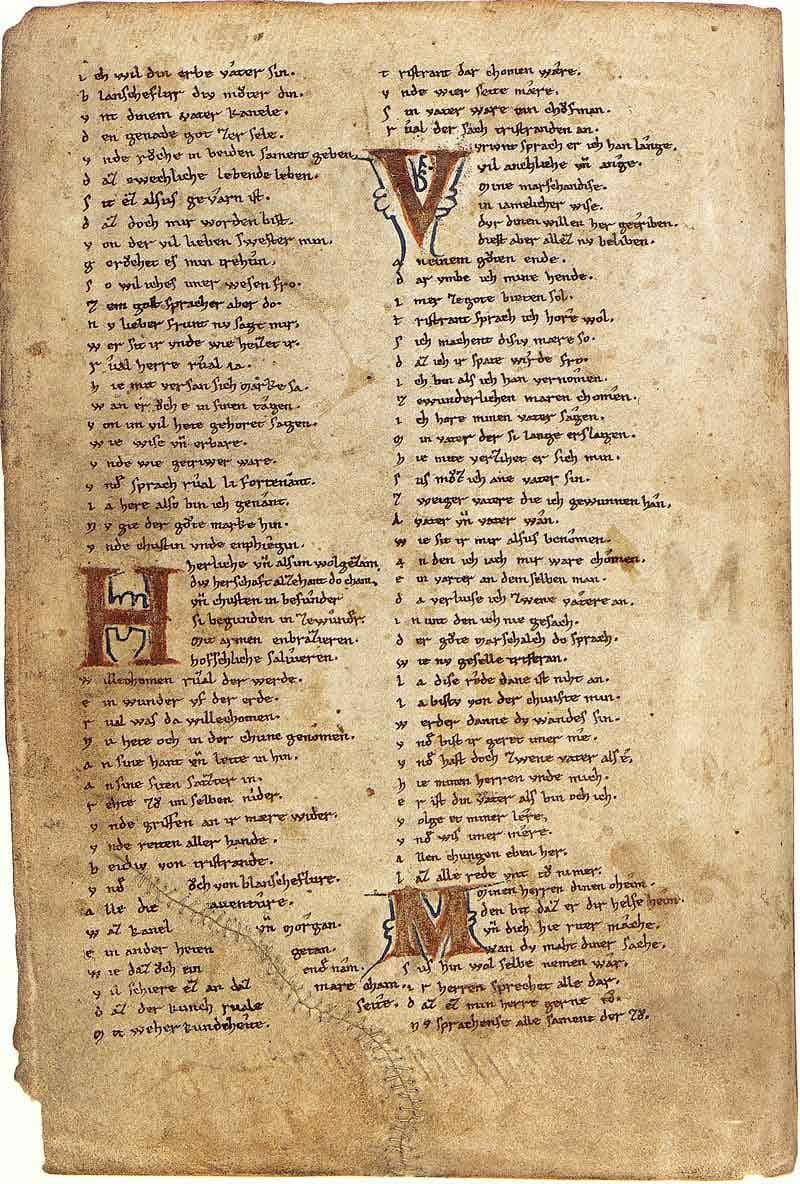 Middle High German Gothic Book Handsc. 1050–1400Transcribe Middle High German epics, courtly romance, Minnesang and law codes copied in Gothic Textualis, from the Nibelungenlied to the Sachsenspiegel.
 Late Medieval and Early Modern German Chancery Handsc. 1400–1650Transcribe notarial deeds, Reformation letters and diplomatic newsletters written in Kanzleischrift and humanist cursive, c. 1400 to 1650.
 German Kurrent Administrative and Personal Handsc. 1650–1915Transcribe two and a half centuries of German Kurrent: parish registers, personal letters and colonial correspondence, with checked readings.
 Sütterlin and Late Kurrentc. 1911–1941Transcribe Sütterlin school hands, personal letters and wartime postcards from the last thirty years German schools taught a running hand.
Transcribing German across the centuries
What survives from the earliest centuries is mostly incidental: German words glossing a Latin text, a short poem on a spare leaf, a charm added to an unrelated manuscript. Only from around 1200 does German get manuscripts of its own — epics, romance, Minnesang and law codes — in the Gothic book hand also used for Latin. Chancery documents follow from the fifteenth century, and from the mid-seventeenth century almost every literate German speaker used Kurrent, the connected cursive behind parish registers, family letters and colonial correspondence, until Sütterlin’s simplified school hand and, after 1941, an abrupt official switch to Latin script ended the tradition.
The hand changes more than the language does. A Caroline scribe reached for whatever Latin script his scriptorium used; Gothic Textualis packs minims so tightly that counting them becomes part of reading; chancery cursive loops well past the letter it is built from; Kurrent and Sütterlin compress the same confusable shapes — e, n, u, long s — into ever faster everyday writing. Abbreviation, damage, mixed languages and a writer’s own habits shape what a transcription has to solve at every stage.
Philologists editing glosses and epics, legal and family historians reading deeds and parish registers, genealogists tracing Kurrent surnames, and archivists cataloguing letters and Feldpost all work from the same material: a page whose script most people can no longer read fluently. A transcription checked against the manuscript, and against a published edition where one exists, gives them a starting point they can trust.
Not sure which hand you have?
Upload a page, pick the closest domain, and test the prompt on one page before running the rest. You can switch domains at any time.