
German · c. 1911–1941
Read Sütterlin and the last generation of German Kurrent
Ludwig Sütterlin designed his school hand in 1911 to be easier to teach than traditional Kurrent, and Prussian and then German schools adopted it from 1915 until the Nazi government abruptly banned it in 1941. Evidano reads both the upright, regularised Sütterlin taught in classrooms and the older, more individual Kurrent that many adults kept using alongside it.
Sample pages
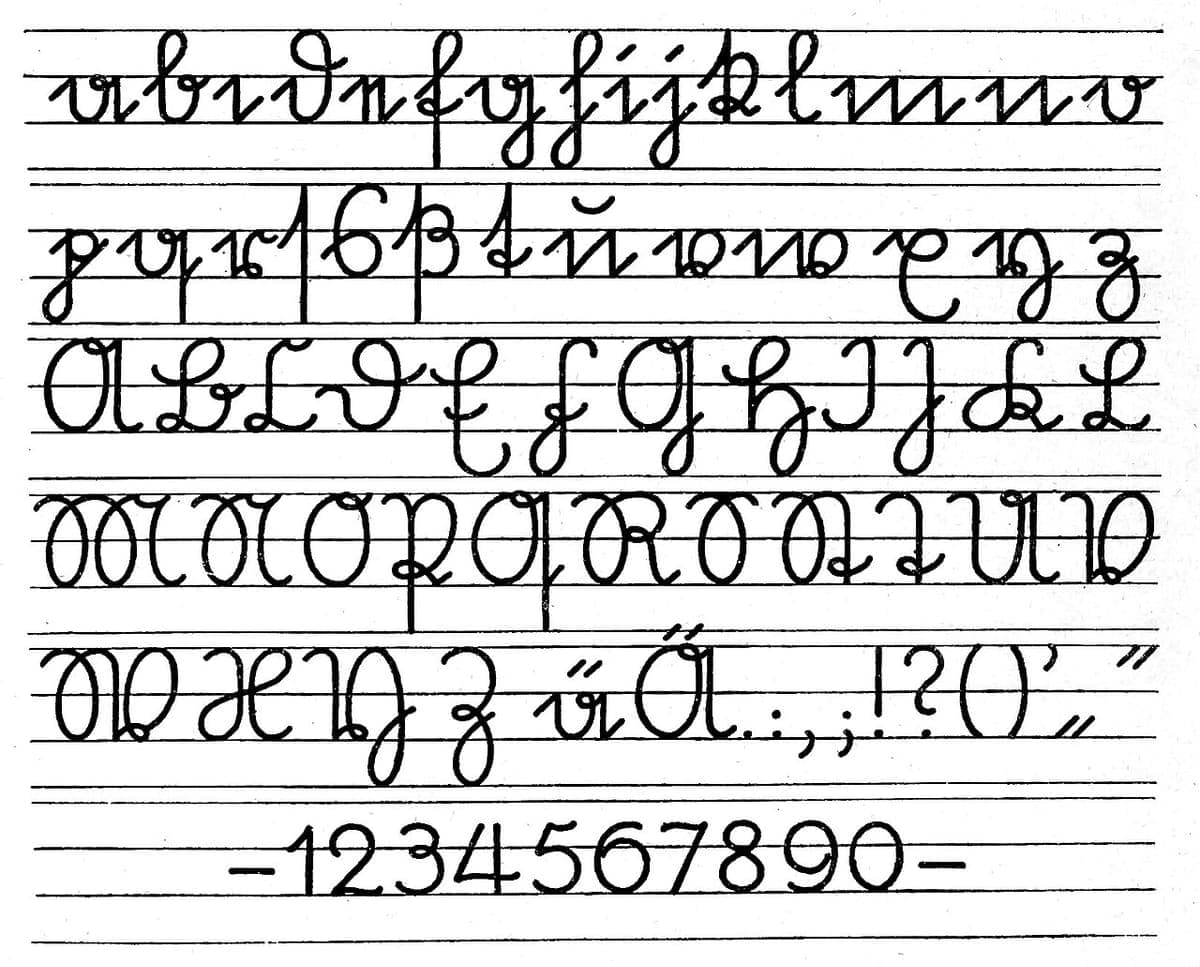
Deutsche Nationalbibliothek, 1922 (script designed 1914) · Source · Public domain
Evidano Transcription
a b c d e f g h i j k l m n o
p q r ſ s ß t u v w x y z
A B C D E F G H I J K L
M N O P Q R [remaining capitals not confidently identifiable]
[capitals and umlaut letters not confidently identifiable] . : , ; ! ? ( ) ' „ "
- 1 2 3 4 5 6 7 8 9 0 -
Generated by Evidano’s advanced model; not yet checked against a published edition.
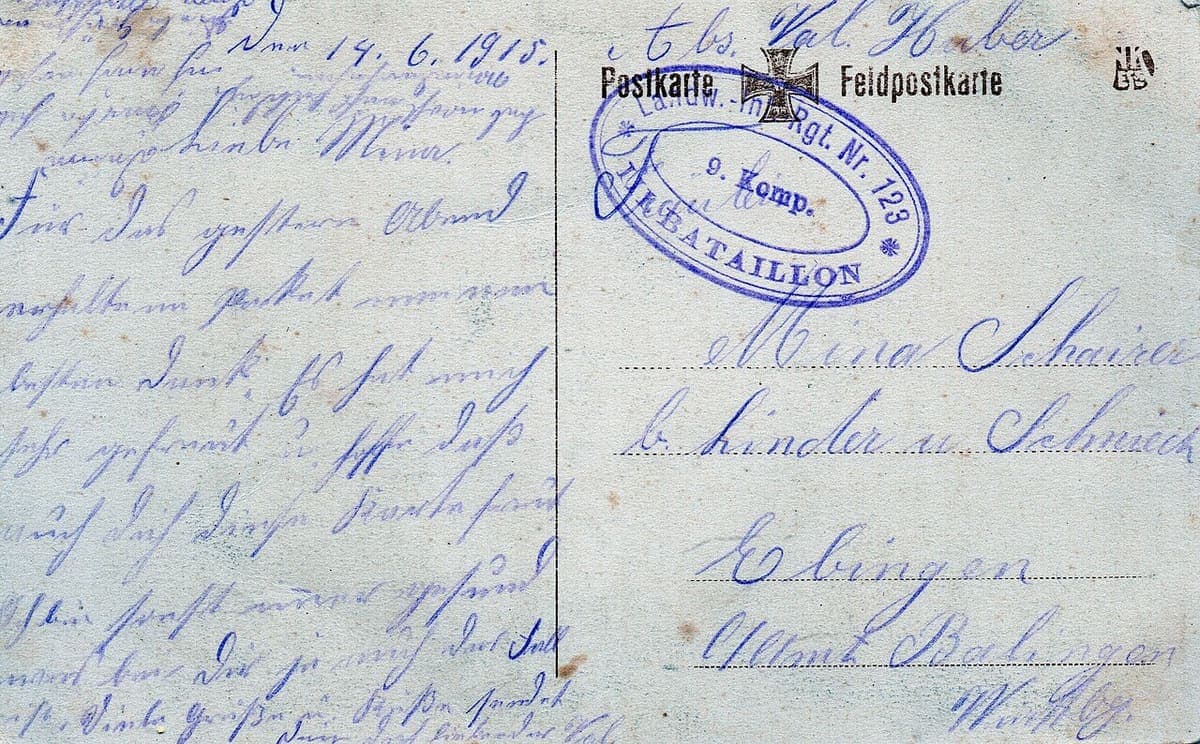
Evidano Transcription
[faint lines at the top, partly cut off, illegible]
Den 14. 6. 1915.
[illegible] Liebe Mina.
Für das gestern Abend
erhaltene Paket meinen
besten Dank. Es hat mich
sehr gefreut u. hoffe daß
auch dich diese Karte [illegible]
[cut off] bin sonst immer[?] gesund
[cut off] bei Dir ja auch der Fall
[cut off] Viele Grüße u. Küsse sendet
Dir Dein liebender Val.
Abs. Val. Haber
Postkarte Feldpostkarte
[stamp: Landw.-Inf.-Rgt. Nr. 123 · 9. Komp. · I. BATAILLON]
Mina Schairer
b. Linder u. Schmeck[?]
Ebingen
OAmt[?] Balingen
Württbg.
Generated by Evidano’s advanced model; not yet checked against a published edition.
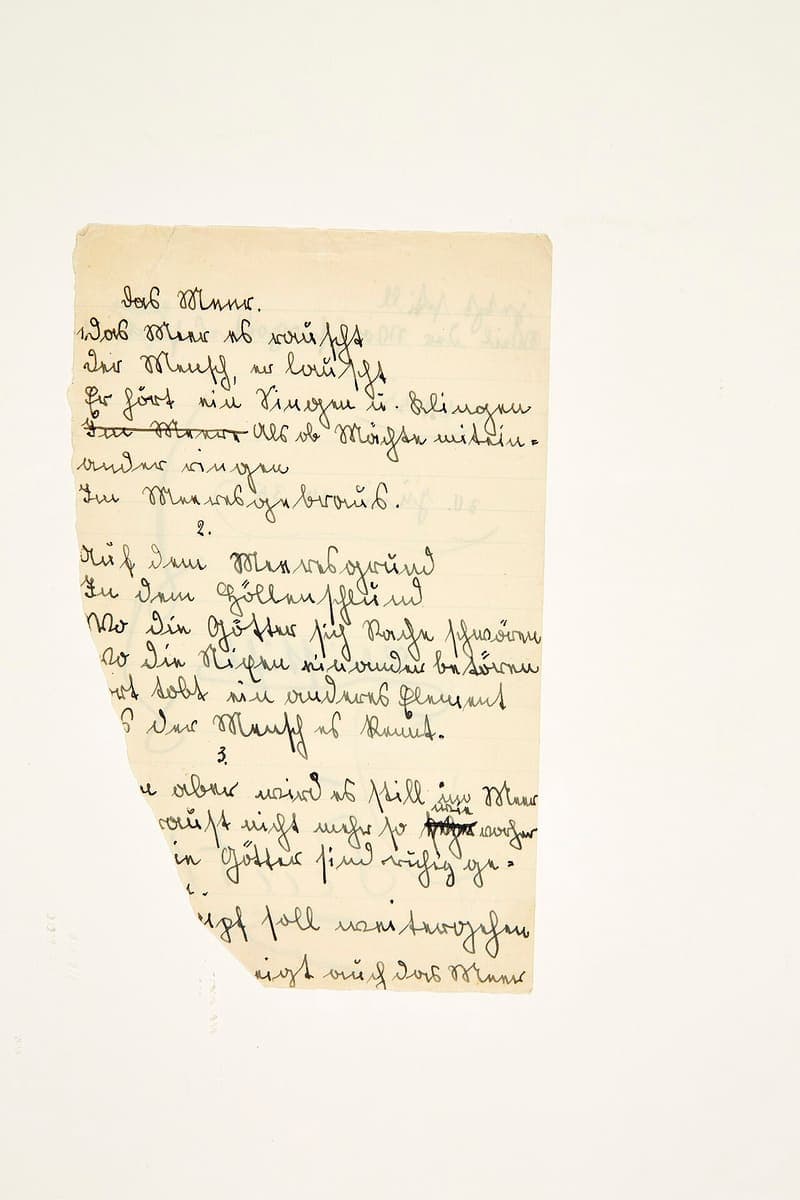
Kunststiftung Ruth Baumgarte, 1935 · Source · CC BY-SA 4.0
Evidano Transcription
Das Meer.
Das Meer es rauscht
Der Mensch, er lauscht
Er hört ein Singen u. Klingen
[cancelled: Im Meere] Als ob Mächte mitein=
ander ringen
Im Meeresgebraus.
Auf dem Meeresgrund
In dem Höllenschlund
Wo die Götter sich Rache schwören
Wo die Riesen einander beschwören
[cut off]rt lebt ein anderes Element
[cut off]s der Mensch es kennt.
[cut off] aber wird es still im Meer
rauscht nicht mehr so [cancelled: illegible] \wie/ vorher
[cut off]ie Götter sind ruhig ge=
[cut off]
[cut off] soll weitergehen
[cut off] nicht auch das Meer
Generated by Evidano’s advanced model; not yet checked against a published edition.
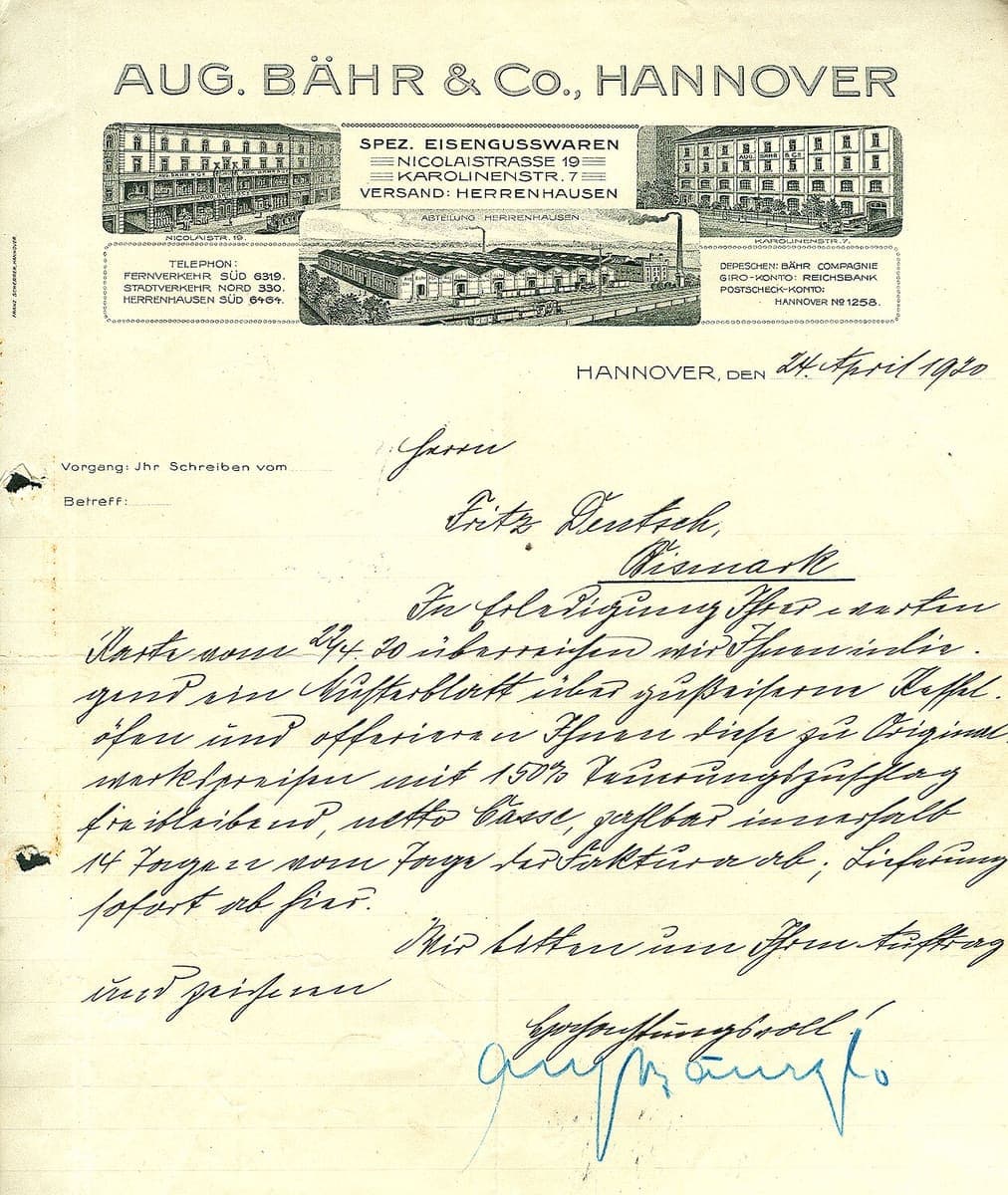
Source · CC BY-SA 3.0 · Scan of the original by Bernd Schwabe, Hannover
Evidano Transcription
The whole handwritten portion of the sheet — the dated place line, the address, the body and the closing — exactly as published in the “Transkript” field of the Wikimedia Commons file description by the collector who scanned the original. It is a transcript on a file description page rather than a scholarly edition, so it carries no editorial apparatus: the line breaks and end-of-line hyphens of the manuscript are kept, and the illegible signature is given as “[Unterschrift]”. The printed letterhead above the date line is not covered.
Hannover, den 24. April 1920

Herrn
Fritz Deutsch,
Bismark.

In Erledigung Ihrer werten
Karte vom 22.4.20 überreichen wir Ihnen inlie-
gend ein Musterblatt über gußeiserne Kessel-
öfen und offerieren Ihnen diese zu Original-
werkspreisen mit 150 % Teuerungszuschlag
freibleibend, netto Casse, zahlbar innerhalb
14 Tagen vom Tage der Faktura ab; Lieferung
sofort ab hier.

Wir bitten um Ihren Auftrag
und zeichnen

Hochachtungsvoll!
[Unterschrift]
Source: Transcript published on the Wikimedia Commons file description page (CC BY-SA 3.0).
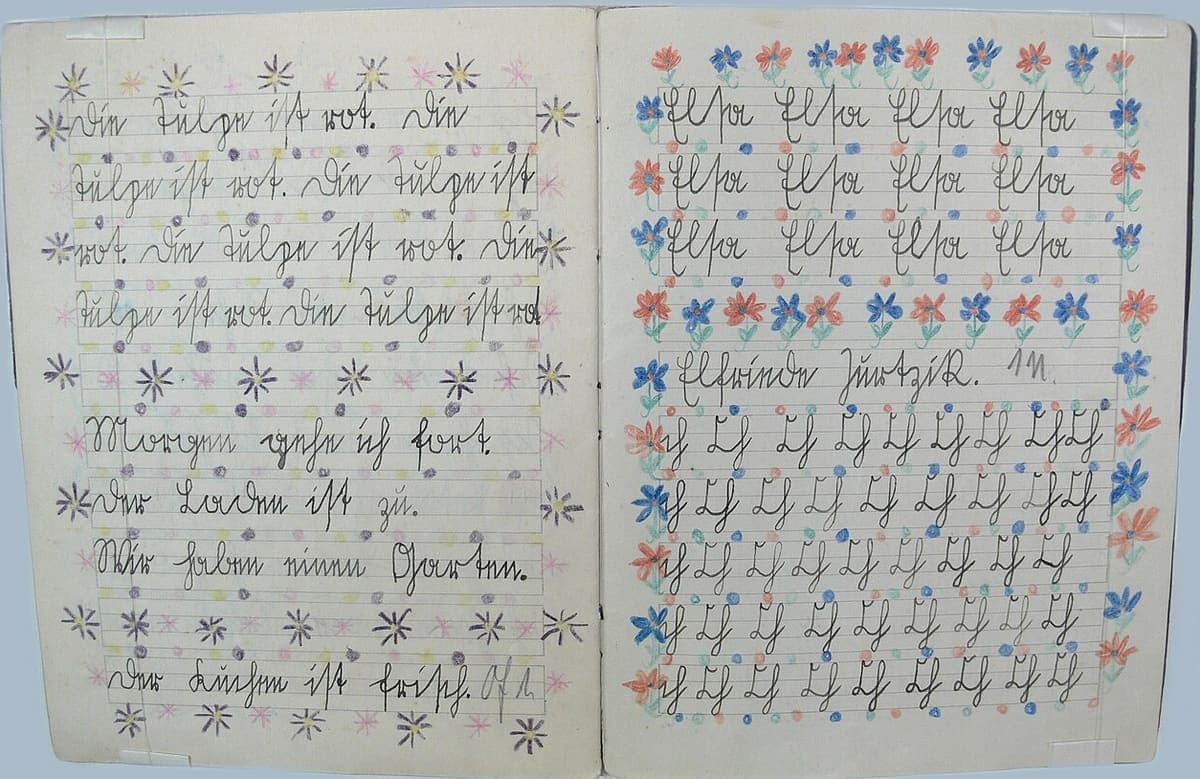
Stiftung Stadtmuseum Berlin, Sammlung Kindheit und Jugend, 1929 · Source · Public domain · Photograph by Andreas Praefcke
Evidano Transcription
Both pages of the open spread, in the reading order left page then right, as set out in the description field of the Wikimedia Commons file page by the photographer who made the image. It is a file-description transcript rather than an edition, and it is deliberately partial: the “(…)” and “[…]” markers are his, standing for the repetitions of each copybook line that he did not write out in full.
Die Tulpe ist rot. (…)
Morgen gehe ich fort.
Der Laden ist zu.
Wir haben einen Garten.
Der Kuchen ist frisch.
Elsa. […]
Elfriede Jurtzik.
ch Ch Ch Ch Ch Ch Ch Ch Ch […]
Source: Transcript published on the Wikimedia Commons file description page (Public domain).
What Sütterlin and late Kurrent look like
Sütterlin was created as a simplified, more upright model for teaching handwriting in German schools, first adopted in Prussia from 1915 and later across Germany, and remained the standard school hand until the Nazi government banned so-called Schwabacher and Sütterlin scripts in 1941 in favour of a Latin-based running hand. In practice, the thirty years this domain covers mix generations: children taught the new Sütterlin model, adults who had learned older, more slanted Kurrent at school decades earlier, and everyone in between, so a family archive from this period can show two or three visibly different versions of what is nominally the same script on different pages.
Sütterlin regularised many of Kurrent’s more idiosyncratic features into a more upright, geometrically consistent letterform, intended to be easier for a child to learn and to write quickly. The letters that cause confusion are largely the same as in older Kurrent — e against n, u marked by its small diacritic, long s against f, final s against other terminal loops — but Sütterlin’s more mechanical regularity can make an unfamiliar reader over-trust the shapes and miss a genuine anomaly, such as a Latin-script insertion for a foreign word or a name.
The documents that survive from this period range from formal specimen sheets used to teach the script and the decorated exercise books in which children copied it out, through ordinary letters, commercial correspondence written by hand on printed letterheads, and postcards of the 1920s and 1930s, to the enormous volume of Feldpost — field postcards and letters exchanged between soldiers and their families — that Germany’s involvement in two world wars produced. Postal conventions, military stamps and abbreviations, and the pressure of writing quickly under difficult conditions all shape the handwriting on this wartime material.
Why ordinary OCR struggles here
Two scripts on one page, or in one archive
Sütterlin’s regular, upright forms sit alongside older, more slanted Kurrent in family papers from this period, sometimes in the same letter where a writer switches between styles or a Latin-script insertion breaks up a Sütterlin passage. Recognising both is necessary, not optional, for material from these three decades.
The same confusable letters as older Kurrent
e and n, long s and f, u and n differ by the same small marks that trip up readers of earlier Kurrent, and Sütterlin’s more mechanical regularity does not remove the ambiguity, it just makes an unfamiliar reader more confident about a wrong guess.
Postal and military conventions
Field postcards carry printed forms, censor stamps, unit and field-post numbers, and standard abbreviations for military ranks and formations, all mixed with a soldier’s own handwritten message. A transcription needs to separate the printed apparatus from the handwritten text.
Handwriting written at speed or under pressure
Personal letters and field postcards from this period were often written quickly, on poor paper, in difficult conditions; a hurried Sütterlin hand can lose the regularity that makes it easier to teach than older Kurrent in the first place.
Who works with this material
Family historians reading letters and postcards
Family archives from this period commonly hold Feldpost and personal letters that mix Sütterlin and older Kurrent from different family members. A transcription that copes with both scripts makes an entire archive usable rather than only its clearest pages.
Historians of the First and Second World Wars
Feldpost is a major primary source for ordinary soldiers’ and families’ experience of both wars. Transcribing large volumes of postcards and letters, separate from their printed military apparatus, supports research at a scale hand transcription cannot easily reach.
Archivists and literary estates
Personal papers, manuscript drafts and correspondence held by literary estates and cultural foundations need careful, corrections-aware transcription that preserves a writer’s own revisions rather than smoothing them away.
Educators explaining German script history
Teaching the difference between Sütterlin and older Kurrent benefits from side-by-side transcriptions of real documents from the same decades, showing students exactly which features changed and which did not.
Getting the best transcription
Say whether you expect Sütterlin, older Kurrent, or a mix
If a document or archive is likely to mix scripts, say so in the prompt rather than assuming one hand throughout; this changes how confidently the model treats an unusual letterform as an anomaly worth flagging.
Separate printed apparatus from the handwriting around it
For field postcards and for business paper, ask for printed headings, stamps, censor marks and pre-printed prompts such as “Betreff” to be identified separately from the handwritten message, so the transcription of the message itself is not interrupted by them.
Ask for revisions to be preserved on drafts
For manuscript drafts such as a poem or a diary entry, ask for crossed-out words and inserted corrections to be marked rather than resolved silently to a single final reading.
Test on your fastest, most personal handwriting first
A hurried wartime postcard is harder than a careful personal letter or a school specimen sheet. If the model handles the hardest item in a collection, the rest should follow with less review.
Further reading on this hand
The palaeography guides the in-app selector points to for this domain, if you want to check a transcription against the standard references.
- German: Gothic Handwriting
This Brigham Young University guide provides historical context and alphabet resources for German Gothic handwriting, including Kurrent and its later educational forms. It illustrates lowercase and capital letterforms and emphasizes comparison among handwritten variants rather than reliance on a single model alphabet. The resource also distinguishes Gothic handwriting from the Latin script that may appear within the same document. It is useful for recognizing both standardized Sütterlin shapes and late documents that retain older Kurrent habits.
Frequently asked questions
- How can I tell whether a document is in Sütterlin or older Kurrent?
- Sütterlin is generally more upright and mechanically regular than older Kurrent, which tends to slant more and show more individual variation; the transcription reads either without needing you to identify which one in advance, though naming it if you know helps set expectations.
- Does the transcription separate a Feldpostkarte’s printed form from the handwritten message?
- Yes, when you ask for it: printed headings, censor stamps and field-post unit numbers can be identified as printed apparatus, distinct from the soldier’s own handwritten text.
- Can it read a hurried, wartime hand as well as a careful school specimen?
- It reads what is actually on the page, and a hurried hand written under pressure is genuinely harder; uncertain words are flagged rather than guessed, which matters more for this kind of material than for a formal specimen sheet.
- What happens with a Latin-script name or foreign word inserted into a Sütterlin letter?
- A deliberate script change, such as a name or a foreign term written in Latin letters within an otherwise Sütterlin text, is recognised as intentional rather than treated as an error in the surrounding script.
- Will corrections on a manuscript draft, like a crossed-out word, be preserved?
- Yes, if you ask for them: struck-through text and inserted replacements are marked as such, so the transcription shows the writer’s revision rather than only the final wording.
Related scripts and pages
Transcribe your Sütterlin or late Kurrent document
Upload a scan, choose Sütterlin and Late Kurrent as the domain, and flag any Feldpost or printed apparatus before you start.