
Greek · c. 300–900
Read uncial columns without losing the sacred contractions
A page of biblical majuscule looks deceptively easy: large, even, separately drawn capitals in ruled columns. The difficulty is everything around the letters. There are no spaces between words, a horizontal stroke may mark a contracted divine name, a number or a suppressed final nu, and three centuries of correctors have written between the lines and in the margins. Evidano keeps the columns and the manuscript lines, marks the contractions instead of quietly expanding them, and separates the later layers from the original hand.
Sample pages
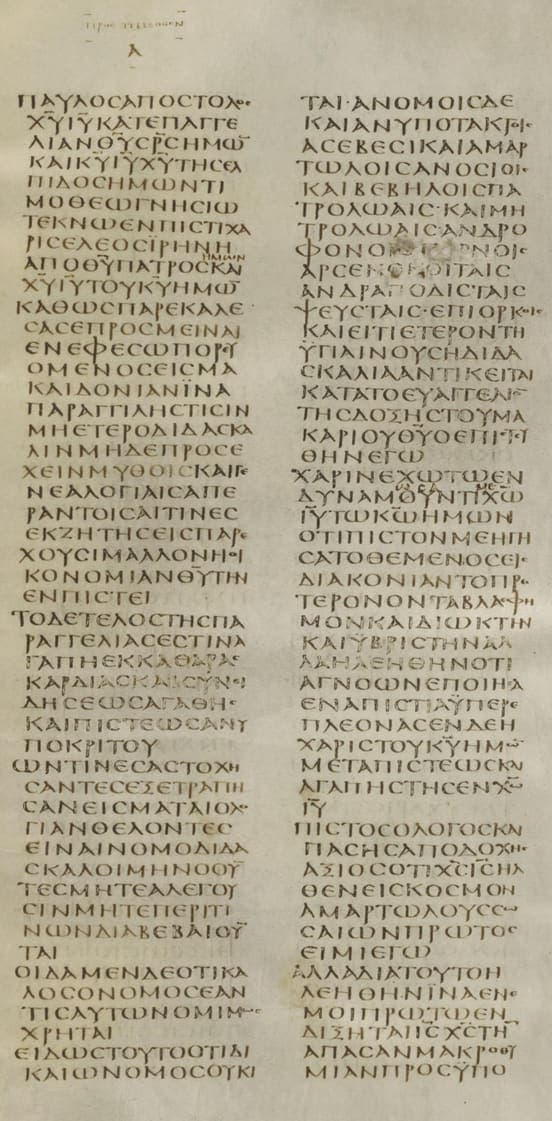
British Library, London, Add MS 43725, c. 350 · Source · CC0 1.0 · Image of the manuscript from codexsinaiticus.org, uploaded to Wikimedia Commons under CC0
Evidano Transcription
The passage that fills these two columns, 1 Timothy 1:1–16, ending in the middle of ὑποτύπωσιν where the third column takes over. The text is Eberhard Nestle’s 1904 critical edition, printed here with its accents, breathings and punctuation and one verse to a line; the codex itself writes unspaced majuscule with no accents and contracts the divine names, and its wording differs from this edition at a few points, so the text is a guide to the passage rather than a copy of the page.
1 Παῦλος ἀπόστολος Χριστοῦ Ἰησοῦ κατ’ ἐπιταγὴν Θεοῦ Σωτῆρος ἡμῶν καὶ Χριστοῦ Ἰησοῦ τῆς ἐλπίδος ἡμῶν
2 Τιμοθέῳ γνησίῳ τέκνῳ ἐν πίστει· χάρις, ἔλεος, εἰρήνη ἀπὸ Θεοῦ πατρὸς καὶ Χριστοῦ Ἰησοῦ τοῦ κυρίου ἡμῶν.
3 Καθὼς παρεκάλεσά σε προσμεῖναι ἐν Ἐφέσῳ, πορευόμενος εἰς Μακεδονίαν, ἵνα παραγγείλῃς τισὶν μὴ ἑτεροδιδασκαλεῖν
4 μηδὲ προσέχειν μύθοις καὶ γενεαλογίαις ἀπεράντοις, αἵτινες ἐκζητήσεις παρέχουσιν μᾶλλον ἢ οἰκονομίαν Θεοῦ τὴν ἐν πίστει·
5 τὸ δὲ τέλος τῆς παραγγελίας ἐστὶν ἀγάπη ἐκ καθαρᾶς καρδίας καὶ συνειδήσεως ἀγαθῆς καὶ πίστεως ἀνυποκρίτου,
6 ὧν τινες ἀστοχήσαντες ἐξετράπησαν εἰς ματαιολογίαν,
7 θέλοντες εἶναι νομοδιδάσκαλοι, μὴ νοοῦντες μήτε ἃ λέγουσιν μήτε περὶ τίνων διαβεβαιοῦνται.
8 Οἴδαμεν δὲ ὅτι καλὸς ὁ νόμος, ἐάν τις αὐτῷ νομίμως χρῆται,
9 εἰδὼς τοῦτο, ὅτι δικαίῳ νόμος οὐ κεῖται, ἀνόμοις δὲ καὶ ἀνυποτάκτοις, ἀσεβέσι καὶ ἁμαρτωλοῖς, ἀνοσίοις καὶ βεβήλοις, πατρολῴαις καὶ μητρολῴαις, ἀνδροφόνοις,
10 πόρνοις, ἀρσενοκοίταις, ἀνδραποδισταῖς, ψεύσταις, ἐπιόρκοις, καὶ εἴ τι ἕτερον τῇ ὑγιαινούσῃ διδασκαλίᾳ ἀντίκειται,
11 κατὰ τὸ εὐαγγέλιον τῆς δόξης τοῦ μακαρίου Θεοῦ, ὃ ἐπιστεύθην ἐγώ.
12 Χάριν ἔχω τῷ ἐνδυναμώσαντί με Χριστῷ Ἰησοῦ τῷ Κυρίῳ ἡμῶν, ὅτι πιστόν με ἡγήσατο θέμενος εἰς διακονίαν,
13 τὸ πρότερον ὄντα βλάσφημον καὶ διώκτην καὶ ὑβριστήν· ἀλλὰ ἠλεήθην, ὅτι ἀγνοῶν ἐποίησα ἐν ἀπιστίᾳ,
14 ὑπερεπλεόνασεν δὲ ἡ χάρις τοῦ Κυρίου ἡμῶν μετὰ πίστεως καὶ ἀγάπης τῆς ἐν Χριστῷ Ἰησοῦ.
15 πιστὸς ὁ λόγος καὶ πάσης ἀποδοχῆς ἄξιος, ὅτι Χριστὸς Ἰησοῦς ἦλθεν εἰς τὸν κόσμον ἁμαρτωλοὺς σῶσαι· ὧν πρῶτός εἰμι ἐγώ·
16 ἀλλὰ διὰ τοῦτο ἠλεήθην, ἵνα ἐν ἐμοὶ πρώτῳ ἐνδείξηται Ἰησοῦς Χριστὸς τὴν ἅπασαν μακροθυμίαν, πρὸς ὑποτύπωσιν τῶν μελλόντων πιστεύειν ἐπ’ αὐτῷ εἰς ζωὴν αἰώνιον.
Source: Eberhard Nestle, Novum Testamentum Graece (1904), digital text published as CC0 by biblicalhumanities.org (CC0 1.0).
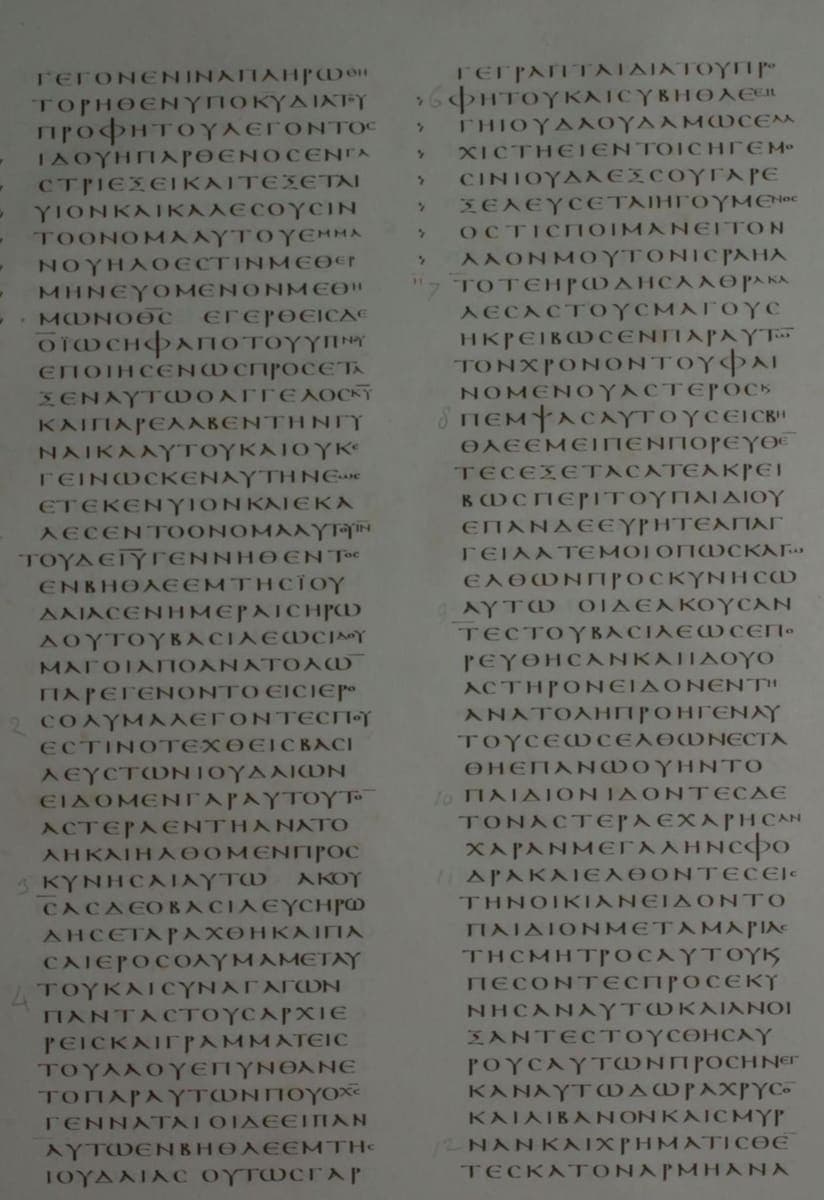
Biblioteca Apostolica Vaticana, Vat. gr. 1209, c. 325–350 · Source · Public domain · Facsimile reproduction of the codex, via Wikimedia Commons
Evidano Transcription
The two columns shown, which begin in the middle of Matthew 1:22 at γέγονεν and break off in 2:12 at μὴ ἀνα-. Nestle’s 1904 edition again supplies the words, one verse to a line, with modern accents and punctuation that the codex does not have; the manuscript spells the names without iota subscript and contracts ΙΣ and ΘΣ.
22 Τοῦτο δὲ ὅλον γέγονεν ἵνα πληρωθῇ τὸ ῥηθὲν ὑπὸ Κυρίου διὰ τοῦ προφήτου λέγοντος
23 Ἰδοὺ ἡ παρθένος ἐν γαστρὶ ἕξει καὶ τέξεται υἱόν, καὶ καλέσουσιν τὸ ὄνομα αὐτοῦ Ἐμμανουήλ, ὅ ἐστιν μεθερμηνευόμενον Μεθ’ ἡμῶν ὁ Θεός.
24 ἐγερθεὶς δὲ ὁ Ἰωσὴφ ἀπὸ τοῦ ὕπνου ἐποίησεν ὡς προσέταξεν αὐτῷ ὁ ἄγγελος Κυρίου, καὶ παρέλαβεν τὴν γυναῖκα αὐτοῦ·
25 καὶ οὐκ ἐγίνωσκεν αὐτὴν ἕως οὗ ἔτεκεν υἱόν· καὶ ἐκάλεσεν τὸ ὄνομα αὐτοῦ Ἰησοῦν.
2:1 Τοῦ δὲ Ἰησοῦ γεννηθέντος ἐν Βηθλέεμ τῆς Ἰουδαίας ἐν ἡμέραις Ἡρῴδου τοῦ βασιλέως, ἰδοὺ μάγοι ἀπὸ ἀνατολῶν παρεγένοντο εἰς Ἱεροσόλυμα
2 λέγοντες Ποῦ ἐστιν ὁ τεχθεὶς βασιλεὺς τῶν Ἰουδαίων; εἴδομεν γὰρ αὐτοῦ τὸν ἀστέρα ἐν τῇ ἀνατολῇ καὶ ἤλθομεν προσκυνῆσαι αὐτῷ.
3 ἀκούσας δὲ ὁ βασιλεὺς Ἡρῴδης ἐταράχθη, καὶ πᾶσα Ἱεροσόλυμα μετ’ αὐτοῦ,
4 καὶ συναγαγὼν πάντας τοὺς ἀρχιερεῖς καὶ γραμματεῖς τοῦ λαοῦ ἐπυνθάνετο παρ’ αὐτῶν ποῦ ὁ Χριστὸς γεννᾶται.
5 οἱ δὲ εἶπαν αὐτῷ· Ἐν Βηθλέεμ τῆς Ἰουδαίας· οὕτως γὰρ γέγραπται διὰ τοῦ προφήτου·
6 Καὶ σύ, Βηθλέεμ γῆ Ἰούδα, οὐδαμῶς ἐλαχίστη εἶ ἐν τοῖς ἡγεμόσιν Ἰούδα· ἐκ σοῦ γὰρ ἐξελεύσεται ἡγούμενος, ὅστις ποιμανεῖ τὸν λαόν μου τὸν Ἰσραήλ.
7 Τότε Ἡρῴδης λάθρᾳ καλέσας τοὺς μάγους ἠκρίβωσεν παρ’ αὐτῶν τὸν χρόνον τοῦ φαινομένου ἀστέρος,
8 καὶ πέμψας αὐτοὺς εἰς Βηθλέεμ εἶπεν· Πορευθέντες ἐξετάσατε ἀκριβῶς περὶ τοῦ παιδίου· ἐπὰν δὲ εὕρητε, ἀπαγγείλατέ μοι, ὅπως κἀγὼ ἐλθὼν προσκυνήσω αὐτῷ.
9 οἱ δὲ ἀκούσαντες τοῦ βασιλέως ἐπορεύθησαν· καὶ ἰδοὺ ὁ ἀστὴρ, ὃν εἶδον ἐν τῇ ἀνατολῇ, προῆγεν αὐτούς ἕως ἐλθὼν ἐστάθη ἐπάνω οὗ ἦν τὸ παιδίον.
10 ἰδόντες δὲ τὸν ἀστέρα ἐχάρησαν χαρὰν μεγάλην σφόδρα.
11 καὶ ἐλθόντες εἰς τὴν οἰκίαν εἶδον τὸ παιδίον μετὰ Μαρίας τῆς μητρὸς αὐτοῦ, καὶ πεσόντες προσεκύνησαν αὐτῷ, καὶ ἀνοίξαντες τοὺς θησαυροὺς αὐτῶν προσήνεγκαν αὐτῷ δῶρα, χρυσὸν καὶ λίβανον καὶ σμύρναν.
12 καὶ χρηματισθέντες κατ’ ὄναρ μὴ ἀνακάμψαι πρὸς Ἡρῴδην, δι’ ἄλλης ὁδοῦ ἀνεχώρησαν εἰς τὴν χώραν αὐτῶν.
Source: Eberhard Nestle, Novum Testamentum Graece (1904), digital text published as CC0 by biblicalhumanities.org (CC0 1.0).
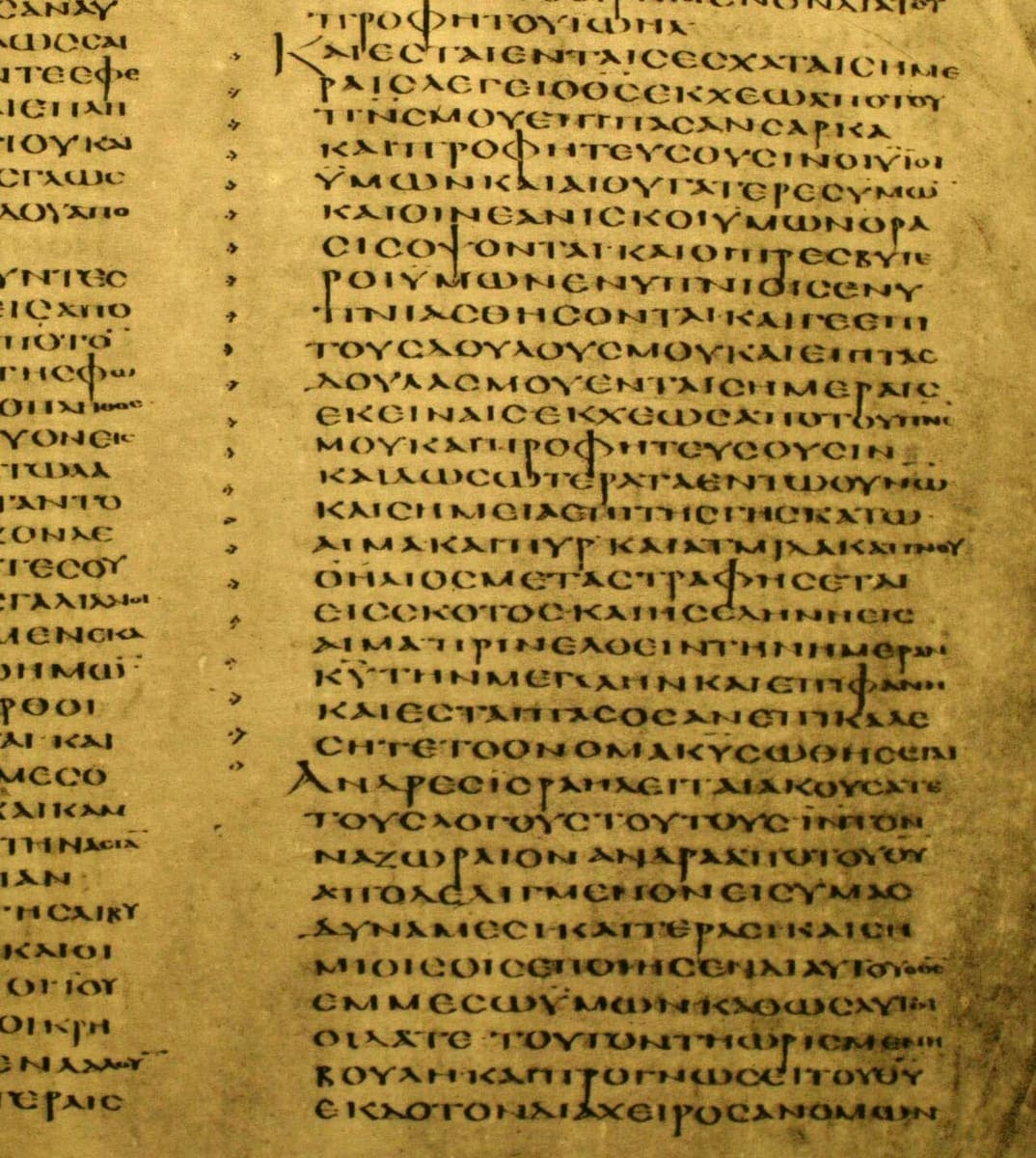
British Library, London, Royal MS 1 D V–VIII, 5th century · Source · Public domain · Codex Alexandrinus, via Wikimedia Commons
Evidano Transcription
Acts 2:17–22, the verses marked by the marginal diplai and the section that follows them; the column begins with the last words of 2:16 and runs on into 2:23 at the foot. Nestle’s 1904 text supplies the words with accents and punctuation, one verse to a line, where the codex writes unspaced majuscule.
17 Καὶ ἔσται ἐν ταῖς ἐσχάταις ἡμέραις, λέγει ὁ Θεός, ἐκχεῶ ἀπὸ τοῦ Πνεύματός μου ἐπὶ πᾶσαν σάρκα, καὶ προφητεύσουσιν οἱ υἱοὶ ὑμῶν καὶ αἱ θυγατέρες ὑμῶν, καὶ οἱ νεανίσκοι ὑμῶν ὁράσεις ὄψονται, καὶ οἱ πρεσβύτεροι ὑμῶν ἐνυπνίοις ἐνυπνιασθήσονται·
18 καίγε ἐπὶ τοὺς δούλους μου καὶ ἐπὶ τὰς δούλας μου ἐν ταῖς ἡμέραις ἐκείναις ἐκχεῶ ἀπὸ τοῦ Πνεύματός μου, καὶ προφητεύσουσιν.
19 καὶ δώσω τέρατα ἐν τῷ οὐρανῷ ἄνω καὶ σημεῖα ἐπὶ τῆς γῆς κάτω, αἷμα καὶ πῦρ καὶ ἀτμίδα καπνοῦ.
20 ὁ ἥλιος μεταστραφήσεται εἰς σκότος καὶ ἡ σελήνη εἰς αἷμα, πρὶν ἐλθεῖν ἡμέραν Κυρίου τὴν μεγάλην καὶ ἐπιφανῆ.
21 καὶ ἔσται πᾶς ὃς ἐὰν ἐπικαλέσηται τὸ ὄνομα Κυρίου σωθήσεται.
22 Ἄνδρες Ἰσραηλεῖται, ἀκούσατε τοὺς λόγους τούτους· Ἰησοῦν τὸν Ναζωραῖον, ἄνδρα ἀποδεδειγμένον ἀπὸ τοῦ Θεοῦ εἰς ὑμᾶς δυνάμεσι καὶ τέρασι καὶ σημείοις, οἷς ἐποίησεν δι’ αὐτοῦ ὁ Θεὸς ἐν μέσῳ ὑμῶν, καθὼς αὐτοὶ οἴδατε,
Source: Eberhard Nestle, Novum Testamentum Graece (1904), digital text published as CC0 by biblicalhumanities.org (CC0 1.0).
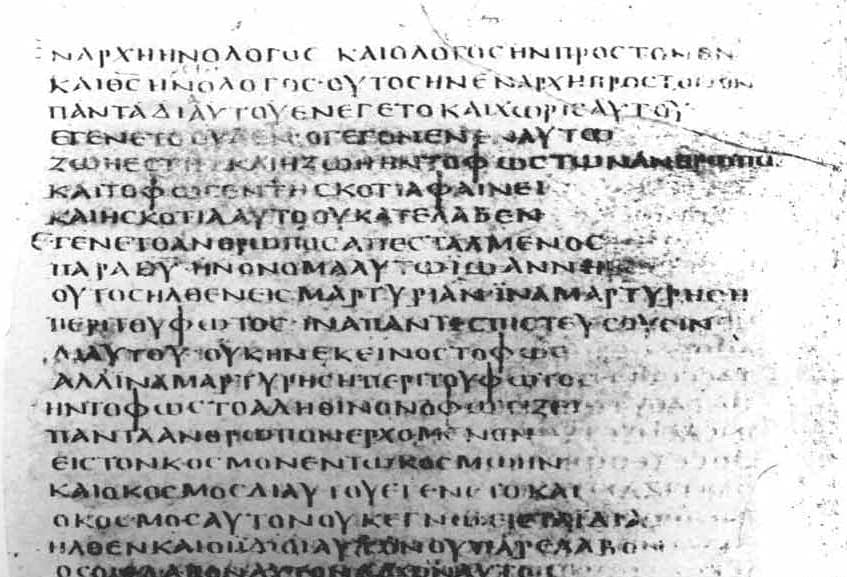
Cambridge University Library, MS Nn. 2. 41, 5th century · Source · Public domain · Photographic facsimile of Codex Bezae, via Wikimedia Commons
Evidano Transcription
[Ε]Ν ΑΡΧΗ ΗΝ Ο ΛΟΓΟΣ ΚΑΙ Ο ΛΟΓΟΣ ΗΝ ΠΡΟΣ ΤΟΝ ΘΝ
ΚΑΙ ΘΣ ΗΝ Ο ΛΟΓΟΣ· ΟΥΤΟΣ ΗΝ ΕΝ ΑΡΧΗ ΠΡΟΣ ΤΟΝ ΘΝ
ΠΑΝΤΑ ΔΙ ΑΥΤΟΥ ΕΓΕΝΕΤΟ ΚΑΙ ΧΩΡΙΣ ΑΥΤΟΥ
ΕΓΕΝΕΤΟ ΟΥΔΕ ΕΝ Ο ΓΕΓΟΝΕΝ ΕΝ ΑΥΤΩ
ΖΩΗ ΕΣΤΙΝ ΚΑΙ Η ΖΩΗ ΗΝ ΤΟ ΦΩΣ ΤΩΝ ΑΝΘΡΩΠΩΝ
ΚΑΙ ΤΟ ΦΩΣ ΕΝ ΤΗ ΣΚΟΤΙΑ ΦΑΙΝΕΙ
ΚΑΙ Η ΣΚΟΤΙΑ ΑΥΤΟ ΟΥ ΚΑΤΕΛΑΒΕΝ
ΕΓΕΝΕΤΟ ΑΝΘΡΩΠΟΣ ΑΠΕΣΤΑΛΜΕΝΟΣ
ΠΑΡΑ ΘΥ ΗΝ ΟΝΟΜΑ ΑΥΤΩ ΙΩΑΝΝΗΣ [?]
ΟΥΤΟΣ ΗΛΘΕΝ ΕΙΣ ΜΑΡΤΥΡΙΑΝ ΙΝΑ ΜΑΡΤΥΡΗΣΗ
ΠΕΡΙ ΤΟΥ ΦΩΤΟΣ ΙΝΑ ΠΑΝΤΕΣ ΠΙΣΤΕΥΣΩΣΙΝ
ΔΙ ΑΥΤΟΥ ΟΥΚ ΗΝ ΕΚΕΙΝΟΣ ΤΟ ΦΩΣ
ΑΛΛ ΙΝΑ ΜΑΡΤΥΡΗΣΗ ΠΕΡΙ ΤΟΥ ΦΩΤΟΣ
ΗΝ ΤΟ ΦΩΣ ΤΟ ΑΛΗΘΙΝΟΝ Ο ΦΩΤΙΖΕΙ
ΠΑΝΤΑ ΑΝΘΡΩΠΟΝ ΕΡΧΟΜΕΝΟΝ
ΕΙΣ ΤΟΝ ΚΟΣΜΟΝ ΕΝ ΤΩ ΚΟΣΜΩ ΗΝ
ΚΑΙ Ο ΚΟΣΜΟΣ ΔΙ ΑΥΤΟΥ ΕΓΕΝΕΤΟ ΚΑΙ
Ο ΚΟΣΜΟΣ ΑΥΤΟΝ ΟΥΚ ΕΓΝΩ ΕΙΣ ΤΑ ΙΔΙΑ
ΗΛΘΕΝ ΚΑΙ ΟΙ ΙΔΙΟΙ ΑΥΤΟΝ ΟΥ ΠΑΡΕΛΑΒΟΝ
ΟΣΟΙ ΔΕ ΕΛΑΒΟΝ ΑΥΤΟΝ [cut off]
Generated by Evidano’s advanced model; not yet checked against a published edition.
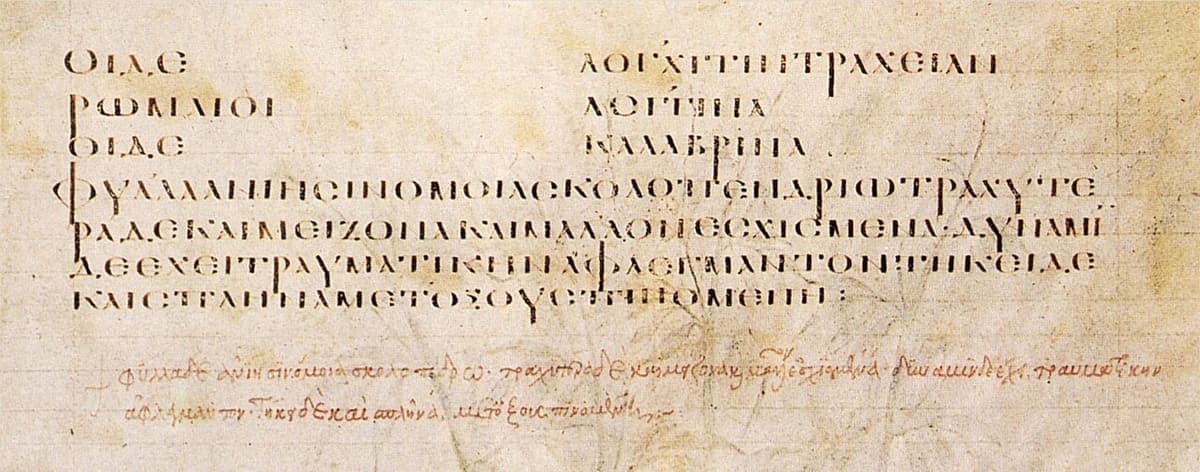
Österreichische Nationalbibliothek, Vienna, Cod. Med. Gr. 1, fol. 214r, c. 512 · Source · Public domain · Scan of the Akademische Druck- und Verlagsanstalt facsimile, via Wikimedia Commons
Evidano Transcription
ΟΙ ΔΕ ΛΟΓΧΙΤΙΝ ΤΡΑΧΕΙΑΝ
ΡΩΜΑΙΟΙ ΛΟΓΓΙΝΑ [?]
ΟΙ ΔΕ ΚΑΛΑΒΡΙΝΑ [?]
ΦΥΛΛΑ ΑΝΙΗΣΙΝ ΟΜΟΙΑ ΣΚΟΛΟΠΕΝΔΡΙΩ ΤΡΑΧΥΤΕ
ΡΑ ΔΕ ΚΑΙ ΜΕΙΖΟΝΑ ΚΑΙ ΜΑΛΛΟΝ ΕΣΧΙΣΜΕΝΑ· ΔΥΝΑΜΙ̅
ΔΕ ΕΧΕΙ ΤΡΑΥΜΑΤΙΚΗΝ ΑΦΛΕΓΜΑΝΤΟΝ· ΤΗΚΕΙ ΔΕ
ΚΑΙ ΣΠΛΗΝΑ ΜΕΤ ΟΞΟΥΣ ΠΙΝΟΜΕΝΗ:
φύλλα δ' ἀνίησιν ὅμοια σκολοπένδρω [?]· τραχύτερα δὲ καὶ μείζονα καὶ μᾶλλον ἐσχισμένα· δύναμιν δ' ἔχει τραυματικὴν
ἀφλέγμαντον· τήκει δὲ καὶ σπλῆνα μετ' ὄξους πινομένη:-
Generated by Evidano’s advanced model; not yet checked against a published edition.
Biblical majuscule and the codices written in it
When the roll gave way to the parchment codex in the fourth century, the formal book hand of the great Bibles was a script modern palaeographers call biblical majuscule: round, upright, almost without slope, with each letter drawn separately between two ruled lines. Epsilon, theta, omicron and sigma are circles or near-circles, sigma is lunate (Ϲ) and omega a shallow double curve, mu has a rounded saddle, and the contrast between thick and thin strokes is slight in the earliest examples and strong by the sixth century. Later uncial drifts: a sloping, laterally compressed “ogival” form appears in the sixth and seventh centuries, and by the eighth and ninth the script is heavy, ornamental and increasingly confined to lectionaries and other liturgical books, while everyday copying has moved to minuscule. A page can therefore be dated within a century or so from the shape of alpha, the weight of the strokes and the treatment of the line ends.
Layout carries much of the meaning. Sinaiticus has four narrow columns to the page, Vaticanus three, Alexandrinus and most later codices two, and the purple gospel books a single broad column of silver and gold on dyed parchment. Text is unspaced and lightly punctuated: a raised or middle point, a small gap, a paragraphos under the start of a line, a first letter enlarged and pushed out into the margin to open a section. Round the text sit an apparatus of aids: running titles, chapter lists and titloi, Eusebian section and canon numbers, diplai in the margin flagging a quotation from the Old Testament, and a coronis with the book’s title at the end. Breathings and accents are rare in the earliest codices and are usually the work of later readers; ekphonetic signs for chanting appear from the ninth century.
Two habits of abbreviation dominate. The nomina sacra contract the holy names to their first and last letters under a horizontal stroke, so that ΘΣ, ΚΣ, ΙΣ, ΧΣ, ΠΝΑ and ΑΝΟΣ stand for God, Lord, Jesus, Christ, spirit and man in all their cases, and the practice spreads to a handful of other words. The same kind of stroke does other work: over a letter at the end of a line it replaces a final nu, and over a letter used as a figure it marks a numeral. Add the marks of use — erasures, letters retraced when the ink had faded, corrections above the line and in the margin, and in a palimpsest an older text showing through — and a single page can carry writing from five centuries.
Why ordinary OCR struggles here
One stroke, three meanings
The horizontal line above a letter group may mark a contracted divine name, a numeral or a suppressed nu at the end of a line. Recognition that treats it as decoration produces ΘΣ as a word, ΚΕ as a syllable and a date as nonsense; recognition that expands everything silently hides the fact that the manuscript wrote a contraction at all, which is exactly what a textual critic is collating.
Unspaced text in confusable round letters
In scriptio continua the reader supplies the word boundaries, and the letters most likely to be confused are the round ones that fill the ruled band: epsilon, theta, omicron and lunate sigma, with lambda, alpha and delta differing only in one stroke. A single wrong division changes the sense of a clause, and there is no spacing evidence to fall back on.
Layers added over three centuries
Correctors erase and rewrite, later readers add breathings, accents and punctuation, a Byzantine hand copies a faded line in minuscule beside it, and marginal numbers point to a system of chapters invented after the codex was made. Software that flattens the page into one stream mixes fourth-century text with fourteenth-century notes.
Ink and parchment that resist the camera
Silver on purple parchment has oxidised to a dark grey that barely separates from its ground, gold letters flare under raking light, faded majuscule has been retraced unevenly, and in palimpsests the wanted text is the fainter one. These pages need multispectral or processed images, and a reading that says plainly where the surface no longer carries a legible letter.
Who works with this material
Textual critics collating manuscripts
Collation depends on details that a smooth reading destroys: which divine names are contracted, where a corrector has intervened, whether a line ends with a written nu or a stroke. Editors need each of those recorded as a separate observation attached to the line it belongs to.
Septuagint and patristic scholars
The same codices carry the Greek Old Testament, the Apostolic Fathers and works that survive nowhere else. Researchers working outside the New Testament rarely have a modern electronic transcription to lean on and need a reliable first reading of a book that has never been keyed.
Libraries digitising uncial fragments
Single leaves and palimpsest fragments turn up in bindings and in monastic collections. A catalogue entry needs enough text to identify the book, the passage and the approximate date of the hand, which a careful transcription of ten lines will usually give.
Teachers and students of palaeography
Reading uncial is taught by working line by line against a known text. A transcription that keeps the manuscript’s lineation lets a student check their own reading, see where the codex divides words differently, and understand why the marginal apparatus is not part of the sentence.
Getting the best transcription
Give the model the contraction list
Name the nomina sacra you expect and say how they should appear: keep ΘΣ, ΙΣ and ΠΝΑ as written, with the expansion in brackets after them, and mark the supralinear stroke. Say separately what to do with a stroke that stands for a final nu at the end of a line.
Ask for columns and manuscript lines
Specify the number of columns and the order to read them, and ask for one ruled line per output line. Where a word runs over a line break, ask for it to be left broken with a hyphen, so that the lineation can be reconstructed from the text.
Keep the apparatus out of the text
Running titles, section and canon numbers, diplai, chapter lists and quire signatures should be reported as separate fields, not merged into the sentence. Ask for later additions — accents, punctuation, corrections between the lines — to be labelled as such rather than absorbed into the reading.
Start with a passage you can check
Test on a page whose text you know, compare the result line by line with a printed edition, and look first at the line ends and the contractions. Once those are handled correctly, move on to the books, such as the Septuagint or the Shepherd of Hermas, where no electronic text is waiting.
Further reading on this hand
The palaeography guides the in-app selector points to for this domain, if you want to check a transcription against the standard references.
- A Short Tutorial on Greek Paleography
This scholarly tutorial introduces the main features required to read Greek manuscripts. It discusses changing Greek letterforms, majuscule and minuscule writing, ligatures, abbreviations, punctuation, and the manuscript use of nomina sacra. Examples demonstrate how supralinear strokes and compressed sacred-name forms differ from ordinary alphabetic sequences. The tutorial is particularly useful for biblical codices where uncial letterforms and nomina sacra occur throughout the text.
Frequently asked questions
- Are nomina sacra recognised as contractions rather than words?
- They can be, when the prompt lists them. The default worth asking for is a double reading: the contracted form exactly as the codex writes it, followed by the expansion in brackets, so that a collation can record the form and a reader can still follow the sense.
- How is text without word division handled?
- The letters are transcribed as a continuous string and word division is offered as a second, clearly marked layer. That way an unusual division in the manuscript is not hidden by a modern one, and a doubtful segmentation can be flagged instead of being decided silently.
- Can Eusebian numbers and chapter lists be kept separate?
- Yes. Marginal numbers, canon tables, titloi and running titles are reported as their own fields with the line they stand beside. This matters because they were added to the tradition later than the text and belong to a different layer of the page.
- What about silver ink on purple parchment or palimpsests?
- Those pages need processed images. Multispectral or infrared photographs, or images in which the contrast between ink and ground has already been raised, give a usable reading; on an ordinary colour photograph of a purple codex much of the text will honestly have to be reported as illegible.
- Will corrections by later hands be distinguished?
- They can be flagged by position and appearance — written above the line, in the margin, in a different module or a thinner pen — and reported as separate hands. Deciding which corrector made which change remains a judgement for the editor, but the transcription can show where the decision is needed.
Related scripts and pages
Transcribe your uncial codices
Upload a folio or a single column, choose Greek Biblical Majuscule and Uncial Codices as the domain, and check the contractions on one page before running a whole book.