
Greek · c. 1450–1800
Renaissance and early modern Greek, page by page
When Constantinople fell the copyists moved west, and their handwriting followed them into the printing house: the first Greek types were cut to imitate a scribe’s pen, ligatures, abbreviations and all. The result is a period in which a printed page can be harder to read than a manuscript, and in which the same sheet often carries Greek in type, Greek in a scholar’s hand and Latin notes between the lines. Evidano transcribes each of those layers separately and expands the ligatures instead of guessing at the letters underneath them.
Sample pages
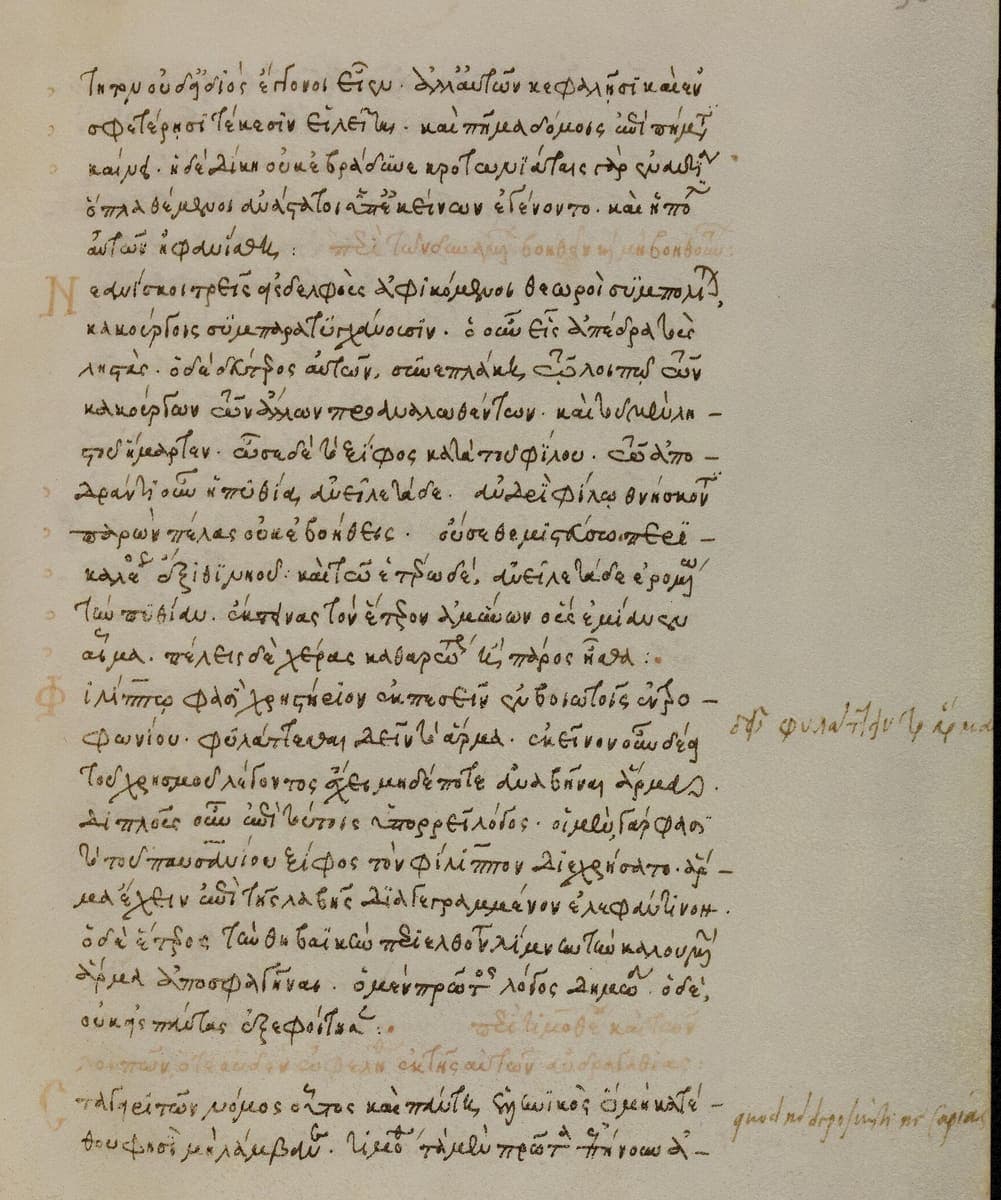
Universitätsbibliothek Heidelberg, Cod. Pal. graec. 155, fol. 30r, c. 1475–1500 · Source · Public domain · Universitätsbibliothek Heidelberg, digitised as Public Domain Mark 1.0
Evidano Transcription
Τὴ[?] γὰρ οὐδ' [illegible] ἔγονοι[?] εἰσίν· ἀλλ' αὐτῶν κεφαλῇσι καὶ ἐν
σφετέρῃσι τέκεσιν εἰλεῖται[?]· καὶ πῆμα δόμοις ἐπὶ[?] σήμε[ρον]
καὶ νῦν· ἡ δὲ δίκη οὐκ ἐβράδυνε[?] [illegible] γὰρ ἐν αὐτῇ[?]
ὅπλα θέμενοι ἀνάστατοι ἀπ' ἐκείνων ἐγένοντο· καὶ ἡ πό[λις]
αὐτῶν[?] ἠφανίσθη :
Νεανίσκοι τρεῖς ἀδελφοὶ ἀφικόμενοι θεωροὶ συμπολ[illegible]
κακούργοις συμπαρατυγχάνουσιν· ὁ οὖν εἷς ἀπέδρα τῶν[?]
λῃστῶν[?]· ὁ δ' ἀδελφὸς αὐτῶν, συνεπλάκη τῷ λοιπῷ τῶν
κακούργων τῶν ἄλλων προαναλωθέντων· καὶ [illegible] -
[illegible] ἥμαρτεν[?]· ὦσα[?] δὲ τὸ ξίφος κατὰ τοῦ φίλου· τῷ ἀπο -
δράντι οὖν ἡ πυθία, ἀνεῖλε τάδε· ἀνδρὶ[?] φίλῳ θνῄσκοντ[ι]
παρὼν πέλας οὐκ ἐβοήθεις· [illegible] -
[illegible] ἔξιθι νηοῦ· καὶ τῷ ἑτέρῳ δέ, ἀνεῖλε τάδε ἐρομ[ένῳ]
τὴν πυθίαν· ἔκτεινας τὸν ἕτερον ἀμύνων οὐκ ἐμίανας[?]
αἷμα· πέλεις δὲ χέρας καθαρωτ[illegible] ἢ πάρος ἦσθα :
Φιλίππῳ φασὶ χρηστήριον συμπεσεῖν ἐν βοιωτοῖς ἐν [illegible] -
φωνίου· φυλάττεσθαι δεῖν τὸ ἅρμα· ἐκεῖνον οὖν διὰ
τοῦ χρησμοῦ [illegible] μηδέποτε ἀναβῆναι ἅρματ[ος]·
διπλοῦς οὖν ἐπὶ τούτοις ὑπορρεῖ λόγος· οἱ μὲν γὰρ φασὶ
τὸ τοῦ παυσανίου ξίφος τὸν φίλιππον διεχρήσατο· ἅρ -
μα ἔχειν ἐπὶ τῆς λαβῆς διαγεγραμμένον ἐλεφάντινον·
ὁ δὲ ἕτερος [illegible] λίμνην τὴν καλουμ[ένην]
ἅρμα ἀποσφαγῆναι· ὁ μὲν πρῶτος λόγος δημώδ[ης][?]· ὁ δέ,
οὐκ ἐς πάντας ἐξεφοίτησε :
Σταγειτῶν νόμος οὗτος καὶ πάντῃ ἐγνωσμένος· ὃ μὴ κατέ -
θου φησὶ μὴ λάμβανε· [illegible] -
[marginal headings in red and Greek/Latin marginal notes illegible]
Generated by Evidano’s advanced model; not yet checked against a published edition.
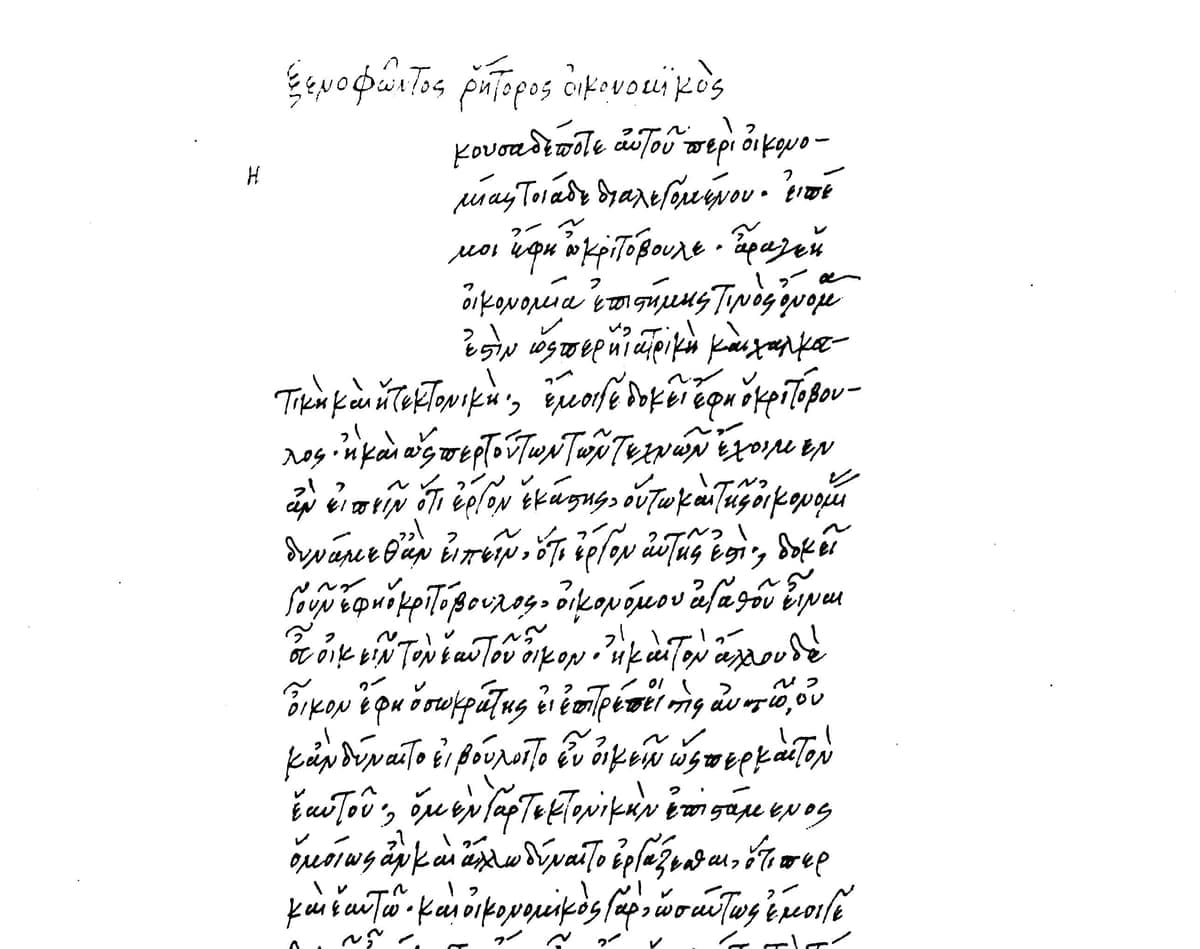
Bibliothèque nationale de France (original manuscript), Ms. grec 1647, fol. 2, late 15th century · Source · Public domain · Plate from Omont’s 1887 album of facsimiles, digitised by the New York Public Library, via the Internet Archive
Evidano Transcription
The text of the page, Xenophon, Oeconomicus 1.1–1.4, breaking off at καὶ εἰ μὴ αὐτὸς τύχοι at the foot of the plate; the scribe’s own heading, Ξενοφῶντος ῥήτορος οἰκονομικός, stands above it. The words are given from the Perseus edition of the Greek text, whose punctuation and paragraphing are modern; the manuscript differs from it in a few small readings.
ἤκουσα δέ ποτε αὐτοῦ καὶ περὶ οἰκονομίας τοιάδε διαλεγομένου·
εἰπέ μοι, ἔφη, ὦ Κριτόβουλε, ἆρά γε ἡ οἰκονομία ἐπιστήμης τινὸς ὄνομά ἐστιν, ὥσπερ ἡ ἰατρικὴ καὶ ἡ χαλκευτικὴ καὶ ἡ τεκτονική;
ἔμοιγε δοκεῖ, ἔφη ὁ Κριτόβουλος.
ἦ καὶ ὥσπερ τούτων τῶν τεχνῶν ἔχοιμεν ἂν εἰπεῖν ὅ τι ἔργον ἑκάστης, οὕτω καὶ τῆς οἰκονομίας δυναίμεθʼ ἂν εἰπεῖν ὅ τι ἔργον αὐτῆς ἐστι;
δοκεῖ γοῦν, ἔφη ὁ Κριτόβουλος, οἰκονόμου ἀγαθοῦ εἶναι εὖ οἰκεῖν τὸν ἑαυτοῦ οἶκον.
ἦ καὶ τὸν ἄλλου δὲ οἶκον, ἔφη ὁ Σωκράτης, εἰ ἐπιτρέποι τις αὐτῷ, οὐκ ἂν δύναιτο, εἰ βούλοιτο, εὖ οἰκεῖν, ὥσπερ καὶ τὸν ἑαυτοῦ;
ὁ μὲν γὰρ τεκτονικὴν ἐπιστάμενος ὁμοίως ἂν καὶ ἄλλῳ δύναιτο ἐργάζεσθαι ὅ τι περ καὶ ἑαυτῷ, καὶ ὁ οἰκονομικός γʼ ἂν ὡσαύτως.
ἔμοιγε δοκεῖ, ὦ Σώκρατες.
ἔστιν ἄρα, ἔφη ὁ Σωκράτης, τὴν τέχνην ταύτην ἐπισταμένῳ, καὶ εἰ μὴ αὐτὸς τύχοι
Source: Xenophon, Oeconomicus, Greek text from the Perseus Digital Library (canonical-greekLit, tlg0032.tlg003.perseus-grc2) (CC BY-SA 4.0).
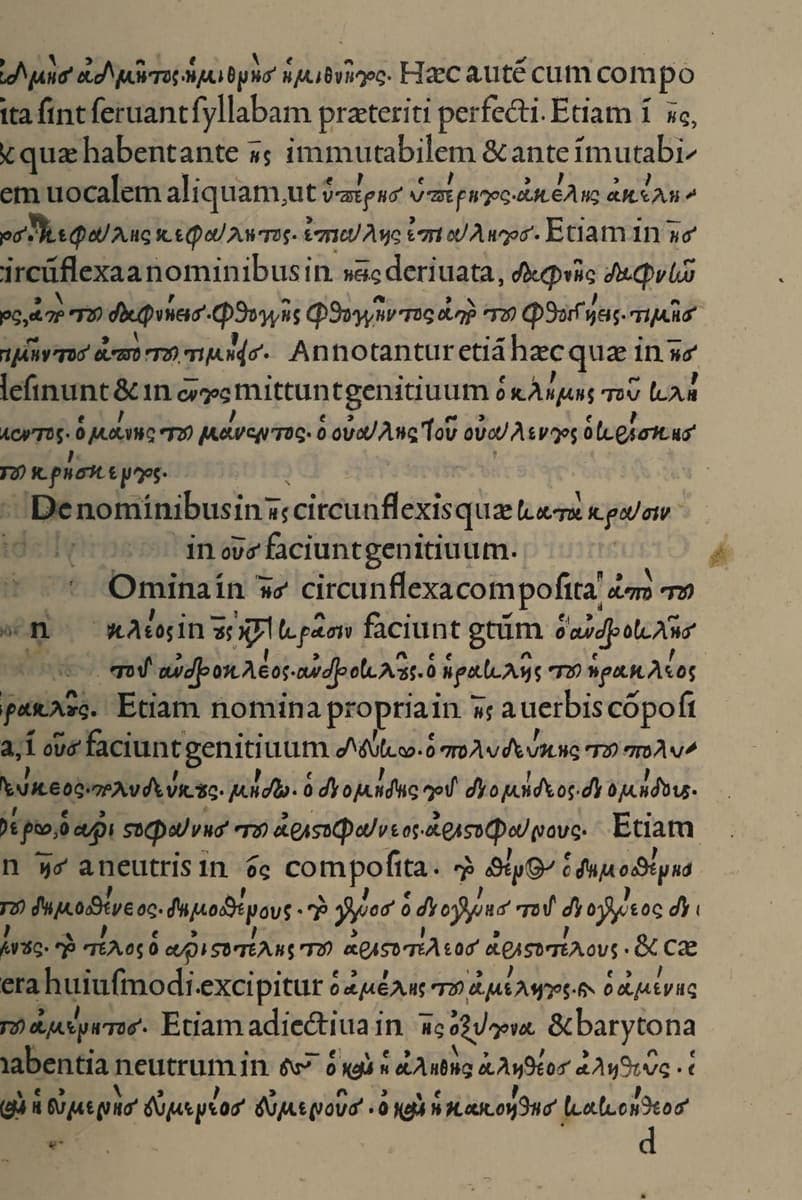
Boston Public Library, January 1498 · Source · Public domain · Boston Public Library copy, digitised by the Internet Archive
Evidano Transcription
[cut off]δμὴς ἀδμῆτος. ἡμιθνὴς ἡμιθνῆτος. Hæc aute[m] cum compo
[cut off]ita ſint ſeruant ſyllabam præteriti perfecti. Etiam i[n] ης,
& quæ habent ante ης immutabilem & ante i[m]mutabi-
[cut off]em uocalem aliquam, ut ὑπέρης ὑπέρητος. ἀπέλης[?] ἀπέλη-
[cut off]. κεφάλης κεφάλητος. ἐπιάλης ἐπιάλητος. Etiam in ης
[cut off]circu[m]flexa a nominibus in ηεις deriuata, δαφνῆς δαφν[?]
[cut off]ς, ἀπὸ τοῦ δαφνήεις. φθογγῆς φθογγῆντος ἀπὸ τοῦ φθογγήεις. τιμῆς
[cut off]μῆντος ἀπὸ τοῦ τιμήεις. Annotantur etia[m] hæc quæ in ης
[cut off]deſinunt & in εντος mittunt genitiuum ὁ κλήμης τοῦ κλή-
[cut off]μεντος. ὁ μάνης τοῦ μάνεντος. ὁ οὐάλης τοῦ οὐάλεντος. ὁ κρήσκης
τοῦ κρήσκεντος.
De nominibus in ης circunflexis quæ κατὰ κρᾶσιν
in ους faciunt genitiuum.
Omina in ης circunflexa compoſita ἀπὸ τοῦ
κλέος in [?] κ[ατὰ] κρᾶσιν faciunt g[eni]t[iuu]m ὁ ἀνδροκλῆς
τοῦ ἀνδροκλέος. ἀνδροκλοῦς. ὁ ἡρακλῆς τοῦ ἡρακλέος
[cut off]ρακλοῦς. Etiam nomina propria in ης a uerbis co[m]poſi-
[cut off]a, i[n] ους faciunt genitiuum δεύκω. ὁ πολυδεύκης τοῦ πολυ-
[cut off]δεύκεος. πολυδεύκους. μήδω. ὁ διομήδης τοῦ διομήδεος. διομήδους.
[cut off]ερω[?], ὁ ἀριστοφάνης τοῦ ἀριστοφάνεος. ἀριστοφάνους. Etiam
[cut off]n ης a neutris in ος compoſita. τὸ θέρος[?] ὁ δημοθέρης[?]
τοῦ δημοθένεος[?]. δημοθένους[?]. τὸ γένος ὁ διογένης τοῦ διογένεος δι-
[cut off]γένους. τὸ τέλος ὁ ἀριστοτέλης τοῦ ἀριστοτέλεος ἀριστοτέλους. & cæ-
[cut off]era huiuſmodi. excipitur ὁ ἀμέλης τοῦ ἀμέλητος. ἢ ὁ ἀμένης
τοῦ ἀμένητος[?]. Etiam adiectiua in ης ὀξύτονα & barytona
[cut off]abentia neutrum in ες ὁ καὶ ἡ ἀληθὴς ἀληθέος ἀληθοῦς. ὁ
[cut off]καὶ ἡ εὐμενὴς εὐμενέος εὐμενοῦς. ὁ καὶ ἡ κακοήθης κακοήθεος
d
Generated by Evidano’s advanced model; not yet checked against a published edition.
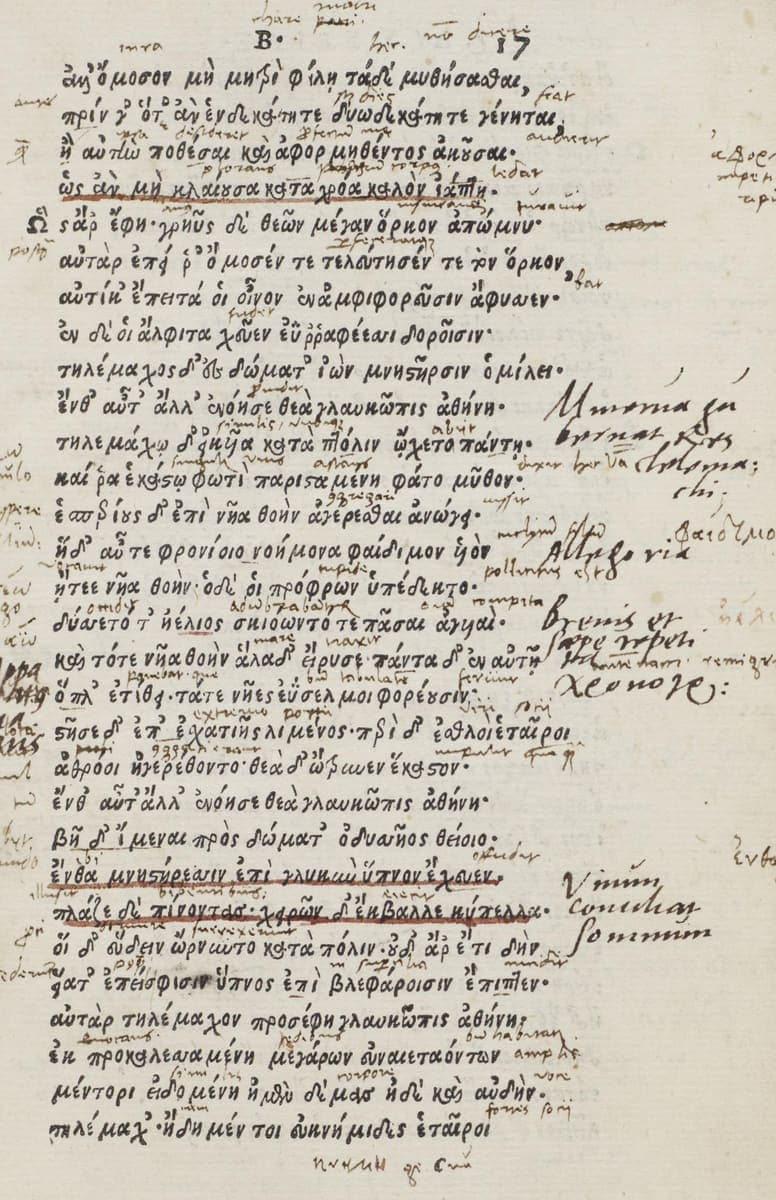
Columbia University Libraries, 1517 · Source · Public domain · Columbia University Libraries copy, digitised by the Internet Archive
Evidano Transcription
The thirty printed verses on the page, Odyssey 2.373–402, from the Perseus edition of the Greek text, with the line numbers of the standard text added; the handwritten glosses and marginal notes are not included. The 1517 edition punctuates and accents differently in places, and prints many of these words with ligatures.
373 ἀλλʼ ὄμοσον μὴ μητρὶ φίλῃ τάδε μυθήσασθαι,
374 πρίν γʼ ὅτʼ ἂν ἑνδεκάτη τε δυωδεκάτη τε γένηται,
375 ἢ αὐτὴν ποθέσαι καὶ ἀφορμηθέντος ἀκοῦσαι,
376 ὡς ἂν μὴ κλαίουσα κατὰ χρόα καλὸν ἰάπτῃ.
377 ὣς ἄρʼ ἔφη, γρῆυς δὲ θεῶν μέγαν ὅρκον ἀπώμνυ.
378 αὐτὰρ ἐπεί ῥʼ ὄμοσέν τε τελεύτησέν τε τὸν ὅρκον,
379 αὐτίκʼ ἔπειτά οἱ οἶνον ἐν ἀμφιφορεῦσιν ἄφυσσεν,
380 ἐν δέ οἱ ἄλφιτα χεῦεν ἐϋρραφέεσσι δοροῖσι.
381 Τηλέμαχος δʼ ἐς δώματʼ ἰὼν μνηστῆρσιν ὁμίλει.
382 ἔνθʼ αὖτʼ ἄλλʼ ἐνόησε θεά, γλαυκῶπις Ἀθήνη.
383 Τηλεμάχῳ ἐικυῖα κατὰ πτόλιν ᾤχετο πάντῃ,
384 καί ῥα ἑκάστῳ φωτὶ παρισταμένη φάτο μῦθον,
385 ἑσπερίους δʼ ἐπὶ νῆα θοὴν ἀγέρεσθαι ἀνώγει.
386 ἡ δʼ αὖτε Φρονίοιο Νοήμονα φαίδιμον υἱὸν
387 ᾔτεε νῆα θοήν· ὁ δέ οἱ πρόφρων ὑπέδεκτο.
388 δύσετό τʼ ἠέλιος σκιόωντό τε πᾶσαι ἀγυιαί,
389 καὶ τότε νῆα θοὴν ἅλαδʼ εἴρυσε, πάντα δʼ ἐν αὐτῇ
390 ὅπλʼ ἐτίθει, τά τε νῆες ἐύσσελμοι φορέουσι.
391 στῆσε δʼ ἐπʼ ἐσχατιῇ λιμένος, περὶ δʼ ἐσθλοὶ ἑταῖροι
392 ἁθρόοι ἠγερέθοντο· θεὰ δʼ ὤτρυνεν ἕκαστον.
393 ἔνθʼ αὖτʼ ἄλλʼ ἐνόησε θεά, γλαυκῶπις Ἀθήνη.
394 βῆ ῥʼ ἰέναι πρὸς δώματʼ Ὀδυσσῆος θείοιο·
395 ἔνθα μνηστήρεσσιν ἐπὶ γλυκὺν ὕπνον ἔχευε,
396 πλάζε δὲ πίνοντας, χειρῶν δʼ ἔκβαλλε κύπελλα.
397 οἱ δʼ εὕδειν ὤρνυντο κατὰ πτόλιν, οὐδʼ ἄρʼ ἔτι δὴν
398 ἥατʼ, ἐπεί σφισιν ὕπνος ἐπὶ βλεφάροισιν ἔπιπτεν.
399 αὐτὰρ Τηλέμαχον προσέφη γλαυκῶπις Ἀθήνη
400 ἐκπροκαλεσσαμένη μεγάρων ἐὺ ναιεταόντων,
401 Μέντορι εἰδομένη ἠμὲν δέμας ἠδὲ καὶ αὐδήν·
402 Τηλέμαχʼ, ἤδη μέν τοι ἐυκνήμιδες ἑταῖροι
Source: Homer, Odyssey, Greek text from the Perseus Digital Library (canonical-greekLit, tlg0012.tlg002.perseus-grc2) (CC BY-SA 4.0).
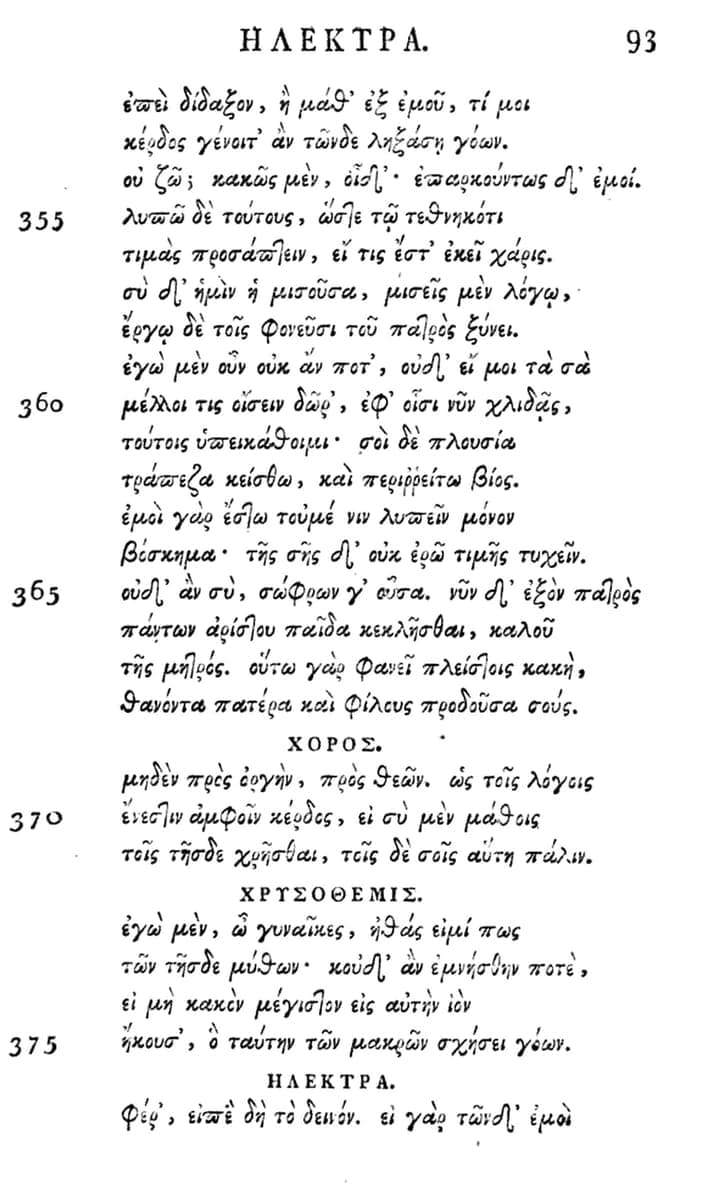
Biblioteca Nazionale di Napoli, 1788 · Source · Public domain · National Library of Naples copy, digitised by Google and the Internet Archive
Evidano Transcription
The verses printed on the page, Sophocles, Electra 352–376, from the Perseus edition, with the speaker changes marked as in the manuscripts and the line numbers of the standard text; the 1788 page prints the speakers’ names in full capitals at the same places.
352 ἐπεὶ δίδαξον, ἢ μάθʼ ἐξ ἐμοῦ, τί μοι
353 κέρδος γένοιτʼ ἂν τῶνδε ληξάσῃ γόων.
354 οὐ ζῶ; κακῶς μέν, οἶδʼ, ἐπαρκούντως δʼ ἐμοί.
355 λυπῶ δὲ τούτους, ὥστε τῷ τεθνηκότι
356 τιμὰς προσάπτειν, εἴ τις ἔστʼ ἐκεῖ χάρις.
357 σὺ δʼ ἡμὶν ἡ μισοῦσα μισεῖς μὲν λόγῳ,
358 ἔργῳ δὲ τοῖς φονεῦσι τοῦ πατρὸς ξύνει.
359 ἐγὼ μὲν οὖν οὐκ ἄν ποτʼ, οὐδʼ εἴ μοι τὰ σὰ
360 μέλλοι τις οἴσειν δῶρʼ, ἐφʼ οἷσι νῦν χλιδᾷς,
361 τούτοις ὑπεικάθοιμι· σοὶ δὲ πλουσία
362 τράπεζα κείσθω καὶ περιρρείτω βίος.
363 ἐμοὶ γὰρ ἔστω τοὐμὲ μὴ λυπεῖν μόνον
364 βόσκημα· τῆς σῆς δʼ οὐκ ἐρῶ τιμῆς τυχεῖν,
365 οὐδʼ ἂν σύ, σώφρων γʼ οὖσα. νῦν δʼ ἐξὸν πατρὸς
366 πάντων ἀρίστου παῖδα κεκλῆσθαι, καλοῦ
367 τῆς μητρός· οὕτω γὰρ φανεῖ πλείστοις κακή,
368 θανόντα πατέρα καὶ φίλους προδοῦσα σούς.
ΧΟΡΟΣ
369 μηδὲν πρὸς ὀργήν, πρὸς θεῶν· ὡς τοῖς λόγοις
370 ἔνεστιν ἀμφοῖν κέρδος, εἰ σὺ μὲν μάθοις
371 τοῖς τῆσδε χρῆσθαι, τοῖς δὲ σοῖς αὕτη πάλιν.
ΧΡΥΣΟΘΕΜΙΣ
372 ἐγὼ μέν, ὦ γυναῖκες, ἠθάς εἰμί πως
373 τῶν τῆσδε μύθων· οὐδʼ ἂν ἐμνήσθην ποτέ,
374 εἰ μὴ κακὸν μέγιστον εἰς αὐτὴν ἰὸν
375 ἤκουσʼ, ὃ ταύτην τῶν μακρῶν σχήσει γόων.
ΗΛΕΚΤΡΑ
376 φέρʼ εἰπὲ δὴ τὸ δεινόν· εἰ γὰρ τῶνδέ μοι
Source: Sophocles, Electra, Greek text from the Perseus Digital Library (canonical-greekLit, tlg0011.tlg005.perseus-grc2) (CC BY-SA 4.0).
Greek writing between the fall of Constantinople and 1800
Greek scribes did not stop working in 1453; many of them simply moved. Cretans and Peloponnesians — Michael Apostolis, Zacharias Calliergis, Andreas Darmarios, Angelos Vergikios, Georgios Hermonymos in Paris — copied classical and patristic texts for cardinals, kings and university teachers, and their books fill the older collections of western Europe. Their writing is Byzantine minuscule continued: the same ligatures and suspensions, but usually smaller, tidier and more even, sometimes consciously imitating an older model. Copies are signed and dated in colophons, often with the year of the world as well as the year of the Lord, and a good many carry the buyer’s Latin note on the flyleaf recording what was paid for them.
Print did not end that tradition; it absorbed it. The first dated Greek book was printed at Milan in 1476, and by the 1490s Aldus Manutius in Venice was using types cut from a cursive scribal hand, with hundreds of sorts for ligatures and abbreviations — the ligature of omicron and upsilon, the sign for -ος, stigma for the pair sigma-tau, the compendium for καί — so that a page of Aldine Greek looks like a manuscript set in metal. Later types, including the grecs du roi cut for the French crown from Angelos Vergikios’s hand, kept the same habits, and Greek printing carried ligatures well into the eighteenth century, long after the letters themselves had settled down. Accents and breathings are printed on every word, and Greek in a Latin book alternates with roman and italic type on the same line.
In the Greek-speaking lands under Ottoman rule the pen carried on. Patriarchal and monastic chanceries issued documents in a looped, heavily abbreviated cursive; monasteries and village communities kept codices of accounts, deeds and memoranda; schools copied grammars, and liturgical books were both copied and imported in print from Venice. From the middle of the eighteenth century the scholars of the Greek Enlightenment write a lighter, print-influenced hand, use western punctuation, and mix in Latin and Italian words. Across the whole period the most common single object is a printed book covered in handwriting: glosses between the lines, translations in the margin, corrections, underlinings and ownership notes in two or three languages.
Why ordinary OCR struggles here
Type that behaves like handwriting
An Aldine page is set with ligatures and suspensions taken straight from a scribe: single sorts for whole letter pairs, endings replaced by a curl, and a compendium for καί. Recognition trained on modern Greek fonts reads these as unrelated letters or drops them, and because they cluster at word endings the damage falls on the grammar of the sentence.
Two alphabets, two languages, one page
Grammars, editions and annotated copies switch between Greek and Latin within a line, in different types and often in different hands. Software that guesses a single language per block transliterates one of them, and the Latin note that explains a Greek word ends up as nonsense in the same paragraph as the text it comments on.
Manuscript written over print
A working copy carries interlinear glosses, marginal translations, underlining in red and later owners’ notes, all at different sizes and angles and sometimes cut by the binder. The printed text and the annotation have to be separated and each attached to the line it belongs to, or the page becomes a single unreadable stream.
Cursive documents from the Ottoman centuries
Chancery and monastic hands of the seventeenth and eighteenth centuries loop heavily, abbreviate names and titles, and date by the year of the world, by the indiction, and sometimes by a sultan’s reign. Numbers written as letters, formulaic openings and heavy ligatures make these documents harder than the books of the same period.
Who works with this material
Rare book libraries and cataloguers
Identifying an early Greek edition means reading its colophon, its signatures and the notes its owners left. A transcription of a title page and a flyleaf, in both alphabets, usually settles the edition and often the provenance as well.
Historians of scholarship and reading
The value of an annotated copy lies in the handwriting, not the print. Researchers tracing how a text was taught need the glosses and marginalia transcribed as a separate layer, keyed to the printed line, so that one reader’s campaign of notes can be followed through a volume.
Editors working from Renaissance copies
Many classical texts survive only, or best, in manuscripts written after 1450 by these emigre scribes. Collating them calls for a faithful reading of a tidy but heavily abbreviated hand, with the copyist’s own corrections and the expansions clearly marked.
Archives of the Greek-speaking world
Monastic and community codices, patriarchal documents and school books from the Ottoman centuries are being catalogued and digitised. The people working on them need names, dates and sums extracted from a looped cursive that no standard model has been trained on.
Getting the best transcription
Say what the page is made of
State whether it is manuscript, print, or print with handwriting on it, and ask for the printed text and each hand to be returned as separate blocks. That one instruction prevents most of the mangling that annotated books produce.
List the ligatures you expect
Name the type or the hand and the abbreviations that go with it: the omicron-upsilon sign, stigma, the compendium for καί, the suspended endings. Ask for each to be expanded in the reading and, where you want the evidence kept, recorded in brackets.
Mark the language of every stretch
Ask for a language tag on each block, so that Latin, Italian or French annotation is transcribed in its own alphabet and not forced into Greek. Say explicitly what to do with a Latin word written above a Greek one: keep it in place as an interlinear gloss.
Check against a printed edition first
Test on a page whose text you can find in an edition, compare the accents and the ligatured endings line by line, then move to the flyleaves and the marginalia, which are the parts no edition can help you with.
Further reading on this hand
The palaeography guides the in-app selector points to for this domain, if you want to check a transcription against the standard references.
- A Short Tutorial on Greek Paleography
This scholarly tutorial surveys Greek manuscript writing across majuscule, Byzantine minuscule, and later cursive traditions. It explains letter variation, ligatures, abbreviations, breathings, accents, punctuation, and nomina sacra with contextual examples. The guide also helps readers distinguish inherited manuscript conventions from forms that resemble modern Greek type. It is useful for post-Byzantine manuscripts because older ligatures and abbreviation systems persisted alongside newer scholarly and print-influenced hands.
Frequently asked questions
- Why is early printed Greek harder than modern Greek?
- Because the first types were designed to look like handwriting. A single sort could carry two letters, an ending or a whole word, and those sorts stayed in use for three centuries. Unless the model is told to expect them, they are read as unrelated letters.
- Can printed text and handwritten notes be separated?
- Yes, and it is worth asking for. The output can give the printed lines first and then each annotation with the line it sits on or beside, distinguishing interlinear glosses from marginal notes, so that a page of Homer does not arrive as a mixture of verse and Latin.
- Are polytonic accents and breathings reproduced?
- They are transcribed as printed or written, including the iota subscript and the grave on final syllables. Where a mark is doubtful — a rubbed accent, a rough breathing lost in the gutter — it can be flagged rather than supplied silently from the grammar.
- What about colophons and ownership notes?
- These are the most useful lines in the book and often the messiest. Ask for them explicitly: the scribe’s name and date, the price paid, the monastery or the collector, and any Latin note on the flyleaf, transcribed as written with the abbreviations expanded in brackets.
- Does it handle Ottoman-era Greek documents?
- It can, with the same care as a Byzantine document: name the type of act, say that dates may be given by the year of the world and the indiction, and ask for the numerals to be reported as written and as figures. The formulaic openings help, but a specialist still has to check the names.
Related scripts and pages
Transcribe your early modern Greek books and papers
Upload a manuscript folio or an annotated printed page, choose Post-Byzantine Greek Manuscripts and Scholarly Hands, and check one page of marginalia first.