
Italian · c. 1400–1600
Transcribe Renaissance humanist codices and drafts
Humanistic script is the one medieval hand that looks like print, and that is the trap: an OCR engine reads it confidently and quietly turns æ into ae, ſ into f, atq; into atqi and a corrected draft into a smooth sentence. Evidano treats the page as manuscript, marks what is abbreviated, and keeps display capitals, marginal notes and cancelled words separate from the text they surround.
Sample pages
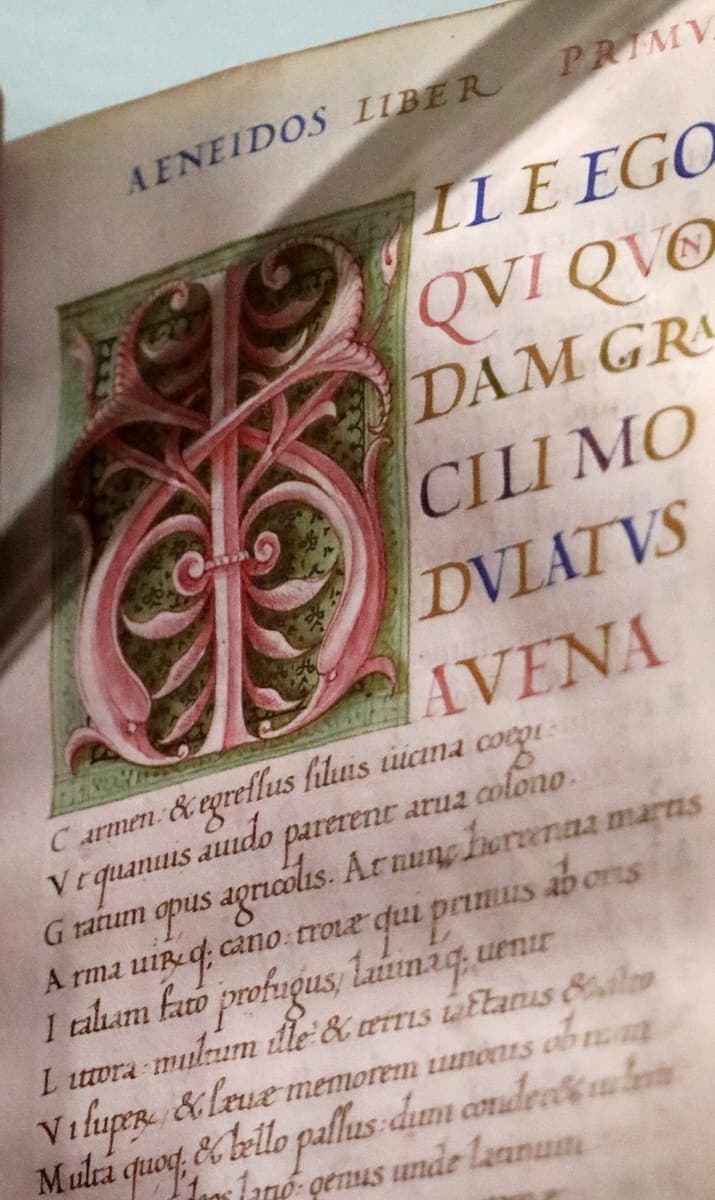
Bibliothèque nationale de France, Paris, c. 1463–1464 · Source · CC BY-SA 4.0 · Photograph: Francesco Bini (Sailko)
Evidano Transcription
The four pre-proem verses and Aeneid I.1–16, the verses visible on the page, from the Latin Wikisource text; the pre-proem quatrain is lettered A–D there. Only the first of the four is set in the page’s display capitals — the other three run on in the sloping hand with the rest. The macrons that Wikisource adds to mark vowel quantity have been removed, since the manuscript does not mark quantity; the edition also prints posthabita as one word where the scribe writes Post habita.
Ille ego, qui quondam gracili modulatus avena
carmen, et egressus silvis vicina coegi
ut quamvis avido parerent arva colono,
gratum opus agricolis, at nunc horrentia Martis
Arma virumque cano, Troiae qui primus ab oris
Italiam, fato profugus, Laviniaque venit
litora, multum ille et terris iactatus et alto
vi superum saevae memorem Iunonis ob iram;
multa quoque et bello passus, dum conderet urbem,
inferretque deos Latio, genus unde Latinum,
Albanique patres, atque altae moenia Romae.
Musa, mihi causas memora, quo numine laeso,
quidve dolens, regina deum tot volvere casus
insignem pietate virum, tot adire labores
impulerit. Tantaene animis caelestibus irae?
Urbs antiqua fuit, Tyrii tenuere coloni,
Karthago, Italiam contra Tiberinaque longe
ostia, dives opum studiisque asperrima belli;
quam Iuno fertur terris magis omnibus unam
posthabita coluisse Samo; hic illius arma,
Source: Publius Vergilius Maro, Aeneis, Liber I, via Latin Wikisource (Public domain).
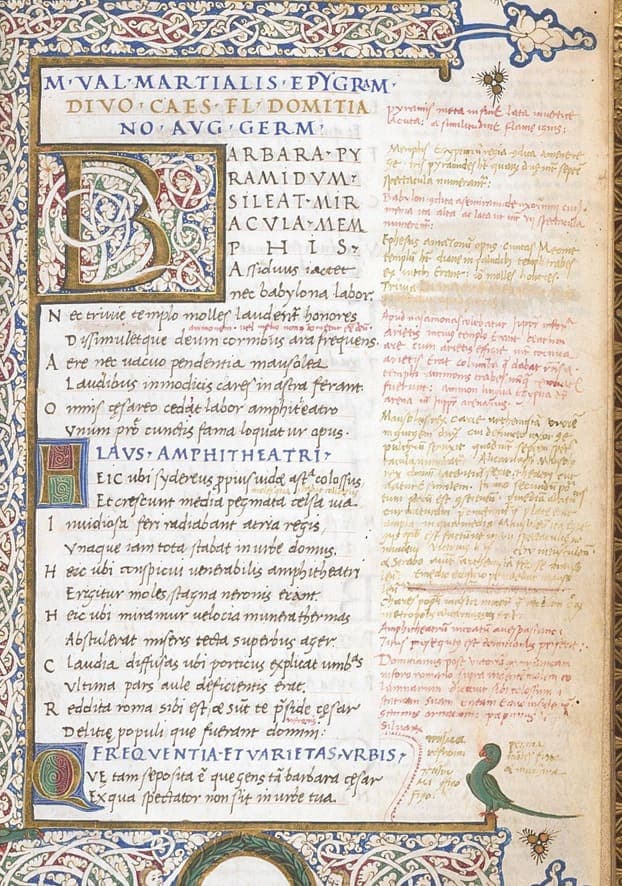
British Library, London, King’s Manuscripts, c. 1470 · Source · Public domain
Evidano Transcription
The three epigrams begun on the page: Liber spectaculorum I and II in full and the opening couplet of III, in the Latin Wikisource text, which is a normalised classical edition with modern punctuation and capitalisation. The rubrics, the marginal commentary and the running head are not part of the edited text.
Barbara pyramidum sileat miracula Memphis,
Assyrius iactet nec Babylona labor;
Nec Triviae templo molles laudentur Iones,
Dissimulet Delon cornibus ara frequens;
Aëre nec vacuo pendentia Mausolea
Laudibus inmodicis Cares in astra ferant.
Omnis Caesareo cedit labor amphitheatro,
Unum pro cunctis fama loquetur opus.
Hic ubi sidereus propius videt astra colossus
Et crescunt media pegmata celsa via,
Invidiosa feri radiabant atria regis
Unaque iam tota stabat in urbe domus.
Hic ubi conspicui venerabilis amphitheatri
Erigitur moles, stagna Neronis erant.
Hic ubi miramur velocia munera thermas,
Abstulerat miseris tecta superbus ager.
Claudia diffusas ubi porticus explicat umbras,
Ultima pars aulae deficientis erat.
Reddita Roma sibi est et sunt te praeside, Caesar,
Deliciae populi, quae fuerant domini.
Quae tam seposita est, quae gens tam barbara, Caesar,
Ex qua spectator non sit in urbe tua?
Source: Marcus Valerius Martialis, Liber spectaculorum, via Latin Wikisource (Public domain).
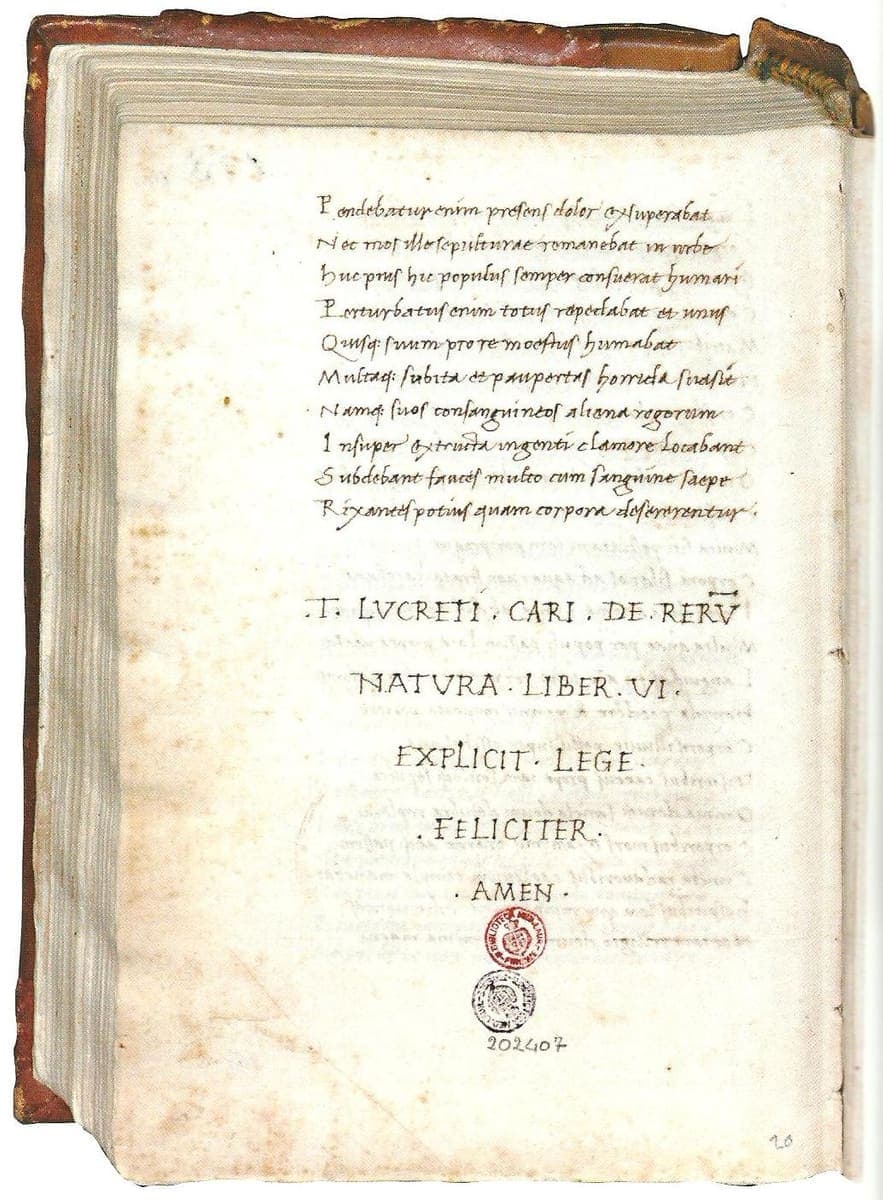
Evidano Transcription
The ten verses above the explicit, De rerum natura VI.1272–1281, from the Latin Wikisource text. That text is a modern critical edition with lower-case initials and punctuation, where the manuscript writes each verse with a capital and almost no stops; its square brackets mark words supplied by editors (cognatum, res) which this manuscript does not have, and its readings part company with this witness at several points — pendebantur and exsuperabat for the scribe’s pendebatur and superabat, quo prius for his huc prius. The explicit in capitals is not part of the edited poem.
pendebantur enim: praesens dolor exsuperabat.
nec mos ille sepulturae remanebat in urbe,
quo prius hic populus semper consuerat humari;
perturbatus enim totus trepidabat et unus
quisque suum pro re [cognatum] maestus humabat.
multaque [res] subita et paupertas horrida suasit;
namque suos consanguineos aliena rogorum
insuper extructa ingenti clamore locabant
subdebantque faces, multo cum sanguine saepe
rixantes, potius quam corpora desererentur,
Source: Titus Lucretius Carus, De rerum natura, Liber VI, via Latin Wikisource (Public domain).
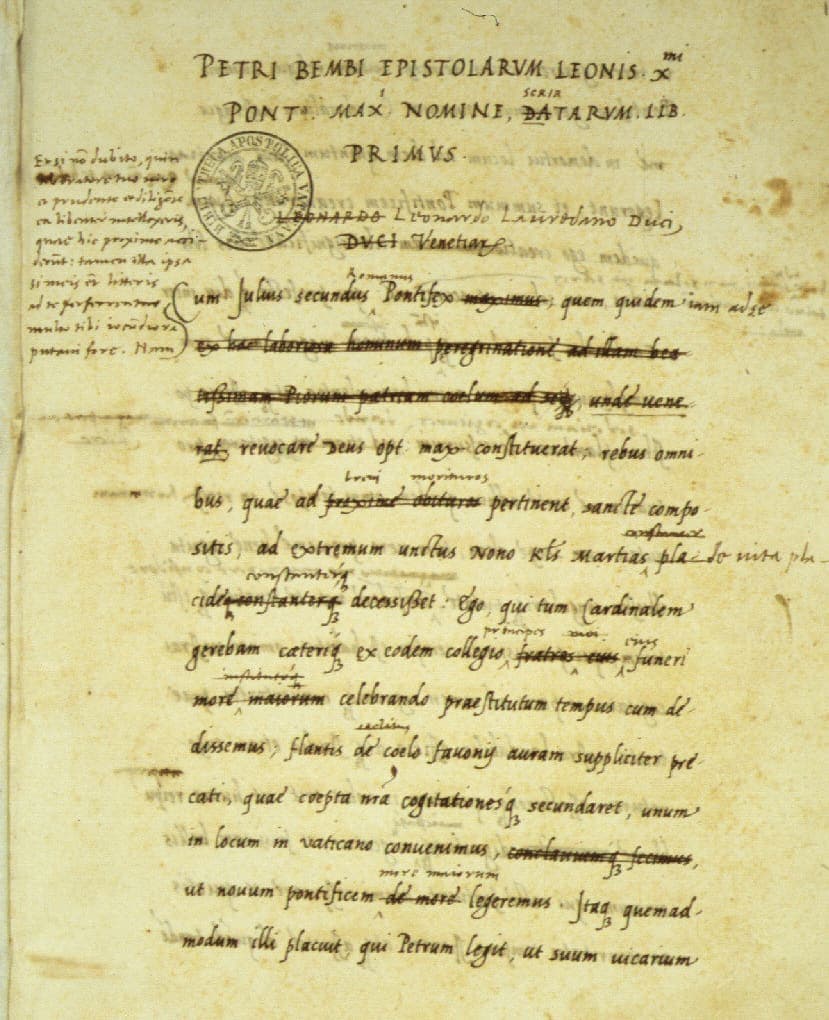
Biblioteca Apostolica Vaticana, Vatican City, Vat. lat. 3364, f. 1r, c. 1517–1519 · Source · Public domain
Evidano Transcription
PETRI BEMBI EPISTOLARVM LEONIS X^mi
PONT^i . MAX^i NOMINE, [cancelled: DA] \SCRIP[?]/TARVM . LIB .
PRIMVS .
[stamp]
[cancelled: LEONARDO] Leonardo Lauredano Duci,
[cancelled: DVCI] Venetiar[um]
Cum Julius secundus \Romanus/ Pontifex [cancelled: maximus], quem quidem iam ad se
[cancelled: ex hac laboriosa hominum peregrinatione ad illam bea]
[cancelled: tissimam Piorum patrum coelum ad se], unde uene
rat, reuocare Deus opt[imus] max[imus] constituerat, rebus omni
bus, quae ad \breui morituros/ [cancelled: proxime obituros] pertinent, sancte compo
sitis, ad extremum unctus Nono K[a]l[endas] Martias \confirmatus[?]/ [cancelled: pla] de uita pla
cide [cancelled: constanterq[ue]] \constanterq[ue]/ decessisset. Ego, qui tum Cardinalem
gerebam, caeteriq[ue] ex eodem collegio \principes/ [cancelled: fratres eius] [illegible]/ \eius/ funeri
more \institutisq[ue]/ [cancelled: maiorum] celebrando praestitutum tempus cum de
dissemus, flantis de \sereno[?]/ coelo Fauonij auram suppliciter pre
cati, quae coepta n[ost]ra cogitationesq[ue] secundaret, unum
in locum in Vaticano conuenimus, [cancelled: conclauumq[ue] fecimus],
ut nouum pontificem \more maiorum/ [cancelled: de more] legeremus. Itaq[ue] quemad
modum illi placuit, qui Petrum legit, ut suum uicarium
[left margin] Ergo no[n] dubito, quin
[cancelled: illegible]
a prudente et diligente
in librorum [illegible],
quae hic proxime acci
derunt: tamen illa ipsa
si meis ex litteris
ad te perferrentur
multo tibi iucundiora
putaui fore. [illegible]
Generated by Evidano’s advanced model; not yet checked against a published edition.
Antiqua, cursive and the pages they fill
About 1400 the Florentine humanists set out to write a script worthy of the classical texts they were recovering, and copied what they believed was the antique letter: in fact the Carolingian minuscule of eleventh- and twelfth-century Italian books. Poggio Bracciolini shaped the formal version, littera antiqua, round, upright, generously spaced, with straight d, a two-compartment a, ct and st ligatures and capitals modelled on Roman inscriptions. Niccolò Niccoli wrote a quicker sloping version, and that cursive, refined in the papal chancery, became the cancelleresca corsiva, later cut as italic type. Scribes such as Bartolomeo Sanvito carried it to Padua, Venice and Rome, and by the middle of the century the two grades were used side by side, often by the same hand: the formal one for the text, the cursive for headings, notes and letters.
Abbreviation is deliberately thin compared with a Gothic book. What remains is a tilde for a suppressed m or n, the q; sign for -que in atq;, neq; and usq;, an ampersand for et, occasional p̄ for pre and a superscript letter in a proper name. Classical spelling is restored: ae and oe appear as æ and œ or as e with a cedilla, aspirated forms such as michi and nichil give way to mihi and nihil, and Greek words are written in Greek minuscule rather than transliterated. Punctuation follows the humanists’ own reform, with the point, the colon, the virgula and, in later books, parentheses and the semicolon; u and v, i and j are positional rather than phonetic, so uenit and iustus are normal spellings.
The page is designed to be read. A codex is ruled in one wide column with generous margins, opens with a white-vine initial and a display line in alternating red, blue and gold capitals, and carries a running head in capitals across the top. Letters and drafts look entirely different: widely spaced lines to leave room for revision, words struck out and replaced above the line, whole clauses added in the margin, and a final fair copy in a smaller, more formal version of the same hand. Vernacular texts were copied in these hands too, so a Boccaccio in humanistic cursive sits beside a Virgil in antiqua on the same shelf.
Why ordinary OCR struggles here
A script that looks like type
Because roman and italic fonts were cut from these hands, generic OCR returns something plausible and wrong: æ silently split, ſ read as f, the q; sign turned into qi or q3, and ct or st ligatures broken into odd letter pairs. Confident errors in a text that reads smoothly are harder to catch than obvious failures.
Positional u/v, i/j and restored spellings
The scribe writes uenit, seruus, iustus and Iohannes, and prints a capital V where a modern edition has U. Normalising by habit produces a text that can no longer be matched against the manuscript, while leaving everything as written can hide a word from a search. The choice has to be explicit and consistent.
Authors’ drafts full of second thoughts
A working page carries deletions, interlinear substitutions, marginal insertions keyed by a caret and instructions to the copyist. Flattened into one line of text it produces a sentence the author never wrote; the layers have to be recorded separately so the earlier and the revised readings can both be recovered.
Two scripts and two languages on one leaf
Display capitals, a red rubric, the text hand and a dense column of annotation in a smaller cursive can all appear on one page, with Greek quotations inside the Latin and vernacular glosses beside it. Each needs its own treatment, and reading order has to follow the layout rather than the raster.
Who works with this material
Editors and textual critics of classical works
Fifteenth-century copies are witnesses in their own right, and collating them means recording each scribe’s readings, his corrections and the variants he entered above the line. That is line-by-line work on hundreds of leaves, and it is where an accurate first transcript saves the most time.
Historians of the book and of libraries
Attributing a codex to a scribe, a workshop or a patron rests on details: how a scribe forms his g, what he does with ct, how he abbreviates -que, what his colophon says. Transcribing colophons, ownership notes and shelfmarks across a collection turns those details into evidence.
Neo-Latin and correspondence projects
Editions of humanist letters need the drafts as well as the fair copies, with the deleted first thoughts legible. A transcript that keeps both layers lets an editor show how a sentence was built instead of printing only its final state.
Type historians and calligraphers
Roman and italic type descend directly from these hands, and comparing a punchcutter’s letters with a scribe’s requires a transcript aligned with the image line by line. Writing manuals and their manuscript models are read the same way.
Getting the best transcription
State your policy on u/v, i/j and the ligatures
Decide whether uenit stays as written or becomes venit, whether Iohannes keeps its I, and whether æ and œ are preserved or resolved to ae and oe. Ask for the policy to be applied uniformly, and for a note wherever the scribe himself is inconsistent, which happens most often in proper names.
Separate display lines from the text
Ask for the running head, the coloured display capitals and the rubrics to be returned as their own fields. On a page where the first verses are set in capitals beside an initial, say that they belong to the poem so the transcript begins with the real first line rather than with the prose below.
Ask for the draft layers, not the result
On an autograph, request the base text, the deletions, the interlinear substitutions and the marginal additions as separate labelled readings, with carets and reference marks reported. Only then ask for a clean reading text; producing it first destroys the evidence you wanted.
Run an annotated page before a plain one
Test on a leaf that carries a commentary in the margin and a Greek word or two in the text. If the marginal column comes back as its own block and the Greek is transcribed in Greek rather than guessed at, the undecorated leaves of the same codex will need very little correction.
Further reading on this hand
The palaeography guides the in-app selector points to for this domain, if you want to check a transcription against the standard references.
- Italian Paleography: Handbook
This Newberry Library handbook surveys Humanistic book and cursive scripts within the history of Italian writing. It explains their relationship to revived Caroline models and to the development of italic handwriting. The examples allow comparison of characteristic letterforms, joining, abbreviation, punctuation, spacing, and page presentation. It is especially useful for Renaissance literary, scholarly, and administrative manuscripts that deliberately contrast Humanistic and Gothic conventions.
Frequently asked questions
- If humanistic minuscule looks like roman type, can ordinary OCR read it?
- It gets far enough to be dangerous. Print OCR has no model for the q; sign, the tilde, the æ ligature or a scribe’s corrections, so it produces a clean-looking text with silent losses at exactly those points. Handwriting transcription treats them as manuscript features and reports them rather than guessing.
- Are æ and œ kept, and what about e with a cedilla?
- All three are recognised and you choose the output. Keeping them preserves the scribe’s classicising spelling, which is one way manuscripts of this period are dated and grouped; resolving them to ae and oe makes the text easier to search. Whichever you pick is applied consistently and recorded.
- How are the few abbreviations that remain expanded?
- The q; sign becomes -que, the tilde restores m or n, the ampersand becomes et where you want it expanded, and each expansion can be bracketed. These are far fewer than in a Gothic book, which makes an unmarked mistake easy to miss, so bracketing is worth the small extra noise in an edition.
- Can an author’s corrected draft be transcribed layer by layer?
- Yes. Struck-through words are transcribed and marked as deleted, words written above the line are marked as insertions, and marginal additions are tied to the caret that places them. You can then ask for the first state, the revised state, or both aligned side by side.
- What happens to Greek words inside a Latin text?
- They are transcribed in Greek script, with accents and breathings where the scribe wrote them, and flagged as a language switch. Guessing at them in Latin letters is the common failure, and it hides precisely the passages a scholar is likely to be looking for.
- Does this domain cover vernacular Italian written in humanistic hands?
- It does. Copies of Boccaccio, Petrarch and contemporary Italian prose in humanistic minuscule or cursive belong here rather than with the Gothic book hands, because the letterforms and the abbreviation habits are those of the humanist scribe, whatever language he is writing.
Related scripts and pages
Transcribe your humanist codices
Upload a decorated opening and an author’s draft, choose Italian Humanistic Minuscule and Cursive, and settle the spelling and ligature rules on the first leaf.