
Indonesian
Read Indonesian in the spelling it was written in
The same word is boekoe in 1920, buku in 1975, and on the shelf below it the page is not in the Latin alphabet at all. Evidano transcribes Indonesian as it stands — old spellings kept, not quietly modernised — and separates the Dutch, Japanese or Chinese-Malay material that shares the page, with the reading beside the image so every line can be checked.
Sample pages
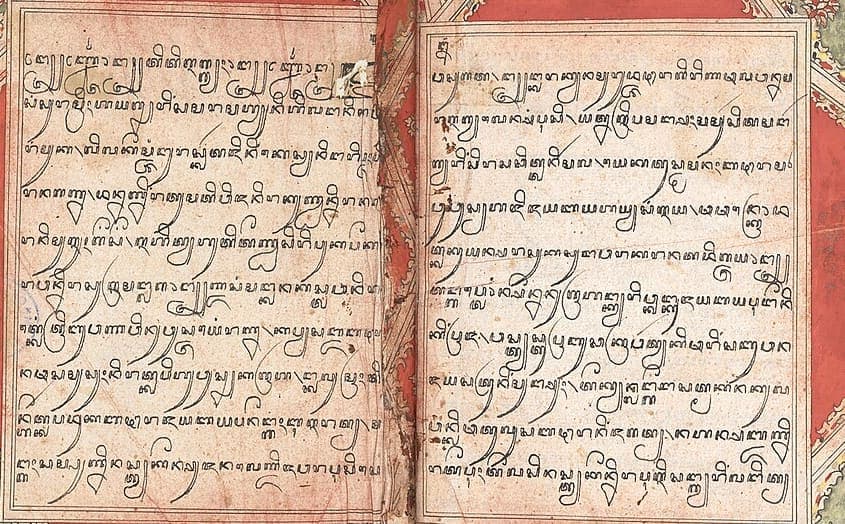
British Library, MSS Jav 4, ff. 2v–3r, before 1797 · Source · CC0 1.0 · British Library, Javanese Manuscripts from Yogyakarta digitisation project
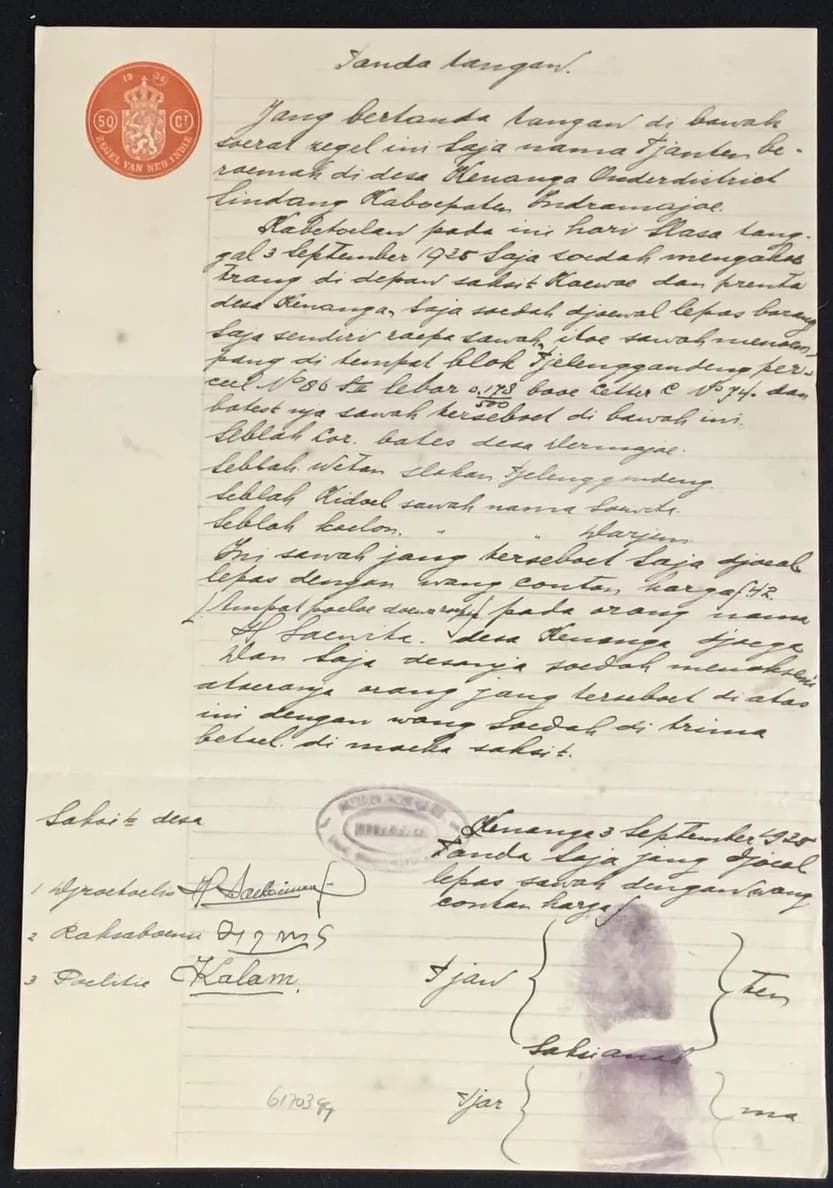
Private collection, 1935 · Source · Public domain
Evidano Transcription
[stamp: 50 Ct]
Tanda tangan.
Jang bertanda tangan di bawah
soerat zegel ini Saja nama Tjanten be-
roemah di desa Kenanga Onderdistrict
Sindang Kaboepaten Indramajoe.
Kabetoelan pada ini hari Slasa tang-
gal 3 September 1925 Saja soedah mengakoe
trang di depan saksi2 Kaoem dan prenta
desa Kenanga, Saja soedah djoewal lepas barang
Saja sendiri roepa sawah, itoe sawah menoe-
jang di tempel blok Tjelenggandeng per-
ceel No 86 ta lebar 0,178/500 baoe letter C No 74. dan
batest nja sawah terseboet di bawah ini.
Seblah lor. bates desa Serengsae [?].
Seblah wetan slokan Tjelenggandeng.
Seblah kidoel sawah nama Sawde [?].
Seblah koelon. " " Marjim [?].
Ini sawah jang terseboet Saja djoeal
lepas dengan wang contan, harga f 42.
(Ampat poeloe doewa roep.) pada orang nama
H Saenika [?]. desa Kenanga djoega
Dan Saja desanja soedah menaksikan
atoeranja wang jang terseboet di atas
ini dengan wang soedah di trima
betoel di moeka saksi2.
Saksi2 desa
1 Ngroetoeloe [?] H Saekiman [signature]
2 Raksaboemi [signature]
3 Poelitie Kalam [signature]
[seal]
Kenanga 3 September 1925
Tanda Saja jang djoeal
lepas sawah dengan wang
contan harga f
Tjap { [thumbprint] } Tjen
Saksi anoe
Tjap { [thumbprint] } ma
6170399
Generated by Evidano’s advanced model; not yet checked against a published edition.
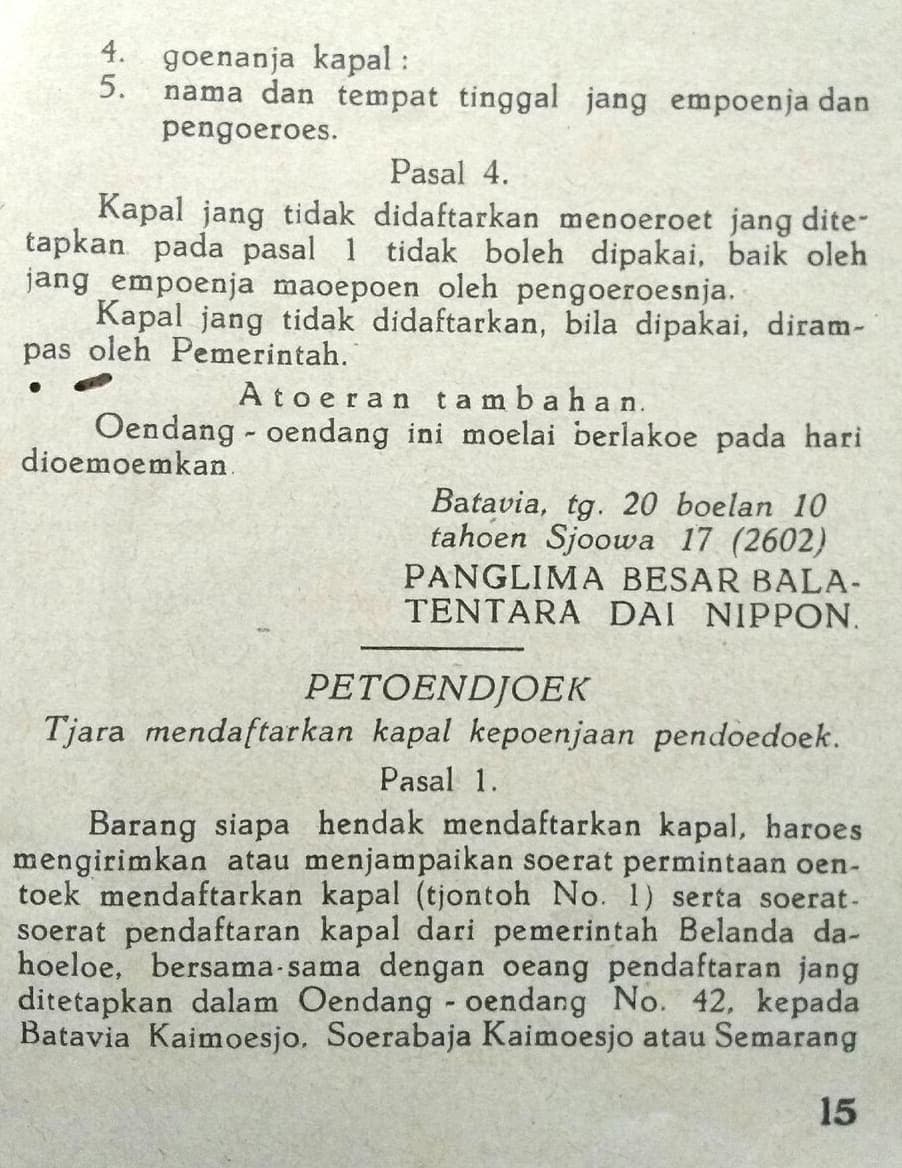
Dewantara Kirti Griya Museum, Yogyakarta, 1942 · Source · Public domain
Evidano Transcription
The whole of the printed page, as proofread and validated on Indonesian Wikisource. Wiki markup has been removed and the centred headings are given on their own lines; the text keeps the Van Ophuijsen spelling and the spaced setting of Oendang - oendang, and the running page number 15 is not repeated here.
4. goenanja kapal:
5. nama dan tempat tinggal jang empoenja dan pengoeroes.
Pasal 4.
Kapal jang tidak didaftarkan menoeroet jang ditetapkan pada pasal 1 tidak boleh dipakai, baik oleh jang empoenja maoepoen oleh pengoeroesnja.
Kapal jang tidak didaftarkan, bila dipakai, dirampas oleh Pemerintah.
Atoeran tambahan.
Oendang - oendang ini moelai berlakoe pada hari dioemoemkan
Batavia. tanggal 20, boelan 10,
tahoen Sjoowa 17 (2602).
PANGLIMA BESAR BALA-
TENTARA DAI NIPPON.
PETOENDJOEK
Tjara mendaftarkan kapal kepoenjaan pendoedoek.
Pasal 1.
Barang siapa hendak mendaftarkan kapal, haroes mengirimkan atau menjampaikan soerat permintaan oentoek mendaftarkan kapal (tjontoh No. 1) serta soerat-soerat pendaftaran kapal dari pemerintah Belanda dahoeloe, bersama-sama dengan oeang pendaftaran jang ditetapkan dalam Oendang-oendang No. 42, kepada Batavia Kaimoesjo, Soerabaja Kaimoesjo atau Semarang
Source: Halaman:Oendang-Oendang dan Ma’loemat-Ma’loemat Pemerintah Balatentara Dai Nippon.pdf/16, via Indonesian Wikisource (Public domain).
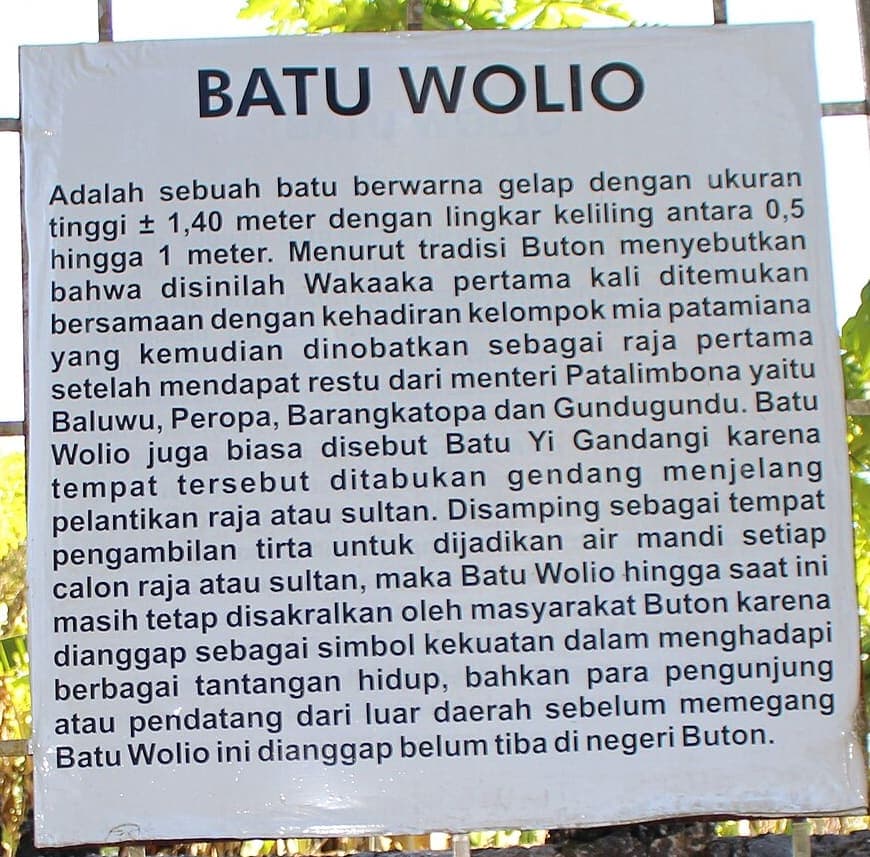
Source · CC BY-SA 4.0 · Ahmad Ridhoni
Evidano Transcription
BATU WOLIO
Adalah sebuah batu berwarna gelap dengan ukuran
tinggi ± 1,40 meter dengan lingkar keliling antara 0,5
hingga 1 meter. Menurut tradisi Buton menyebutkan
bahwa disinilah Wakaaka pertama kali ditemukan
bersamaan dengan kehadiran kelompok mia patamiana
yang kemudian dinobatkan sebagai raja pertama
setelah mendapat restu dari menteri Patalimbona yaitu
Baluwu, Peropa, Barangkatopa dan Gundugundu. Batu
Wolio juga biasa disebut Batu Yi Gandangi karena
tempat tersebut ditabukan gendang menjelang
pelantikan raja atau sultan. Disamping sebagai tempat
pengambilan tirta untuk dijadikan air mandi setiap
calon raja atau sultan, maka Batu Wolio hingga saat ini
masih tetap disakralkan oleh masyarakat Buton karena
dianggap sebagai simbol kekuatan dalam menghadapi
berbagai tantangan hidup, bahkan para pengunjung
atau pendatang dari luar daerah sebelum memegang
Batu Wolio ini dianggap belum tiba di negeri Buton.
Generated by Evidano’s advanced model; not yet checked against a published edition.
One language, three spellings, more than one alphabet
Indonesian has been respelled twice within living memory, and both reforms left their traces in the archives. The Van Ophuijsen system, official from 1901, wrote oe for u, j for y, tj for c, dj for j, nj for ny, sj for sy and an apostrophe for the Arabic ʿayn or hamza, so a 1930s title page reads Ma’loemat, Soerabaja and djoega. The Republican or Soewandi spelling announced on 19 March 1947 turned every oe into u but left dj, tj and j alone. Only the Ejaan Yang Disempurnakan of 17 August 1972 produced the letters used now. One family’s papers can therefore spell a single surname three ways, and the person’s own signature usually keeps the oldest form.
Print and typing of the older period carry conventions that are easy to lose. Reduplication is abbreviated with a raised figure two — anak² for anak-anak, karadjaan² for karadjaan-karadjaan — which OCR reads as a footnote marker or a squared number. Quotation runs low-then-high („ ”) in books set from Dutch founts, guilder sums appear as ƒ 1.10, and words break across lines with no hyphen in some lithographed hikayat. Dutch loan spelling survives inside Indonesian sentences: politiek, redactie, conferentie, Volksraad.
The alphabet itself is a recent arrival for much of the material. Javanese literature was copied in Aksara Jawa, an Indic syllabary written left to right with no spaces between words, in which vowels hang above, below or on either side of the consonant and a second consonant is stacked underneath as a pasangan; Balinese manuscripts use the closely related Aksara Bali on palm leaf. Malay and Javanese religious writing used Jawi and pegon, the Arabic script read right to left with letters added for local sounds. Alongside these sit Dutch colonial paperwork on stamped zegel paper, Japanese occupation circulars dated by the Sjoowa and Koki years, and the plain modern Indonesian of a form, a certificate or a roadside board.
Why ordinary OCR struggles here
Spelling that shifts under the word
A recogniser trained on present-day Indonesian pulls soerat towards surat and Tjipto towards Cipto. That is a silent edit, not a reading: it destroys the evidence a date rests on and breaks the match between a name on a deed and the same name on a later identity card. The old orthography has to be preserved as a deliberate choice.
The raised two and other printers’ shorthand
Reduplication marked with ², the low-high quotation marks, the ƒ for guilders and the abbreviations tg. and dsb. are all ordinary in pre-1972 text and all misread by general OCR. Expanding ² correctly means knowing which word it doubles, which is a reading decision rather than a character decision.
A different writing system on the next shelf
Aksara Jawa runs without word spaces, hangs its vowel signs around the consonant and stacks a second consonant below the line, so segmentation cannot be done on white space at all. Jawi and pegon run right to left in the same collection. Neither can be handled by a model that assumes a Latin baseline.
Four administrations on one desk
A single box can hold Dutch-language registers with Indonesian names, a Chinese-Malay newspaper using Hokkien romanisations, a Japanese military ordinance full of romanised office names, and a Republican circular. Revenue stamps, village seals and inked thumbprints are printed across the text rather than beside it.
Who works with this material
Civil registration and family research
Netherlands Indies burgerlijke stand volumes, village land papers and later kartu keluarga describe the same people under different spellings and different administrations. Researchers need the names exactly as each document gives them, because Soerjadi and Suryadi have to be recognised as one person by the reader rather than by the transcription.
Manuscript digitisation programmes
Projects photographing pesantren and private collections across the archipelago produce thousands of leaves in Aksara Jawa, Aksara Bali, Jawi and pegon before anyone has read a line. A first transcription that respects the script and flags what is uncertain lets a catalogue be built from the images instead of from the covers.
Press and periodical historians
The Chinese-Malay press, the Balai Pustaka list and the vernacular papers of the 1910s to 1940s are the record of how Indonesian became a national language. Working through them needs the printed spelling preserved, since the shift from oe to u is itself part of what is being studied.
Notaries, land offices and back offices
Deeds, certificates and application forms arrive as phone photographs with a meterai stamp across the signature and a table that has to stay a table. What is wanted is the text with its fields intact, so a value stays attached to its label rather than being flattened into a paragraph.
Getting the best transcription
State the orthography and forbid modernising
Tell the model which spelling the document uses and that it must be reproduced letter for letter, including oe, dj, tj and the apostrophe. Without that instruction a model will drift towards present-day forms on the easy words and leave the hard ones alone, which is the worst of both.
Ask for the modern reading as a second block
If you also want searchable text, request a normalised version alongside the diplomatic one rather than instead of it. Keeping the two apart means the archival spelling stays citable while an index can be built from the modernised column.
Name the second script and say what to do with it
Where a page carries Aksara Jawa, Jawi or pegon, say so and choose: transliterate into Latin, transcribe in the original script, or mark the block and leave it. Say too whether Dutch or romanised Japanese passages should be labelled by language.
Start with a stamped, folded handwritten sheet
Run a deed on zegel paper before the printed material. If the model keeps the revenue stamp, the seal and the thumbprint out of the running text and marks the words hidden under the fold, the printed pages will need only spot checks.
Frequently asked questions
- Will old spellings such as oe and dj be modernised automatically?
- No, unless you ask for that. The default is to reproduce the spelling on the page, so soedah stays soedah and Djakarta stays Djakarta. A modernised version can be produced as a separate block if you want one for searching.
- Can it read Javanese or Balinese script?
- Yes, and it treats them as scripts rather than as decoration: the vowel signs around a consonant and the pasangan stacked beneath it are read as part of one syllable, and the lack of word spacing is handled by reading rather than by splitting on white space. You choose whether the output is transliterated into Latin letters or kept in the original characters.
- How is the raised ² for reduplication handled?
- It is recognised as a reduplication mark. You can have it kept exactly as printed, expanded to the full doubled form such as anak-anak, or expanded with a note recording that the original used the abbreviation.
- What happens on a page that mixes Dutch, Indonesian and Japanese terms?
- Each stretch is transcribed in its own language and can be labelled, so a Dutch heading, an Indonesian clause and a romanised Japanese office name are not forced into one vocabulary. Nothing is translated unless you ask for a translation separately.
- Are revenue stamps, seals and thumbprints separated from the text?
- Yes. Stamped and printed matter that sits on top of the writing is reported apart from the body, and words obscured by a seal or a thumbprint are marked as uncertain instead of being invented.
- Does it cope with modern forms and signage as well as archives?
- It does. Certificates, invoices, application forms and roadside boards are read with their layout kept, so headings, captions and table cells stay distinct and local names that no dictionary lists are transcribed as written.
Related scripts and pages
Transcribe your Indonesian material
Upload a deed, a pre-war printed page, a manuscript leaf or a photograph of a sign, and check the Indonesian reading line by line before you export it.