
Tagalog
Read Tagalog across four centuries of script and spelling
Baybayin, the pre-colonial syllabary, could not show a consonant at the end of a syllable until Spanish printers added a cancelling mark in the 1620s, and three centuries later Tagalog print still spelled words the Spanish way — c, qu, a tilde over ng̃ — until the 1940 Abakada reform. Evidano reads baybayin as the syllabic script it is, keeps pre-reform spelling as printed rather than modernising it, and reads a present-day Filipino form or sign with the same care.
Sample pages
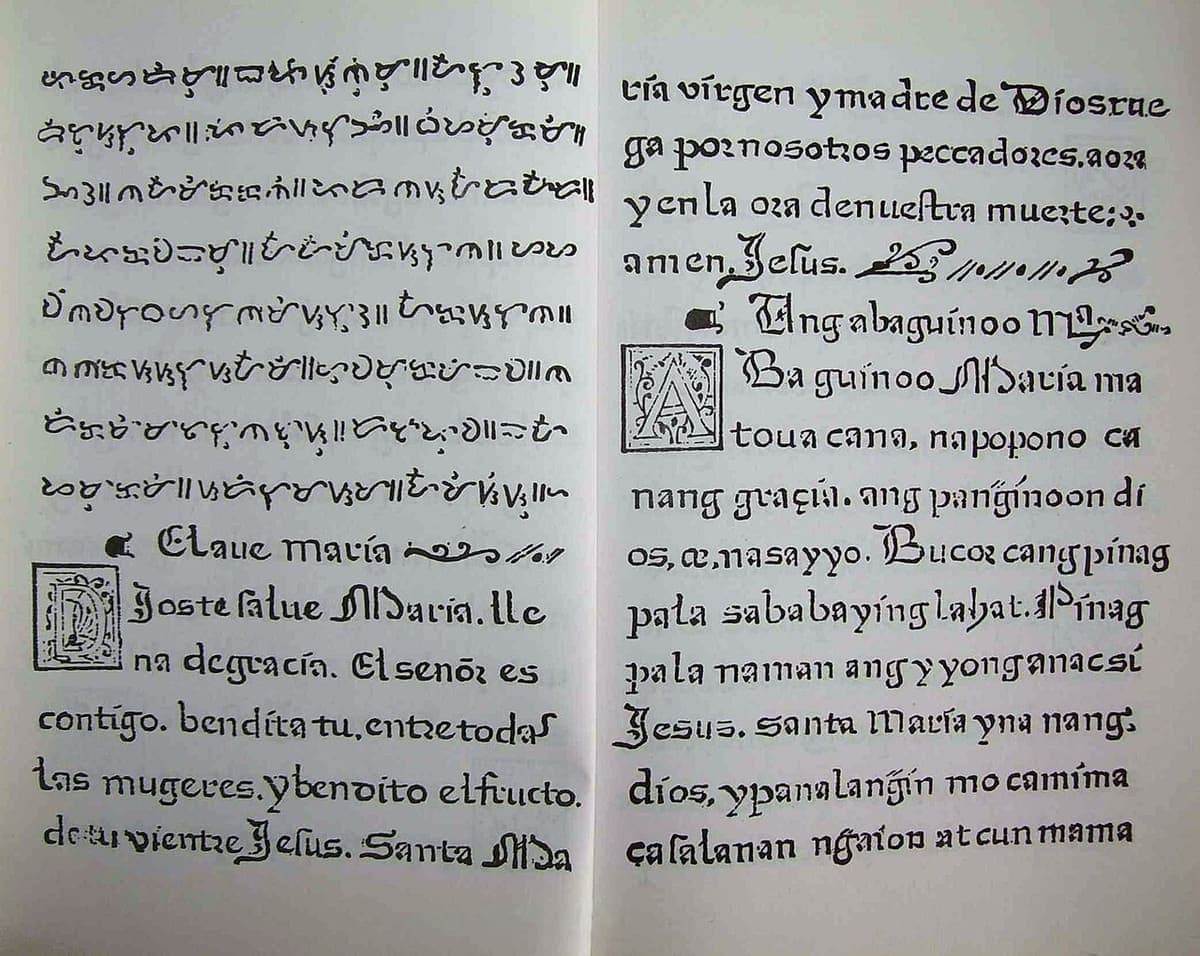
Source · CC BY-SA 3.0 · Gubernatoria
Evidano Transcription
[8 lines of baybayin: illegible]
¶ El aue maria [baybayin]
Díoste salue María. lle
na degracía. El senõr es
contígo. bendíta tu, entre todas
las mugeres. ybendito elfructo.
detu vientre Jesus. Santa M[ari]a
ría vírgen ymadre de Díos rue
ga por nosotros peccadores. aora
y en la ora denuestra muerte.
amen. Jesus. [baybayin]
¶ Ang abaguínoo M [baybayin]
A Ba guínoo María ma
toua cana, napopono ca
nang graçía. ang pangínoon di
os, æ, nasayyo. Bucod cang pinag
pala sababayíng lahat. Pinag
pala naman ang y yong anac si
Jesus. santa María yna nang
díos, ypanalangín mo camí ma
casalanan ngaion at cun mama
Generated by Evidano’s advanced model; not yet checked against a published edition.
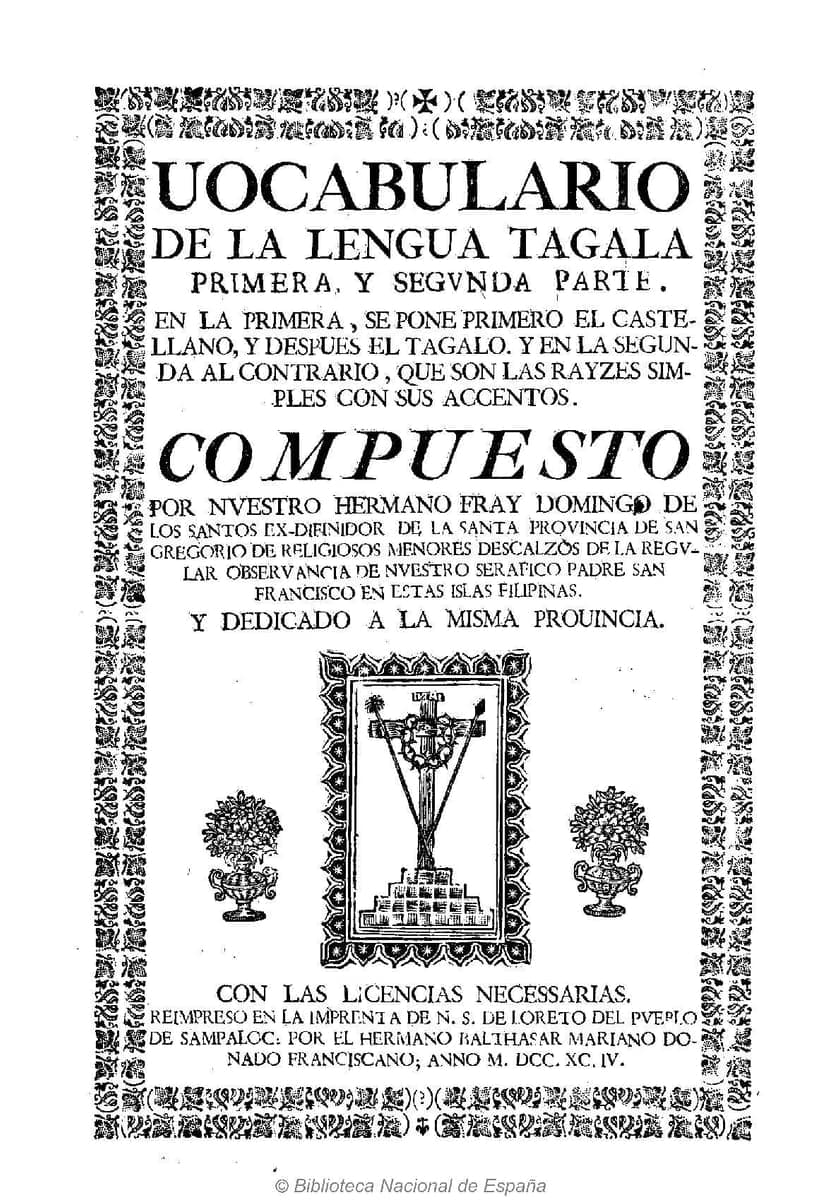
Biblioteca Nacional de España, 1794 · Source · Public domain
Evidano Transcription
UOCABULARIO
DE LA LENGUA TAGALA
PRIMERA, Y SEGVNDA PARTE.
EN LA PRIMERA, SE PONE PRIMERO EL CASTE-
LLANO, Y DESPUES EL TAGALO. Y EN LA SEGUN-
DA AL CONTRARIO, QUE SON LAS RAYZES SIM-
PLES CON SUS ACCENTOS.
COMPUESTO
POR NVESTRO HERMANO FRAY DOMINGO DE
LOS SANTOS EX-DIFINIDOR DE LA SANTA PROVINCIA DE SAN
GREGORIO DE RELIGIOSOS MENORES DESCALZOS DE LA REGV-
LAR OBSERVANCIA DE NVESTRO SERAFICO PADRE SAN
FRANCISCO EN ESTAS ISLAS FILIPINAS.
Y DEDICADO A LA MISMA PROUINCIA.
CON LAS LICENCIAS NECESSARIAS.
REIMPRESO EN LA IMPRENTA DE N. S. DE LORETO DEL PVEBLO
DE SAMPALOC: POR EL HERMANO BALTHASAR MARIANO DO-
NADO FRANCISCANO; ANNO M. DCC. XC. IV.
© Biblioteca Nacional de España
Generated by Evidano’s advanced model; not yet checked against a published edition.
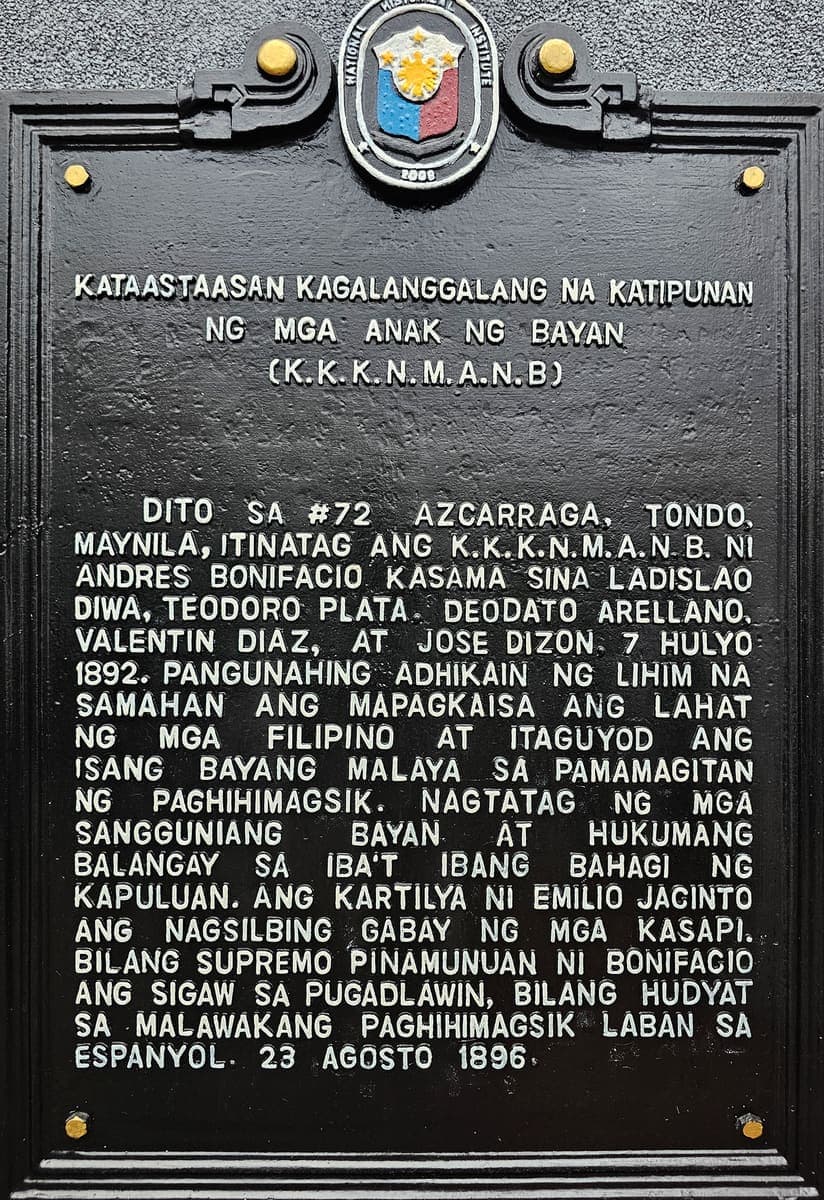
Source · CC BY-SA 4.0 · Andre Ryan Maceda
Evidano Transcription
KATAASTAASAN KAGALANGGALANG NA KATIPUNAN
NG MGA ANAK NG BAYAN
(K.K.K.N.M.A.N.B)
DITO SA #72 AZCARRAGA, TONDO,
MAYNILA, ITINATAG ANG K.K.K.N.M.A.N.B. NI
ANDRES BONIFACIO KASAMA SINA LADISLAO
DIWA, TEODORO PLATA. DEODATO ARELLANO,
VALENTIN DIAZ, AT JOSE DIZON. 7 HULYO
1892. PANGUNAHING ADHIKAIN NG LIHIM NA
SAMAHAN ANG MAPAGKAISA ANG LAHAT
NG MGA FILIPINO AT ITAGUYOD ANG
ISANG BAYANG MALAYA SA PAMAMAGITAN
NG PAGHIHIMAGSIK. NAGTATAG NG MGA
SANGGUNIANG BAYAN AT HUKUMANG
BALANGAY SA IBA'T IBANG BAHAGI NG
KAPULUAN. ANG KARTILYA NI EMILIO JACINTO
ANG NAGSILBING GABAY NG MGA KASAPI.
BILANG SUPREMO PINAMUNUAN NI BONIFACIO
ANG SIGAW SA PUGADLAWIN, BILANG HUDYAT
SA MALAWAKANG PAGHIHIMAGSIK LABAN SA
ESPANYOL. 23 AGOSTO 1896.
Generated by Evidano’s advanced model; not yet checked against a published edition.
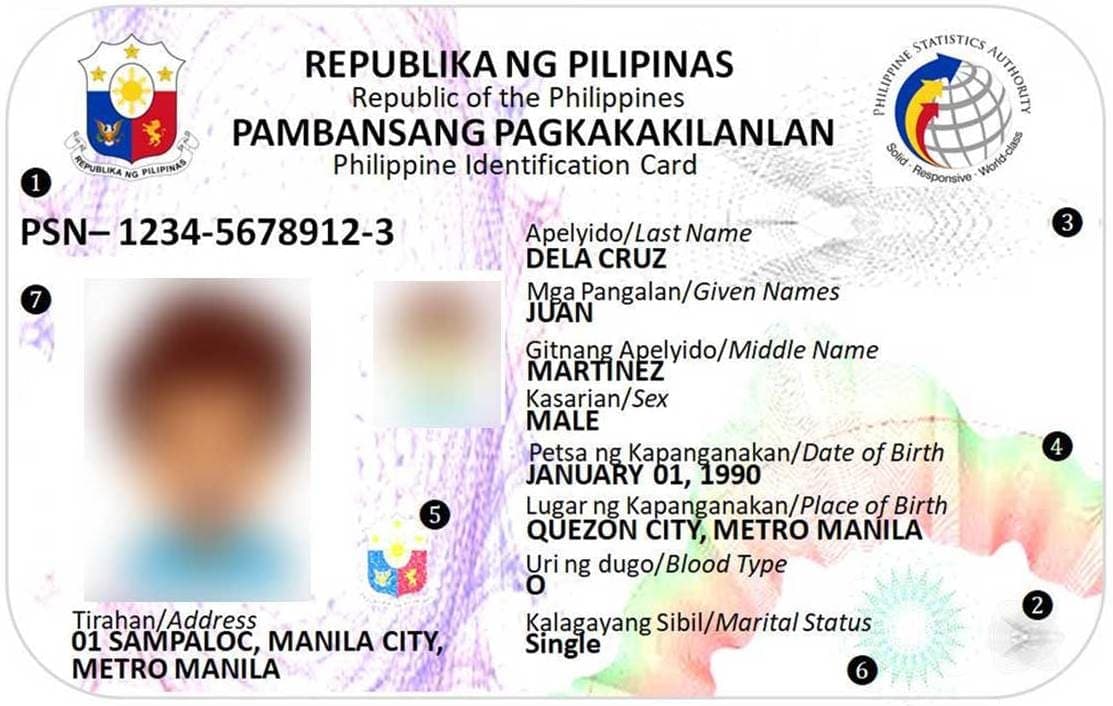
Philippine Statistics Authority, c. 2018 · Source · Public domain · Philippine Information Agency
Evidano Transcription
REPUBLIKA NG PILIPINAS
Republic of the Philippines
PAMBANSANG PAGKAKAKILANLAN
Philippine Identification Card
[seal: REPUBLIKA NG PILIPINAS] [logo: PHILIPPINE STATISTICS AUTHORITY · Solid · Responsive · World-class]
PSN– 1234-5678912-3
Tirahan/Address
01 SAMPALOC, MANILA CITY,
METRO MANILA
Apelyido/Last Name
DELA CRUZ
Mga Pangalan/Given Names
JUAN
Gitnang Apelyido/Middle Name
MARTINEZ
Kasarian/Sex
MALE
Petsa ng Kapanganakan/Date of Birth
JANUARY 01, 1990
Lugar ng Kapanganakan/Place of Birth
QUEZON CITY, METRO MANILA
Uri ng dugo/Blood Type
O
Kalagayang Sibil/Marital Status
Single
Generated by Evidano’s advanced model; not yet checked against a published edition.
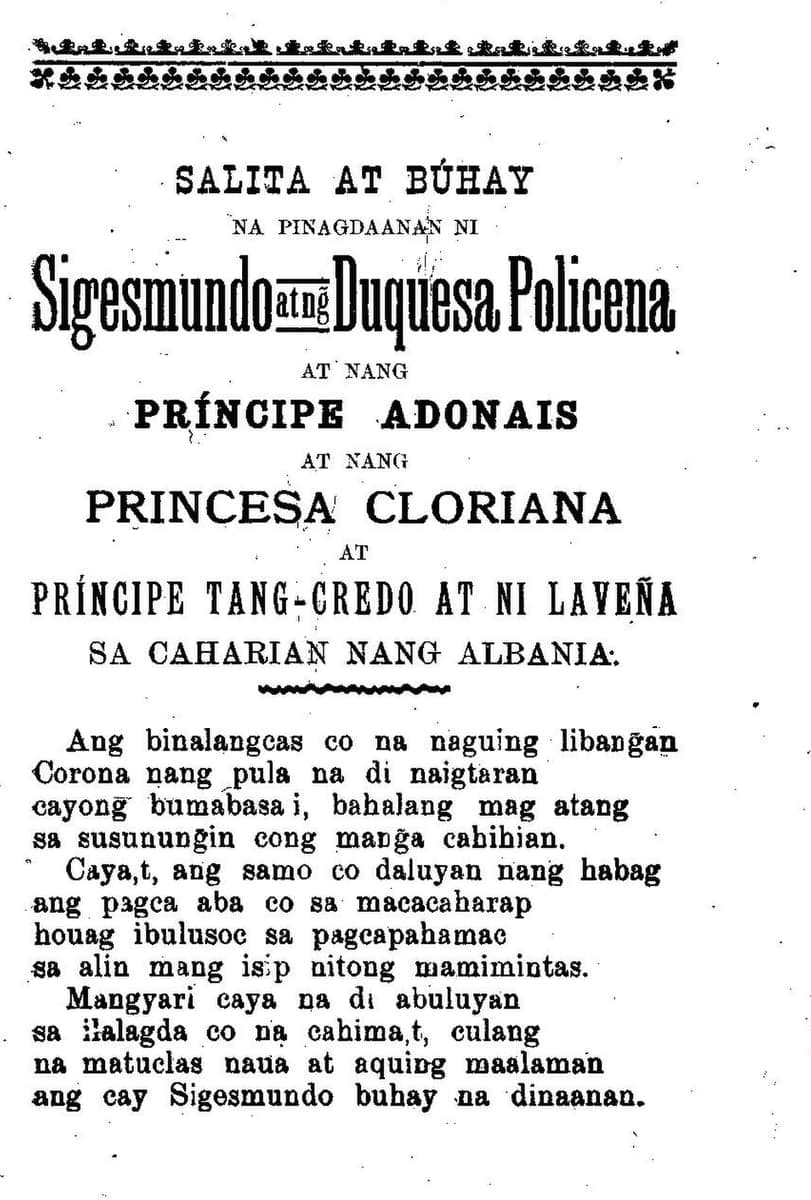
Bartlett Collection on the Philippines and the East Indies, American Philosophical Society Library; microfilm digitised by the University of Michigan, 1914 · Source · Public domain
Evidano Transcription
The whole leaf — the display title and the three opening quatrains — as proofread and validated on Tagalog Wikisource (page quality 4). Line breaks, the accented ú of búhay and the chapbook’s habit of writing an enclitic with a comma on either side (Caya,t, cahima,t,) follow the print. The n-with-tilde that the 1914 type sets in libang̃an, cayong̃, susunung̃in, mang̃a and the title’s at ng̃ has been restored from this scan, which shows it plainly; Wikisource prints those words with a plain ng.
SALITA AT BÚHAY
NA PINAGDAANAN NI
Sigesmundo at ng̃ Duquesa Policena
AT NANG
PRÍNCIPE ADONAIS
AT NANG
PRINCESA CLORIANA
AT
PRÍNCIPE TANG-CREDO AT NI LAVEÑA
SA CAHARIAN NANG ALBANIA.

Ang binalangcas co na naguing libang̃an
Corona nang pula na di naigtaran
cayong̃ bumabasa i, bahalang mag atang
sa susunung̃in cong mang̃a cahihian.

Caya,t, ang samo co daluyan nang habag
ang pagca aba co sa macacaharap
houag ibulusoc sa pagcapahamac
sa alin mang isip nitong mamimintas.

Mangyari caya na di abuluyan
sa ilalagda co na cahima,t, culang
na matuclas naua at aquing maalaman
ang cay Sigesmundo buhay na dinaanan.
Source: Pahina:Salita at buhay na pinagdaanan ni Sigesmundo at ng duquesa Policena.pdf/4, via Tagalog Wikisource (Public domain).
From baybayin to Abakada: four spellings of one language
Baybayin is an Indic-descended abugida of three vowel signs and around fourteen consonant symbols, each of which stands for a consonant plus the vowel a unless a kudlit — a dot or a short line placed above or below — shifts it to i/e or o/u. In its earliest form the script had no way to write a bare consonant at the end of a syllable at all; Fray Francisco López introduced a cross-shaped kudlit around 1620 to cancel the vowel and mark a closed syllable, so a page can belong to either convention depending on when and by whom it was cut or printed. The first dated specimen of baybayin in print is also the first book printed in the Philippines: Doctrina Christiana en lengua española y tagala, produced at Manila in 1593, which gives its catechism in Spanish, in romanised Tagalog set in Gothic type, and in baybayin, so the same prayer can be checked across three forms on one opening.
Spanish missionaries used baybayin for a time — colonial records describe Tagalog notaries signing legal documents in it well into the seventeenth century — but printing settled on romanised Tagalog spelled by Spanish convention: c and qu for the sound now written k, a tilde over ng̃ for the velar nasal, doubled vowels, and an unaspirated h. Franciscan and Augustinian friars fixed this spelling for two centuries of vocabularios, catecismos and corridos verse romances, from Pedro de San Buenaventura’s 1613 dictionary through Fray Domingo de los Santos’s Vocabulario de la lengua tagala, reprinted at Sampaloc in 1794 and still following the same conventions.
José Rizal argued in the 1880s for a spelling closer to Tagalog’s own phonology, replacing c and qu with k and marking the language’s own sounds directly; Lope K. Santos’s 1940 Balarila ng Wikang Pambansa then fixed the twenty-letter Abakada as the basis of the national language, later widened to today’s twenty-eight-letter Filipino alphabet to admit loan letters such as f and j. Baybayin, meanwhile, survived as a ceremonial script rather than a working one: it names government seals, appears on the peso banknote, and was declared the country’s national writing system by law in 2018, so a single research file can now hold a 1593 catechism, an eighteenth-century missionary dictionary and a modern plaque cut in the same syllabary.
Why ordinary OCR struggles here
A syllabary, not an alphabet
Each baybayin symbol stands for a whole consonant-vowel syllable rather than a single sound, and in its earliest form the script marked no consonant at the end of a syllable at all. A recogniser built for alphabetic scripts has no way to represent that, and the missing final consonant has to be supplied from the word it belongs to.
Kudlit marks that move the vowel
A single dot or line placed above or below a baybayin consonant switches its vowel from a to i/e or o/u, and a small cross beneath cancels the vowel altogether. At the resolution of a photographed page these marks are easy to lose or to misplace against the wrong symbol.
Two centuries of Spanish-based spelling
Printed Tagalog from 1593 to the 1940s used c and qu for k, a tilde over ng̃, and doubled vowels — spelling a model trained on modern Filipino reads as error and silently corrects, changing a name or a word rather than transcribing it.
Worn letterpress and crowded woodcut borders
Early Manila printing, including the 1593 Doctrina Christiana, shows uneven inking, worn type and dense ornamental borders pressed close against the text block, which confuses layout detection built for clean modern scans into reading ornament as text or text as ornament.
Who works with this material
Baybayin and early-print researchers
Scholars working on the 1593 Doctrina Christiana and other rare survivals need the syllabic text kept as a syllabary, not silently converted to Latin letters, with each kudlit recorded so a question about the pre- or post-1620 convention can be checked directly against the image.
Church and colonial-record historians
Parish sacramental books, missionary vocabularios and gobernadorcillo correspondence sit across diocesan and Spanish archives. Reading them means reproducing Spanish-era Tagalog spelling as printed, so a name or place is not quietly changed to its modern form.
Philippine heritage and revolutionary-history projects
Cataloguing historical markers, monument inscriptions and revolutionary-era ephemera such as the Kartilya at scale needs modern Filipino capital-letter signage read accurately, abbreviations and all, for a heritage register or a local-history database.
Civil registries and identification agencies
PhilSys enrolment, PSA civil registration and similar bodies process bilingual Filipino-English forms by the thousand and need each labelled field kept attached to its value, so Apelyido and Last Name are not flattened into one column of text.
Getting the best transcription
Say whether the page is baybayin or romanised
State the script so the model reads baybayin symbols as syllables, with kudlit marks changing or cancelling the vowel, rather than trying to map them onto Latin letters one by one.
Name the period for Spanish-based spelling
Telling the model the material is, for example, "1790s missionary Tagalog" keeps c, qu and the tilde over ng̃ in the transcription instead of silently correcting them to k and ng as modern Filipino would write them.
Start a worn early printed book on its clearest opening
The Doctrina Christiana’s dense woodcut borders and worn type make it the hardest page in a run of similar material; confirm the model separates ornament from text there before working through cleaner, later pages.
Keep bilingual form fields paired
For a modern Filipino-English form or card, ask for each label kept with its value, so a bilingual document is returned as matched pairs rather than collapsed into a single run of text.
Frequently asked questions
- Can it read baybayin, the pre-colonial syllabary?
- Yes. Each symbol is read as a consonant-plus-vowel syllable, and the kudlit marks placed above, below or through a symbol are read as changing or cancelling that vowel rather than being treated as stray marks.
- Does baybayin need the cross-shaped cancelling mark to be read correctly?
- No. A bare consonant symbol is read correctly whether or not the cross-shaped kudlit that Spanish printers added around 1620 is present, since both the earlier and later conventions appear in the historical record.
- Will old Spanish-based Tagalog spelling be modernised automatically?
- No, unless you ask for that. Spellings such as c, qu, ll and the tilde over ng̃ are reproduced as printed, and a modernised Filipino version can be produced as a separate output.
- Can it tell baybayin apart from similar Southeast Asian scripts?
- Yes. Baybayin’s smaller set of consonant shapes and its own kudlit conventions are recognised as the Tagalog script rather than folded into a related but distinct script such as Javanese or Balinese.
- How does it handle a bilingual Filipino-English form?
- Each field is read together with its label, so a Filipino heading and its English translation stay paired with the same value instead of being merged or duplicated.
- Does it cope with worn letterpress and crowded woodcut borders?
- It separates ornamental borders and printer’s marks from the running text, and flags letters obscured by worn or blotted type as uncertain rather than guessing at them.
Related scripts and pages
Transcribe your Tagalog material
Upload a baybayin manuscript, a Spanish-era catechism or dictionary, a historical marker or a bilingual Filipino form, and check the reading line by line before you export it.