
Italian · c. 1500–1700
Transcribe Cinquecento and Seicento letters and records
By 1550 an educated Italian could write three hands and used them in the same breath: a display capital for the address, a fluent italic for the body, a private flourish for the signature. Add courtesy titles shrunk to V.S. Ill.ma et Ecc.ma and a docket squeezed on the fold, and a page holds several kinds of writing at once. Evidano keeps them apart, reports the abbreviations rather than guessing at them, and marks where the hand changes.
Sample pages
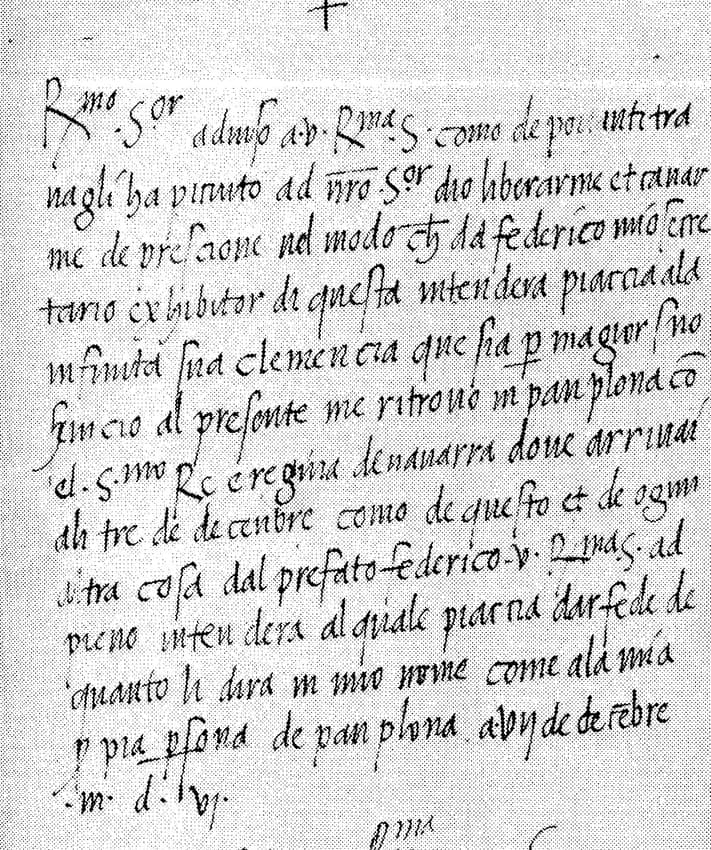
Evidano Transcription
R[everendissi]mo S[ign]or aduiſo a v[ostra] R[everendissi]ma S[ignoria] como de poi infiniti[?] tra
uagli ha p[iaci]uto[?] ad n[ost]ro S[ign]or dio liberarme et ſanar
me de preſcione nel modo ch[e] da federico mio ſecre
tario exhibitor di queſta intendera piaccia ala
infinita ſua clemencia que ſia p[er] magior ſuo
ſ[er]uicio al preſente me ritrouo in panplona co[n]
el. S[erenissi]mo Re e regina de nauarra doue arriuai
ali tre de decenbre como de queſto et de ogni
altra coſa dal prefato federico v[ostra] R[everendissi]ma S[ignoria] ad
pieno intendera al quale piaccia dar fede de
quanto li dira in mio nome come ala mia
p[ro]pria p[er]ſona de panplona a vij de dece[n]bre
.m. d. vj.
R[everendissi]ma [cut off]
Generated by Evidano’s advanced model; not yet checked against a published edition.
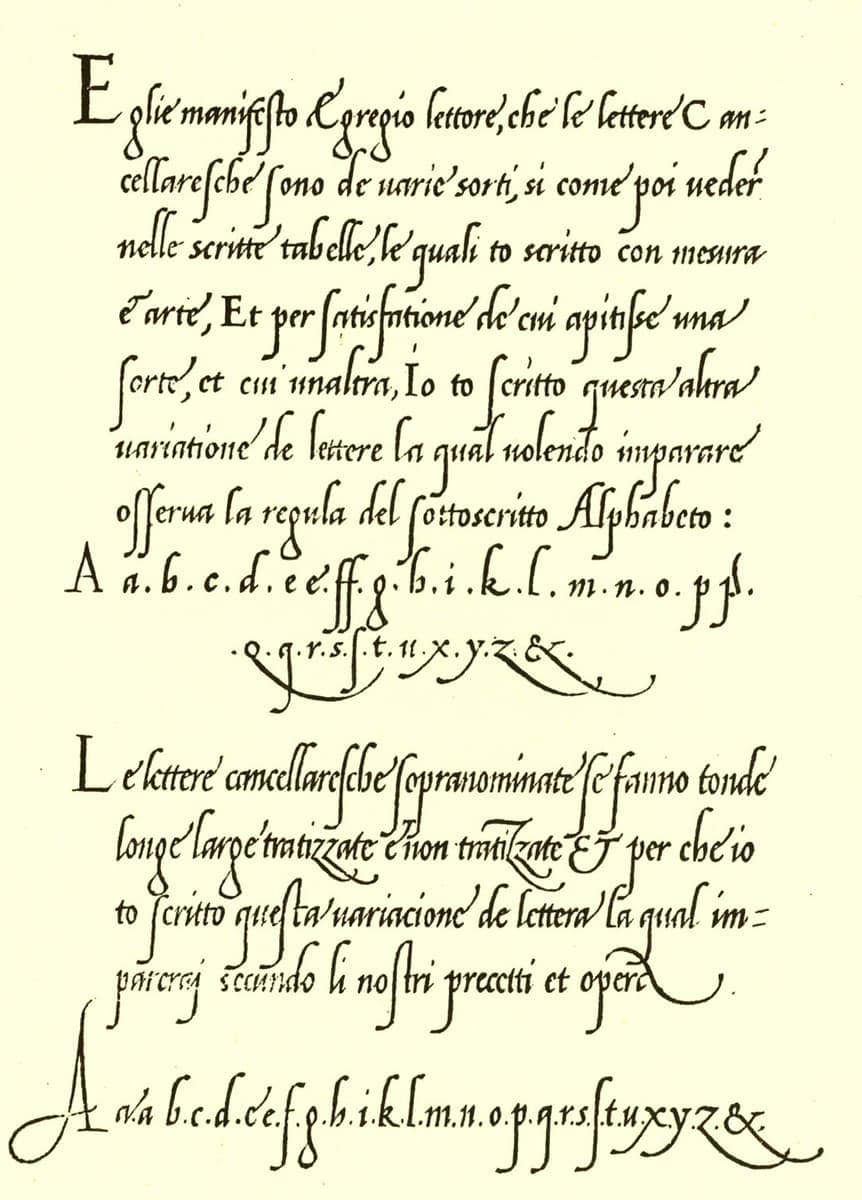
Evidano Transcription
E glie' manifesto Egregio lettore, che' le' lettere' C an=
cellaresche' sono de uarie' sorti, si come' poi ueder'
nelle' scritte' tabelle', le' quali to scritto con mesura
e' arte', Et per satisfatione' de' cui apitisse' una
sorte', et cui unaltra, Io to scritto questa' altra
uariatione' de lettere la qual uolendo imparare'
osserua la regula del sottoscritto Alphabeto :
A a. b. c. d. e e'. ff. g. h. i. k. l. m. n. o. p p ſ.
. q. q. r. s. ſ. t. u. x. y. z. &.
L e' lettere' cancellaresche' sopranominate' se' fanno tonde'
longe' large' tratizzate' e' non tratizate' Et per che' io
to scritto questa' uariacione' de lettera la qual im=
pareraj secundo li nostri precetti et opere .
A a/a b. c. d. e. f. g. h. i. k. l. m. n. o. p. q. r. s. ſ. t. u. x. y. z. &.
Generated by Evidano’s advanced model; not yet checked against a published edition.
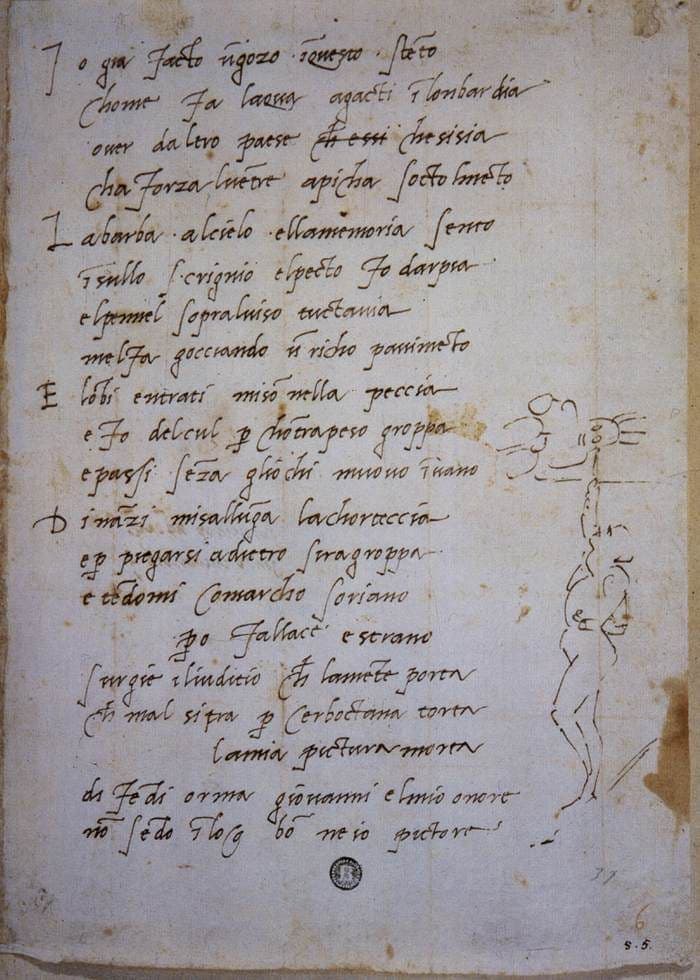
Casa Buonarroti, Florence, c. 1510 · Source · Public domain
Evidano Transcription
The whole sonnet with its coda, in the text Cesare Guasti printed from this autograph in 1863 (p. 158, the reading he sets against the traditional 1623 version on the facing page). Guasti modernises the spelling and supplies punctuation and apostrophes, so the manuscript’s own forms — chome, socto ’l mento, j Lombardia — do not appear. Words the Internet Archive scan of the edition mangled have been restored from the page image (I’ for r, l’acqua for Y acqua, iudizio for indizio, sendo for sendd).
I’ ho già fatto un gozzo in questo stento,
Come fa l’acqua a’ gatti in Lombardia,
O ver d’altro paese che si sia,
Ch’a forza ’l ventre appicca sotto ’l mento.
La barba al cielo, e la memoria sento
In sullo scrignio, e ’l petto fo d’arpia;
E ’l pennel sopra ’l viso tuttavia
Mel fa, gocciando, un ricco pavimento.
E lombi entrati mi son nella peccia,
E fo del cul per contrapeso groppa,
E’ passi senza gli occhi muovo invano.
Dinanzi mi s’allunga la corteccia,
E per piegarsi adietro si ragroppa,
E tendomi com’arco soriano.
Però fallace e strano
Surgie il iudizio che la mente porta;
Che mal si tra’ per cerbottana torta.
La mia pittura morta
Difendi orma’, Giovanni, e ’l mio onore,
Non sendo in loco bon, nè io pittore.
Source: Cesare Guasti (ed.), Le rime di Michelangelo Buonarroti (Florence: Le Monnier, 1863), p. 158, via Internet Archive (Public domain).
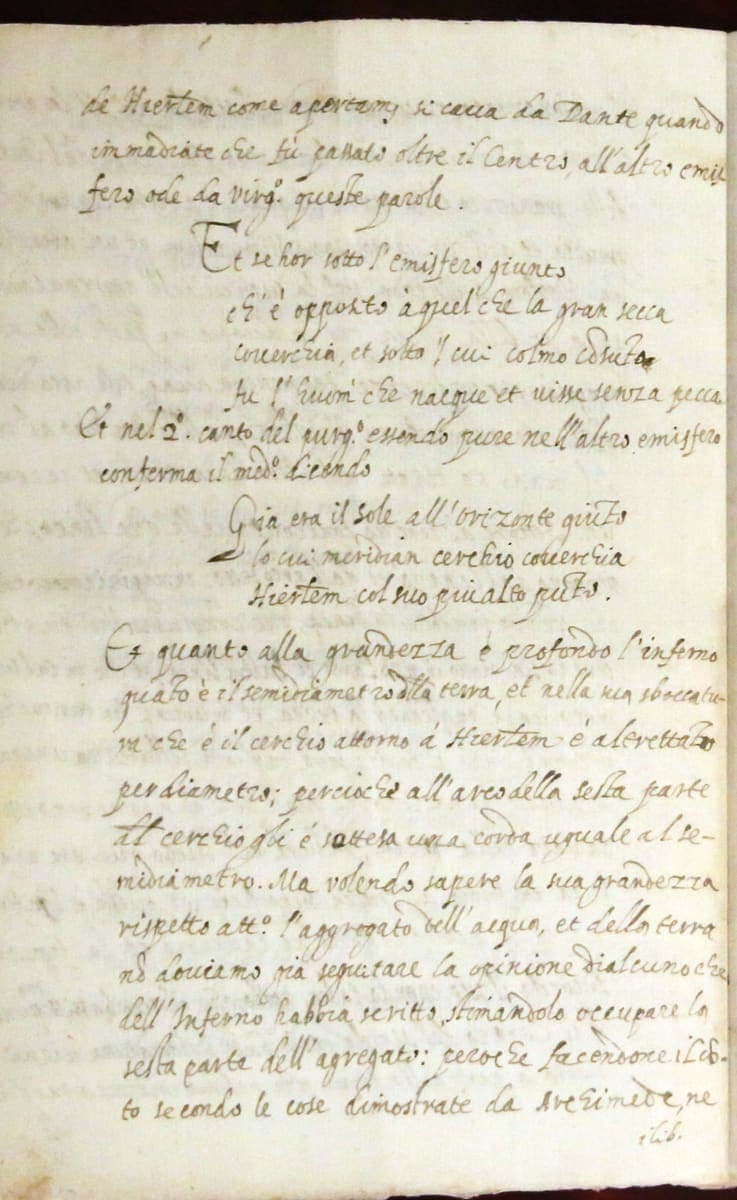
Biblioteca Nazionale Centrale, Florence, Rinuccini XXI, 1592 · Source · CC BY-SA 4.0 · Photograph: Francesco Bini (Sailko)
Evidano Transcription
The left-hand page of the opening, which begins in mid-sentence and runs to the foot, in the text of the Edizione Nazionale edited by Antonio Favaro, vol. IX (Florence, 1899), p. 38, as proofread on Italian Wikisource. Favaro modernises spelling and punctuation and expands the abbreviations, so the edition prints Ierusalem where the manuscript has an abbreviated Hierusalem; the quoted tercets are indented as here.
…e la base o sboccatura viene verso tal parte della terra, che nel suo mezzo racchiude Ierusalem, come apertamente si cava da Dante, quando, immediate che fu passato oltre il centro all’altro emisfero, ode da Virgilio queste parole:
E se’ or sotto l’emisfero giunto,
Ch’è opposito a quel che la gran secca
Coverchia, e sotto ’l cui colmo consunto
Fu l’Uom che nacque e visse senza pecca;
e nel secondo canto del Purgatorio, essendo pure nell’altro emisfero, conferma il medesimo, dicendo:
Già era ’l Sole all’orizzonte giunto,
Lo cui meridian cerchio coverchia
Ierusalem col suo più alto punto.
E quanto alla grandezza, è profondo l’Inferno quanto è il semidiametro della terra; e nella sua sboccatura, che è il cerchio attorno a Ierusalem, è altrettanto per diametro, per ciò che all’arco della sesta parte del cerchio gli è sottesa una corda uguale al semidiametro.
Ma volendo sapere la sua grandezza rispetto a tutto l’aggregato dell’acqua e della terra, non doviamo già seguitare la opinione di alcuno che dell’Inferno abbia scritto, stimandolo occupare la sesta parte dello aggregato; però che, facendone il conto secondo le cose dimostrate da Archimede ne i libri Della sfera e del cilindro,
Source: Galileo Galilei, Le opere, Edizione Nazionale, ed. Antonio Favaro, vol. IX (Florence, 1899), p. 38, via Italian Wikisource (Public domain).
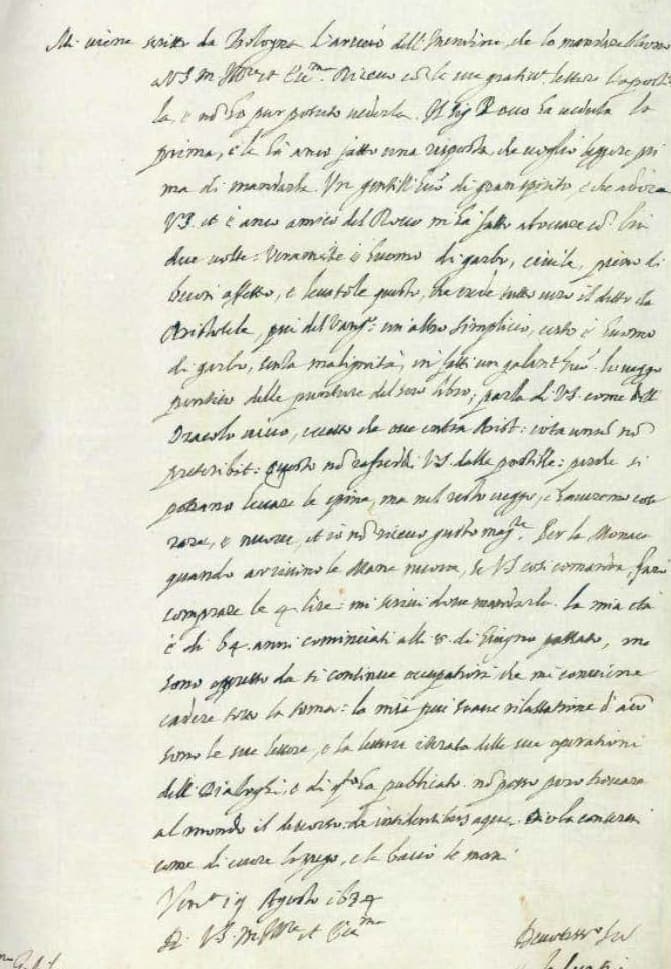
Museo Galileo, Florence, 19 August 1634 · Source · CC BY-SA 4.0 · Photograph: Luandama
Evidano Transcription
The last two paragraphs of the letter and its date line, from the Edizione Nazionale of Galileo’s works edited by Antonio Favaro, vol. XVI (Florence, 1905), letter no. 2979, which prints the autograph as Florence, Biblioteca Nazionale Centrale, Mss. Galileiani, P. VI, T. XII, c. 77. Favaro keeps Micanzio’s spelling and his contractions; the superscript letters of the subscription are not reproduced here, and two errors in the Internet Archive scan of the edition (De insidentibus- aquae, mandarla !) have been corrected.
Per la monaca, quando arrivino le mane nuove, se V. S. così comanda, farò comprare le 4 lire: mi scrivi dove mandarla.
La mia età è di 64 anni, cominciati alli 8 di Giugno passato, ma sono oppresso da sì continue occupationi, che mi conviene cadere sotto la soma. La mia più soave rilassatione d’animo sono le sue lettere, e la lettura iterata delle sue operationi, delli Dialoghi e di quanto ha publicato. Non posso però trovare al mondo il discorso De insidentibus aquae. Dio la conservi, come di cuore Lo prego: e le bacio le mani.
Ven.a, 19 Agosto 1634.
Source: Le opere di Galileo Galilei, Edizione Nazionale, ed. Antonio Favaro, vol. XVI (Florence, 1905), no. 2979, via Internet Archive (Public domain).
Italic, and everything that survived beside it
The chancery cursive of the papal scriptors was published as a method in the 1520s, when Ludovico degli Arrighi and Giovanni Antonio Tagliente printed writing books from woodblocks cut to imitate the pen, and Palatino, Amphiareo and their successors carried the fashion through the century. What they taught — a narrow, sloping letter with a flat-cut nib, few joins, springing ascenders, a single-compartment a and long descenders on f and ſ — became the ordinary hand of letters, petitions, diplomatic dispatches and scholars’ notes from Venice to Palermo. It never had the field to itself. Notaries kept a tighter, more abbreviated hand; account books stayed in a rounder mercantile letter well into the sixteenth century; and registers of some tribunals held on to angular forms that look a century older than they are.
The abbreviation system of these centuries is one of courtesy. Titles collapse into superscripts — V.S. for Vostra Signoria, Ill.mo, Ecc.mo, R.mo, S.r, P.rone Col.mo, Devotiss.mo Ser.re — and the same letter may open with four of them in a row before the first verb. Above the line sit m.to for molto, n.ro for nostro, p.re for padre, with a tilde still doing duty for a suppressed nasal. Elision is written with the apostrophe that print had made familiar, so ch’, de’, all’ and c’havemo appear as they do in books; accents arrive late and unevenly. Money keeps its old signs, scudi, lire, soldi and denari, and quantities are given in braccia, canne, some and barili.
A letter has a shape you can rely on. The recipient’s titles stand at the head, often alone on a line, followed by a deep blank space that measures the respect owed; the body runs in a hand that may be a secretary’s; the date line gives place and day; and the subscription and signature sit low on the right, with the address and a note of receipt written on the outside after folding. Chancery documents add signatures of the officials at the foot, a registration note in the margin, and a seal on a tongue of parchment. In Tuscany the year still began on 25 March until the eighteenth century, and Venice kept its own reckoning, so dates in January, February and March need care even in the Seicento.
Why ordinary OCR struggles here
Courtesy titles written as superscripts
Ill.mo, Ecc.ma, S.ria, Aff.mo and their neighbours are the most frequent words on the page and the least like ordinary text: a stem, a full stop and two raised letters, sometimes with a stroke over them. Print-trained OCR drops the raised letters or turns them into digits, and the salutation, which identifies the correspondents, is the first thing lost.
More than one hand on a sheet
A ducal letter is written by a secretary and signed by the duke; a petition is drafted in one hand and endorsed in two others; a register carries entries by successive clerks. Each hand has its own letterforms and its own abbreviations, and a transcript that does not say where one stops and the next begins hides evidence about who did what.
Letters that look alike in a fast italic
Long ſ and f separate only by a nib-width crossbar; c and open e are drawn with the same movement; capital I and J are one letter with a longer or shorter tail; and flourished descenders on p, q and z sweep through the line below, where they are read as extra marks on the following words.
Text outside the text
The address panel, the note of the day a letter arrived, the registration in the margin, the file number added by an archivist and the summary written on the verso all belong to the document but not to its message. Merged into one stream they corrupt the sense; discarded, they take with them the whole history of how the paper was handled.
Who works with this material
Editors of early modern correspondence
Scientific, artistic and diplomatic letters are published as corpora of thousands of items, each needing date, place, sender, addressee and body in fixed fields. Getting the salutation and the subscription right matters as much as the message, because that is where the relationship between the writers is recorded.
State, ducal and ecclesiastical archives
Series of dispatches, petitions, trial records and licences are usually described only by year and office. Item-level transcription of headings and first lines gives readers a searchable calendar, and shows which pieces carry registrations, endorsements or seals before anyone opens the box.
Genealogists working after the Council of Trent
Parish registers of baptisms, marriages and deaths begin in the later sixteenth century and are written in the same mixed hands, with names in Latin and observations in Italian. What the searcher needs is every name, its variants and the date attached to it, not a smoothed paraphrase.
Historians of science, art and the book
Attribution and chronology often turn on a note in a margin or a hand in a workshop record. Reading autographs alongside secretarial copies, and marking which is which, is the work that keeps such arguments honest.
Getting the best transcription
Decide what happens to the courtesy abbreviations
List the ones your archive uses — V.S., Ill.mo, Ecc.mo, S.re, Aff.mo, m.to, n.ro — and say whether they are kept as written, expanded, or expanded in brackets. Keeping them is usually right for an edition and makes the salutations comparable across a whole series of letters.
Ask for the letter to come back in parts
Request the heading, the body, the place and date line, the subscription, the signature, the address panel and any docket as separate fields. Say which side of the sheet you have photographed, so a note written across the fold is not read as a continuation of the last sentence.
Have changes of hand flagged
Ask for a marker wherever the writing changes: secretary to signatory, main entry to marginal registration, Italian body to Latin formula. On a document with several endorsements this is the difference between a usable record and a paragraph nobody can attribute.
Check the year before you trust the sequence
For Tuscan material dated between January and 24 March, and for Venetian material dated in January or February, ask for the year exactly as written with the modern equivalent in brackets. Test the setting on a letter from that window before running a whole correspondence.
Further reading on this hand
The palaeography guides the in-app selector points to for this domain, if you want to check a transcription against the standard references.
- Italian Paleography: Handbook
This Newberry Library handbook covers the principal Italian book and documentary scripts that remained in use during the early modern period. It treats mercantesca, cancelleresca, Humanistic, italic, and mixed practices in their historical and social contexts. The accompanying manuscript resources document variant letters, abbreviations, punctuation, spacing, additions, and page organization. It is useful for sixteenth- and seventeenth-century records in which several inherited script traditions appear together.
Frequently asked questions
- Are V.S. Ill.ma and the other courtesy formulas expanded automatically?
- Not unless you ask. They are recognised as abbreviations and returned as written, with the raised letters placed on the line, so Ill.mo does not become Illmo or Ill10. If you want Vostra Signoria Illustrissima spelled out, the expansion can be supplied in brackets and applied to every letter in the series.
- Can a secretary’s hand be told apart from an autograph signature?
- Changes of hand are flagged where they are visible, and the signature is returned as its own field rather than as the last line of the body. Whether a given signature is genuine remains a judgement for you, but the transcript tells you that the letter and its subscription were written by different pens.
- Do these hands still use the old Florentine and Venetian year?
- They do. Tuscany kept 25 March as the first day of the year until 1750 and Venice its own style, so a document dated February 1633 in Florence is 1634 by modern reckoning. Dates are transcribed as written, with a converted date added in brackets when you ask for one.
- What about account books and notarial acts of the same period?
- They belong to this domain when the hand has gone over to italic, and the older material is better served by the mercantesca and notarial pages, which handle ledger columns and Latin formulae in more detail. Where a single archive mixes all three, the same job can be run with different settings per series.
- Will the address and the note of receipt on the back be transcribed?
- Yes, as separate labelled blocks. The address, the merchant’s or courier’s notes, the day the letter was received and any later archival numbering are kept apart from the body, which is what makes it possible to reconstruct how long the post took and how the file was assembled.
- How are heavily flourished signatures handled?
- The reading is given where the letters can be made out and marked as uncertain where the flourish takes over; the paraph itself is described rather than invented. For a series signed by the same person, comparing several examples usually settles the doubtful letters.
Related scripts and pages
Open your Cinquecento and Seicento files
Send a letter with its address and docket, choose Early Modern Italian Italic and Mixed Documentary Hands, and agree the abbreviation and dating rules before the series.