
English · c. 1500–1650
Read Tudor and Jacobean paperwork line by line
Between the Reformation and the Civil War an English clerk could write two alphabets in one sentence: a spiky secretary hand for the body of a letter and a rounded italic for the name at the end. Add superscript contractions, a long ſ that reads as f, and sums in Roman numerals with li, s and d, and a page a contemporary took in at a glance stops most modern eyes. Evidano works through the letters, bonds, accounts and registers of this period and shows what it expanded and where it hesitated.
Sample pages
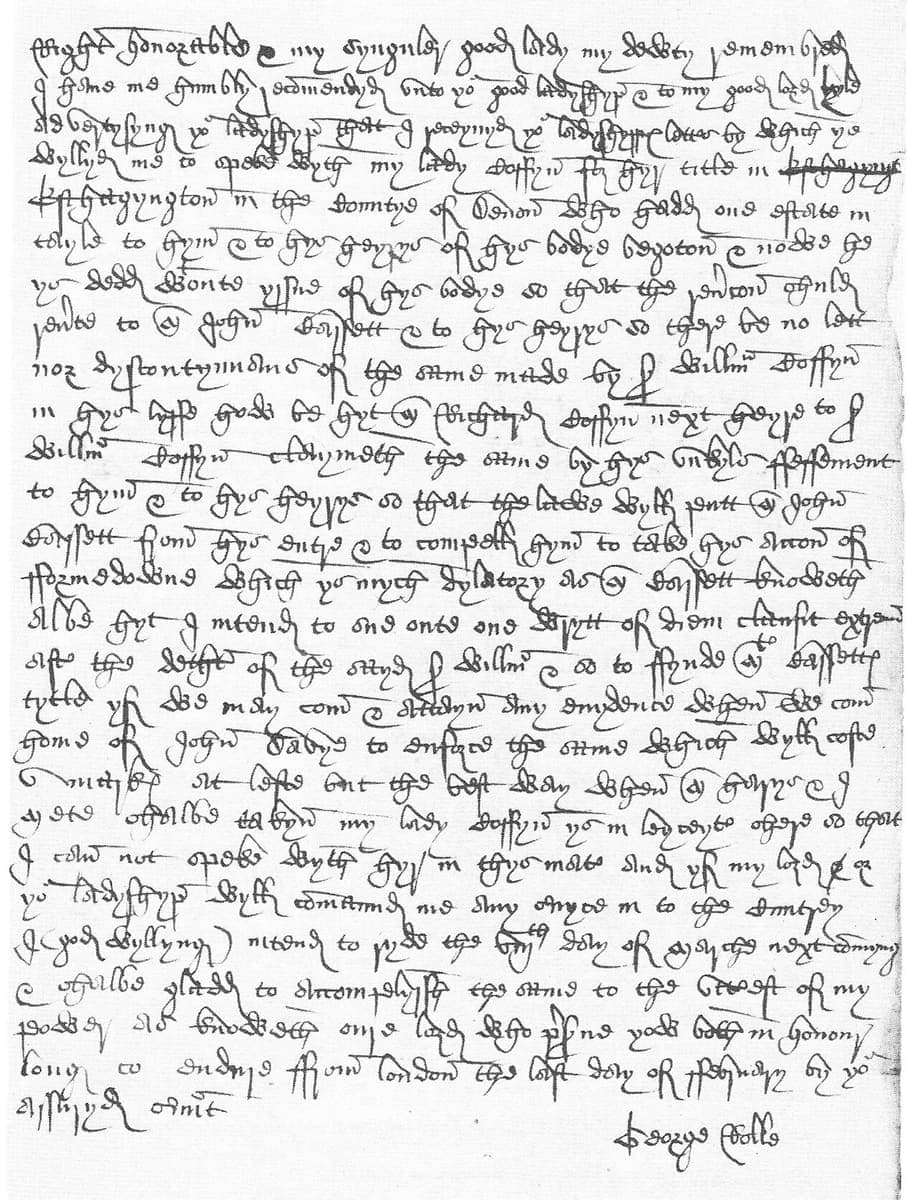
Evidano Transcription
Right honorable & my synguler good lady my dewty remembryd
I haue me humbly recomendyd vnto yo[ur] good ladyshyp & to my good lord yo[ur]
[illegible] certyfyng yo[ur] ladyshyp that I receyvyd yo[ur] ladyshyps letter by wh[i]ch ye
wyllyd me to speke wyth my lady Coffyn for thys title in [cancelled: Eshagyng]
Eshagyngton[?] in the countye of devon who hadd one estate in
tayle to hym & to hys heyres of hys bodye begoton & [illegible] the
yo[ur] lady wonte yssue of hys bodye so [cancelled: that the] reuercon shuld
[illegible] to a John Bassett & to hys heyres so ther be no lese
nor dyscontynuance of the same made by s[i]r Will[ia]m Coffyn
in hys lyff how be hyt a Richard Coffyn next heyre to s[i]r
Will[ia]m Coffyn claymyth the same by hys vncles feffement
to hym & to hys heyres so that the ladye wyff vnto[?] a John
Bassett from[?] hys entre[?] & to compell hym to take hys accon of
fformedowne wh[i]ch yo[ur] nyth dylatory as a Bassett knowyth
also hyt I intend to sue onte one wrytt of diem clausit extre[m]
after the deth of the sayd s[i]r Will[ia]m & so to fynde a Bassetts
tytle yf we may come & attayn any evydence wher we com
home of John Dabys[?] to enforce the same wh[i]ch wyth coste
& nether[?] at lest but the best way wher a forther & I
[illegible] shalbe taken my lady Coffyn ys in london[?] [illegible] so that
I cowd not speke wyth hyr in thys mater and yf my lord & ye
yo[ur] ladyshyp wyll command me any seruyce in to the cuntrey
I (god wyllyng) intend to ryde the [illegible]th day of marche next commyng
& shalbe gladd to accomplysh the same to the best of my
power as knowyth owr lord who p[re]s[er]ue yow both in honor
long to endure from london the last day of ffebruary by yo[ur]
assuryd s[er]u[a]nt
George Rolle
Generated by Evidano’s advanced model; not yet checked against a published edition.
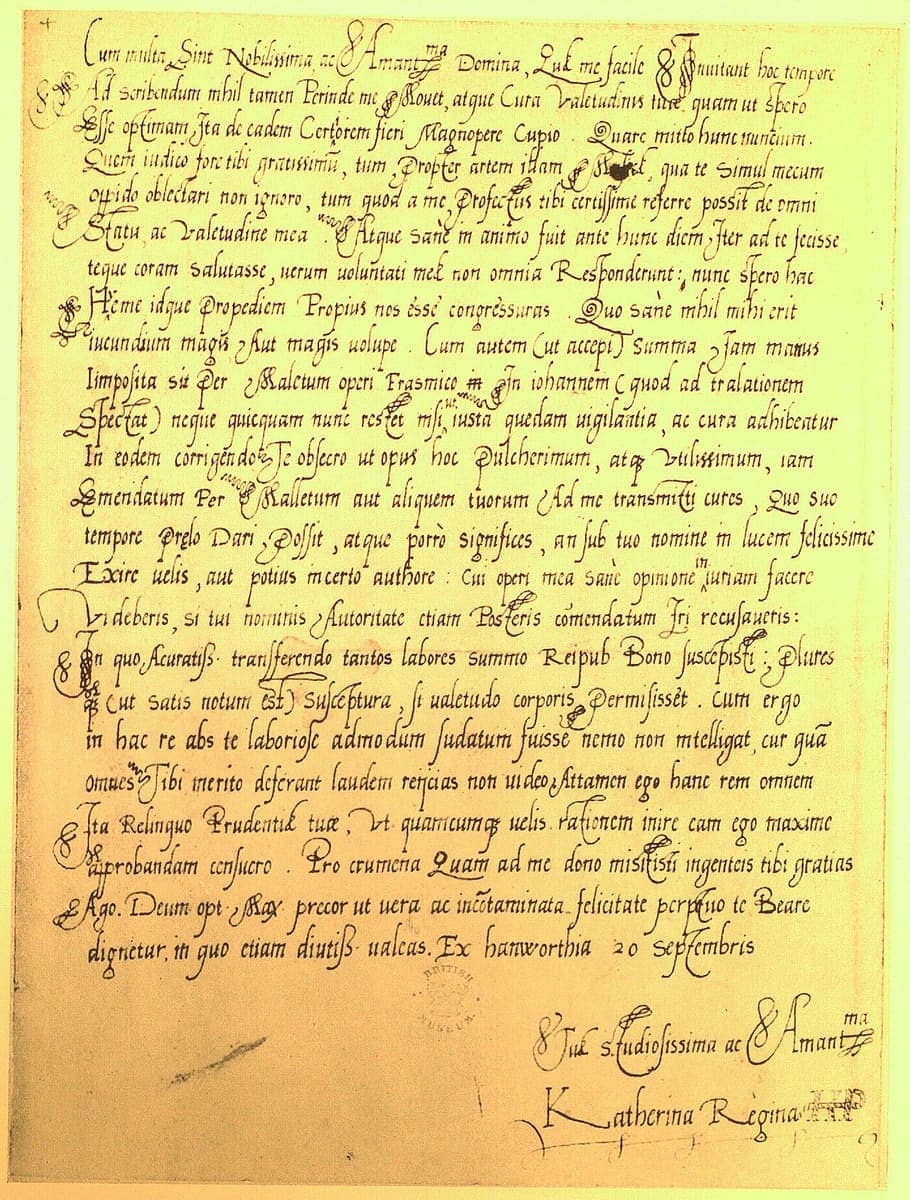
British Library, Cotton MS Vespasian F III, f. 37, 20 September, c. 1544 · Source · Public domain
Evidano Transcription
- Cum multa Sint Nobilissima ac Amant[issi]ma Domina, Quæ me facile Inuitant hoc tempore
Ad scribendum nihil tamen Perinde me mouet, atque Cura Valetudinis tuæ quam ut Spero
Esse optimam Jta de eadem Certiorem fieri Magnopere Cupio . Quare mitto hunc nuncium.
Quem iudico fore tibi gratissimu[m], tum Propter artem illam [blotted word] qua te Simul mecum
oppido oblectari non ignoro, tum quod a me Profectus tibi certissime referre possit de omni
Statu ac Valetudine mea . Atque sane in animo fuit ante hunc diem, Jter ad te fecisse
teque coram Salutasse, uerum uoluntati meæ non omnia Responderunt; nunc Spero hac
Hyeme idque Propediem Propius nos esse congressuras . Quo sane nihil mihi erit
iucundium magis Aut magis uolupe . Cum autem (ut accepi) Summa Jam manus
Jmposita sit Per Maletum operi Erasmico [cancelled: in] \in/ iohannem (quod ad tralationem
Spectat) neque quicquam nunc restet nisi iusta quædam uigilantia, ac cura adhibeatur
In eodem corrigendo, Te obsecro ut opus hoc Pulcherimum, atq[ue] Vtilissimum, iam
Emendatum Per Malletum aut aliquem tuorum Ad me transmitti cures, Quo Suo
tempore Prelo Dari Possit, atque porrò significes, an Sub tuo nomine in lucem felicissime
Exire uelis, aut potius incerto authore : Cui operi mea sane opinione \in/iuriam facere
Videberis, si tui nominis Autoritate etiam Posteris comendatum Jri recusaueris:
In quo Acuratiss[ime] transferendo tantos labores summo Reipub[licae] Bono Suscepisti; Plures
(ut satis notum est) Susceptura, si ualetudo corporis Permisisset . Cum ergo
in hac re abs te laboriose admodum Sudatum fuisse nemo non intelligat, cur qua[m]
omnes Tibi merito deferant laudem reijcias non uideo, Attamen ego hanc rem omnem
Jta Relinquo Prudentiæ tuæ, Vt quamcumq[ue] uelis rationem inire eam ego maxime
approbandam censuero . Pro crumena Quam ad me dono misististi ingentes tibi gratias
Ago. Deum opt[imum] Max[imum] precor ut uera ac inco[n]taminata felicitate perpetuo te Beare
dignetur, in quo etiam diutiss[ime] ualeas. Ex hanworthia 20 Septembris
Tuæ Studiosissima ac Amant[issi]ma
Katherina Regina KP
Generated by Evidano’s advanced model; not yet checked against a published edition.
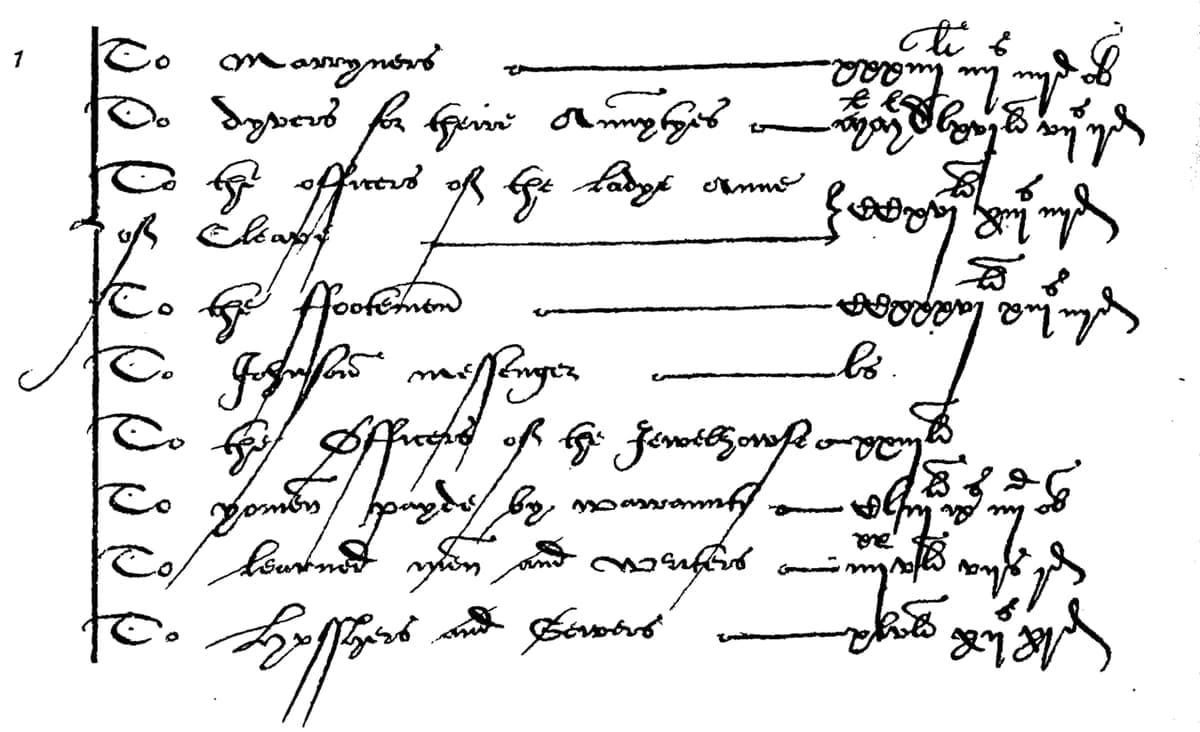
Plate XXX (1), document 1555; plate 1879 · Source · Public domain · Facsimile plate from Andrew Wright, Court-hand Restored, 10th ed. (London, 1879)
Evidano Transcription
All nine entries, from the letterpress key that Wright prints beneath the plate. The pound and shilling abbreviations li and s, which the Internet Archive’s scan of that key reads as u, 11 and 8, have been restored from the facsimile itself; the decimal equivalents in round brackets are Wright’s own, and the two thousand-marks in the second entry are printed as he gives them.
To Marryners xxxiiij li iiij s iiij d ob. (34l. 4s. 4½d.)
To dyvers for theire Annuytyes - - m l m l dlxvj li vij s ij d (2,566l. 7s. 2d.)
To the Officers of the Ladye Anne of Cleave ccxvj li xiij s iiij d (216l. 13s. 4d.)
To the Footemen ccxxxvj li xiij s iiij d (236l. 13s. 4d.)
To Johnson Messenger - - - - l s. (50s.)
To the Officers of the Jewelhowse - - xxiij li (23l.)
To yomen payde by warraunte - - - cliij li ix s iiij d ob. (153l. 9s. 4½d.)
To learned men and writers - iiijxx v li vij s j d (85l. 7s. 1d.)
To Husshers and Sewers - xlv li xij s xj d (45l. 12s. 11d.)
Source: Andrew Wright, Court-hand Restored, ed. C. T. Martin, 10th ed. (London, 1879), plate XXX and key, via Internet Archive (Public domain).
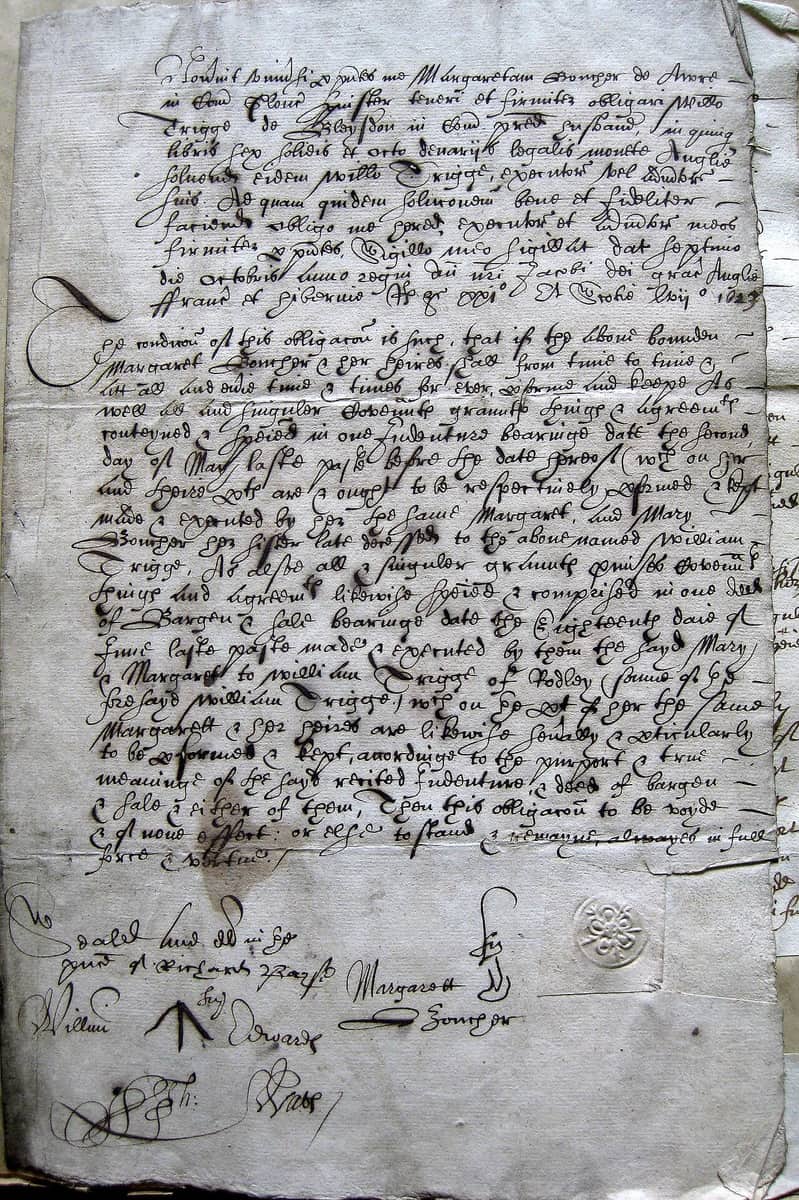
Source · Public domain · Photograph of a seventeenth-century manuscript in private hands
Evidano Transcription
Noverint vniv[er]si p[er] p[re]se[n]tes me Margaretam Bonger de Awre
in Com[itatu] Glouc[estrie] spinster teneri et firmiter obligari Will[ielm]o
Trigge de Blaysdon in Com[itatu] p[re]d[ic]to husband[man] in quinq[ue]
libris sex solidis et octo denarijs legalis monete Anglie
solvend[is] eidem Will[ielm]o Trigge, executor[ibus] vel admin[istratoribus]
suis. Ad quam quidem soluc[i]o[n]em bene et fideliter
faciend[am] obligo me hered[es], executor[es] et admin[istratores] meos
firmiter p[er] p[re]se[n]tes, Sigillo meo sigillat[as] dat[as] septimo
die octobris Anno regni d[omi]ni n[ost]ri Jacobi dei grac[ia] Anglie
ffranc[ie] et hibernie Regis xxi^o et Scotie lvij^o 1623
The condic[i]on of this obligac[i]on is such, that if the aboue bounden
Margaret Bonger & her heires shall from time to time &
att all and eu[er]ie time & times for ever, p[er]forme and keepe As
well all and singuler Coven[a]nt[es] graunt[es] thing[es] & agreem[en]t[es]
conteyned & spec[i]fied in one Indenture bearinge date the second
day of May laste paste before the date hereof (w[hi]ch on her
and theire p[ar]te are & ought to be respectiuely p[er]formed & kept
made & executed by her the saide Margaret, and Mary
Bonger her sister late dece[a]ssed to the aboue named William
Trigge, As also all & singuler grauntes p[ro]misses Coven[a]nt[es]
thing[es] and agreem[en]t[es] likewise spec[i]fied & comprised in one deede
of Bargen & sale bearinge date the Eighteenthe daie of
June laste paste made & executed by them the sayd Mary
& Margaret to Willi[a]m Trigge of Podley sonne of the
foresayd William Trigge (w[hi]ch on the p[ar]te of her the sayd
Margaret & her heires are likewise seu[er]ally & p[ar]ticularly
to be p[er]formed & kept, accordinge to the purport & true
meaninge of the sayd recited Indenture, & deed of bargen
& sale & either of them, Then this obligac[i]on to be voyde
& of none effect: or else to stand & remayne alwayes in full
force & vertue. /
Sealed and d[e]l[i]u[er]ed
in the p[re]sence of
Will[i]am [his mark] Edward[es]
Margaret [her mark] Bonger
Tho: Wase
Generated by Evidano’s advanced model; not yet checked against a published edition.
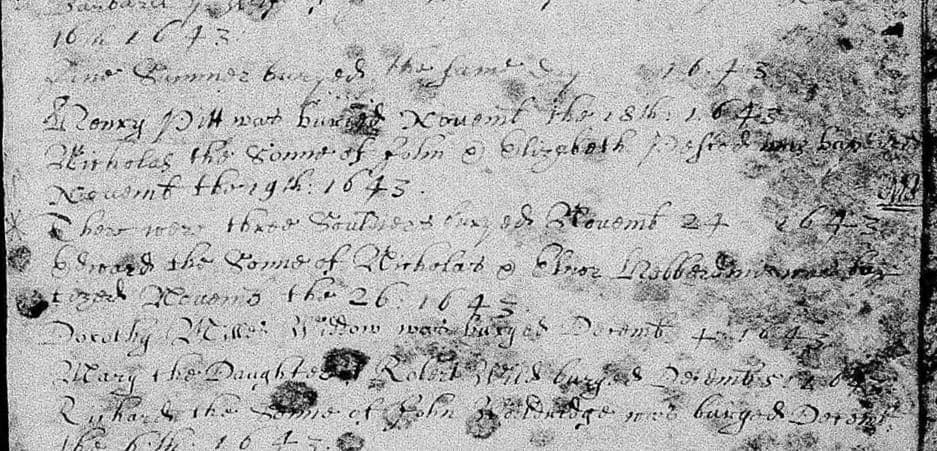
Evidano Transcription
[illegible] buryed [illegible]
16th 1643
Jane Comner [?] buryed the same day 1643
Henry Pitt was buryed Nouemb the 18th: 1643
Nicholas the sonne of John & Elizabeth Pested was baptized
Nouemb the 19th: 1643.
There wer three Souldiers buryed Nouemb 24 : 1643
Edward the sonne of Nicholas & Elnor Hobbard [?] was bap
tized Nouemb the 26: 1643
Dorothy Miller Widdow was buryed Decemb 4: 1643
Mary the Daughter of Robert Wild buryed Decemb 5: 1643
Richard the sonne of John Holdridge was buryed Decemb
the 6th: 1643.
Generated by Evidano’s advanced model; not yet checked against a published edition.
Secretary, italic and the hands in between
The English secretary hand is the ordinary writing of the sixteenth and early seventeenth centuries, taught from copybooks such as Beauchesne and Baildon’s of 1570 and used for everything from a household letter to a Star Chamber deposition. Its signature letters are a two-stroke e like a reversed 3, a c barely distinguishable from that e, a looped h whose tail swings below the line, a horned w, a p with its bowl set to the left of a straight descender, and at least three shapes of r. Final letters trail off in flourishes that mean nothing at all. The italic hand, learned from Italian models and taught to gentlewomen and to grammar-school boys, sits beside it: upright, separate letters, single-compartment a, a straight-backed d. From about 1570 the two are used together — italic for names, headings and Latin, secretary for the rest — and by 1630 the mixed hand is the norm.
Spelling is not yet fixed, so a clerk doubles consonants almost at will — gett, ffrom, hadd — and writes capital F as ff. Abbreviation, by contrast, is systematic. A superscript letter after y stands for a whole word: yᵉ for the, yᵗ for that, yᵘ for you, yʳ for your, each a survival of thorn rather than a real y. A bar over a vowel supplies a missing m or n; per, par and pro keep the medieval crossed and curled p; a terminal flourish on s or n may be a suspension or may be nothing; and the Latin formulae of a bond are contracted so hard that only the shape of the phrase identifies them. Christian names arrive as Willm, Jno, Rich. and Eliz., and parties who could not write drew a cross between the words the mark of.
Layout follows the genre. A letter opens with a wide superscription — Right honourable and my singular good lady — dates itself at the foot, and carries an address and often a docket in another hand on the outside. A bond gives the obligation in Latin and the condition in English, with a seal and the marks of witnesses at the bottom. Accounts run in a narrow column of Roman numerals with li, s, d and ob. for the halfpenny. Parish registers, ordered in 1538 and copied onto parchment from 1598, set out christenings, weddings and burials year by year, with regnal dating beside the year of grace.
Why ordinary OCR struggles here
Two scripts sharing one line
A secretary e and an italic e are drawn differently, and a document that switches between them mid-sentence — for a manor, a legal term or a signature — defeats a recogniser trained on one shape per letter. The switch is meaningful: what stands in italic is usually what the writer wanted picked out.
Superscripts that stand for words
yᵉ, yᵗ, yʳ, wᵗʰ and wᶜʰ are the ordinary shorthand of the period, and the raised letter is often no bigger than a speck. Read as literal y and w they produce nonsense; expanded silently they hide the fact that the writer contracted at all.
Money, dates and Roman numerals
Sums use minuscule Roman numerals with the last i drawn as j, so xiij is thirteen, and eighty is iiij with a superscript xx. Years may be regnal, and the legal year began on 25 March, so February 1602 in a register is 1603 to us. None of this survives a reading that treats figures as letters.
Damage, damp and rebinding
Register pages are damp-stained and mould-spotted, letters were folded, sealed and torn open, and much of this material is now read from microfilm rather than parchment. Ink shows through from the other side, and a whole name can sit under a blot no processing will lift.
Who works with this material
Family historians working before 1700
Christenings, weddings and burials, wills and inventories are where an English pedigree is built or broken. What is wanted is the name exactly as the clerk spelled it, the date as it stands, and a clear mark where damp has taken a word away.
Editors of early modern correspondence
Letter projects need the superscription, the date clause and the address panel kept apart from the body, and a consistent policy on expansions. Endorsements added by a secretary or a later archivist belong in the record too, since they show how the letter was filed.
Local record societies and archive volunteers
Churchwardens’ accounts, manor court rolls and quarter sessions files are transcribed by volunteers with uneven experience of the period. A first pass through the formulae and the figures leaves the group free to argue about the difficult names instead of retyping boilerplate.
Literary and theatre scholars
Play manuscripts, commonplace books and verse miscellanies of this period survive in mixed hands, often several in one volume. Distinguishing the hands, keeping deletions and interlineations, and marking where a stage direction is squeezed into the margin all matter more than a smooth reading text.
Getting the best transcription
Say what to do with the superscripts
Decide whether yᵉ, yᵗ and wᶜʰ should stand as written, be expanded to the, that and which, or be expanded with the supplied letters bracketed. State the same rule for the crossed p and the bar that supplies m or n.
Ask for money and dates to be left as they stand
Ask for Roman numerals in the form the clerk wrote them, with li, s, d and ob. kept rather than converted. If you also want a decimal equivalent, ask for it in a separate field so the reading and the arithmetic can be checked apart.
Describe the shape of the document
Say whether this is a folded letter with an address panel, a bond with a Latin obligation and an English condition, or a ruled account, and where the endorsements sit. Naming the parts stops a docket written sideways from landing in the middle of the text.
Test on a page you can already read
Start with a document you have transcribed yourself or one printed in a record society volume, compare it word for word, and tune the instructions until names, marks and figures come back the way your project records them.
Further reading on this hand
The palaeography guides the in-app selector points to for this domain, if you want to check a transcription against the standard references.
- English Handwriting 1500–1700: An Online Course
This University of Cambridge course teaches English handwriting from 1500 to 1700 through manuscript examples, alphabets, and transcription exercises. It distinguishes book, court, secretary, italic, mixed, and round hands and explains that more than one script may occur in a single document. Its supporting materials address contractions, abbreviation marks, punctuation, letter variation, and period uses of u and v. It is especially useful for recognizing the mixed secretary and italic practices of Tudor and Jacobean records.
Frequently asked questions
- Can it tell secretary from italic within one document?
- Yes, and it can report the change. Names, headings, Latin tags and signatures are commonly italic inside a secretary letter, and that contrast can be marked in the output rather than left for an editor to guess at.
- How is yᵉ handled — is it the or ye?
- It is recognised as the old thorn abbreviation rather than the letter y, and you choose the output: keep the superscript form, expand it to the, or expand it with the added letters marked. The same choice covers yᵗ, yᵘ and yʳ.
- Will Roman numerals in accounts come out correctly?
- They are read as numerals rather than letters, including the final j in xiij and the score notation with a superscript xx, and li, s, d and ob. are kept. Sums are not silently corrected: if a total does not add up, that is a fact about the account.
- What happens to a mark instead of a signature?
- A cross, an initial or a device drawn between the words the mark of is recorded as a mark and attributed to the named party rather than turned into letters. Seals and the position of witnesses at the foot can be noted in the same way.
- Does dating by regnal year cause trouble?
- The regnal year is transcribed as written — anno regni … Jacobi vicesimo primo — beside the year of grace where both are given. Nothing is converted unless you ask, because conversion depends on the reign and on the 25 March year-start.
Related scripts and pages
Transcribe your Tudor and Jacobean documents
Upload a letter, a bond, an account or a parish register, choose Tudor and Jacobean Hands, and fix the expansion rules once for the whole bundle.