
Italian · c. 1250–1550
Get ledgers, letters and ricordanze off the page
Mercantesca was written fast, by men trained in the abacus school rather than the scriptorium, and it shows: loops on b, d, h and l run into the line above, the a is left open at the top, and a column of Roman numerals dissolves into the same minim strokes as the words beside it. Evidano reads the entry and the sum as separate things, keeps the debit and credit sides of an opening apart, and leaves the date exactly as the writer put it.
Sample pages
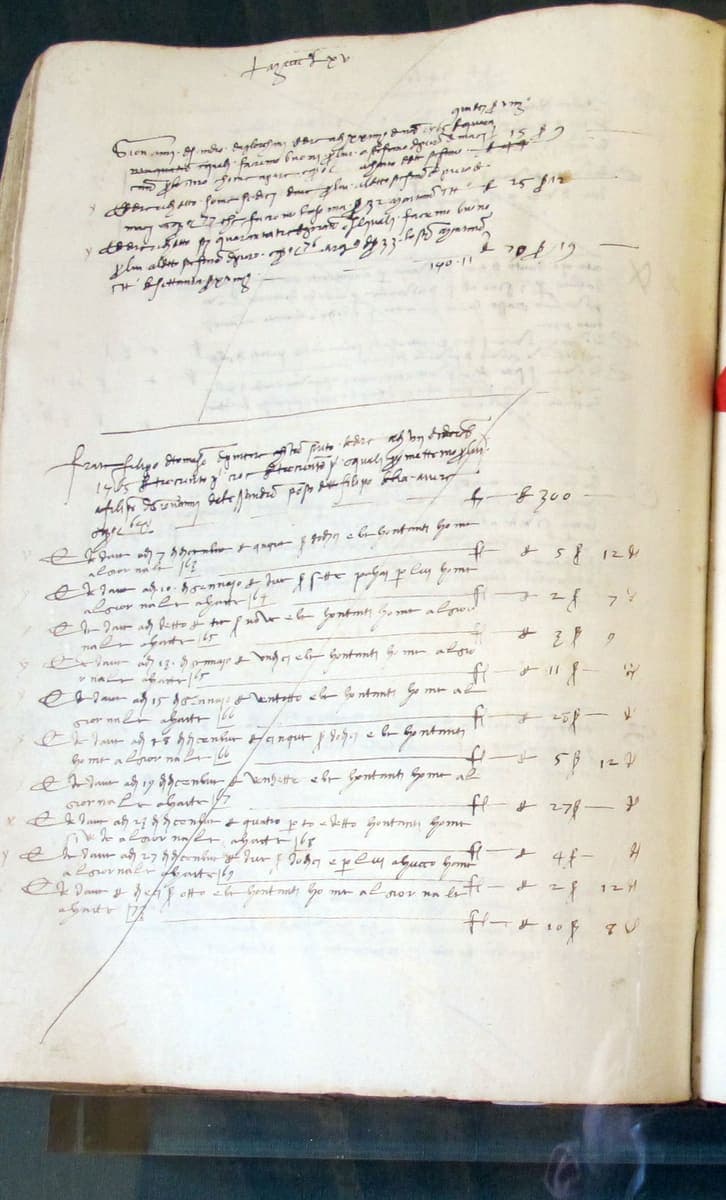
Archivio di Stato di Prato, Ceppi 212, 1465 · Source · CC BY-SA 3.0 · Photograph: Francesco Bini (Sailko)
Evidano Transcription
[upper account illegible]
Frate[?] Filippo [illegible]
1465 [illegible]
[illegible] — fl — £ 300 —
[illegible]
E dee dare a dì 7 [illegible]
[illegible] 164 — fl — £ 5 s 12 d
E dee dare a dì 10 di gennaio[?] [illegible]
[illegible] 164 — fl — £ 2 s 7 d
E dee dare a dì detto [illegible]
[illegible] 165 — fl — £ 3 s 9
E dee dare a dì 13 di maggio[?] [illegible]
[illegible] 165 — fl — £ 11 s — d
E dee dare a dì 15 di gennaio[?] [illegible]
[illegible] 166 — fl — £ 25 s — d
E dee dare a dì 28 [illegible]
[illegible] 166 — fl — £ 5 s 12 d
E dee dare a dì 17 [illegible]
[illegible] 167 — fl — £ 27 s — d
E dee dare a dì 27[?] [illegible]
[illegible] 168 — fl — £ 4 s — d
E dee dare a dì 27 [illegible]
[illegible] 169 — fl — £ 2 s 12 d
E dee dare [illegible]
[illegible] — fl — £ 10 s 8 d
Generated by Evidano’s advanced model; not yet checked against a published edition.
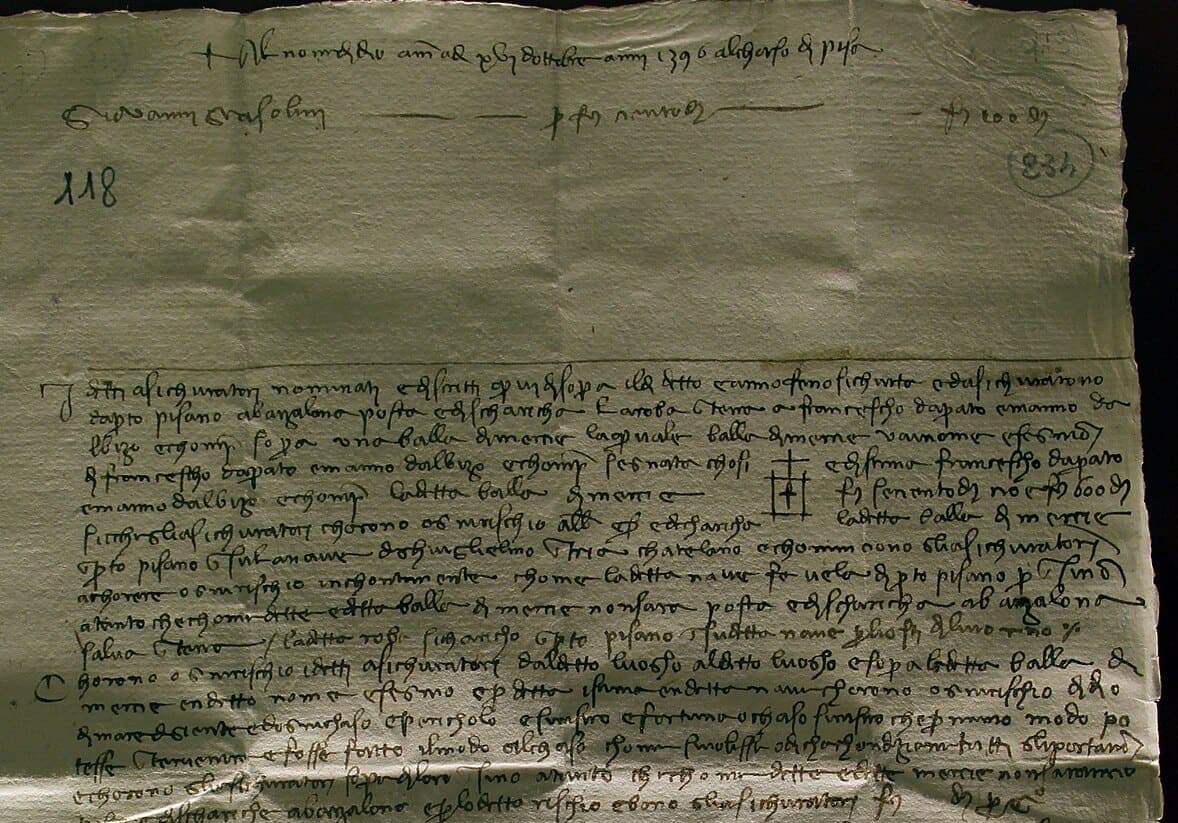
Archivio di Stato di Prato, Archivio Datini, 16 October 1395 · Source · CC BY 3.0 · Photograph: Francesco Bini (Sailko)
Evidano Transcription
- Al nome di dio ame[n] adi 16[?] dottobre anno 1396 alusança[?] di pisa
Giovanni Grasolini —— —— p[er] f[iorini] [illegible] —— —— f[iorini] 100 [illegible]
118 (234)
Detti asichuratori nominati e schritti [illegible]
[illegible] pisano [illegible] posta [illegible] e tenuta[?] a Francescho da prato e manno d[illegible]
[illegible] sopra una balla di merce la quale balla di merce va a nome [illegible]
di Francescho da prato e manno dalbizo e chonp[agn]i [illegible] Francescho da prato
e manno dalbizo e chonp[agn]i la detta balla di merce — [mark] [illegible] la detta balla di merce
[illegible] gli asichuratori [illegible] rischio [illegible]
[illegible] pisano [illegible] gli asichuratori
[illegible] rischio [illegible] la detta nave [illegible] pisano [illegible]
[illegible] detta balla di merce non sara posta [illegible]
[illegible] la detta [illegible] pisano [illegible] nave [illegible]
[remaining lines illegible]
Generated by Evidano’s advanced model; not yet checked against a published edition.
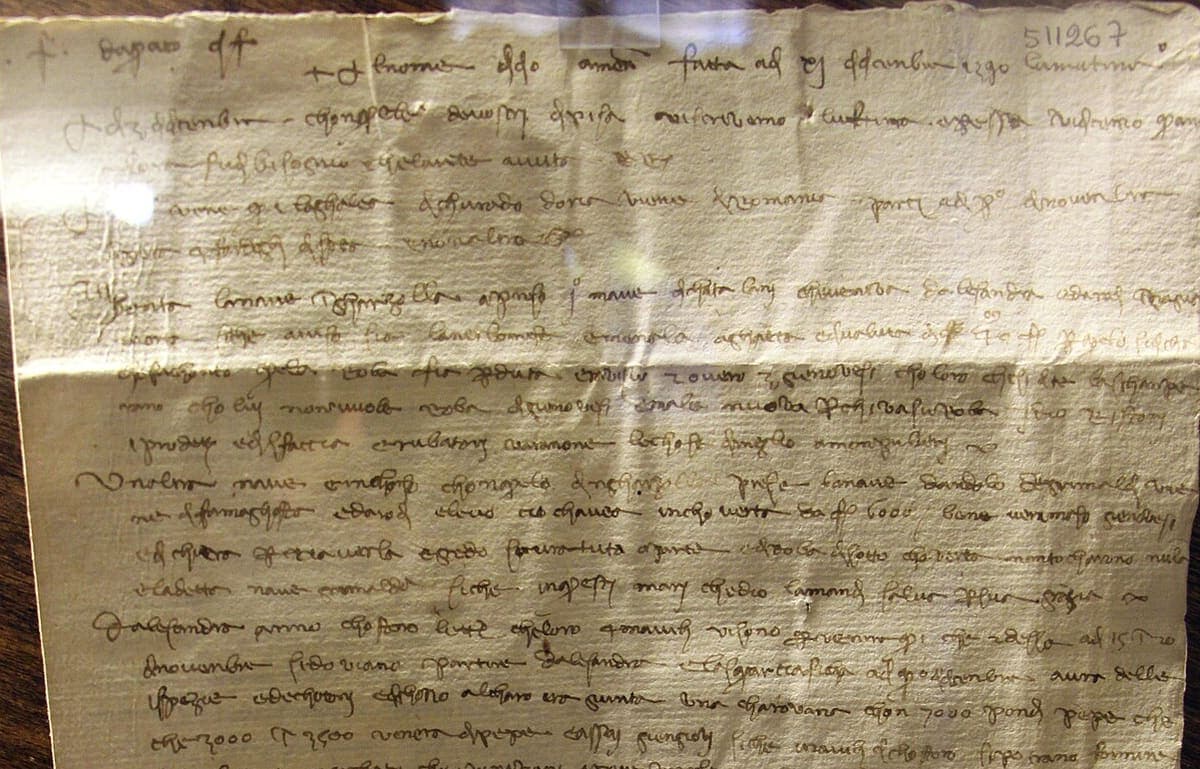
Archivio di Stato di Prato, Archivio Datini, 11 December 1390 · Source · CC BY 3.0 · Photograph: Francesco Bini (Sailko)
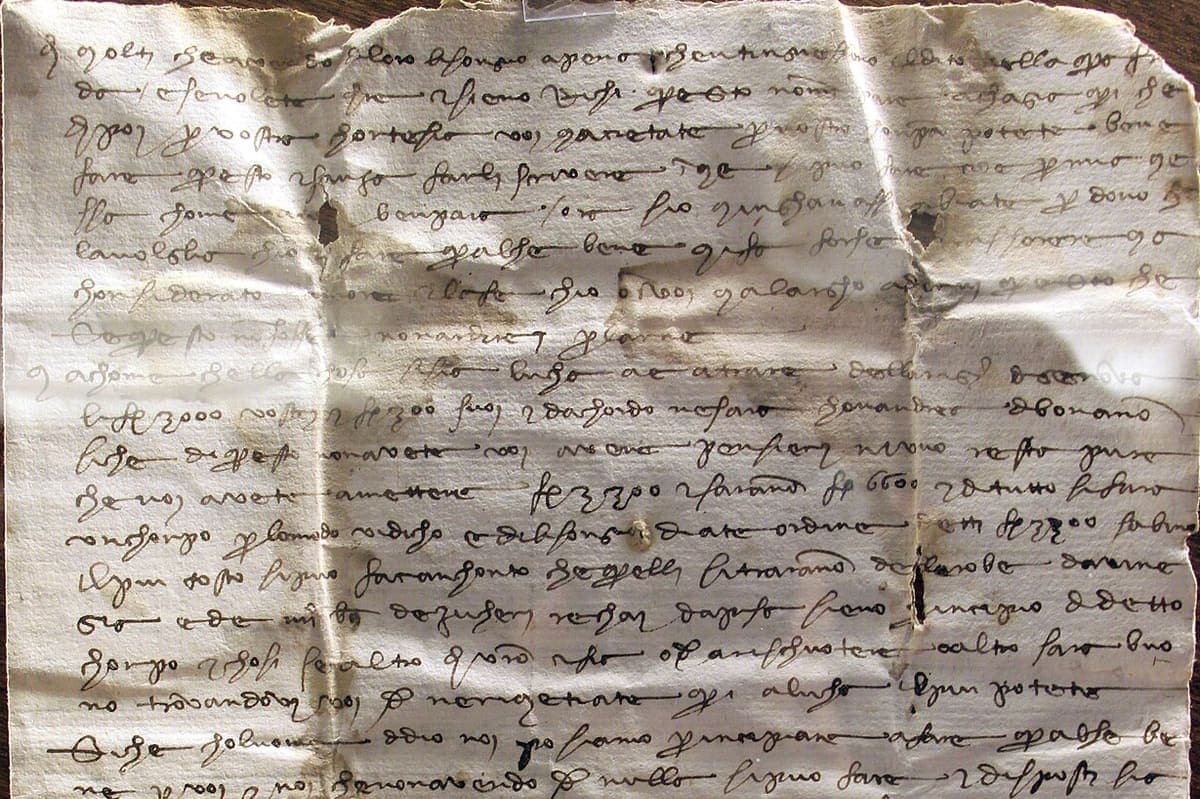
Archivio di Stato di Prato, Archivio Datini, 13 March 1396 · Source · CC BY 3.0 · Photograph: Francesco Bini (Sailko)
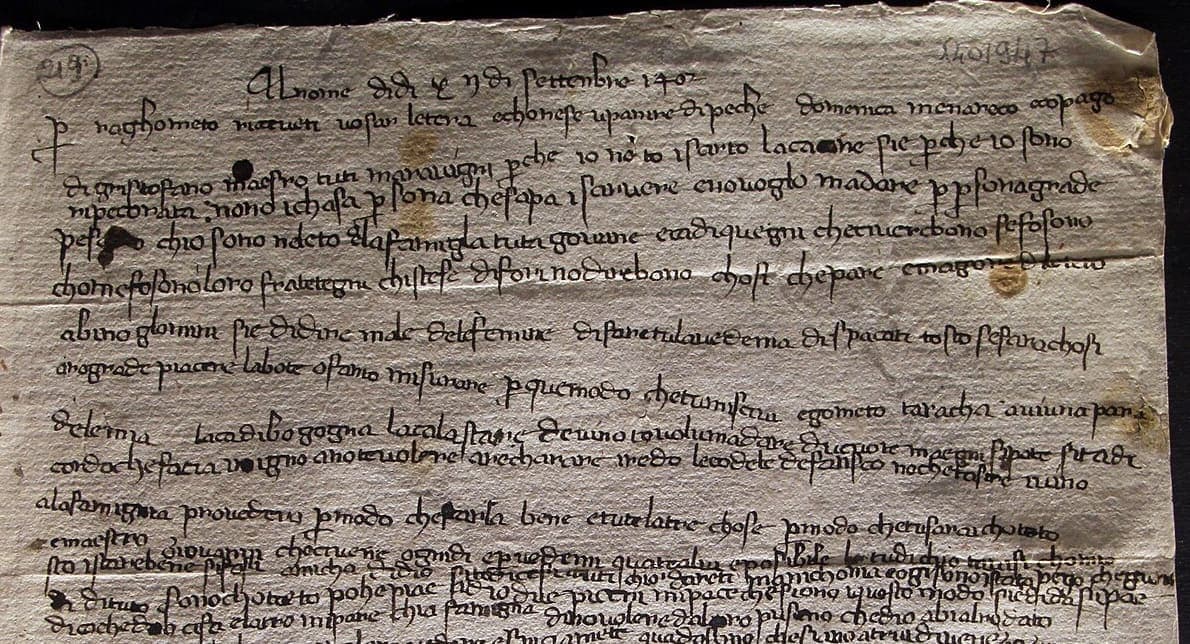
Archivio di Stato di Prato, Archivio Datini, 12 September 1402 · Source · CC BY 3.0 · Photograph: Francesco Bini (Sailko)
Evidano Transcription
(219) 1401947
Al nome di dio a d[ì] 12 di settenbre 1402
[remaining lines illegible]
Generated by Evidano’s advanced model; not yet checked against a published edition.
The hand of the fondaco and the account book
From the late thirteenth century Italian merchants wrote in a cursive of their own, the lettera mercantesca, learned alongside arithmetic in the scuole d’abaco and used from Genoa and Venice to the branches in Barcelona, Bruges and Famagusta. It is rounder and more upright than the chancery cursive it grew out of, written with a broad nib held flat, and built for speed: few pen-lifts, long loops on the ascenders of b, d, h and l, an open-topped a, a single-stroke e that often loses its bar, and a g whose lower lobe swings left as an open hook. Long ſ stands inside words and round s closes them; word division is erratic, and the same clerk will write per lui as one word and dellamia as three.
What separates it from a book hand is everything that is not prose. Money is written as Roman numerals in the Florentine manner, with the last unit as a j, so viij and xxiij look like clusters of minims, and each sum is followed by the currency: f. or a lily-like mark for fiorini, £ for lire, s. for soldi, d. for denari, often with a qualifier such as a oro, di grossi or di piccioli. Weights and lengths carry their own abbreviations for libbre, once, braccia, canne and staia. Entries open with fixed formulas — E dee dare, E dee avere, Ricordanza che… — and close with a posting reference to another book and folio. When an account was settled the whole block was struck through with one or two diagonal strokes, which is a statement about the account, not a deletion of the text.
Each genre has its own shape on the page. A libro di debitori e creditori sets one account per opening, debits left and credits right, every line beginning with the day and ending with the sum ranged right. Ricordanze and libri di famiglia run as solid paragraphs, mixing purchases, dowries, births and deaths in one sequence. Letters open with a merchant’s mark and the invocation Al nome di Dio amen, run without paragraph breaks to the subscription, and carry the address and a note of receipt on the outside of the folded sheet.
Why ordinary OCR struggles here
Numbers that look like words
Roman numerals are written cursively and joined, so iiij can be read as a word ending in -uj, and the terminal j of a sum is easily taken for a letter. Arabic figures appear from the fourteenth century for quantities and dates but rarely for money, so one page may carry both systems, plus fractions written as small superscript strokes.
Money columns and the shape of an opening
A ledger page is not running text. The date, the narrative and the sum belong to different columns, sums are ranged right against ruled lines, and totals are carried to another book and folio. Read as a single stream, the amounts detach from their entries and the debit side merges with the credit side.
Dates that do not mean what they say
Florence began the year on 25 March, Pisa a year ahead of it, Venice on 1 March; a letter dated February 1402 in Florence is 1403 by modern reckoning. Merchants also date by the local style at both ends of a correspondence, so a transcription that silently modernises the year quietly falsifies the chronology of a whole account.
Cancellations, additions and paper in bad condition
Settled entries are crossed through, corrections sit above the line with a caret, and later hands add postings in a different ink. The paper is thin, folded for the post and stained along the folds, and the writing on the other side shows through as extra strokes.
Who works with this material
Economic and business historians
Price series, exchange rates and freight costs are built by reading thousands of entries with each sum tied to its date and commodity. Such a project needs rows rather than prose: date, narrative, currency, amount, and the folio the entry is posted to.
Archivists opening merchant fonds
Company archives survive as thousands of letters and hundreds of registers, most described only at series level. Transcribing the opening lines, the date and the correspondent turns a bundle into an item-level list readers can search before ordering the box.
Family historians using ricordanze
Household books record births, marriages, dowries and deaths years before parish registers begin, buried between purchases of cloth and payments to masons. Genealogists need those entries pulled out with their dates intact and the personal names spelled as the writer spelled them.
Art historians tracking payments
Commissions are documented in the account books of the guilds, the confraternities and the works of a cathedral rather than in letters. Reading the ledger line that names the painter, the sum and the day it was paid settles questions of chronology that stylistic argument cannot.
Getting the best transcription
Ask for rows, not prose, on account pages
Tell the model that the page is a ledger and specify the fields you want: day, entry text, currency, amount, and any posting reference. Say whether the debit and credit sides should be returned as two blocks or interleaved, and ask for the ruled totals to be kept separate from the entries above them.
Set the numeral and currency policy
Decide whether Roman numerals are kept as written, with the terminal j, or converted to figures, and whether lire, soldi and denari are expanded or left as £, s. and d. Converting is convenient for analysis, but keep an unconverted column as well so a doubtful sum can be checked against the image.
Name the dating style before you start
Tell the model which style the book uses and ask for the year exactly as written, with any modern equivalent added in brackets rather than substituted. This matters most for the months between January and March, where Florentine and Pisan reckonings differ from ours.
Test on a page that has been corrected
Choose an opening with struck-through entries, a marginal addition and a carry-forward, rather than a clean one. If cancelled entries come back marked as cancelled instead of dropped, and the addition is placed where the caret puts it, the rest of the register will follow.
Further reading on this hand
The palaeography guides the in-app selector points to for this domain, if you want to check a transcription against the standard references.
- Italian Paleography: Handbook
This Newberry Library handbook presents mercantesca as a distinctive Italian script associated with merchants and urban lay writing. It explains the script's social setting and contrasts it with formal book and chancery hands. Manuscript examples and supporting materials expose users to characteristic letterforms, abbreviations, punctuation, word division, and numerical or documentary context. It is particularly useful for account books and commercial correspondence where writing and calculation occupy the same page.
Frequently asked questions
- Can a ledger opening come back as a table with the money columns intact?
- Yes. Ask for a table and name the columns; each entry is returned with its day, its text and its amount in separate fields, and the debit and credit sides are labelled. Sums that are ranged right against a rule stay attached to the line they belong to rather than drifting to the next one.
- Are Roman numerals converted to figures?
- Only if you ask. The default keeps the numeral as written, including the terminal j and any bar or superscript, because that form is evidence of how the book was kept. A converted column can be produced alongside it for arithmetic, and the two can be compared to catch a misread minim.
- How is the Florentine year beginning on 25 March handled?
- The date is transcribed as it stands and, if you want, the modern year is added in brackets. Nothing is silently converted: in a book kept in Florentine style a January entry belongs to the year the clerk wrote, and moving it forward would put payments out of sequence with the letters that discuss them.
- What happens to the address and docket on the back of a letter?
- They come back as separate labelled blocks, so the address, the merchant’s mark and the note of the day the letter arrived do not run into the body. That docket is often the only record of how long the post took between two branches.
- Does it distinguish a cancelled entry from a deleted one?
- A diagonal stroke through a block usually means the account was settled, so the text underneath is transcribed and flagged as struck through rather than dropped. Words scratched out inside a line are reported as corrections, with the reading underneath where it can still be seen.
- Is mercantesca different enough from chancery hands to need its own setting?
- Yes. It uses fewer Latin abbreviations, more commercial signs, and a numeral practice a chancery clerk never needed, and its loops and open a are its own. For notarial instruments and official letters written in the same decades, use the Cancelleresca and Notarial Hands domain instead.
Related scripts and pages
Put your merchant archive into columns
Send one ledger opening and one letter, choose Italian Mercantesca Accounts and Correspondence, and set the numeral and dating rules on the first page.