
Italian · c. 1300–1600
Read charters, instruments and chancery registers
A notarial page is nine parts formula and one part fact, and the formulae are cut to stumps: a clause of twenty words appears as four letters and a stroke, and the notary finishes an entire paragraph with ec. Evidano works through the protocol, the body and the subscription in turn, marks what it has expanded, and leaves the dating clause, the tabellion sign and the chancery signature where they belong.
Sample pages
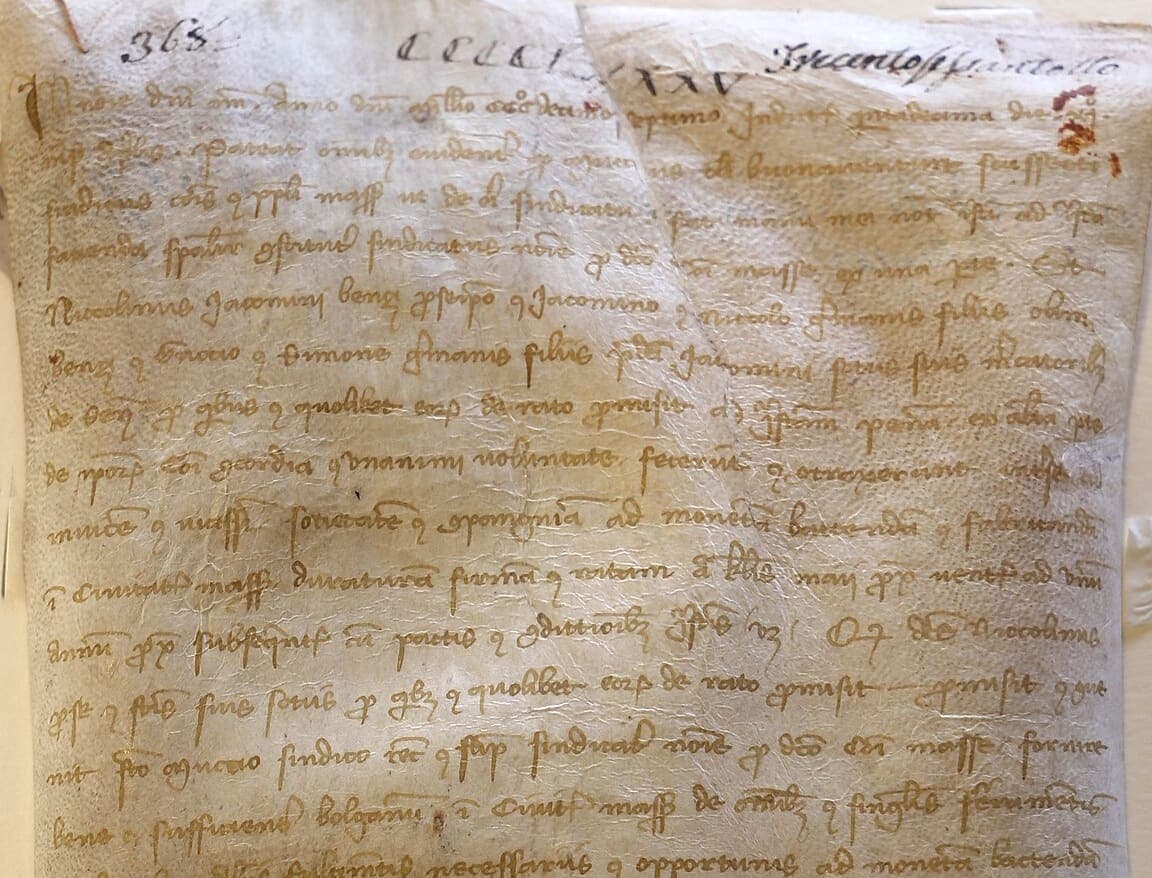
Archivio di Stato di Siena, 11 April 1317 · Source · CC BY-SA 4.0 · Photograph: Francesco Bini (Sailko)
Evidano Transcription
368 CCCCLXXV Trecentoſeſſantotto
[remaining lines illegible]
Generated by Evidano’s advanced model; not yet checked against a published edition.
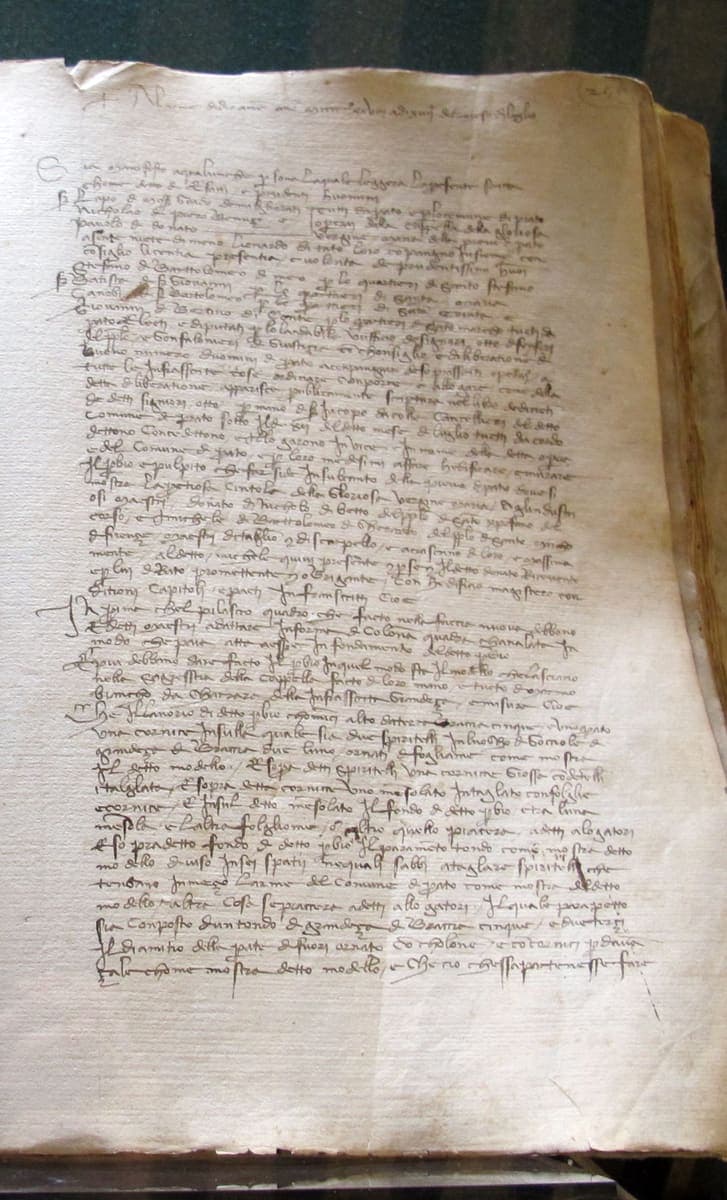
Archivio di Stato di Prato, Patrimonio ecclesiastico 1009, 14 July 1428 · Source · CC BY-SA 3.0 · Photograph: Francesco Bini (Sailko)
Evidano Transcription
The heading and the upper part of the page, from the invocation down to the words that introduce the list of conditions; the entry continues below with the clauses on the pulpit itself. The text is as printed by Cesare Guasti in 1887 from this register. A semi-diplomatic edition: Guasti keeps the scribe’s spelling and expands the abbreviations silently, adds modern punctuation and prints Roman numerals in lower case. Two places where the Internet Archive OCR corrupted the printed text (Sla for Sia, and the Roman date figures) have been restored from the page image.
Al nome di Dio amen. Anno mccccxxviii a dì xiiii del mese di luglio.
Sia manifesto a qualunque persona la quale leggerà la presente scritta,
chome detto dì e savi e prudenti huomini ser Lapo di messer Guido de’ Migliorati,
Nicholao di Piero Benuzi e Pavolo di Donato, tutti da Prato e per lo Comune
di Prato Operai della Cappella della gloriosa Vergine Maria della pieve di Prato,
asente nientedimeno Lionardo di Tato loro compagno; insieme con consiglio
licentia presentia e volontà de’ prudentissimi huomini Stefano di Bartolomeo
di Meo per lo quartieri di Santo Stefano, ser Batista di ser Giovanni per lo
quartieri di Santa Maria, Zanobi di ser Bartolomeo per lo quartieri di Santa
Trinita, e Giovanni di Bertino di Conte per lo quartieri di Santo Marcho,
tucti da Prato, electi et diputati per lo laudabile ufficio de’ Signori Otto Difensori
del popolo e Gonfalonieri di giustizia, con chonsiglio e diliberatione di
buono numero d’uomini di Prato, a conpagnia de’ soprasscriti Operai, a tutte
le infrasscrite cose ordinare comporre e allogare, come della detta diliberatione
apparisce publicamente scriptura nel libro de’ dicreti de’ detti Signori Otto per
mano di ser Iacopo da Colle cancellieri del detto Comune di Prato, sotto il dì
xij del detto mese di luglio; tucti dacordo dettono concedettono et allogarono
in vice e in nome della detta Opera e del Comune di Prato e per loro medesimi
affare hedificare e murare il perbio e pulpito che far si de’ in sul canto della
pieve di Prato, dove si mostra la pretiosa Cintola della gloriosa Vergine Maria,
agli industriosi maestri Donato di Nicholò di Betto del popolo di Santo Cristofano
del Corso e Michele di Barttolomeo di Gherardo del popolo di Santo Marcho di
Firenze, maestri d’intaglio e di scarpello, e a ciascuno di loro; e massimamente
al detto Michele quivi presente e per sè e il detto Donato ricevente e per lui de
rato promettente e obrigante, con hedificio magistero conditioni capitoli e pacti
infrascritti, cioè:
Source: Cesare Guasti, Il pergamo di Donatello pel Duomo di Prato (Florence: Le Monnier, 1887), pp. 18–19, via Internet Archive (Public domain).
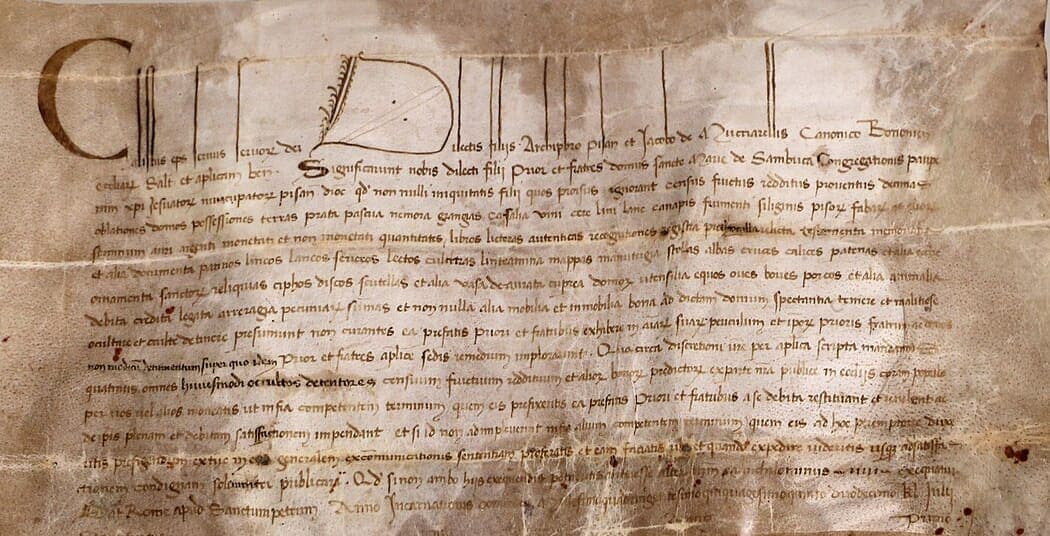
Museo della città, Livorno, 20 June 1455 · Source · CC BY 3.0 · Photograph: Francesco Bini (Sailko)
Evidano Transcription
Calistus ep[iscopu]s seruus seruor[um] dei dilectis filijs Archip[res]b[yte]ro pisan[o] et Jacobo de [illegible] Canonico Bononien[si]
eccl[es]iar[um] Sal[u]t[em] et ap[osto]licam ben[edictionem]. Significarunt nobis dilecti filij Prior et fratres domus sancte Marie de Sambuca Congregationis paupe
rum xp[ist]i Jesuator[um] nuncupator[um] pisan[e] dioc[esis] q[uo]d non nulli iniquitatis filij quos prorsus ignorant census fructus redditus prouentus decimas
oblationes domos possessiones terras prata pascua nemora grangias casalia uini cere lini lane canapis frumenti siliginis pisor[um] fabar[um] et alior[um] [?]
seminum auri argenti monetati et non monetati quantitates libros litteras autenticas recognitiones registra prothocolla [illegible] testamenta memori[illegible]
et alia documenta[?] pannos lineos laneos sericos lectos culcitras linteamina mappas manutergia stolas albas cruces calices patenas et alia [illegible]
ornamenta sanctor[um] reliquias ciphos discos scutellas et alia uasa deaurata cuprea[?] domor[um] utensilia equos oues boues porcos et alia animalia
debita credita legata arreragia pecuniar[um] summas et nonnulla alia mobilia et inmobilia bona ad dictam domum spectantia temere et malitiose
occultare et occulte detinere presumunt non curantes ea prefatis Priori et fratribus exhibere in animar[um] suar[um] periculum et ip[s]or[um] prioris fratrum ac [illegible]
non modicum detrimentum super quo idem Prior et fratres ap[osto]lice sedis remedium implorarunt. Quocirca discretioni u[est]re per ap[osto]lica scripta mandamus
quatinus omnes huiusmodi occultos detentores censuum fructuum reddituum et alior[um] bonor[um] predictor[um] ex parte n[ost]ra publice in ecclesijs coram populo
per uos uel alios moneatis ut infra competentem terminum quem eis prefixeritis ea prefatis Priori et fratribus a se debita restituant et reuelent ac
de ip[s]is plenam et debitam satisfactionem impendant et si id non adimpleuerint infra alium competentem terminum quem eis ad hoc peremptorie duxe
ritis prefigendum extunc in eos generalem excommunicationis sententiam proferatis et eam faciatis ubi et quando expedire uideritis usq[ue] ad satisfa
ctionem condignam solenniter publicari. Quod si non ambo hijs exequendis potueritis[?] interesse[?] alter u[est]r[u]m[?] ea nichilominus [illegible] exequatur[?].
Dat[um] Rome apud Sanctumpetrum Anno Incarnationis dominice [illegible]esimoquadringentesimoquinquagesimoquinto duodecimo k[a]l[endas] Julij
[illegible] Primo
Generated by Evidano’s advanced model; not yet checked against a published edition.
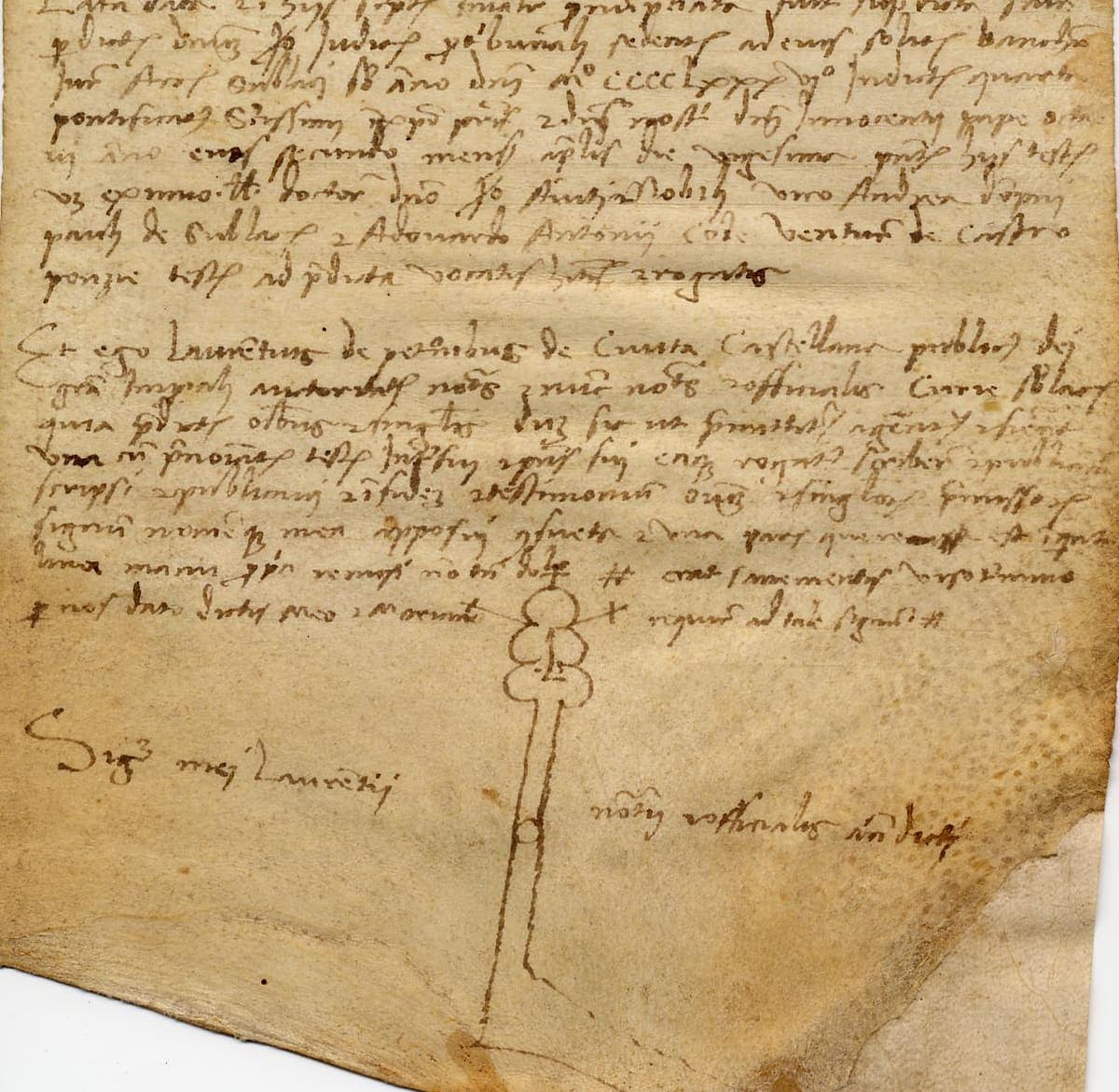
Archivio della Parrocchia di Santa Maria Assunta, 15 November 1490 · Source · CC BY-SA 4.0 · Archivio Parrocchia Santa Maria Assunta
Evidano Transcription
[remaining lines illegible]
[signum tabellionis]
Sig[num] mei Laurentij
not[ari]j [et] officialis in d[ic]tis
Generated by Evidano’s advanced model; not yet checked against a published edition.
How chancery and notarial pages are built
Two writing cultures dominate the Italian document between 1300 and 1600. The notary drafted a short minute in his register of imbreviature and, when a party paid for it, engrossed the full instrument on a parchment sheet; the communal, signorial and papal chanceries produced letters, privileges, decrees and contracts written by professional scribes. Their scripts converge in the minuscola cancelleresca: sloping, narrow, with tall ascenders looped to the left on b, h, l and d, descenders drawn far below the line on f, ſ, p and q, and terminal strokes that curl up at the end of a word. Fifteenth-century chanceries, above all the papal one, refined this into the sharply pointed cancelleresca corsiva that the writing masters later printed as italic.
The letters that cause trouble are few and constant. Long ſ and f differ only in a crossbar that a rapid hand omits; c and t are distinguished, if at all, by the length of the headstroke; e is often a single loop; and looped ascenders can be read as l where the loop belongs to a b. Above the line sits the abbreviation system: a straight or wavy bar for a suppressed m or n, a superscript vowel for a whole syllable, the crossed p for per and par, the barred q for que and quod, the 9 sign for con and, at the end of a word, for -us. Formulae are suspended after a syllable or two — pñtib3 for presentibus, dds for dictus, and ec. for a clause everyone knew by heart. Numbers are Roman, often lower-case with a final j and enclosed in points.
The furniture around the text matters as much as the text. An engrossed instrument opens with an invocation and closes with the notary’s subscription — Et ego … publicus imperiali auctoritate notarius … rogatus scripsi — beside his signum tabellionis, a personal pen-drawn emblem no two notaries shared. Papal letters begin with a first line in elongated letters, are dated by the Roman kalends with the year of the Incarnation and of the pontificate, and carry the writer’s name at the foot right and a lead bulla on cords through the folded plica. In a register of minutes each entry is struck through with a vertical or diagonal line once the instrument had been written out, and the parties’ names are repeated in the margin as a finding aid.
Why ordinary OCR struggles here
Formulae reduced to stumps
The most abbreviated words are the ones a reader most needs: the clauses of warranty, renunciation and penalty. Expanding pñtib3, sup̄scriptis or a bare ec. correctly needs the formulary behind the document, and a system trained on running prose will either invent a word or drop the abbreviation mark and produce nonsense.
Latin and volgare on the same sheet
The instrument is in Latin, the contract drawn by a communal chancellor is in Italian, and the two meet inside one register or even one entry, with vernacular names, measurements and object descriptions embedded in Latin clauses. Language switching mid-line defeats a model that has been told the page is in one language.
Dates by kalends, indiction and pontifical year
A dating clause may give the day by counting backwards to the kalends, the year by the Incarnation in the local style, the indiction, and the regnal or pontifical year, all in abbreviated Roman numerals. Every element must survive transcription intact, because they are what a diplomatist uses to test whether the document is genuine.
Marks that are not letters
A tabellion sign, a chancery flourish, a paraph, a registration note, the crossing-out of an engrossed minute and the holes and folds of the plica all sit in the writing area. Read as characters they corrupt the surrounding words; ignored altogether, the record loses the evidence that shows who wrote and validated the act.
Who works with this material
Editors of charter and cartulary corpora
A regesta project needs each act reduced to its parties, its object, its date and its place, with the formulae recorded but not retyped. Getting the protocol and eschatocol out reliably is the slow part, and it is exactly the part that repeats from document to document.
Genealogists in the notarile archives
Dowry contracts, wills, emancipations and inventories name women, children and servants who appear in no other record. Searching them means having the names, the patronymics and the places out of the Latin formulae and into an index, spelled as the notary wrote them.
Historians of art, building and the crafts
Commissions survive as contracts drawn up before a chancellor or a notary, listing materials, measurements in braccia, delivery dates and stage payments. Those clauses answer questions about workshop practice that the finished object cannot.
Legal and institutional historians
Statutes, deliberations and privileges show how a commune or a signoria actually worked. Reading a series of them in order requires consistent treatment of the technical vocabulary and of the offices named in the arenga, not a loose paraphrase.
Getting the best transcription
Say what to do with the formulae
Choose one rule and apply it to the whole fond: expand abbreviations in square brackets, expand silently, or keep the abbreviation marks as written. State that ec. is to be kept as ec. rather than filled out, since the clause it stands for varies with the formulary the notary followed.
Ask for the parts of the act to be labelled
Request the invocation, the list of parties, the dispositive clauses, the witnesses, the dating clause and the notarial subscription as separate blocks. On a register page, ask for each minute to be returned separately with any marginal name and any cancellation stroke noted.
Keep the date and compute it separately
Have the dating clause transcribed exactly, kalends, indiction and pontifical year included, and any modern equivalent supplied in brackets. Where the style of the year is not stated, leave it open rather than assuming: Florentine, Pisan and Venetian reckonings all appear in these archives.
Start with an engrossed parchment, then a register
Test on a finished instrument, where the hand is careful and the structure visible, before moving to the minutes, which are faster, more abbreviated and full of deletions. Corrections you make on the parchment carry over to the register of the same notary.
Further reading on this hand
The palaeography guides the in-app selector points to for this domain, if you want to check a transcription against the standard references.
- Italian Paleography: Handbook
This Newberry Library handbook describes minuscola cancelleresca and other scripts used in Italian documentary culture. It relates chancery forms to administrative and notarial functions and illustrates their more formal and cursive varieties. The materials address alphabets, abbreviations, punctuation, word spacing, flourishes, and the coexistence of multiple hands or scripts. This coverage is well suited to legal instruments, official correspondence, and registers produced between the fourteenth and sixteenth centuries.
Frequently asked questions
- Are the Latin abbreviations expanded, and can I see which words were expanded?
- Both are available. You can have a strictly diplomatic text that keeps every bar, superscript and 9 sign, or an expanded reading text with the supplied letters in square brackets. For an edition the bracketed form is usually right, because it lets a reviewer check an expansion against the parchment without going back to the archive.
- What happens when Latin and Italian alternate inside one document?
- The transcript follows the page rather than a single declared language, so a vernacular list of materials inside a Latin instrument comes out as the notary wrote it. Ask for language switches to be flagged and you get a marker at each change, which helps when the two use the same abbreviation with different values.
- Is the notary’s signum tabellionis transcribed?
- It is described and located rather than transcribed, since it is a drawn emblem, not writing. The subscription around it, which names the notary and the authority he held, is transcribed in full: that formula is what identifies the hand and lets you group instruments by their author.
- Can registers of imbreviature be read, with their crossed-out entries?
- Yes, and the crossings matter. A minute struck through usually means the instrument was engrossed and delivered, so the text is transcribed and the stroke recorded rather than treated as a deletion. Marginal notes of names, of payment and of later cancellation are kept as separate labelled fields.
- How are dates by the Roman kalends and the indiction handled?
- They are kept word for word, including the pontifical or regnal year, and a converted date can be added in brackets. Nothing is normalised away, because a mismatch between indiction and year is one of the standard tests for a forged or misdated act.
- Does the elongated first line of a papal letter cause problems?
- It is treated as its own line, with the stretched ascenders and the wide spacing allowed for, so the address and the pope’s name are not lost or merged into the body. Chancery signatures at the foot and registration notes on the fold are reported separately from the text of the letter.
Related scripts and pages
Open your notarial and chancery series
Upload one engrossed instrument and one page of minutes, choose Italian Cancelleresca and Notarial Hands, and fix the expansion and dating rules before the rest of the fond.