
Spanish · c. 1400–1550
Read the looped court hand of the Castilian chanceries
Cortesana curls every ascender and descender back on itself and carries the pen through whole phrases without lifting it, so de la dicha çibdad can arrive as one long shape and the rúbrica under a royal signature looks like another line of words. Evidano transcribes cédulas, ejecutorias, capitulations and notarial receipts in this hand, separates the signature and the marginal registration from the body, and leaves the contractions standing if that is what your edition needs.
Sample pages
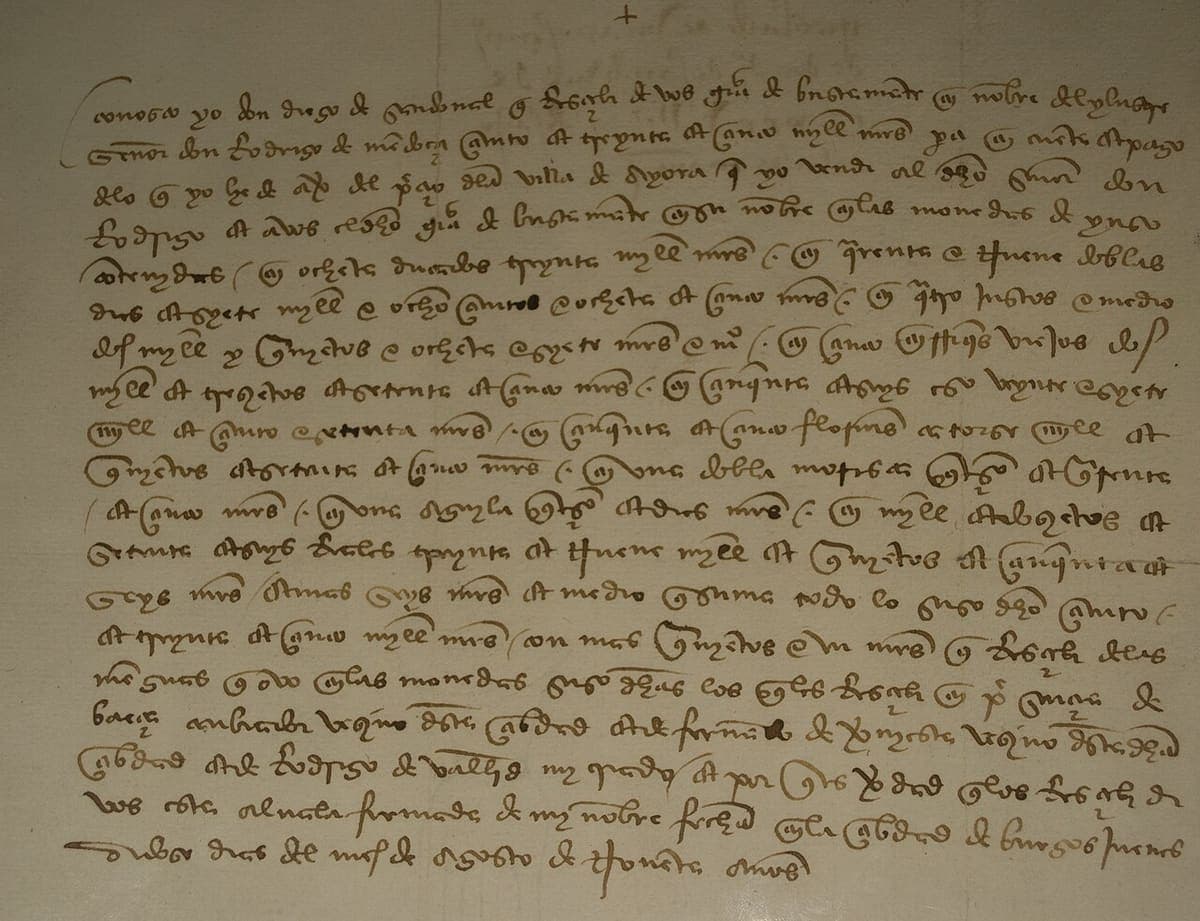
Archivo Municipal de Ayora, 12 August 1490 · Source · CC BY-SA 4.0 · Photograph by Dorieo, Wikimedia Commons, CC BY-SA 4.0
Evidano Transcription
conosco yo don diego d[e] sandoual q[ue] R[e]cebi d[e] vos gar[ci]a d[e] bustama[n]te en no[m]bre del yllustre
señor don Rodrigo d[e] me[n]doça çie[n]to et treynta et çinco myll mr[s] p[ar]a en cue[n]ta et pago
dlo q[ue] yo he d[e] au[e]r del p[re]çio dela villa d[e] ayora q[ue] yo vendi al d[ic]ho señor don
Rodrigo et a vos resçebi gar[ci]a d[e] bustama[n]te en su no[m]bre enlas monedas d[e] yuso
contenydas ( en ochenta ducados treynta myll mr[s] ( en q[ua]renta e nueue doblas
dos et syete myll e ocho çie[n]tos e ochenta et çinco mr[s] ( en q[ua]tro justos e medio
dos myll y q[ui]nie[n]tos e ochenta e syete mr[s] e m[edi]o ( en çinco enrriq[ue]s viejos dos
myll et trezie[n]tos et setenta et çinco mr[s] ( en çinquenta et seys rreales veynte e syete
myll et çie[n]to e setenta mr[s] / en çinquenta et çinco florines catorze myll et
q[ui]nie[n]tos et setenta et çinco mr[s] ( en vna dobla morisca q[ui]nie[n]tos et sesenta
et çinco mr[s] ( en vna agyla q[ui]nie[n]tos et dos mr[s] ( en myll et dozie[n]tos et
setenta et seys rreales treynta et nueue myll et q[ui]nie[n]tos et çinquenta et
seys mr[s] / et mas seys mr[s] et medio su[m]ma todo lo suso d[ic]ho çie[n]to
et treynta et çinco myll mr[s] / con mas q[ui]nie[n]tos e un mr[s] q[ue] R[e]cebi delos
[illegible] q[ue] [illegible] conlas monedas suso d[ic]has los quales R[e]cebi en p[re]sençia d[e]
[illegible] vezino dela çibdad [illegible] d[e] [illegible] vezino desta d[ic]ha
çibdad et Rodrigo d[e] vallejo my criado et por q[ue] es verdad [illegible] de
vos esta aluala firmada de my no[m]bre fecha enla çibdad d[e] burgos [illegible]
doze dias del mes de agosto de nouenta años
Generated by Evidano’s advanced model; not yet checked against a published edition.
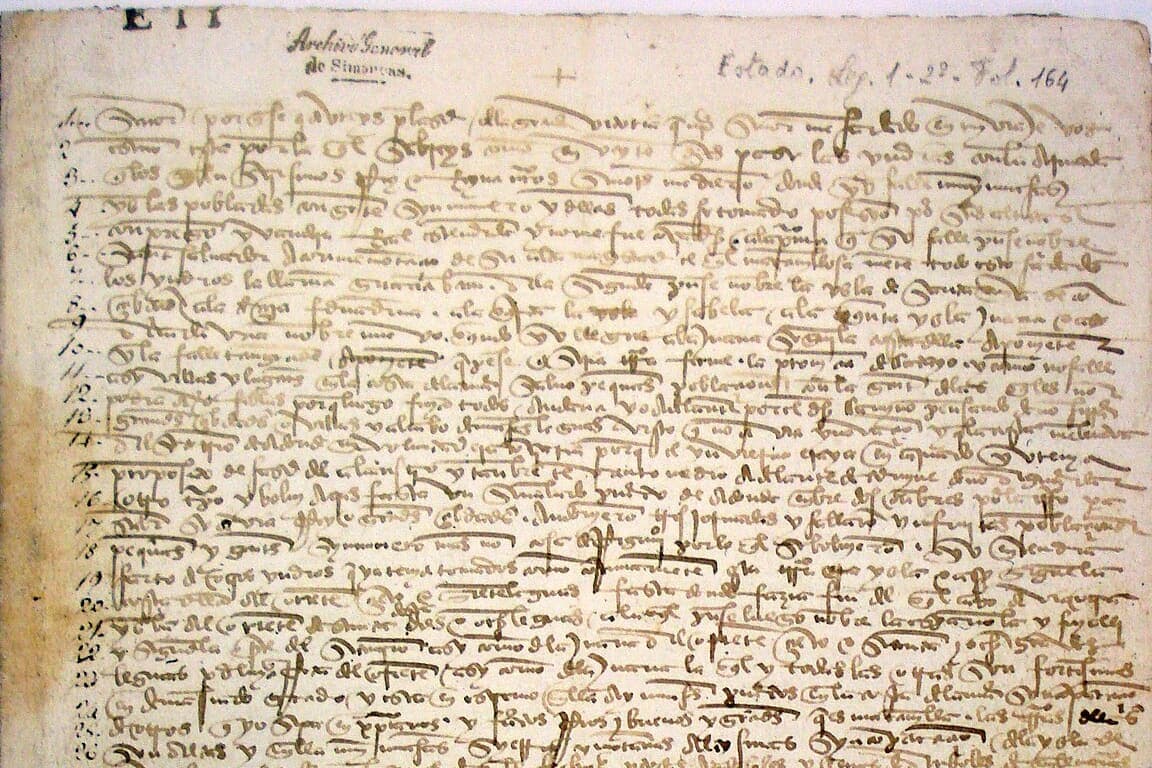
Archivo General de Simancas, Estado, leg. 1-2º, f. 164, 1493 · Source · Public domain
Evidano Transcription
The opening of the letter, which is what the upper part of this page carries, in Martín Fernández de Navarrete’s edition of 1825, printed — as the archivist Tomás González certifies at its foot — literally from this original in the archive of Simancas. Accents, capitals and punctuation are the editor’s; where the copy gives the number of days in confused Roman numerals he prints veinte and notes that it should be seventy-one. Scanning errors in the digitised volume have been repaired, and the page continues well past the last line given here.
Señor: Porque sé que habréis placer de la grande vitoria que nuestro Señor me ha dado en mi viage, vos escribo esta, por la cual sabréis como en veinte dias pasé á las Indias con la armada que los Ilustrísimos Rey y Reina nuestros Señores me dieron, donde yo fallé muy muchas islas pobladas con gente sin número; y dellas todas he tomado posesión por sus Altezas con pregón y bandera Real extendida, y no me fue contradicho.
A la primera que yo fallé puse nombre San Salvador, á conmemoración de su Alta Magestad, el cual maravillosamente todo esto ha dado: los indios la llaman Guanahani. A la segunda puse nombre la isla de Santa María de Concepción; á la tercera Fernandina; á la cuarta la Isabela; á la quinta isla Juana, é así á cada una nombre nuevo.
Cuando yo llegué á la Juana seguí la costa della á poniente, y la fallé tan grande que pensé que sería tierra firme, la provincia de Catayo.
Source: Martín Fernández de Navarrete, Colección de los viages y descubrimientos que hicieron por mar los españoles, I (Madrid, 1825), pp. 167–168, via Internet Archive (Public domain).
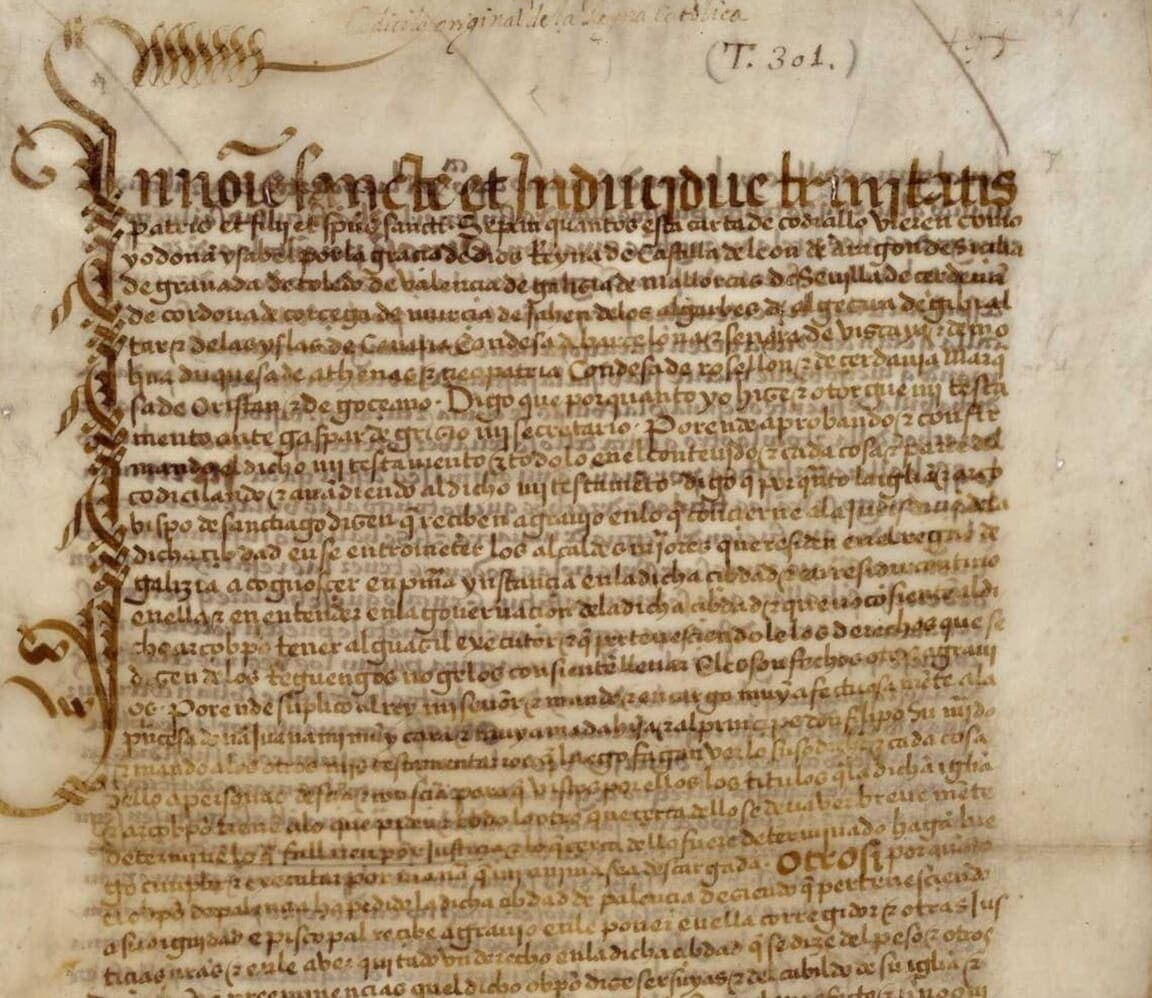
Biblioteca Nacional de España, 23 November 1504 · Source · Public domain
Evidano Transcription
Codicilo original de la Reyna Catolica
(T. 301.)
In no[m]i[n]e sancte et Indiuidue trinitatis
patris et filij et sp[irit]us sancti Sepan quantos esta carta de codicillo vieren como
yo dona ysabel por la graçia de dios Reyna de castilla de leon de aragon de siçilia
de granada de toledo de valençia de galizia de mallorcas de Seuilla de çerdeña
de cordoua de corçega de murçia de jahen de los algarbes de algezira de gibral
tar [et] de las yslas de canaria condesa de barçelona [et] señora de viscaya [et] de mo
lina duquesa de athenas [et] de neopatria condesa de rosellon [et] de çerdanya marq[ue]
sa de oristan [et] de goçeano. Digo que por quanto yo hize [et] otorgue mi testa
mento ante gaspar de griçio mi secretario Porende aprobando [et] confir
mando el dicho mi testamento [et] todo lo en el contenido [et] cada cosa [et] parte del
codicilando [et] anadiendo al dicho mi testame[n]to digo q[ue] porq[uan]to la igl[es]ia [et] arço
bispo de sanctiago dizen q[ue] reçiben agrauio en lo q[ue] co[n]çierne a la jurisdiçion de la
dicha çibdad en se entremeter los alcaldes mayores que residen enel regno de
galizia a cognosçer en p[ri]m[er]a ynstançia en la dicha çibdad [et] en residir contino
en ella [et] en entender en la gouernaçion de la dicha çibdad [et] que no co[n]siente[n] al di
cho arçob[is]p[o] tener alguaçil executor [et] q[ue] p[er]tenesçiendo le los derechos que se
dizen de los reguengos no ge los consiente[n] lleuar e le son fechos otros agraui
os Porende suplico al rey mi señor [et] mando [et] encargo muy afectuosame[n]te a la
p[ri]nçesa doña juana mi muy cara [et] muy amada hyja [et] al p[ri]nçipe don felipe su m[ar]ido
[et] mando a los otros mis testamentarios q[ue] luego fagan ver lo susod[ic]ho [et] cada cosa
dello a p[er]sonas de sçiençia [et] co[n]sçiençia [et] visto por ellos los titulos q[ue] la dicha igl[es]ia
[et] arçob[is]p[o] tiene[n] a lo que pide[n] [et] todo lo otro que çerca dello se deua ver breueme[n]te
determinen lo q[ue] fallaren por justiçia e lo q[ue] çerca dello fuere determi[n]ado fagan lue
go cu[m]plir [et] executar por man[er]a q[ue] mi anima sea descargada Otrosi por qua[n]to
el ob[is]p[o] de palençia ha pedido la dicha çibdad de palençia deziendo q[ue] p[er]tenesçiendo
a su dignidad e[p]is[co]pal reçibe agrauio en le poner en ella corregidor [et] otras jus
tiçias n[uest]ras [et] en le auer quitado vn derecho en la dicha çibdad q[ue] se dize del peso [et] otros
derechos [et] preeminençias que el dicho ob[is]p[o] dize ser suyas [et] del cabildo de su igl[es]ia [et]
[cut off]
Generated by Evidano’s advanced model; not yet checked against a published edition.
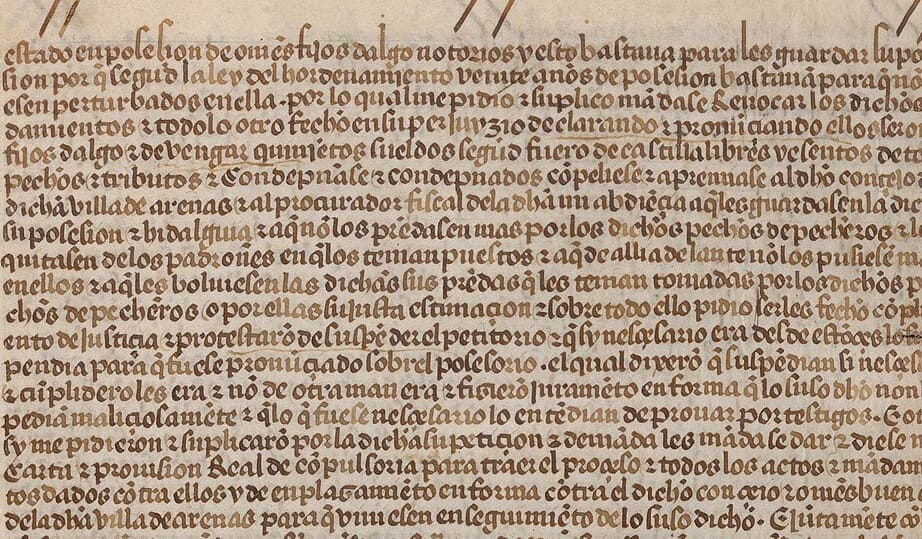
Boston Public Library, 1514 · Source · Public domain · Boston Public Library, via the Digital Public Library of America and Wikimedia Commons
Evidano Transcription
estado en posesion de om[e]s fijos dalgo notorios y esto bastaua para les guardar su po
sion por q[ue] segu[n]d la ley del hordenamiento veynte años de posesion bastaua para q[ue] no [cut off]
esen perturbados en ella . por lo qual me pidio z suplico ma[n]dase Reuocar los dichos [cut off]
damientos z todo lo otro fecho en su per juyzio declarando z pronu[n]çiando ellos ser [cut off]
fijos dalgo z de vengar quinie[n]tos sueldos segu[n]d fuero de castilla libres y esentos de to [cut off]
pechos z tributos z condepnase z condepnados co[m]peliese z apremiase al d[ic]ho conçejo d [cut off]
d[ic]ha villa de arenas z al procurador fiscal de la d[ic]ha mi abdie[n]çia a q[ue] les guardasen la dic [cut off]
su posesion z hidalguia z a q[ue] no los pre[n]dasen mas por los dichos pechos de pecheros z le [cut off]
quitasen de los padrones en q[ue] los tenian puestos z a q[ue] de alli adelante no los pusiese[n] m [cut off]
en ellos z a q[ue] les boluiesen las d[ic]has sus pre[n]das q[ue] les tenian tomadas por los dichos p [cut off]
chos de pecheros o por ellas su justa estimaçion z sobre todo ello pidio serles fecho co[m]pli [cut off]
ento de justiçia z protestaro[n] de suspe[n]der el petitorio z q[ue] sy nesçesario era desde esto[n]çes lo s [cut off]
pendia para q[ue] fuese pronu[n]çiado sobrel posesorio . el qual dixero[n] q[ue] suspe[n]dian si nesçes [cut off]
z cunplidero les era z no de otra manera z fiziero[n] jurame[n]to en forma q[ue] lo suso d[ic]ho non [cut off]
pedia[n] maliçiosame[n]te z q[ue] lo q[ue] fuese nesçesario lo ente[n]dian de prouar por testigos . E ot [cut off]
sy me pidiero[n] z suplicaro[n] por la d[ic]ha suspe[n]çion z dema[n]da les ma[n]dase dar z diese m [cut off]
carta z prouision Real de co[m]pulsoria para traer el proçeso z todos los actos z ma[n]dam [cut off]
tos dados co[n]tra ellos y de enplazamie[n]to en forma co[n]tra el dicho conçejo z omes buen [cut off]
dela d[ic]ha villa de arenas para q[ue] viniesen en seguimie[n]to de lo suso dicho . E justame[n]te co[n] [cut off]
Generated by Evidano’s advanced model; not yet checked against a published edition.
What cortesana looks like and where it was used
Cortesana is the writing Castilian officialdom settled into once the albalaes cursive had loosened. From the last quarter of the fourteenth century the letters grow rounder, ascenders and descenders curl into closed loops, and the pen leaves the page less and less; by the reign of the Catholic Monarchs almost every royal secretary, council scribe and notary in the peninsula wrote it. It served the whole apparatus of government — cédulas and provisiones on paper, privileges and cartas ejecutorias on parchment, capitulations, receipts, protocols of sale and dowry — and it went with the administration to Granada in 1492 and across the Atlantic soon afterwards. Around the middle of the sixteenth century the courts pushed it aside in favour of the faster, tighter procesal.
The script is small, wide and round. The b, l, h and d carry looped ascenders that lean forward over the letters that follow; g, y, q and long ſ drop loops that tangle with the line beneath; e is often a closed circle finished with a hairline, and the two forms of s alternate by position. Because the pen stays down, de, del, que, dicho and the endings of names fuse into single shapes that have to be divided by sense rather than by eye. The contraction system is inherited from the medieval hands but used harder: dho for dicho, mrs for maravedís, Vra Alteza and Sus Altezas, Rl for real, xpiano for cristiano, and superscript o and a closing ordinals and names.
Much of the page is not running text at all. A royal cédula opens with El Rey, or El Rey e la Reyna, on a line of its own, states its business in a paragraph or two and closes with Yo el Rey, a secretary’s Por mandado del rey and a flourished rúbrica. A provisión begins with the full string of royal titles; a chancery ejecutoria is a bound parchment book whose first leaf is illuminated and whose text then runs on for dozens of dense pages. Sums are Roman numerals with the U that marks thousands of maravedís, dates are given by the año del nascimiento, and the margins carry registration notes, chancellors’ marks, later archival numbers and, in famous documents, line numbers added by nineteenth-century editors.
Why ordinary OCR struggles here
Loops that belong to another line
Ascenders from the line below and descenders from the line above cross the writing, so any page carries three layers of strokes at once. Segmentation designed for print joins the wrong halves together and reports letters where only the tail of a neighbouring word passes through.
Words that never end
The pen runs unbroken through de la dicha, por quanto and que le sea, and the same phrases are contracted so hard that the boundaries have to be settled by grammar rather than by white space. Engines that trust spacing return strings that are neither Spanish nor obvious nonsense, and those are the slowest kind of error to repair.
Signatures, rúbricas and registration marks
Yo el Rey, the secretary’s clause, the chancellor’s mark and the notary’s rúbrica are drawn rather than written. Treated as text they generate invented words; ignored altogether, the transcription loses the very marks that make the document authentic.
Money and dates inside the prose
Maravedí sums run into the sentence as Roman numerals with the U of thousands and the sign for a cuento, and in a receipt or an account they are the part that matters. A rent, a price or a year can be wrong while the surrounding sentence still reads perfectly well.
Who works with this material
Archives holding chancery series
Simancas, the Real Chancillerías of Valladolid and Granada and the municipal archives keep kilometres of this writing. Reference staff need a text they can index by person, place and date so that a researcher’s request can be answered without opening every bundle.
Genealogists working on hidalguía suits
An ejecutoria names parents, grandparents, witnesses and neighbours, and repeats them over dozens of leaves. What matters is that every name and place is caught, spelled as the scribe spelled it, and tied to the folio where it appears.
Historians of the early Atlantic world
Capitulations, instructions, licences and the letters that went with them survive as chancery copies in this hand. Reading them beside the printed editions of the nineteenth century shows where an editor normalised, guessed or silently mended a passage.
Economic historians in notarial protocols
Sales, dowries, rents and apprenticeships are recorded in bound registers of receipts and contracts. A usable transcription has to keep the sums exactly, including the U of thousands, because the figures are the data and the formulae around them are not.
Getting the best transcription
Name the document type before the page
Say whether you are sending a cédula, a provisión, an ejecutoria or a notarial instrument. The opening and closing formulae differ, and a model told what to expect will label the intitulatio, the dispositive clause and the subscription instead of running them together.
Ask for signatures and margins as their own blocks
Request the body of the text, then the signature clause, the secretary’s line, the rúbricas and every marginal note separately, each with its position. That keeps the drawn marks out of the prose and preserves the registration notes that date the document’s passage through the chancery.
Fix the contraction and numeral policy
Decide whether dho, mrs and Vra Alteza are to be expanded, and ask for maravedí sums to be given exactly as written, with a converted figure alongside rather than instead. Numbers are where a silent normalisation does the most damage.
Test on a page with a sum and a signature
Pick the least tidy leaf you have, one that carries a total and a subscription, and check it fully before running a whole book. If the loops, the figure and the rúbrica come back correctly there, a long ejecutoria will hold up.
Further reading on this hand
The palaeography guides the in-app selector points to for this domain, if you want to check a transcription against the standard references.
- Spanish Handwriting History
This Brigham Young University guide identifies Cortesana as a major Spanish secretary hand used during the fifteenth and sixteenth centuries. It situates the script alongside Procesal and explains their relationship to administrative and court writing. The site's alphabet resources support comparison of connected lowercase forms, capitals, abbreviations, and individual variation. It is directly useful for recognizing the rounded and looped forms of Castilian chancery documents.
Frequently asked questions
- How is cortesana different from procesal?
- Cortesana is rounder and still legible word by word, with looped ascenders and moderate joining. Procesal, which grows out of it after about 1500, compresses the letters, lengthens the joins and can run whole lines together; the extreme form, procesal encadenada, is treated on its own page here.
- Can the royal signature and its rúbrica be separated from the text?
- Yes. Yo el Rey, Yo la Reyna, the secretary’s Por mandado clause and the flourish itself are returned as a labelled block at the end, with the flourish described rather than transcribed, so the body of the document is not polluted by invented words.
- What happens to words that are joined together?
- They are divided as an editor would divide them, using the formulae of the document type, and the transcription notes where the division is a judgement rather than something the scribe marked. You can also ask for the text exactly as written, without spaces added.
- Are maravedí sums converted into modern figures?
- Only if you ask. The default keeps the Roman numerals and the U of thousands as they stand, since that is what a diplomatic edition needs; a converted figure can be supplied beside each sum for checking against an account book.
- Can a whole bound ejecutoria be transcribed consistently?
- Yes, and consistency is the point: the same expansion rules, the same treatment of names and the same folio references across every leaf. Run the first few leaves, settle the conventions on them, and apply the same instructions to the rest of the volume.
Related scripts and pages
Transcribe your cortesana chancery documents
Upload a cédula, an ejecutoria or a notarial register, choose Cortesana Court and Chancery Documents, and settle the conventions on one leaf before the volume follows.