
Italian · c. 1200–1400
Turn Trecento book hands into searchable text
Italian rotunda looks tidy from a distance and then fuses its letters: the bows of b, d, o and p bite into each other, r becomes a 2-shaped hook after any round letter, and one stroke over a word can stand for m, n or a whole syllable. Evidano transcribes the folio verse by verse, expands or preserves the abbreviations as you instruct, and keeps rubrics, paraphs and later glosses apart from the poem.
Sample pages
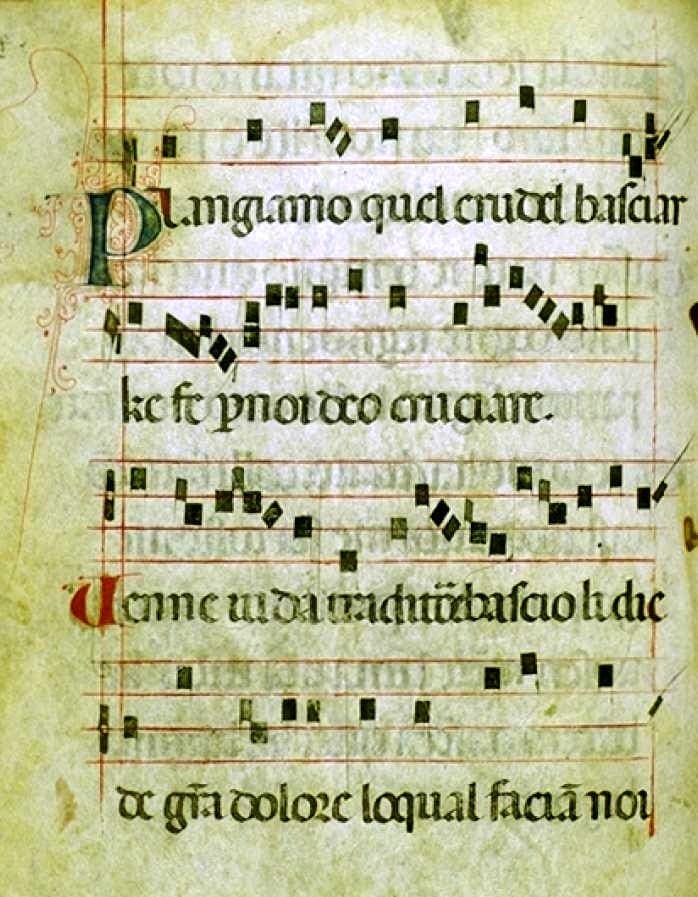
Biblioteca del Comune e dell’Accademia Etrusca, Cortona, MS 91, f. 46v, late 13th century · Source · Public domain
Evidano Transcription
Plangiamo quel crudel baſciar
ke ſe p[er] noi deo cruciare.
Venne iuda tradit[or]e baſcio li[?] die
de gra[n] dolore loqual facia[m] noi
Generated by Evidano’s advanced model; not yet checked against a published edition.
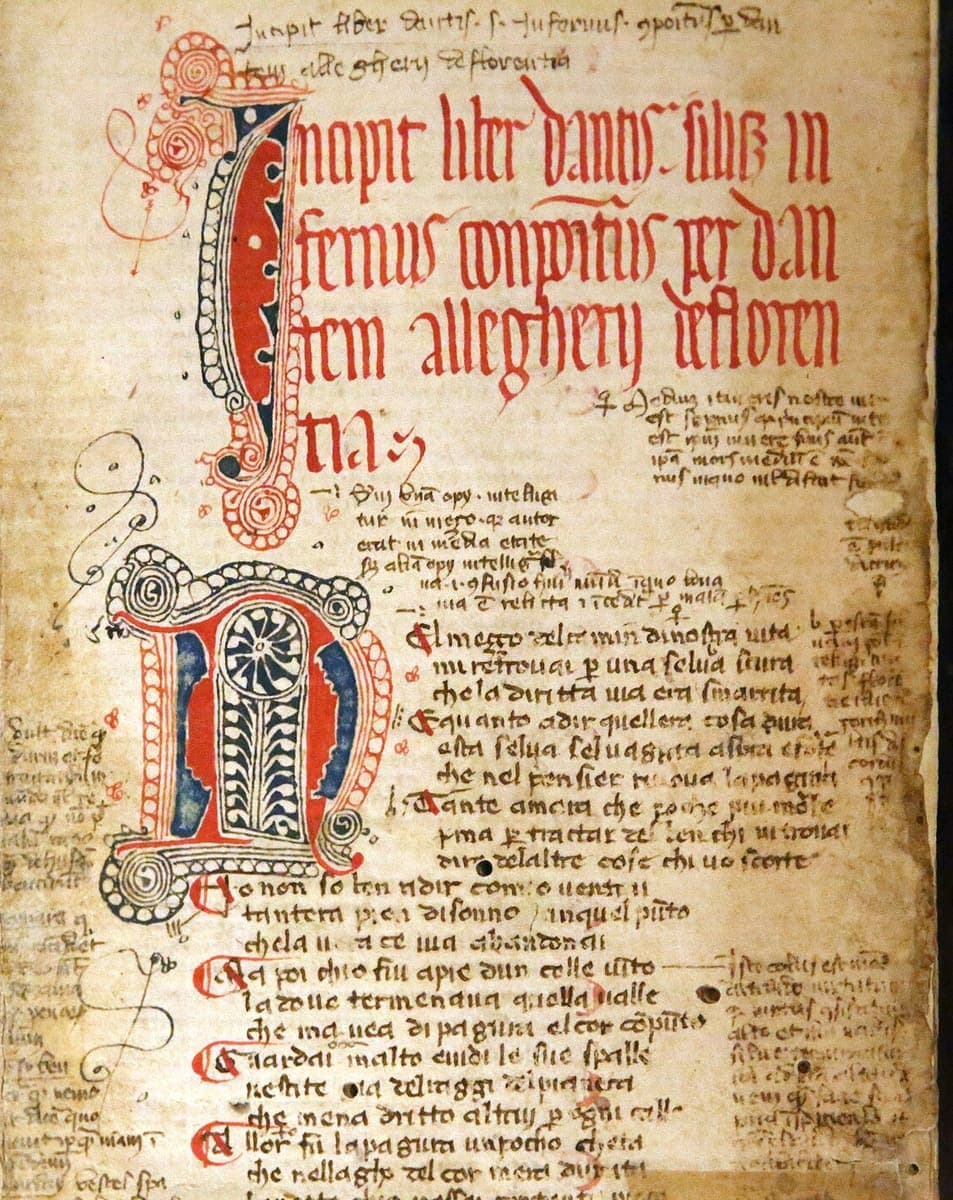
Biblioteca Medicea Laurenziana, Florence, Plut. 40.22, 23 February 1355 · Source · CC BY-SA 4.0 · Photograph: Francesco Bini (Sailko), Wiki Loves Monuments Italia
Evidano Transcription
Inferno I, verses 1–21, the poem text visible below the initial; the text of the Società Dantesca Italiana edition (1921) as reproduced on Wikisource, a normalised edition with modern punctuation and apostrophes. The red Latin incipit, the interlinear notes and the marginal glosses are not part of the edited text.
Nel mezzo del cammin di nostra vita
mi ritrovai per una selva oscura,
ché la diritta via era smarrita.
Ahi quanto a dir qual era è cosa dura
esta selva selvaggia e aspra e forte
che nel pensier rinova la paura!
Tant’è amara che poco è più morte;
ma per trattar del ben ch’i’ vi trovai,
dirò de l’altre cose ch’i’ v’ ho scorte.
Io non so ben ridir com’i’ v’intrai,
tant’era pien di sonno a quel punto
che la verace via abbandonai.
Ma poi ch’i’ fui al piè d’un colle giunto,
là dove terminava quella valle
che m’avea di paura il cor compunto,
guardai in alto e vidi le sue spalle
vestite già de’ raggi del pianeta
che mena dritto altrui per ogne calle.
Allor fu la paura un poco queta,
che nel lago del cor m’era durata
la notte ch’i’ passai con tanta pieta.
Source: Dante Alighieri, Divina Commedia, Inferno, Canto I (Società Dantesca Italiana text, 1921), via Wikisource (Public domain).
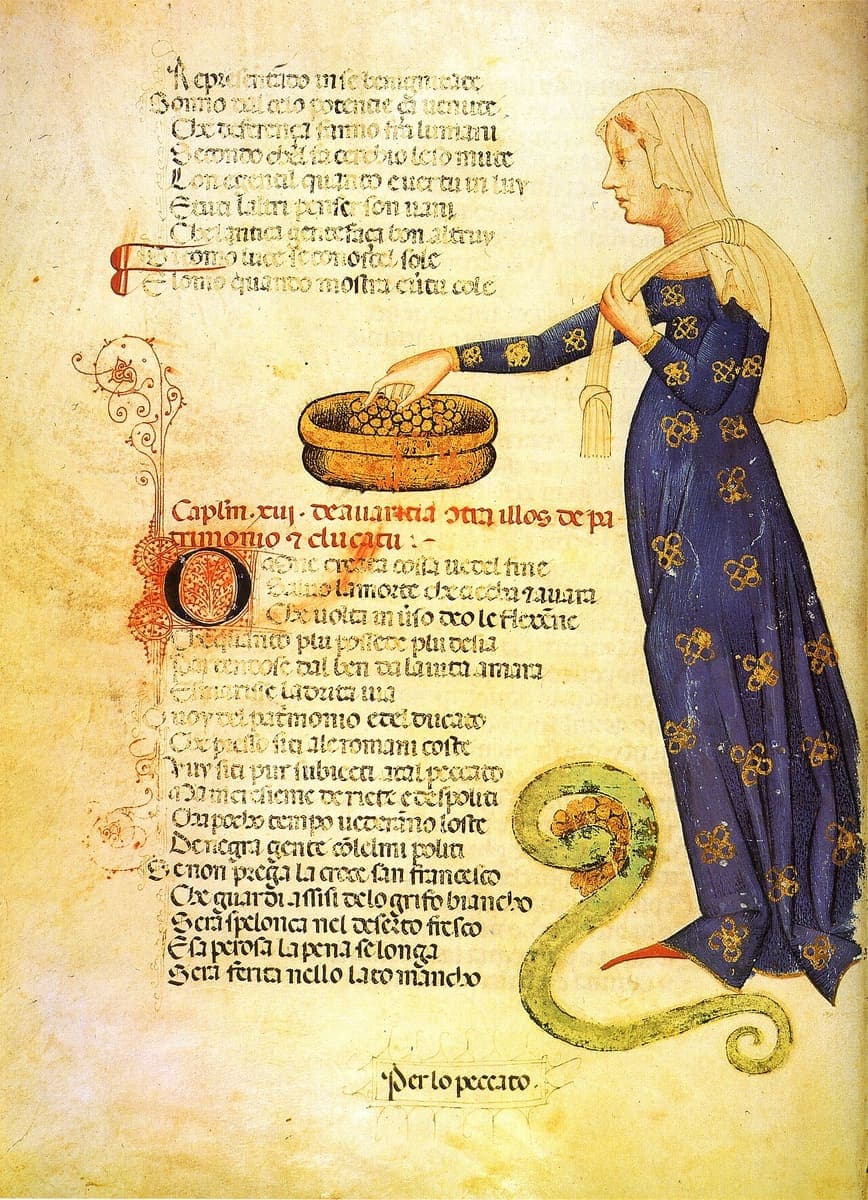
Biblioteca Medicea Laurenziana, Florence, Plut. 40.52, f. 24v, 14th century · Source · Public domain
Evidano Transcription
All twenty-seven verses on the folio, from the close of the chapter on nobility to the first nine tercets of the chapter against avarice, in Pasquale Rosario’s edition (Lanciano, 1916), which marks this very folio as “L. c. 24 t.” and the catchword as the start of f. 25. A normalised text with modern punctuation; the edition numbers the chapter XIII where the manuscript rubric reads Cap. XIIII. OCR errors in the Internet Archive text (l’ read as 1’, como read as corno) were corrected against the page image.
Representando in sé benignitate,
Sonno dal celo potenzie già venute
Che defferenza fanno fra l’umani,
Secondo che ’l fa cerchio le so mute.
L’om è gentil, quando è vertù in lui,
E tutti l’altri penser son vani,
Che l’antica gente faccia bono altrui.
Sì como a luce se conosce ’l sole,
E l’omo quando mostra e vertù cole.
CAPITOLO XIII
Onne creata cosa vede ’l fine
Salvo la mente ch’è ceca e avara,
Che volta in verso Deo le flexe rine,
Che quanto più possedè più desia,
Partendose dal ben de la vita amara,
E sì smarrisce la dritta via.
O voi del Patrimonio e del Ducato,
Che presso siti a le romane coste,
Vui siti pur subiecti a tal peccato.
Ma incresieme de Riete e de Spoliti
Ch’a poco tempo vederanno l’oste
De negra gente con l’elmi politi.
Se non prega la croce san Francesco,
Che guardi Assisi de lo grifo bianco,
Sera spelonca nel deserto fresco;
E s’a Perugia la pena se allonga,
Sera ferita ne lo lato manco,
Source: Cecco d’Ascoli, L’Acerba, ed. Pasquale Rosario (Lanciano: Carabba, 1916), pp. 70–71, via Internet Archive (Public domain).
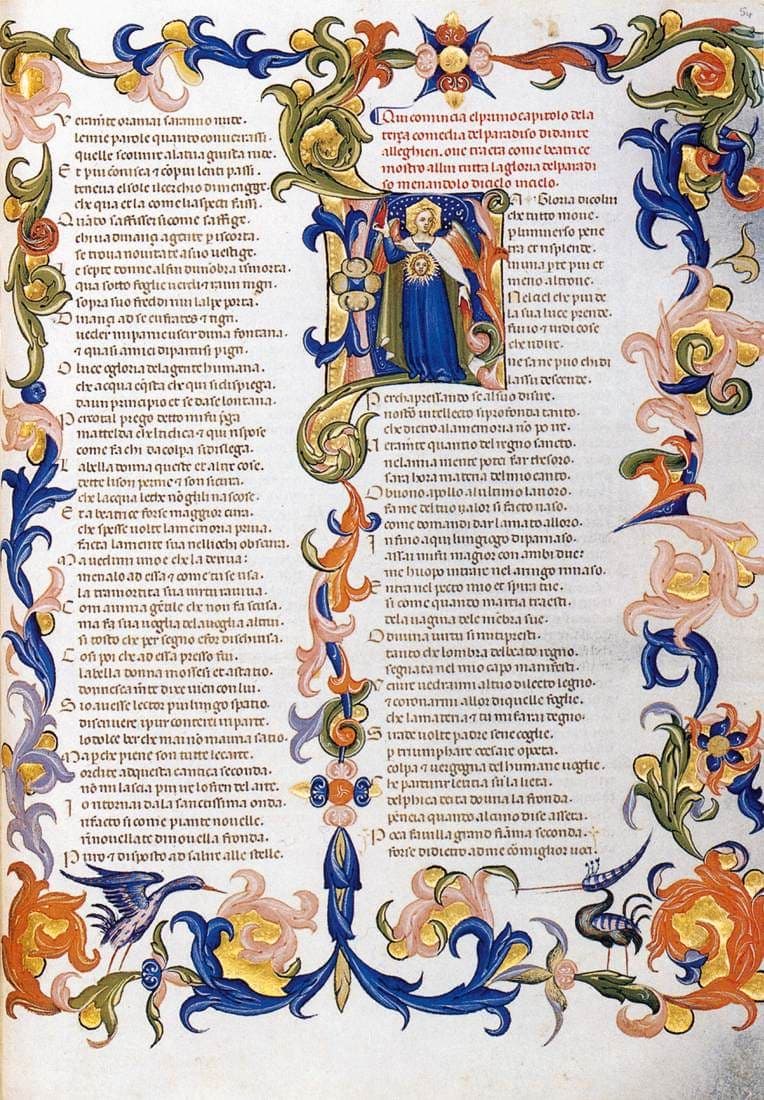
Beinecke Rare Book and Manuscript Library, Yale University, f. 54r, 1386–1388 · Source · Public domain
Evidano Transcription
The right-hand column: Paradiso I, verses 1–35, from beside the miniature down to the foot of the column, in the Società Dantesca Italiana text (1921) via Wikisource, with modern punctuation. The Italian rubric above and the left-hand column (the last forty verses of Purgatorio XXXIII) are not included.
La gloria di colui che tutto move
per l’universo penetra, e risplende
in una parte più e meno altrove.
Nel ciel che più de la sua luce prende
fu’ io, e vidi cose che ridire
né sa né può chi di là sù discende;
perché appressando sé al suo disire,
nostro intelletto si profonda tanto,
che dietro la memoria non può ire.
Veramente quant’io del regno santo
ne la mia mente potei far tesoro,
sarà ora materia del mio canto.
O buono Appollo, a l’ultimo lavoro
fammi del tuo valor sì fatto vaso,
come dimandi a dar l’amato alloro.
Infino a qui l’un giogo di Parnaso
assai mi fu; ma or con amendue
m’è uopo intrar ne l’aringo rimaso.
Entra nel petto mio, e spira tue
sì come quando Marsïa traesti
de la vagina de le membra sue.
O divina virtù, se mi ti presti
tanto che l’ombra del beato regno
segnata nel mio capo io manifesti,
vedra’ mi al piè del tuo diletto legno
venire, e coronarmi de le foglie
che la materia e tu mi farai degno.
Sì rade volte, padre, se ne coglie
per trïunfare o cesare o poeta,
colpa e vergogna de l’umane voglie,
che parturir letizia in su la lieta
delfica deïtà dovria la fronda
peneia, quando alcun di sé asseta.
Poca favilla gran fiamma seconda:
forse di retro a me con miglior voci
Source: Dante Alighieri, Divina Commedia, Paradiso, Canto I (Società Dantesca Italiana text, 1921), via Wikisource (Public domain).
What a vernacular textualis page looks like
Italian scribes of the thirteenth and fourteenth centuries wrote the vernacular in the same littera textualis they used for Latin, but in its southern form, the rotunda: rounder and broader than the fractured textualis of Paris or Oxford, with short ascenders, little lateral compression and hardly any of the northern hairline feet. It carried lyric anthologies, the laude sung by confraternities, translations of Latin classics, chronicles and above all the Commedia, which Florentine workshops such as that of Francesco di ser Nardo da Barberino copied by the dozen in the 1330s and 1340s. Grades run from the large, heavily rubricated textualis of illuminated Commedia codices to the smaller, quicker textualis of study copies, and by the second half of the century to the rounded semi-gothic in which Boccaccio and Petrarch wrote out their own works.
The letterforms to learn are the two-compartment a, uncial d with a sloping ascender beside straight d (often both in one line), long ſ inside words with round s at the end, the r rotunda after o, b, p and every other bowed letter, and the fusion of facing curves so that do, po and be read as a single shape. The vernacular adds spellings a Latin-trained eye does not expect: ç or z for the affricates, k or ch for hard c, gh before front vowels, x in northern texts, and i and j interchangeable, with j regular at the end of a run of minims and of Roman numerals. Abbreviation is borrowed wholesale from Latin: a bar over a vowel drops a following m or n, p with a crossed descender is per or par, p with a bar is pre, q with a bar is que, the 9-shaped sign is con, the tironian ⁊, often crossed, serves for e and et, and superscript vowels stand for whole syllables, so the same word can appear in three lengths on one page.
Verse is laid out one line per verse, usually in two columns, with the first letter of each line pushed out into its own thin column and touched with yellow or red. Tercets are marked with alternating red and blue paraphs, and each canto opens with a rubric in red, frequently in Latin even when the poem is Italian, and a decorated initial that may swallow the first word or two. Laudari set the text beneath four-line red staves with square notation and write the refrain only once. Commentaries and glosses were added around the poem in a smaller cursive by the same or later hands, and their reference marks and sigla intrude between the lines.
Why ordinary OCR struggles here
Minims, bites and the r rotunda
Runs of i, m, n and u dissolve into equal strokes, so in una and inuia look alike until the sense is weighed. Fused bows hide the boundary between two letters, and the 2-shaped r after o or p is read by print-trained OCR as a z or a numeral. Long ſ and f differ only by the crossbar, which is faint in a worn rotunda.
A Latin abbreviation system applied to Italian
The crossed p, the barred q and the 9-shaped con were designed for Latin endings, and a scribe copying Italian reused them with local values: ch with a bar is che, the tironian sign is e rather than et, and a superscript a after q may be qua or quan. Expanding by Latin habit produces words that break the metre, and the choice must be recorded so an editor can reverse it.
Spelling that has not settled
Trecento Italian has no orthography. The same scribe writes ç, z and zz for one sound, doubles consonants at will, splits ne la and de la or fuses them, and attaches clitics to the preceding verb. A transcription that silently modernises these forms destroys exactly the evidence historical linguists and dialectologists want from the manuscript.
Rubrics, initials, paraphs and glosses
A decorated initial may carry the first letters of the canto; the rubric above it switches into Latin; paraphs, verse-initials and catchwords sit outside the text block; and marginal commentary in a different hand wraps round three sides. Generic OCR reads all of this as one stream and produces a text no editor can use.
Who works with this material
Dante and Trecento philologists
Collating the hundreds of surviving Commedia manuscripts, or the witnesses of a lyric anthology, starts with a faithful line-by-line transcript of each one. A diplomatic first pass that keeps the scribe’s spellings and marks expansions gives an editor something to check against the folio and feed into a collation tool.
Historical linguists and corpus builders
Projects that document early Italian by date and region depend on manuscript forms, not on the normalised readings of critical editions. Consistent handling of ç, k, gh, doubled consonants and word division across a whole codex makes the transcription usable as linguistic evidence.
Musicologists working on laude and early polyphony
Editing a laudario means recovering the text written beneath the staves, syllable by syllable, together with refrain cues and the stanza structure the scribe left implicit. A transcription that respects the text lines under each staff can be aligned to the notation afterwards.
Cataloguers and teachers of Italian palaeography
Describing a codex requires its rubrics, incipits and explicits read accurately, and students learning rotunda need a transcript they can hide and compare with the page. Both benefit from output that separates rubric, text and gloss.
Getting the best transcription
Fix the glyph and expansion policy first
Say whether ſ should be kept or printed as s, whether ç and k stay as written, whether the tironian sign becomes ⁊, e or et, and whether abbreviations are expanded silently, in brackets or not at all. For an edition choose brackets, so every expansion remains visible in the transcript.
Describe the page architecture
Tell the model that the folio has two columns of verse, that the first letter of each line stands in a separate column, and that paraphs, rubrics and glosses should be labelled rather than merged. Ask for one verse per line and for column breaks to be marked.
Test on the busiest folio
Run a page with a historiated initial, a rubric and marginal commentary before the plain ones. If the initial’s letters are restored to the first verse and the gloss is kept apart there, the unadorned folios will need little correction.
Compare with an edition, not against it
Modern editions of the Commedia or the Acerba are normalised and punctuated; where the transcript differs in spelling or word division that is usually the manuscript speaking, not an error. Check disagreements against the image before changing either.
Further reading on this hand
The palaeography guides the in-app selector points to for this domain, if you want to check a transcription against the standard references.
- Italian Paleography: Handbook
This Newberry Library handbook introduces scripts used in Italian vernacular manuscripts and documents. Its discussion of littera textualis describes angularity, fractured strokes, lateral compression, spacing, abbreviation, columns, initials, and paragraph marks. The handbook places graphical features within the social and documentary settings in which each script was used. It is directly useful for formal thirteenth- and fourteenth-century Italian books written in Gothic Textualis.
Frequently asked questions
- Will the transcription keep ç, k, ch and gh as the scribe wrote them?
- Yes. The default is a diplomatic transcription that preserves the manuscript spelling, including ç, k, doubled consonants and the scribe’s word division. If you want a reading text for searching, ask for normalisation to modern Italian and it is applied consistently across the codex, with the original forms available on request.
- How are the tironian sign and the crossed p handled in Italian text?
- They are recognised as abbreviations, not as a 7 or a p with a stray stroke. You decide whether the tironian sign is printed as ⁊, e or et and whether per, par and pre are expanded silently or in brackets; the same rule is then used on every page so the apparatus can be built from the transcript.
- Can it follow two-column verse with a separate column of initials?
- It transcribes column by column, one verse per line, and rejoins each initial to its verse even where the letter was written by the rubricator in a different colour. Paraphs marking tercets can be kept as ¶ or dropped, and column and folio breaks are recorded.
- What happens to marginal commentary and later hands?
- Text outside the ruled block is transcribed separately and labelled by position, so the Latin or Italian gloss on a Commedia folio does not leak into the poem. Interlinear notes and modern pencil foliation are flagged in the same way.
- Does it read the words under musical notation in a laudario?
- Yes. The text lines beneath the staves are transcribed in order and the notation is ignored, which is what an editor of the laude needs; syllable spacing that the scribe stretched to fit the melody is closed up, and refrain cues are kept.
- Will it work on the semi-gothic of Boccaccio’s and Petrarch’s autographs?
- The rounded semi-gothic they used shares its letterforms and abbreviations with textualis and is handled by the same prompt. Choose this domain for the fourteenth century; for humanistic hands of the 1400s use the Humanistic Minuscule and Cursive domain instead.
Related scripts and pages
Transcribe your Trecento folios
Upload a scan, choose Italian Vernacular Gothic Textualis as the domain, and run a rubricated page first to settle the expansion rules.