
Korean
Korean scans, letters and signs turned into text
A hangul syllable is not one shape but a block assembled from two, three or four jamo, and a quick hand runs those parts together until the block loses its square outline. Evidano reads modern Korean print, handwritten letters, signage and older vertical pages that mix hangul with hanja, and puts the transcription beside the image so every block can be checked.
Sample pages
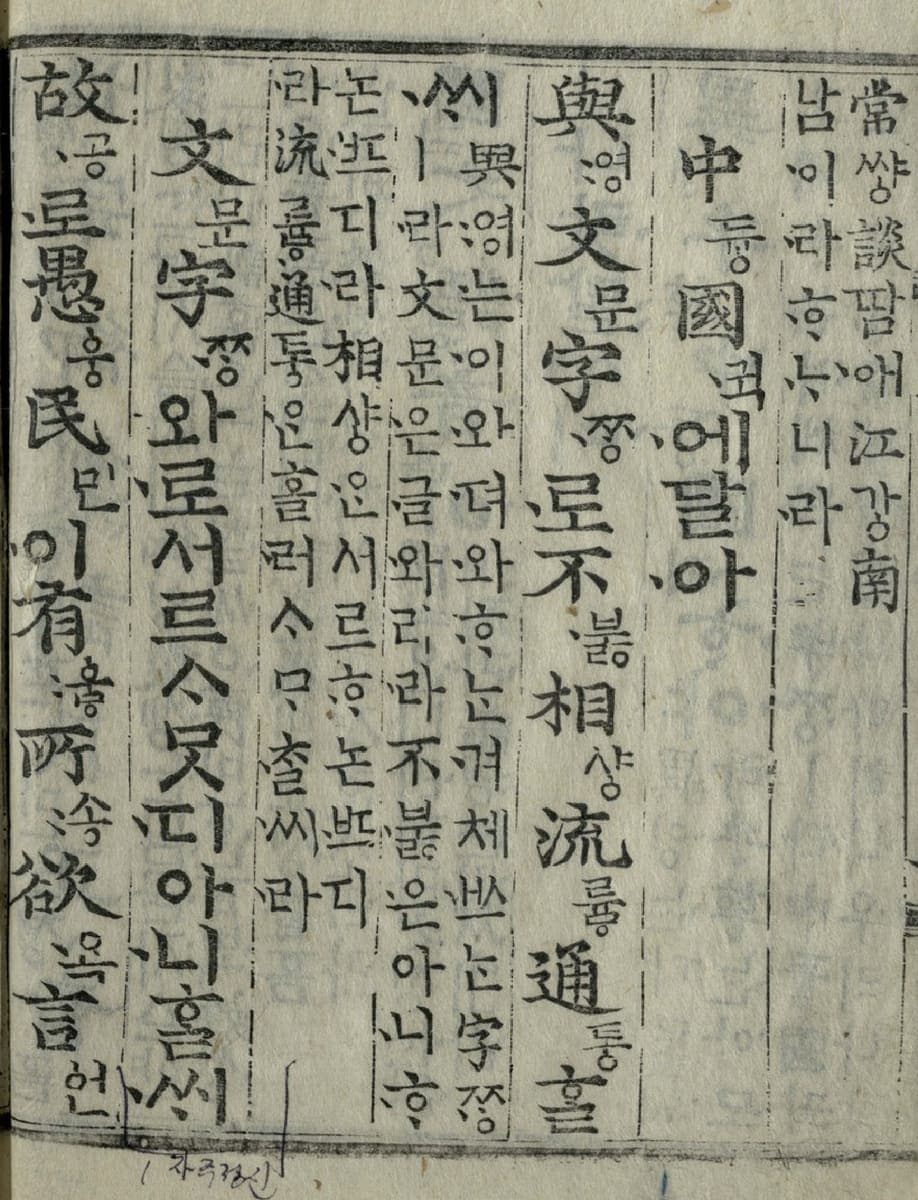
National Hangeul Museum digital archive, 1568 reprint of the 1459 text · Source · Public domain
Evidano Transcription
The passage carried in the columns of this detail, as proofread on Korean Wikisource from a facsimile of the same Eonhae text. The crop cuts through the columns at its right edge, where the passage begins, so the text is given from the start of that sentence rather than from the edge of the image. Wiki markup has been removed: the small hangul reading printed beside each hanja follows it directly, the annotation columns run on after the sentence they gloss, and the pitch dots 〮 and 〯 are kept where the source records them.
常쌰ᇰ談땀애〮江가ᇰ南남이〮라〮ᄒᆞ〮ᄂᆞ〮니라〮
中듀ᇰ國귁〮에〮달아〮
與영〯文문字ᄍᆞᆼ〮로〮不부ᇙ〮相샤ᇰ流류ᇢ通토ᇰᄒᆞᆯᄊᆡ〮 與영〯는〮이〮와〮뎌〮와〮ᄒᆞ〮ᄂᆞᆫ겨〮체ᄡᅳ〮ᄂᆞᆫ字ᄍᆞᆼ〮ㅣ라〮文문은〮글〮와〮리라〮不부ᇙ〮은〮아니〮ᄒᆞ〮논ᄠᅳ〮디라〮相샤ᇰᄋᆞᆫ〮서르ᄒᆞ〮논ᄠᅳ〮디라〮流류ᇢ通토ᇰᄋᆞᆫ〮흘러〮ᄉᆞᄆᆞᄎᆞᆯ〮씨〮라〮
文문字ᄍᆞᆼ〮와〮로〮서르ᄉᆞᄆᆞᆺ디〮아니〮ᄒᆞᆯᄊᆡ〮
故공〮로〮愚ᅌᅮᆼ民민이〮有ᅌᅮᇢ〯所송〯欲욕〮言ᅌᅥᆫ
Source: 훈민정음언해, proofread page 4 of the facsimile 훈민정음·석보상절·월인천강지곡, via Korean Wikisource (Public domain).
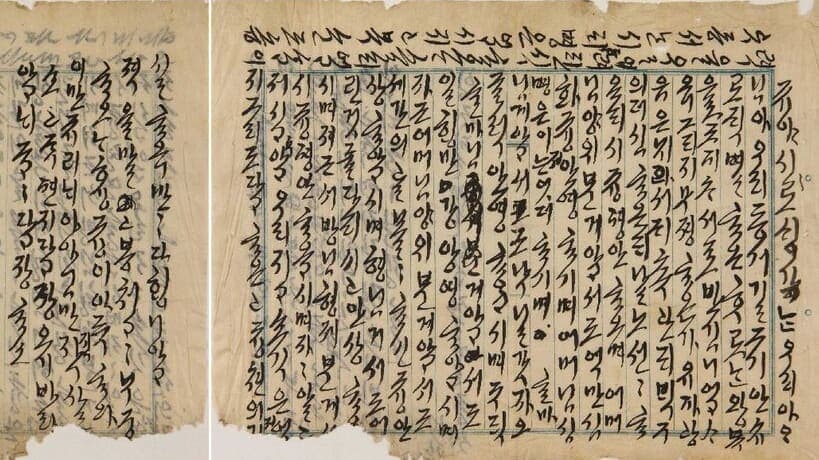
National Library of Korea (digital collection); original held by the Nampyeong Mun family, Boseong, undated; cycle year imja, eighth month · Source · Public domain
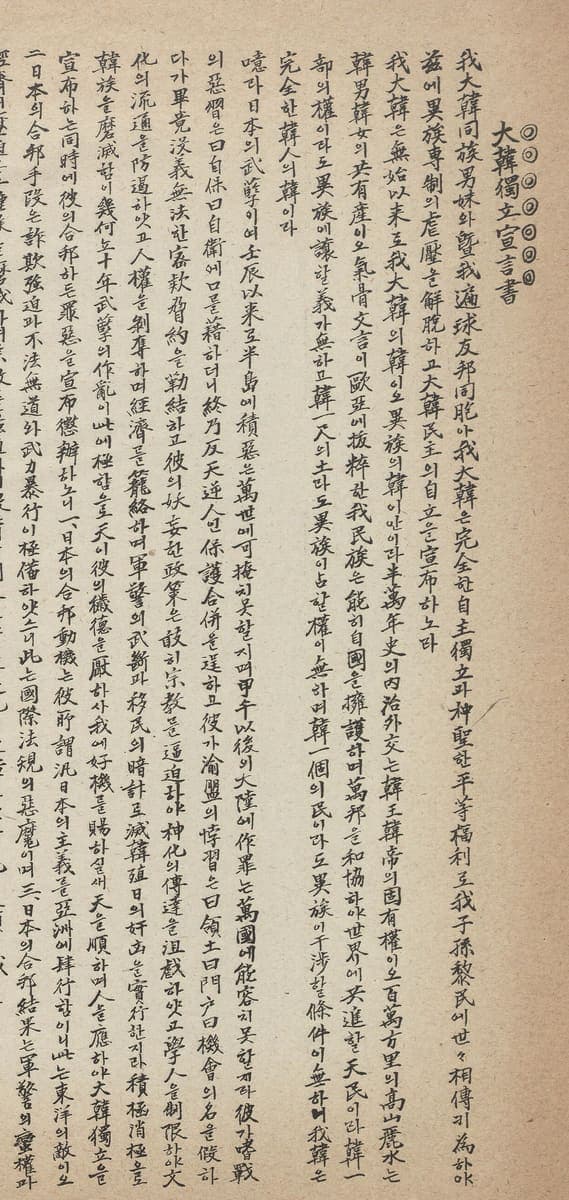
Source · Public domain · Cho So-ang (1887–1958)
Evidano Transcription
The heading and the first two paragraphs, which occupy the columns shown in this crop. Korean Wikisource proofreads this very file; the text keeps the sheet’s mixed script, its lack of word spacing and the repeat mark 々, and adds no punctuation of its own.
大韓獨立宣言書
我大韓同族男妹와曁我遍球友邦同胞아我大韓은完全한自主獨立과神聖한平等福利로我子孫黎民에世々相傳키爲하야玆에異族專制의虐壓을解脫하고大韓民主의自立을宣布하노라
我大韓은無始以來로我大韓의韓이오異族의韓이아니라半萬年史와內治外交는韓王韓帝의固有權이오百萬方里의高山麗水는韓男韓女의共有産이오氣骨文言이歐亞에拔粹한我民族은能히自國을擁護하며萬邦을和協하야世界에共進할天民이라韓一部의權이라도異族에讓할義가無하고韓一尺의土라도異族이占할權이無하며韓一個의民이라도異族이干涉할條件이無하니我韓은完全한韓人의韓이라
Source: 대한독립선언서, proofread page for this image, via Korean Wikisource (Public domain).
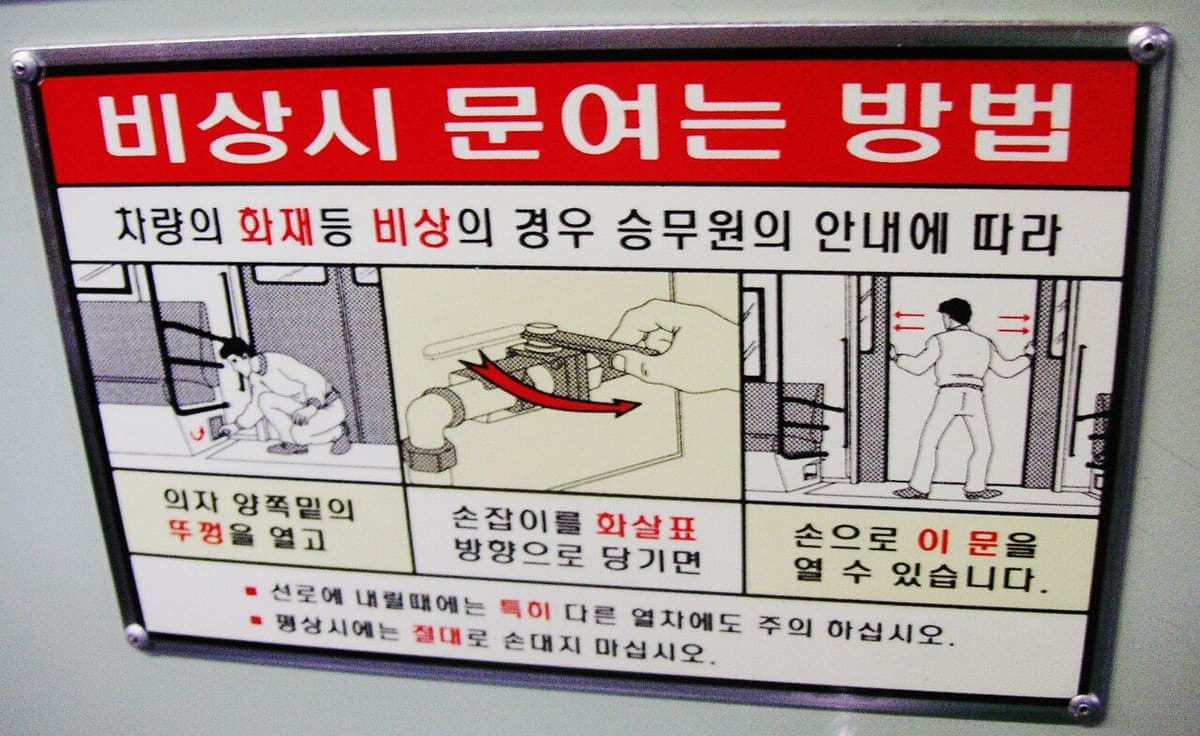
Source · CC BY-SA 3.0 · Nesnad
Evidano Transcription
비상시 문여는 방법
차량의 화재등 비상의 경우 승무원의 안내에 따라
의자 양쪽밑의 손잡이를 화살표 손으로 이 문을
뚜껑을 열고 방향으로 당기면 열 수 있습니다.
■ 선로에 내릴때에는 특히 다른 열차에도 주의 하십시오.
■ 평상시에는 절대로 손대지 마십시오.
Generated by Evidano’s advanced model; not yet checked against a published edition.
What Korean text looks like on the page
Hangul was promulgated in 1446 and works by composition: twenty-four basic letters are stacked into a square syllable block, with the vowel written to the right of the initial consonant or underneath it, and a final consonant — the batchim, sometimes a cluster of two — squeezed along the bottom. Unicode allows 11,172 of these blocks, of which a few hundred carry most modern text and the rest turn up in names, dialect, onomatopoeia and old spellings. Alongside hangul, Chinese characters (hanja) remained normal in serious prose until the late twentieth century and still appear in personal names, legal wording, newspaper headlines and dictionary entries.
Direction changed as well as script. Books, letters and newspapers were written in vertical columns read from the right until well into the twentieth century; modern Korean runs horizontally from the left, and a single archive box may hold both. Fifteenth- and sixteenth-century printing adds its own furniture: a small hangul reading printed beside each hanja in eonhae translations, side dots (방점) marking pitch, and letters that have since fallen out of use — the dot vowel ㆍ, ᅀ, ᅌ and ㆆ. Word spacing is a late arrival, introduced by the all-hangul Tongnip sinmun in 1896 and only settled by the Korean Language Society’s 1933 spelling proposals, so older text arrives as an unbroken column of blocks.
Everyday material is no simpler. Handwriting ranges from the upright court hand of a formal letter to a fast 흘림 cursive in which one block flows into the next and a writer who has run out of paper turns the sheet and writes up the margin. Forms and certificates carry red seal impressions stamped across the wording, tables with ruled cells, and numbers written as Arabic digits in some places and hanja numerals in others. Signs and packaging mix hangul with English, romanised names and stylised display faces, often photographed at an angle.
Why ordinary OCR struggles here
A character that has to be assembled first
Recognition has to work out where one syllable block ends and the next begins, then read the jamo inside it in the right order. Small differences decide the reading: ㅁ, ㅇ and ㅎ share a round or boxy body, ㅐ and ㅔ differ by one short stroke, ㅗ and ㅜ are the same shape turned over, and a doubled ㄲ or ㅆ can look like a single letter in a soft scan. A dropped batchim silently changes the word rather than producing a visible error.
Cursive that joins the parts together
In a handwritten letter the strokes of a block are written without lifting the brush or pen, ㄹ collapses into a loop, and the join often continues into the block below, so the column reads as one continuous line. Nineteenth-century vernacular letters add lines written up the margins and across the top of the sheet, which have to be placed in the right order rather than read as they fall on the page.
Hanja mixed into Korean sentences
In mixed-script writing the content words are Chinese characters and only the particles and verb endings are hangul, so a single line asks for two recognition problems at once, across a character inventory of several thousand shapes with variant and abbreviated forms. Older printing may also gloss each character with its hangul reading in small type beside it, which is easily merged into the main line.
Layout that a Korean reader takes for granted
Vertical columns run right to left, headers and captions may run horizontally on the same page, seals and stamps sit on top of the text, and forms put short answers in ruled boxes. Generic OCR reads such a page in raster order and returns a jumble in which a stamped date, a marginal note and the body text are interleaved.
Who works with this material
Family papers and local-history archives
Household registers, land deeds, clan genealogies and bundles of vernacular letters are the everyday stock of Korean local history. What such projects need first is a readable text with names, dates and place names in the form the document uses, so that a run of documents can be indexed before anyone decides which are worth a full edition.
Modern-history and periodical research
Newspapers, magazines and institutional records from the 1890s to the 1960s are printed in mixed script and set in columns. Researchers working through them want the hanja kept as printed, since replacing a character with its hangul reading loses the distinction between homophones that the writer relied on.
Offices handling scanned Korean paperwork
Contracts, certificates, invoices and application forms arrive as phone photographs with a seal stamped across the signature block. The useful output is the text with the table structure kept, so that a field and its value stay together instead of being flattened into one paragraph.
Libraries, museums and teaching
Catalogue records, exhibition labels and classroom sheets all start from an accurate reading of an object. A transcription set beside the image lets a curator check a shelfmark, or a student compare a printed block with the same syllable in a cursive hand.
Getting the best transcription
Set the script policy before you start
Say whether hanja should stay as written, be followed by the hangul reading in brackets, or be replaced by it, and whether obsolete letters such as the dot vowel ㆍ should be preserved. Fixing this once keeps a hundred pages consistent, and a mixed-script corpus stays searchable in the form its editors expect.
Describe the direction and the furniture
Tell the model that the page runs in vertical columns from the right, where the glosses or ruby readings sit, and what to do with lines written up the margin of a letter. Ask for headers, seals and marginal additions to be labelled separately rather than folded into the body text.
Leave the spelling alone
Ask explicitly for the spacing and spelling on the page, not modern orthography: pre-1933 forms, missing word spaces and dialect spellings are evidence. If you also want a modernised version, request it as a second block so the two can be compared.
Start with the page you dread
Run a fast cursive letter or a stamped form before the clean printed material. If the hardest item comes back with the columns in order and the stamped text separated, the rest of the batch will need only spot checks.
Frequently asked questions
- Can it read Korean that runs in vertical columns from the right?
- Yes. Column order is treated as part of the reading task, so a page of vertical text comes back in the order a reader would follow it, and horizontal headings or captions on the same page are kept apart from the columns.
- Are hanja kept, or converted to hangul?
- That is your choice. The default keeps every character as it stands on the page, which is what an edition of a mixed-script text needs. Ask for the hangul reading in brackets after each character, or for a fully hangul version, and the same rule is applied throughout.
- How well does it cope with handwritten hangul?
- Handwriting is read as a hand rather than as a font: joined blocks, looped ㄹ and the compressed final consonants of a fast letter are recognised as the syllables they stand for. Passages that are genuinely ambiguous are marked instead of being guessed.
- What happens to old spellings and letters such as ㆍ or the side dots?
- They can be preserved. The dot vowel, ᅀ, ᅌ and the pitch dots of fifteenth- and sixteenth-century printing are transcribed where they appear, and you can ask for them to be recorded but not normalised, so that later comparison with a modernised text stays possible.
- Will a sign or form with English mixed in be handled?
- Yes. Korean, romanised names and English on the same plate are transcribed in place, and the reading order of a sign — heading, instruction, captions, footnotes — is kept rather than being read line by line across unrelated blocks.
Related scripts and pages
Transcribe your Korean documents
Upload a scan or a photograph — a letter, a form, a printed page or a sign — and check the Korean transcription line by line before you export it.