
Vietnamese
Vietnamese text with every mark in the right place
A single Vietnamese letter can carry two marks at once — one that changes the vowel and one that carries the tone — and ế, ệ and ự are three different letters, not decorated versions of one. Evidano transcribes photographs of Vietnamese handwriting, print, signage and older chữ Nôm pages with the marks kept as written, so you are not left guessing which word the page actually says.
Sample pages
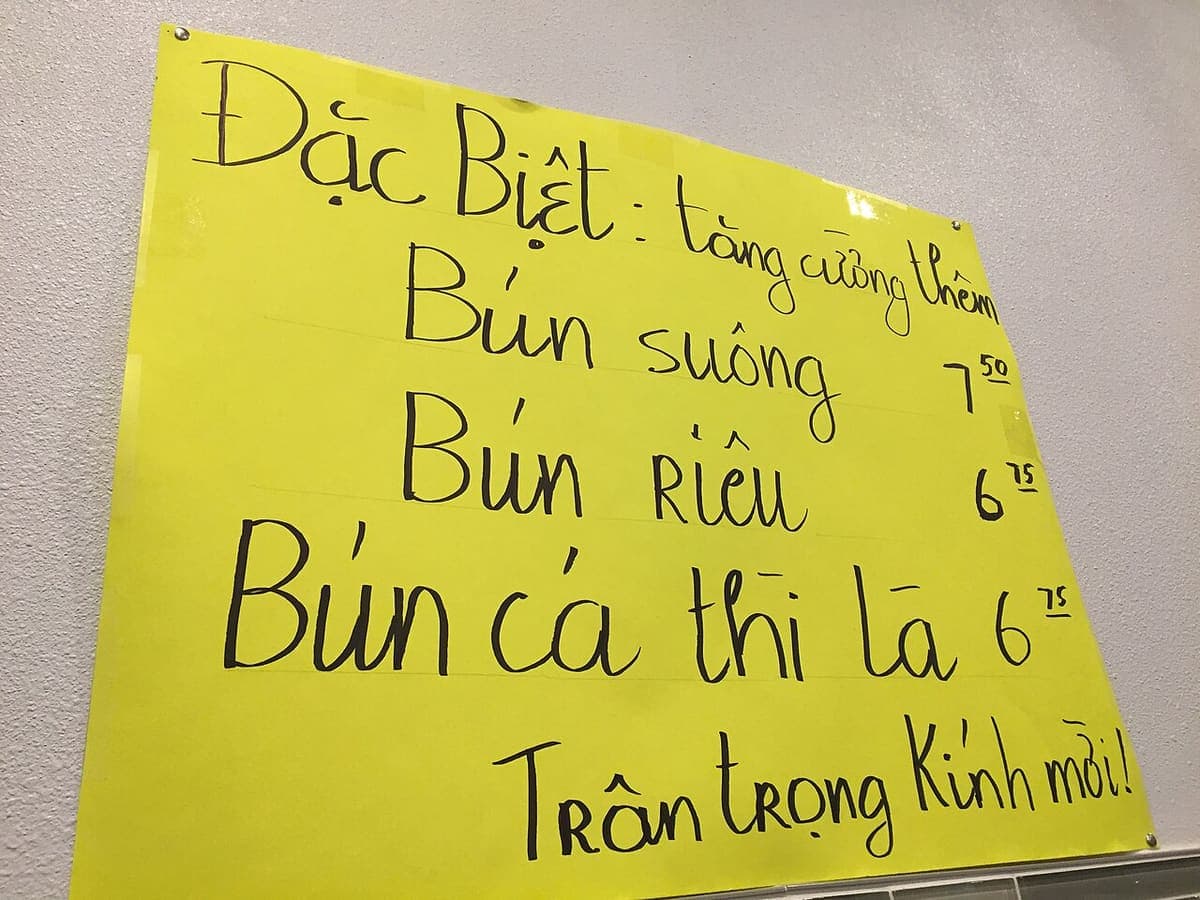
Source · CC BY-SA 4.0 · Minh Nguyen
Evidano Transcription
Đặc Biệt : tăng cường thêm
Bún suông 7 50
Bún Riêu 6 75
Bún cá thì là 6 75
Trân trọng Kính mời!
Generated by Evidano’s advanced model; not yet checked against a published edition.
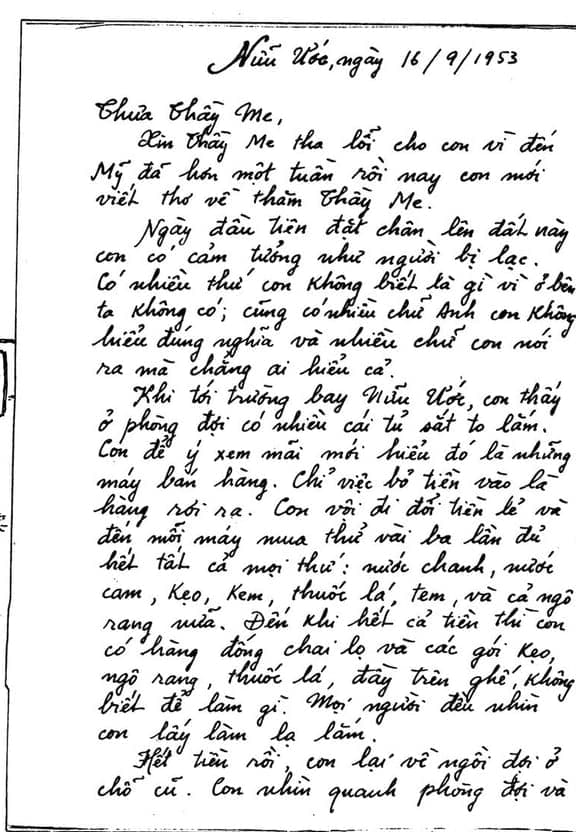
University of Michigan copy, digitised by Google, letter dated 1953; workbook published 1956 · Source · Public domain
Evidano Transcription
Nữu Ước, ngày 16/9/1953
Thưa Thầy Mẹ,
Xin Thầy Mẹ tha lỗi cho con vì đến
Mỹ đã hơn một tuần rồi nay con mới
viết thơ về thăm Thầy Mẹ.
Ngày đầu tiên đặt chân lên đất này
con có cảm tưởng như người bị lạc.
Có nhiều thứ con không biết là gì vì ở bên
ta không có; cũng có nhiều chữ Anh con không
hiểu đúng nghĩa và nhiều chữ con nói
ra mà chẳng ai hiểu cả.
Khi tới trường bay Nữu Ước, con thấy
ở phòng đợi có nhiều cái tủ sắt to lắm.
Con để ý xem mãi mới hiểu đó là những
máy bán hàng. Chỉ việc bỏ tiền vào là
hàng rơi ra. Con vội đi đổi tiền lẻ và
đến mỗi máy mua thử vài ba lần đủ
hết tất cả mọi thứ: nước chanh, nước
cam, kẹo, kem, thuốc lá, tem, và cả ngô
rang nữa. Đến khi hết cả tiền thì con
có hàng đống chai lọ và các gói kẹo,
ngô rang, thuốc lá, đầy trên ghế, không
biết để làm gì. Mọi người đều nhìn
con lấy làm lạ lắm.
Hết tiền rồi, con lại về ngồi đợi ở
chỗ cũ. Con nhìn quanh phòng đợi và
Generated by Evidano’s advanced model; not yet checked against a published edition.
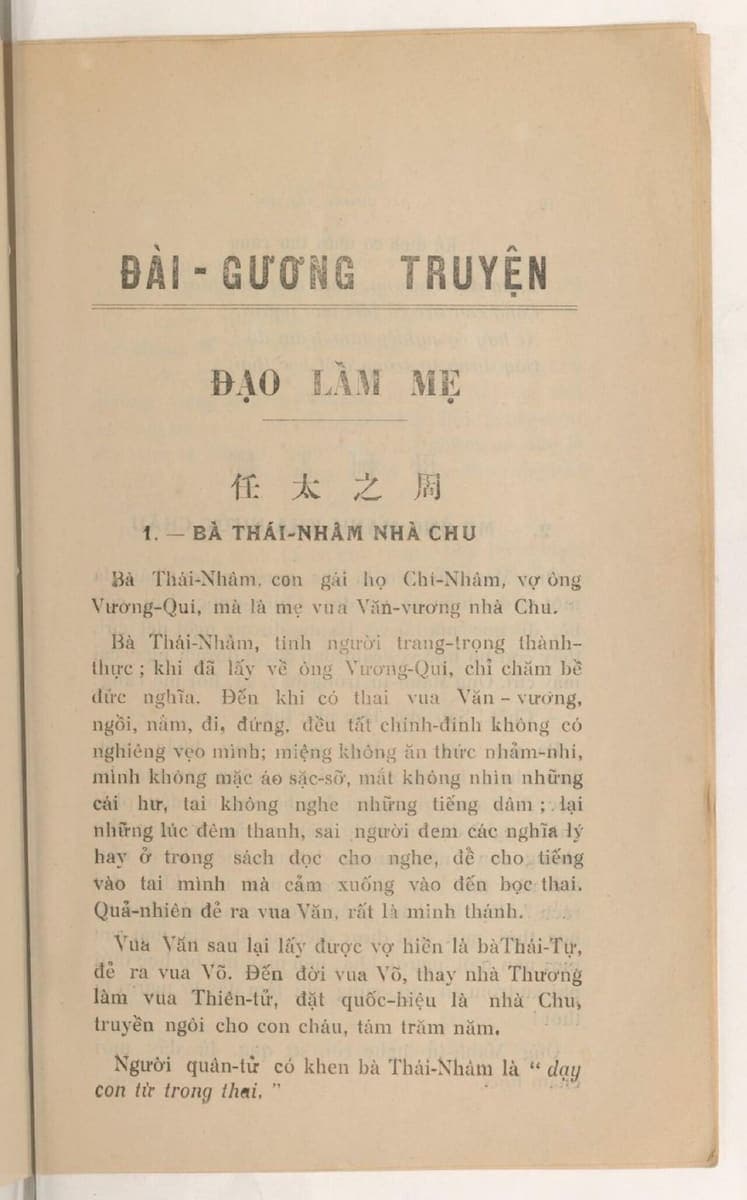
Bibliothèque nationale de France, 8° INDO-CHINOIS 322 (via Gallica), 1925 · Source · Public domain
Evidano Transcription
The whole page — running head, section title, the Chinese-character chapter title and the four paragraphs beneath it — as proofread on Vietnamese Wikisource from this scan. Template markup for type size and letter-spacing has been removed; the hyphens inside compounds and the quotation marks are the book’s own.
ĐÀI-GƯƠNG TRUYỆN
ĐẠO LÀM MẸ
任太之周
1. — BÀ THÁI-NHÂM NHÀ CHU
Bà Thái-Nhâm, con gái họ Chí-Nhâm, vợ ông Vương-Quí, mà là mẹ vua Văn-vương nhà Chu.
Bà Thái-Nhâm, tính người trang-trọng thành-thực; khi đã lấy về ông Vương-Quí, chỉ chăm bề đức nghĩa. Đến khi có thai vua Văn-vương, ngồi, nằm, đi, đứng, đều tất chính-đính không có nghiêng vẹo mình; miệng không ăn thức nhảm-nhí, mình không mặc áo sặc-sỡ, mắt không nhìn những cái hư, tai không nghe những tiếng dâm; lại những lúc đêm thanh, sai người đem các nghĩa lý hay ở trong sách đọc cho nghe, để cho tiếng vào tai mình mà cảm xuống vào đến bọc thai. Quả-nhiên đẻ ra vua Văn, rất là minh thánh.
Vua Văn sau lại lấy được vợ hiền là bà Thái-Tự, đẻ ra vua Võ. Đến đời vua Võ, thay nhà Thương làm vua Thiên-tử, đặt quốc-hiệu là nhà Chu, truyền ngôi cho con cháu, tám trăm năm.
Người quân-tử có khen bà Thái-Nhâm là “dạy con từ trong thai.”
Source: Đài gương truyện, proofread page 11 of the Commons scan, via Vietnamese Wikisource (Public domain).
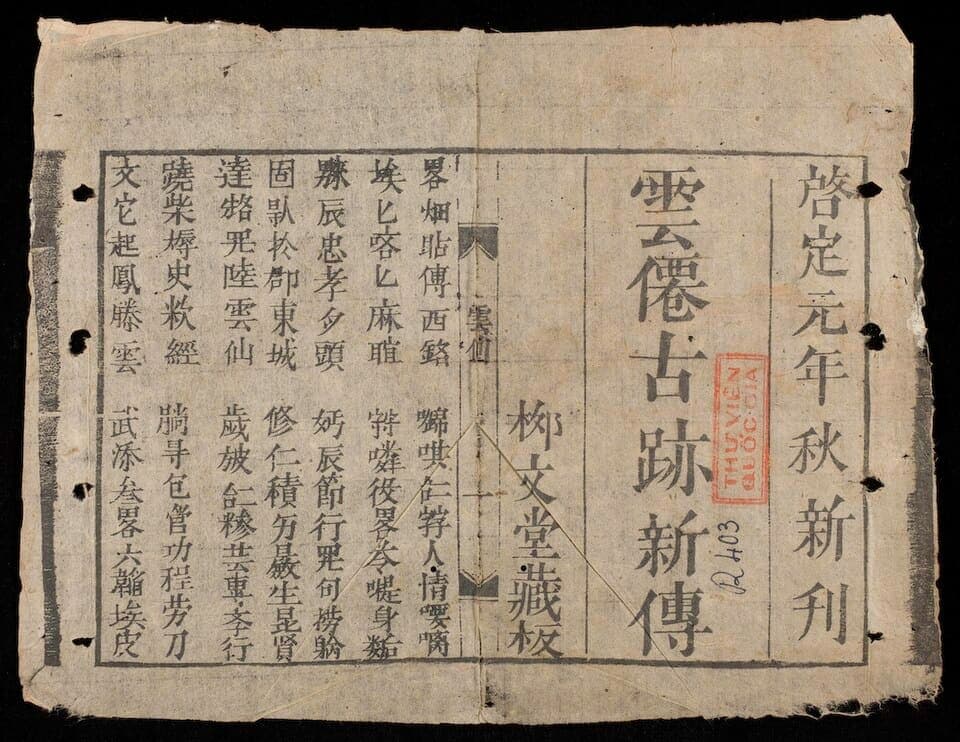
Source · Public domain · Vietnamese Nôm Preservation Foundation
Evidano Transcription
The first four verse lines of the poem, which fill the columns at the right of the text block, in chữ Nôm. Vietnamese Wikisource edits this very printing and prints the Nôm text beside a quốc ngữ reading; the four lines given here contain no character outside Unicode, though the edition as a whole uses private-use glyphs for characters that are not yet encoded.
畧畑䀡傳西銘
𡄎唭𠄩𡦂人情喓𠻗
埃匕𠳺匕麻𦖑
𡨺噒役畧苓𠽮身𡢐
Source: Lục Vân Tiên (bản Nôm 1916), phần I, via Vietnamese Wikisource (Public domain).
What Vietnamese looks like on the page
Modern Vietnamese is written in quốc ngữ, a Latin alphabet with seven extra letters — ă, â, đ, ê, ô, ơ, ư — and five tone marks written above or below the vowel. The two systems combine, so one vowel may carry a hat and an acute (ế), a hat and a dot below (ệ), a horn and a dot (ự), or a horn and a tilde (ữ). Spaces fall between syllables rather than between words, so a two-syllable word looks like two words, and the alphabet is small enough that everything depends on the marks: ma, mà, má, mả, mã and mạ are six different words built from the same two letters.
Before quốc ngữ took over, Vietnamese was written with Chinese characters. Classical texts, edicts, genealogies and stelae use chữ Hán, while the vernacular was written in chữ Nôm, characters invented for Vietnamese by pairing a Chinese element for the sound with one for the sense. Woodblock editions run in vertical columns read from the right, and thousands of Nôm characters are still outside Unicode, so even a modern scholarly edition falls back on private-use glyphs or a description of the components. Almost no reader of Vietnamese today can read a Nôm page, which is exactly why the transcriptions matter.
In between sit the printed books, newspapers and official papers of the twentieth century: pre-1945 typography hyphenates compounds (trang-trọng, Thái-Nhâm), sets a chapter title in Chinese characters above its Vietnamese heading, and prints tone marks in a slightly different position from a modern digital font. Everyday material adds handwriting, in which the marks are drawn after the word and drift over the neighbouring letter, and signage — a marker-written menu board, a price with a superscript, a laminated notice photographed at an angle.
Why ordinary OCR struggles here
Two marks stacked on one letter
The hardest part of Vietnamese recognition is not the letters but what sits above and below them. A hook, a tilde and a dot are a few pixels apart on a phone photograph, and generic OCR routinely drops the tone, moves it to the wrong vowel of a diphthong, or normalises ư to u. The result is a text that looks Vietnamese and reads as nonsense, with no visible error to flag.
Spacing that does not mark words
Because every syllable stands alone, a line break can split a compound and a spell-checker cannot tell a mistake from an ordinary syllable. Older printing hyphenates compounds and proper names, so the same phrase appears as one hyphenated unit in a 1925 book and as loose syllables in a modern one. A transcription has to reproduce what the page does rather than tidy it.
Chữ Nôm and chữ Hán on the same shelf
A Nôm page needs a different skill entirely: reading columns from the right, recognising characters that appear in no standard font, and knowing that woodblock editions of the same poem differ line by line. Output has to say which characters are certain, and pair them with a quốc ngữ reading, or the text is unusable for anyone but a specialist.
Handwriting and signs made by hand
In a handwritten letter the diacritics are added in a second pass, so a hat may hover between two letters and a dot below may land on the line. Menu boards and market signs bring marker strokes on coloured paper, prices written as superscripts, and perspective distortion from a photograph taken at chest height — all of which push generic OCR into inventing words.
Who works with this material
Family history and land records
Genealogies, house registers and land deeds are the documents most often photographed and sent round a family, and the older ones are in characters nobody in the family can read. What is wanted is a reading that keeps names and dates intact and says plainly where the writing is chữ Hán, where it is Nôm and where a later hand has added a quốc ngữ note.
Libraries and Nôm digitisation projects
Institutions holding woodblock books and manuscripts need a first-pass text they can correct, with columns in order, characters that are missing from Unicode marked rather than silently replaced, and a note where the block is worn. That is the difference between a scan that can be searched and a picture in a folder.
Diaspora archives and community publishing
Community newspapers, parish bulletins, letters and photograph captions from Vietnamese communities abroad are full of handwriting and hand-lettered signs. Projects collecting them need the diacritics right, because a name with the wrong tone mark is a different name and will not match anything.
Businesses working with Vietnamese paperwork
Invoices, delivery notes, menus and product labels arrive as photographs. A transcription that keeps prices, units and the layout of a table is what makes the difference between retyping a document and checking one.
Getting the best transcription
Ask for the marks exactly as written
Say that tone and vowel marks must be transcribed as they appear and that no spelling correction should be applied. If a mark is genuinely unreadable, ask for it to be flagged rather than filled in from context — a plausible guess is worse than a visible gap.
Decide what to do with old orthography
Pre-war books hyphenate compounds and use spellings that a modern reader would change. State whether you want them kept, which is what an edition or a citation needs, or normalised, which is what a search index usually wants; asking for both in one pass gives you two blocks you can compare.
For Nôm, ask for the characters and the reading
Request the Nôm text column by column and a quốc ngữ reading beside it, with unencoded characters described by their components rather than approximated by a similar Chinese character. Say which edition you are working from, because the same poem differs from one woodblock printing to the next.
Test on the worst photograph you have
Start with a marker-written sign shot at an angle or a letter in a fast cursive. If the tone marks survive on that, the printed material will be straightforward, and you will already know how the model reports the readings it is unsure of.
Frequently asked questions
- Are the tone marks and vowel marks kept exactly?
- Yes. Each syllable is transcribed with the marks that are on the page, including the combinations that stack a vowel mark and a tone on one letter. Where the image cannot settle whether a mark is a hook, a tilde or a dot, the reading is flagged instead of being smoothed over.
- Can it read chữ Nôm and chữ Hán pages?
- It reads them as columns of characters running from the right, and can give a quốc ngữ reading alongside. Characters that Unicode does not encode are reported by their components, and a note is added where a worn block leaves the reading uncertain.
- What happens to pre-1945 hyphenated spelling?
- It is preserved by default, because the hyphens in a 1925 book are part of what the book says. Ask for a modernised text as well and you get both, which is the practical way to keep a citation faithful while making a corpus searchable.
- Does handwriting work, including marks drawn after the word?
- Handwriting is read as a hand rather than as type, so a hat that hovers between two letters or a dot that has slipped below the line is assigned to the vowel it belongs to. Cursive letters, marker-written signs and forms filled in by hand are all in scope.
- What about a page that mixes Vietnamese with French or Chinese?
- Mixed pages are common, from colonial-era forms to a chapter heading printed in Chinese characters above its Vietnamese title. Each stretch is transcribed in its own script and can be labelled, so the languages do not run together in the output.
Related scripts and pages
Transcribe your Vietnamese documents
Upload a photograph of a letter, a sign, a printed page or a Nôm woodblock and check the diacritics line by line before you export.