
English · c. 1250–1500
Turn Anglicana and Textualis pages into checked text
Between the thirteenth century and the introduction of print, English was written in hands that pile minims into unreadable ridges, use ȝ for three different sounds and abbreviate with signs no keyboard carries. Verse adds its own traps: offset capitals in a ruled column of their own, brackets tying tail-rhyme lines together, and bobs floated into the margin. Evidano reads what is on the ruled line and tells you where it is unsure.
Sample pages
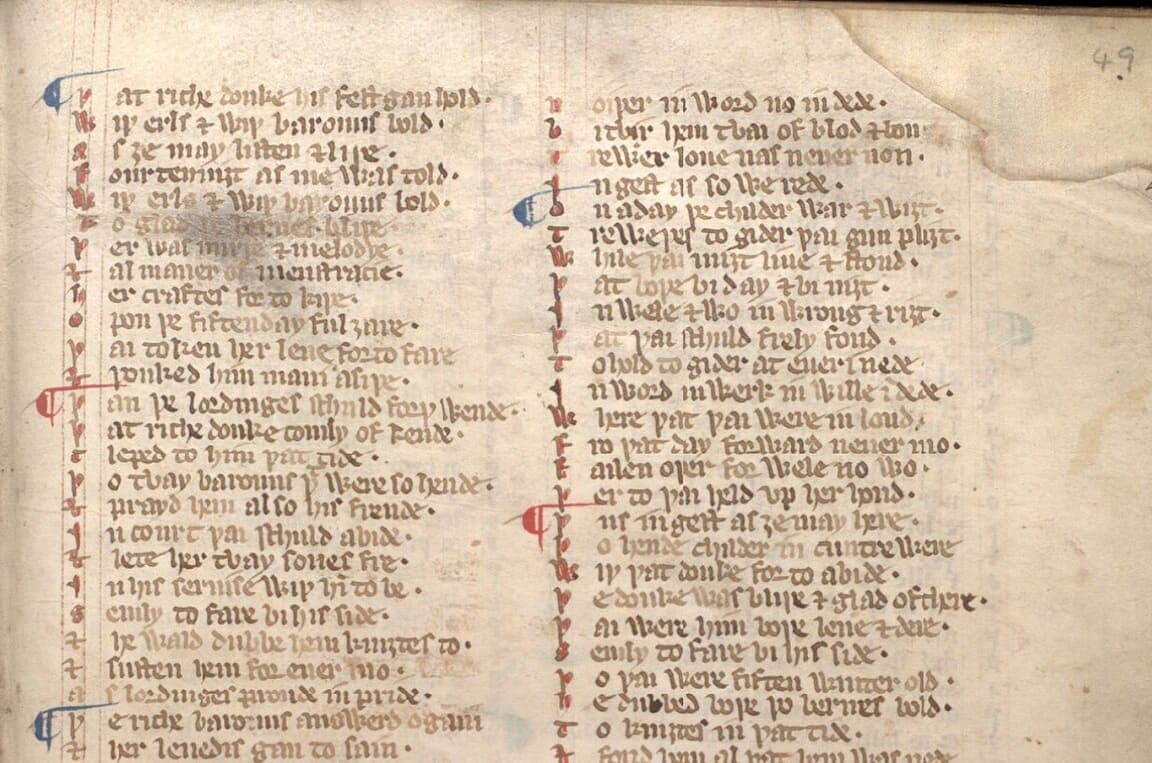
National Library of Scotland, Adv. MS 19.2.1, f. 49r, c. 1330–1340 · Source · Public domain
Evidano Transcription
The first twelve lines of the left-hand column (Kölbing’s lines 97–108), from his edition of the Auchinleck text, which marks the folio at this point as 49a. Thorn and yogh have been restored from the Internet Archive OCR against the folio; the offset initial of each line is printed here as part of its word.
Þat riche douke his fest gan hold
Wiþ erls & wiþ barouns bold,
As ȝe may listen & liþe,
Fourtenniȝt, as me was told,
Wiþ meete and drynke meryst on mold,
To glad þe bernes bliþe.
Þer was mirþe & melodye
& al maner of menstracie,
Her craftes for to kiþe.
Opon þe fiftenday ful ȝare
Þai token her leue forto fare
& þonked him mani a siþe.
Source: Amis and Amiloun, ed. Eugen Kölbing, Altenglische Bibliothek II (Heilbronn, 1884), pp. 7–8, via Internet Archive (Public domain).
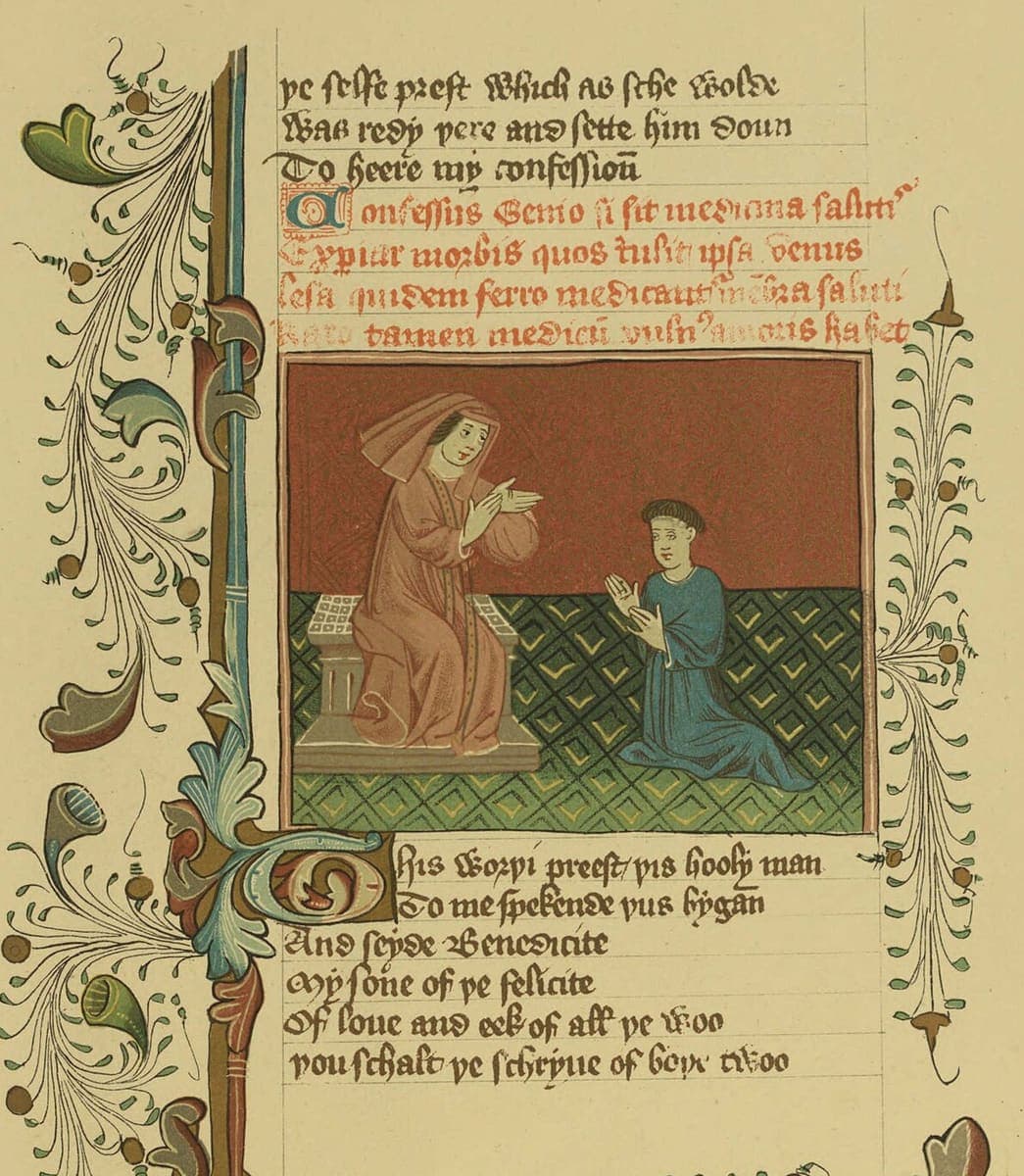
Facsimile plate, Bernard Quaritch, London, Palæography (1894), plate 15, manuscript before 1399; plate 1894 · Source · Public domain · Chromolithograph by W. Griggs, 1894
Evidano Transcription
þe ſelfe preſt Which as ſche wolde
Was redy þere and ſette him doun
To heere my confeſſiou[n]
Confeſſus Genio ſi ſit medicina ſaluti[s]
Experiar morbis quos tulit ipſa venus
Leſa quidem ferro medicantur me[m]bra ſaluti
Raro tamen medicu[m] vuln[us] amoris habet
This worþi preeſt / þis hooly man
To me ſpekende þus bygan
And ſeyde Benedicite
My ſone of þe felicite
Of loue and eek of all[e] þe woo
þou ſchalt þe ſchryue of boþe twoo
Generated by Evidano’s advanced model; not yet checked against a published edition.
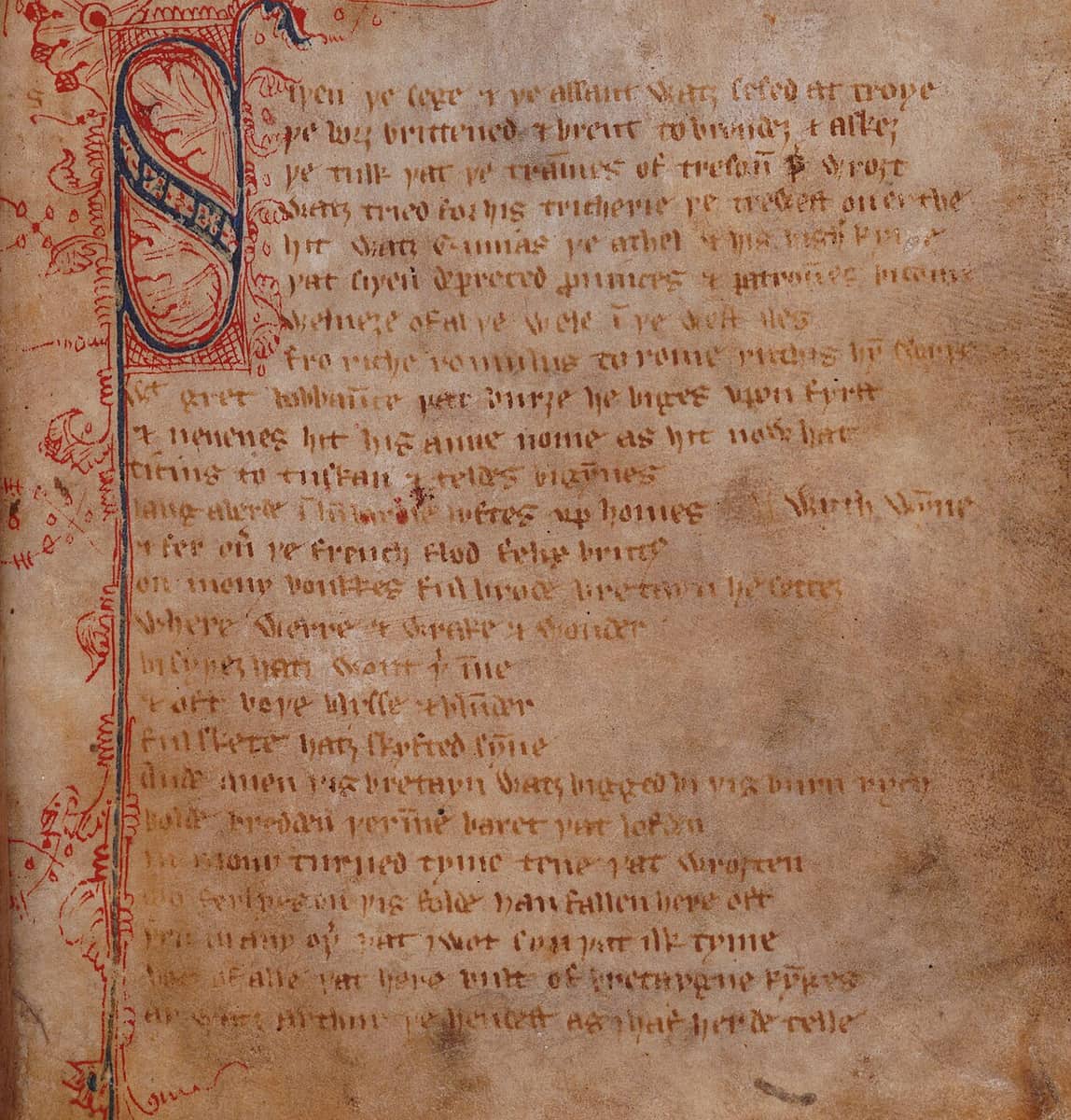
British Library, Cotton MS Nero A.x/2, f. 95r, c. 1375–1400 · Source · Public domain · Digitised by the British Library
Evidano Transcription
Lines 1–24, the whole of the folio: Richard Morris’s Early English Text Society text, whose marginal note places the page break after line 24. Morris keeps the manuscript’s spelling and adds modern punctuation and the ampersand for the Tironian sign; thorn and yogh are restored from the Internet Archive OCR against the page, and his square brackets mark a word he supplied.
Siþen þe sege & þe assaut watz sesed at Troye,
Þe borȝ brittened & brent to brondez & askez,
Þe tulk þat þe trammes of tresoun þer wroȝt,
Watz tried for his tricherie, þe trewest on erthe;
Hit watz Ennias þe athel, & his highe kynde,
Þat siþen depreced prouinces, & patrounes bicome
Welneȝe of al þe wele in þe west iles,
Fro riche Romulus to Rome ricchis hym swyþe,
With gret bobbaunce þat burȝe he biges vpon fyrst,
& neuenes hit his aune nome, as hit now hat;
Ticius to Tuskan [turnes] & teldes bigynnes,
Langaberde in Lumbardie lyftes vp homes,
& fer ouer þe French flod Felix Brutus
On mony bonkkes ful brode Bretayn he settez
    wyth wynne;
Where werre, & wrake, & wonder,
    Bi syþez hatz wont þer-inne,
    & oft boþe blysse & blunder
    Ful skete hatz skyfted synne.
Ande quen þis Bretayn watz bigged bi þis burn rych,
Bolde bredden þer-inne, baret þat lofden,
In mony turned tyme tene þat wroȝten;
Mo ferlyes on þis folde han fallen here oft
Þen in any oþer þat I wot, syn þat ilk tyme.
Source: Sir Gawayne and the Green Knight, ed. Richard Morris, EETS o.s. 4 (London, 1864), pp. 1–2, via Internet Archive (Public domain).
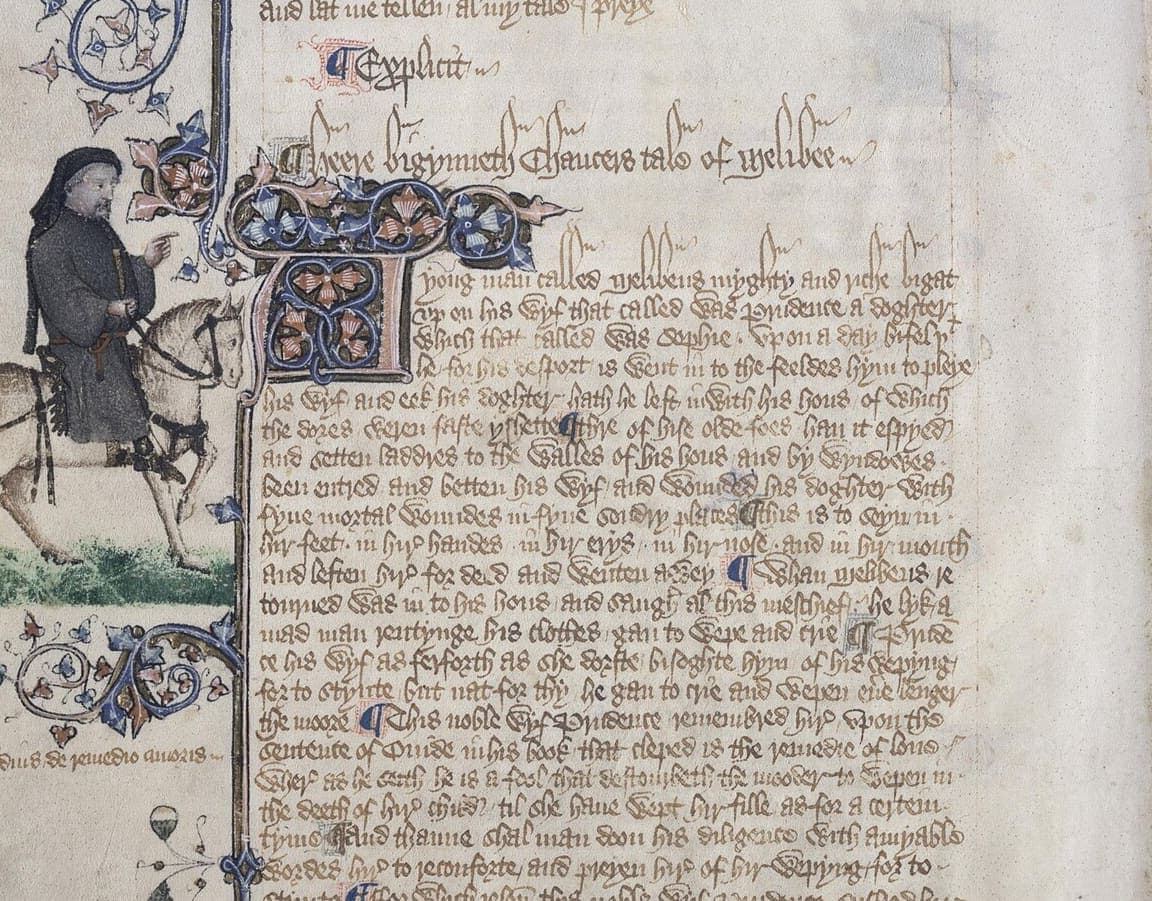
Huntington Library, San Marino, MS EL 26 C 9, f. 153v, c. 1400–1410 · Source · Public domain
Evidano Transcription
From the head of the folio, which Furnivall marks as leaf 157 back in the older foliation, to the words to maken swiche a sorwe near the foot. Furnivall’s Chaucer Society print is diplomatic: the virgules are the scribe’s punctuation, ¶ stands for his paragraph marks and ‖ for the triangular pause mark, and his italics for expanded abbreviations are silently resolved here. The marginal Latin note Ouidius de remedio amoris beside the Ovid reference is not included.
¶ Therfore lordynges alle / I yow biseche
If þat yow thynke / I varie as in my speche
As thus / though that I telle som what moore
Of prouerbes / than ye han herd bifoore
Comprehended / in this litel tretys heere
To enforce with / theffect of my mateere
And though I / nat the same wordes seye
As ye han herd / yet to yow alle I preye
Blameth me nat for as in my sentence
Shul ye / nowher / fynden difference
ffro the sentence / of this tretys lyte
After the which / this murye tale I write
And therfore / herkneth / what þat I shal seye
And lat me tellen / al my tale I preye
¶ Explicit
¶ Heere bigynneth Chaucers tale of Melibee
A Yong man called Melibeus myghty and riche / bigat vp on his wyf that called was Prudence / a doghter which that called was Sophie /.
Vpon a day bifel þat he / for his desport / is went in to the feeldes hym to pleye / his wyf / and eek his doghter / hath he left in with his hous / of which the dores / weren fast yshette ¶ thre of hise olde foes / han it espyed and setten laddres / to the walles of his hous / and by wyndowes been entred / and betten his wyf / and wounded his doghter with fyue mortal woundes in fyue sondry places ¶ this is to seyn / in hir feet. in hire handes /. in hir erys /. in hir nose /. and in hire mouth and leften hire for deed / and wenten awey
¶ Whan Melibeus / retourned was in to his hous / and saugh al this meschief he lyk a mad man rentynge his clothes / gan to wepe and crie
¶ Prudence his wyf / as ferforth as she dorste / bisoghte hym / of his wepyng for to stynte / but nat for-thy / he gan to crie and wepen euere lenger the moore
¶ This noble wyf Prudence / remembred hire / vpon the sentence of Ouide / in his book / that cleped is the remedie of loue ‖ where as he seith / he is a fool / that destourbeth the mooder to wepen in the deeth of hire child / til she haue wept hir fille / as for a certein tyme ¶ And thanne / shal man doon his diligence with amyable wordes / hire to reconforte / and preyen hire of hir wepyng for to stynte ¶ ffor which resoun this noble wyf Prudence / suffred hir housbonde for to wepe and crie / as for a certein space /. And whan she saugh hir tyme / she seyde hym in this wise ¶ Allas / my lord quod she / why make ye youre self for to be lyk a fool / for sothe / it aperteneth nat to a wys man / to maken swiche a sorwe /
Source: The Ellesmere MS of Chaucer’s Canterbury Tales, ed. F. J. Furnivall, Chaucer Society (London, 1868–79), pp. 200–202, via Internet Archive (Public domain).
Anglicana, secretary and the book hands beside them
From about 1250 the English documentary cursive known as Anglicana becomes the ordinary hand for books in the vernacular. It is recognisable by its double-compartment a, the looped and forked ascenders on b, h, k and l, a two-storey w with a long final stroke, a long r whose shoulder drops below the line, and a sigma-shaped final s. A calligraphic version, Anglicana formata, is the hand of the Ellesmere Chaucer; a plainer version fills the Auchinleck manuscript seventy years earlier. From the later fourteenth century the imported secretary hand joins it, bringing a single-compartment a, a horned e, a splayed w and a long descending r, and by 1450 most scribes write a mixture of the two. Alongside both stands Textualis, the formal book hand of liturgical and Latin volumes, with its broken feet and biting curves.
The letters that cause trouble are the ones English kept or invented. Thorn survives in þe, þat and þis, and by the fifteenth century is written so like y that early printers substituted a y outright. Yogh (ȝ) does duty for the sound in niȝt, for the y in ȝe and, in northern texts, for z. Long s is easily read as f, u and v are chosen by position rather than by sound, and i and j are the same letter. Above the line sit the abbreviation marks: a macron for a lost m or n, superscript vowels and a hooked r for -er and -re, the crossed p for per and par, the p with a curl for pro, the 9 for con- at the start of a word, and a barred ꝥ for that.
Layout is part of the reading. Verse in Anglicana books is written one line to the ruled line with the opening capital of every line pulled out into its own narrow column, so the first letter of each line sits detached from the rest of the word. Tail-rhyme romances are bracketed at the right; the alliterative long line runs across the whole column with a short bob and wheel written wherever there is room. Pilcrows in red or blue mark divisions of prose, Latin verses may be entered in red beside the English, and running heads, catchwords and quire signatures live at the extreme edges of the page.
Why ordinary OCR struggles here
Minims that make no shapes
In words like mynne, uniuersite or nunne a scribe writes a row of identical short strokes with no visual clue where one letter stops. The reading has to come from the word, from the language and from what the sentence needs, which is exactly the kind of judgement character-based recognition cannot make.
Thorn, yogh and the y that is not a y
By 1450 þ and y are drawn almost alike, so þe becomes ye and þat becomes yt in the hands of an unwary reader. Yogh looks like a tailed z or a stretched 3. Both letters must be recognised as themselves before any decision is taken about whether to keep or modernise them.
Brevigraphs that carry whole syllables
A crossed p is per or par, the same p with a curl is pro, a 9 at the head of a word is con-, and a superscript curl is -er, -re or -ur depending on where it sits. Miss one and the word is wrong; expand one silently and an editor cannot tell what the scribe wrote.
Faded ink and cropped margins
The Gawain manuscript is rubbed and brown, many romance books were trimmed hard when rebound, and marginal Latin, catchwords and later scribbles sit on the same surface as the poem. Marking what is illegible is more useful than filling the gap with a plausible word.
Who works with this material
Editors of Middle English texts
Collating witnesses of a romance or a devotional treatise means comparing spellings word by word. A transcription that preserves ȝ, þ and the scribe’s abbreviation marks can be collated directly; one that has been quietly modernised cannot.
Dialect and corpus linguists
The atlases of late medieval English are built from forms such as sche, scho, hir, hem, xal and qu-. Those forms only survive a transcription that resists correcting them, and a consistent policy on expansions keeps counts comparable between manuscripts.
Libraries digitising vernacular collections
A page image without text is not searchable. Even a first-pass transcription lets a reader find a lyric by its first line or a tale by a phrase, and gives cataloguers something to check incipits and explicits against.
Teachers and students of palaeography
Working from an image with a transcription beside it is how the letterforms are learned. Minim groups, the difference between Anglicana and secretary w, and the brevigraph for con- all become obvious once you can compare a reading with the stroke that produced it.
Getting the best transcription
Decide what happens to ȝ and þ
State whether yogh and thorn should be kept as characters, replaced by gh/y and th, or kept with a modern equivalent in brackets. Also say how the barred ꝥ and the crossed p should appear, because those choices affect every line of the book.
Describe the page furniture
Tell the model that the opening capitals of verse lines are ruled into a separate column and belong to their words, that pilcrows mark divisions, and that bobs and tail-rhyme brackets are part of the verse. Otherwise the offset letters come back as a stray column of characters.
Ask for uncertainty to be marked
A rubbed line is better returned with the doubtful letters flagged than smoothed over. Request an explicit marker for illegible stretches so that a reviewer can go straight to them under better light or with an ultraviolet image.
Start with a stanza you already know
Run a page whose text is printed in an edition you have, compare line for line, and adjust the prompt until the expansions and the letterforms match your own conventions. Then let the rest of the manuscript through.
Further reading on this hand
The palaeography guides the in-app selector points to for this domain, if you want to check a transcription against the standard references.
- How to Read Medieval Handwriting (Paleography)
This Harvard University guide focuses on reading later medieval English handwriting, especially Anglicana and secretary scripts found in Middle English manuscripts. It illustrates distinctive forms of d, r, s, g, w, and y and explains the difficulty of minim sequences involving i, j, n, u, v, m, and w. It covers thorn, eth, yogh, long s, u and v variation, macrons for omitted letters, common abbreviations, and manuscript punctuation. These examples make it particularly useful for manuscripts written between the thirteenth and fifteenth centuries.
Frequently asked questions
- How are minim sequences handled?
- They are read as words rather than as strokes, using the surrounding language, so that a row of six minims comes back as mynne rather than as an arbitrary division. Where two readings are genuinely possible the alternative can be noted instead of chosen silently.
- Can I keep the scribe’s virgules and pilcrows?
- Yes. Manuscript punctuation — the virgule, the punctus, the punctus elevatus and the pilcrow — can be reproduced as it stands, which matters if you are studying how a scribe pointed his text rather than what a modern editor thinks the sentence means.
- Does it tell Anglicana from secretary?
- The two can be distinguished by their characteristic letters, and mixed hands can be reported as mixed. That is a description rather than a dating, but it is a useful first note when you are sorting a collection of undated books.
- What about verse layout, bobs and tail-rhyme brackets?
- The transcription follows the ruled lines and can record where a bob has been written to the right of the column and where a bracket ties rhyming lines together, so the stanza form can be reconstructed without going back to the image.
- Are Latin rubrics and marginal glosses separated from the English?
- They are. A red Latin verse beside an English couplet, a running head, a catchword or a later reader’s note can each be tagged so the poem itself stays clean while nothing on the page is lost.
Related scripts and pages
Transcribe your Middle English pages
Upload a romance, a chronicle or a devotional book, choose Later Middle English Manuscripts, and set the yogh and thorn policy once.