
Russian · c. 1850–1918
Pre-reform Russian, as it was printed and written
Until 1918 Russian was written with ѣ, і, ѳ, ѵ and a hard sign after every final consonant, in a cursive where ш and т, и and н differ by a stroke. Evidano keeps the old letters, holds ruled registers together column by column, and separates a printed form from what was written into it.
Sample pages
Source · CC BY-SA 4.0 · MNI74, via Wikimedia Commons
Evidano Transcription
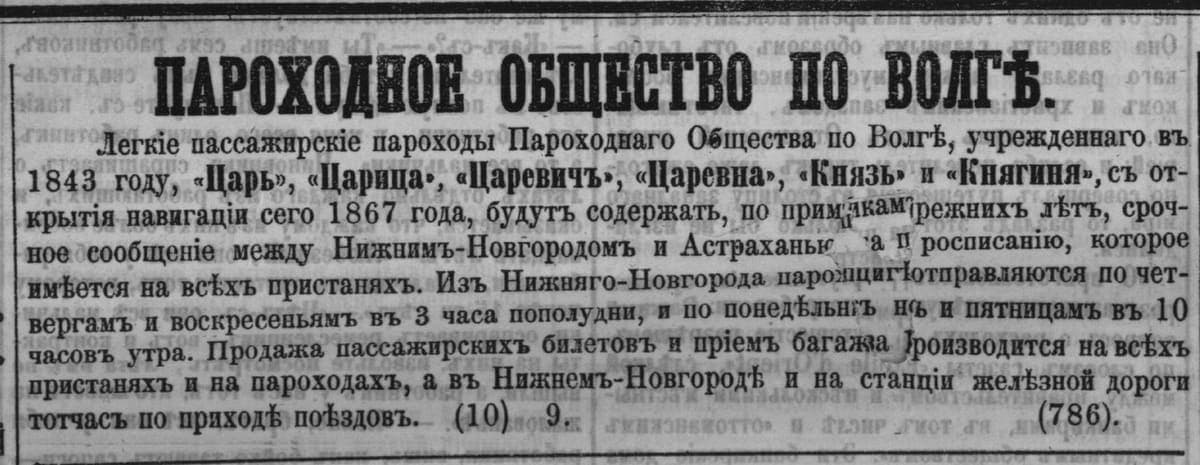
ПАРОХОДНОЕ ОБЩЕСТВО ПО ВОЛГѢ.
Легкіе пассажирскіе пароходы Пароходнаго Общества по Волгѣ, учрежденнаго въ
1843 году, «Царь», «Царица», «Царевичъ», «Царевна», «Князь» и «Княгиня», съ от-
крытія навигаціи сего 1867 года, будутъ содержать, по примѣрамъ прежнихъ лѣтъ, сроч-
ное сообщеніе между Нижнимъ-Новгородомъ и Астраханью, по росписанію, которое
имѣется на всѣхъ пристаняхъ. Изъ Нижняго-Новгорода пароходы отправляются по чет-
вергамъ и воскресеньямъ въ 3 часа пополудни, и по понедѣльникамъ и пятницамъ въ 10
часовъ утра. Продажа пассажирскихъ билетовъ и пріемъ багажа производится на всѣхъ
пристаняхъ и на пароходахъ, а въ Нижнемъ-Новгородѣ и на станціи желѣзной дороги
тотчасъ по приходѣ поѣздовъ. (10) 9. (786).
Generated by Evidano’s advanced model; not yet checked against a published edition.
Central State Historical Archive of Ukraine, Kyiv, f. 1164, op. 1, d. 442, l. 141, 1898 · Source · CC BY-SA 4.0 · Alexkrakovsky, via Wikimedia Commons
Evidano Transcription
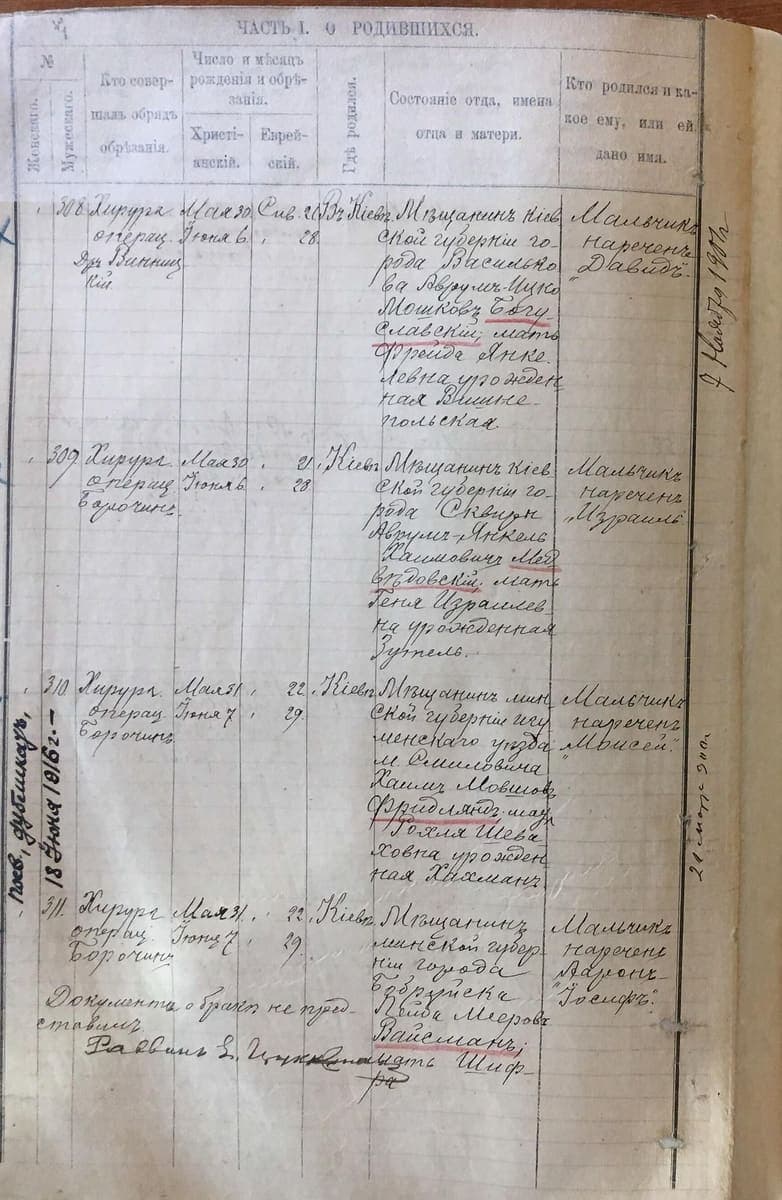
ЧАСТЬ I. О РОДИВШИХСЯ.
| № Женскаго. | № Мужескаго. | Кто совершалъ обрядъ обрѣзанія. | Число и мѣсяцъ рожденія и обрѣзанія. Христіанскій. | Число и мѣсяцъ рожденія и обрѣзанія. Еврейскій. | Гдѣ родился. | Состояніе отца, имена отца и матери. | Кто родился и какое ему, или ей, дано имя. |
|---|---|---|---|---|---|---|---|
| 308 | Хирургъ операц. Д-ръ Винницкій | Мая 30, Іюня 6 | Сив. 21, 28 | Въ Кіевѣ | Мѣщанинъ Кіевской губерніи города Василькова Аврумъ-Ицко Мошковъ Богуславскій; мать Фрейда Янкелевна урожденная Вишнепольская. | Мальчикъ нареченъ "Давидъ" | |
| 309 | Хирургъ операц. Борочинъ | Мая 30, Іюня 6 | 21, 28 | Кіевъ | Мѣщанинъ Кіевской губерніи города Сквиры Аврумъ-Янкель Хаимовичъ Медвѣдовскій; мать Геня Израилевна урожденная Зутель. | Мальчикъ нареченъ "Израиль" | |
| 310 | Хирургъ операц. Борочинъ | Мая 31, Іюня 7 | 22, 29 | Кіевъ | Мѣщанинъ минской губерніи игуменскаго уѣзда м. Смиловича[?] Хаимъ Мовшовъ Фридляндъ; мать Гохля Шеваховна[?] урожденная Хахманъ[?] | Мальчикъ нареченъ "Моисей" | |
| 311 | Хирургъ операц. Борочинъ | Мая 31, Іюня 7 | 22, 29 | Кіевъ | Мѣщанинъ минской губерніи города Бобруйска Лейба Мееровъ Вайсманъ; мать Шифра | Мальчикъ нареченъ Ааронъ-"Іосифъ" |
Документа о бракѣ не представилъ.
Раввинъ [?] Цук[illegible, overwritten]
[margin, left:] посв.[?] дубликатъ, 18 Іюня 1916 г.
[margin, right:] 7 Ноября 1907 г.
[margin, right:] 21 март 900 г.
Generated by Evidano’s advanced model; not yet checked against a published edition.
Evidano Transcription
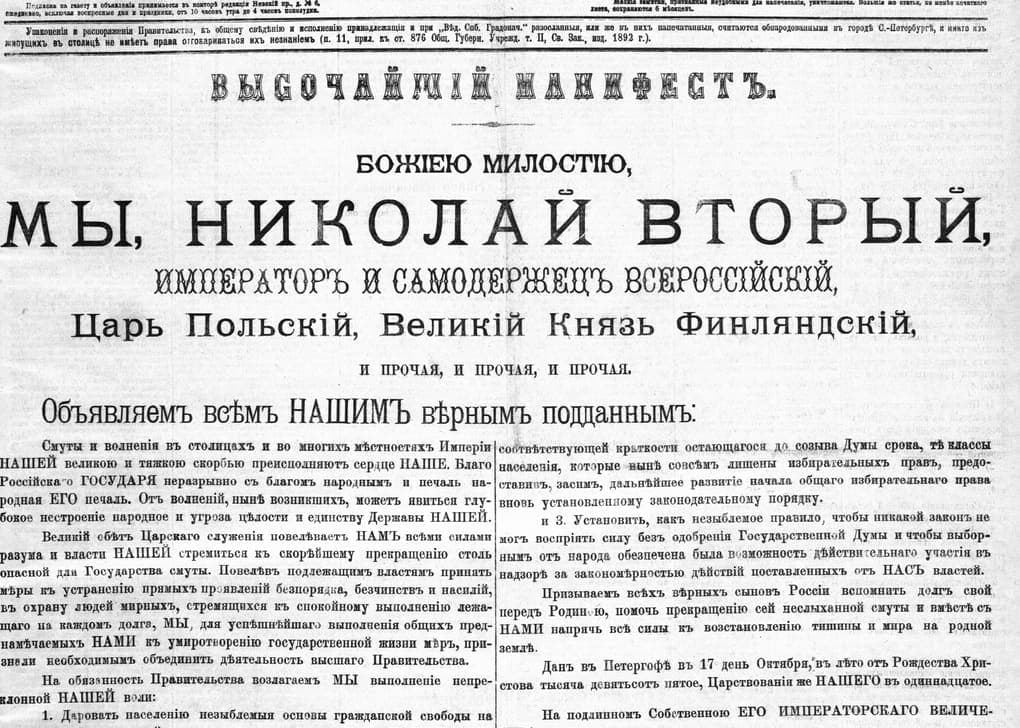
The manifesto itself, from the first paragraph to the signature line; the newspaper’s masthead, notices and the accompanying report by Count Witte are not included. The text is the official version printed in the Complete Collection of Laws, given there in modern orthography, while the newspaper sets it in pre-reform spelling.
Смуты и волнения в столицах и во многих местностях Империи Нашей великой и тяжкой скорбью преисполняют сердце Наше. Благо Российского Государя неразрывно с благом народным и печаль народная Его печаль. От волнений, ныне возникших, может явиться глубокое нестроение народное и угроза целости и единству Державы Нашей.
Великий обет Царского служения повелевает Нам всеми силами разума и власти Нашей стремиться к скорейшему прекращению столь опасной для Государства смуты. Повелев подлежащим властям принять меры к устранению прямых проявлений беспорядка, бесчинств и насилий, в охрану людей мирных, стремящихся к спокойному выполнению лежащего на каждом долга, Мы, для успешнейшего выполнения общих преднамечаемых Нами к умиротворению государственной жизни мер, признали необходимым объединить деятельность высшего Правительства.
На обязанность Правительства возлагаем Мы выполнение непреклонной Нашей воли:
1) Даровать населению незыблемые основы гражданской свободы на началах действительной неприкосновенности личности, свободы совести, слова, собраний и союзов.
2) Не останавливая предназначенных выборов в Государственную Думу, привлечь теперь же к участию в Думе, в мере возможности, соответствующей краткости остающегося до созыва Думы срока, те классы населения, которые ныне совсем лишены избирательных прав, предоставив за сим дальнейшее развитие начала общего избирательного права вновь установленному законодательному порядку, и
3) Установить, как незыблемое правило, чтобы никакой закон не мог восприять силу без одобрения Государственной Думы и чтобы выборным от народа обеспечена была возможность действительного участия в надзоре за закономерностью действий поставленных от Нас властей.
Призываем всех верных сынов России вспомнить долг свой перед Родиною, помочь прекращению сей неслыханной смуты и вместе с Нами напрячь все силы к восстановлению тишины и мира на родной земле.
Дан в Петергофе, в 17-й день Октября в лето от Рождества Христова тысяча девятьсот пятое, Царствования же Нашего одиннадцатое.
На подлинном Собственною Его Императорского Величества рукою подписано: «НИКОЛАЙ».
Source: Манифест об усовершенствовании Государственного порядка, ПСЗРИ, ser. 3, no. 26803, vol. 25, pp. 754–755, via Russian Wikisource (Public domain).
Source · CC BY-SA 4.0 · Sergeybodrow, via Wikimedia Commons
Evidano Transcription
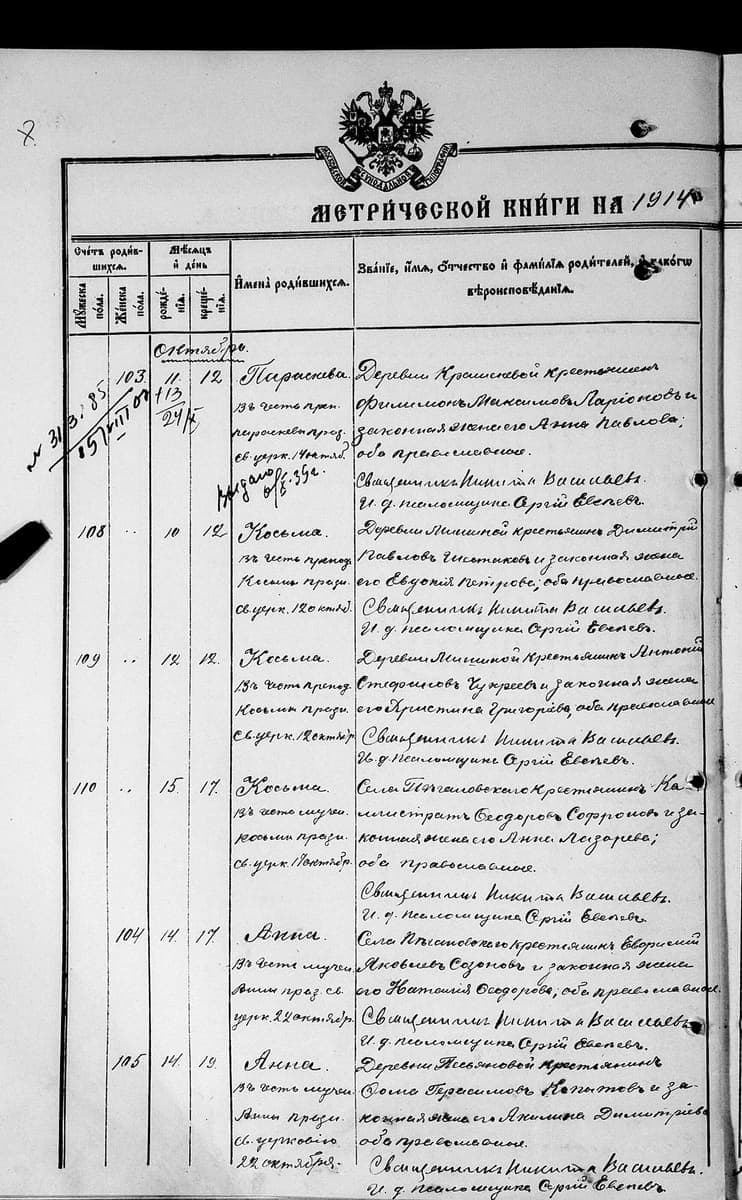
7
МЕТРИЧЕСКОЙ КНИГИ НА 1914 й
| Счетъ родившихся. Мужеска пола. | Счетъ родившихся. Женска пола. | Мѣсяцъ и день рожденія. | Мѣсяцъ и день крещенія. | Имена родившихся. | Званіе, имя, отчество и фамилія родителей, и какого вѣроисповѣданія. |
|---|---|---|---|---|---|
| Октябрь. | |||||
| 103. | 11. +13 24/X | 12 | Параскева. въ честь преп. параскевы празд. св. церк. 14 октяб. выдано 8/X 39 г. | Деревни Крашневой[?] крестьянинъ Филимонъ Максимовъ Ларіоновъ и законная жена его Анна Павлова; оба православные. Священникъ Никита Васильевъ. И. д. псаломщика Сергій Евсеевъ. | |
| 108 | .. | 10 | 12 | Косьма. въ честь препод. Косьмы празд. св. церк. 12 Октяб. | Деревни Мишиной крестьянинъ Димитрій Павловъ Чистяковъ и законная жена его Евдокія Петрова; оба православные. Священникъ Никита Васильевъ. И. д. псаломщика Сергій Евсеевъ. |
| 109 | .. | 12 | 12. | Косьма. въ честь препод. Косьмы празд. св. церк. 12 Октябр. | Деревни Мишиной крестьянинъ Антоній Стефановъ Чукреевъ и законная жена его Христина Григорьева; оба православные. Священникъ Никита Васильевъ. И. д. псаломщика Сергій Евсеевъ. |
| 110 | .. | 15. | 17. | Косьма. въ честь мучен. Косьмы празд. св. церк. 17 Октябр. | Села Пугачевскаго[?] крестьянинъ Калистратъ Ѳеодоровъ Софроновъ и законная жена его Анна Лазарева; оба православные. Священникъ Никита Васильевъ. И. д. псаломщика Сергій Евсеевъ. |
| 104 | 14. | 17. | Анна. въ честь мучен. Анны праз. св. церк. 22 Октябр. | Села Пысановскаго[?] крестьянинъ Евфимій[?] Яковлевъ Сазоновъ и законная жена его Наталія Ѳеодорова; оба православные. Священникъ Никита Васильевъ. И. д. псаломщика Сергій Евсеевъ. | |
| 105 | 14. | 19. | Анна. въ честь мучен. Анны празд. св. церковію 22 октября. | Деревни Песьяновой крестьянинъ Ѳома Герасимовъ Копытовъ[?] и законная жена его Акилина Димитріева; оба православные. Священникъ Никита Васильевъ. И. д. псаломщика Сергій Евсеевъ. |
[margin:] № 313185[?] 15/VIII 57[?]
Generated by Evidano’s advanced model; not yet checked against a published edition.
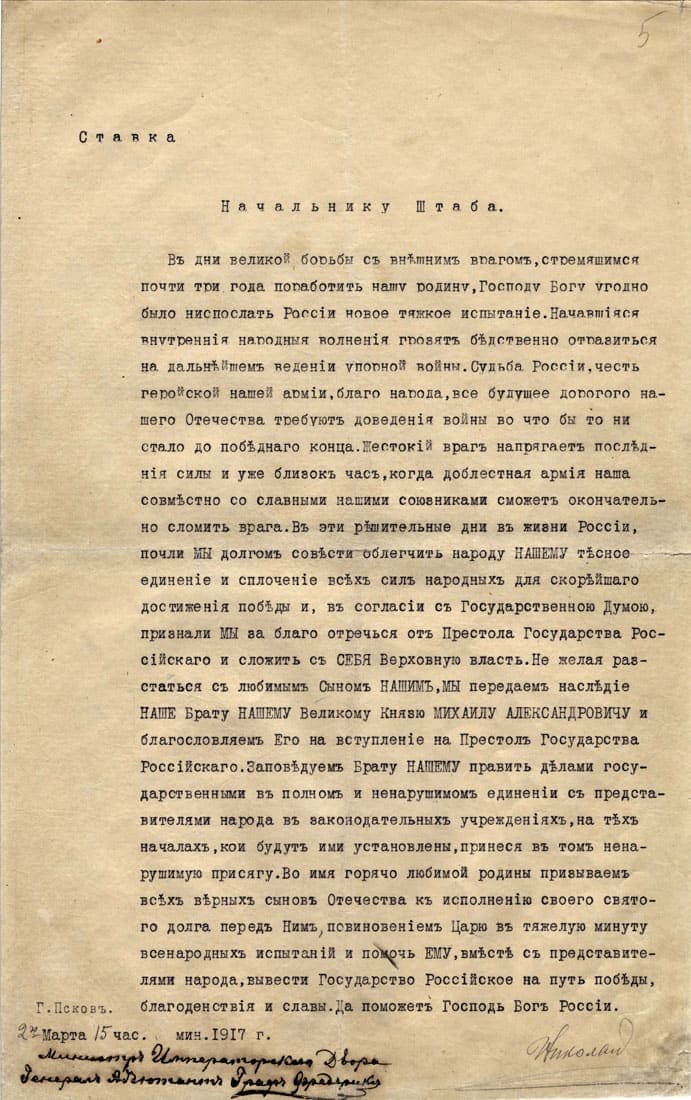
Evidano Transcription
The whole sheet, in the pre-reform orthography of the document; Wikisource gives this photograph as its source. The spaced capitals of the original are printed here as ordinary capitals, and the pencil signature is transcribed as the last line.
Ставка
Начальнику Штаба.
Въ дни великой борьбы съ внѣшнимъ врагомъ, стремящимся почти три года поработить нашу родину, Господу Богу угодно было ниспослать Россiи новое тяжкое испытанiе. Начавшiяся внутреннiя народныя волненiя грозятъ бѣдственно отразиться на дальнѣйшемъ веденiи упорной войны. Судьба Россiи, честь геройской нашей армiи, благо народа, все будущее дорогого нашего Отечества требуютъ доведенiя войны во что бы то ни стало до побѣднаго конца. Жестокiй врагъ напрягаетъ послѣднiя силы и уже близокъ часъ, когда доблестная армiя наша совмѣстно со славными нашими союзниками сможетъ окончательно сломить врага. Въ эти рѣшительные дни въ жизни Россiи, почли МЫ долгомъ совѣсти облегчить народу НАШЕМУ тѣсное единенiе и сплоченiе всѣхъ силъ народныхъ для скорѣйшаго достиженiя побѣды и, въ согласiи съ Государственною Думою, признали МЫ за благо отречься отъ Престола Государства Россiйскаго и сложить съ СЕБЯ Верховную власть. Не желая разстаться съ любимымъ сыномъ НАШИМЪ, МЫ передаемъ наслѣдiе НАШЕ Брату НАШЕМУ Великому Князю МИХАИЛУ АЛЕКСАНДРОВИЧУ и благословляемъ Его на вступленiе на Престолъ Государства Россiйскаго. Заповѣдуемъ Брату НАШЕМУ править дѣлами государственными въ полномъ и ненарушимомъ единенiи съ представителями народа въ законодательныхъ учрежденiяхъ на тѣхъ началахъ, кои будутъ ими установлены, принеся въ томъ ненарушимую присягу. Во имя горячо любимой родины призываемъ всѣхъ вѣрныхъ сыновъ Отечества къ исполненiю своего святого долга передъ Нимъ, повиновенiемъ Царю въ тяжелую минуту всенародныхъ испытанiй и помочь ЕМУ, вмѣстѣ съ представителями народа, вывести Государство Россiйское на путь побѣды, благоденствiя и славы. Да поможетъ Господь Богъ Россiи.
г. Псковъ.
2 Марта 15 час. 5 мин. 1917 года.
Николай
Source: Акт об отречении Николая II (дореформенная орфография), via Russian Wikisource (Public domain).
What the last imperial records look like
The half-century before 1918 is the best-documented period of imperial Russia and the last one written in the old orthography. Yat appears in a fixed list of roots and endings that every schoolchild memorised; decimal і is written before vowels and in міръ meaning the world; fita is kept in names of Greek origin and izhitsa in a handful of church words; and a hard sign is added to every word ending in a consonant, which adds several per cent to the length of any text. Dates are Julian and run thirteen days behind the Western calendar by 1900, which is why so many documents of 1917 carry two.
Handwriting in this period is a mature, connected cursive taught from a standard copybook, which makes it more uniform than eighteenth-century hands and no easier to read quickly. и, н, ш, щ, л and п resolve into runs of nearly identical strokes; т and м, ц and щ differ in a tail; a clerical hand in a register compresses names to fit a ruled column. Alongside the writing there is a great deal of print: newspapers with masthead, small-type notices and columns of advertisements, ministerial forms, and official manifestos set in large display type and posted in every province.
Most of the record survives as filled-in forms. A parish register, a revision return, a school report and a police form all begin as a printed grid with headings, into which a clerk writes names, dates, ages and remarks, sometimes squeezing later notes between the rules. Jewish, Lutheran, Catholic and Muslim communities kept their own registers on the same imperial pattern, so a single opening can run Russian in one set of columns and Hebrew, Latin or Arabic script in the other. Stamps, seals, signatures and archival numbering are added on top, and the paper is often thin enough for the verso to show through.
Why ordinary OCR struggles here
Old letters that a modern model deletes
Yat, decimal і, fita, izhitsa and the final hard sign carry information: they distinguish words, they date a document, and they spell names. A model tuned on modern Russian removes them and produces text that looks right but no longer matches the page, which makes a quotation impossible to check.
Ruled forms and their columns
The value of a register lies in the alignment: this name against this date, this age in this column. Recognition that reads a page as lines of text scrambles that grid, and the resulting list of words is useless for indexing even when every letter is correct.
Two or three scripts on one opening
A synagogue register keeps parallel Russian and Hebrew columns; Baltic and Polish parishes mix Cyrillic with Latin script; Muslim communities add Arabic. Recognition has to switch alphabets and reading directions within one image and keep the two versions of a name attached to each other.
Print of every size on one sheet
A newspaper front page carries a masthead in ornamental type, a manifesto in large display capitals, a price table, and notices in type barely two millimetres high, sometimes with the verso showing through. Reading order and type size have to be handled together or the small print is lost.
Who works with this material
Genealogists and family historians
Parish and synagogue registers, confession lists and recruit rolls are where a family line is actually traced. What is needed from them is a table: one row per person, with the date, the place and the spelling of the name exactly as the clerk wrote it.
Archives digitising registry books
A register series is thousands of near-identical openings. Automatic reading turns them into a searchable index in which a surname can be found across a district, with the image always one click away for verification.
Historians of the revolution and the war
The papers of 1905 to 1918 are printed, typed and handwritten by turns, often within one file. Quoting them properly means keeping the pre-reform spelling and the old-style dates, and knowing whether a text comes from a manifesto, a newspaper or a typed original.
Corpus and language projects
Historical Russian corpora need text that preserves the orthography of the source, because the whole point is to study how spelling, vocabulary and syntax changed. A silently modernised transcription cannot be used for that at all.
Getting the best transcription
Say that the old letters stay
Ask explicitly for ѣ, і, ѳ, ѵ and the final hard sign to be preserved. If you also want a modern-spelling version for searching, ask for both in one pass rather than converting afterwards, so that the two versions come from the same reading of the page.
Describe the form before you run the series
Give the column headings of your register once and ask for output as rows against those headings. Once the shape is fixed, hundreds of openings from the same series can be run with the same instruction and compared with each other.
Keep the dates as they stand
Ask for old-style dates to be transcribed as written and converted only in a separate field. Documents of 1917 sometimes carry both styles, and a conversion applied twice is the commonest silent error in a genealogical database.
Test on the worst opening in the volume
Pick a page with a later correction squeezed between the rules, a stamp across the text and show-through from the verso. If the entries and the additions come back distinguishable there, the rest of the volume will need only spot-checks.
Further reading on this hand
The palaeography guides the in-app selector points to for this domain, if you want to check a transcription against the standard references.
- Pre-Reform Russian Orthography Cheat Sheet
This guide summarizes Russian orthography before the reforms implemented in 1917 and 1918. It explains the functions of obsolete letters including і, ѣ, ѳ, and ѵ and the historical use of final hard signs. The resource also discusses relevant morphological and spelling patterns rather than treating the removed letters as interchangeable ornaments. It is particularly useful for late Imperial printed and handwritten records whose cursive is readable only when pre-reform spelling is recognized.
Frequently asked questions
- Will yat and the final hard sign be kept?
- Yes, when you ask for them. Keeping them lets you quote the document exactly and match a name to its spelling in other records; a modernised version can be generated at the same time for indexing and full-text search.
- Can a parish register be output as a table?
- It can, and that is the best way to use one. The printed headings are read once, then each entry becomes a row with the dates, the name, the parents and the officiating clergy in separate fields, and marginal notes attached to the entry they belong to.
- How are registers with Hebrew or Latin columns handled?
- Each column is read in its own script and direction, and the two versions of an entry are linked, so a name written in Russian on one page and in Hebrew on the facing page stays a single record. Where the two disagree, both readings are given.
- Are Julian dates converted to the Western calendar?
- Only if you ask, and the written date is always kept. From 1900 the difference is thirteen days; documents from 1917 and 1918 sometimes give both, so the safe practice is to transcribe what is on the page and put any conversion in a field of its own.
- What about stamps, seals and later pencil notes?
- They are reported separately from the entries. Duty stamps, parish seals, archival foliation and pencilled corrections all sit on the same surface as the text but belong to different moments in the document’s life, and keeping them apart is usually what a researcher needs.
Related scripts and pages
Transcribe your pre-reform records
Upload a register opening, a form or a newspaper page, choose Late Imperial Pre-Reform Russian Records, and say whether the old letters stay.