
Norwegian
Norwegian read in both its written forms
Norway has written itself in two official standards since 1885, so an archive box moves between Bokmål and Nynorsk from one document to the next, and a page from before 1938 may still spell å as aa. Evidano keeps each page in the spelling it was written in and tells the two norms apart rather than levelling them into one.
Sample pages
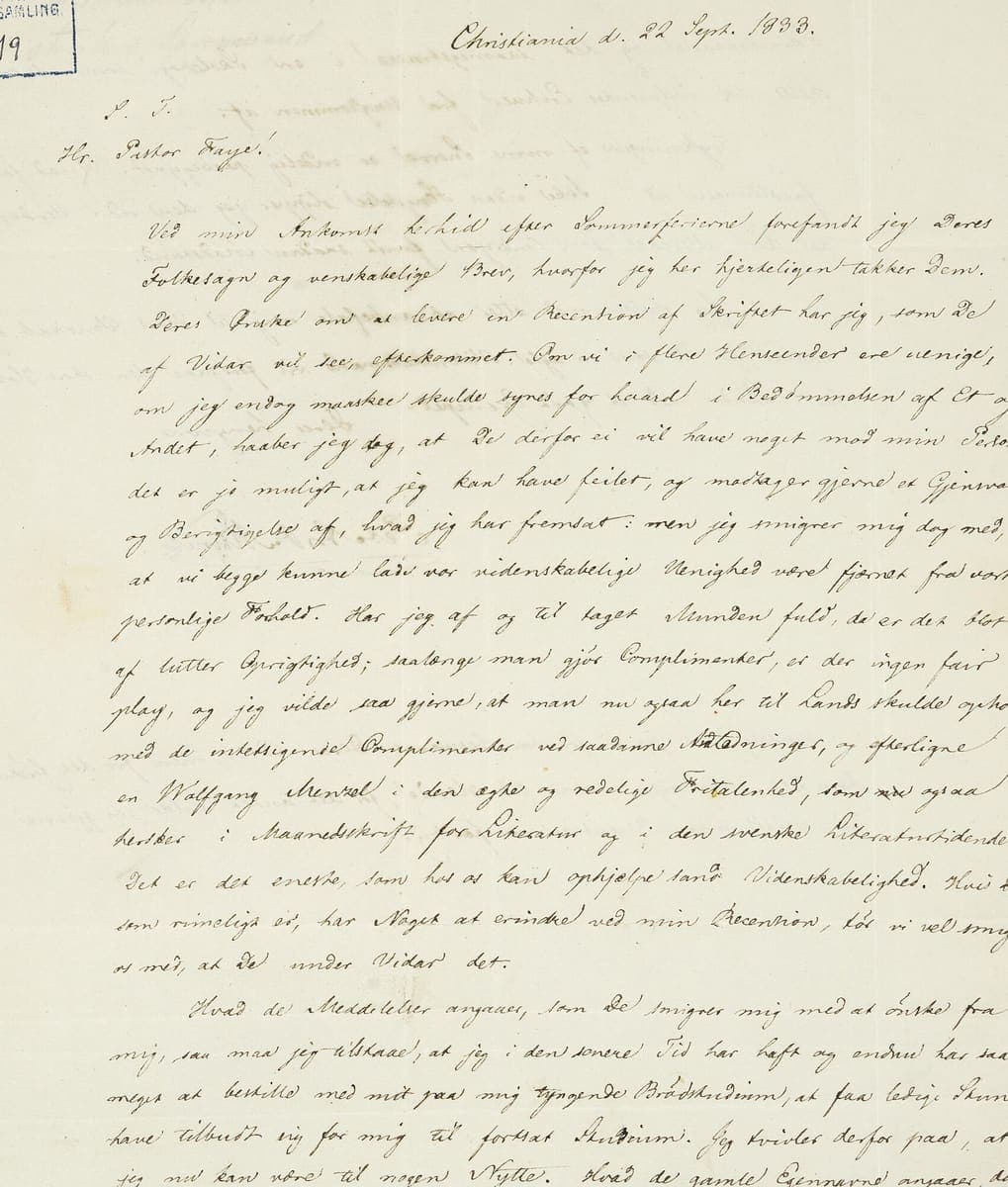
National Library of Norway (Nasjonalbiblioteket), 22 September 1833 · Source · Public domain
Evidano Transcription
The dateline, the salutation and the opening of the letter, from the transcription of the recto. The crop is tighter than the text: it clips the right-hand end of almost every line, and it runs out partway through the second paragraph, so the transcription completes lines the image cuts off. The sheet’s address panel, off to the left, and the closing lines on the verso are not included. A diplomatic transcription proofread on Norwegian Wikisource from the National Library’s digitisation, keeping Munch’s Danish-Norwegian spelling; a word he struck through is given here as written before deletion.
Christiania d. 22 Sept. 1833.
L. S.
Hr. Pastor Faye!
Ved min Ankomst hertil efter Sommerferierne forefandt jeg Deres Folkesagn og venskabelige Brev, hvorfor jeg her hjerteligen takker Dem. Deres Ønske om at levere en Recention af Skriftet har jeg, som De af Vidar vil see, efterkommet. Om vi i flere Henseender ere uenige, om jeg endog maaskee skulde synes for haard i Bedømmelsen af Et og Andet, haaber jeg dog, at De derfor ei vil have noget mod min Person; det er jo muligt, at jeg kan have feilet, og modtager gjerne et Gjensvar og Berigtigelse af, hvad jeg har fremsat: men jeg smigrer mig dog med, at vi begge kunne lade vor videnskabelige Uenighed være fjærnet fra vort personlige Forhold. Har jeg af og til taget Munden fuld, da er det blot og lutter Oprigtighed; saalænge man gjør Complimenter, er der ingen fair play, og jeg vilde saa gjerne, at man nu ogsaa her til Lands skulde ophøre med de intelligente Complimenter ved saadanne Anledninger, og efterligne en Wolfgang Menzel i den ægte og redelige Fritalenhed, som nu ogsaa hersker i Maanedsskrift for Literatur og i den svenske Literaturtidende. Det er det eneste, som hos os kan ophjælpe sand Videnskabelighed. Hvis De, som rimeligt er, har Noget at erindre ved min Recension, tør vi vel smigre os med, at De under Vidar det.
Hvad de Meddelelser angaaer, som De smigrer mig med at ønske fra mig, saa maa jeg tilstaae, at jeg i den senere Tid har haft og endnu har saa meget at bestille med mit paa mig tyngende Brødstudium, at faa ledige Stunde have tilbudt sig for mig til fortsat Studium. Jeg tvivler derfor paa, at jeg nu kan være til nogen Nytte. Hvad de gamle Egennavne angaaer, da troer jeg, at man jo før jo heller bør begynde med at indføre en rigtigere
Source: Brev fra Peter Andreas Munch til Andreas Faye av 1833-09-22, proofread page via Norwegian Wikisource (Public domain).
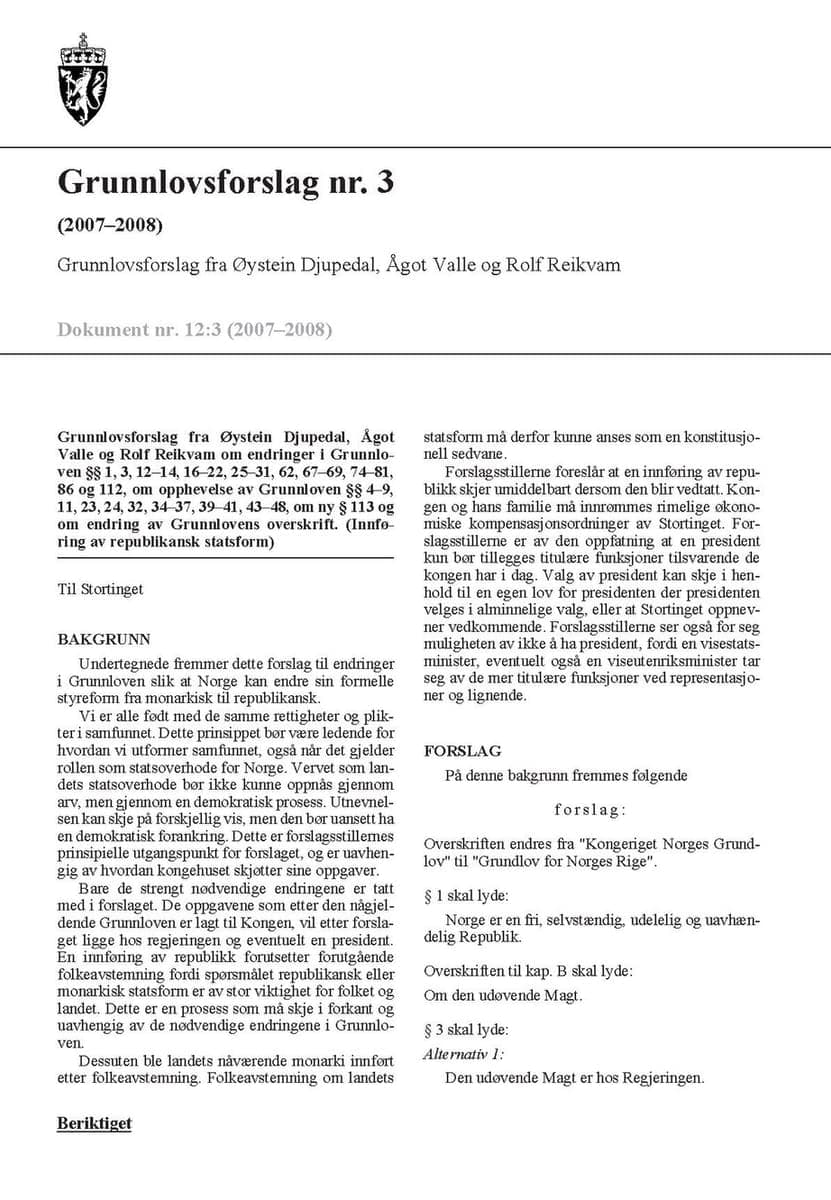
Stortinget (Norwegian Parliament), 2008 · Source · Public domain
Evidano Transcription
The title block, the opening paragraph of "Bakgrunn" and the "Forslag" section with its quoted 1814 clause, transcribed on Norwegian Wikisource from the Storting’s own published document and validated to its highest proofreading status; the intervening paragraphs of argument, also on this page, are omitted here.
Grunnlovsforslag nr. 3
(2007–2008)
Grunnlovsforslag fra Øystein Djupedal, Ågot Valle og Rolf Reikvam
Dokument nr. 12:3 (2007–2008)
Til Stortinget
BAKGRUNN
Undertegnede fremmer dette forslag til endringer i Grunnloven slik at Norge kan endre sin formelle styreform fra monarkisk til republikansk.
FORSLAG
På denne bakgrunn fremmes følgende forslag:
forslag:
Overskriften endres fra «Kongeriget Norges Grundlov» til «Grundlov for Norges Rige».
§ 1 skal lyde:
Norge er en fri, selvstændig, udelelig og uavhændelig Republik.
Overskriften til kap. B skal lyde:
Om den udøvende Magt.
§ 3 skal lyde:
Alternativ 1:
Den udøvende Magt er hos Regjeringen.
Source: Grunnlovsforslag 3 (2007-2008).pdf, proofread page via Norwegian Wikisource (Public domain).
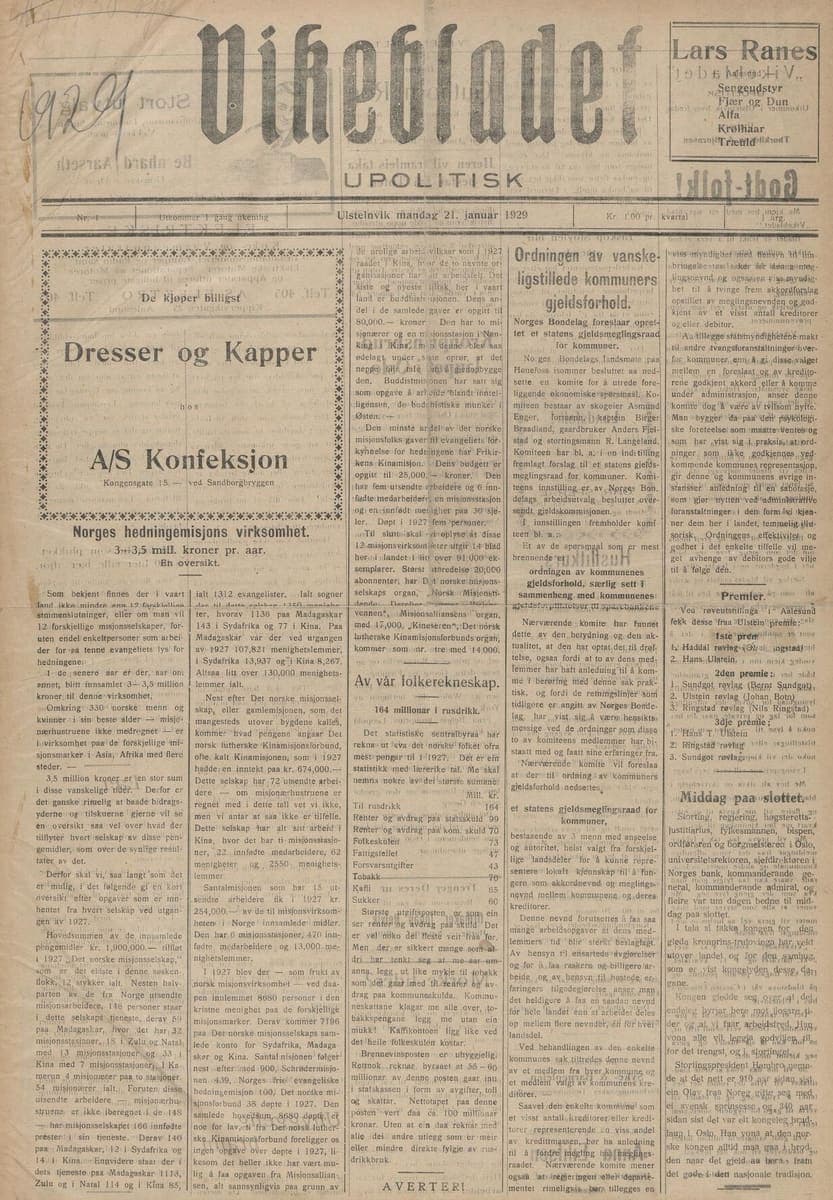
National Library of Norway (Nasjonalbiblioteket), 21 January 1929 · Source · Public domain
Evidano Transcription
1929
Vikebladet
UPOLITISK
Nr. 1 | Utkommer 1 gang ukentlig | Ulsteinvik mandag 21. januar 1929 | Kr. 1.00 pr. kvartal
De kjøper billigst
Dresser og Kapper
hos
A/S Konfeksjon
Kongensgate 15 — ved Sandborgbryggen
Norges hedningemisjons virksomhet.
3—3,5 mill. kroner pr. aar.
En oversikt.
Som bekjent finnes der i vaart
land ikke mindre enn 12 forskjellige
sammenslutninger, eller om man vil
12 forskjellige misjonsselskaper, for-
uten endel enkeltpersoner som arbei-
der for aa tenne evangeliets lys for
hedningene.
I de senere aar er der, aar om
annet, blitt innsamlet 3—3,5 million
kroner til denne virksomhet.
Omkring 330 norske menn og
kvinner i sin beste alder — misjo-
nærhustruene ikke medregnet — er
i virksomhet paa de forskjellige mi-
sjonsmarker i Asia, Afrika med flere
steder. —
3.5 million kroner er en stor sum
i disse vanskelige tider. Derfor er
det ganske rimelig at baade bidrags-
yderne og tilskuerne gjerne vil se
en oversikt saa vel over hvad der
tilflyter hvert selskap av disse pen-
gemidler, som over de synlige resul-
tater av det.
Derfor skal vi, saa langt som det
er mulig, i det følgende gi en kort
oversikt efter opgaver som er inn-
hentet fra hvert selskap ved utgan-
gen av 1927.
Hovedsummen av de innsamlede
pengemidler kr. 1,900,000.— tilfalt
i 1927 „Det norske misjonsselskap,“
som er det eldste i denne søsken-
flokk, 12 stykker ialt. Nesten halv-
parten av de fra Norge utsendte
misjonsarbeidere, 148[?] personer staar
i dette selskaps tjeneste, derav [?]
paa Madagaskar, hvor det har 32
misjonsstasjoner, 18 i Zulu og Natal
med 13 misjonsstasjoner og 33 i
Kina med 7 misjonsstasjoner. I Ka-
merun 4 misjonærer paa to stasjoner.
54 misjonærer ialt. Foruten disse
utsendte arbeidere — misjonærhu-
struene er ikke iberegnet i de 148[?]
— har misjonsselskapet 166 innfødte
prester i sin tjeneste. Derav 140
paa Madagaskar, 12 i Sydafrika og
14 i Kina. Endvidere staar der i
dets tjeneste paa Madagaskar 1118[?],
Zulu og i Natal 114 og i Kina 85,
ialt 1312 evangelister. Ialt sogner
der til dette selskap [?] menighe-
ter, hvorav 1136 paa Madagaskar
143 i Sydafrika og 77 i Kina. Paa
Madagaskar var der ved utgangen
av 1927 107,821 menighetslemmer,
i Sydafrika 13,937 og i Kina 8,267.
Altsaa litt over 130,000 menighets-
lemmer ialt.
Nest efter Det norske misjonssel-
skap, eller gamlemisjonen, som det
mangesteds utover bygdene kalles,
kommer hvad pengene angaar Det
norsk lutherske Kinamisjonsforbund,
ofte kalt Kinamisjonen, som i 1927
hadde en inntekt paa kr. 674,000.—
Dette selskap har 72 utsendte arbei-
dere — om misjonærhustruene er
regnet med i dette tall vet vi ikke,
men vi antar at saa ikke er tilfelle.
Dette selskap har alt sitt arbeid i
Kina, hvor det har ti misjonsstasjo-
ner, 22 innfødte medarbeidere, 62
menigheter og 2550 menighets-
lemmer.
Santalmisjonen som har 15 ut-
sendte arbeidere fik i 1927 kr.
254,000.— av de til misjonsvirksom-
heten i Norge innsamlede midler.
Den har 6 misjonsstasjoner, 470 inn-
fødte medarbeidere og 13,000 me-
nighetslemmer.
I 1927 blev der — som frukt av
norsk misjonsvirksomhet — ved daa-
pen innlemmet 8680 personer i den
kristne menighet paa de forskjellige
misjonsmarker. Derav kommer 7196
paa Det norske misjonsselskaps sam-
lede konto for Sydafrika, Madaga-
skar og Kina. Santalmisjonen følger
nest efter med 900, Schrødermisjo-
nen 439, Norges frie evangeliske
hedningemisjon 100, Det norske mi-
sjonsforbund 38 døpte i 1927. Den
samlede hovedsum, 8680 døpte, er
noe for lav, ti fra Det norsk luther-
ske Kinamisjonsforbund foreligger os
ingen opgave over døpte i 1927, li-
kesom det heller ikke har vært mu-
lig å faa opgaven fra Misjonsallian-
sen, alt sannsynligvis paa grunn av
de urolige arbeidsvilkaar som i 1927
raadet i Kina, hvor de to nevnte or-
ganisasjoner har sitt arbeidsfelt. Det
siste og nyeste tiltak her i vaart
land er buddhistmisjonen. Dens an-
del i de samlede gaver er opgitt til
80,000.— kroner. Den har to mi-
sjonærer og en misjonsstasjon i Nan-
king i Kina, men denne blev saa
ødelagt under siste oprør, at det
neppe blir tale om å gjenopbygge
den. Buddhistmisjonen har satt sig
som opgave å arbeide blandt intel-
ligensen, de buddhistiske munker i
Østen.
Den minste andel av det norske
misjonsfolks gaver til evangeliets for-
kyndelse for hedningene har Frikir-
kens Kinamisjon. Dens budgett er
opgitt til 25,000.— kroner. Den
har fem utsendte arbeidere og 6 inn-
fødte medarbeidere, en misjonsstasjon
og en innfødt menighet paa 30 sje-
ler. Døpt i 1927 fem personer.
Til slutt skal vi oplyse at disse
12 misjonsvirksomheter utgir 14 blad
her i landet i litt over 91,000 ek-
semplarer. Størst utbredelse 20,000
abonnenter, har Det norske misjons-
selskaps organ, „Norsk Misjonsti-
dende“. Derefter [illegible]
vennen“, Misjonsalliansens organ,
med 17,000, „Kineseren“, Det norsk
lutherske Kinamisjonsforbunds organ,
kommer som nr. tre med 14,000.
Av vår folkerekneskap.
164 millionar i rusdrikk.
Det statistiske sentralbyraa har
rekna ut kva det norske folket ofra
mest pengar til i 1927. Det er ein
statistikk med lærerike tal. Me skal
nemna nokre av dei største sumane:
| Mill. kr. | |
|---|---|
| Til rusdrikk | 164 |
| Renter og avdrag paa statsskuld | 99 |
| Renter og avdrag paa kom. skuld | 70 |
| Folkeskolen | 73 |
| Fattigstellet | 47 |
| Forsvarsutgifter | 43 |
| Tobakk | 70 |
| Kaffi | 65[?] |
| Sukker | 60 |
Største utgiftsposten er som ein
ser renter og avdrag paa skuld. Det
er vel noko dei fleste veit fraa før.
Men der er sikkert mange som al-
dri har tenkt seg at me aar um
anna legg ut like mykje til tobakk
som det gaar med til renter og av-
drag paa kommuneskulda. Kommu-
neskattane klagar me alle over, to-
bakkspengane legg me utan ein
mukk! Kaffikontoen ligg like ved
det heile folkeskulen kostar.
Brennevinsposten er uhyggeleg.
Rettnok reknar byraaet at 55—60
millionar av denne posten gaar inn
i statskassen i form av avgifter, toll
og skattar. Nettotapet paa denne
posten vert daa ca. 100 millionar
kronar. Utan[?] at ein daa reknar med
alle dei andre utlegg som er meir
eller mindre direkte fylgje av rus-
drikkbruk.
AVERTER!
Ordningen av vanske-
ligstillede kommuners
gjeldsforhold.
Norges Bondelag foreslaar opret-
tet et statens gjeldsmeglingsraad
for kommuner.
Norges Bondelags landsmøte paa
Hønefoss isommer besluttet aa ned-
sette en komite for å utrede fore-
liggende økonomiske spørsmaal. Ko-
miteen bestaar av skogeier Asmund
Enger, formann, kaptein Birger
Braadland, gaardbruker Anders Fjel-
stad og stortingsmann R. Langeland.
Komiteen har bl. a. i en indstilling
fremlagt forslag til et statens gjelds-
meglingsraad for kommuner. Komi-
teens innstilling er av Norges Bon-
delags arbeidsutvalg besluttet over-
sendt gjeldskommisjonen.
I innstillingen fremholder komi-
teen bl. a.:
Et av de spørsmaal som er mest
brennende er
ordningen av kommunenes
gjeldsforhold, særlig sett i
sammenheng med kommunenes
gjeldsforpliktelser til sparebankene[?].
Nærværende komite har funnet
dette av den betydning og den ak-
tualitet, at den har optatt det til drøf-
telse, ogsaa fordi at to av dens med-
lemmer har hatt anledning til å kom-
me i berøring med denne sak prak-
tisk, og fordi de retningslinjer som
tidligere er angitt av Norges Bonde-
lag har vist sig å være hensikts-
messige ved de ordninger som disse
to av komiteens medlemmer har bi-
staatt med og faatt sine erfaringer fra.
Nærværende komite vil foreslaa
at der til ordning av kommuners
gjeldsforhold nedsettes
et statens gjeldsmeglingsraad for
kommuner,
bestaaende av 3 menn med anseelse
og autoritet, helst valgt fra forskjel-
lige landsdeler for å kunne repre-
sentere lokalt kjennskap til å fun-
gere som akkordnevnd og meglings-
nevnd mellem kommunene og deres
kreditorer.
Denne nevnd forutsettes å faa saa
mange arbeidsoppgaver at dens med-
lemmers tid blir sterkt beslaglagt.
Av hensyn til ensartede avgjørelser
og for å faa raskere og billigere ar-
beide og av hensyn til høstede er-
faringers tilgodegjørelse anser man
det heldigere å faa en saadan nevnd
for hele landet enn at arbeidet deles
op mellem flere nevnder, en for hver
landsdel.
Ved behandlingen av den enkelte
kommunes sak tiltredes denne nevnd
av et medlem fra hver kommune og
et medlem valgt av kommunens kre-
ditorer.
Saavel den enkelte kommune som
et visst antall kreditorer eller kredi-
torer representerende en viss andel
av kredittmassen bør ha anledning
til å fordre megling [?] meglings-
raadet. Nærværende komite mener
ogsaa at regjeringen eller departe-
mentet rimeligvis bør tillegges en
Lars Ranes
Sengeudstyr
Fjær og Dun
Alfa
Krølhaar
Treuld[?]
viss myndighet med hensyn til inn-
bringelse av saker for denne meg-
lingsnevnd og ogsaa en viss myndig-
het til å tvinge frem akkordforslag
opstillet av meglingsnevnden og god-
kjent av et visst antall kreditorer
og/eller debitor.
Aa tillegge statsmyndighetene makt
til andre tvangsforanstaltninger over-
for kommuner, enn å gi disse valget
mellem en foreslaatt og av kredito-
rene godkjent akkord eller å komme
under administrasjon, anser denne
komite dog å være av tvilsom nytte.
Man bygger da paa den psykologi-
ske foreteelse som maatte ventes og
som har vist sig i praksis, at ord-
ninger som ikke godkjennes ved-
kommende kommunes representasjon,
gir denne og kommunens øvrige in-
stanser anledning til en sabotasje,
som gjør nytten ved administrative
foranstaltninger i den form vi kjen-
ner dem her i landet, temmelig illu-
sorisk. Ordningens effektivitet og
godhet i det enkelte tilfelle vil me-
get avhenge av debitors gode vilje
til å følge den.
Premier.
Ved røveutstillinga i Aalesund
fekk desse fraa Ulstein premie:
1ste premie:
- Haddal røvlag ([illegible]ngstad)
- Hans Ulstein.
2den premie: - Sundgot røvlag (Bernt Sundgot)
- Ulstein røvlag (Johan Botn)
- Ringstad røvlag (Nils Ringstad)
3dje premie: - Hans T. Ulstein
- Ringstad røvlag
- Sundgot røvlag
Middag paa slottet.
Storting, regjering, høgsteretts-
justitiarius, fylkesmannen, bispen,
ordføreren og borgmesteren i Oslo,
universitetsrektoren, sjefdirektøren i
Norges bank, kommanderande ge-
neral, kommanderande admiral, og
fleire var um dagen bedne til mid-
dag paa slottet.
I tala si takka kongen for den
gleda kronprins-trulovinga har vekt
utover landet og for den samhug
som er vist kongelyden[?] desse da-
gane.
Kongen gledde seg over at det
endeleg byrjar bere mot ljosare ti-
der og at vi faar arbeidsfred. Han
vona alle vil leggja godviljen til
for det trengst, og i stortinget.
Stortingspresident Hambro nemn-
de at det nett er 910 aar sidan sist
ein Olav fraa Noreg [?] seg med
ei svensk prinsesse, og 340 aar
sidan sist det var eit kongeleg brud-
laup i Oslo. Han vona at den nor-
ske kongen alltid maa gaa i brod-
den naar det gjeld aa bera fram
det gode i den nasjonale tradisjon.
Generated by Evidano’s advanced model; not yet checked against a published edition.
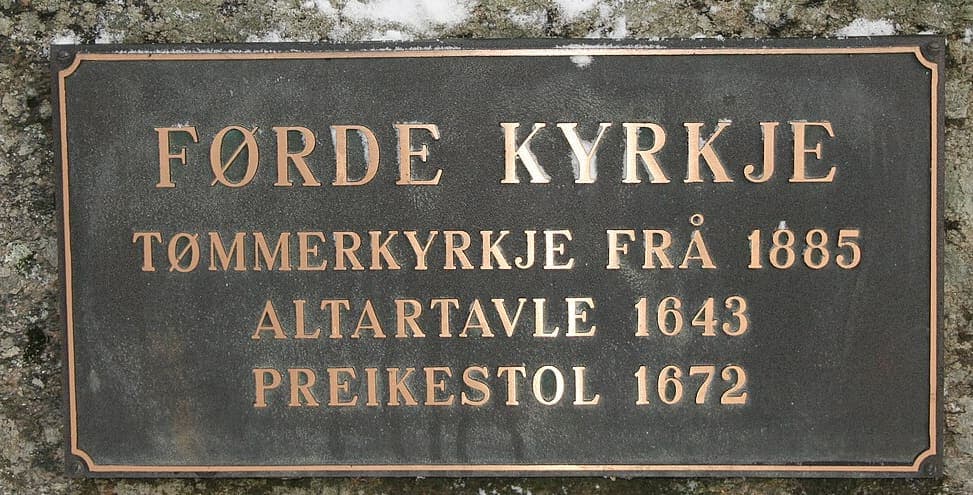
Source · CC BY-SA 3.0 · Photograph by Eirik
Evidano Transcription
FØRDE KYRKJE
TØMMERKYRKJE FRÅ 1885
ALTARTAVLE 1643
PREIKESTOL 1672
Generated by Evidano’s advanced model; not yet checked against a published edition.
Bokmål, Nynorsk and the Danish-Norwegian page before both
Until 1814 Norway was under the Danish crown, and its clergy, courts and printers wrote Danish; the union with Sweden that followed did not touch the written language, which is why there is no single date at which "Norwegian" properly begins. Two answers to that inheritance now stand side by side as official norms. Bokmål grew out of the Dano-Norwegian usage of the towns, brought closer to Norwegian speech by the spelling reforms of 1907, 1917 and 1938 and renamed from Riksmål in 1929. Nynorsk was built the other way round: from the 1840s the philologist Ivar Aasen travelled the country recording rural dialects and in 1853 published a grammar, and in 1873 a dictionary, of the composite standard he called Landsmål, renamed Nynorsk at the same 1929 reform. Both are taught in every school, both appear in the Storting’s own papers, and a municipality can choose either as its working language, so a twentieth-century Norwegian archive mixes the two without warning.
The two norms share an alphabet of twenty-nine letters, and the last three, æ, ø and å, exist in no English keyboard layout and are the ones an uncalibrated model is likeliest to drop or garble. Å is comparatively new: before the 1917 reform made it standard, and 1938 made it compulsory in schools, the same sound was written aa, a spelling that survives today only in older personal and place names such as Aasen or Aalesund. Consonant doubling is the main vowel-length signal in both norms, so a single or double letter after a vowel can be the only thing that distinguishes two different words, and long compounds are written solid, with no space or hyphen between their parts. Nynorsk keeps a wider range of accepted forms than Bokmål, so kyrkje, kva and ikkje sit on the same shelf as kirke, hva and ikke, and neither spelling is a mistake.
Everyday Norwegian material spans all of this at once. A nineteenth-century letter is written in the Danish-based hand and spelling that came before either reform; a Storting document from this century can quote the 1814 Constitution’s original wording, selvstændig and uavhændelig, inside an otherwise ordinary modern Bokmål page; and a church or trail sign in a Nynorsk municipality reads frå and kyrkje where the same sign further east would read fra and kirke.
Why ordinary OCR struggles here
Two norms treated as one language
A model calibrated on generic "Norwegian" text has usually seen far more Bokmål than Nynorsk, and quietly corrects kyrkje to kirke or kva to hva, or blends the two into a hybrid that neither norm actually allows. Both spellings need to be recognised as valid outputs in their own right, not as competing guesses at the same word.
Æ, ø, å and the ghost of aa
These three letters sit outside the alphabet an English-trained model expects, so æ is read as a stretched a, ø as an o with a stray mark, and å as a or aa. Material written before the 1938 reform genuinely does spell å as aa, which is correct for its date and needs to be kept rather than silently modernised.
Solid compounds with no natural break
Norwegian compounds are written as one unbroken word, sometimes running to five or six elements, and layout analysis trained on English tends to insert a space wherever the shape of the word suggests one, or to read the whole string as noise. Getting the word right means recognising Norwegian morphology, not just Latin letterforms.
Quoted old spelling inside a modern page
Because Norway’s founding texts are reproduced verbatim in later law, a Storting document from this decade can carry a clause in the 1814 Constitution’s own spelling, such as selvstændig and Regjeringen’s older forms, set beside ordinary contemporary Bokmål on the same page. A transcription that modernises everything indiscriminately erases exactly the distinction the document is drawing.
Who works with this material
Local and family historians
Bygdebok projects and genealogists work through parish registers, newspaper notices and letters that cross the Danish-Norwegian, Riksmål and modern Bokmål or Nynorsk periods within a single family archive. They need names and place names kept in the spelling of their date, since a farm name modernised to today’s form can break a match against the land register.
Municipalities and public offices
Norwegian law lets residents write to their council in either Bokmål or Nynorsk and expects a reply in kind, so offices digitising decades of correspondence need the two norms told apart rather than folded into one. A transcription that keeps kva as kva, not silently turned into hva, keeps that record usable for its own purpose.
Newspaper and archive digitisation
Regional papers such as Vikebladet ran for a century in much the same close-set column layout, moving through several spelling reforms without ever changing their masthead. A project indexing decades of issues needs the reforms themselves to survive the transcription, so a search for aar and for år can be understood as the same word at different dates.
Students of Norwegian language history
Coursework on the Bokmål-Nynorsk split works from primary material: an 1830s Danish-Norwegian letter, Aasen’s own Landsmål writings and a Storting document quoting the 1814 Constitution’s wording beside modern prose. None of that comparison holds if the transcription quietly normalises the older spelling to match the newer.
Getting the best transcription
Say which norm to expect
Tell the prompt whether the page is Bokmål or Nynorsk, or that it may switch between the two, and ask for the spelling to be reproduced as written rather than corrected to the other standard. That one instruction is what keeps kyrkje from becoming kirke.
Set a rule for æ, ø, å and aa
Decide whether å should be kept as å or, for material that predates the 1917–38 reforms, whether the older aa spelling should be preserved as written or given alongside a modernised form. Fix the rule once and it applies across the whole batch.
Flag the document’s date
A page from 1833 needs to be read as Danish-Norwegian, not corrected towards modern Bokmål, while a modern Storting document that quotes the 1814 Constitution needs both spellings kept apart on the same page. Naming the date range in the prompt stops the model from levelling the two together.
Test on a mixed page first
Before running a full archive box, try a page likely to hold more than one register at once, such as a form that quotes older law or a scan that pairs a Nynorsk sign with a Bokmål caption. If the norms come back distinguished there, the more uniform pages need only a spot check.
Frequently asked questions
- Can the transcription tell Bokmål and Nynorsk apart?
- Yes. Each is recognised as its own valid norm rather than a misspelling of the other, so kva, ikkje and kyrkje are kept as written on a Nynorsk page and hva, ikke and kirke on a Bokmål one. If a scan mixes both, each stretch can be labelled by norm.
- What happens to æ, ø and å?
- They are transcribed as themselves. For material written before the å reform, the historical aa spelling is kept as printed; ask for a modernised å alongside it if you want both forms for searching.
- Will an 1830s Danish-Norwegian letter come out as modern Bokmål?
- No, not unless you ask for it. The default keeps the letter’s own spelling, forms such as Grundloven and selvstændig included, since normalising them would erase the evidence of when the document was written.
- Can it separate a quoted historic clause from the surrounding modern text?
- Yes. Where a modern Norwegian document quotes older wording, such as the 1814 Constitution’s original phrasing, that stretch can be marked and kept in its own spelling rather than folded into the rest of the page.
- Does it split up Norwegian’s long compound words?
- No, compounds are transcribed as the single unbroken words they are. If you need them broken into their component parts for indexing, ask for that as a separate, labelled step rather than the main transcription.
Related scripts and pages
Transcribe your Norwegian documents
Upload a letter, a form or a photographed sign, say whether it is Bokmål or Nynorsk, and check the first page before running the rest.