
Swedish · c. 1750–1900
Two scripts, one writer, one line
Between about 1750 and 1900 a Swedish or Norwegian clerk could write the body of an entry in Gothic cursive and every personal and place name in Latin round hand, switching alphabet in the middle of a sentence and back again. Print did the same thing more slowly, keeping Fraktur for headings long after the text beneath had gone over to roman type.
Sample pages
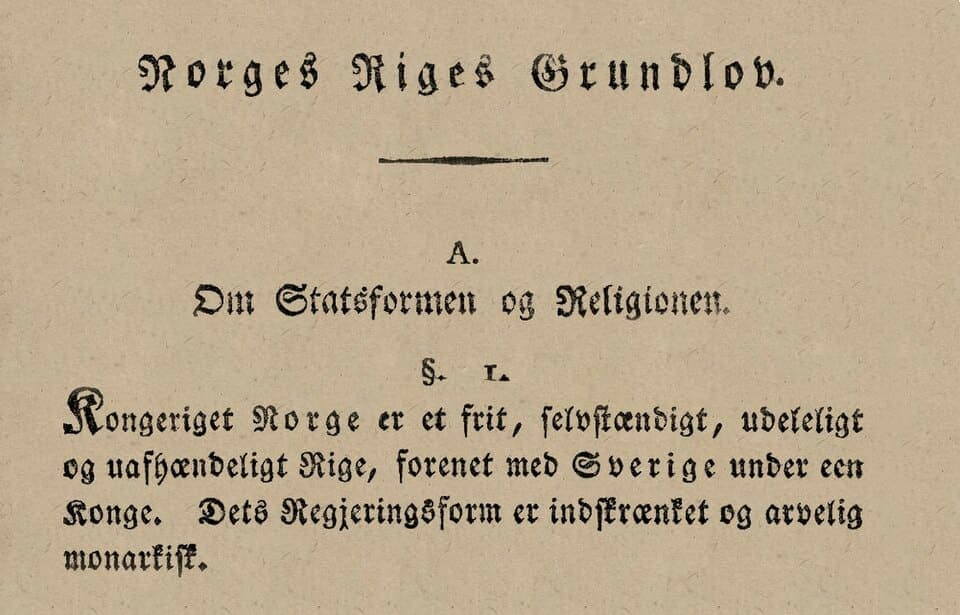
National Library of Norway, 1814 · Source · Public domain · National Library of Norway
Evidano Transcription
Norges Riges Grundlov.
A.
Om Statsformen og Religionen.
§. I.
Kongeriget Norge er et frit, ſelvſtændigt, udeleligt
og uafhændeligt Rige, forenet med Sverige under een
Konge. Dets Regjeringsform er indſkrænket og arvelig
monarkiſk.
Generated by Evidano’s advanced model; not yet checked against a published edition.
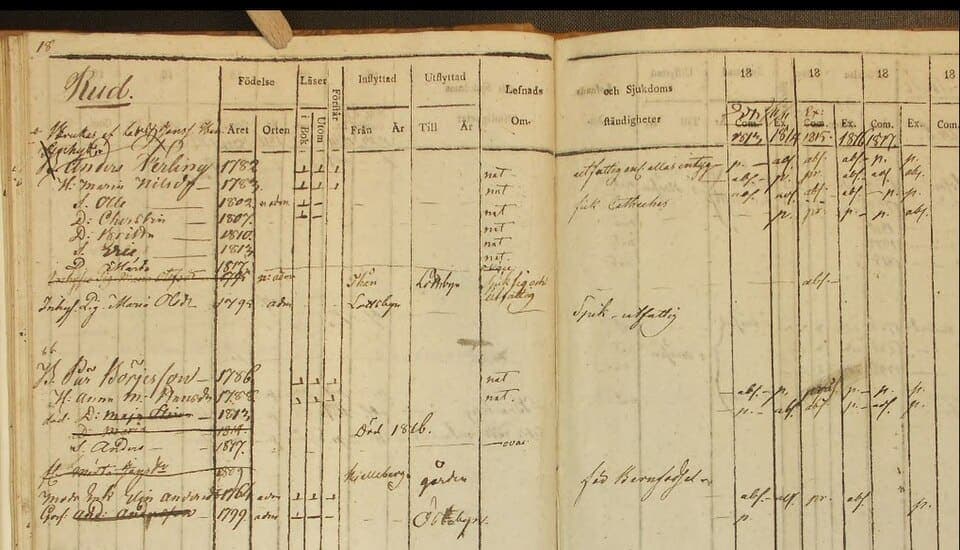
Source · Public domain · Church records of Brålanda parish
Evidano Transcription
18
Rud.
| Namn | Födelse Året | Födelse Orten |
|---|---|---|
| [cancelled: Brukare af Lottbytorp [?]] | ||
| Anders Norling | 1782 | |
| H. Maria Nilsdr | 1783. | |
| S. Olle | 1802 | adm |
| D: Cherstin | 1807. | |
| D: Kristin [?] | 1810. | |
| S. Eric | 1813 | |
| D. Märta | 1817. | |
| [cancelled: Inhys. Pig. Anna Olofsdr [?]] | [cancelled: 1798 [?]] | [cancelled: adm] |
| Inhys. Pig. Maria Olsdr | 1795 | adm |
| ½ Pär Börjesson | 1786 | |
| H. Anna M: Hansdr | 1788 | |
| [cancelled: D: Maja Stina] | 1813 | |
| [cancelled: D: Maria] | 1814 | |
| S. Anders | 1817. | |
| [cancelled: [illegible]] | [cancelled: 1803 [?]] | |
| Moder Enk. [illegible] Andersdr | 1764 [?] | adm |
| Gof. And: [cancelled: Andersson] | 1799. | adm |
[remaining columns (reading marks, moves, Död 1816, remarks, communion attendance 1814–1817) not reliably legible at this resolution]
Generated by Evidano’s advanced model; not yet checked against a published edition.
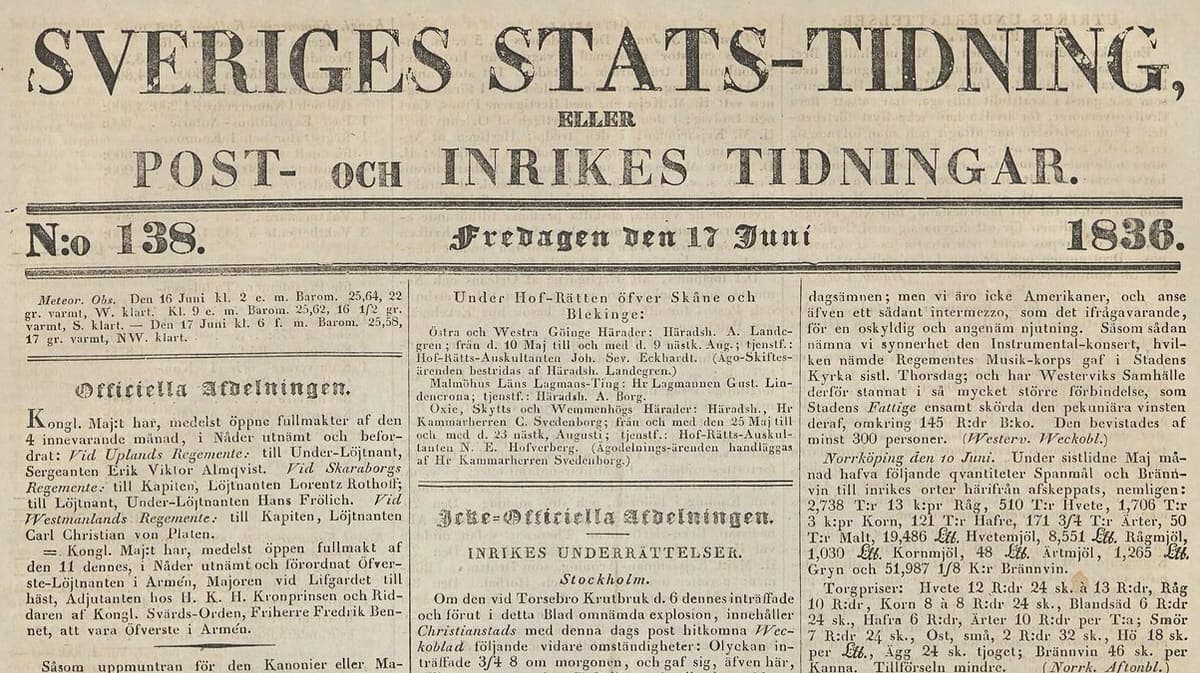
Source · Public domain · Scan on Wikimedia Commons
Evidano Transcription
SVERIGES STATS-TIDNING,
ELLER
POST- OCH INRIKES TIDNINGAR.
N:o 138. Fredagen den 17 Juni 1836.
Meteor. Obs. Den 16 Juni kl. 2 e. m. Barom. 25,64, 22
gr. varmt, W. klart. Kl. 9 e. m. Barom. 25,62, 16 1/2 gr.
varmt, S. klart. — Den 17 Juni kl. 6 f. m. Barom. 25,58,
17 gr. varmt, NW. klart.
Officiella Afdelningen.
Kongl. Maj:t har, medelst öppne fullmakter af den
4 innevarande månad, i Nåder utnämt och befor-
drat: Vid Uplands Regemente: till Under-Löjtnant,
Sergeanten Erik Viktor Almqvist. Vid Skaraborgs
Regemente: till Kapiten, Löjtnanten Lorentz Rothoff;
till Löjtnant, Under-Löjtnanten Hans Frölich. Vid
Westmanlands Regemente: till Kapiten, Löjtnanten
Carl Christian von Platen.
= Kongl. Maj:t har, medelst öppen fullmakt af
den 11 dennes, i Nåder utnämt och förordnat Öfver-
ste-Löjtnanten i Armén, Majoren vid Lifgardet till
häst, Adjutanten hos H. K. H. Kronprinsen och Rid-
daren af Kongl. Svärds-Orden, Friherre Fredrik Ben-
net, att vara Öfverste i Armén.
Såsom uppmuntran för den Kanonier eller Ma-
Under Hof-Rätten öfver Skåne och
Blekinge:
Östra och Westra Göinge Härader: Häradsh. A. Lande-
gren; från d. 10 Maj till och med d. 9 nästk. Aug.; tjenstf.:
Hof-Rätts-Auskultanten Joh. Sev. Eckhardt. (Ägo-Skiftes-
ärenden bestridas af Häradsh. Landegren.)
Malmöhus Läns Lagmans-Ting: Hr Lagmannen Gust. Lin-
dencrona; tjenstf.: Häradsh. A. Borg.
Oxie, Skytts och Wemmenhögs Härader: Häradsh., Hr
Kammarherren C. Svedenborg; från och med den 25 Maj till
och med d. 23 nästk, Augusti; tjenstf.: Hof-Rätts-Auskul-
tanten N. E. Hofverberg. (Ägodelnings-ärenden handläggas
af Hr Kammarherren Svedenborg.)
Icke-Officiella Afdelningen.
INRIKES UNDERRÄTTELSER.
Stockholm.
Om den vid Torsebro Krutbruk d. 6 dennes inträffade
och förut i detta Blad omnämda explosion, innehåller
Christianstads med denna dags post hitkomna Wec-
koblad följande vidare omständigheter: Olyckan in-
träffade 3/4 8 om morgonen, och gaf sig, äfven här,
dagsämnen; men vi äro icke Amerikaner, och anse
äfven ett sådant intermezzo, som det ifrågavarande,
för en oskyldig och angenäm njutning. Såsom sådan
nämna vi synnerhet den Instrumental-konsert, hvil-
ken nämde Regementes Musik-korps gaf i Stadens
Kyrka sistl. Thorsdag; och har Westerviks Samhälle
derför stannat i så mycket större förbindelse, som
Stadens Fattige ensamt skörda den pekuniära vinsten
deraf, omkring 145 R:dr B:ko. Den bevistades af
minst 300 personer. (Westerv. Weckobl.)
Norrköping den 10 Juni. Under sistlidne Maj må-
nad hafva följande qvantiteter Spanmål och Bränn-
vin till inrikes orter härifrån afskeppats, nemligen:
2,738 T:r 13 k:pr Råg, 510 T:r Hvete, 1,706 T:r
3 k:pr Korn, 121 T:r Hafre, 171 3/4 T:r Ärter, 50
T:r Malt, 19,486 Ltt. Hvetemjöl, 8,551 Ltt. Rågmjöl,
1,030 Ltt. Kornmjöl, 48 Ltt. Ärtmjöl, 1,265 Ltt.
Gryn och 51,987 1/8 K:r Brännvin.
Torgpriser: Hvete 12 R:dr 24 sk. à 13 R:dr, Råg
10 R:dr, Korn 8 à 8 R:dr 24 sk., Blandsäd 6 R:dr
24 sk., Hafra 6 R:dr, Ärter 10 R:dr per T:a; Smör
7 R:dr 24 sk., Ost, små, 2 R:dr 32 sk., Hö 18 sk.
per Ltt., Ägg 24 sk. tjoget; Brännvin 46 sk. per
Kanna. Tillförseln mindre. (Norrk. Aftonbl.)
Generated by Evidano’s advanced model; not yet checked against a published edition.
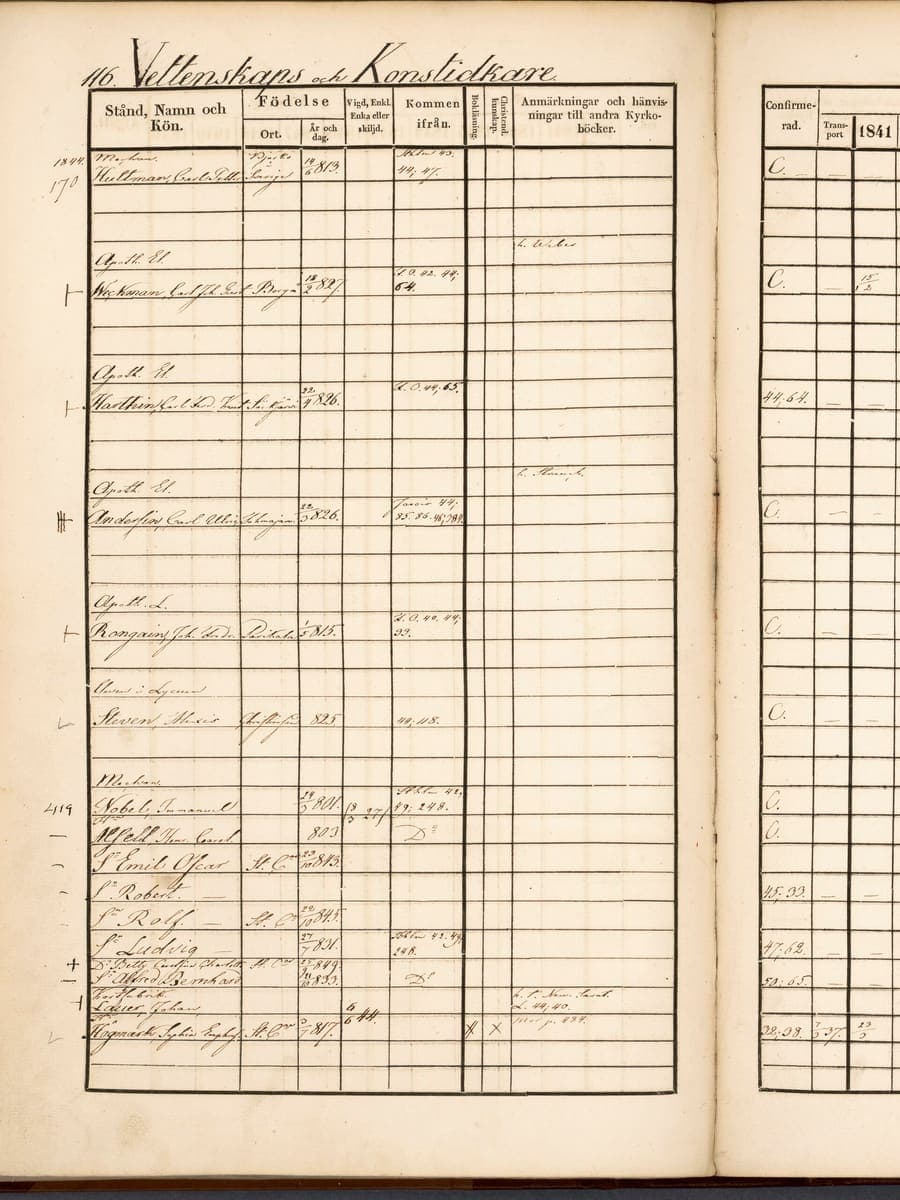
Riksarkivet (National Archives of Sweden), 1849 · Source · Public domain · Riksarkivet; S:ta Katarina svenska församling i S:t Petersburg
Evidano Transcription
- Vettenskaps och Konstidkare
| Stånd, Namn och Kön. | Födelse Ort. | Födelse År och dag. | Vigd, Enkl. Enka eller skiljd. | Kommen ifrån. | Bokläsning. | Christend. kunskap. | Anmärkningar och hänvisningar till andra Kyrkoböcker. | Confirmerad. | Transport | 1841 | |
|---|---|---|---|---|---|---|---|---|---|---|---|
| 1844. 170 | Mechan. Hultman, Carl Petter | Djurö [?] Sverige | 14/6 813. | St. Cl. [?] 43, 44; 47. | C. | ||||||
| Apoth. El. Wickman, Carl Joh. Gust. | S. Borg [?] | 18/2 827. | S. O. [?] 42. 44; 64. | t. Wib. [?] | C. | 15/2 | |||||
| Apoth. El. Harthin, Carl Lud. Theod. | [illegible] | 22/7 826. | S. O. 44; 65. | 44. 64. | |||||||
| Apoth. El. Andersin, Carl Ulric | [illegible] | 22/5 826. | [illegible] 44; 35. 36. 46; 288 [?] | t. M[?] | C. | ||||||
| Apoth. L. Rungain [?], Joh. Ludv. [?] | Parikkala [?] | 1/5 815. | S. O. 40, 44; 33. | C. | |||||||
| Elev i Lyceum. Steven, Alexis | Christinestad [?] | 825 | 40; 118. | C. | |||||||
| 419 | Mechan. Nobel, Immanuel | 24 [?]/3 801. | 18/[?] 27 | St. Pbg [?] 42, 49; 248. | C. | ||||||
| H. Ahlsell, Andr. Carol. | 803 | D:o | C. | ||||||||
| S. Emil Oscar | St. C. | 29/10 843. | |||||||||
| S. Robert | 45; 33. | ||||||||||
| S. Rolf | St. C. | 20/10 845. | |||||||||
| S. Ludvig | 27/7 831. | St. Pbg [?] 42. 49; 248. | 47; 62. | ||||||||
| + | D. Betty Carolina Charlotta [?] | St. C. | [?] 849. | ||||||||
| S. Alfred Bernhard | 21/10 833. | D:o | 50; 65. | ||||||||
| Bokhåll. [?] Låser [?], Johan | 6/6 44. | t. S. [illegible] L. 44; 40. | |||||||||
| H. Hogmark [?], Sophia Euphros. | St. C. | 7 [?]/7 817. | X | X | [illegible] p. 234 [?] | 38; 38. | 3/2 37. | 13 [?]/2 |
Generated by Evidano’s advanced model; not yet checked against a published edition.
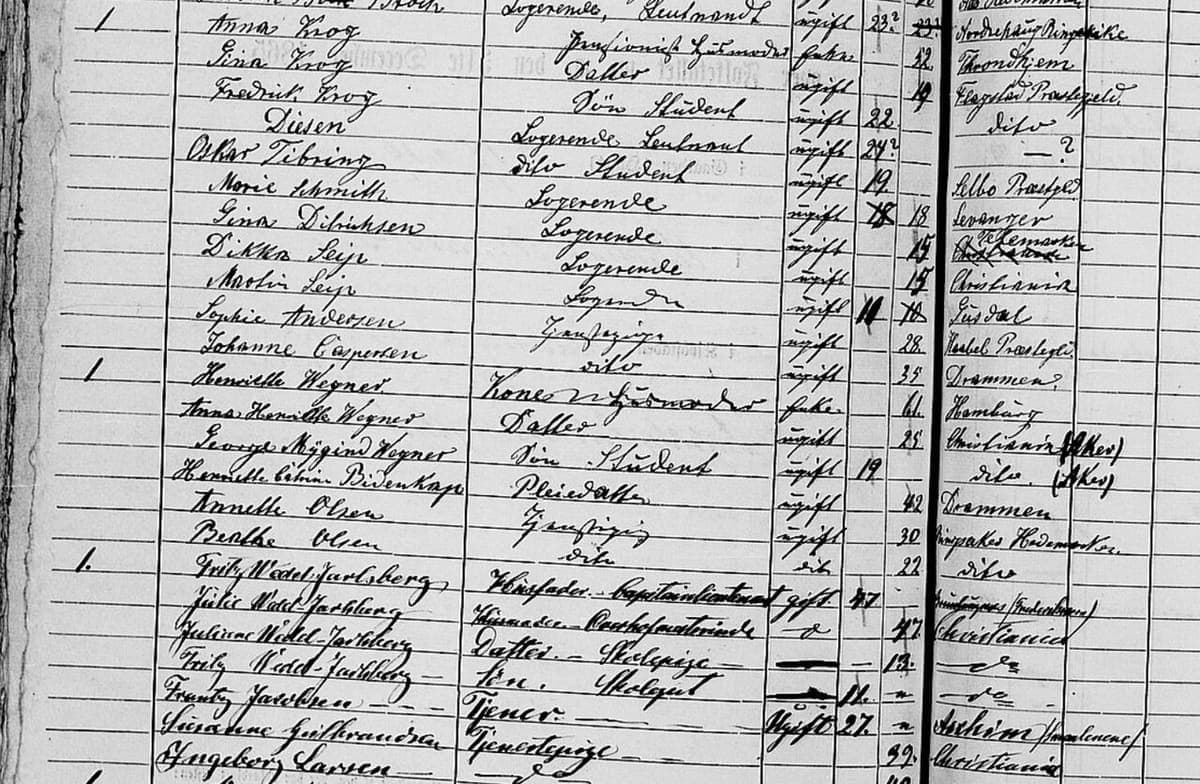
Arkivverket / Digitalarkivet, 1865 · Source · Public domain · Digitalarkivet, media.digitalarkivet.no/view/38027/2082
Evidano Transcription
| 1 | [illegible] Krog | logerende, Leutnant | ugift | 23 1/2 | [cancelled: 22] | Nordrehoug Ringerike |
| Anna Krog | Pensionist Huusmoder | Enke | 52 | Throndhjem | ||
| Gina Krog | Datter | ugift | 19 | Flakstad Præstegjeld | ||
| Fredrik Krog | Søn Student | ugift | 22 | dito | ||
| Diesen | logerende Leutnant | ugift | 24 1/2 | — ? | ||
| Oskar Tibring | dito Student | ugift | 19 | Selbo Præstegjeld | ||
| Marie Schmith | logerende | ugift | [cancelled: 18] | 18 | Levanger | |
| Gina Didrichsen [?] | logerende | ugift | 15 | Øvre Telemarken | ||
| Dikka Sejer [?] | logerende | ugift | 15 | Christiania | ||
| Malia [?] Sejer [?] | logerende | ugift | [cancelled: 11] | 11 | Gausdal | |
| Sophie Andersen | Tjenestepige | ugift | 28 | Vaaler [?] Præstegjeld | ||
| Johanne Caspersen | dito | ugift | 35 | Drammen | ||
| 1 | Henriette Wegner | Kone Huusmoder | Enke | 61 | Hamburg | |
| Anna Henriette Wegner | Datter | ugift | 25 | Christiania (Aker) | ||
| George Mygind Wegner | Søn Student | ugift | 19 | dito (Aker) | ||
| Henriette Catrine Bidenkap | Pleiedatter | ugift | 42 | Drammen | ||
| Annette Olsen | Tjenestepige | ugift | 30 | Ringsaker Hedemarken | ||
| Berthe Olsen | dito | dito | 22 | dito | ||
| 1 | Fritz Wedel-Jarlsberg | Huusfader - Capitainlieutenant | gift | 47 | Fredriksværn (Fredriksværn) | |
| Julie Wedel-Jarlsberg | Huusmoder - Postmesterinde | do | 47 | Christiania | ||
| Juliane Wedel-Jarlsberg | Datter - Skolepige | 13 | do | |||
| Fritz Wedel-Jarlsberg | Søn - Skolegut | 11 | do | |||
| Frantz Jacobsen | Tjener | Ugift | 27 | Askim Smaalenene | ||
| Susanne Gulbrandsen | Tjenestepige | 32 [?] | Christiania | |||
| 1 | Ingeborg Larsen | Tjenestepige | 40 | [illegible] |
Generated by Evidano’s advanced model; not yet checked against a published edition.
A century and a half of changing over
The change from Gothic to Latin script in Scandinavia was not an event but a long overlap. In the eighteenth century the everyday hand is still Gothic cursive, but writers already reach for Latin letters — latinsk skrift — when they write a proper name, a foreign word, a title or a technical term, because those are the things a Gothic hand renders badly. In the nineteenth century the proportion tips: names and headings are Latin, then whole entries, and by the 1870s most new registers are written in a round Latin hand with only a few Gothic habits surviving in the abbreviations.
The two systems have to be read by different rules. In Gothic, e, n, u and r are the same short stroke and a small bow distinguishes u from n; long ſ reaches below the line and is easily mistaken for f; h, k and l loop above it. In Latin round hand the e is open, c and e are close together, and the capitals I, J and S are drawn with sweeping flourishes that can carry over the neighbouring word. The vowels å, ä and ö, and Norwegian æ and ø, appear in both systems, sometimes with the ring or the dots and sometimes as an a with a superscript letter left over from older practice.
The paperwork changes shape at the same time. Household examination rolls, parish registers, censuses and emigration lists move from ruled columns drawn by hand to printed forms with fixed headings, then to forms printed with a heading in Fraktur and filled in Latin script. Newspapers and official gazettes make the same move: by the 1830s a Swedish state newspaper sets its news in roman type and keeps Fraktur for the standing section headings. Notes are added to older entries for decades afterwards, so one register page can contain a Gothic entry from 1815, a Latin-script correction from 1850 and a stamp from the 1880s.
Why ordinary OCR struggles here
Alphabet changes inside a line
A single entry may run: Gothic for the occupation, Latin for the name, Gothic again for the remark. Recognition that assumes one script per page produces gibberish at every switch, and the switches fall precisely on the names an index is built from.
Two sets of confusable letters at once
Gothic contributes the e/n/u/r problem and long ſ against f; Latin round hand contributes flourished capitals and open e against c. A page with both needs the right resolution rules applied to the right stretch of writing.
Printed forms with handwritten fillings
From the middle of the nineteenth century most of these records are forms. The printed headings must be read once and used as structure, not repeated as if the clerk had written them, and empty cells have to be reported as empty rather than filled from the row above.
Layers of later additions
Household rolls were kept in use for years and annotated continuously: a move, a death, a certificate of literacy, a stamp. The additions are in different inks, different scripts and different hands, and a transcription that merges them into the original entry invents a family history.
Who works with this material
Genealogists working nineteenth-century records
Household rolls, censuses and emigration lists are the standard route from a living family back to the 1700s. What matters is that the names come out in the script they were written in and that the columns stay aligned, because an age or a birthplace in the wrong row sends the research down a false line.
Emigration and population historians
Moving-out lists, passenger records and parish notes track a whole generation across the Atlantic. Working at that scale needs consistent transcription of place names and dates from forms that changed layout every few years.
Editors of nineteenth-century correspondence
Letters, diaries and drafts from this period mix Gothic and Latin script according to the writer’s schooling and mood. An edition has to record which script each passage is in, because the choice often marks a quotation, a name or a shift of register.
Archives publishing digitised registers
The Swedish and Norwegian national archives have put these series online in full. Adding searchable text to them, with the printed headings used as field names, is what turns a shelf of scanned volumes into a database people can query.
Getting the best transcription
Warn the model that scripts alternate
Say that Gothic cursive and Latin round hand may appear in the same line, and ask for each stretch to be labelled with the script it is written in. That label is also useful evidence later, when you want to know which parts of an entry the clerk treated as names.
Use the printed headings as the schema
Give the column headings from the form and ask for one row per person, with empty cells reported as empty. On a census or a household roll this turns a page into records that can be loaded straight into a database.
Ask for later additions to be dated where possible
Request annotations, stamps and corrections as separate items, with a note on ink and script. In a household roll kept in use for twenty years, that separation is what stops a later move from being read as part of the original entry.
Test on the messiest page in the volume
Pick an opening with crossings-out, marginal notes and a change of clerk. If the transcription keeps the rows straight and marks what it cannot read, the clean pages will need no more than a glance.
Further reading on this hand
The palaeography guides the in-app selector points to for this domain, if you want to check a transcription against the standard references.
- Avskrifter
This National Archives of Norway resource provides guidance and transcription aids for reading Norwegian archival documents. It includes access to transcriptions that allow comparison between original Gothic handwriting and readable text. The materials support recognition of historical letterforms, spelling variation, abbreviations, names, and record-specific vocabulary. They are useful for eighteenth- and nineteenth-century Norwegian sources in which Gothic and Latin-based cursive increasingly coexist.
Frequently asked questions
- Can one page contain both Gothic and Latin script?
- Constantly, and that is the normal case in this period. Each passage is recognised on its own terms and labelled, so a Gothic remark and a Latin-script name in the same cell are both transcribed correctly instead of one of them being forced into the other alphabet.
- How are å, ä, ö, æ and ø handled?
- They are transcribed as written, including the older forms where a superscript letter stands in for the ring or the dots. Where a mark is ambiguous the reading is flagged rather than resolved from modern spelling.
- What happens to the printed headings on a form?
- They are read once and used to structure the output, so the values come back under the right field names. They are not repeated for every row, and they are never reported as something written by hand.
- Are ditto marks and abbreviations expanded?
- Only if you ask, and then with a mark showing that the value was inferred. Occupational and status abbreviations can be kept as written and expanded in a separate field, which is what most database projects want.
- Does the same approach work on printed newspapers of the period?
- Yes. Fraktur headings over roman-type columns are recognised as two founts, and the column structure is preserved, so an official gazette can be read as text with its sections intact rather than as one long block.
Related scripts and pages
Transcribe a register that changes script
Upload a household roll, a census page or a nineteenth-century letter and get the Gothic and the Latin passages labelled and kept apart.