
Persian · c. 1650–1900
Broken script, letter by letter
Shikasta is nastaʿliq written for speed and then admired for it: the pen refuses to lift, so letters that join nowhere else in Persian are joined here, and the dots that tell پ from چ are dropped or slid along the line. Most of what survives is correspondence, where the reader is expected to know the formula being abbreviated. Evidano works through these sheets a line at a time and reports seals, dates and marginal notes separately from the body.
Sample pages
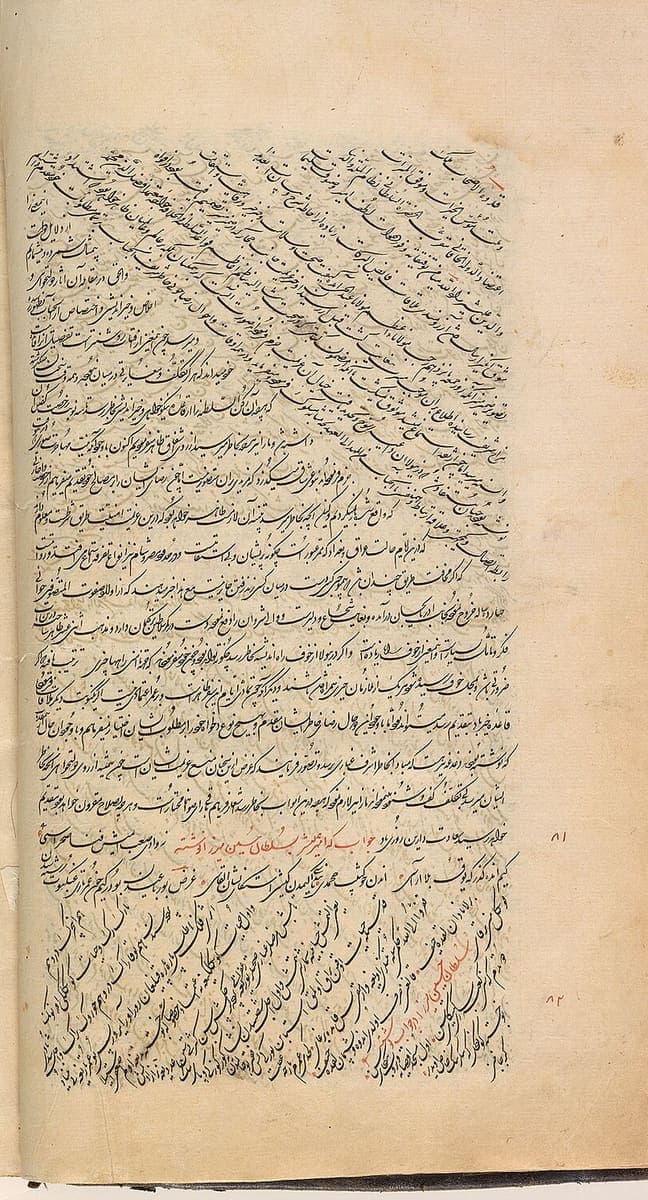
Arthur M. Sackler Gallery, Smithsonian Institution, S2014.7, 1682 · Source · Public domain
Evidano Transcription
[slanting lines at the top of the page illegible]
که واقع شد با لشکر[?] [illegible] و لیکن آنچه بخاطر میرسد تنبیه آن لازمست ظاهر خواهد بود که درین عزیمت امنیت طریق شرطست و معلوم دارد[?]
که درین ایام حالت عراق و بغداد که ممر عبور است چگونه پریشان و بی استقامت است و در حدود مصر و شام نیز انواع تفرقه [illegible]
رابطه اصحاب[?]
که اگر مخالفت طریق چندان [illegible] کسی درست در میان کسی رسید رفتن جایز نیست مع هذا خبر میدهند که [illegible] جوانی
چهارده ساله خروج نموده بجانب آذربایجان درآمده و بغایت شجاع و دلیر است و والی شروان را دفع نموده است [illegible] سلاطین ترکمان دارد و مذهب اثنی عشر ظاهر ساخته[?] [interlinear note illegible]
فکر و تامل بسیار است و نیز از خوف [interlinear word illegible] زیاده است و اگر درینولا از خوف راه اندیشه بخاطر رسد چگونه [illegible] که جهت امنی راهها چیزی [illegible] اگر
ضروری باشد و [illegible] خوف رسیده [illegible] از ملازمان چیزی همراه باشند و دیگر آنکه چنین [illegible] ایام این سفر ظاهر است و بر [illegible] اعتمادی نیست اگر مکتوب دیگر [illegible]
قاعده[?] خیرباد[?] بتقدیم رسد میتوانند بود اما با وجود این حال رضای خاطر ایشان مقدم و بهیچ نوع دلخواه خود را بر مطلوب ایشان اختیار نمیفرماییم و با وجود آن حال [illegible]
که نوشته بود[?] [illegible] است که مبادا بخاطر اشرف غباری رسد و تصور فرمایند که غرض ازین سخنان منع عزیمت ایشانست [illegible] همیشه از روی دولتخواهی آنچه بخاطر
ایشان میرسد بی تکلف گفت و شنود [illegible] ما نیز لازم نمود که همیشه درین ابواب بخاطر رسد اشعار فرماییم تا [illegible] رای صواب نما مختار است و هرچه بصلاح مقرون خواهد بود بتقدیم
خواهد رسید سعادت دارین روزی باد جواب که امیر علیشیر بسلطان حسین میرزا نوشته نه وادی صعب ایمیش[?] فنا صحراسی
۸۱
[remaining lines illegible]
Generated by Evidano’s advanced model; not yet checked against a published edition.
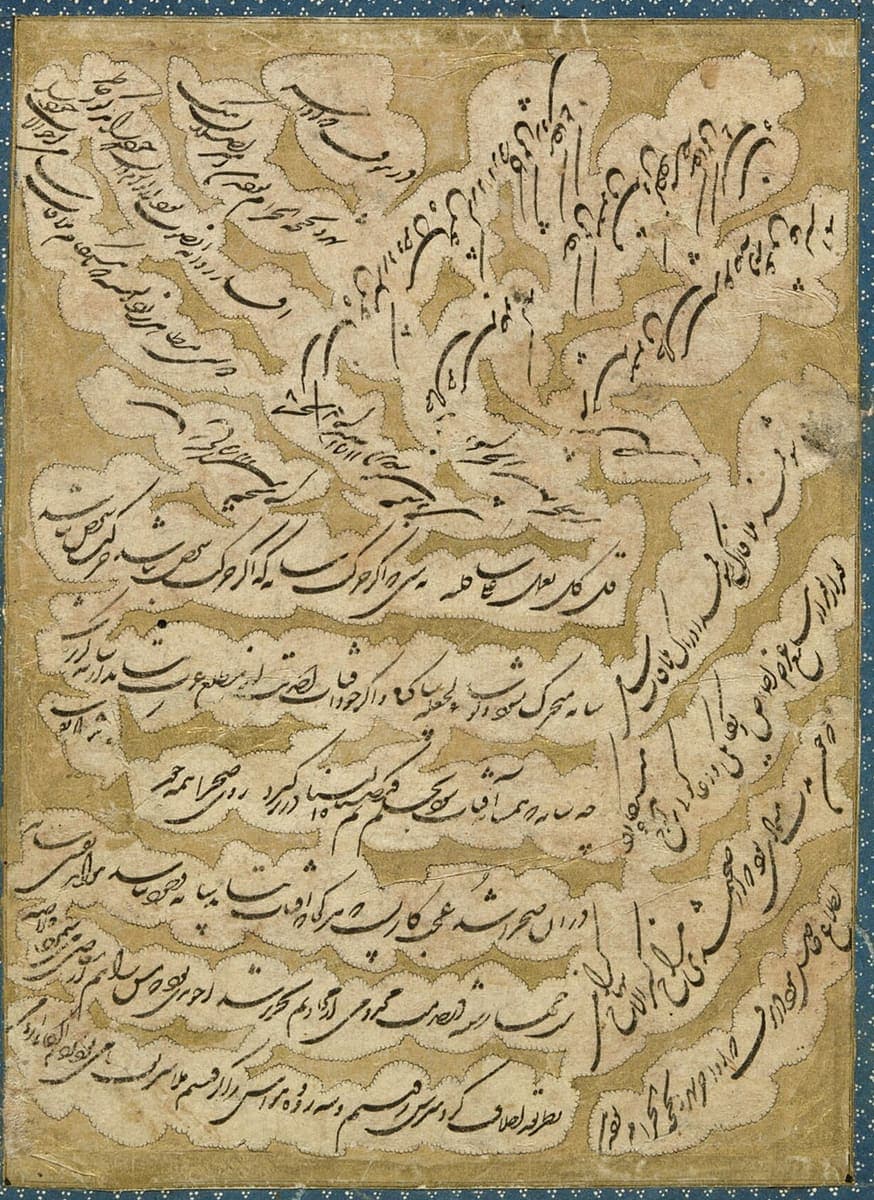
Art Institute of Chicago, 2014.1012, 1767 · Source · CC0 1.0
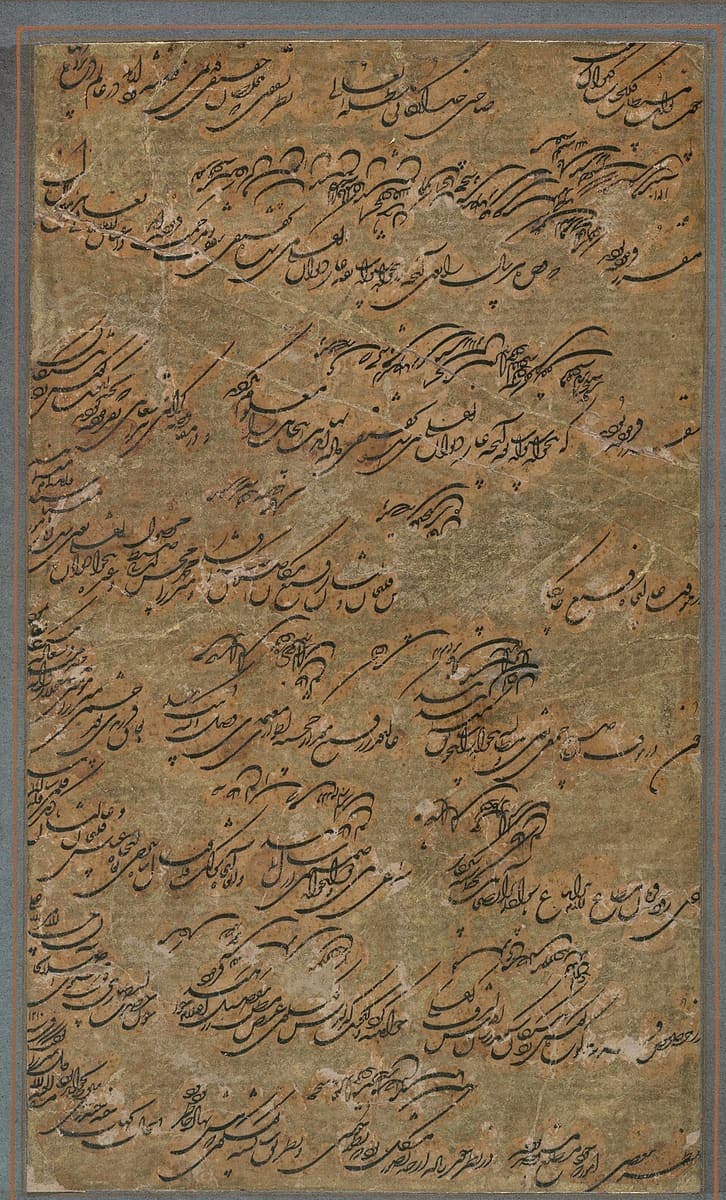
Harvard Art Museums, 1958.212, 1795–96 · Source · Public domain
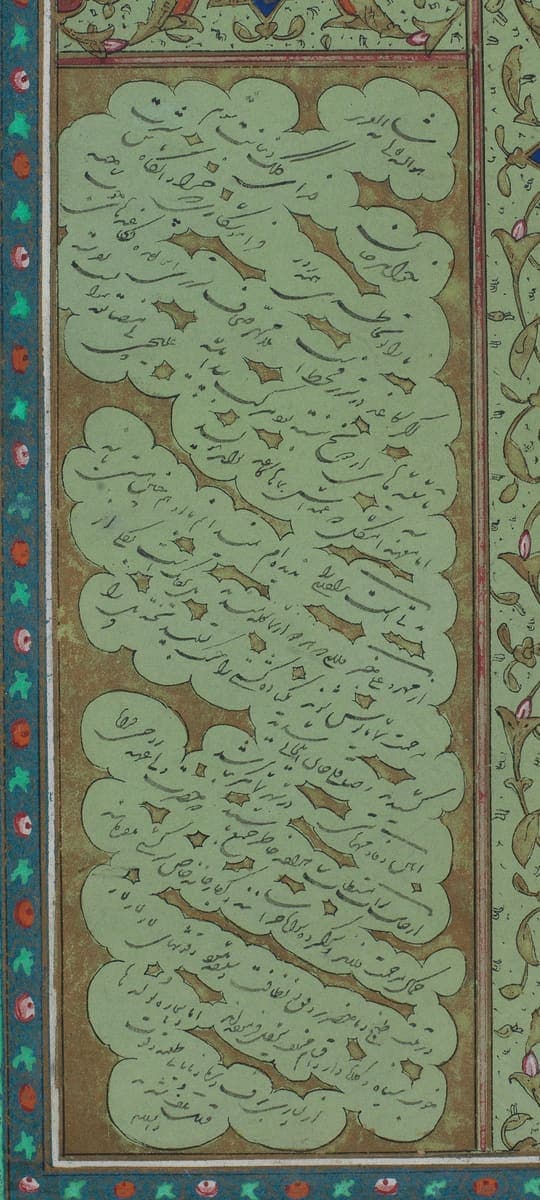
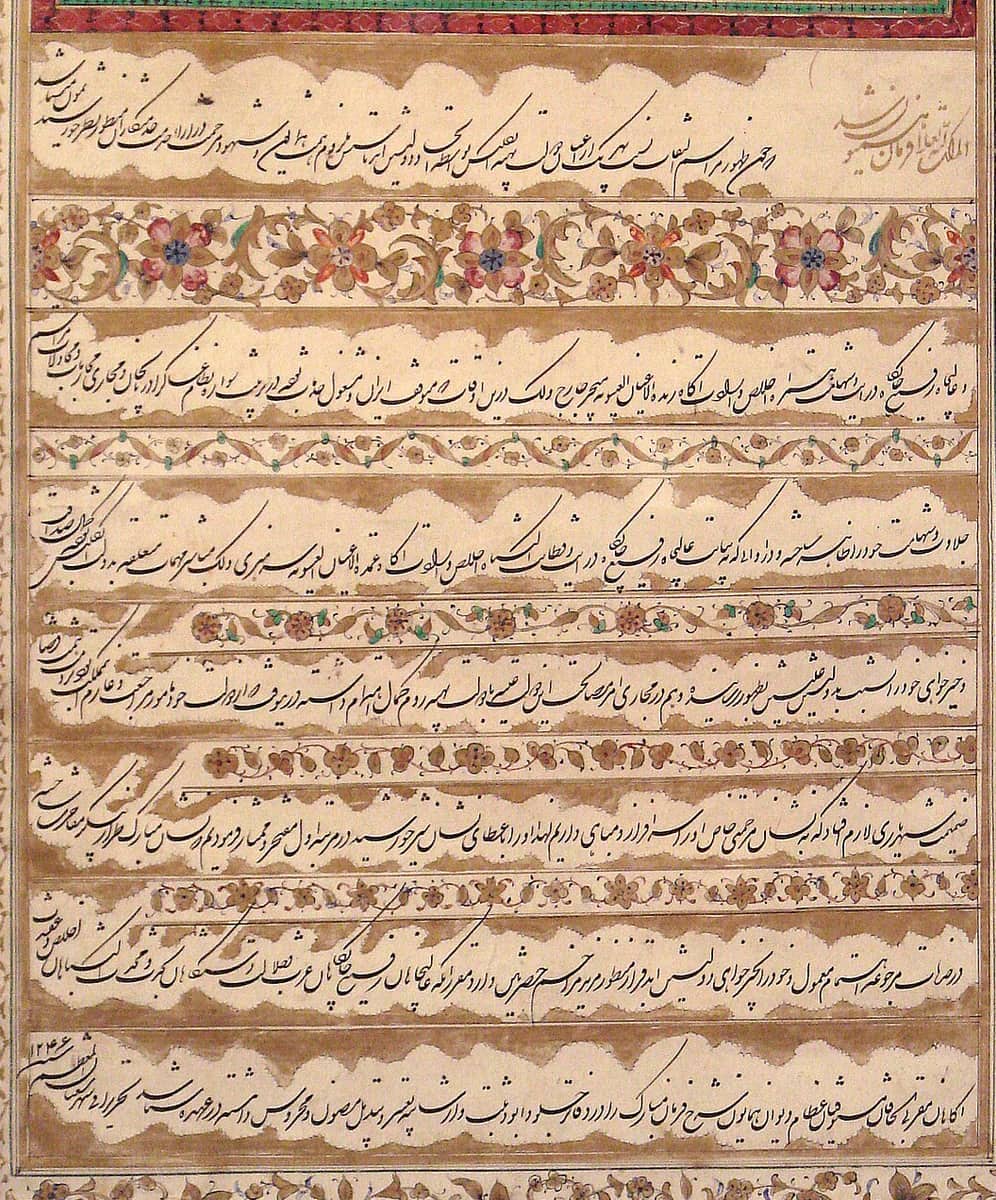
Metropolitan Museum of Art, New York, January 1831 · Source · CC BY-SA 3.0 · Photograph by Wikimedia Commons user PHGCOM
Evidano Transcription
الملک لله تعالی
فرمان همایون شد
[seven lines of shikasta, not verified]
[…] در عهده شناسند تحریرا فی شهر شعبان المعظم ۱۲۴۶
Generated by Evidano’s advanced model; not yet checked against a published edition.
How the hand and the sheet are put together
Shikasta nastaʿliq grew out of the chancery in the later seventeenth century, when secretaries writing at dictation began breaking the proportions of nastaʿliq to keep up. By the eighteenth century it was studied for its own sake: Darwīsh ʿAbd al-Majīd Ṭāliqānī, who died in 1771, is the figure the tradition looks back to, and Sayyid ʿAlī Akbar Golestāneh, who died in 1901, carried it into Qajar album pieces. The everyday version stayed in use for government paper, family letters, bills and deeds until lithography displaced it, so a scruffy note about the price of grain and a gold-sprinkled album leaf can be the same script at two speeds.
The mechanics are what make it hard. Persian has seven letters — ا, د, ذ, ر, ز, ژ and و — that never connect to what follows; in shikasta the pen carries straight on through them, so a line can be one continuous stroke broken only where the writer chose to lift. Bodies shrink: س and ش lose their teeth and flatten into a bar, ع and غ close into a knot, and ه, ی and ن are pulled into shallow curves that carry three letters inside them. Dots are dropped, gathered into a dash or laid over the neighbouring word, and the four letters Persian added to the Arabic alphabet lose their marks first. What the reader recognises is not letters but the silhouette of a stock phrase.
The sheet has its own conventions. A letter opens at the top right with a small invocation such as هو or بسمه تعالی, clear of the first line; the body then climbs from right to left, and when a line reaches the edge it turns up the margin or doubles back between two lines. Honorifics swallow whole clauses — a correspondent is addressed by title and epithet for three lines before anything is asked — so the useful content is often the last sentence. Seals are stamped at the head or foot, the date is written in words or in abjad letters, and endorsements and later family notes fill the margins in hands that are not the writer’s. Account papers add siyāq, an abbreviated notation for sums that looks nothing like the digits ۱۲۳.
Why ordinary OCR struggles here
Word boundaries disappear
Because the pen joins letters that ought to stand apart, the white space that normally separates Persian words is absent for a whole clause at a time. Segmenting on gaps produces one enormous token, and segmenting on strokes cuts inside words; either way the output does not match anything in a dictionary.
The dots are missing or in the wrong place
A single skeleton can be read as ب, پ, ت, ث, ن or ی, and shikasta routinely leaves it bare or moves its dots to sit above the previous word. Only the sense of the sentence and the stock phrases of Persian letter-writing decide which letter it is, which is knowledge a character classifier does not have.
Lines that rise, turn and double back
Text climbs to the left, runs up the margin, comes back over itself around a seal or a hole in the paper, and resumes below. Reading in horizontal bands mixes the margin into the body and puts the last clause of a sentence three lines above its start.
Layers added years apart
A petition carries the request, the answer written across it, a registration note, a seal and a family annotation from two generations later. Flattened into one transcription they read as a single confused text; kept apart with their positions, they are the document’s history.
Who works with this material
Historians of Safavid and Qajar Iran
Provincial correspondence, petitions and drafts held in national and family archives carry the detail that chronicles leave out — prices, appointments, quarrels over water. A searchable first reading makes it possible to work through a box of loose sheets instead of a chosen dozen.
Archivists describing deeds and decrees
Endowment deeds, sale contracts and farmans are catalogued by parties, property, date and seal. Those elements sit in predictable places on the sheet, so pulling them out first turns an undescribed bundle into a finding aid.
Editors of Persian letter collections
Munshaʾāt volumes and the published correspondence of Qajar statesmen are edited from several copies at once. An editor needs each witness rendered as it stands, with its abbreviations left unexpanded, before deciding what the author wrote.
Curators and provenance researchers
Album leaves and single sheets carry signatures, dedications, collectors’ notes and seal impressions that decide attribution. These are short passages in odd corners of the page, and they are usually the last thing a catalogue records.
Getting the best transcription
Say what kind of document it is
A petition, a private letter, a farman and an account leaf each have their own formulae. Naming the genre lets the model predict the opening invocation, the honorific block and the closing, so that its guesses fall on real phrases rather than plausible letter shapes.
Ask for the parts of the sheet separately
Request the invocation, the body, each margin, the seal legends and any later endorsement as separate blocks, with a note of where each sits and which way it runs. Where a line turns into the margin, ask for it to be joined to the line it continues and for the join to be marked.
Be explicit about dots and abbreviations
Decide whether you want missing dots supplied silently, supplied in brackets, or left out, and whether contracted honorifics should be expanded. For a corpus, pick one convention and state it in every prompt, or half the files will disagree with the other half.
Start with a sheet you can already read
Run a document whose date, sender and outcome you know before you trust a batch. Checking the date line, the seal and one honorific formula against what you know tells you quickly whether the model is following this writer’s joins or inventing them.
Further reading on this hand
The palaeography guides the in-app selector points to for this domain, if you want to check a transcription against the standard references.
- Calligraphy
This Encyclopaedia Iranica article provides a historical survey of Persian calligraphic styles, including the development of broken or Shikasta forms from Nastaʿliq. It places these scripts within the professional and literary culture of Iran and the wider Persianate world. The discussion explains relationships among script styles, aesthetic principles, and increasingly rapid or cursive execution. It is useful for Shikasta correspondence because it supplies the historical distinction between formal Nastaʿliq and its more compressed cursive derivatives.
Frequently asked questions
- How does it decide where one word ends and the next begins?
- From the language rather than from the ink. The model proposes a reading of the whole stroke sequence and then splits it into Persian words that make sense together, which is how a human reader handles a clause written without a single lift of the pen. Places where the split is doubtful can be flagged rather than smoothed over.
- Will it put back dots the writer left out?
- Only if you ask. The default is to give the word the reading the sense requires and to note that the marks are absent from the sheet, so that a reader who cares about the physical document is not told it carries dots it does not have. Bracketed restoration is available as an option.
- Can seal legends be read?
- Sometimes. Seals are cut in a compressed script, are often stamped unevenly, and carry a name, a title and a year in a few square centimetres. They are best run as a separate close crop; where the impression is too faint the legend is reported as illegible rather than guessed.
- What happens with siyāq figures in accounts?
- Siyāq is a separate notation, not Persian numerals, and it is treated as such: the tokens are returned as they stand with their position in the column, and conversion to figures is offered as a second step so that an accountancy convention is never quietly imposed on the original.
- Are marginal notes added later kept apart from the letter?
- Yes. Endorsements, registration notes and family annotations are returned as their own blocks with their position on the sheet, because they can be a century younger than the text they sit beside and often contradict it.
Related scripts and pages
Put your shikasta papers into text
Upload a letter, petition or farman, choose Persian Shikasta Nastaʿliq Correspondence, and say which genre the sheet belongs to.