
Polish · c. 1800–1918
One register, two languages, one formula
Civil registration in the Russian partition ran on a sentence that barely changed for a century: Działo się w… on one page and Состоялось въ… a few volumes later, the same clause translated word for word when Russian replaced Polish in 1868. Because the wording is fixed, the information sits entirely in the names, ages, hours and villages threaded through it — the parts written fastest, in two alphabets, with a surname often spelled one way in the text and another in the signature.
Sample pages
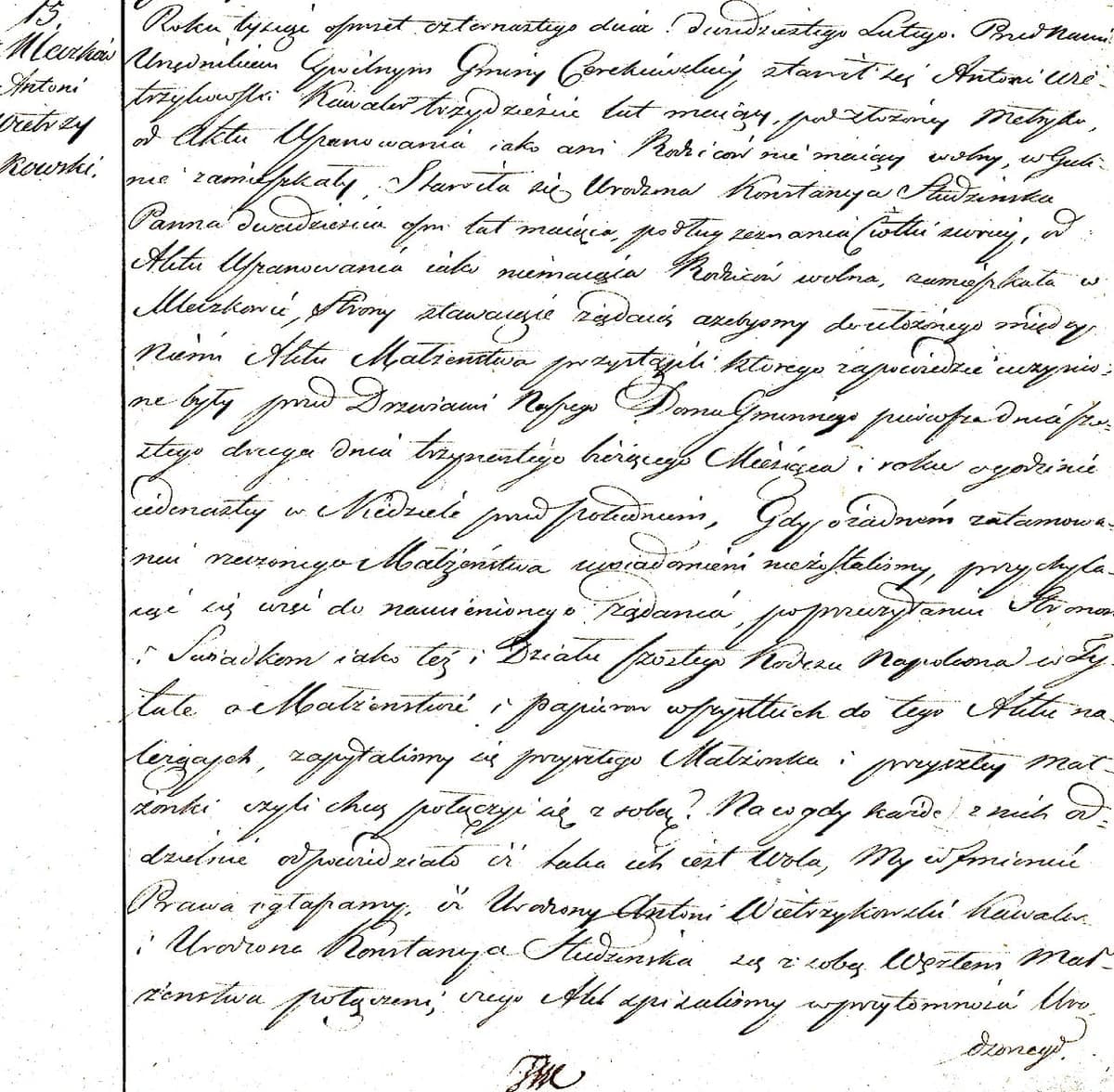
Archiwum Państwowe w Radomiu, 20 February 1814 · Source · Public domain · Archiwum Państwowe w Radomiu
Evidano Transcription
- Mierków[?]
Antoni
Wietrzy
kowski.
Roku tysiąc osmset czternastego dnia Dwudziestego Lutego. Przed Nami
Urzędnikiem Cywilnym Gminy Cerekiewskiey stawił się Antoni Wie-
trzykowski Kawaler trzydzieście lat maiący, pod złożoney Metryki,
od Aktu Upranowania iako ani Rodziców nie maiący wolny, w Guli-
nie zamieszkały, Stawiła się Urodzona Konstancya Studzinska
Panna dwadzieścia ośm lat maiąca, podług zeznania Ciotki swoiey, od
Aktu Upranowania iako niemaiąca Rodziców wolna, zamieszkała w
Mierkowie[?], Strony stawaiące żądaią ażebyśmy do ułożonego między
niemi Aktu Małżeństwa przystąpili którego zapowiedzie uczynio-
ne były przed Drzwiami Naszego Domu Gminnego pierwsza dnia szo-
stego druga dnia trzynastego bieżącego Miesiąca i roku o godzinie
iedenastey w Niedziele przed południem, Gdy o żadném zatamowa-
niu rzeczonego Małżeństwa uwiadomieni nie zostaliśmy, przychyla-
iąc się więc do namienionego żądania, po przeczytaniu Stronom
i Świadkom iako też i Działu szóstego Kodexu Napoleona w Ty-
tule o Małżeństwie i papierów wszystkich do tego Aktu na-
leżących, zapytaliśmy się przyszłego Małżonka i przyszłey mał-
żonki czyli chcą połączyć się z sobą? Na co gdy każde z nich od-
dzielnie odpowiedziało iż taka ich iest Wola, My w Imieniu
Prawa ogłaszamy, iż Urodzony Antoni Wietrzykowski Kawaler
i Urodzona Konstancya Studzinska są z sobą Węzłem Mał-
żeństwa połączeni, czego Akt spisaliśmy w przytomności Uro-
dzoney.
[paraph]
Generated by Evidano’s advanced model; not yet checked against a published edition.
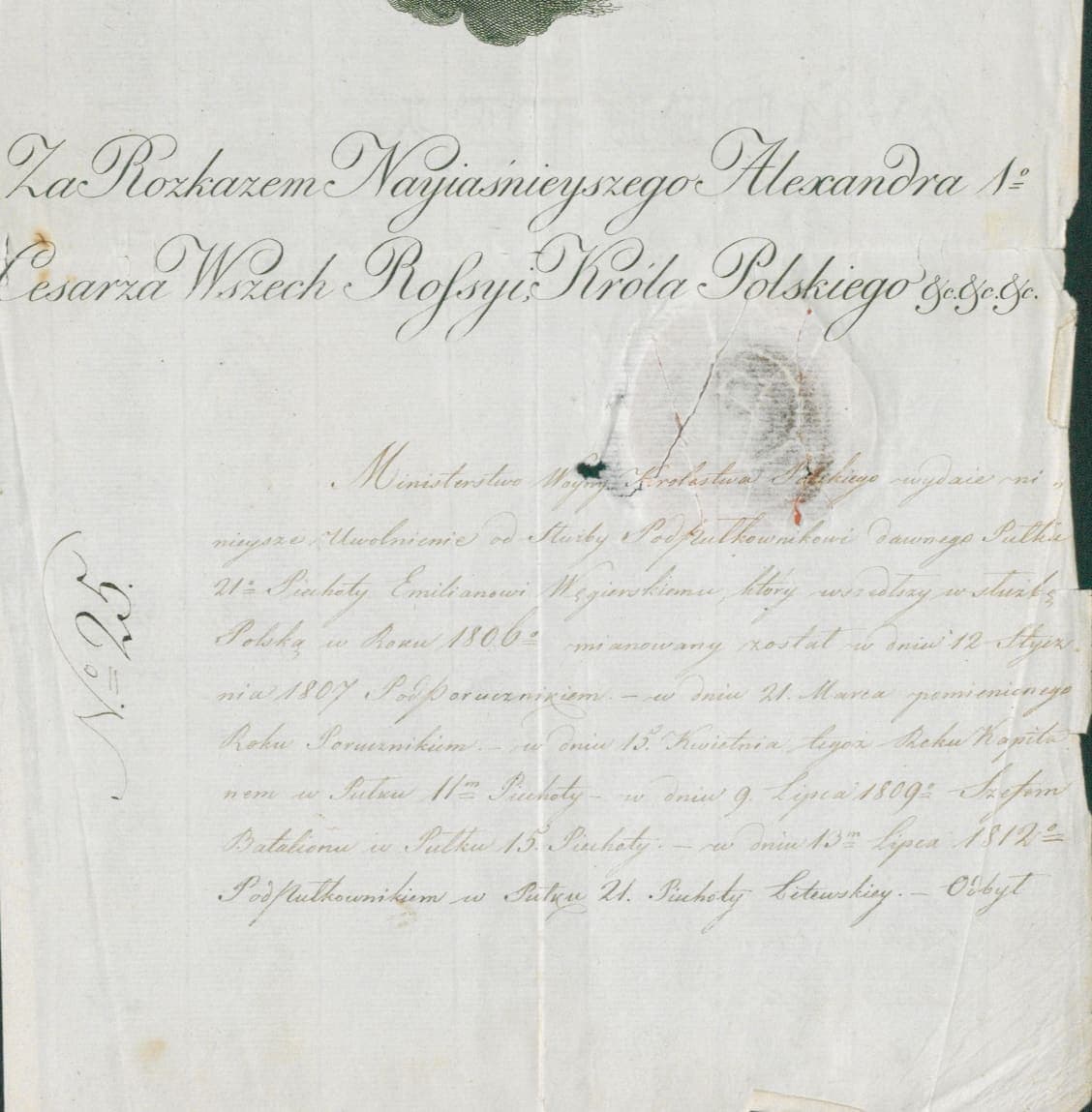
Archiwum Państwowe w Poznaniu, 53/1926/0/1/163, 1815 · Source · CC0 1.0 · State Archive in Poznań / Wikimedia Polska cooperation project
Evidano Transcription
Left margin
Nro 25.
Za Rozkazem Nayiaśnieyszego Alexandra 1go
Cesarza Wszech Rossyi, Króla Polskiego &c. &c. &c.
Ministerstwo Woyny Krolestwa Polskiego wydaie ni=
nieysze Uwolnienie od Służby Podpułkownikowi dawnego Pułku
21go Piechoty Emilianowi Węgierskiemu, ktory wszedłszy w Służbę
Polską w Roku 1806m mianowany został w dniu 12 Stycz=
nia 1807 Podporucznikiem. — w dniu 21. Marca pomienionego
Roku Porucznikiem. — w dniu 15. Kwietnia tegoż Roku Kapita=
nem w Pułku 11m Piechoty. — w dniu 9. Lipca 1809go Szefem
Batalionu w Pułku 15. Piechoty. — w dniu 13go Lipca 1812go
Podpułkownikiem w Pułku 21. Piechoty Litewskiey. — Odbył
Generated by Evidano’s advanced model; not yet checked against a published edition.
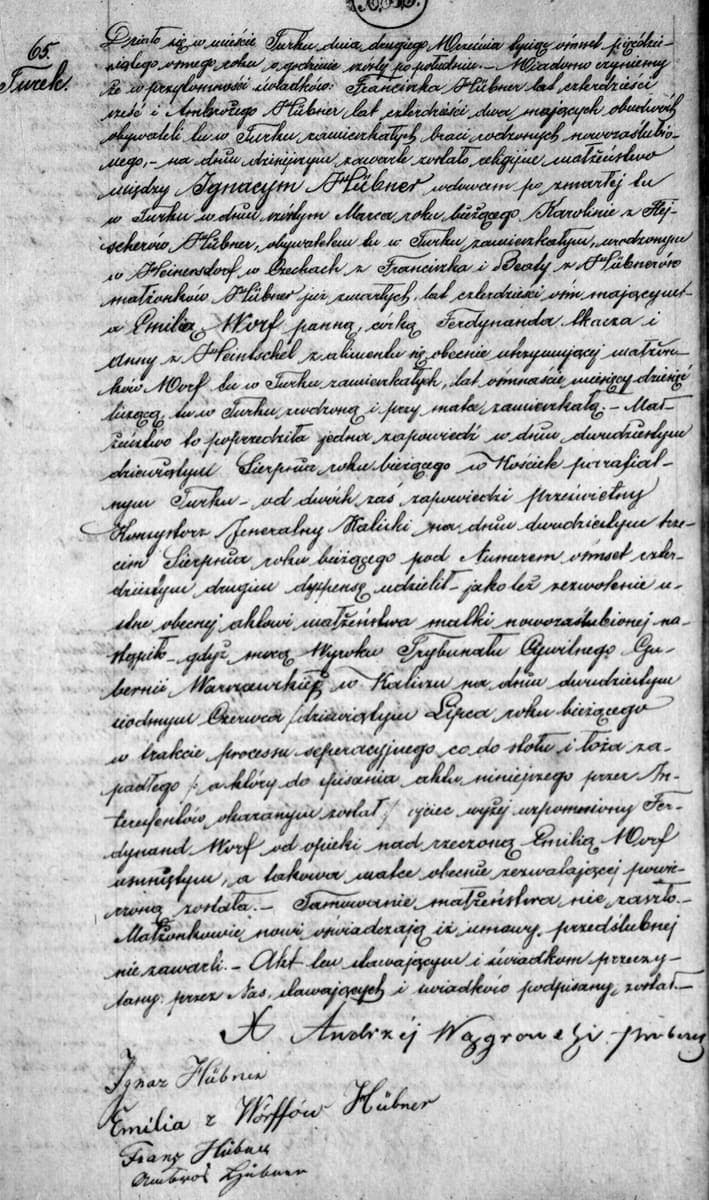
Archiwum Państwowe w Poznaniu, Oddział w Koninie, 2 September 1858 · Source · Public domain · Archiwum Państwowe w Poznaniu, Oddział w Koninie
Evidano Transcription
Margin
- Turek.
Działo się w mieście Turku dnia drugiego Września tysiąc ośmset pięćdzie-
siątego ósmego roku o godzinie szóstej po południu. - Wiadomo czyniemy
że w przytomności świadków: Franciszka Hübner lat czterdzieści
sześć i Ambrożego Hübner lat czterdzieści dwa mających obudwóch
obywateli tu w Turku zamieszkałych braci rodzonych nowozaślubio-
nego, - na dniu dzisiejszym zawarte zostało religijne małżeństwo
między Ignacym Hübner wdowcem po zmarłej tu
w Turku w dniu szóstym Marca roku bieżącego Karolinie z Flej-
scherów Hübner, obywatelem tu w Turku zamieszkałym, urodzonym
w Heinersdorf w Czechach z Franciszka i Beaty z Hübnerów
małżonków Hübner już zmarłych, lat czterdzieści ośm mającym -
a Emilią Worf panną, córką Ferdynanda tkacza i
Anny z Heintschel z alimentu się obecnie utrzymującej małżon-
ków Worf tu w Turku zamieszkałych, lat ośmnaście miesięcy dziesięć
liczącą, tu w Turku urodzoną i przy matce zamieszkałą. - Mał-
żeństwo to poprzedziła jedna zapowiedź w dniu dwudziestym
dziewiątym Sierpnia roku bieżącego w Kościele parafial-
nym Turku - od dwóch zaś zapowiedzi Prześwietny
Konsystorz Jeneralny Kaliski na dniu dwudziestym trze-
cim Sierpnia roku bieżącego pod Numerem ośmset czter-
dziestym drugim dyspensę udzielił - jako też zezwolenie u-
stne obecnej aktowi małżeństwa matki nowozaślubionej na-
stąpiło - gdyż mocą Wyroku Trybunału Cywilnego Gu-
bernii Warszawskiej w Kaliszu na dniu dwudziestym
siódmym Czerwca /dziewiątym Lipca/ roku bieżącego
w trakcie procesu separacyjnego co do stołu i łoża za-
padłego /: a który do spisania aktu niniejszego przez In-
teresentów okazanym został :/ ojciec wyżej wspomniony Fer-
dynand Worf od opieki nad rzeczoną Emilią Worf
usuniętym, a takowa matce obecnie zezwalającej powie-
rzoną została. - Tamowanie małżeństwa nie zaszło. -
Małżonkowie nowi oświadczają iż umowy przedślubnej
nie zawarli. - Akt ten stawającym i świadkom przeczy-
tany, przez Nas, stawających i świadków podpisany został. -
X Andrzej Wągrowski proboszcz
Ignaz Hübner
Emilia z Worfów Hübner
Franz Hübner
Ambroż Hübner
Generated by Evidano’s advanced model; not yet checked against a published edition.
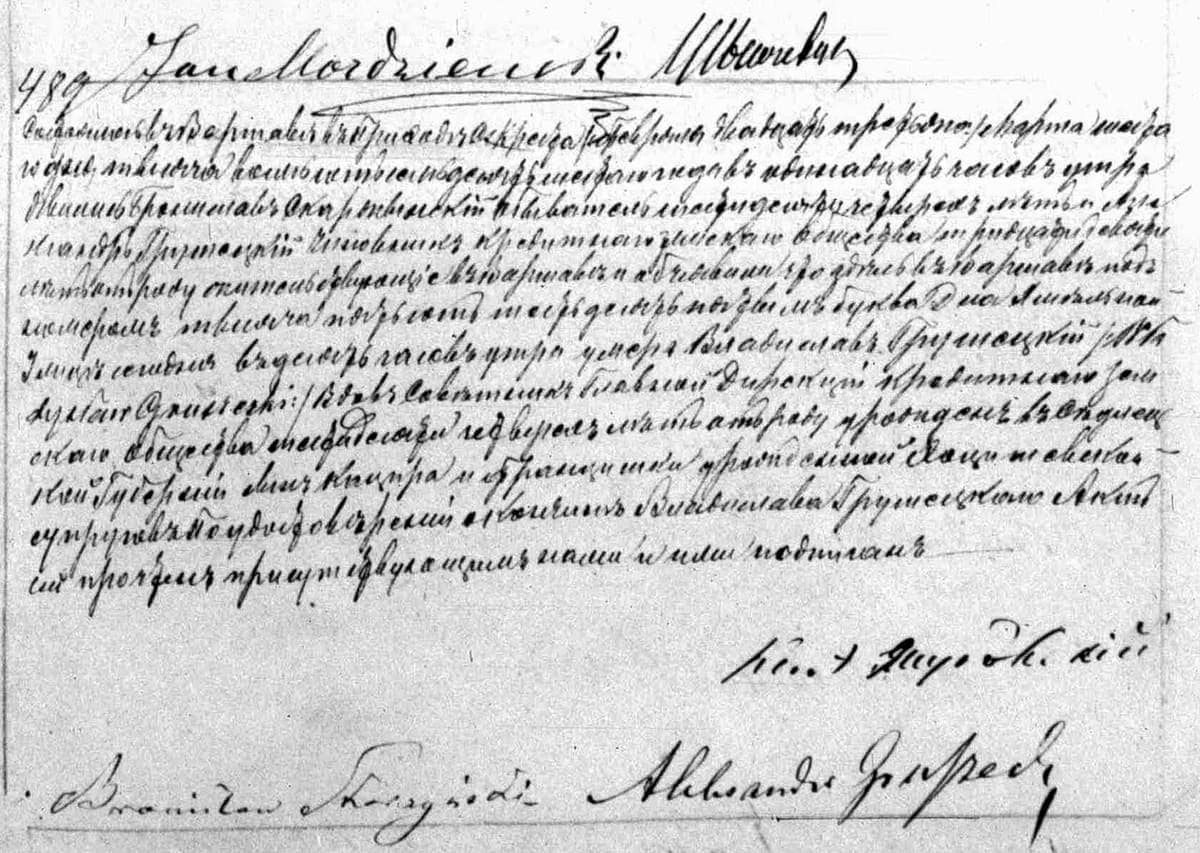
Archiwum Państwowe m.st. Warszawy, 1876 · Source · Public domain · Scan published via Genealodzy.pl
Evidano Transcription
- Jan Mordziewski[?] [illegible]
Состоялось въ Варшавѣ въ приходѣ Св. Креста [illegible]
[illegible] тысяча [illegible] часовъ утра.
[illegible] Грушецкій [illegible]
[illegible] Варшавѣ [illegible] подъ
номеромъ тысяча [illegible]
[illegible] въ десять часовъ утра умеръ Владиславъ Грушецкій [illegible]
(Wladislaw Gruszecki) [illegible]
[illegible]
[illegible] Губерніи сынъ Каспра и Францишки [illegible]
супругъ [illegible] Владислава Грушецкаго Актъ
сей прочтенъ присутствующимъ нами и ими подписанъ.
[signature]
Bronisław [illegible] Aleksander [illegible]
Generated by Evidano’s advanced model; not yet checked against a published edition.
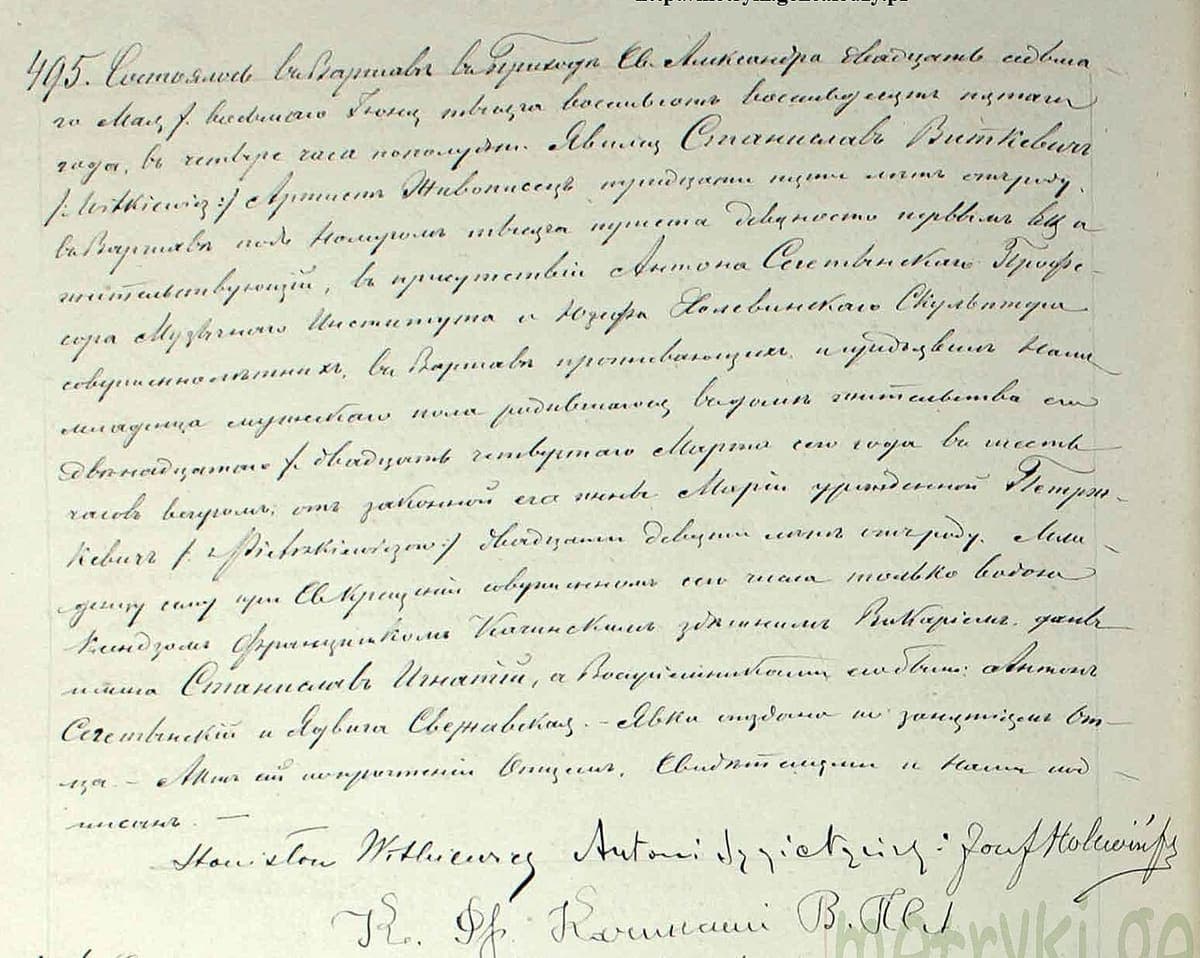
Parish of St Alexander, Warsaw, 1885 · Source · Public domain · Scan from the metryki.genealodzy.pl digitisation project
Evidano Transcription
- Состоялось въ Варшавѣ въ Приходѣ Св. Александра двадцать седьма-
го Мая /: девятаго Іюня тысяча восемьсотъ восемьдесятъ пятаго
года, въ четыре часа пополудни. Явился Станиславъ Виткевичъ
/: Witkiewicz :/ Артистъ Живописецъ тридцати пяти лѣтъ отъ роду,
въ Варшавѣ подъ Номеромъ тысяча триста девяносто первымъ бук[ва][?] а
жительствующій, въ присутствіи Антона Сегетынскаго Профе-
сора Музычнаго Института и Юзефа Холевинскаго Скульптора
совершеннолѣтнихъ, въ Варшавѣ проживающихъ, и предъявилъ Намъ
младенца мужескаго пола родившагося въ домѣ жительства его
двѣнадцатаго /: двадцать четвертаго Марта сего года въ шесть
часовъ вечеромъ, отъ законной его жены Маріи урожденной Петрж-
кевичъ /: z Pietrzkiewiczów :/ двадцати девяти лѣтъ отъ роду. Мла-
денцу сему при Св. Крещеніи совершенномъ сего числа только водою
Ксендзомъ Францишкомъ Каминскимъ здѣшнимъ Викаріемъ, даны
имена Станиславъ Игнатій, а Воспріемниками его были: Антонъ
Сегетынскій и Ядвига Свержавская[?]. - Явка опоздана по занятіямъ от-
ца. - Актъ сей по прочтеніи Отцомъ, Свидѣтелями и Нами под-
писанъ. -
Stanisław Witkiewicz Antoni Sygietyński Józef Holewiński
Ks. Ff. Kaminski B. P. A.[?]
Generated by Evidano’s advanced model; not yet checked against a published edition.
How the acts were written
Civil registration on the French model arrived with the Duchy of Warsaw in 1808 and survived in Congress Poland long after Napoleon. Instead of the ruled columns used in Austria and Prussia, each event is a paragraph of continuous Polish prose written by the registrar — in practice the parish priest — who states where and when the act was drawn up, who appeared, their ages, occupations and places of residence, the facts declared, the witnesses, and the reading over of the act before signature. Early acts open with the year: Roku tysiąc ośmset czternastego dnia dwudziestego Lutego. From the 1820s the opening settles into Działo się w mieście Turku dnia drugiego Września, and the number of the act with the surname is repeated in the left margin so a volume can be searched without reading it.
On 1 January 1868 Russian became the language of civil registration in the Kingdom of Poland. The clerk kept the same book, the same formula and the same order of facts, and simply translated: Состоялось въ Варшавѣ … въ … часовъ … The hand changes with the language — Russian civil cursive, with the pre-reform letters ѣ, і, ѳ and the final hard sign ъ, and with the notorious sequences in which и, н, п and т are drawn as identical arcs and only the length of a stroke separates them. Dates are given twice, Julian and Gregorian, separated by a slash or a bracket, and ages and hours are spelled out in words rather than figures.
Polish never leaves the page. Surnames have to be pushed through Cyrillic — Grzegorz becomes Гржегоржъ, Szczepan becomes Щепанъ — and many registrars, knowing how badly that works, add the Latin-script spelling in brackets immediately after the Cyrillic one. Signatures at the foot are almost always in Latin script, in the signatories’ own hands, so the last three lines of a Russian act are Polish. Add to that the stamps of the registrar, the numbers of the act repeated in the margin and in an annual index, later annotations recording a marriage or a court decision, and the same event written up twice in a duplicate copy sent to the district court, and the difference between two versions of one act becomes a research question in its own right.
Why ordinary OCR struggles here
A formula that invites invention
Most of every act is boilerplate the model has seen a thousand times, and the temptation is to complete it from memory. The danger is that the rest — a name, an age, an hour, a village — gets completed the same confident way. Transcribing these registers means being strict about what is actually legible on the line.
Two alphabets on the same line
A Russian act carries Polish surnames in brackets, Latin-script signatures and sometimes a Polish marginal note. Treated as one script, the Latin passages come back as Cyrillic nonsense, and it is precisely those passages that record how the family itself spelled its name.
Pre-reform letters and identical strokes
Recognition trained on modern Russian drops ѣ, і and ѳ or silently modernises them, and reads handwritten и, н, п, т and л by guesswork. In a register the misread letter is usually inside a Polish surname that no Russian dictionary can repair.
Numbers written as words, dates written twice
Ages, hours, house numbers and years are spelled out at length, and every date carries its Julian and Gregorian forms. A transcription that quietly converts the pair to one figure destroys the evidence a genealogist uses to decide which calendar a family, a parish or a clerk was actually working in.
Who works with this material
Genealogists working the Polish registers
Anyone tracing a family through Mazovia or Kalisz province meets Polish acts to 1867 and Russian acts afterwards in one parish. They need every name, age, occupation and village lifted out of the paragraph into fields, with the Polish and Cyrillic forms of a surname kept side by side.
Indexing projects and record societies
Volunteer projects index these books act by act for whole deaneries. A first pass that reliably reports the act number, the date, the principal names and the witnesses turns weeks of typing into checking, provided uncertain readings are flagged rather than smoothed over.
Social and demographic historians
Occupations, ages at marriage, literacy shown by signatures and the pattern of dispensations are all recoverable at scale. That work depends on transcriptions keeping numbers as words where the clerk wrote words, because a normalised age hides how the figure was arrived at.
Researchers of Jewish and non-Catholic records
Separate civil registers were kept for Jewish, Protestant and Orthodox communities under the same law and in the same two languages, often with Hebrew signatures added at the foot. They need a transcription that handles a third script on the page without dropping it.
Getting the best transcription
Say which side of 1868 you are on
Tell the model the year and the expected language of the volume, and warn it that both may appear in one book. A volume opened in Polish and continued in Russian is the normal case, and saying so up front stops one language being forced on the whole run.
Ask for the margin as its own field
The act number and the surname in the left margin are the index of the volume. Requested separately, they give you a usable finding aid even from pages whose body text needs review, and they act as a check on the name inside the act.
Set the rules for scripts and old letters
State that Latin-script names and signatures are to be transcribed in Latin script, and that ѣ, і, ѳ and final ъ are to be kept rather than modernised. Ask for a normalised Polish form of each name as a separate value, so the strict reading and the searchable one both exist.
Test on the year the language changed
Take a volume that runs across 1867 and 1868 and transcribe the last Polish act and the first Russian one. If both come back correctly labelled, with the double dates intact, the rest of the parish will usually follow.
Further reading on this hand
The palaeography guides the in-app selector points to for this domain, if you want to check a transcription against the standard references.
- Russian Handwriting: Introduction
This Brigham Young University guide introduces Russian printed and cursive alphabets, including archaic letters found in Imperial records. It provides alphabet charts, handwriting examples, vocabulary, grammar, and record-format guidance. The materials show how cursive Cyrillic differs from type and how names, dates, and official terms appear in historical documents. It is useful for partition-era Polish records because Russian administrative entries often accompany Polish Latin-script text.
Frequently asked questions
- Can the same tool read both the Polish and the Russian acts?
- Yes, and it can be told to expect the switch inside one volume. Each act is labelled with the language it is written in, so a run of pages can cross from Działo się to Состоялось without the transcription silently pretending the register never changed.
- How are Polish surnames written in Cyrillic handled?
- The Cyrillic spelling is transcribed as it stands and, where the registrar has added the Latin-script form in brackets, that is kept too. A suggested Polish reading can be supplied as a separate field, but it is never substituted for what the clerk actually wrote.
- Are pre-reform letters preserved?
- They are. Yat, decimal і, fita and the final hard sign are part of the record and are reported as written. Modernising them makes two different clerks look identical and removes one of the few clues to when and where a hand was trained.
- What is done with the double dates?
- Both members of the pair are transcribed in the order they appear, with the calendar of each identified. A single normalised date can be added alongside, which is useful for sorting, but the pair itself stays in the text.
- The formula is always the same. Can the model just fill it in?
- It should not, and review is built around that risk. Standing phrases are recognised as standing phrases, while the variable parts — names, ages, hours, places, occupations — carry a confidence flag, so an unreadable line is never quietly supplied from the pattern.
Related scripts and pages
Transcribe a partition-era register
Upload acts in Polish or Russian, choose Polish and Russian Civil Records, and set how names should be reported before you index a whole parish.