
Portuguese · c. 1385–1520
Read the chancery hands of the house of Avis
From the accession of João I to the end of the Manueline reforms, Portuguese clerks wrote a rounded, joined hand in which the ascenders of b, d, h and l carry wide loops and a letter often passes straight through its neighbour. Two things defeat ordinary recognisers here: the loop that turns an e into something that reads as c or o, and the density of contraction, where a whole royal style can be reduced to a handful of letters under a tilde.
Sample pages
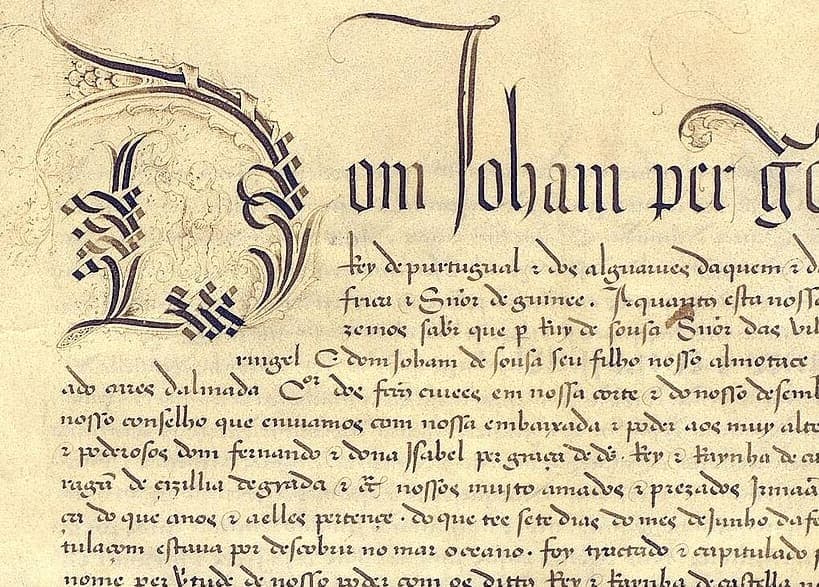
Archivo General de Indias, Seville, 1494 · Source · Public domain
Evidano Transcription
Dom Joham per g [cut off]
Rey de purtugual e dos alguarues daquem e d [cut off]
frica e S[enh]or de guinee . A quanto[s] esta nossa [cut off]
zemos sab[e]r que p[er] Ruy de sousa S[enh]or das vil [cut off]
ringel E dom Joham de sousa seu filho nosso almotace [cut off]
ado ares dalmada Cor[regedor] dos f[ei]t[o]s ciuees em nossa corte e do nosso desemb [cut off]
nosso conselho que enuiamos com nossa embaixada e poder aos muy alt [cut off]
e poderosos dom fernando e dona Jsabel per graça de d[eu]s Rey e Raynha de ca [cut off]
ragu[m] de çizillia de gr[an]ada e c[etera] nossos muyto amados e prezados Jrmaa [cut off]
ca do que anos e aelles pertençe . do que tee sete dias do mes de Junho da f [cut off]
tulaçom estaua por descobrir no mar oceano . foy tractado e capitulado p [cut off]
nome per v[ir]tude de nosso poder com os dittos Rey e Raynha de castella [cut off]
Generated by Evidano’s advanced model; not yet checked against a published edition.
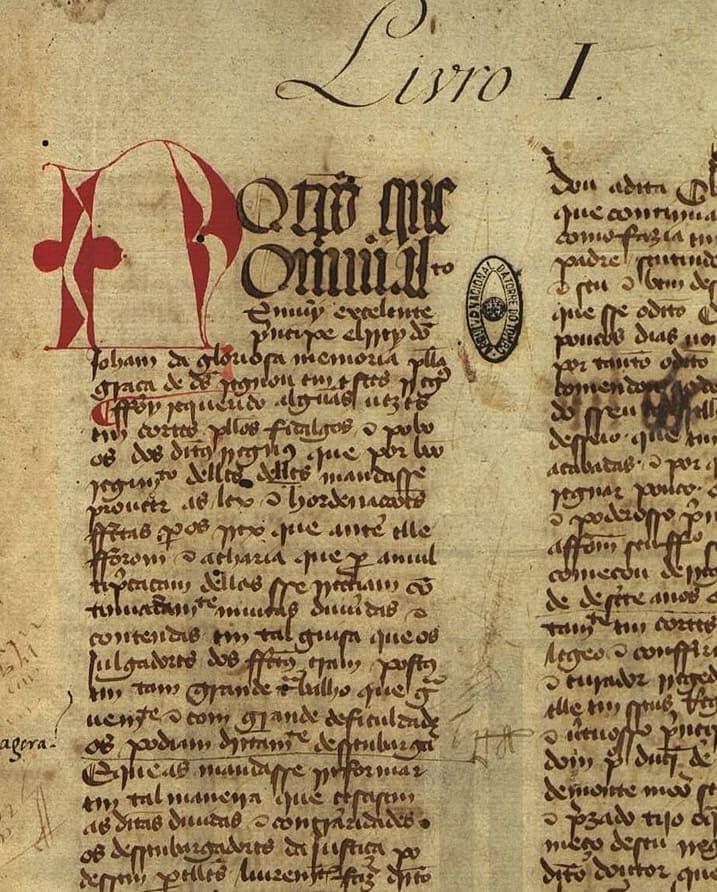
Arquivo Nacional da Torre do Tombo, Núcleo Antigo, Códice 4, f. 1r, 15th century · Source · CC BY-SA 4.0 · Digitarq, Arquivo Nacional da Torre do Tombo
Evidano Transcription
Livro I.
[display capitals illegible]
e muy excelente
principe elRey d[om]
Joham da gloriosa memoria pella
graça de d[eu]s rreynou[?] em estes rregnos
ffoy rrequerido algu[m]as uezes
em cortes pellos fidalgos e pouo
os dos ditos rregnos que por be[m]
rregim[en]to delles delles mandasse
proueer as leys e hordenaçoe[e]s
ffeitas pellos rreys que ante elle
fforom e acharia que p[er] a mul
tiplicaçam dellas se rrecreciam co[n]
tinuadam[en]te muytas duuidas e
contendas em tal guisa que os
julgadores dos ffeitos eram postos
em tam grande trabalho que gra
uemente e com grande deficuldade
os podiam direitam[en]te desembargar
E que as mandasse rreformar
em tal maneyra que cessassem
as ditas duuidas e contrariedades e
os desembargadores da justiça po
dessem pellas liurem[en]te ffaz[er] dir[eit]o
[cut off at the image edge; illegible]
Generated by Evidano’s advanced model; not yet checked against a published edition.
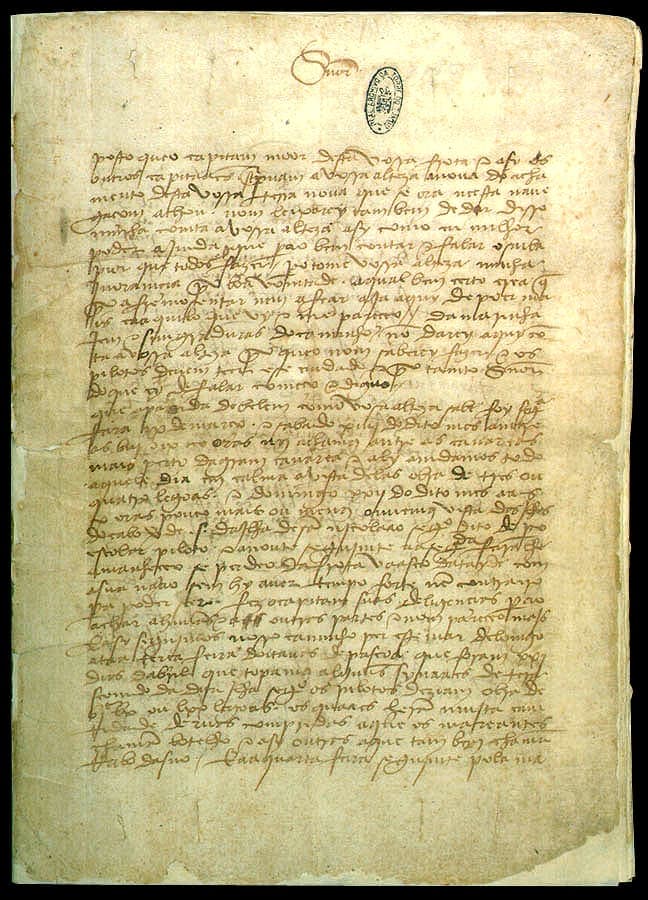
Arquivo Nacional da Torre do Tombo, Gaveta 8, maço 2, n.º 8, 1 May 1500 · Source · Public domain
Evidano Transcription
The opening of the letter as printed in the 1892 Torre do Tombo collection, a diplomatic text that keeps the writer’s spelling, separates his agglutinations with a space and adds the value of each Roman numeral in round brackets; the page carries more than is quoted here. Scanning errors in the Internet Archive text (b for v, c for e) have been corrected, and the editor’s line-end hyphens removed.
Senhor. Posto que o capitam moor d esta vossa frota, e asy os outros capitaães, sprevam a Vossa Alteza a nova do achamento d esta vossa terra nova, que se ora neesta navegaçom achou, nom leixarey tambem de dar d isso minha comta a Vossa Alteza, asy como eu milhor poder, ajmda que, pera o bem contar e falar, o saiba pior que todos fazer; pero tome Vossa Alteza minha inoramçia por boa vomtade; a qual bem certo crea, que por afremosentar nem afear aja aquy de poer mais ca aquilo que vy e me pareçeo.
Da marinhajem e simgraduras do caminho nom darey aquy conta a Vossa Alteza, porque o nom saberey fazer, e os pilotos devem teer ese cuidado; e portamto, senhor, do que ey de falar começo e diguo:
Que a partida de Belem, como Vosa Alteza sabe, foy segunda feira ix de Março, e sabado xiiij (14) do dito mes, amtre as viij (8) e ix oras, nos achamos amtre as Canareas, mais perto da Gram Canarea; e aly amdamos todo aquele dia em calma, a vista d elas, obra de tres ou quatro legoas; e domingo xxij (22) do dito mes, aas x oras, pouco mais ou menos, ouvemos vista das jlhas de Cabo Verde, saber: da jlha de Sam Njcolaao, segundo dito de Pero Escolar, piloto.
Source: Alguns Documentos do Archivo Nacional da Torre do Tombo ácerca das Navegações e Conquistas Portuguezas (Lisbon: Imprensa Nacional, 1892), pp. 108–109, via Internet Archive (Public domain).
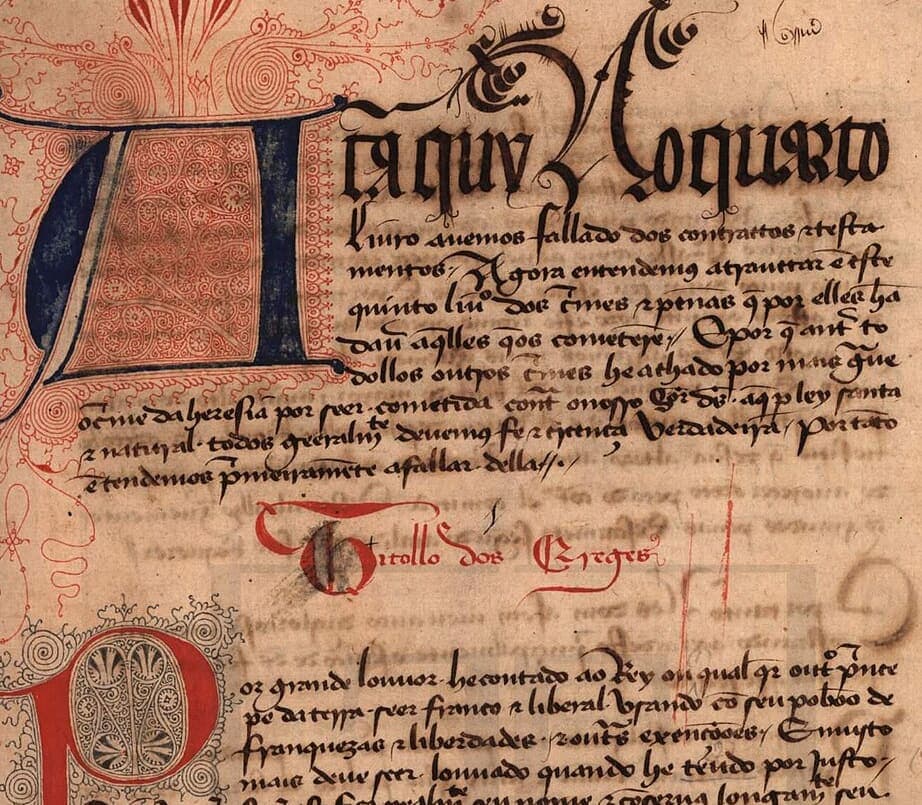
Arquivo Nacional da Torre do Tombo, Núcleo Antigo, Códice 14, f. 1r, 15th century · Source · CC BY-SA 4.0 · Digitarq, Arquivo Nacional da Torre do Tombo
Evidano Transcription
The prologue to Book V and the opening of its first title as printed in Ordenaçoens do Senhor Rey D. Affonso V (Coimbra, 1786), whose spelling follows the manuscripts but whose punctuation and capitals are the printer’s. The long s of the printed page, which the Internet Archive scan reads as f, has been restored. The edition rests on another exemplar and differs from this codex in small readings: where the print has entendemos tratar em este quinto Livro, the manuscript writes entendemos ajuntar a este quinto livro.
Taa qui no quarto Livro avemos fallado dos Contrautos, e Testamentos: agora entendemos tratar em este quinto Livro dos Crimes, e Penas, que por elles ham d’haver aquelles, que os cometerem. E porque antre todollos outros crimes he achado por mais grave o crime da Heresia, por seer cometida contra Nosso Senhor Deos, a que per ley santa e natural todos geralmente devemos fé e crença verdadeira, portanto entendemos primeiramente fallar della.
Titulo I. Dos Ereges.
Por grande louvor he contado ao Rey, ou a qualquer outro Princepe da terra, seer franco, e liberal, usando com seu povoo de franquezas, e liberdades; e muito mais deve seer louvado quando he avudo por justo.
Source: Ordenaçoens do Senhor Rey D. Affonso V, livro V (Coimbra: Real Imprensa da Universidade, 1786), pp. 1–2, via Internet Archive (Public domain).
Cortesã, the chancery book and the letter home
The script Portuguese palaeographers call cortesã grows out of late Gothic cursive during the fifteenth century and rules royal and notarial writing until the processual hands take over after about 1550. It is rounded and connected: strokes are made without lifting the pen, ascenders loop generously, descenders sweep left. Formal codices use a slower, more upright version with red and blue initials, as in the surviving codices of the Ordenações Afonsinas compiled under Afonso V; letters and instruments are written faster and more freely, as in Pero Vaz de Caminha’s report of 1500 or the ratification of the treaty settled at Tordesillas in 1494.
What the eye must learn is the joining. The e is a loop that closes against the next letter and is constantly taken for c, o or a; c and t differ mainly in the height of a hairline; long ſ and f are told apart by one crossbar; and descenders from the line below cut through the line above. Contraction is everywhere: q with a superscript stroke for que, tildes for a suppressed nasal, superscript o and a closing names and ordinals, and standing forms for the words a chancery repeats all day, among them elRey, Vossa Alteza, graça and mercee. Numerals are lower-case Roman with the last unit as j, so xiiij and viij sit inside a sentence; Arabic figures appear beside them from the late fifteenth century, and years run in the Era de Cristo.
Layout follows the genre. A royal instrument opens with a display line, sometimes gilded, carrying the intitulatio: Dom Joham per graça de Deus rey de Purtugual e dos Algarves. A decorated initial fills the left margin, the body runs in long lines, and the act closes with place, date, the clerk’s name, the royal signature and the notary’s sinal, a drawn monogram that is not writing at all. A codex of the Ordenações is different again: ruled in one or two columns, rubrics in red, running titles, numbered paragraphs, and margins that collect the notes of later readers. Caminha’s letter has none of this — thirty crowded lines to the page and abbreviation that grows heavier as the writer tires.
Why ordinary OCR struggles here
Letters that share their strokes
Because the pen rarely leaves the page, one letter’s exit stroke is the next letter’s entry, and loops enclose the characters beside them. Models trained on separated letterforms cut these joins in the wrong place and return plausible non-words. What is needed is a reader that recognises whole words and formulae, and a transcription that marks the joins that are genuinely ambiguous.
A chancery vocabulary written in shorthand
Titles, offices, courtesies and dates are abbreviated by convention rather than rule: elRey, V. A., dº for dito, mº for muito, gª for graça. Expanded silently they read smoothly but hide the page; left standing they make the text unsearchable. Decide early which the project wants, and whether expansions are bracketed.
Numbers, money and measures
Distances, soundings, quantities and sums run through these documents in lower-case Roman numerals, sometimes with a superscript c or m for hundreds and thousands. A recogniser that normalises them to Arabic figures loses the form and often the value. Transcribe the numeral as written and supply the modern figure beside it.
Display lines, sinais and later hands
The gilded intitulatio, the drawn sinal and the royal signature belong to different systems from the body text, and archivists have added shelfmarks, summaries and stamps to the same leaf for four centuries. Each has to be labelled for what it is, so that a nineteenth-century pencil note is not read as part of a fifteenth-century act.
Who works with this material
Historians of the Portuguese expansion
The Gavetas, the Corpo Cronológico and the chancery registers hold the instructions, reports and accounts of the voyages. Researchers need ship names, place-names and quantities exactly as written, because these are the words that later copies and translations quietly change.
Legal and institutional historians
The Ordenações, the forais and the registers of grants are read clause by clause. What helps is a text that preserves rubrics, paragraph numbers and running titles, so a passage can be cited by book and title rather than by the page of a modern reprint.
Archivists writing catalogue entries
A catalogue entry needs the date, the parties, the type of act and the clerk’s name. A first machine reading of the opening and closing lines of each item turns a maço of loose parchments into a searchable list far faster than reading each one through.
Teachers of Portuguese palaeography
Cortesã is where most students meet joined writing. Setting a transcription beside the image, with expansions marked, shows a class exactly which loop was misread and why, on a dated corpus they can practise with.
Getting the best transcription
Name the script and the period
Say that the document is Portuguese of the fifteenth or early sixteenth century in a cortesã chancery hand, that the writing is joined, that e can look like c or o, and that the text may open with a display line in a different script from the body.
Fix the treatment of abbreviations and honorifics
List the forms you expect — elRey, V. A., dº, mº, gª, the barred q, the nasal tilde — and say whether to expand them, bracket the expansions or leave them standing. A short glossary given up front is worth more than any correction afterwards.
Decide what counts as text
Ask for the intitulatio, the signature and the sinal to be recorded as separate elements rather than folded into the last line, and for marginal notes and archival stamps to be labelled. On a codex page, keep rubrics and running titles apart from the body.
Test on a page with numbers in it
Choose a folio full of dates, distances or sums. If the Roman numerals come back with their final j and their superscript letters intact, and modern values are supplied beside them rather than substituted, the series can be trusted.
Further reading on this hand
The palaeography guides the in-app selector points to for this domain, if you want to check a transcription against the standard references.
- History of Portuguese Handwriting
This Brigham Young University guide identifies Cortesão as a major Portuguese documentary script of the late medieval and early modern periods. It explains the hand's place between earlier Gothic writing and the later dominance of Processual and Humanistic scripts. Alphabet resources on the site support comparison of connected forms, capitals, and writer-specific variants. The guide is directly relevant to royal and chancery documents produced around the Avis and early Manueline periods.
Frequently asked questions
- What exactly is the cortesã hand?
- It is the name Portuguese palaeography gives to the rounded, joined chancery writing of the fifteenth and early sixteenth centuries, between late Gothic cursive and the processual hands. In practice it covers a wide range, from the careful book version used for codices to the rapid script of a letter written at sea.
- Is Caminha’s letter a typical example?
- It is typical of practical writing rather than formal chancery production: quick, personal, heavily abbreviated, on an unruled page. A model that copes with it will usually cope with the correspondence and shipboard accounts of the same decades.
- How are royal styles and honorifics handled?
- They can be returned as written, marks in place, or expanded. Since a full royal style recurs dozens of times in a register, a consistent policy matters more than the choice; expanding in brackets keeps the page readable and the index complete.
- Can the display line and the decorated initial be read?
- Usually yes. Strapwork capitals are legible once the model is told they are letters and not ornament, and an initial left blank or filled with penwork is reported as such. Gold lettering photographed at an angle is the hard case and often needs a second image.
- What about the marginal notes in later hands?
- They are transcribed separately and labelled. A codex of the Ordenações may carry annotations from the sixteenth to the nineteenth century, and mixing them into the medieval text is the most damaging error a legal-history transcription can make.
Related scripts and pages
Transcribe your chancery books and letters
Run one register opening, one loose instrument and one private letter through Cortesão and Johannine Chancery Hands before you commit a whole maço.