
Portuguese · c. 1200–1400
Read the first acts drawn up in Portuguese
Between the royal testament of 1214 and the end of the fourteenth century, scribes in Portugal compressed their letters into a narrow Gothic script and began drawing up charters in the vernacular instead of Latin. The obstacle is seldom a single letter: it is the run of undotted minims in a word such as mui, and the small stroke over a vowel that decides whether the word is nõ or non.
Sample pages
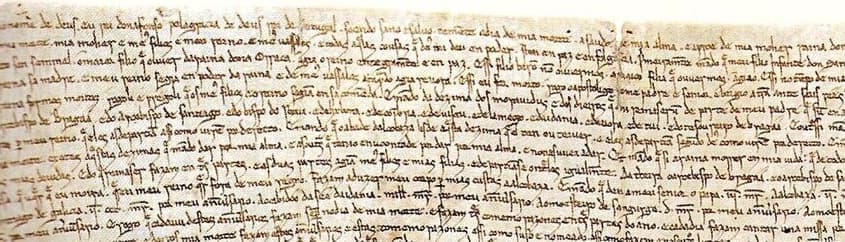
Arquivo Nacional da Torre do Tombo, 27 June 1214 · Source · Public domain
Evidano Transcription
The opening of the act in the text published on Portuguese Wikisource, which prints the exemplar known as the Braga version; the surviving exemplars carry the same act and the first lines of this sheet agree with the printed wording word for word. The edition runs on without line breaks, so the divisions below fall at sentence ends and not at the ends of the manuscript lines; the crop shows the left-hand part of the opening lines only.
En’o nome de Deus. Eu rei don Afonso pela gracia de Deus rei de Portugal, seendo sano e saluo, temẽte o dia de mia morte, a saude de mia alma e a proe de mia molier raina dona Orraca e de meus filios e de meus uassalos e de todo meu reino fiz mia mãda per que depos mia morte mia molier e meus filios e meu reino e meus uassalos e todas aquelas cousas que Deus mi deu en poder sten en paz e en folgãcia.
Primeiramente mãdo que meu filio infante don Sancho que ei da raina dona Orraca agia meu reino entegramente e en paz. E ssi este for morto sen semmel, o maior filio que ouuer da raina dona Orraca agia o reino entegramente e en paz. E ssi filio barõ nõ ouuermos, a maior filia que ouuermos agia’o.
E ssi no tẽpo de mia morte meu filio ou mia filia que deuier a reinar nõ ouuer reuora, segia en poder da raina sa madre e meu reino segia en poder da raina e de meus uassalos ata quando agia reuora.
Source: Testamento de Afonso II, versão de Braga, via Wikisource em português (Public domain).
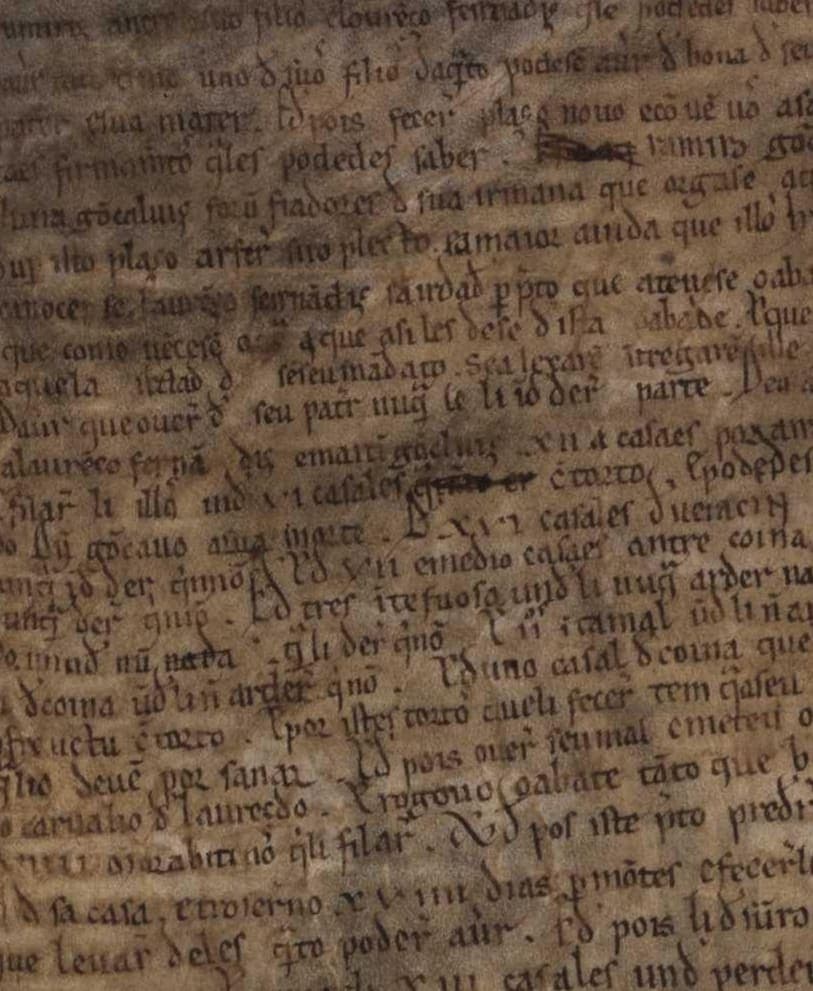
Arquivo Nacional da Torre do Tombo, Mosteiro do Salvador de Vairão, mç. 2, doc. 40, early 13th century · Source · Public domain
Evidano Transcription
[illegible] antre[?] isto filio e lourẽco fernandiz q[ue] le podedes saber
[illegible] uno d[e] isto filio daq[ue]sto podese [illegible] d[e] bona d[e] seu
[illegible] e sua mater . E d[e] pois fecer[on] plazos nouos e co[n]ue[n]uo as[cut off]
[illegible] firmame[n]to q[ue] les podedes saber . [cancelled: illegible] ramiro go[n][cut off]
[illegible]lina go[n]çaluiz [illegible] fiadores d[e] sua irmana que ot[or]gase[?] aq[cut off]
[illegible] illo plazo arter isto plecto . [illegible] ainda que illo h[cut off]
[illegible]nocer se lourẽco fernãdiz saudad [illegible] que ateuese o aba[cut off]
[illegible] que conio[?] uecese [illegible] que asi les dese d[e] ista abade . E que
[illegible] aquela metad d[e] [illegible] seu madato . Se a lexase integrame[n]te [illegible]
[illegible] que ouer d[e] seu patr[e] nu[n]q[a] le li io der parte . [illegible]
[illegible] a lourẽco fernãdiz e marti[n] go[n]çaluiz . x i i . casales por am[cut off]
[illegible] filar li illo [illegible] x i . casales [cancelled: illegible] e t[er]cero[?] . E podedes
[illegible] go[n]çaluo [illegible] morte . E . x i i . casales d[e] uenacin
[illegible] io der q[ui]nõ . E d[e] v i i[?] e medio casales antre coina
[illegible] der q[ui]nõ . E d[e] tres [illegible] u[n]d[e] li nu[n]q[a] arder na[cut off]
[illegible] mad nu[n]q[a] nada . q[ue] li der q[ui]nõ . E i i i casal[?] u[n]d[e] li na[cut off]
[illegible] d[e] coina u[n]d[e] li nu[n]q[a] arder q[ui]nõ . E d[e] uno casal d[e] coina que
[illegible]fructu e[n] t[er]cero . E por istes touro[?] cueli fecer tem q[ue] a seu
[illegible]lho deue por sanar . E d[e] pois ouer seu mal e meteu o
[illegible] o caruaiho d[e] lauredo[?] . E rogou o o abate ta[n]to que b[cut off]
[illegible] abate no[n] q[ue] li filar . E d[e] pos iste p[ro] predi[cut off]
[illegible] d[e] sa casa . e touierno . x v i i i . dias p[or] mo[n]ster e fecer li
[illegible] que leuar deles q[ua]nto poder auer . E d[e] pois li d[e] iuro
[illegible] x i i . casales und perder[cut off]
Generated by Evidano’s advanced model; not yet checked against a published edition.
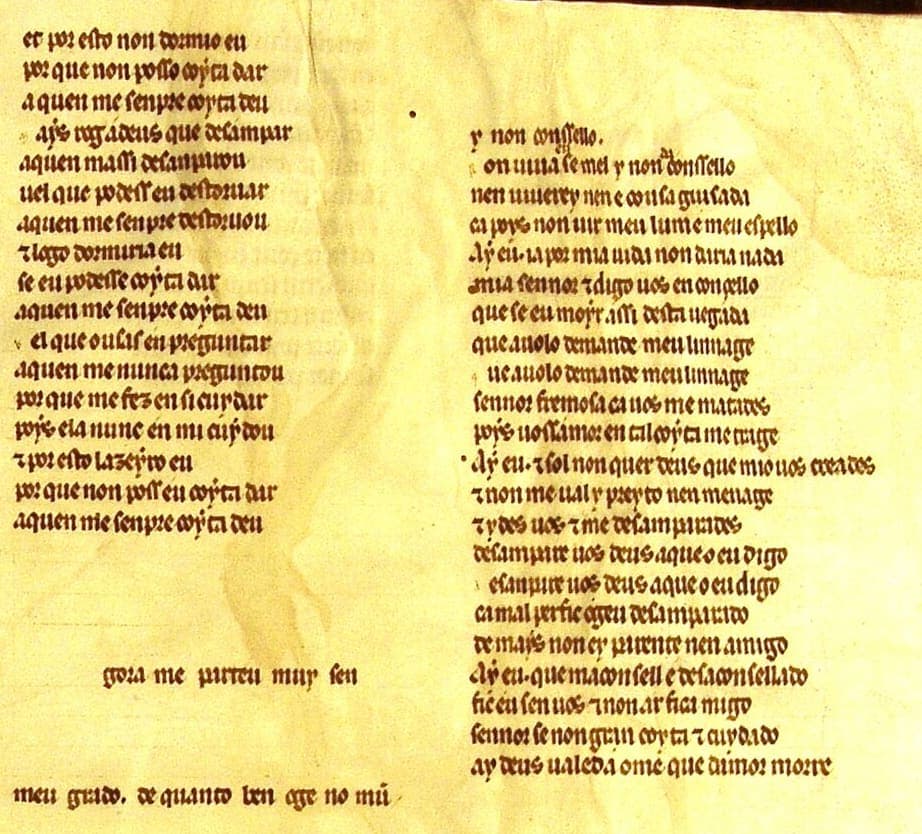
Biblioteca da Ajuda, Lisbon, f. 82r, late 13th century · Source · Public domain
Evidano Transcription
Verses 12–28 of cantiga 289 as printed in Carolina Michaëlis de Vasconcelos’s critical edition of the Cancioneiro da Ajuda (1904), which is based on this manuscript and normalises spelling, accentuation and punctuation; the readings of the Cancioneiro da Vaticana are given in her apparatus and are not reproduced here. Line breaks follow the edition, which matches the ruling of the column. Internal apostrophes are given as ’, and plain scanning errors in the Internet Archive text have been corrected against the printed page.
E por esto non dórmio eu
porque non posso coita dar
a quen me sempre coita deu.
Mais rog’ a Deus que desampar
a quen m’assi desamparou,
vel que podess’ eu destorvar
a quen me sempre destorvou.
E logo dormiria eu,
se eu podesse coita dar
a quen me sempre coita deu.
Vel que ousass’ én preguntar
a quen me nunca preguntou,
por qué me fez en si cuidar,
pois ela nunc’ en mi cuidou.
E por esto lazeiro eu:
porque non posso coita dar
a quen me sempre coita deu.
Source: Carolina Michaëlis de Vasconcelos (ed.), Cancioneiro da Ajuda, vol. I (Halle: Niemeyer, 1904), no. 289, pp. 579–580, via Internet Archive (Public domain).
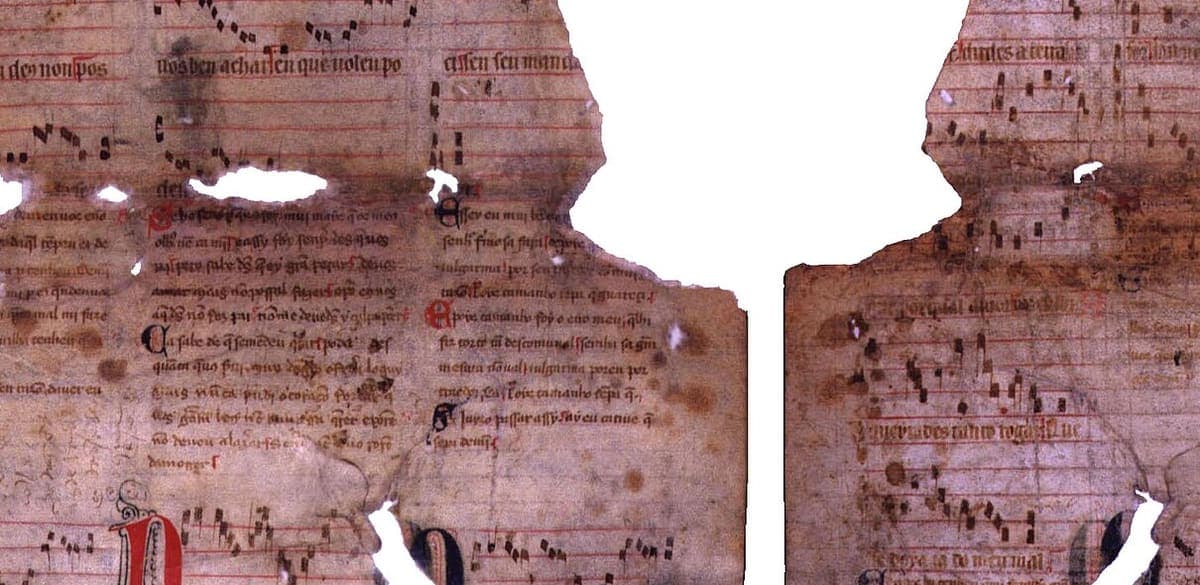
Arquivo Nacional da Torre do Tombo, c. 1300 · Source · Public domain
Evidano Transcription
[illegible] des non pos
[remaining text illegible]
nos ben achar en que uolen po
[strophes illegible at this resolution]
assen seu manda[cut off]
Assen eu mui be[cut off]
senh[or] fr[e]mosa [illegible]
uulgar mal por sen [illegible]
[illegible]
[illegible] cuidando[?] foy o cor[?] meu, q[ue] lh
fiz [illegible] mal descomunal senhor sa gran
mesura [illegible] uulgar ma[l][?] poren por
[illegible], Ca oie [illegible] q[ue],
E [illegible] passar assy. ca eu [illegible] q[ue]
[illegible]
[illegible]
Generated by Evidano’s advanced model; not yet checked against a published edition.
From chancery cursive to the cancioneiro page
Gothic writing reached Portugal with the Cistercians and the canons of Santa Cruz de Coimbra, and by the reign of Afonso II it had displaced the older script in every kind of record. Three registers work side by side: an upright, broken textualis for books, a rounded and deliberate chancery hand for royal acts, and a fast sloping cursive for drafts, notarial memoranda, inquirições and accounts. The vernacular arrives unevenly. Church business stays Latin well into the fourteenth century while the royal chancery writes steadily more Portuguese from the 1250s, so one monastic fonds will hand you acts in both languages from the same decade, sometimes in the same hand.
The letters to watch are the ones that lose their shape: a narrows into a double-storey box, d tilts its ascender back over the bowl, long ſ and round s share a page, and r rotunda replaces upright r after o, b and p. Minims are the real difficulty, since i carries no dot and mui, mia and uiuo dissolve into rows of identical strokes. Abbreviation is heavy and systematic. A tilde marks a suppressed nasal, giving nõ and mãda; q with a stroke through the tail is que; p with a crossed descender is per and with a closed loop pro; superscript vowels close ordinals; the tironian sign stands for e. Numerals stay Roman, and years run in the Era Hispanica until the reform of 1422 moved Portugal to the Era de Cristo.
Layout is as informative as the letters. A foral or a settlement is often a carta partida por ABC, its two halves separated by a wavy cut through large display letters so that they can be matched again; treaties hang seals from silk cords through slits in a folded edge. Registers are ruled in two columns with red rubrics. A songbook leaf is ruled for verse, one line to a line, with space reserved for an initial and, lower down, strophes spaced out for notation that never arrived. Drafts look nothing like fair copies: the Notícia de Torto is a working memorandum, its lines crowded and words struck through.
Why ordinary OCR struggles here
Rows of minims without dots
In a compressed Gothic hand i, m, n and u are the same short stroke, and the i is undotted before the fourteenth century. A general recogniser scores each stroke on its own and returns nun for mui or inuo for uiuo. Only the phrase and the formula it belongs to settle the reading, which is where a model trained on medieval Iberian text pulls away from one trained on print.
A stroke that is a whole syllable
The nasal tilde, the barred q, the looped p and the superscript vowels each stand for one or more letters, and they float above the line where an image model treats them as noise. Dropping them turns mãda into mada; inventing them adds nasals the scribe never wrote. Expansions have to be produced consistently and, where the edition asks for it, marked as expansions.
Two languages in one archive
A thirteenth-century fonds holds Latin donations, vernacular sales and bilingual confirmations, and the vernacular is unstandardised: one clerk writes both molier and molher. Language has to be identified document by document rather than once for a series, and nothing may be silently modernised, because the variation is the evidence.
Drafts, cuts and reused parchment
Chirographs are cut through their display letters, sealed acts are rubbed along the fold, and drafts carry cancellations and interlinear additions. Many songbook leaves survive only because a binder cut them up: the Sharrer parchment is a torn, stained bifolium recovered from a binding, with holes in the middle of words. A transcription must record a gap as a gap instead of closing it.
Who works with this material
Builders of Old Portuguese corpora
Historical grammars and dictionaries of Portuguese rest on a thin set of thirteenth-century texts. Extending that base with unpublished charters calls for transcriptions that keep every spelling, mark each expansion and record where and when the act was written, so a form can be localised before it is counted.
Municipal and monastic archives
Forais, foros and tombos are the founding documents of Portuguese towns and are still cited for boundaries and rights. Archivists digitising them want a first pass that identifies the act, the parties and the dating clause, and that leaves place-names untouched for a local editor.
Editors of the cantigas
Work on the Galician-Portuguese lyric turns on comparing the Ajuda codex with the later Italian copies. A transcription that preserves verse division, refrain repetition and the spaces left for initials lets an editor collate witnesses without re-reading the manuscript for its layout.
Historians of lordship and property
The inquirições and the notarial books that follow record who held what, in the words of sworn witnesses. Searchable text across a whole series turns them from a reading exercise into evidence about settlement, dues and family.
Getting the best transcription
Declare the century and the language mix
Say that the material is thirteenth- or fourteenth-century Portuguese or Latin in a Gothic hand and may change language between documents. Add that years may run in the Era Hispanica, used in Portugal until 1422, so a date thirty-eight years out is not an error to correct away.
Set an abbreviation policy before the first page
Decide whether the tilde is expanded, whether barred q is written out as que and looped p as pro, and whether expansions are bracketed. State that i is undotted and that u and v are positional variants of one letter, so uiuo is not quietly rewritten as vivo.
Give verse pages their own instructions
For a songbook leaf, ask for one verse per line, for the refrain to be written where the scribe wrote it, and for a blank initial or an unfinished strophe to be flagged rather than filled in. Otherwise a model will helpfully complete the poem from the version it knows.
Start with the worst sheet you have
Test on a draft or a damaged fragment, not a clean charter. If cancellations, interlinear additions and holes come back marked, and the reading order across a two-column register holds, the rest needs only spot checks.
Further reading on this hand
The palaeography guides the in-app selector points to for this domain, if you want to check a transcription against the standard references.
- History of Portuguese Handwriting
This Brigham Young University guide provides a chronological framework for the handwriting systems used in Portuguese records. It describes the transition from Visigothic to later Gothic and documentary practices before the rise of Cortesão and Processual. The associated handwriting materials offer alphabet charts and examples for comparing variant forms across periods. This framework is useful for identifying thirteenth- and fourteenth-century Portuguese charters whose scripts are transitional.
Frequently asked questions
- When do Portuguese documents stop being written in Latin?
- There is no single date. Vernacular texts appear from the start of the thirteenth century, the royal chancery uses Portuguese regularly from the 1250s, and church institutions keep Latin much longer. Since both occur in one series, let each document be identified on its own.
- How are the dates converted?
- Documents down to 1422 usually date by the Era Hispanica, thirty-eight years ahead of the Christian year, so Era 1252 is 1214. The numerals are transcribed as they stand and the converted year supplied in a note. Later registers switch to the Era de Cristo, and the clause says which is meant.
- Can undotted minims really be resolved?
- Not stroke by stroke, but in context they can. Charter formulae are repetitive and the vocabulary of a sale is small, so mui rather than nun follows from the clause. Words that stay genuinely ambiguous should come back flagged for an editor to settle against the parchment.
- What happens to the nasal tilde?
- It is treated as an abbreviation, not an accent. Depending on the convention you choose, nõ comes back as written or expanded to non with the added letter marked. The choice has to hold across a series: a corpus in which half the nasals are expanded cannot be searched.
- Can text under music staves be read?
- The words can, and the staves are treated as non-text. On a leaf such as the Sharrer parchment the syllables are spaced out to sit under the notes, so the transcription joins them into words and can note where the spacing falls; the melodies need a musicologist.
Related scripts and pages
Put your Gothic Portuguese documents into text
Send one charter, one draft and one songbook leaf through Portuguese Gothic Documentary Hands, and compare what comes back before committing a series.