
Portuguese · c. 1500–1650
Read the chained hands of the Portuguese courts
Clerks working for the tribunals and notaries of sixteenth-century Portugal wrote at speed, joining letter to letter and word to word until a whole clause arrives as one unbroken chain. Word division has to be reconstructed from grammar and from the formulae the office repeated daily, and the signatures that close each session are drawn, not written.
Sample pages
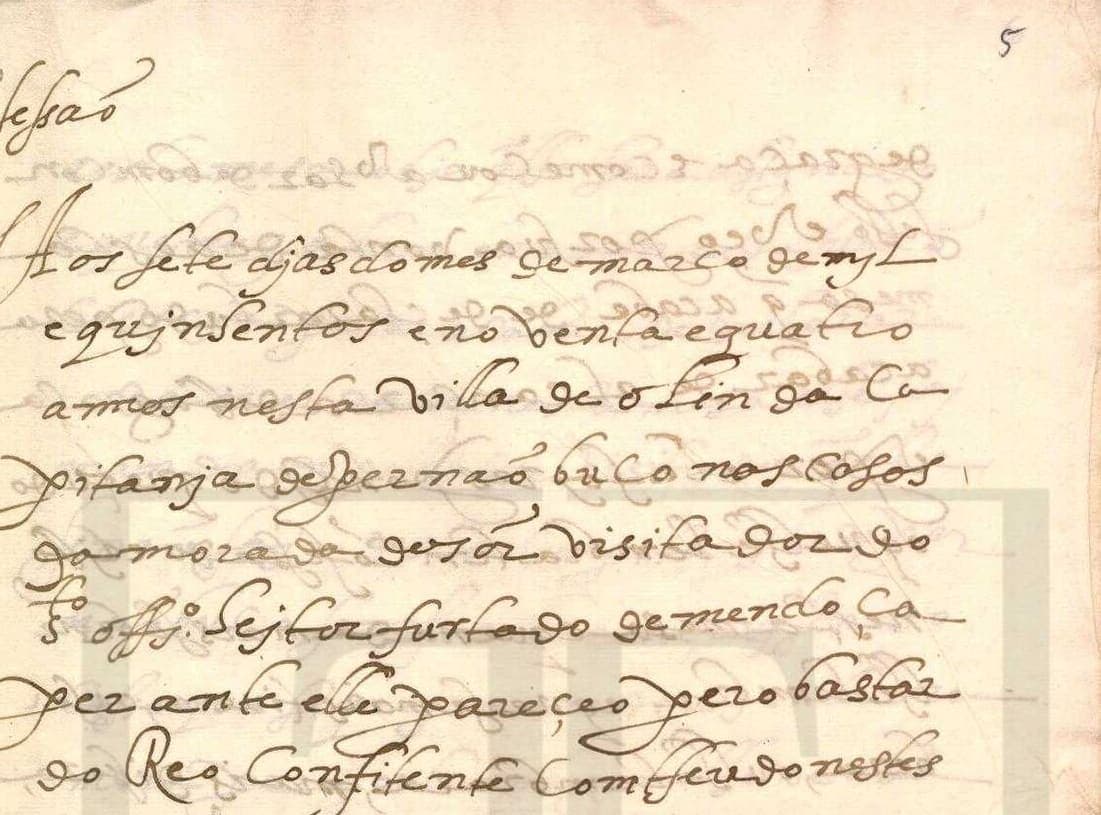
Arquivo Nacional da Torre do Tombo, PT/TT/TSO-IL/28/13180, 7 March 1594 · Source · Public domain
Evidano Transcription
5
[cut off]fessaõ
Aos sete djas do mes de março de myl
e qujnsentos e no venta e quatro
annos nesta villa de olin da Ca
pitanja de pernaõ buCo nos Cosos[?]
da morada do s[enh]or visita dor do
s[ant]o offi[ci]o heitor furtado de mendo ça
per ante elle pareçeo pero bastar
do Reo Confitente Comtheudo nestes
Generated by Evidano’s advanced model; not yet checked against a published edition.
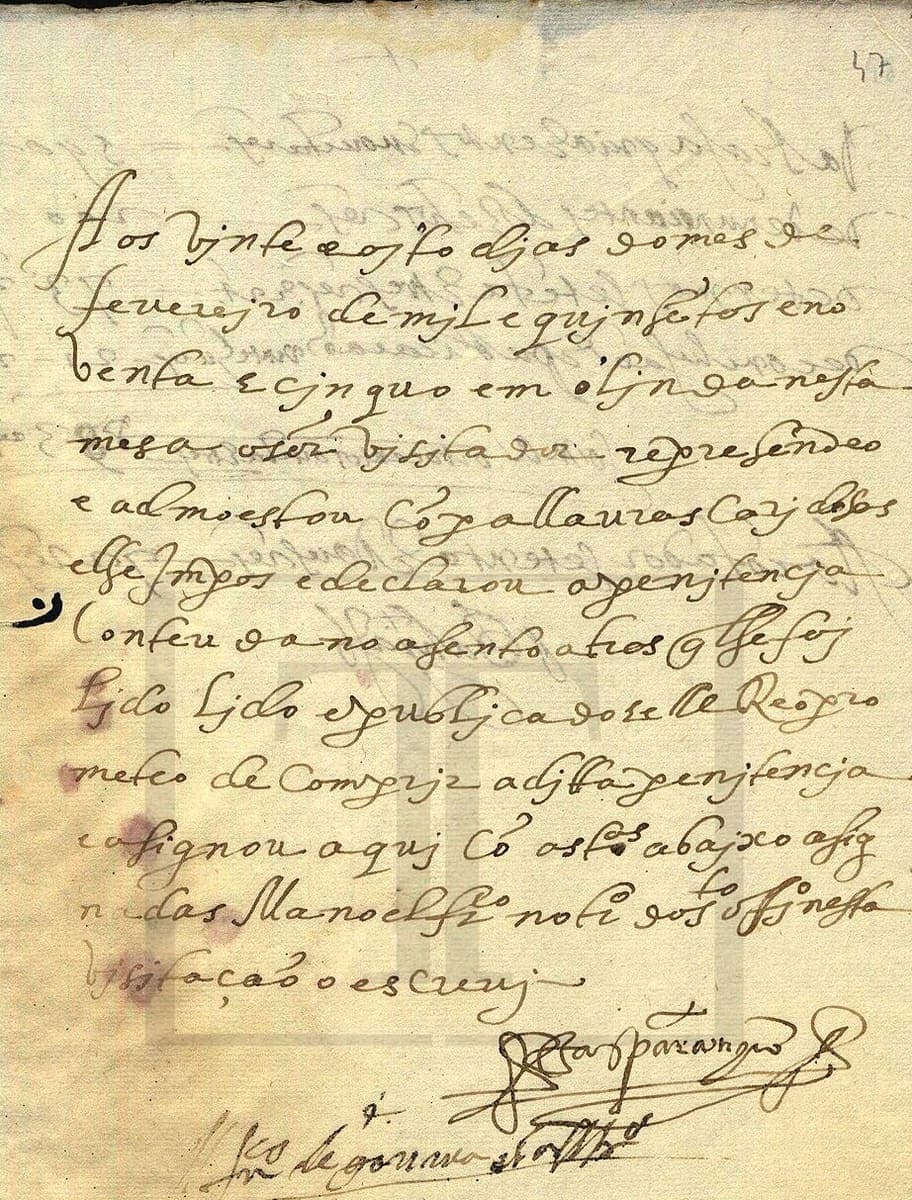
Arquivo Nacional da Torre do Tombo, PT/TT/TSO-IL/28/12917, 28 February 1595 · Source · Public domain
Evidano Transcription
47
Aos vinte e ojto djas do mes de
feverejro de mjl e qujnhe[n]tos e no
benta e cjnquo em oljnda nesta
mesa o s[enh]or vjsitador reprehendeo
e admoestou co[m] pallauras carjdosas
e lhe Jmpos e declarou a penjtencja
conteuda no asento atras q[ue] lhe foj
ljdo ljdo e publjcado o elle Reo pro
meteo de comprjr a djta penjtencja
e asjgnou aquj co[m] as t[estemunh]as abajxo asjg
nadas Manoel fr[ancis]co not[ari]o do s[ant]o off[ici]o nesta
vjsitaçaõ o escrevj
Gaspar aranjo[?] [signature]
fr[ancis]co de gouuea t[estemunh]a
Generated by Evidano’s advanced model; not yet checked against a published edition.
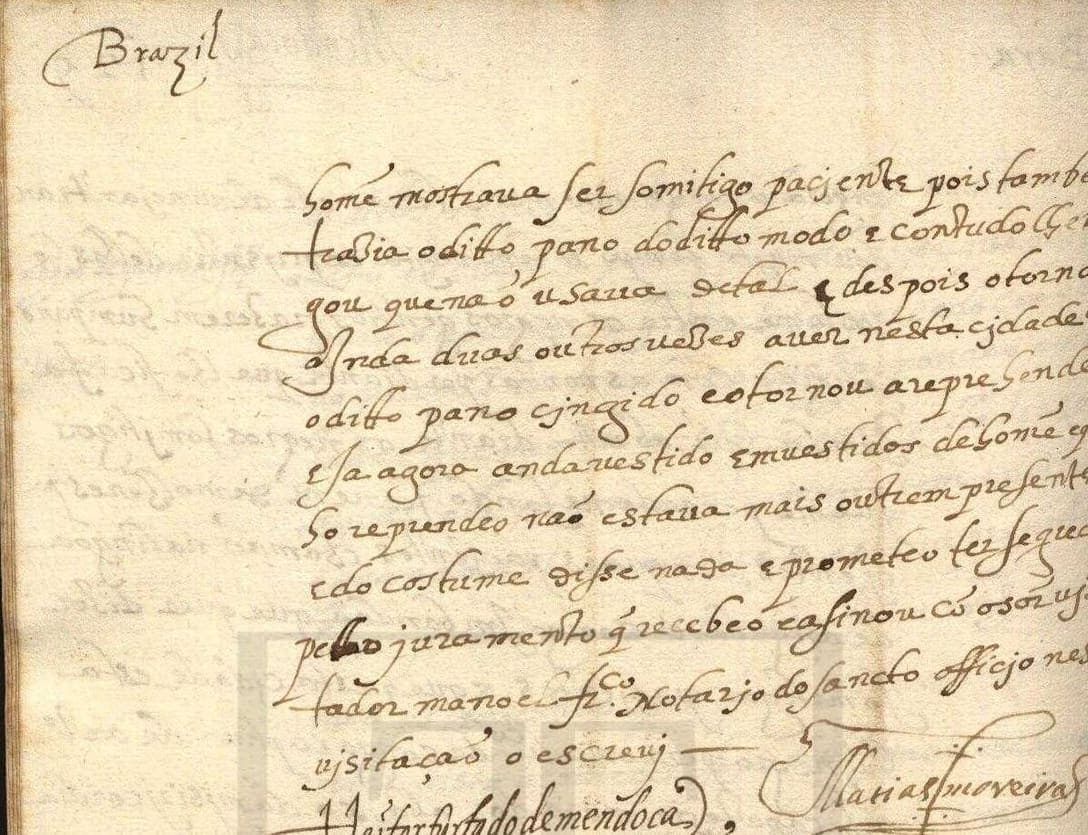
Arquivo Nacional da Torre do Tombo, PT/TT/TSO-IL/038/0779, 1590s · Source · Public domain
Evidano Transcription
Brazil
home[m] mostraua ser somitigo pacjente pois tambe[m]
trazia oditto pano doditto modo e contudo che
gou que nao o vsaua detal q[ue] despois otorna
Ainda duas outras ueses a uer nesta cjdade
oditto pano cjngido eotornou areprehende
e ja agora anda uestido em uestidos de home[m] e q[ue]
so reprendeõ naõ estaua mais outrem presente
edo costume disse nada eprometeo ter segred
pello juramento q[ue] recebeo easinou co[m] oso[nh]or uj
sjtador manoel fr[ancis]co Notarjo do sancto officjo nes
ujsitaçaõ o escreuj
Heitor furtado de mendoca Matias moreira
Generated by Evidano’s advanced model; not yet checked against a published edition.
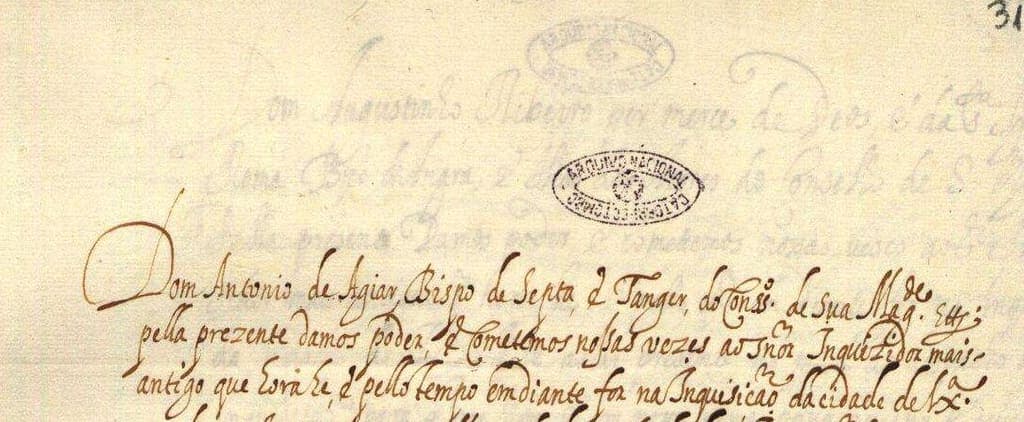
Arquivo Nacional da Torre do Tombo, PT/TT/TSO-IL/029/0990, f. 31, 24 May 1614 · Source · Public domain
Evidano Transcription
31
Dom Agostinho[?] Ribeiro por merce de Deos e da S[an]ta [cut off]
Sena[?] B[is]po [illegible] do Conselho de S [cut off]
pella prezente damos poder e cometemos nossas vezes [illegible]
Dom Antonio de Agiar, Bispo de Septa e Tanger, do Cons[elh]o de Sua Mag[estad]e ett[ceter]a;
pella prezente damos poder, e Cometemos nossas vezes ao s[enh]or Inquizidor mais
antigo que Eora he, e pello tempo emdiante for na Inquisicaõ da cidade de Lx[bo]a
[cut off]
Generated by Evidano’s advanced model; not yet checked against a published edition.
What processual writing looks like on the page
Processual is the working hand of the Portuguese courts, notaries and secretariats from about 1500 until the middle of the seventeenth century, when italic gradually displaces it. It is what happens to the cortesã hand when a clerk has to record a hearing at the speed of speech: the pen leaves the paper only to dot nothing and to start a new line, the letters lose their bodies, ascenders and descenders lengthen into hooks, and neighbouring words are linked so tightly that palaeographers call the extreme form encadeada, chained. Individual clerks vary enormously, and the same file can hold a careful title page, a rapid session record and a barely controlled marginal addition.
The letters that survive the compression are few. Round shapes flatten into strokes, so c, e, o and r are told apart mainly by where the joining stroke enters and leaves; s at the end of a word becomes a long loop; t keeps only a tick of its crossbar; and h, l and b are all tall loops. Abbreviation is by suspension and superscript, with the recurring institutional vocabulary reduced to a few letters: S.to Off.o for Santo Ofício, dº for dito, R.do for reverendo, mag.de for magestade, V.M. for Vossa Mercê. The tilde covers suppressed nasals, numerals stay Roman inside loops and flourishes, and dates are usually spelled out in full — mil e quinhentos e noventa e quatro annos — which makes them easier to recognise than to read.
The page is layered. A session opens with a heading such as Sessão, a marginal note names the deponent, and the folio number sits in the top corner in a later archival hand. The body runs unruled from edge to edge, and the entry closes with the notary’s formula — o escrevi — and the drawn signatures and rubricas of the visitor, the notary and, where he could write, the accused. Around these, later hands have added foliation, cross-references and stamps, and iron-gall ink has often bitten through the leaf so that the verso shows faintly through the recto. The largest surviving body of this writing is the archive of the Inquisition, whose processes, denunciation books and registers run to tens of thousands of volumes and are largely unpublished.
Why ordinary OCR struggles here
Words with no gaps between them
In encadeada writing the space between words is smaller than the space inside them, and the joining stroke does not stop at a word boundary. A model that segments on white space produces long nonsense strings; one that has learnt the formulae of a session record splits perante elle pareceo correctly because it knows the phrase. Expect to review word division rather than letters.
An office vocabulary written in initials
Every tribunal contracts the words it uses most. Santo Ofício, reverendo, licenciado, Vossa Mercê, capitania and the saints’ names all appear as two or three letters with a superscript ending, and the same clerk may write the same word three ways on one page. Expansion needs a list built from the series being transcribed, not a general dictionary.
Signatures that look like writing
A Portuguese rubrica is a drawn flourish, sometimes with the name buried inside it and sometimes without any letters at all. Read literally it comes back as a line of gibberish attached to the last sentence. It should be recorded as a signature, with the name given where it can be made out and marked as illegible where it cannot.
Ink burn, show-through and tight bindings
Iron-gall ink eats into the paper, so the text of the verso shows through and in places has fallen out altogether. Process files are bound tightly and photographed at the gutter, and older reproductions are grey microfilm. A transcription must distinguish what is lost from what is merely faint, and mark holes rather than guessing across them.
Who works with this material
Genealogists working in notarial and court series
Portuguese and Brazilian family research runs through wills, inventories, dowries and process files, where a single line can name three generations and a place of origin. What such work needs is not a polished edition but a reliable reading of names, ages, trades and dates, with everything doubtful flagged.
Historians of the Inquisition and of the colonial world
Process files and visitation books are the fullest record of ordinary speech from the Portuguese empire, and they name enslaved and free people from Africa, Brazil and Asia who appear nowhere else. Searchable text lets a researcher find one name across thousands of folios instead of reading each volume through.
Legal and administrative historians
Autos, libels, sentences and commissions follow fixed structures. Marking those structures during transcription — heading, deposition, oath, sentence, subscription — turns a file into evidence about procedure, not just about the case.
Archives publishing digitised process files
A repository that has scanned a series can add a first-pass transcription to each image, so that catalogue searches reach the words on the page. Even an imperfect reading of the marginal headings and dates makes a large fonds navigable for the first time.
Getting the best transcription
Say what the document is before you ask for the text
Tell the model that the material is Portuguese of the sixteenth or early seventeenth century in a chained processual hand, that words may be joined across their boundaries, and that the file is a court record with headings, marginal notes and subscriptions.
Supply the office’s abbreviations
Give the standard forms of the series — S.to Off.o, dº, Vª Mce, R.do, esco for escrivão — and say whether you want them expanded or kept. A dozen lines of glossary at the start of a run removes most of the recurring errors from a whole maço.
Ask for signatures and marginalia to be separated
Request that rubricas, marginal headings, archival foliation and stamps be returned as their own fields rather than run into the paragraph. That one instruction is what makes a session record usable as data, since the deponent’s name is usually in the margin.
Calibrate on a page you have already read
Take a folio you have transcribed yourself, compare the two readings and note what is systematically wrong: word division, a particular abbreviation, the numerals. Fix those in the prompt before running the series, and re-check on a page with ink burn-through.
Further reading on this hand
The palaeography guides the in-app selector points to for this domain, if you want to check a transcription against the standard references.
- History of Portuguese Handwriting
This Brigham Young University guide describes Processual as a central Portuguese legal and administrative hand used during the early modern period. It relates Processual to Spanish Procesal while distinguishing the Portuguese historical sequence and terminology. The site's alphabet charts and handwriting tools help users compare highly connected letters and common document forms. It is especially useful for court and notarial records written in rapid Processual or encadeada styles.
Frequently asked questions
- What is the difference between processual and encadeada?
- Processual is the name of the hand used in the courts and notarial offices; encadeada describes how far a particular clerk takes the joining, with letters and words chained into continuous strokes. In practice they are two points on a scale, and a single file often moves between them from one entry to the next.
- How is word division handled?
- It is reconstructed from the grammar and from the formulae, then checked. The transcription can be delivered with modern word spacing, which is what most researchers want, or with the joins marked where the manuscript gives no space at all, which matters to palaeographers studying the hand itself.
- Can the names of witnesses and defendants be extracted reliably?
- Names are the hardest part of any court record, because they are often abbreviated, spelled by ear and sometimes only in the margin. Reading them against the marginal heading and the repeated mentions inside the entry gives a much better result than reading each occurrence on its own.
- What happens to Latin passages inside a Portuguese file?
- Formulae from canon law, oaths and scriptural quotations appear in Latin in the middle of Portuguese sessions, usually heavily abbreviated. They are transcribed as Latin and marked, so that a search for a Portuguese phrase does not silently include them.
- Do old microfilm reproductions work?
- They can, but they cost accuracy. Grey microfilm flattens the contrast between ink and show-through, and a scale bar or frame edge can be read as text. Where a colour scan of the same folio exists it is always worth using it instead, and any reading taken from film should say so.
Related scripts and pages
Open up your process files
Send a session, a sentence and a register folio through Portuguese Processual and Encadeada Records, and see how much of a maço becomes searchable.