
Portuguese · c. 800–1200
Read the Visigothic charters of early Portugal, letter by letter
Between the ninth century and about 1200 the scribes of Braga, Guimarães, Coimbra and Lorvão wrote a script in which a looks like u, t carries a loop that turns it into a small a, and the letter that became ç was still a z. Evidano transcribes these sheets line by line, keeps the Era date and the abbreviation signs as written, and separates the witness columns and signa from the body of the act.
Sample pages
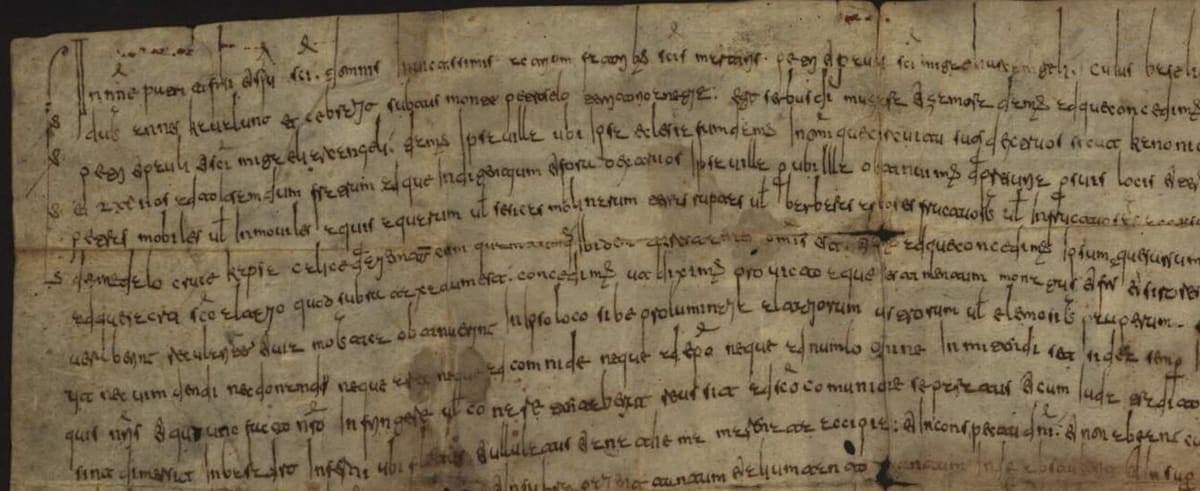
Arquivo Nacional da Torre do Tombo, PT/TT/MSPC/01/1, 27 March 882 · Source · CC BY-SA 4.0 · Digitarq, Arquivo Nacional da Torre do Tombo
Evidano Transcription
The body of the charter as printed in Portugaliae Monumenta Historica, Diplomata et Chartae, vol. I (1867), no. IX, which reproduces the spelling of the original; the detail shows the opening lines across most of the width of the sheet, and the witness columns and the notary’s line at the foot are outside it. Obvious OCR confusions of the Internet Archive text (c for e, l for t) have been corrected; the editor’s (sic) and (?) are kept.
Christus. In nomine patri et filii et spiritus sancti, domnis inuictissimis ac triumphatoribus sanctis martiris petri et pauli sancti migaeli arcamgeli. cuius baselica fumdamus in uilla quod uocitant lauridosa inter duas annes kaualuno et cebrario subtus monte petroselo territorio anegrie. ego serbus dei muzara et zamora damus adque concedimus ad deum et ad ipsa baselica que nos fundamus in nomine sancti petri et pauli et sancti migaeli arcangeli. damus ipsa uilla ubi ipsa eclesia fumdamus in omnique circuitu suos dextruos sicut kanonica sententia docet: duodecim pasales pro corpora tumudamdum (sic) et lxxii° ad toloramdum fratrum adque indigentium et foru dextruos ipsa uilla pro ubi illa obtinuimus de presuria pro suis locis et terminus antiquiis cum pascuis padulibus montes fontes petras mobiles uel inmouiles aquis aquarum uel sesicas molinarum terras ruptas uel barbaras arbores fructuosas uel infructuosas accessum uel regressum cubus cubas lectus kadedras mensas signum de medalo cruce kapsa calice de ariemto cum quamtumque ibidem aprestamo ominis est.
damus atque concedimus ipsum que sursum taxatum est pro remedio animabus nostris ad ista eclesia adque sacrosancto altario quod subra taxatum est. concedimus ut diximus pro uicto atque uestimentum monagus et fratres et sirores et propinquis nostris et qui bonus fuerint et in uita sancta perseueraberint seculariter et uia monastica obtinuerint in ipso loco, sibe pro luminaria altariorum uestrorum uel elemosias pauperum, sicut lex et canonica sententia docet, et ibi notuimus ut nec uimdendi nec donandi neque a rex neque ad comnide neque ad episcopo neque ad numlo omine inmitendi. set sidea semper inienua usque in sempiternum, et post parte propimquis nostris et qui unc facto nostro infringere uel conare tentaberit reus sit ad sancto comunione separatus et cum iuda traditore accipiat participio in eterna danatione sint dimersit (sic) in baradro inferni ubi fletus et ullulatus et anathema marenata accipiat, et in conspectu domini, et non abeant cum domino in prima resurectione ressusitandi. nisi percusus (?) ad eclesia et ab omni cetum Christianorum. et insubra parient tantum et alium tanto quantum inde abstulerit et insuper auri talemtum post parti testamenti et coram pontificum, et iudice suo iudigado. et anc scriptura testamenti plena abea firmitate: notum die quod erit vi kalendas abriles era dccccxx. muzara et zamora in hanc kartulla testamenti manus nostras.
Source: Portugaliae Monumenta Historica, Diplomata et Chartae, vol. I (Lisbon: Academia das Ciências, 1867), no. IX, p. 6, via Internet Archive (Public domain).
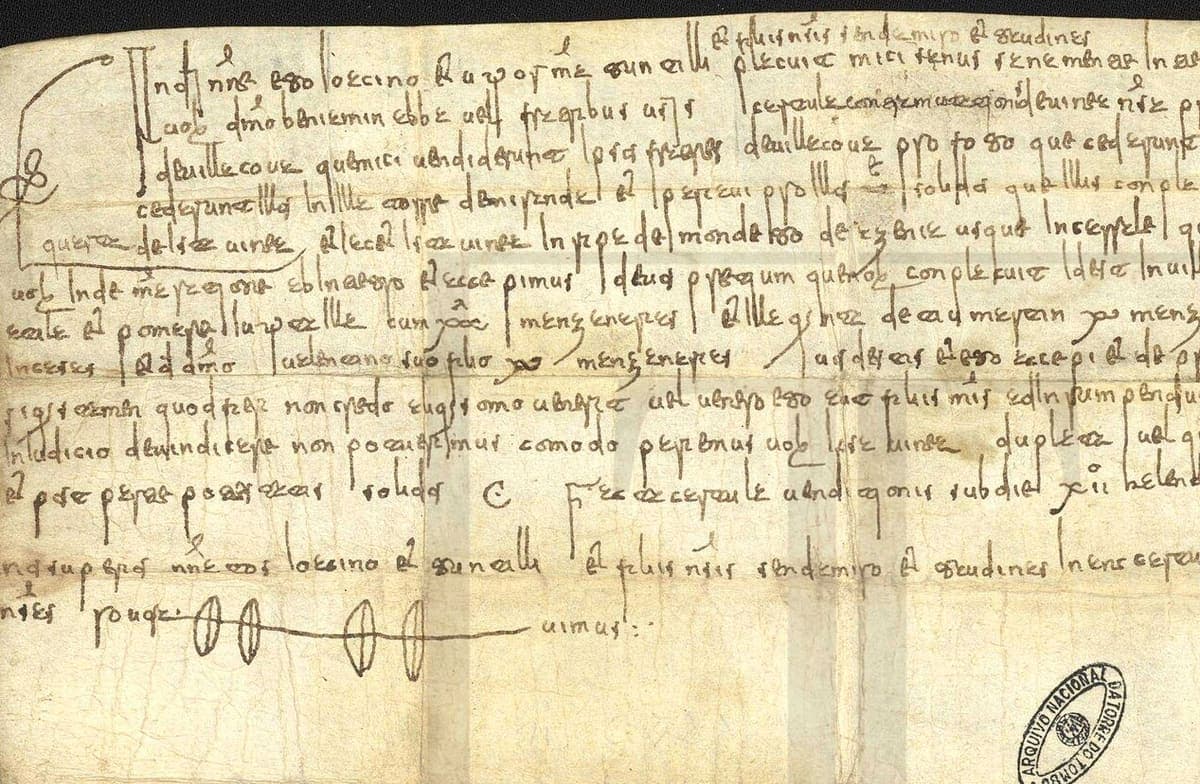
Arquivo Nacional da Torre do Tombo, PT/TT/MSML/CE1/14, f. 1r, 21 March 998 · Source · CC BY-SA 4.0 · Digitarq, Arquivo Nacional da Torre do Tombo
Evidano Transcription
The text and roboratio of the charter as printed in Portugaliae Monumenta Historica, Diplomata et Chartae, vol. I (1867), no. CLXXIX, a diplomatic text that keeps the scribe’s spelling; the witness columns at the foot of the sheet are outside the crop and are not given. Plain OCR errors of the Internet Archive text (l for t, c for e, a dropped f) have been corrected; the signa drawn inside rouorauimus are marked [signa]; superscript ordinal letters on numerals are printed on the line.
Christus. In dei nomine ego ioacino et uxor mea guntilli et filiis nostris sendamiro et gaudinas placuit mici sanus sana mente integroque consilio mente perfecta ut facerem uobis domno beniamin abba uel fratribus uestris cartula contramutationis de uinea nostra propria que abemus in monasterio de uillacoua que mici uendiderunt ipsos fratres de uillacoua pro fogo que cedarunt et fecerunt damno et proinde cedarunt illos in illa torre de miranda et pariaui pro illos xx solidos que illis conplacuit et proinde fecerunt mici carta quarta de ista uinea et iacet ista uinea in ripa de mondego de azenia usque in carrale que uadit ad illo barco do adque uendo uobis inde mea ratione ab integro et accepimus de uos pretium que nobis conplacuit id est in uilla de oliueira uinea qui fuit de magister atila et pomare iuxta illa cum xxxa manzanarias et illa quinta de tiu martin xv manzanarias et terras calbas et sua ratione in casas et de domno ualentino suo filio xv manzanarias uos destis et ego accepi et de pretio aput uos nicil remansit in deuitum. siquis tamen quod fieri non credo aliquis omo uenerit uel uenero ego aut filiis meis ad inrumpendum anc cartula uenditionis que nos in iudicio deuindicare non potuerimus comodo pariemus uobis ipsa uinea duplata uel quantum ad uos fuerit meliorata et post parte potestatis solidos c. Facta cartula uenditionis sub die xii° kalendas apriles. Era Ta xxxa via.
Nos superios nominatos ioacino et guntilli et filiis nostris sendamiro et gaudinas in anc cartula quot fieri uoluimus manus nostras rouora [signa] uimus.
Source: Portugaliae Monumenta Historica, Diplomata et Chartae, vol. I (Lisbon: Academia das Ciências, 1867), no. CLXXIX, p. 110, via Internet Archive (Public domain).
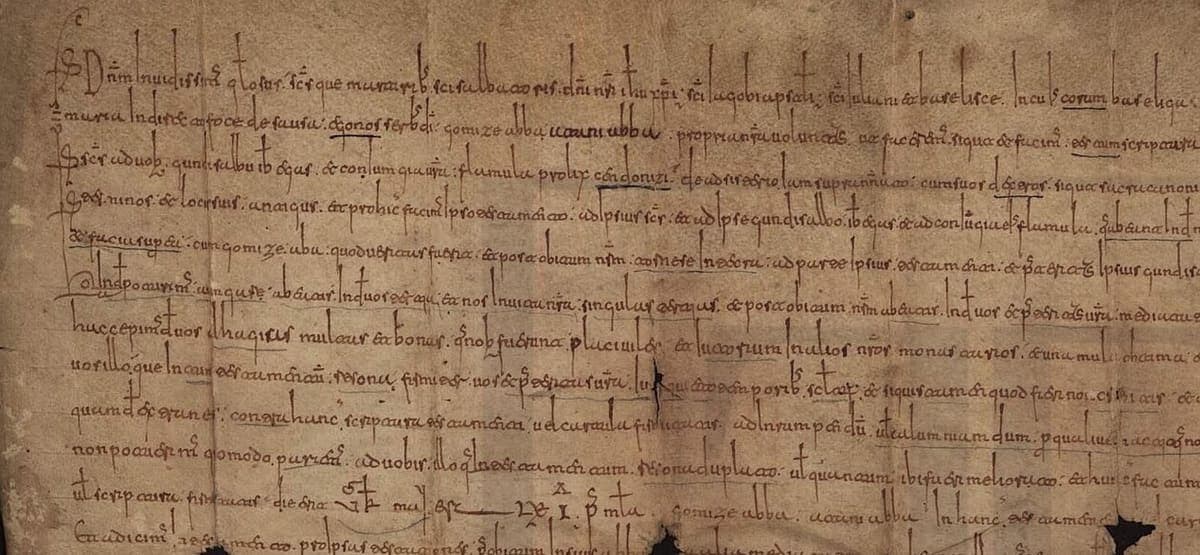
Arquivo Nacional da Torre do Tombo, PT/TT/MSPS/005/0001, 1053 · Source · CC BY-SA 4.0 · Digitarq, Arquivo Nacional da Torre do Tombo
Evidano Transcription
[chrismon] D[omi]n[i]s inuictissimis glo[rio]sis. s[an]c[t]isque martirib[us] s[an]c[t]i salbatoris. d[omi]ni n[ost]ri ih[es]u xp[ist]i; s[an]c[t]i iacobi ap[osto]li; s[an]c[t]i iuliani & baselisce. in cui[us] s[an]c[t]orum baseliqu[illegible]
[illegible] murata [illegible] de fausia[?]. Ego nos ferb[i] d[e]i. gomize abba. uicenti abba. propria n[ost]ra uoluntate. ut fac[illegible]. siqua & fac[illegible]: est cum scriptura[?]
[illegible] gundisalbo[?] [illegible]. & coniugi u[est]re: flamula prolix condonizi. [illegible] cum suos [illegible]. siqua [illegible]
[illegible] minos. de locellus. antiquis[?]. & pro hic fac[illegible] pro testamentum[?] [illegible] & ad ipse gundisalbo. [illegible] & ad coniugi u[est]re flamula. sub una [illegible]
& fac[illegible]: cum gomize abba: quod [illegible]. & post obitum n[ost]r[u]m. [illegible] ad parte ipsius. [illegible] & pro parte ipsius gundisa[illegible]
[illegible] abeatis. in duos [illegible] qui. & nos in uita n[ost]ra: singulas [illegible]. & post obitum n[ost]r[u]m abeatis. in duos [illegible]. medietate[m]
huc cepim[us] duos dhagitas multas & bonas. q[uo]d nob[is] fuerint placibiles. & [illegible] n[ost]ros [illegible]. & una mula [illegible]
uos illo que in [illegible] testamentum: [illegible] temporib[us] [illegible]. & siquis testamentum quod fieri non [illegible]
quam [illegible]: contra hunc scripturam testamentum uel cartula firmitatis. ad inrumpendum. uel calumniandum. p[er] qualibet racione [illegible]
non potuerit quomodo. pariat. a duobis. illo[?] [illegible] testamentum. [illegible] duplatas: ut quantum ibi fuerit melioratas: & hunc [illegible]
ut scriptura [illegible] die [illegible] era [illegible]. gomize abba. uicenti abba in hanc testamentum [illegible]
[remaining lines illegible]
Generated by Evidano’s advanced model; not yet checked against a published edition.
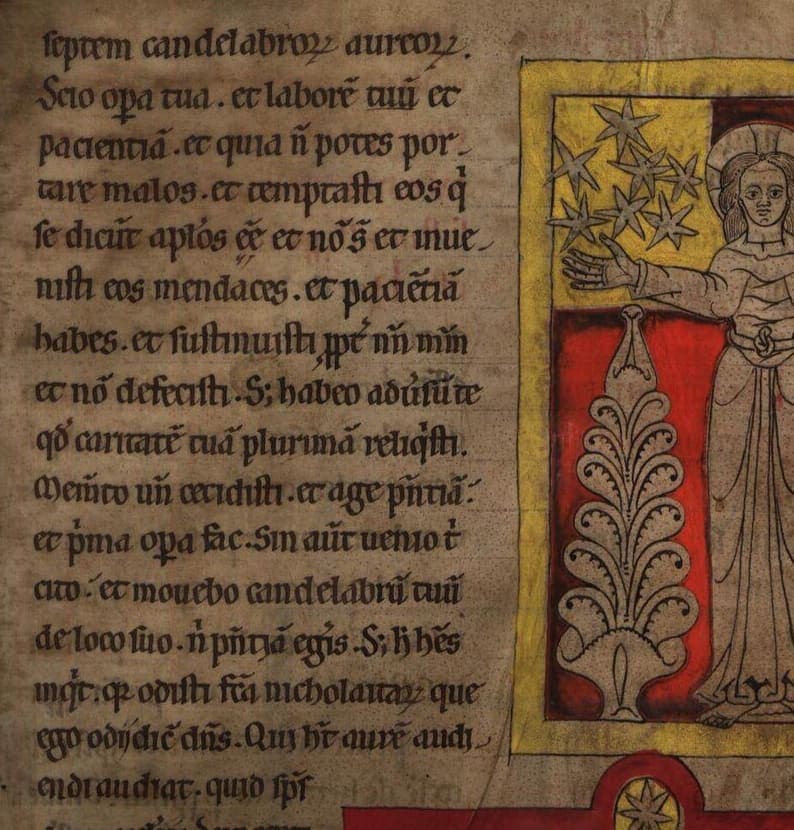
Arquivo Nacional da Torre do Tombo, Mosteiro de Lorvão, livro 43, fl. 49, 1189 · Source · Public domain
Evidano Transcription
septem candelabro[rum] aureo[rum] .
Scio op[er]a tua . et labore[m] tuu[m] et
pacientia[m] . et quia n[on] potes por
tare malos . et temptasti eos q[ui]
se dicu[n]t ap[osto]los e[ss]e et no[n] s[unt] et inue
nisti eos mendaces . et pacie[n]tia[m]
habes . et sustinuisti p[ro]pt[er] n[ome]n m[eu]m
et no[n] defecisti . S[ed] habeo adu[er]su[m] te
q[uo]d caritate[m] tua[m] plurima[m] reliq[ui]sti .
Meme[n]to un[de] cecidisti . et age p[e]n[i]t[ent]ia[m] .
et p[ri]ma op[er]a fac . Sin au[te]m uenio t[ibi]
cito . et mouebo candelabru[m] tuu[m]
de loco suo . n[isi] p[e]n[i]t[ent]ia[m] eg[er]is . S[ed] h[oc] h[ab]es
inq[ui]t . q[uia] odisti f[a]c[t]a nicholaita[rum] que
ego odi dic[it] d[omi]n[u]s . Qui h[abe]t aure[m] audi
endi audiat . quid sp[iritu]s
[cut off]
Generated by Evidano’s advanced model; not yet checked against a published edition.
What a Visigothic page from Portugal looks like
Visigothic script was the ordinary writing of the western Iberian peninsula from the eighth century, and in the land that became Portugal it outlasted its use elsewhere: the foundation charter of the church of Lardosa of 882, the earliest dated Portuguese document, is written in it, and northern charters keep Visigothic letterforms after 1200. Two registers coexist. The book minuscule is round, upright and evenly spaced, the hand of cartularies and of the few surviving liturgical codices. The charter cursive is tall and narrow, its ascenders stretching far above the line, its letters leaning into each other in long chains of ligatures; it is this cursive that fills the monastic fonds of the Torre do Tombo.
The letters that matter are the ones that do not resemble their modern descendants. The a is open at the top and reads as u; the t carries a loop to the left of its stem and is taken for a; the g hangs below the line like a q with a curled tail; the z is a hooked shape that later scribes reinterpreted as c with a cedilla, which is where ç comes from. Two ligatures for ti separate a plain syllable from an assibilated one, s and r are nearly identical, and the sign for 40 is a barred X. Abbreviation runs on superscript letters, a stroke through the descender of p for per, contractions such as nsr for noster, and the nasal bar.
Layout is formulaic. A charter opens with a chrismon or the word Christus, an invocation and an address to the saints of the church concerned; the dispositive text runs in long lines across the sheet; a sanction clause threatens anathema; the dating clause gives a Roman calendar day and a year in the Era Hispanica, thirty-eight years ahead of the Christian year; and the roboratio is followed by drawn signa and by columns of witnesses marked test. or conf. The Latin is full of Romance intrusions, and Lorvão and Coimbra acts carry Mozarabic names of the type iben Zaton. By the later twelfth century Caroline minuscule had taken over in the cathedral chapters, and the Lorvão Apocalypse of 1189 is written in the rounded book hand that replaced the old script.
Why ordinary OCR struggles here
a, u, t and the ti ligatures
Optical models trained on print read the open Visigothic a as u and the looped t as a, so that testamento comes back as aesaamenau. The two ti ligatures, which record whether the syllable was pronounced ti or tsi, look like decorative variants and are flattened into one. A model that has learnt the script reads them as letters and can note which form the scribe used.
Signs that are not letters
The superscript -is and -us marks, the stroke through the p, the abbreviation for que and the flourish on a final s all sit at letter height, so they are read as extra letters or dropped altogether. The same happens to the barred X for 40 in a date, and a whole Era hangs on that one stroke.
Dates, numerals and formulae
The year is given as an Era with superscript ordinal letters, the day is counted backwards from the kalends, nones or ides, and sums are in Roman numerals inside running text. A transcription that reproduces the numerals as written and adds the converted year in a note is far more useful than one that silently modernises either.
Signa, columns and later hands
Below the text come drawn signa, sometimes splitting the word roboramus itself, and several narrow columns of witness names in more than one hand. Archival stamps, dorsal notes in Gothic or modern cursive and the holes left by seals lie on the same sheet, and a line-by-line reading has to keep them apart.
Who works with this material
Editors of cartularies and monastic fonds
The Lorvão, Pedroso, Paço de Sousa and Guimarães collections were printed in the nineteenth century, often from copies and with gaps. Re-editing them from the originals starts with a transcription that keeps the scribe’s spelling, marks every expansion and records where signa and witness columns fall, so the new text can be collated against Portugaliae Monumenta Historica rather than retyped.
Historians of settlement and lordship
Presúria clauses, boundary descriptions and lists of appurtenances are where the history of the Entre-Douro-e-Minho and the Mondego frontier is written. A searchable transcription that leaves place-names in their charter spelling lets a researcher follow one villa or one family across dozens of acts.
Linguists and onomasticians
These Latin texts are shot through with early Galician-Portuguese forms and with Mozarabic and Arabic personal names. Corpus builders need the Romance spellings and the iben patronymics exactly as written, with the ti ligature distinction preserved because it records pronunciation.
Teachers of Iberian palaeography
A transcription set beside the image makes a Visigothic alphabet exercise self-checking: students see where they read a as u or missed a superscript -is, and the Era conversion can be practised on real dating clauses.
Getting the best transcription
Name the script and the dating system
Tell the model that the text is Latin in Visigothic cursive or minuscule, that years run in the Era Hispanica and that numerals may use a barred X for 40 and superscript ordinal letters. That instruction alone stops it modernising dates or reading the 40 sign as a ten.
Fix the conventions for letters and expansions
Ask for u and v, i and j to be kept as the scribe wrote them, for the Visigothic z to be transcribed as z rather than ç, and for expansions to be shown in brackets. If you want the two ti ligatures distinguished, say so; otherwise both come back as ti.
Try the foot of the sheet first
Run a sheet whose lower half is witness columns and signa. If the columns come back in order, each test. and conf. is kept and the drawn signa are treated as non-text, the running text above will be straightforward; if the columns are merged into one line, add an instruction on reading order.
Keep the lineation and note the anomalies
Transcribe line by line so every reading can be located, and ask for doubtful letters to be flagged rather than guessed. Label cartulary copies and later dorsal notes as such, so that a twelfth-century Caroline copy of a tenth-century act is not mistaken for the original.
Further reading on this hand
The palaeography guides the in-app selector points to for this domain, if you want to check a transcription against the standard references.
- History of Portuguese Handwriting
This Brigham Young University guide traces Portuguese handwriting from Visigothic script through early modern documentary systems. It dates Visigothic use broadly from the seventh into the thirteenth century and notes characteristic developments including the cedilla. The guide places early Iberian writing in chronological relation to later Cortesão, Processual, and Humanistic hands. Its Visigothic section is directly useful for the oldest Portuguese and Portuguese-related manuscript traditions.
Frequently asked questions
- Is the text Latin or early Portuguese?
- Almost always Latin, but a notarial Latin full of Romance spellings, place-names and personal names. The transcription keeps those forms: it does not correct mediadade to medietatem or turn an iben patronymic into a Latin genitive, because those are the details linguists and genealogists want.
- How is the Era date handled?
- The numerals stand as written, superscript ordinal letters included, and the converted year can be added in a note: Era 920 is AD 882, Era 1036 is AD 998. The day stays in Roman form, so vi kalendas abriles is kept with 27 March supplied beside it.
- Can it tell the two ti ligatures apart?
- Yes, where the resolution allows. The assibilated form has a distinct upper loop, and the transcription can mark it so that an editor studying the pronunciation of gratia or sententia can find every instance.
- What happens with the chrismon, signa and witness columns?
- The chrismon is recorded as a symbol rather than as letters, drawn signa are noted where they interrupt the text, and each witness column is read top to bottom with test. and conf. kept, so the order and grouping of subscribers survives.
- Does it work on cartulary copies such as the Livro Preto of Coimbra or the Liber Fidei of Braga?
- Yes. Those copies are in Caroline or early Gothic minuscule rather than Visigothic, and the change of script is handled; what no model can do is restore what the copyist misread. Where a copy stands beside an original, transcribe both and compare.
- How does it cope with the mixed hands of the twelfth century?
- Many charters between about 1100 and 1200 combine Caroline letterforms with Visigothic abbreviations or the old looped t. Each letter is read on its own merits, and the scope note can record which system the abbreviations follow, which is itself evidence for dating.
Related scripts and pages
Transcribe your Visigothic charters
Upload a scan, choose Portuguese Visigothic Manuscripts and Charters as the domain, and check the dating clause and witness columns on one sheet first.