
Spanish · c. 1200–1450
Read Castilian charters and codices of the Gothic centuries
Castilian scribes between Alfonso VIII and Juan II left the i undotted, tied their letters into rows of identical strokes and buried whole syllables under a wavy line, so that quantos, nunca and maravedís can look much alike. Evidano transcribes privileges, fueros, albalaes and chronicle codices line by line, keeps the wheel, the confirmation columns and the rubrics apart from the body, and flags an uncertain numeral instead of smoothing it away.
Sample pages
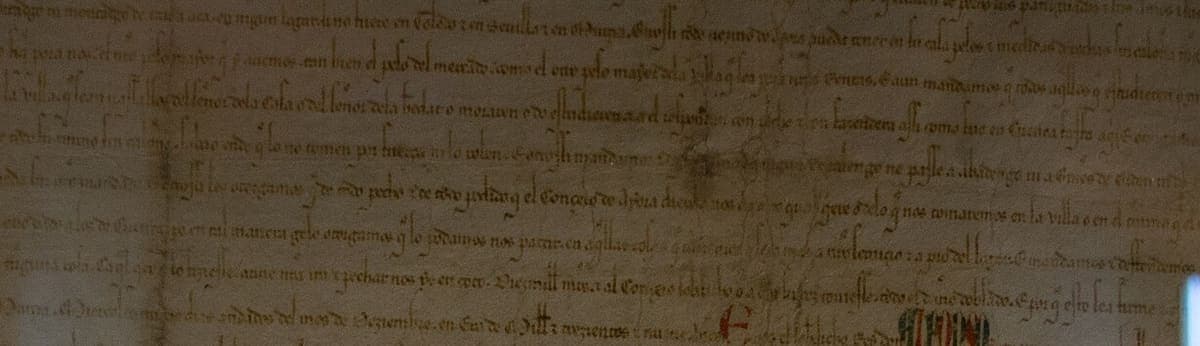
Archivo Municipal de Ayora, 9 December 1271 · Source · CC BY-SA 4.0 · Photograph by Dorieo, Wikimedia Commons, CC BY-SA 4.0
Evidano Transcription
The exemption clauses shown in the photograph and the dating clause at the foot of the sheet, from the transcription of the whole privilege published on the Commons file page by the photographer. Slashes mark the ends of the parchment lines, round brackets hold his conjectures, and his modern word division, accents and punctuation have been kept; the ellipsis is where his text passes to the dating clause.
E mandamos / que todo vezino de Ayora que no dé portadgo ni montadgo de tiempo a acá en ningún logar, si no fuere en Toledo e en Sevilla e en Murcia. Otrossí, todo vezino de Ayora pueda tener en su casa pesos e medidas derechas, sin calonna nunguna, e el que no las toviere derechas, que peche la calonna como / (dicho) fuera manda, pero salvo si que por a nós el nuestro peso mayor que y avemos, también el peso del mercado, aquellos que estovieren e moraren en las casas e en las heredades de los vezinos de Ayo/ra, que tovieren casa pobladas en la villa, que sean vassallos del sennor de la casa o del sennor de la heredat o moraren o do estovieren e a él respondan con pecho e con facendera, assí como fue en cuenca fasta aquí.
…
Fecho el privilegio en Murcia, miércoles, nueve días andados del mes de deziembre, en era de mille e trezientos e nueve annos.
Source: Transcription of the privilege on the Wikimedia Commons file page, by the photographer (user Dorieo) (CC BY-SA 4.0).
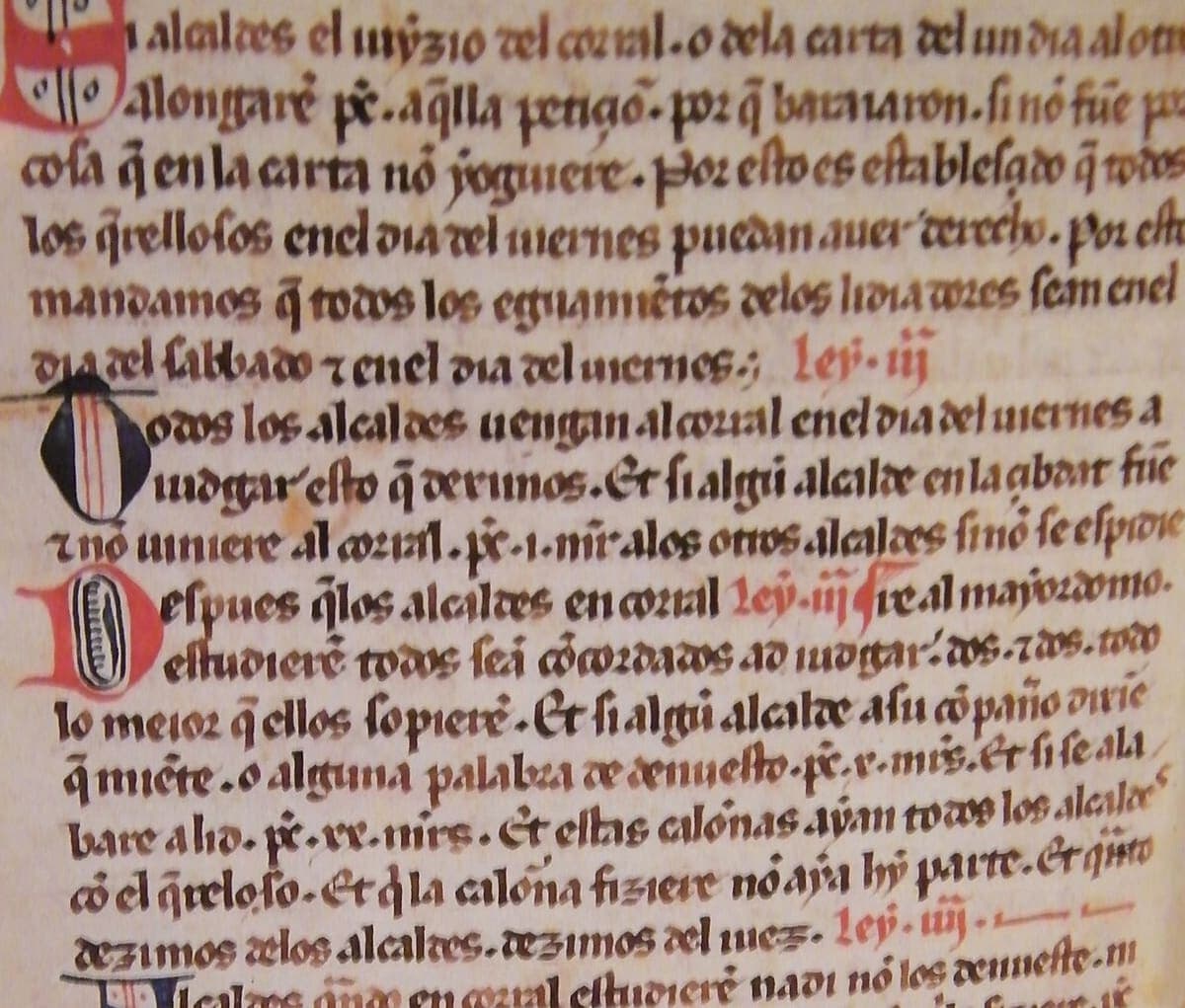
Source · CC BY-SA 3.0 · Photograph of the facsimile by Dorieo, Wikimedia Commons, CC BY-SA 3.0
Evidano Transcription
[cut off]i alcaldes el iuyzio del corral . o dela carta del un dia al otr[o]
alongare[n] . p[eche] . aq[ue]lla petiçio[n] . por q[ue] baraiaron . si no[n] fue p[cut off]
cosa q[ue] en la carta no[n] yoguiere . Por esto es establesçado q[ue] todos
los q[ue]rellosos enel dia del uiernes puedan auer derecho . Por est[o]
mandamos q[ue] todos los eguamie[n]tos delos lidiadores sean enel
dia del sabbado ⁊ enel dia del uiernes . ley . iij
Todos los alcaldes uengan al corral enel dia del uiernes a
iudgar esto q[ue] deximos . Et si algu[n] alcalde en la çibdat fue[re]
⁊ no[n] uiniere al corral . p[eche] . i . m[o]r[auedi] alos otros alcaldes si no[n] se espidie[re]
Despues q[ue] los alcaldes en corral ley . iij [?]ie al mayordomo .
estudiere[n] todos sea[n] co[n]cordados ad iudgar . dos . ⁊ dos . todo
lo meior q[ue] ellos sopiere[n] . Et si algu[n] alcalde a su co[m]paño dixie[re]
q[ue] mie[n]te . o alguna palabra de denuesto . p[eche] . x . m[o]r[auedi]s . Et si se ala
bare a lio . p[eche] . xx . m[o]r[auedi]s . Et estas calo[n]as ayan todos los alcaldes
co[n] el q[ue]reloso . Et q[ue] la calo[n]a fiziere no[n] aya hy parte . Et q[ua]nto
dezimos delos alcaldes . dezimos del iuez . ley . iiij .
[cut off]Alcaldes q[ua]ndo en corral estudiere[n] nadi no[n] los denueste . ni
Generated by Evidano’s advanced model; not yet checked against a published edition.
Evidano Transcription
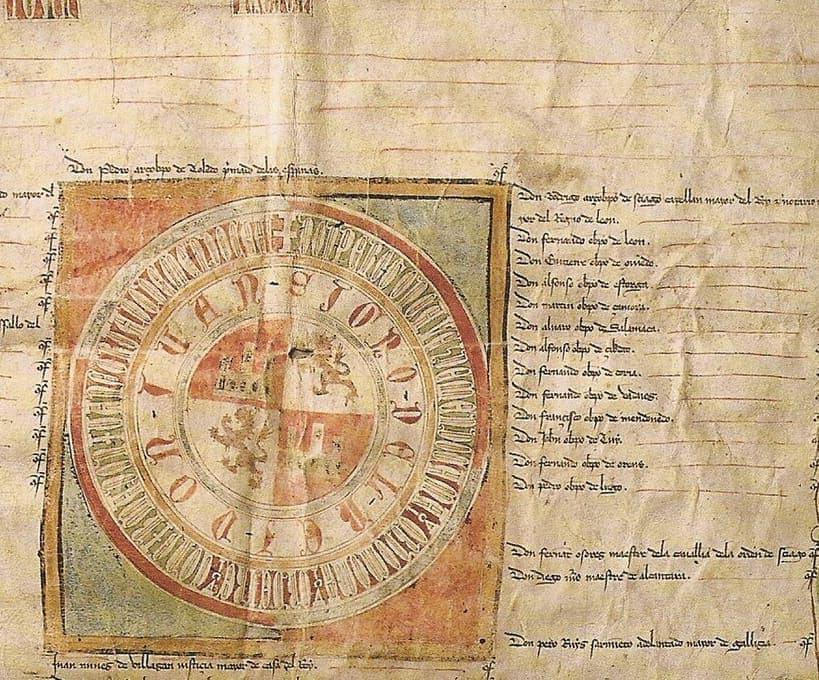
Don pedro arçob[is]po de toledo p[ri]mado delas espannas. cf
[left column of confirmations cut off at the image edge]
SIGNO DEL REY DON IUAN[?]
[outer legend illegible]
Don Rodrigo arçob[is]po de s[an]tiago capellan mayor del Rey e notario ma [cut off]
yor del Regno de leon.
Don fernando ob[is]po de leon.
Don Gutierre ob[is]po de ouiedo.
Don alfonso ob[is]po de astorga.
Don martin ob[is]po de çamora.
Don aluaro ob[is]po de Salamanca.
Don alfonso ob[is]po de çibdad.
Don fernando ob[is]po de coria.
Don fernando ob[is]po de badaios.
Don francisco ob[is]po de mendonedo.
Don Joh[a]n ob[is]po de Tui.
Don fernando ob[is]po de orens.
Don pedro ob[is]po de lugo.
Don ferrnand osores maestre dela caualleria dela orden de s[an]tiago cf
Don diego mño[?] maestre de alcantara. cf
Don pedro Ruys sarmiento adelantado mayor de gallizia. cf
Juan nunnes de billasan iustiçia mayor de casa del Rey.
Generated by Evidano’s advanced model; not yet checked against a published edition.
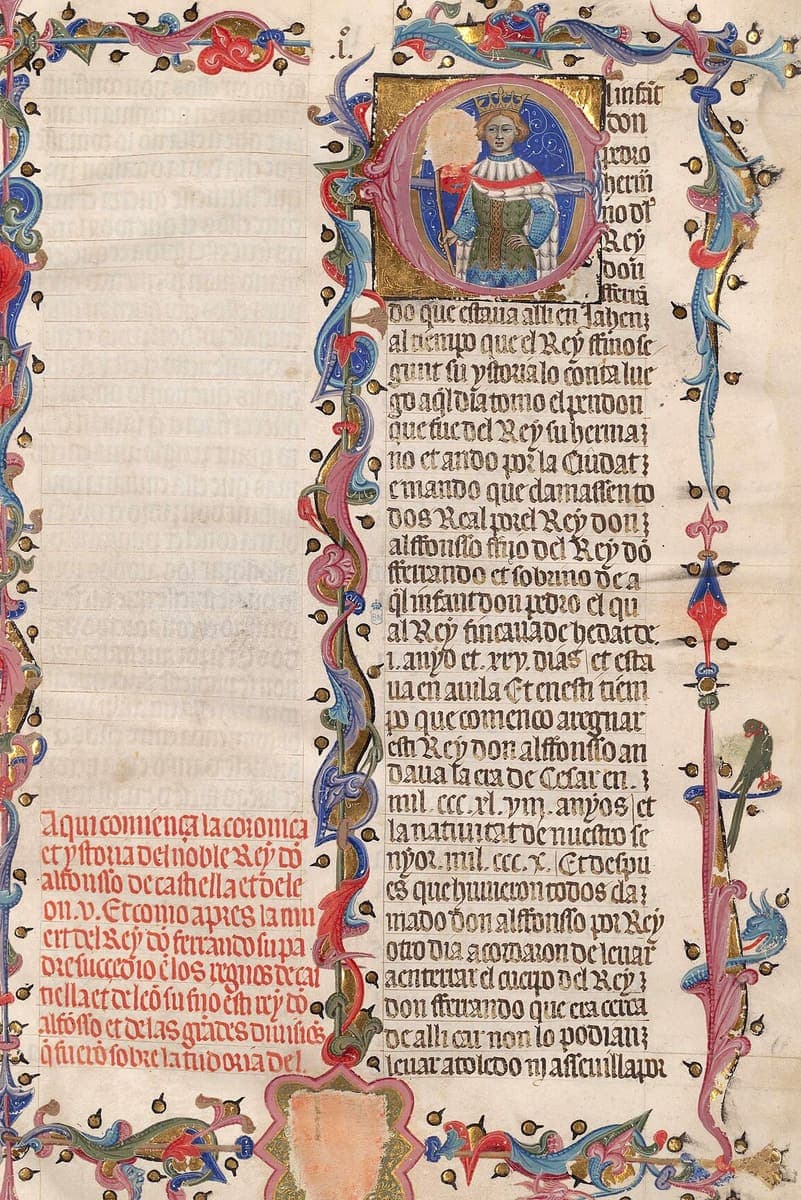
Biblioteca Nacional de España (Biblioteca Digital Hispánica), Fourteenth century · Source · Public domain
Evidano Transcription
The red rubric at the foot of the left-hand column and the opening words of the right-hand column beside the initial, as transcribed on the Commons file page; word division, accents and punctuation are the transcriber’s, and his text stops where the bracketed ellipsis stands.
Aqui comiença la coronica et ystoria del noble rey don Alfonsso de Castiella e de Leon. Et como apres la muert del rey don Fernando, su padre, suçcedio en los regnos de Castiella et de Leon su fijo, esti rey don Alfonso et de las grandes divisiones que fueron sobre la tudoria del.
El infant don Pedro hermano del rey don Fferrando […]
Source: Transcription of the incipit on the Wikimedia Commons file page (CC BY-SA 4.0).
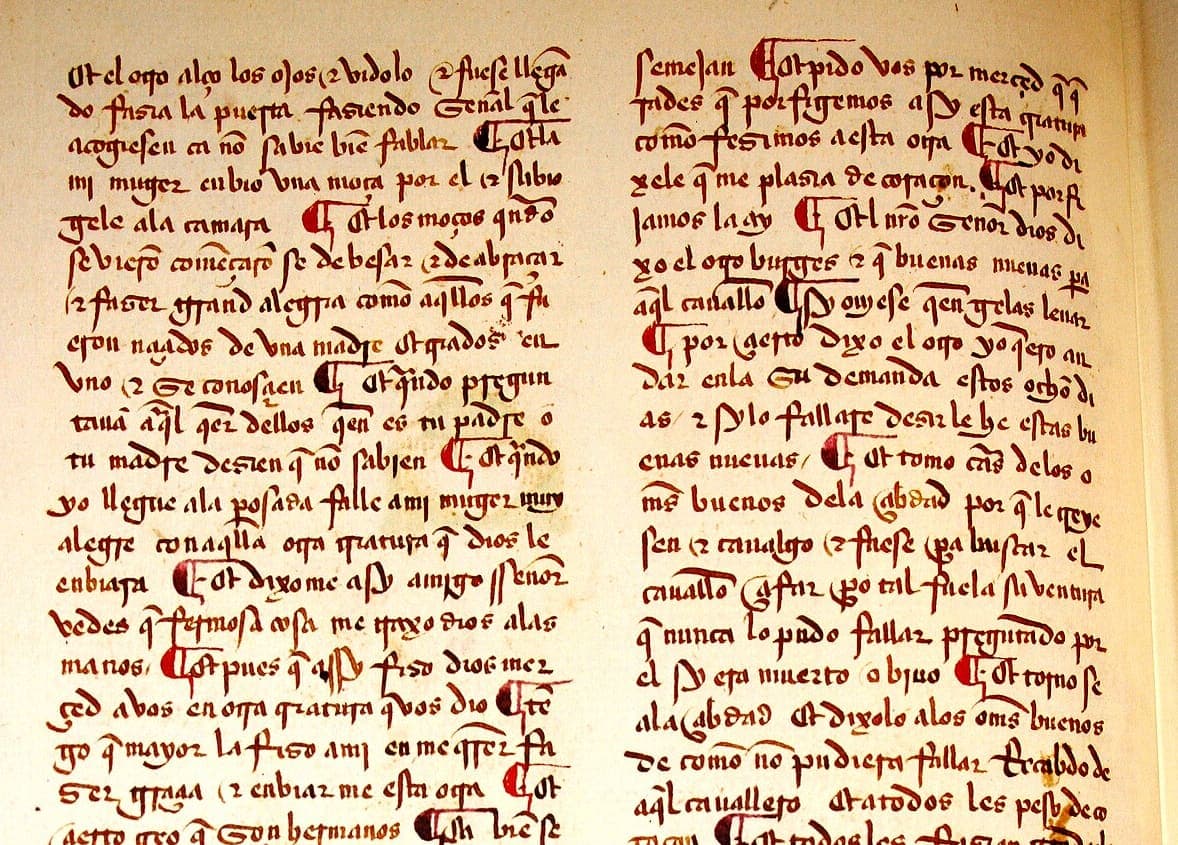
Bibliothèque nationale de France, Paris, ms. espagnol 36, f. 35v, Fifteenth century · Source · Public domain
Evidano Transcription
Both columns of the folio, in Heinrich Michelant’s 1872 edition of this Paris manuscript (p. 72). His word division, accents and punctuation are kept, his German-style quotation marks are given here as double quotes, and his readings stand where they differ from the folio — he prints moça where the scribe wrote mora. Scanning errors in the digitised volume have been repaired against the manuscript; the paragraph breaks are editorial, since the edition sets the passage as continuous prose and the folio ends mid-word at plaser.
e el otro alço los ojos e vidolo e fuese llegando fasia la puerta, fasiendo señal que le acogiesen; ca non sabia bien fablar. E la mi muger enbio una moça por el e subiogelo a la camara, e los moços, quando se vieron, començaronse de besar, de abraçar e faser grand alegria, comon aquellos que fueron nacidos de una madre e criados en uno e se conoscien.
E quando preguntavan a qualquier dellos: "Quien es tu padre o tu madre?" desien que non sabien; e quando yo llegue a la posada, falle a mi muger muy alegre con aquella otra criatura que Dios le enbiara e dixome asy: "Amigo sseñor, vedes que fermosa cosa me traxo Dios a las manos, e pues que assy fizo Dios merced a vos en otra criatura que vos dio, tengo que mayor la fizo a mi en me querer fazer gracia e enbiar me esta otra; e cierto creo que son hermanos, ca bien se semejan, e pido vos por merced que querades que porfigemos asy esta criatura comon fesimos a esta otra." E yo dixele que me plasia de coraçon e porfijamos la ay.
— El nuestro señor Dios! dixo el otro burges, e que buenas nuevas para aquel cavallero, sy oviese quien gelas levar! — Por cierto, dixo el otro, yo quiero andar en la su demanda estos ocho dias, e sy lo fallare, desir le he estas buenas nuevas.
E tomo cartas de los omens buenos de la cibdad, porque lo creyesen e cavalgo e fuese para buscar el cavallero Cifar; pero tal fue la su ventura que nunca lo pudo fallar, preguntando por el sy era muerto o bivo, e tornose a la cibdat e dixolo a los omens buenos de comon non pudiera fallar recabdo de aquel cavallero, e a todos les peso de coraçon. E todos les fasian grand plaser
Source: Historia del Cavallero Cifar, ed. Heinrich Michelant, Bibliothek des Litterarischen Vereins in Stuttgart 112 (Tübingen, 1872), p. 72, via Internet Archive (Public domain).
How Castile wrote between 1200 and 1450
Once Caroline minuscule had displaced Visigothic script, Iberian writing hardened into Gothic, and Castile used it in three registers at once. Solemn parchment grants were drawn in the wide, deliberately old-fashioned letra de privilegios, arranged around the wheel-shaped signo rodado. Everyday business went into the letra de albalaes, the chancery cursive named after the albalá, the short royal order Alfonso X’s office issued by the hundred: it slopes right, drives ascenders and descenders far past the line and links letters in twos and threes. Books — Alfonsine histories and law codes, town fueros, chronicles, romances — took a rounded Gothic textualis, the letra redonda, in two columns with red rubrics. Parchment carried the solemn acts, paper from Xàtiva and Italy the albalaes and the files of town councils; from about 1380 the albalaes hand loosens into precortesana and then cortesana.
The alphabet is small but treacherous. The d is uncial, its stem curving back over the bowl; long ſ stands beside a round final s that can be taken for a figure 6; r rotunda follows o, b and other bows; z is drawn like a figure 3 and, tailed with a cedilla, gives the ç of coraçon and merçed. Nothing dots the i, so mill, nin, muy and uiuir dissolve into rows of minims that only the sense of the clause separates, while u and v, i and j are positional variants rather than distinct letters. Capitals are drawn rather than written, and in codices a coloured calderón marks each new sentence under rubrics that number the laws.
Abbreviation is systematic and dense: a wavy stroke for a missing nasal or a general contraction, q with a stroke for que, p with a barred descender for per or par, superscript letters for ra, ri and ro, and the fixed forms of business writing — dho for dicho, nro for nuestro, obpo for obispo, mrs for maravedís. Numbers are Roman, written small with a final j, as in xiij or cccc, and sums are counted in maravedís. Dates are the trap: Castile reckoned by the Hispanic era, thirty-eight years ahead of the Christian year, until Juan I ordered the change at the Cortes of Segovia in 1383, after which acts are dated by the año del nascimiento. A privilege sets its dating clause after the grant, then the rueda with the king’s name inside and his motto round the rim, then columns of archbishops, bishops and ricos omnes, each name closed by a hook, and last the scribe’s subscription along the foot.
Why ordinary OCR struggles here
Minims, and the words that dissolve into them
Eight strokes in a row may be muy, nin, mill or uiuir, and an abbreviation bar turns the same shape into quantos or quien. Engines trained on print settle the ambiguity from a modern dictionary and produce fluent Spanish that is not what the scribe wrote — worse than an obvious error, because nothing looks wrong.
Documents that are not one block of text
A privilege carries a chrismon, the grant itself, a wheel with two rings of lettering, columns of confirmations and a subscription along the foot; a codex page carries rubrics, calderones and later marginal notes. Straight line-by-line recognition runs them together, so a bishop’s name lands inside a clause of the grant.
Numbers, money and two dating systems
Lower-case Roman numerals with their final j sit beside sums in maravedís and days counted as días andados of the month. One misread stroke changes a rent or moves a charter by ten years, and the switch from era to nativity dating in 1383 leaves the same year in two forms in one archive.
Formulas that invite a model to guess
These texts are built from set phrases: Sepan quantos esta carta vieren, por fazer bien e merced, e mando e defiendo. A model that has learned the formula completes it smoothly and glides over the names, places and sums — the only parts that differ from one document to the next.
Who works with this material
Municipal and cathedral archives
Fueros, cartas pueblas, confirmations and rent books are the backbone of a Spanish local archive. Cataloguers need searchable text that keeps the diplomatic sections apart, so an act can be summarised, dated and indexed without anyone reading the parchment again.
Historians of the Castilian chancery
A confirmation column dates a privilege as sharply as its era clause, because bishops and magnates come and go. Prosopographers comparing hundreds of such lists want each column returned in its own order, with sees and court offices still attached to the names.
Editors of medieval Castilian texts
An edition of a fuero, a chronicle or a romance begins with a transcription that reproduces the spelling of the witness, marks every expansion and keeps folio and column references, so that readings can be collated between manuscripts and against printed editions.
Language historians and corpus builders
The retreat of the Hispanic era, the spread of ç and z and the vocabulary of taxation are all traced through dated documents. A corpus is only as reliable as the transcriptions under it, which have to be reproducible rather than quietly modernised.
Getting the best transcription
Say which register you are in
Tell the model whether the page is a solemn privilege, a chancery albalá or a book hand, and give the decade if you know it. Naming the register removes a class of errors at once, because the cursive and the rounded book hand form their a, d and s differently.
Set the expansion and spelling rules before the batch
Decide whether que, dicho and maravedís are expanded silently, expanded in square brackets or left as they stand, and whether ç, long ſ and the manuscript’s u and v are kept. Hold the same rule across the run so the output can be searched consistently.
Ask for the parts of the document to be labelled
Ask for the body, the two rings of the rueda, each confirmation column, the marginal notes and the subscription as separate blocks in reading order, with rubrics marked as such. In a codex, ask for column breaks and calderones to survive, so the sentence divisions stay visible.
Check the numbers before the prose
Transcribe one document, then check the era or nativity year, the day of the month and every sum against the catalogue entry. A model that reads xiij and mrs correctly on a crowded line is usually safe on the formulaic prose around them.
Further reading on this hand
The palaeography guides the in-app selector points to for this domain, if you want to check a transcription against the standard references.
- Spanish Handwriting History
This Brigham Young University guide presents a chronological account of Spanish handwriting from Visigothic through early modern scripts. It places medieval Gothic and documentary developments between the decline of Visigothic writing and the rise of Cortesana and Procesal. The accompanying alphabet and handwriting resources allow comparison of recurring letterforms and scribal variation. This historical framework is useful for identifying Castilian records written before the full development of fifteenth-century court hands.
Frequently asked questions
- What is the difference between letra de albalaes, letra de privilegios and cortesana?
- Letra de privilegios is the formal parchment hand of solemn grants: wide, upright, deliberately conservative. Letra de albalaes is the working chancery cursive of roughly 1250 to 1380, sloping, with long ascenders and few loops. Cortesana grows out of it after about 1380, rounder and much more joined; it has its own page here.
- Will the abbreviations be expanded?
- Whichever way you ask. The default is a semi-diplomatic text in which common contractions are expanded and the expansion marked, so mrs is given as maravedís with the supplied letters shown. For a strict diplomatic edition, ask for the signs to stand as written.
- Can it read the wheel and the confirmation columns of a privilege?
- Yes. The inner and outer rings of the rueda come back as their own lines, and each column of confirmations as a list in the order it was written. Marks that are not text — the hook after a name, a cross, a blank ruled line — are labelled rather than turned into words.
- How are era and nativity dates handled?
- The clause is transcribed exactly as it stands. On request the Hispanic era is converted as well, by subtracting thirty-eight years, while documents after the change of 1383 are left as they are; the conversion is reported beside the original wording, never in place of it.
- Do these hands write anything but Castilian?
- Often. Latin formulas sit inside Castilian acts, and the chanceries of Aragon, Navarre and Portugal wrote close cousins of the script for Aragonese, Catalan and Galician-Portuguese. Name the language of the page and any second language you expect, and the two are kept apart instead of one being corrected into the other.
Related scripts and pages
Transcribe your Gothic Castilian charters and codices
Upload a privilege, a fuero or a page of a chronicle, choose Castilian Gothic and Albalá Hands as the domain, and test one document before the rest of the archive follows.