
Russian · Image to Text
Nine centuries of Cyrillic, hand by hand
Russian has been written in four quite different ways: the upright ustav of the earliest church books, the narrower poluustav with its ligatured headings, the looping skoropis of the Muscovite chancelleries, and the civil alphabet and cursive introduced by Peter I. Evidano treats each as its own problem, from an eleventh-century gospel to a parish register of 1914.
Choose the hand or document type
 Church Slavonic Ustav Manuscriptsc. 1000–1400Transcribe eleventh- to fourteenth-century ustav: yat, the yus letters, titla, letter-numerals and unspaced lines, on real folios with checked readings.
 Church Slavonic Poluustav and Vyazc. 1300–1700Transcribe poluustav manuscripts and early Cyrillic printing, and unpick vyaz headings where letters share masts and nest inside one another.
 Muscovite Skoropis Documentsc. 1500–1700Transcribe Russian chancery cursive of the sixteenth and seventeenth centuries: raised endings, looped ligatures, prikaz formulae and column scrolls.
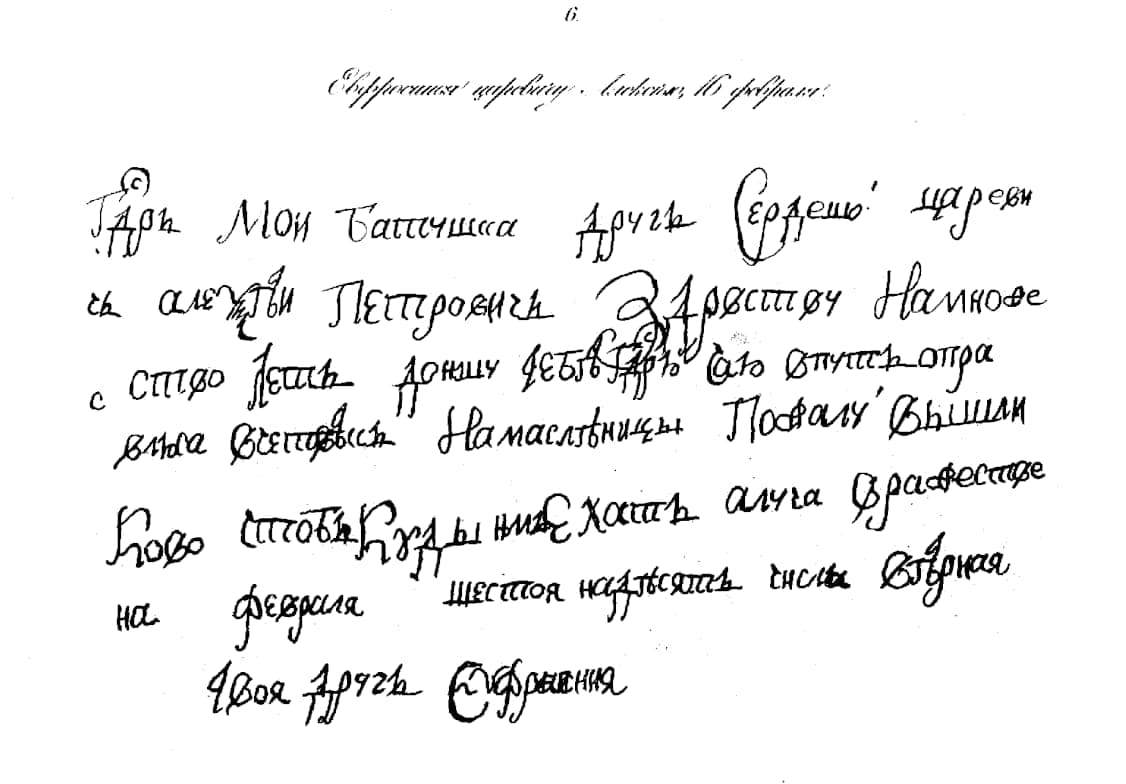 Imperial Russian Civil Script and Cursivec. 1700–1850Transcribe post-Petrine Russia: grazhdansky shrift in print and the looping cursive of chanceries, petitions and literary autographs, 1700 to 1850.
 Late Imperial Pre-Reform Russian Recordsc. 1850–1918Transcribe pre-reform Russian: yat, decimal i, fita and the final hard sign in parish registers, newspapers, forms and official acts down to 1918.
Transcribing Russian across the centuries
What survives from Rus before 1400 is mostly liturgical: gospel books, psalters and florilegia drawn letter by letter in ustav, with a much larger alphabet than the modern one, no gaps between words, and numbers written as letters under a stroke. Beside them lie the birch-bark letters of Novgorod, scratched with a stylus by people who were not scribes at all. From the fourteenth century the book hand narrows into poluustav, headings are compressed into vyaz, and after 1564 the first printed books copy that hand closely.
Administration produced a different script. Skoropis, the cursive of the prikazy, ran on glued column scrolls and in bound registers from about 1500 until Peter I; it lifts half its endings above the line and loops the rest. Peter replaced it for secular use with the civil alphabet and a cursive taught from Western copybooks, and that alphabet, still carrying yat, decimal і, fita and a hard sign on every word, lasted until 1918. The last imperial century is largely printed forms filled in by hand: revision tales, parish registers and official acts.
The people who read this material are editors of early Slavonic texts, church and Old Believer historians, archivists describing chancery files, genealogists working through registers, and language projects that need the orthography preserved rather than tidied away. Each of the five pages below covers one hand or period, with sample pages, their sources and, where a published reading exists, a checked transcription beside the image.
Not sure which hand you have?
Upload a page, pick the closest domain, and test the prompt on one page before running the rest. You can switch domains at any time.