
Sanskrit · c. 1000–1900
Close to Devanagari, and not the same
Nandinagari was the book hand of the Deccan for eight hundred years, and it is close enough to Devanāgarī to be read wrongly with confidence: the two share a structure and a good deal of shape, and then part company over the headstroke, half a dozen consonants and most of the conjuncts. Almost nobody reads it now, including scholars fluent in Sanskrit. Evidano treats it as its own script rather than as a variant, and returns Nandinagari, Devanāgarī or IAST as you prefer.
Sample pages
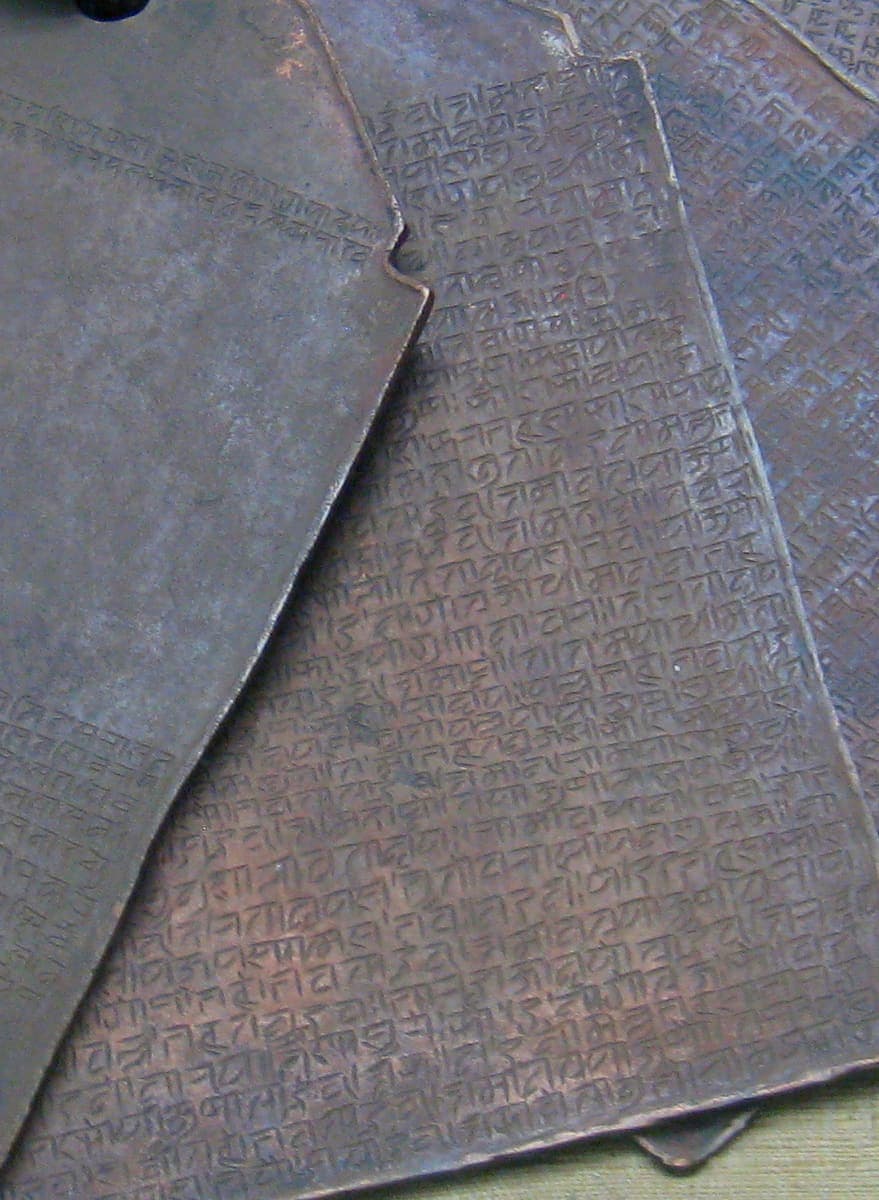
National Museum, New Delhi, 1543 · Source · Public domain · Photograph by Wikimedia Commons user Daderot
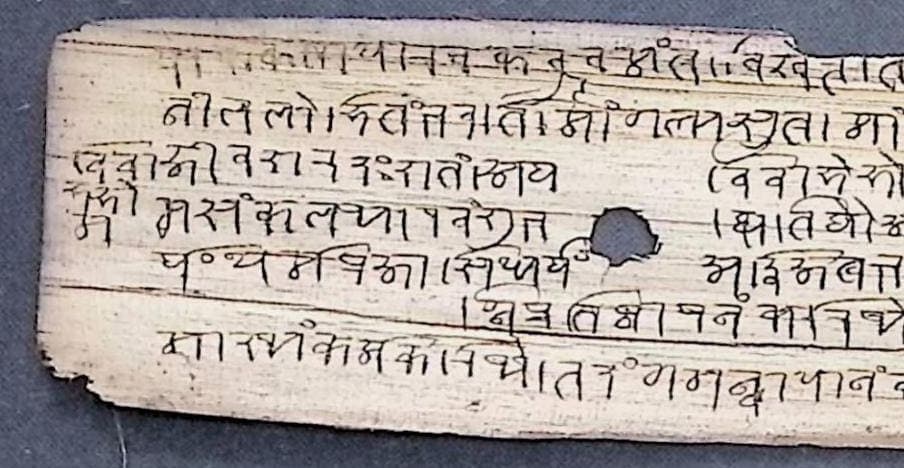
Central Sanskrit University, Sringeri · Source · CC0 1.0 · Digitised by eGangotri
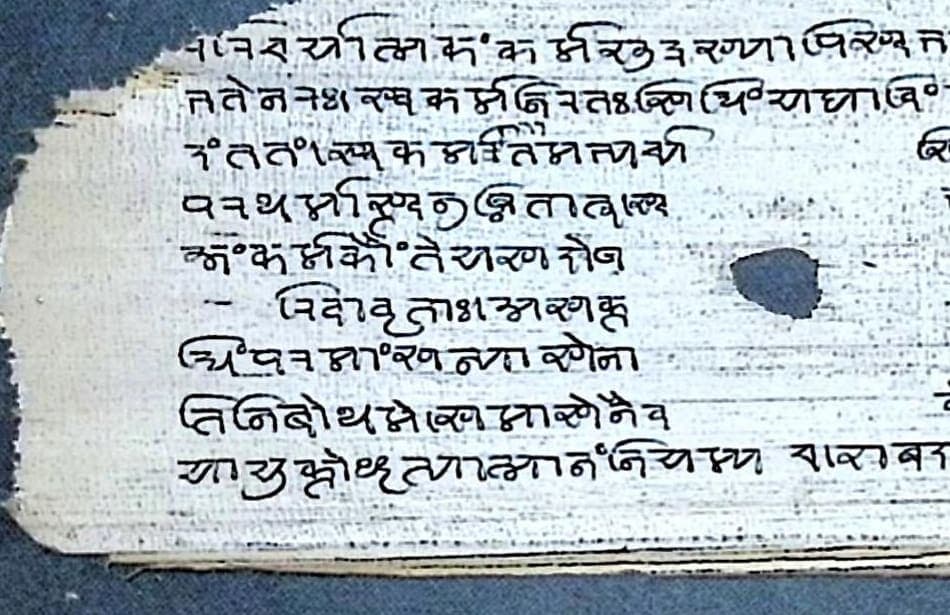
Central Sanskrit University, Sringeri · Source · CC0 1.0 · Digitised by eGangotri
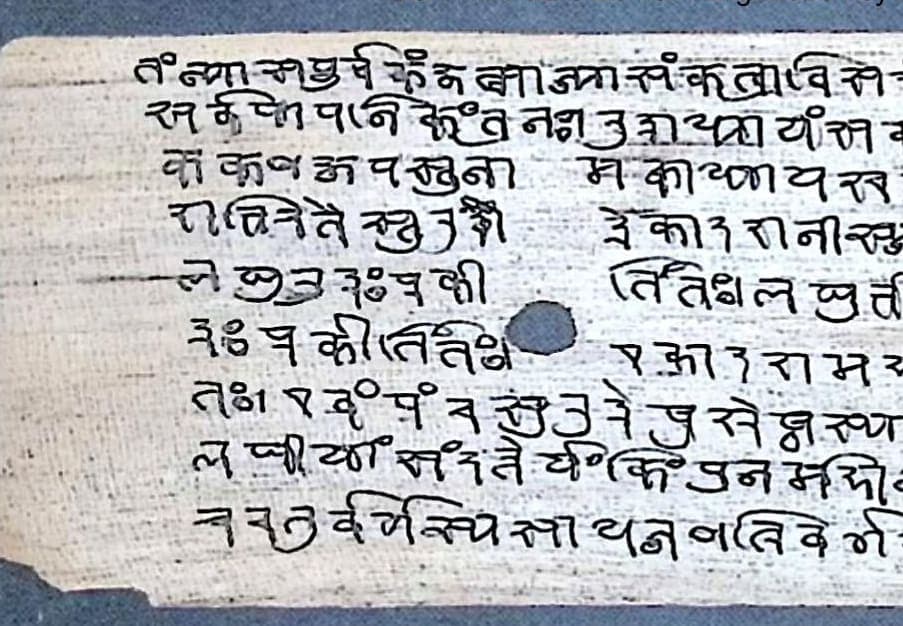
Central Sanskrit University, Sringeri · Source · CC0 1.0 · Digitised by eGangotri
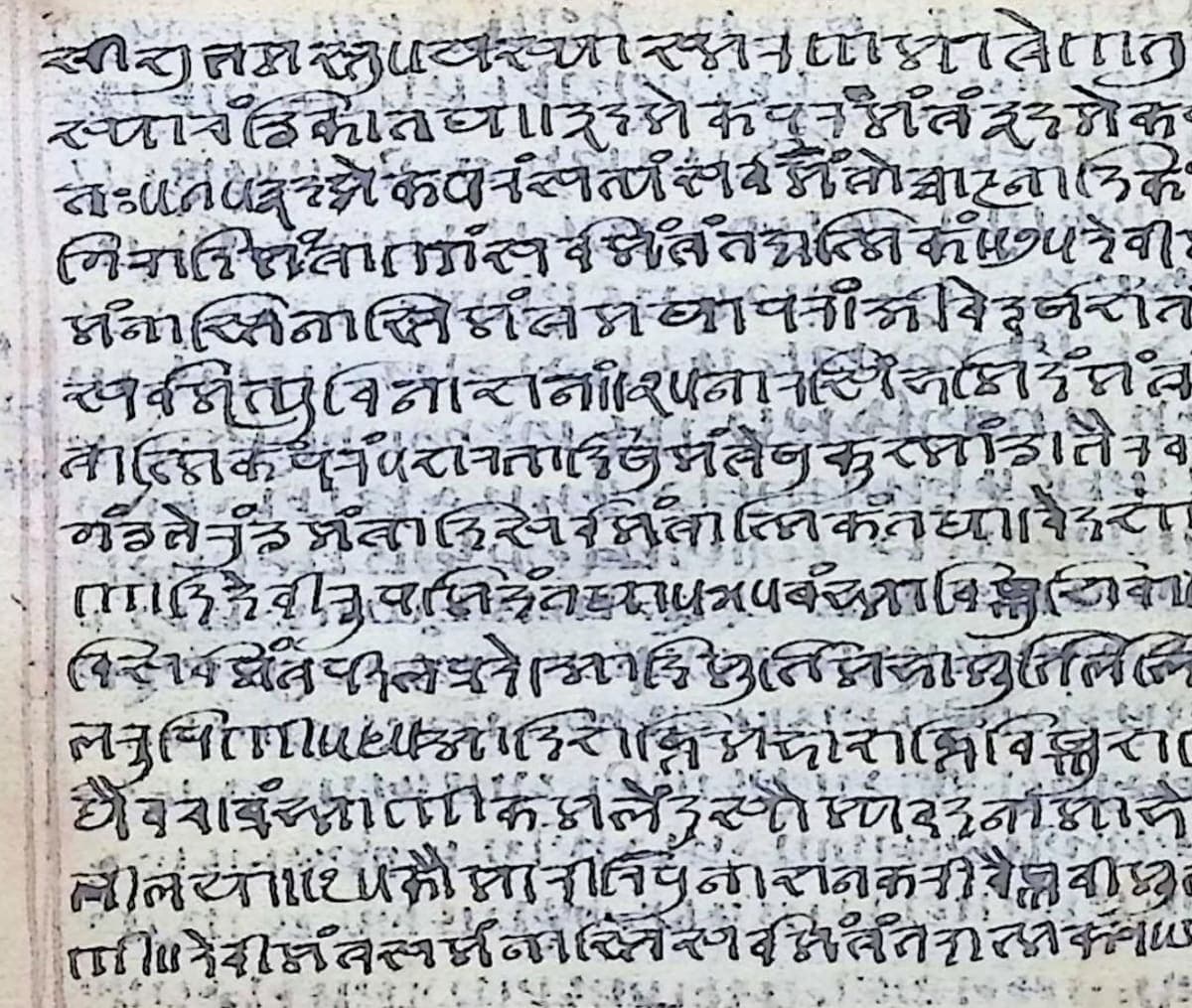
Central Sanskrit University, Sringeri · Source · CC0 1.0 · Digitised by eGangotri
A southern Nagari and the surfaces it was written on
Nandinagari developed out of the same Nāgarī stock as Devanāgarī and settled in the Deccan — in what is now Karnataka and the neighbouring parts of Maharashtra and Andhra — where it was used for Sanskrit from about the eleventh century until the nineteenth. The Vijayanagara chancery engraved its royal grants in it; the maṭhas of the Mādhva tradition copied the works of Madhva, Jayatīrtha and Vyāsatīrtha in it; and the Vedic schools of the region wrote their saṃhitās and ritual manuals in it. Kannada was written beside it in a related but separate alphabet, so a scribe in Sringeri or Udupi handled two scripts and could put both on one leaf. By the end of the nineteenth century printing had displaced it entirely, and the script went out of use so completely that most of the manuscripts written in it have never been read.
It looks like Devanāgarī at a glance and behaves differently in detail. The headstroke is there but often broken between akṣaras or missing over some of them, so the line does not run continuously the way a Devanāgarī line does; the bodies are rounder and more open; and several letters differ from their northern counterparts only by a hook, a terminal or the direction of a small stroke — enough to make a Devanāgarī reading wrong, not enough to make it look wrong. Vowel signs attach in the familiar positions but with their own shapes, and conjunct consonants are formed by stacking with reduced lower members whose forms have to be learned separately. Unicode gave the script its own block precisely because these differences cannot be represented by reusing Devanāgarī code points.
Three surfaces carry it. Palm leaf is the oldest: incised with a stylus, blackened with soot, four to eight lines to a strip, with cord holes punched through the writing. Paper arrives in the seventeenth and eighteenth centuries and brings ink, red margin rules and, on thin sheets, heavy show-through from the other side. Royal grants were engraved on sheets of copper strung together on a ring and sealed, so that the same script appears as shallow tooling on metal, catching the light rather than the eye. On all three the writing is continuous: sandhi joins word to word, there are no spaces, sentences end in a daṇḍa and sections in a double daṇḍa, folio numbers sit in the margin in letter-numerals, and a manuscript opens with an invocation before the text proper begins.
Why ordinary OCR struggles here
A script that invites the wrong answer
Any system trained on Devanāgarī will read Nandinagari fluently and produce plausible Sanskrit with a scatter of substituted consonants. That is worse than failing outright, because the output looks correct and the errors are spread thinly through the text.
A headline that comes and goes
Devanāgarī is segmented largely by its unbroken headstroke. In Nandinagari the headstroke is intermittent, so the visual cue that separates one akṣara from the next is unreliable and the line has to be divided on the shapes below it.
Continuous text with no word gaps
Sandhi runs the words together and nothing marks their edges. The transcription has to segment as well as recognise, and a wrong split yields a grammatical Sanskrit word that is not the one on the leaf.
Three materials, three problems
Incised palm leaf loses contrast where the soot has gone; paper manuscripts show the verso through the sheet; engraved copper depends entirely on the raking light of the photograph. The script is the same in each case and the image processing is not.
Who works with this material
Scholars of Dvaita Vedānta
The commentarial tradition of Madhva and his successors survives mainly in Nandinagari copies held by maṭhas in Karnataka. Much of it has never been printed, so a first reading of a bundle is the step that decides whether a work is known at all.
Vedic textual scholarship
Saṃhitā and ritual manuscripts from the Deccan record recitational traditions with their own readings. What matters is a transcription that keeps the manuscript’s spelling and accent marks rather than silently agreeing with a printed edition.
Manuscript libraries in Karnataka and Tamil Nadu
Collections in Sringeri, Mysore, Udupi and Thanjavur hold large runs of Nandinagari material catalogued only by title. Reading the opening and closing lines of each bundle produces the incipit, the extent and the colophon that a record needs.
Epigraphists working on Vijayanagara grants
Copper-plate charters name donors, villages, boundaries and dates, and they are the backbone of the region’s administrative history. Getting the formulaic sections into text quickly leaves the specialist to work on the parts that vary.
Getting the best transcription
State that it is Nandinagari, not Devanagari
This is the single most useful thing you can put in the prompt. Without it the model will default to the northern script, and its output will be readable, confident and wrong in a way that is hard to catch by eye.
Ask for the script you actually want back
Nandinagari has its own Unicode block; converting to Devanāgarī is convenient but discards distinctions the script makes. Decide whether you want Nandinagari, Devanāgarī, IAST or two of them in parallel, and say so every time.
Flag the passages in other scripts
Ritual and anthology manuscripts move into Grantha, Kannada, Telugu or Devanāgarī without warning. Ask for each stretch to be tagged with the script it is in, so that a quoted mantra is not transliterated as though it were the surrounding text.
Photograph copper plates twice
Engraved metal needs raking light from two directions to bring up all the strokes, and a single flat photograph will lose whole lines. Run both exposures and compare the readings rather than trusting one image.
Further reading on this hand
The palaeography guides the in-app selector points to for this domain, if you want to check a transcription against the standard references.
- Proposal to Encode the Nandinagari Script in ISO/IEC 10646
This Unicode proposal was prepared for the International Organization for Standardization and International Electrotechnical Commission (ISO/IEC) encoding process. It documents Nandinagari from South Indian Sanskrit manuscripts and distinguishes it from Devanagari and other related scripts. The proposal presents vowels, consonants, combining signs, conjunct behavior, virama, punctuation, numerals, and fractions with manuscript evidence. It is directly useful for Nandinagari transcription because it defines script-specific characters that can be mistaken for superficially similar Devanagari forms.
Frequently asked questions
- Is Nandinagari just a variant of Devanagari?
- They are related, and they share their structure, but the letterforms diverge enough that Unicode encodes them separately. Treating Nandinagari as a font variant of Devanāgarī produces systematic substitutions in a handful of consonants and in most conjuncts.
- Can the output be given in Devanagari anyway?
- Yes, and for many purposes that is what a reader wants. The conversion is done as a second step from a Nandinagari reading, so the original characters remain available if you later need to know exactly what was on the leaf.
- How are the numerals and fractions handled?
- Nandinagari has its own digits and a set of fraction signs, and they are transcribed as they stand with a conversion offered separately. Folio numbers written with letters rather than digits are reported as a field of their own.
- What about the invocation at the head of a manuscript?
- The opening sign and the invocation formula are returned as a separate block. They are formulaic, they often identify the tradition a copy belongs to, and they are the part most likely to be misread as ordinary text.
- Does it work on copper plates as well as manuscripts?
- The script is the same, so the recognition transfers; the difficulty moves to the image. Engraved letters have no colour contrast at all, and results depend far more on how the plate was lit and photographed than on the age or the hand.
Related scripts and pages
Read your Nandinagari manuscripts
Upload a palm leaf, a paper folio or a copper plate, choose Nandinagari Sanskrit Manuscripts, and say which script you want the transcription in.