
Swedish · c. 1500–1750
Swedish before the spelling settled
A Swedish clerk of the sixteenth or seventeenth century wrote å as an a with a small o above it, ä as an a with an e, and ended half his words in a flourish that may be a letter or may be nothing at all. The same office printed its ordinances in Fraktur and set every Latin word inside them in roman type. Both habits have to be read as they stand rather than corrected into modern Swedish.
Sample pages
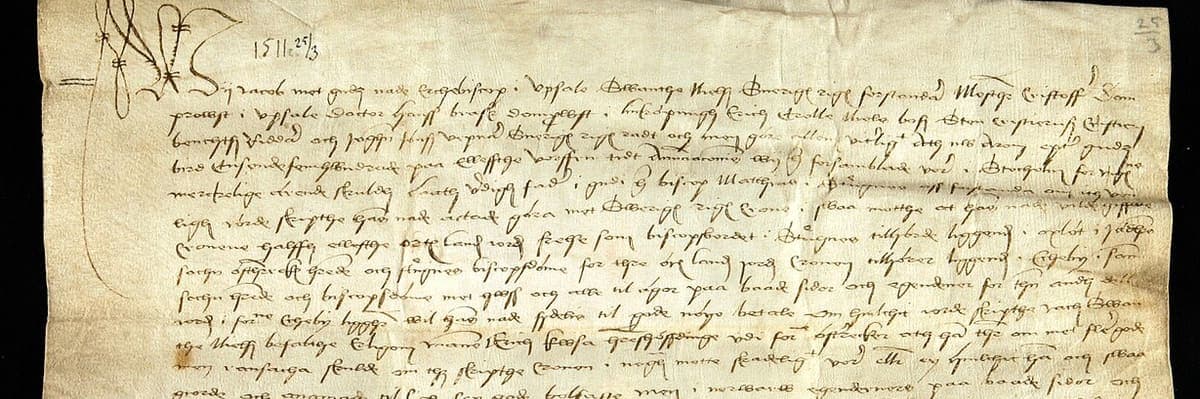
Riksarkivet (National Archives of Sweden), SDHK 36960, 25 March 1511 · Source · Public domain · Riksarkivet, Svenskt Diplomatarium
Evidano Transcription
1511 25/3
25
3
Wij Iacob met gudz nade Erchebiſcop i Vpſale Swantthe[?] Nielſſ[?] Swerigis Rikis forſtandare Meſter Criſtoff[er] dom
proweſt i Vpſale Doctor hanſſ braſk domprowſt[?] i lincopingh[?] Erik[?] trolle [illegible]
[illegible] Swerigis Rikis radt och [illegible] epter gudz
byrd tuſende femhundrade paa elleffte [illegible] forſamblade wore . [illegible]
merckelige erende ſkuldh [illegible] biſcop Matthias . [illegible]
[illegible] gora met Swerigis Rikis Crone . ſſaa motthe at han [illegible] wille giffue
Cronone halfft ellefftte öre land iord ſkoge ſom biſcopſbordet i [illegible] liggendis . [illegible]
ſokn [illegible] hede och ſtrengnes biſcopſdöme for tree öre land [illegible] Cronon [illegible] liggendis . Egeby . ſom
ſokn hede och biſcopſdöme met hwſſ och alle til ägor paa baad ſidor och egendomer for then andra [illegible]
iord i for[nem]de Egeby ligge[ndis] [illegible] nöye betale . Om hwilket wnder ſkripthe [illegible]
[illegible]
[illegible] ranſaka ſkulle om the ſkripthe Cronon . [illegible] eller ey [illegible] och ſſaa
[illegible] egendomer paa baade ſidor och
Generated by Evidano’s advanced model; not yet checked against a published edition.
Source · Public domain · Scan of the 1541 Bible on Wikimedia Commons
Evidano Transcription
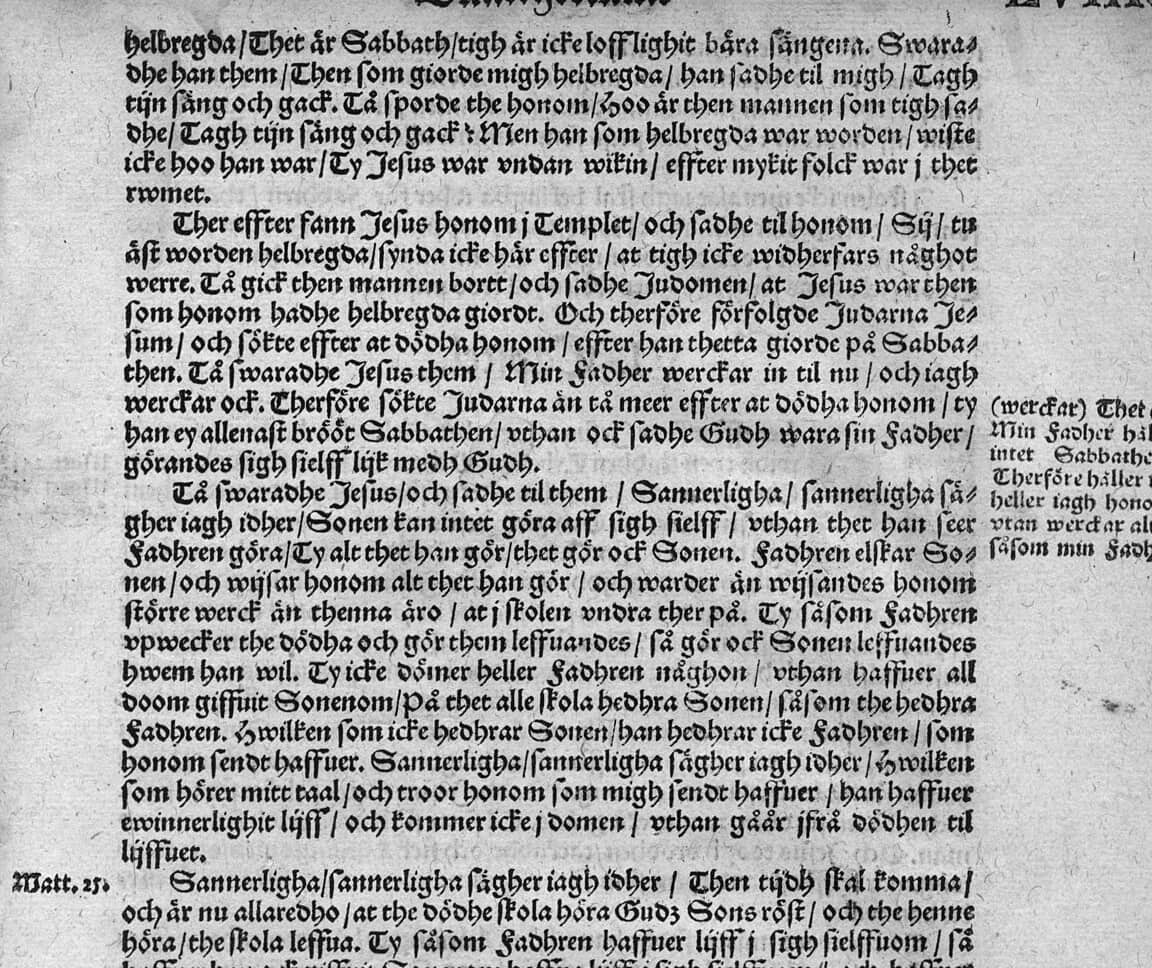
The first three paragraphs of the page and the marginal note that belongs to the third, as transcribed on Swedish Wikisource from this scan. The transcription keeps the 1541 spelling and prints the virgules of the original as commas; the marginal note is given after the paragraph it stands beside.
helbregda, Thet
är Sabbath, tigh är icke lofflighit bära sängena. Swaradhe
han them, Then som giorde migh helbregda, han sadhe til
migh, Tagh tijn säng och gack. Tå sporde the honom, Hoo
är then mannen som tigh sadhe, Tagh tijn säng och gack?
Men han som helbregda war worden, wiste icke hoo han
war, Ty Jesus war vndan wikin, effter mykit folck war j
thet rwmet.

Ther effter fann Jesus honom j Templet, och sadhe til
honom, Sij, tu äst worden helbregda, synda icke här effter,
at tigh icke widherfars någhot werre. Tå gick then mannen
bortt, och sadhe Judomen, at Jesus war then som honom
hadhe helbregda giordt. Och therföre förfolgde Judarna
Jesum, och sökte effter at dödha honom, effter han thetta
giorde på Sabbathen. Tå swaradhe Jesus them, Min Fadher
werckar in til nu, och iagh werckar ock.

(werckar) Thet är, Min Fadher håller intet Sabbathen, Therföre håller icke heller iagh honom, vtan werckar altijd såsom min Fadher.

Therföre sökte Judarna än tå meer effter at dödha honom, ty han ey allenast brööt Sabbathen, vthan ock sadhe Gudh wara sin Fadher, görandes sigh sielff lijk medh Gudh.
Source: Bibeln (Gustav Vasa), S. Johannis Euangelium, page transcription on Swedish Wikisource (Public domain).
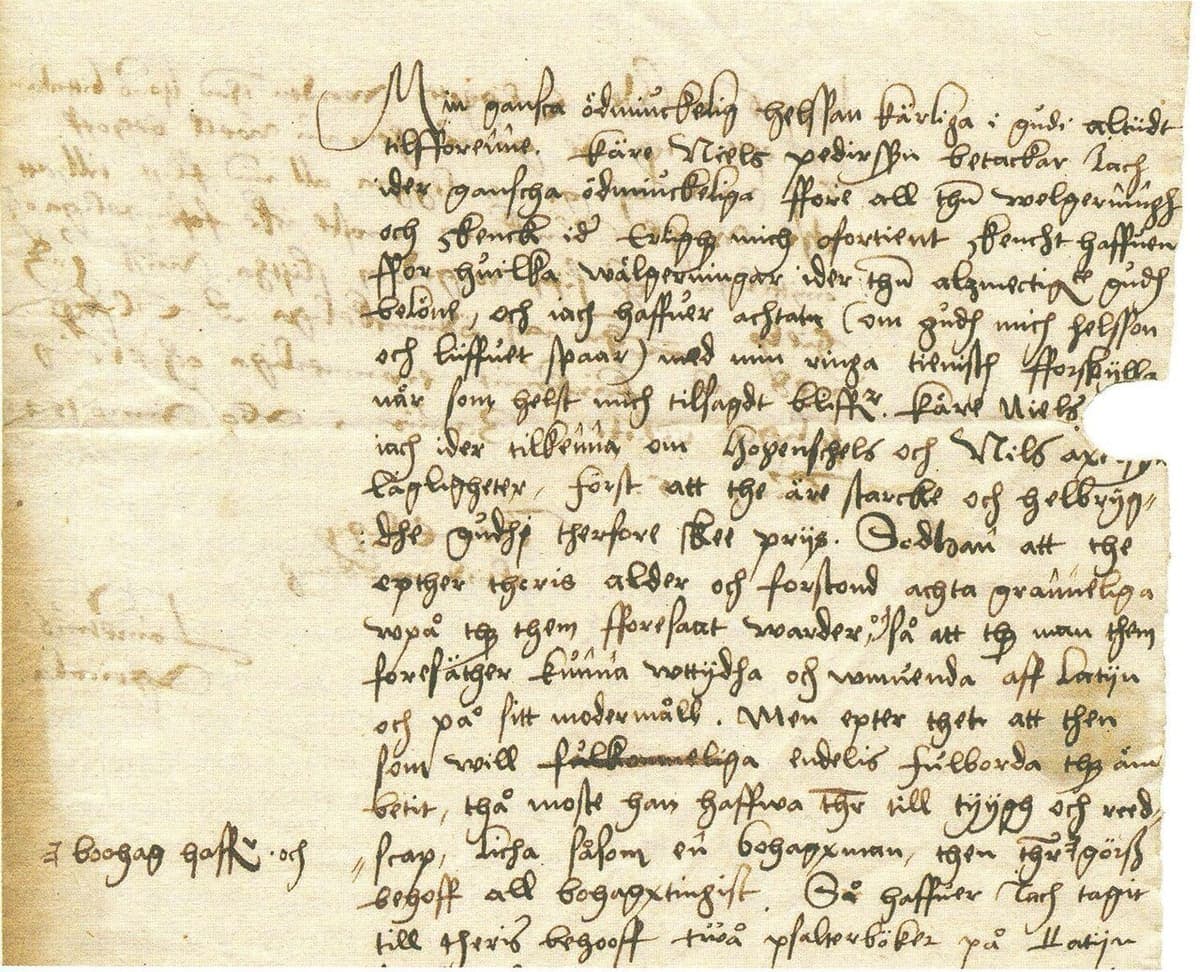
Uppsala University Library, 1549 · Source · Public domain · Uppsala University Library; reproduced in K. Tarkiainen, Sveriges Österland (2008)
Evidano Transcription
Min ganſka ödmiukelig helſan kärliga i gudi altijdt
tilförenne. Käre Niels pedherſſn betackar Iach
ider ganſcha ödmiukeliga ffore all then welgerningh
och ſkenck id[er] Eskep [?] mich ofortient ſkenckt haffuen
ffor huilka wälgerningar ider then alzmectig[e] gudh
belöne, och iach haffuer achtat (om gudh mich helſſan
och liffuit ſpaar) med min ringa tieniſt fförſkylla [cut off]
när ſom helſt mich tilſagdt bliff[ue]r. Käre Niels
iach ider tilkenna om Hogenſchels [?] och Nils ax[cut off]
lägliggelſer [?], förſt att the äre ſtarcke och helbryg[cut off]
the gudhi therfore ſkee prijs. Sedhan att the
epther theris alder och forſtond achta granneliga
wppå th[et] them fforeſatt warder, ſå att th[et] man them
foreſäger kunna wttijdha och nemnenda aff Latijn
och på ſitt modermåll. Men epter thet att then
ſom will [cancelled: fulkommeliga] endelis fulborda th[et] än
betit, thå moſte han haffwa th[et] till tijgh [?] och verk
ſkap, lijka ſåſom en bogapxman [?], then th[e]r giörß
behoff all bogapxtingiſt [?]. Så haffuer Iach tagit
till theris behoff tuå pſalterböker på Latijn
[left margin, with insertion mark:] / bogap[?] haff[ue]r och
Generated by Evidano’s advanced model; not yet checked against a published edition.
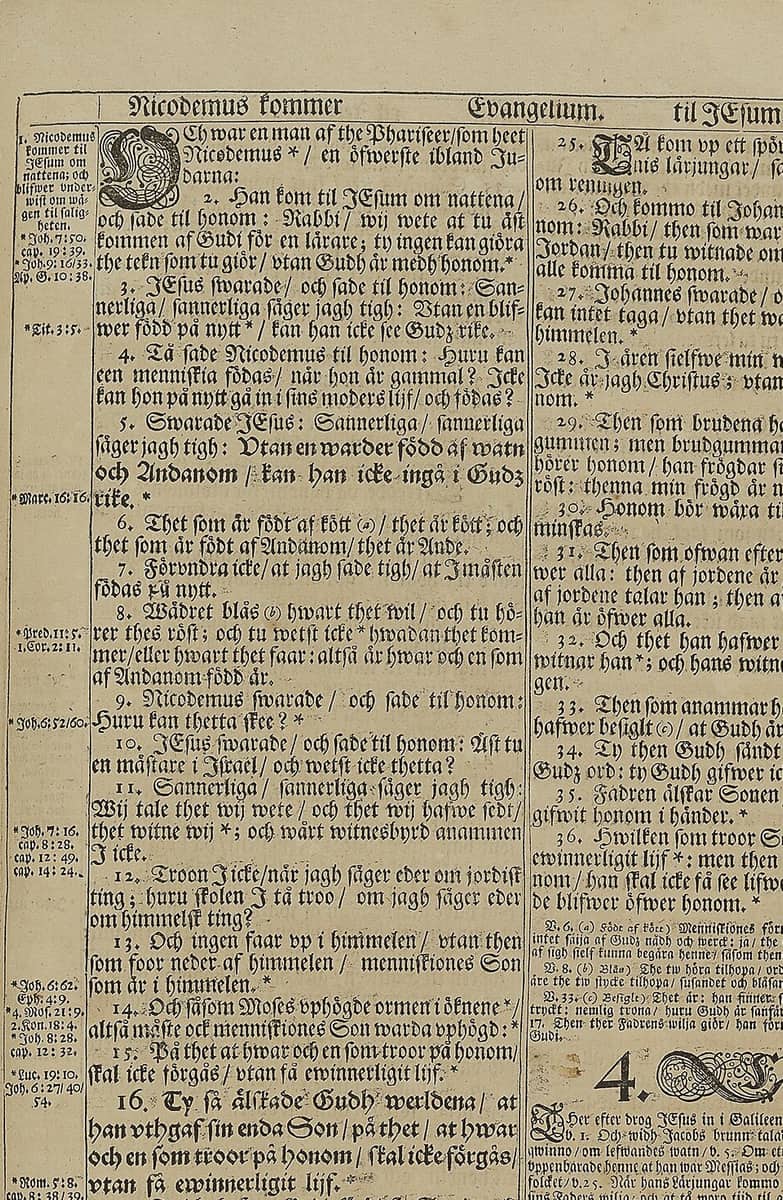
Source · CC0 1.0 · Scan of the 1703 Bible on Wikimedia Commons
Evidano Transcription
Nicodemus kommer Evangelium. til JEſum
- Nicodemus
kommer til
JEſum om
nattena; och
blifwer vnder=
wiſt om wä=
gen til ſalig=
heten.
Joh. 7: 50.
cap. 19: 39.
Joh. 9: 16/ 33.
Ap. G. 10: 38.Tit. 3: 5.
Marc. 16: 16.
Pred. 11: 5.
- Cor. 2: 11.
Joh. 6: 52/ 60.
Joh. 7: 16.
cap. 8: 28.
cap. 12: 49.
cap. 14: 24.Joh. 6: 62.
Eph. 4: 9.- Moſ. 21: 9.
- Kon. 18: 4.
- Joh. 8: 28.
cap. 12: 32. - Luc. 19: 10.
Joh. 6: 27/ 40/
- Rom. 5: 8.
cap. 8: 38/ 39.
OCh war en man af the Phariſeer/ ſom heet
Nicodemus * / en öfwerſte ibland Ju=
darna:
2. Han kom til JEſum om nattena/
och ſade til honom: Rabbi/ wij wete at tu äſt
kommen af Gudi för en lärare; ty ingen kan giöra
the tekn ſom tu giör/ vtan Gudh är medh honom.*
3. JEſus ſwarade/ och ſade til honom: San=
nerliga/ ſannerliga ſäger jagh tigh: Vtan en blif=
wer född på nytt * / kan han icke ſee Gudz rike.
4. Tå ſade Nicodemus til honom: Huru kan
een menniſkia födas/ när hon är gammal? Icke
kan hon på nytt gå in i ſins moders lijf/ och födas?
5. Swarade JEſus: Sannerliga/ ſannerliga
ſäger jagh tigh: Vtan en warder född af watn
och Andanom / kan han icke ingå i Gudz
rike. *
6. Thet ſom är födt af kött (a) / thet är kött; och
thet ſom är födt af Andanom/ thet är Ande.
7. Förundra icke/ at jagh ſade tigh/ at I måſten
födas på nytt.
8. Wädret blås (b) hwart thet wil/ och tu hö=
rer thes röſt; och tu wetſt icke * hwadan thet kom=
mer/ eller hwart thet faar: altſå är hwar och en ſom
af Andanom född är.
9. Nicodemus ſwarade / och ſade til honom:
Huru kan thetta ſkee? *
10. JEſus ſwarade/ och ſade til honom: Äſt tu
en mäſtare i Iſraël/ och wetſt icke thetta?
11. Sannerliga / ſannerliga ſäger jagh tigh:
Wij tale thet wij wete/ och thet wij hafwe ſedt/
thet witne wij *; och wårt witnesbyrd anammen
I icke.
12. Troon I icke/ när jagh ſäger eder om jordiſk
ting; huru ſkolen I tå troo/ om jagh ſäger eder
om himmelſk ting?
13. Och ingen faar vp i himmelen/ vtan then
ſom foor neder af himmelen / menniſkiones Son
ſom är i himmelen. *
14. Och ſåſom Moſes vphögde ormen i öknene /
altſå måſte ock menniſkiones Son warda vphögd:
15. På thet at hwar och en ſom troor på honom/
ſkal icke förgås/ vtan få ewinnerligit lijf. *
16. Ty ſå älſkade Gudh werldena/ at
han vthgaf ſin enda Son/ på thet/ at hwar
och en ſom troor på honom/ ſkal icke förgås/
vtan få ewinnerligit lijf. *
[lines cut off at the right edge of the image]
25. TÅ kom vp ett ſpör
nis lärjungar/ ſa
om reningen.
26. Och kommo til Johan
nom: Rabbi/ then ſom war
Jordan/ then tu witnade om
alle komma til honom.
27. Johannes ſwarade/ o
kan intet taga/ vtan thet wa
himmelen. *
28. I ären ſielfwe min w
Icke är jagh Chriſtus; vtan
nom. *
29. Then ſom brudena ha
gummen; men brudgumman
hörer honom/ han frögdar ſi
röſt: thenna min frögd är n
30. Honom bör wäxa til
minſkas.
31. Then ſom ofwan efter
wer alla: then af jordene är
af jordene talar han; then a
han är öfwer alla.
32. Och thet han hafwer
witnar han *; och hans witne
gen.
33. Then ſom anammar h
hafwer beſiglt (c) / at Gudh är
34. Ty then Gudh ſändt
Gudz ord: ty Gudh gifwer ic
35. Fadren älſkar Sonen
gifwit honom i händer. *
36. Hwilken ſom troor S
ewinnerligit lijf *: men then
nom/ han ſkal icke få ſee lijfwe
de blifwer öfwer honom. *
V. 6. (a) Födt af kött) Menniſkiones förn
intet ſäija af Gudz nådh och werck: ja/ the
af ſigh ſielf kunna begära henne/ ſåſom then
V. 8. (b) Blås) The tw höra tilhopa/ ord
äre the tw ſtycke tilhopa/ ſuſandet och blåſan
V. 33. (c) Beſiglt) Thet är: han ſätter [?] ſ
tryck: nemlig trona/ huru Gudh är ſannfär
17. Then ther Fadrens wilja giör/ han förn
Gudi.
4.
THer efter drog JEſus in i Galileen
v. 1. Och widh Jacobs brunn tala
qwinno/ om lefwandes watn/ v. 5. Om et
vppenbarade henne at han war Meſſias; och
folcket/ v. 25. När hans lärjungar kommo
Generated by Evidano’s advanced model; not yet checked against a published edition.
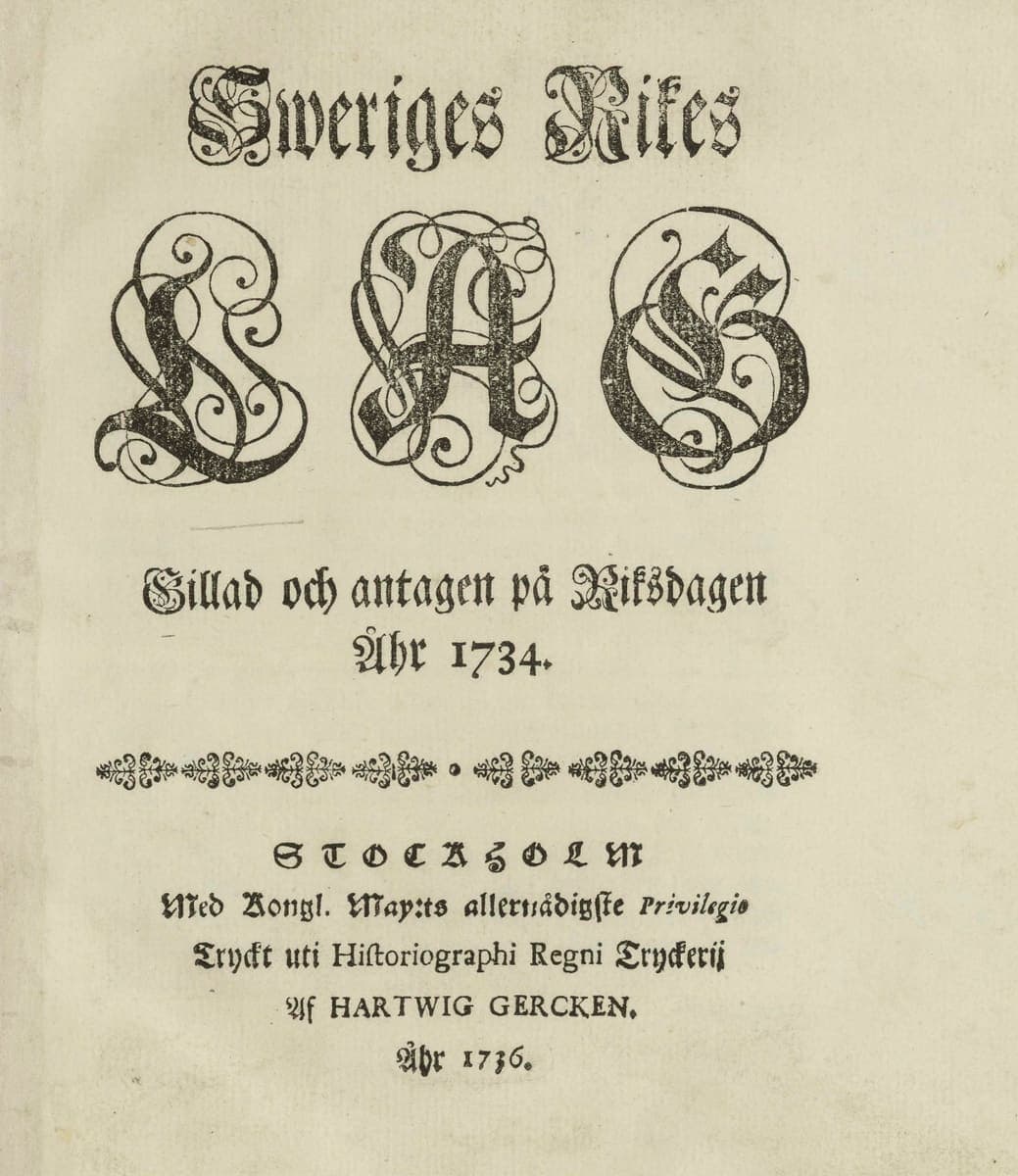
Source · CC0 1.0 · Scan of the 1736 printing on Wikimedia Commons
Evidano Transcription
Sweriges Rikes
LAG
Gillad och antagen på Riksdagen
Åhr 1734.
STOCKHOLM
Med Kongl. May:ts allernådigſte Privilegio
Tryckt uti Hiſtoriographi Regni Tryckerij
Af HARTWIG GERCKEN,
Åhr 1736.
Generated by Evidano’s advanced model; not yet checked against a published edition.
The shape of early modern Swedish writing
After 1500 the Swedish chanceries move from the late Gothic charter hand of the Middle Ages to a neo-Gothic cursive that stays in use, with slow changes, until the eighteenth century. It is written quickly and slopes to the right; long ſ falls below the line and is easily taken for f, while the round s appears only at the end of a word; h and k throw loops above the line, and e, n, u and r reduce to short strokes that differ mainly in their joins. Terminal letters attract flourishes that can stand for an -er, an -en or nothing whatever, and the difference is a matter of the clerk’s habit rather than a rule.
The vowels are the giveaway. Å is written as an a with a superscript o, ä as an a with a superscript e, and ö as an o with the same mark, all of them drifting toward the modern rings and dots only late in the period; w does duty for v, dubbled consonants come and go, and the same word can appear three ways in a single document. Dates are given by regnal year, by feast day, or by both; money is counted in daler, mark and öre with their own abbreviations, and grain and land in tunnor, spannland and öresland.
Print runs in parallel. From the Gustav Vasa Bible of 1541 onwards Swedish is set in Fraktur, with the running head, the marginal notes and the verse references in smaller founts, while Latin words and often proper names are set in roman type inside the same line. Royal ordinances, placards and the law book of 1734 keep the same convention, and their title pages combine a decorated display Fraktur with roman capitals. The typographic distinction is deliberate and worth preserving in a transcription: it tells you which words the printer regarded as foreign.
Why ordinary OCR struggles here
Vowel marks that are not yet diacritics
A superscript o or e sits above the letter it modifies, at the height where a later reader expects an abbreviation stroke. Read as an abbreviation, it turns hår into har plus a missing syllable; ignored, it removes the distinction between three different vowels.
Flourishes that may or may not be letters
The tail on a final r or n is sometimes an ending, sometimes ornament. Deciding needs the grammar of the sentence and the habits of the individual clerk, and the honest output marks the doubtful ones rather than silently choosing.
Two founts in one printed line
Swedish Fraktur and Latin roman type sit side by side in ordinances and bibles. Recognition trained on one of them mangles the other, and it is usually the roman words — names, legal terms, references — that carry the information a reader is searching for.
Charters written for the seal, not the reader
A sealed charter is a wide sheet with thirty lines of small cursive above a fold carrying a dozen seals. The ink has faded unevenly, the fold cuts the last lines, and the writing runs edge to edge without margins, so line breaks and word division have to be recovered from the image itself.
Who works with this material
Editors of Swedish administrative sources
Registers, council minutes and tax books are published in long series that still begin with a manual reading of each page. A machine first pass that keeps the clerk’s spelling and flags the flourishes saves the slow part of that work without deciding anything.
Economic and local historians
Land books, accounts and court records carry sums in daler and mark and areas in öresland and tunnland. The research depends on those figures surviving transcription in the units they were written in, next to the names of the farms they belong to.
Historians of the Swedish language
The move from a with a superscript o to å, the loss of the old case endings and the settling of spelling can only be traced in dated documents. That means transcriptions that preserve variation instead of removing it, and enough of them to count.
Libraries with early printed collections
Sixteenth- and seventeenth-century Swedish books are digitised page by page and searched by title. Full text, with Fraktur and roman type distinguished, turns a scanned bible or ordinance into something a reader can quote from and compare.
Getting the best transcription
Explain the vowel marks first
Tell the model that å, ä and ö may appear as a or o with a superscript letter, and say whether you want them normalised or kept as written. This one instruction removes the most common systematic error in early modern Swedish transcription.
Set a policy for terminal flourishes
Ask that word-final flourishes be transcribed only where they are supported by the grammar, and marked where they are ambiguous. A page with twenty flagged endings is more useful than a clean page that quietly invented ten of them.
Ask for founts to be reported in print
On a printed page, request a note of which words are in roman type inside the Fraktur. That distinction is how the printer marked Latin, and it is the fastest way to find names and technical terms in an ordinance.
Test on a sealed charter and on a bible page
The charter shows how the model copes with faded, fold-damaged cursive; the printed page shows how it handles a marginal apparatus. Between them they predict what a mixed box of chancery papers and printed placards will cost in review.
Further reading on this hand
The palaeography guides the in-app selector points to for this domain, if you want to check a transcription against the standard references.
- Lär dig läsa frakturstil
This Swedish historical research resource teaches the reading of handwritten Fraktur-style material in Swedish archives. It explains that a large proportion of older Swedish records use Gothic handwriting and that spelling and letterforms were not fully standardized. The page supplies alphabet support and exercises based on archival examples with substantial writer variation. It is directly useful for early modern Swedish administrative and ecclesiastical records written in neo-Gothic hands.
Frequently asked questions
- How are the old forms of å, ä and ö handled?
- They are recognised as vowel marks rather than abbreviation strokes and can be reported either as written, with the superscript noted, or normalised to modern letters. For linguistic work the first is the right choice; for indexing, the second, with the original kept alongside.
- Can long ſ be told apart from f?
- Yes, from the crossbar, which reaches through the stem on an f and only to the left of it on a long ſ, and from the shape of the word. Where a stroke is genuinely ambiguous the reading is flagged rather than guessed.
- What happens to the abbreviations for money and measures?
- Daler, mark, öre, tunnor and their symbols are transcribed as they stand, and can be expanded in brackets if you ask. What is never done is converting a sum into modern figures inside the text, because the notation itself dates the document.
- Is Fraktur print handled differently from handwriting?
- It is treated as a separate recognition problem, with its own long ſ, ligatures and the roman-type insertions that sit inside it. A page that mixes a printed form with a handwritten filling is read as two layers and returned as two labelled blocks.
- Can it read a charter with the last lines lost in the fold?
- What survives is transcribed and the loss is marked at the point where it happens. Nothing is completed from the standard formula, since on a charter the closing lines carry the date and the witnesses, and those are exactly what a reader needs to be sure of.
Related scripts and pages
Transcribe early modern Swedish
Upload a charter, a court book page or a Fraktur ordinance and set the rules for vowel marks and flourishes before the rest of the volume.