
Slovenian
Read Slovenian from its oldest text to today’s print
The Freising Manuscripts, copied around the year 1000, are the oldest surviving continuous text in Slovene and the oldest Slavic text written in the Latin alphabet at all, spelled out with no settled orthography to follow. Slovene then argued out two rival Latin spelling systems for the better part of three centuries, while for two centuries of Austrian rule its names sat inside documents written mostly in German Kurrent. Evidano reads every one of these stages and shows the source page beside every line it produces.
Sample pages
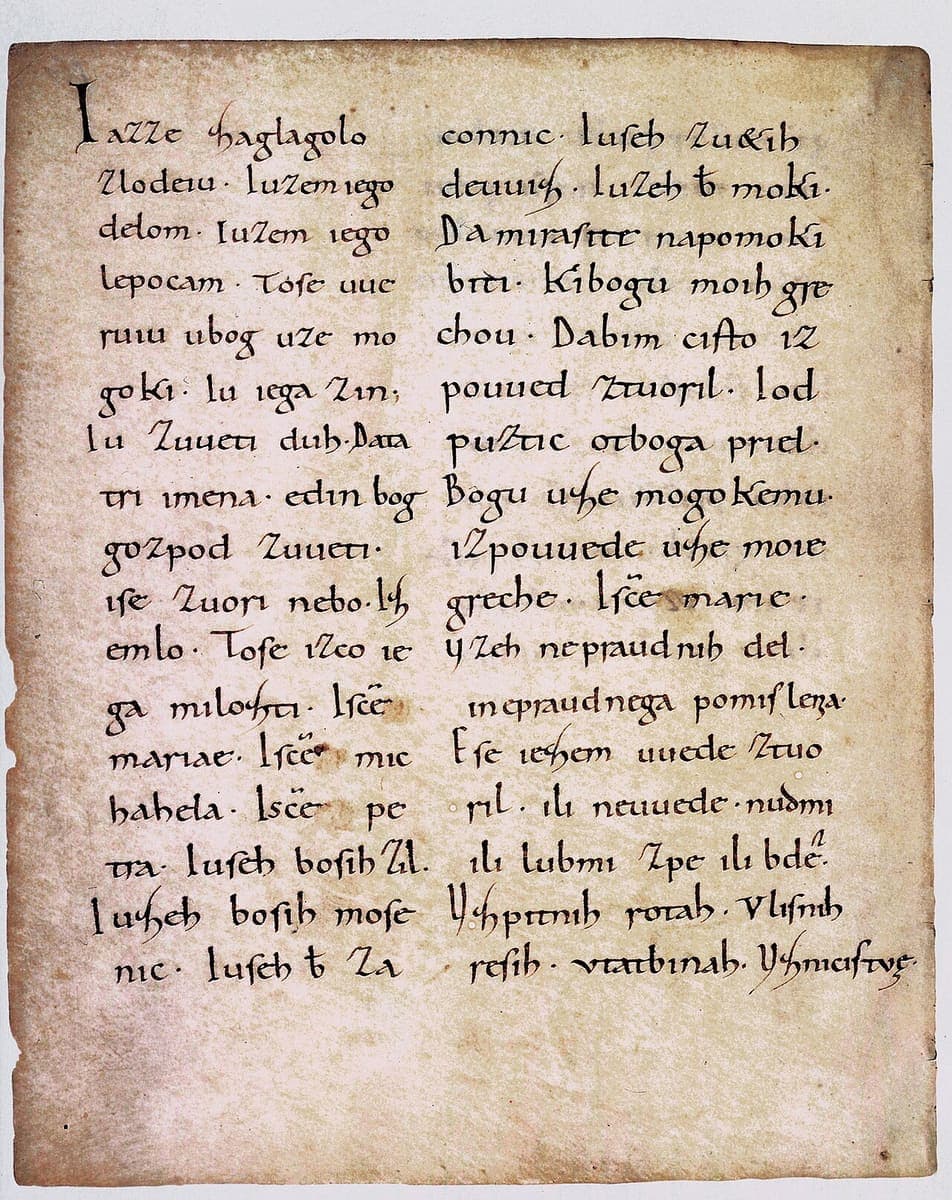
Bavarian State Library, Munich, c. 1000 · Source · Public domain
Evidano Transcription
Iazze haglagolo
Zlodeiu . Iuzem iego
delom . Iuzem iego
lepocam . Toſe uue
ruiu ubog uze mo
goki . Iu iega Zin ;
Iu Zuueti duh . Data
tri imena . edin bog
gozpod Zuueti .
iſe Zuori nebo . Iſ
emlo . Toſe iZco ie
ga miloſti . Iſce
mariae . Iſce mic
habela . Iſce pe
tra . Iuſeh boſih Zl .
Iuſeh boſih moſe
nic . Iuſeh b Za
connic . Iuſeh Zuetih
deuuiz . Iuzeh b moki .
Damiraſtite napomoki
biti . Kibogu moih gre
chou . Dabim ciſto iZ
pouued Ztuoril . Iod
puztic otboga priel .
Bogu uſe mogokemu .
iZpouuede uſe moie
greche . Iſce marie .
yZeh nepraudnih del .
inepraudnega pomiſlena
Eſe ieſem uuede Ztuo
ril . ili neuuede . nudmi
ili lubmi Zpe ili bde .
Vſpitnih rotah . Vliſnih
reſih . vtatbinah . Vſmiaſtve .
Generated by Evidano’s advanced model; not yet checked against a published edition.
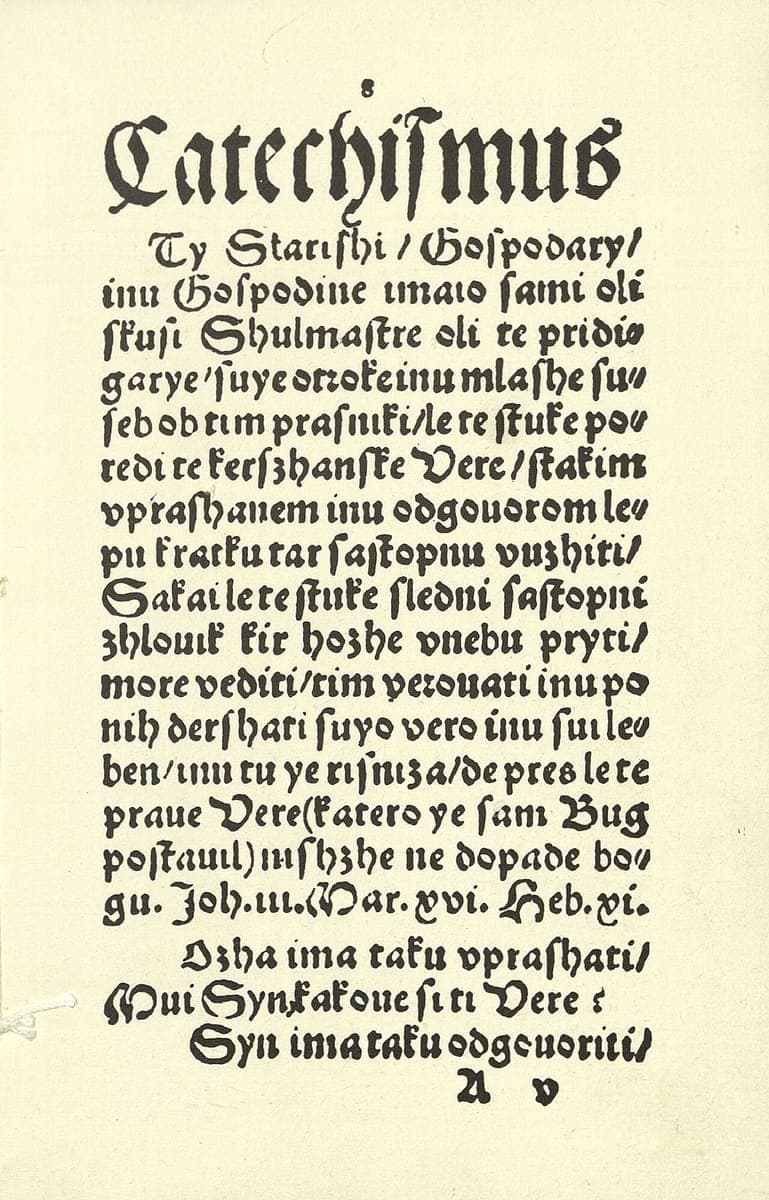
National and University Library, Ljubljana (dLib.si), 1550 · Source · CC0 1.0
Evidano Transcription
8
Catechismus
Ty Starishi / Gospodary/
inu Gospodine imaio sami oli
skusi Shulmastre oli te pridi=
garye/suye otroke inu mlashe su=
seb ob tim prasniki/le te stuke po=
redi te kerszhanske Vere / stakim
vprashanem inu odgouorom le=
pu kratku tar sastopnu vuzhiti/
Sakai le te stuke sledni sastopni
zhlouik kir hozhe vnebu pryti/
more vediti/tim verouati inu po
nih dershati suyo vero inu sui le=
ben/inu tu ye risniza/de pres le te
praue Vere(katero ye sam Bug
postauil) nishzhe ne dopade bo=
gu. Joh. iii. Mar. xvi. Heb. xi.
Ozha ima taku vprashati/
Mui Syn kakoue si ti Vere ?
Syn ima taku odgouoriti/
A v
Generated by Evidano’s advanced model; not yet checked against a published edition.
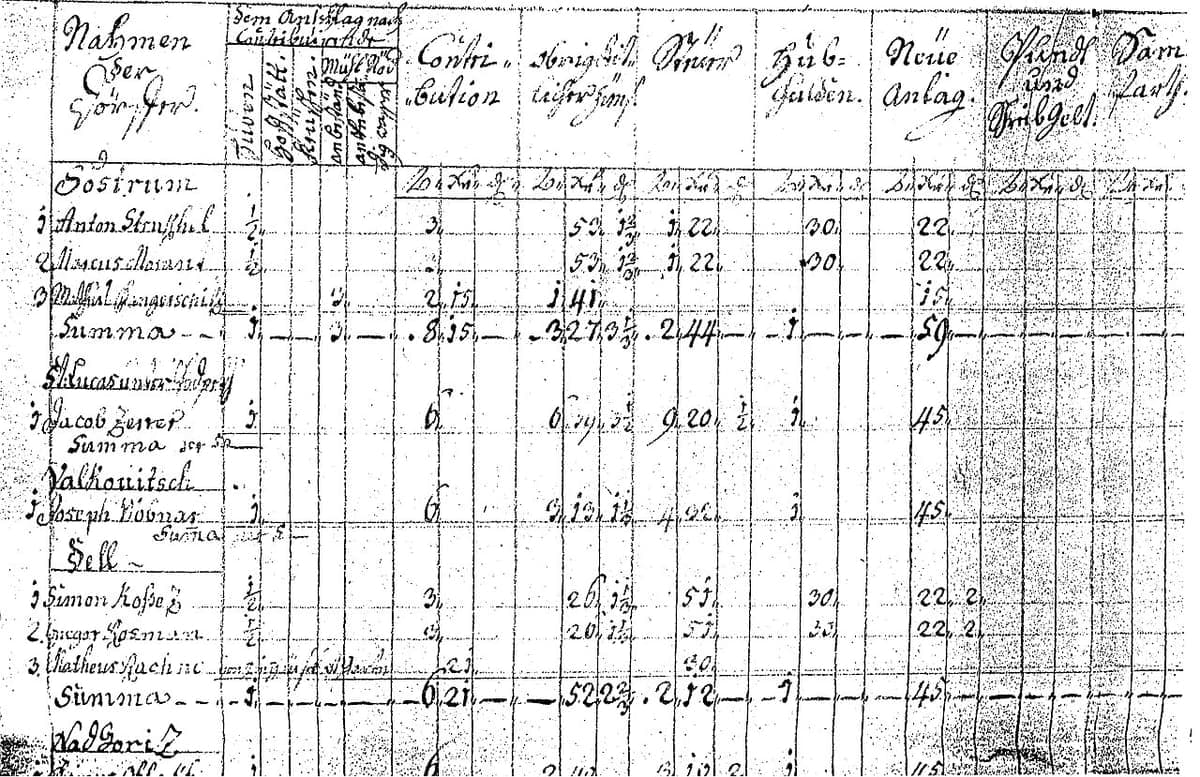
Archives of the Republic of Slovenia (SI AS 174, L285), 18th century · Source · Public domain
Evidano Transcription
| Nahmen der Höffen. | Dem Anschlag nach Contribuiert der: Huben | Hoffstätt | Keuschen | Müll Rad an Bestand | [illegible] | Contri= bution | Obrigkeit= licher Zins | Vinum | Hub= Gulden. | Neue Anlag. | Pfund und Treibgelt. | Tam farth[?] |
|---|---|---|---|---|---|---|---|---|---|---|---|---|
| Sostrum | fl kr d | fl kr d | fl kr d | fl kr d | fl kr d | fl kr d | fl kr | |||||
| 1 Anton Struschel[?] | 1/2 | 3 | 53 [?] | 1 22 | 30 | 22 | ||||||
| 2 Marcus Morautz[?] | 1/2 | 3[?] | 53 [?] | 1 22 | 30 | 22 | ||||||
| 3 [illegible] Pangerschitz | 3 | 2 15 | 1 41 | 15 | ||||||||
| Summa | 1 | 3 | 8 15 | 3 27 3 1/3[?] | 2 44 | 1 | 59 | |||||
| St. Lucas unter Podpetz[?] | ||||||||||||
| 1 Jacob Zerer | 1 | 6 | 6 49[?] 3 1/2[?] | 9 20 1/2 | 1 | 45 | ||||||
| Summa ut s[upr]a | ||||||||||||
| Valkouitsch | ||||||||||||
| 1 Joseph Pöbnar[?] | 1 | 6 | 3 13 1 1/2[?] | 4 22 | 1 | 45 | ||||||
| Suma ut s[upr]a | ||||||||||||
| Sell | ||||||||||||
| 1 Simon Kosse[?] | 1/2 | 3 | 26 1 1/2[?] | 5 1 | 30 | 22 2 | ||||||
| 2 Gregor Kosman | 1/2 | 3 | 20 1 1/2[?] | 5 1 | 30 | 22 2 | ||||||
| 3 Matheus [illegible] [illegible] | 21 | 30 | ||||||||||
| Summa | 1 | 6 21 | 52 2 2/3 | 2 12 | 1 | 45 | ||||||
| Nadgoriz |
[last row cut off]
Generated by Evidano’s advanced model; not yet checked against a published edition.
Evidano Transcription
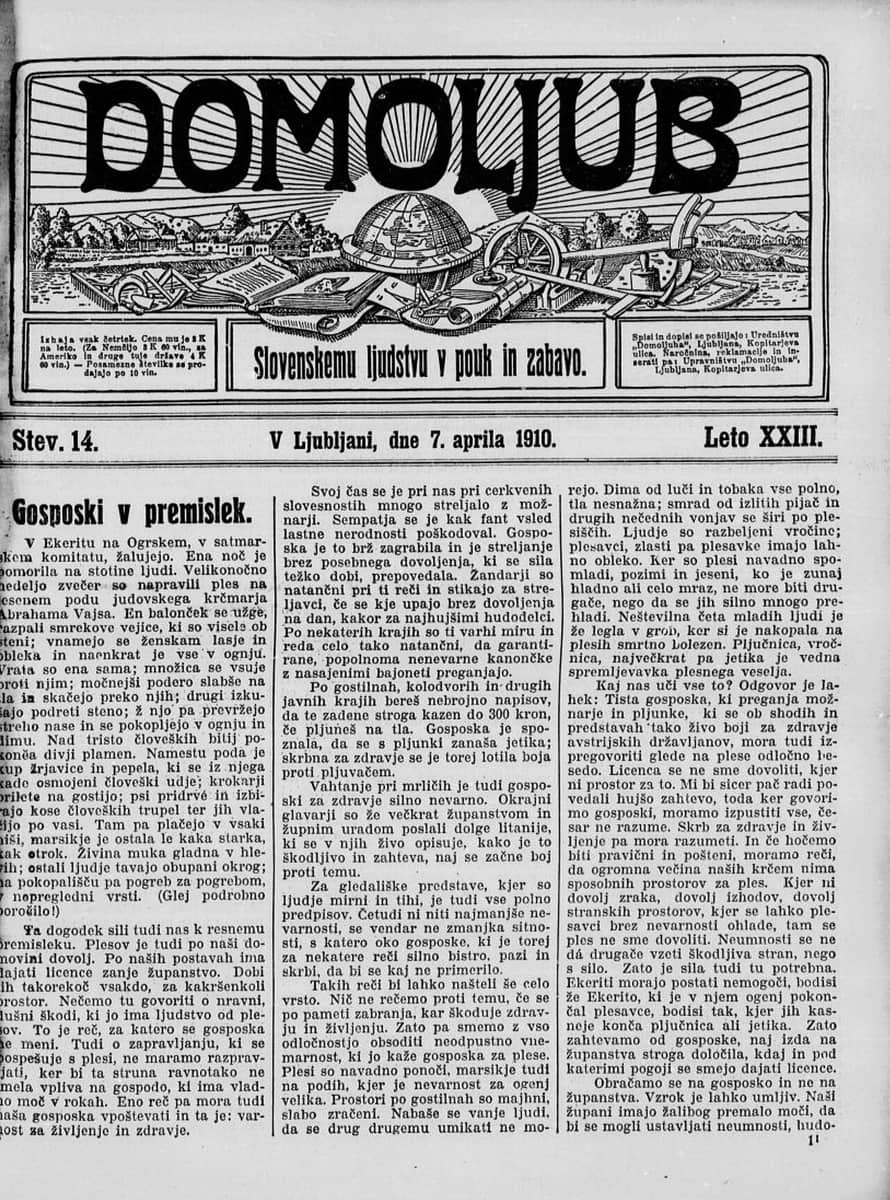
DOMOLJUB
Izhaja vsak četrtek. Cena mu je 2 K
na leto. (Za Nemčijo 2 K 60 vin., za
Ameriko in druge tuje države 4 K
60 vin.) - Posamezne številke se pro-
dajajo po 10 vin.
Slovenskemu ljudstvu v pouk in zabavo.
Spisi in dopisi se pošiljajo: Uredništvu
„Domoljuba“, Ljubljana, Kopitarjeva
ulica. Naročnina, reklamacije in in-
serati pa: Upravništvu „Domoljuba“,
Ljubljana, Kopitarjeva ulica.
Štev. 14. V Ljubljani, dne 7. aprila 1910. Leto XXIII.
Gosposki v premislek.
V Ekeritu na Ogrskem, v satmar-
skem komitatu, žalujejo. Ena noč je
pomorila na stotine ljudi. Velikonočno
nedeljo zvečer so napravili ples na
lesenem podu judovskega krčmarja
Abrahama Vajsa. En balonček se užge,
razpali smrekove vejice, ki so visele ob
steni; vnamejo se ženskam lasje in
obleka in naenkrat je vse v ognju.
Vrata so ena sama; množica se vsuje
proti njim; močnejši podero slabše na
tla in skačejo preko njih; drugi izku-
šajo podreti steno; ž njo pa prevržejo
streho nase in se pokopljejo v ognju in
dimu. Nad tristo človeških bitij po-
konča divji plamen. Namestu poda je
kup žrjavice in pepela, ki se iz njega
kade osmojeni človeški udje; krokarji
prilete na gostijo; psi pridrvé in izbi-
rajo kose človeških trupel ter jih vla-
čijo po vasi. Tam pa plačejo v vsaki
hiši, marsikje je ostala le kaka starka,
kak otrok. Živina muka gladna v hle-
vih; ostali ljudje tavajo obupani okrog;
na pokopališču pa pogreb za pogrebom,
v nepregledni vrsti. (Glej podrobno
poročilo!)
Ta dogodek sili tudi nas k resnemu
premisleku. Plesov je tudi po naši do-
movini dovolj. Po naših postavah ima
dajati licence zanje županstvo. Dobi
jih takorekoč vsakdo, za kakršenkoli
prostor. Nečemo tu govoriti o nravni,
dušni škodi, ki jo ima ljudstvo od ple-
sov. To je reč, za katero se gosposka
ne meni. Tudi o zapravljanju, ki se
pospešuje s plesi, ne maramo razprav-
ljati, ker bi ta struna ravnotako ne
imela vpliva na gospodo, ki ima vlad-
no moč v rokah. Eno reč pa mora tudi
naša gosposka vpoštevati in ta je: var-
nost za življenje in zdravje.
Svoj čas se je pri nas pri cerkvenih
slovesnostih mnogo streljalo z mož-
narji. Sempatja se je kak fant vsled
lastne nerodnosti poškodoval. Gospo-
ska je to brž zagrabila in je streljanje
brez posebnega dovoljenja, ki se sila
težko dobi, prepovedala. Žandarji so
natančni pri ti reči in stikajo za stre-
ljavci, če se kje upajo brez dovoljenja
na dan, kakor za najhujšimi hudodelci.
Po nekaterih krajih so ti varhi miru in
reda celo tako natančni, da garanti-
rane, popolnoma nenevarne kanončke
z nasajenimi bajoneti preganjajo.
Po gostilnah, kolodvorih in drugih
javnih krajih bereš nebrojno napisov,
da te zadene stroga kazen do 300 kron,
če pljuneš na tla. Gosposka je spo-
znala, da se s pljunki zanaša jetika;
skrbna za zdravje se je torej lotila boja
proti pljuvačem.
Vahtanje pri mrličih je tudi gospo-
ski za zdravje silno nevarno. Okrajni
glavarji so že večkrat županstvom in
župnim uradom poslali dolge litanije,
ki se v njih živo opisuje, kako je to
škodljivo in zahteva, naj se začne boj
proti temu.
Za gledališke predstave, kjer so
ljudje mirni in tihi, je tudi vse polno
predpisov. Četudi ni niti najmanjše ne-
varnosti, se vendar ne zmanjka sitno-
sti, s katero oko gosposke, ki je torej
za nekatere reči silno bistro, pazi in
skrbi, da bi se kaj ne primerilo.
Takih reči bi lahko našteli še celo
vrsto. Nič ne rečemo proti temu, če se
po pameti zabranja, kar škoduje zdrav-
ju in življenju. Zato pa smemo z vso
odločnostjo obsoditi neodpustno vne-
marnost, ki jo kaže gosposka za plese.
Plesi so navadno ponoči, marsikje tudi
na podih, kjer je nevarnost za ogenj
velika. Prostori po gostilnah so majhni,
slabo zračeni. Nabaše se vanje ljudi,
da se drug drugemu umikati ne mo-
rejo. Dima od luči in tobaka vse polno,
tla nesnažna; smrad od izlitih pijač in
drugih nečednih vonjav se širi po ple-
siščih. Ljudje so razbeljeni vročine;
plesavci, zlasti pa plesavke imajo lah-
no obleko. Ker so plesi navadno spo-
mladi, pozimi in jeseni, ko je zunaj
hladno ali celo mraz, ne more biti dru-
gače, nego da se jih silno mnogo pre-
hladi. Neštevilna četa mladih ljudi je
že legla v grob, ker si je nakopala na
plesih smrtno bolezen. Pljučnica, vroč-
nica, največkrat pa jetika je vedna
spremljevavka plesnega veselja.
Kaj nas uči vse to? Odgovor je la-
hek: Tista gosposka, ki preganja mož-
narje in pljunke, ki se ob shodih in
predstavah tako živo boji za zdravje
avstrijskih državljanov, mora tudi iz-
pregovoriti glede na plese odločno be-
sedo. Licenca se ne sme dovoliti, kjer
ni prostor za to. Mi bi sicer pač radi po-
vedali hujšo zahtevo, toda ker govori-
mo gosposki, moramo izpustiti vse, če-
sar ne razume. Skrb za zdravje in živ-
ljenje pa mora razumeti. In če hočemo
biti pravični in pošteni, moramo reči,
da ogromna večina naših krčem nima
sposobnih prostorov za ples. Kjer ni
dovolj zraka, dovolj izhodov, dovolj
stranskih prostorov, kjer se lahko ple-
savci brez nevarnosti ohlade, tam se
ples ne sme dovoliti. Neumnosti se ne
dá drugače vzeti škodljiva stran, nego
s silo. Zato je sila tudi tu potrebna.
Ekeriti morajo postati nemogoči, bodisi
že Ekerito, ki je v njem ogenj pokon-
čal plesavce, bodisi tak, kjer jih kas-
neje konča pljučnica ali jetika. Zato
zahtevamo od gosposke, naj izda na
županstva stroga določila, kdaj in pod
katerimi pogoji se smejo dajati licence.
Obračamo se na gosposko in ne na
županstva. Vzrok je lahko umljiv. Naši
župani imajo žalibog premalo moči, da
bi se mogli ustavljati neumnosti, hudo-
11
Generated by Evidano’s advanced model; not yet checked against a published edition.
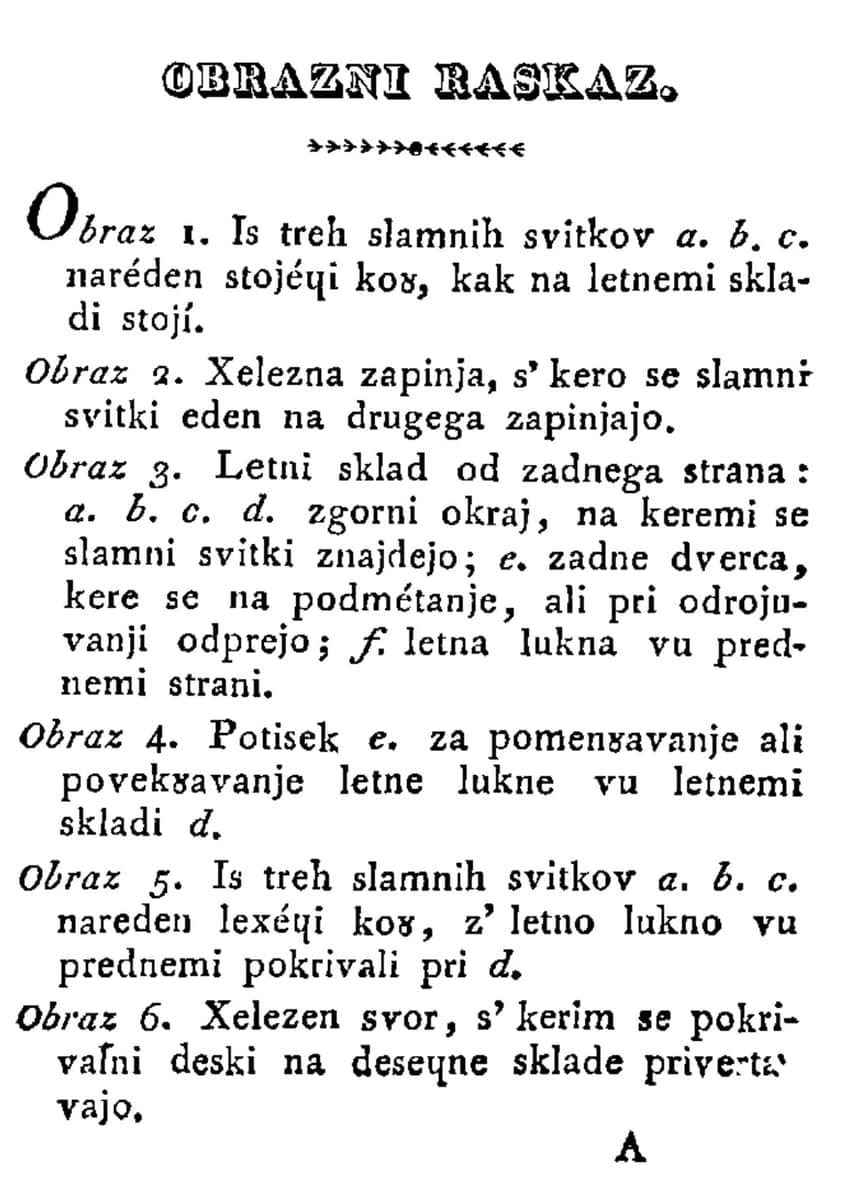
National and University Library, Ljubljana, 1831 · Source · Public domain
Evidano Transcription
The whole page: the heading and all six numbered plate descriptions. The Slovenian Wikisource text is a proofread reading edition rather than a diplomatic one — it transliterates Dajnko’s special letters into the modern Slovene č, š and ž, so the printed Xelezna is given as Železna and koʙ as koš, and it drops the italics the printer used for the word Obraz and for the figure letters. Each numbered entry is set here as one line.
OBRAZNI RASKAZ.
Obraz 1. Is treh slamnih svitkov a. b. c. naréden stojéči koš, kak na letnemi skladi stojí.
Obraz 2. Železna zapinja, s' kero se slamni svitki eden na drugega zapinjajo.
Obraz 3. Letni sklad od zadnega strana: a. b. c. d. zgorni okraj, na keremi se slamni svitki znajdejo; e. zadne dverca, kere se na podmétanje, ali pri odrojuvanji odprejo; f. letna lukna vu prednemi strani.
Obraz 4. Potisek e. za pomenšavanje ali povekšavanje letne lukne vu letnemi skladi d.
Obraz 5. Is treh slamnih svitkov a. b. c. nareden ležéči koš, z' letno lukno vu prednemi pokrivali pri d.
Obraz 6. Železen svor, s' kerim se pokrivalni deski na desečne sklade privertavajo.
Source: Čelarstvo (1831), Stran 34, proofread text via Slovenian Wikisource (CC BY-SA 4.0).
What Slovenian writing has looked like
The Freising Manuscripts survive bound into a Bavarian codex now held at Munich: two confession formulas and a sermon on sin and penance, copied by a German-trained scribe around the year 1000 from an older Slovene original. Because no Slavic Latin spelling existed yet, the scribe reached for German scribal habits to represent sounds Latin had no letters for, so the same Slovene sound can appear spelled two or three different ways within a few lines. The result predates every other Latin-alphabet Slavic text and is one of the very few written traces of the Alpine Slavic mission the Salzburg diocese ran among Carantania’s Slovene-speaking population.
A settled Slovene orthography took another five and a half centuries to arrive. Primož Trubar’s Catechismus of 1550, the first printed Slovene book, spelled sounds with digraphs of his own devising, and Adam Bohorič’s 1584 grammar fixed a related digraph system, bohoričica, using sh for š, zh for č and similar combinations, that lasted into the nineteenth century. Rival alphabets followed: Franc Metelko proposed a set of special diacritic letters in the 1820s, Peter Dajnko another in the same decade, and the resulting "črkarska pravda", the orthography war of the 1830s, ended only when Slovene writers adopted Ljudevit Gaj’s Croatian-style č, š and ž, fixed as the standard from the late 1840s and unchanged since.
Through the eighteenth and nineteenth centuries, Carniola, Styria and Carinthia kept their official records in German, written in Kurrent cursive, whose broken, angular letterforms bear no resemblance to Latin cursive. Theresian and Franciscean cadastral surveys, parish registers and estate ledgers list Slovene tenants, hamlets and field names inside otherwise German entries, so a single line can carry a Slovene surname spelled by a German-trained clerk’s ear in the middle of an otherwise German sentence.
Why ordinary OCR struggles here
No settled spelling in the oldest text
The Freising Manuscripts spell Slovene sounds ad hoc, borrowing German scribal conventions letter by letter rather than following any Slavic orthography, since none existed. A system trained on modern Slovene spelling has nothing to match this against and misreads it as garbled Latin.
Digraphs that look like ordinary letter pairs
Bohoričica’s sh, zh and similar combinations stand for single sounds, not two letters read separately, and the obsolete special characters Metelko and Dajnko each proposed have no modern keyboard equivalent at all. A system has to know which spelling system a page uses before it can read it correctly.
Slovene names inside German Kurrent
Austrian cadastral and parish records are written in German Kurrent cursive, whose letterforms differ sharply from Latin script, and the Slovene personal and place names scattered through them were spelled by German-trained clerks who often guessed at the sounds. A system tuned only to German expects German name patterns and mangles the Slovene ones.
Several spelling systems on one archive shelf
A single family or parish archive can span Freising-style ad hoc spelling in transcribed extracts, bohoričica in an eighteenth-century book, and modern gajica in a twentieth-century letter, so no single fixed spelling rule works across the whole collection.
Who works with this material
Slavicists and medievalists
Scholars working on the Freising Manuscripts and the earliest Alpine Slavic mission sources need a reading that respects the tenth-century scribe’s ad hoc spelling rather than one that silently corrects it toward modern Slovene.
Historians of Slovenian print and orthography
Tracing the shift from Trubar’s spelling through bohoričica to the Metelko, Dajnko and Gaj alphabets means reading each system on its own terms, since a page cannot be understood if its digraphs or special letters are misread as something else.
Genealogists and archivists reading Austrian-era records
Parish registers, cadastral surveys and estate ledgers from Carniola, Styria and Carinthia carry Slovene names inside German Kurrent text. Family historians and archive staff need those names read as Slovene, not forced into German spelling patterns.
Newspaper and periodical digitisation projects
Slovenian libraries and local history societies hold large runs of nineteenth- and twentieth-century weeklies and newspapers that are scanned but not always searchable as text, and need reliable transcription to make them so.
Getting the best transcription
Name the spelling stage
Say whether a page uses Freising-style ad hoc spelling, bohoričica digraphs, the Metelko or Dajnko letters, or modern gajica, so the model does not silently convert older spelling to today’s alphabet unless you ask for that.
Flag Slovene names inside German Kurrent
For cadastral and parish records, note that personal and place names may be Slovene even though the surrounding text is German, so those words are read as Slovene rather than forced into German spelling patterns.
Decide how to handle digraphs
Choose whether bohoričica combinations such as sh and zh should be kept as printed or converted to their modern š and č equivalents, and apply that choice consistently across a whole book or archive.
Test on a name you can check
Before transcribing a full parish register or cadastre, run a page with a place or personal name you can independently verify, so a spelling or script error is caught before it repeats through the rest of the volume.
Frequently asked questions
- Can Evidano read the Freising Manuscripts’ unusual spelling?
- Yes, the ad hoc, German-influenced spelling of the tenth-century original is read as written rather than corrected toward modern Slovene, which matters for anyone studying the text’s language history.
- Does it recognise bohoričica digraphs like sh and zh as single sounds?
- Yes, once you note that a page uses bohoričica, these combinations are read as the single sounds they represent, and you can ask for them either kept as printed or converted to modern š and č.
- What about the Metelko or Dajnko alphabets?
- Both are recognised as historic Slovene spelling systems in their own right, with their special letters read as the sounds they were designed for rather than as unfamiliar symbols.
- Can it separate Slovene names from the German Kurrent around them?
- Yes, once told to expect them, Slovene personal and place names embedded in German cadastral or parish entries are read as Slovene rather than mangled into German spelling patterns.
- Does it handle modern Slovenian č, š and ž correctly?
- Yes, in both printed and handwritten modern Slovenian these are recognised as distinct letters, which matters most for names and places in forms, registers and correspondence.
Related scripts and pages
Turn your Slovenian sources into text
Upload a historic Slovene text, an Austrian-era register or a modern document, and check the reading against the image before you export.