
Spanish · c. 1500–1650
Read the chained hand of Spanish notaries and courts
In procesal the pen almost never leaves the paper: c, e, r, s and t shrink to the same short stroke, capitals become loops the height of three lines, and a clause can run for a whole line without one visible break between words. Evidano works through protocol books, probanzas, tithe accounts and wills in this hand, holds the marginal headings and correction clauses apart from the text, and marks the readings it is unsure of instead of inventing a plausible name.
Sample pages
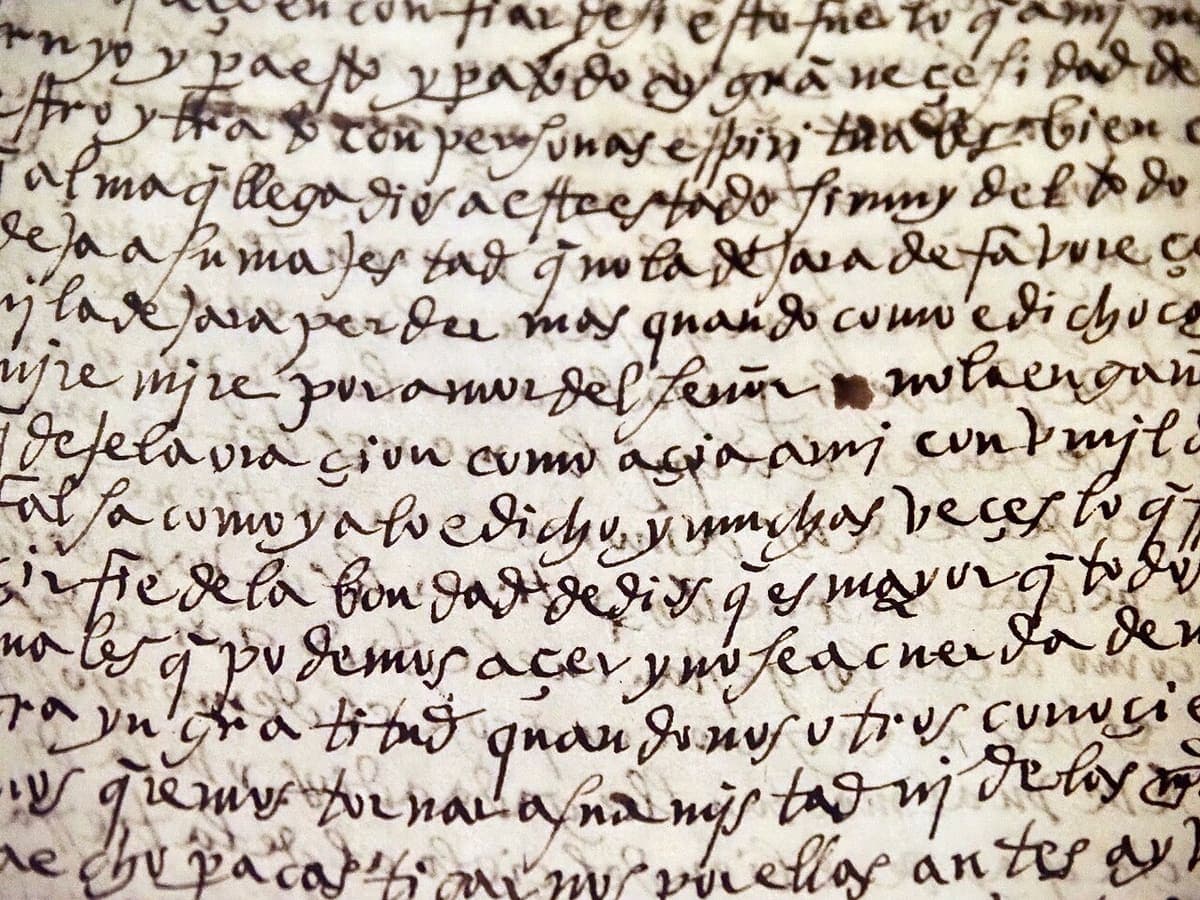
Real Biblioteca del Monasterio de El Escorial, 1565–1575 · Source · CC0 1.0 · Photograph by Laci3, Wikimedia Commons, CC0
Evidano Transcription
The passage shown in the photograph, given in the modernised text of the 1927 Espasa-Calpe edition on Spanish Wikisource (chapter XIX of the Life). That edition adds accents and punctuation and regularises the saint’s spelling, where the autograph writes without accents and abbreviates freely; an obvious typographical slip in the digitised text (maestró) has been corrected. The close-up cuts the first and last words of most lines, so the printed text runs slightly beyond both edges of the image, and it stops where the last legible line does.
Esto fué lo que a mí me destruyó; y para esto y para todo hay gran necesidad de maestro, y trato con personas espirituales. Bien creo, que alma que llega Dios este estado, si muy del todo no deja á su Majestad, que no la dejará de favorecer ni la dejará perder; mas cuando, como he dicho, cayere, mire, mire por amor del Señor, no la engañe en que deje la oracion, como hacia á mí con humildad falsa, como ya lo he dicho y muchas veces lo querría decir.
Fie de la bondad de Dios, que es mayor que todos los males que podemos hacer, y no se acuerda de nuestra ingratitud, cuando nosotros, conociéndonos, queremos tornar a su amistad, ni de las mercedes que nos ha hecho para castigarnos por ellas; antes ayudan á perdonarnos mas presto.
Source: Santa Teresa de Jesús, Su vida, chapter XIX (Espasa-Calpe, Madrid, 1927), via Wikisource (Spanish) (Public domain).
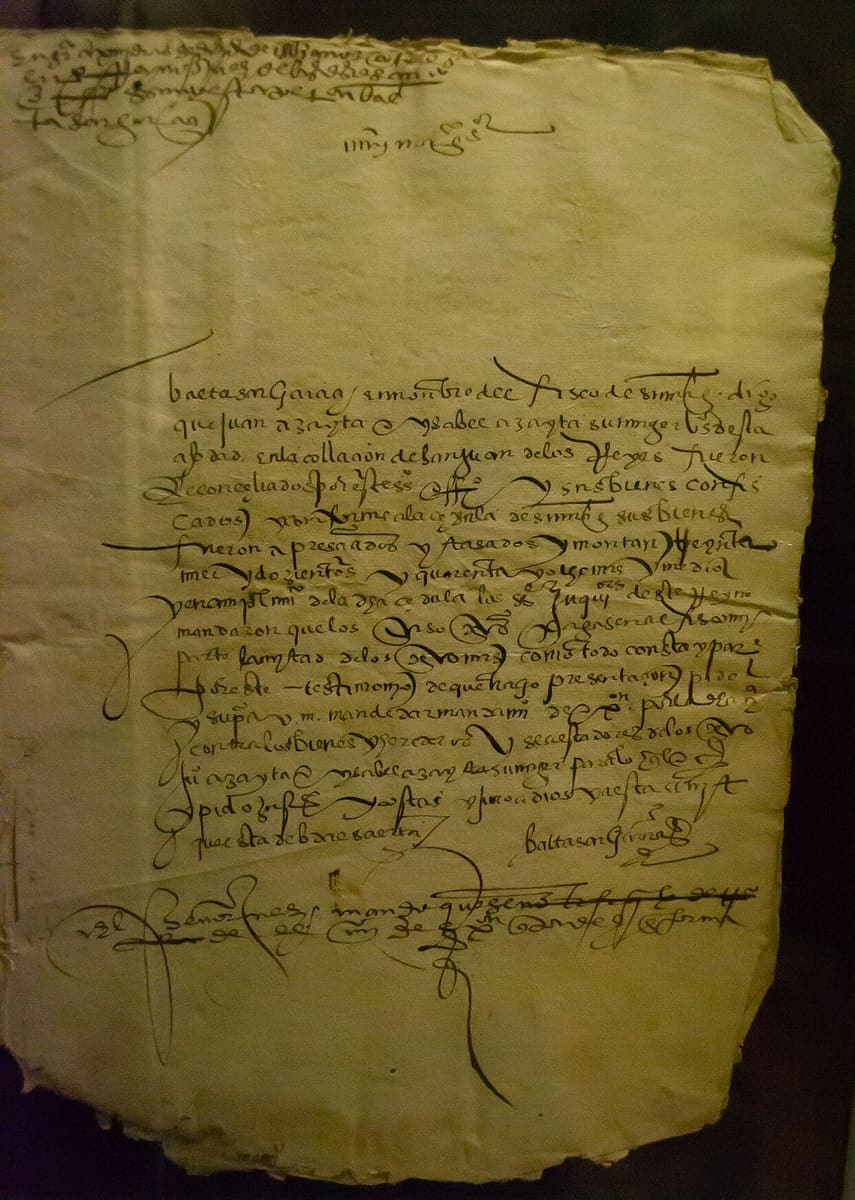
Palacio de los Olvidados, Granada, Sixteenth century · Source · CC BY-SA 4.0 · Photograph by Dorieo, Wikimedia Commons, CC BY-SA 4.0
Evidano Transcription
[illegible]
[illegible]
[illegible]
[illegible]
muy mag[nifi]co s[eñ]or
baltasar garcia en nombre del fisco de su mag[esta]d dig[o]
que Jua[n] azayta e ysabel azayta su muger v[ezin]os desta
çib[da]d en la collaçion de san Jua[n] de los Reyes fueron
Reconçiliados por este s[ant]o offi[ci]o y sus bienes confis
cados y conforme a la çedula de su mag[esta]d sus bienes
fueron apresçiados y tasados y montan treynta[?]
mill y dozientos y quarenta y seys m[a]r[avedi]s y medio
[illegible] de la d[ic]ha çedula los s[eñore]s Inq[uisidore]s deste Reyno
mandaron que los suso d[ic]hos presentasen [illegible]
por tasados de los d[ic]hos m[a]r[avedi]s como todo consta y par[e]
çe deste testimonio de que hago presentaçion y pido[?]
sup[lic]o a v[uestra] m[erced] mande dar mand[amien]to de ex[ecuci]on [illegible]
contra los bienes [illegible] y secrestadores de los d[ic]hos
Ju[an] azayta e ysabel azayta su muger para lo qual [illegible]
pido Justi[ci]a y costas y para ello [illegible]
que esta debaxo escrita[?]
Baltasar garcia [signature]
[illegible decree lines, partly struck through]
Generated by Evidano’s advanced model; not yet checked against a published edition.
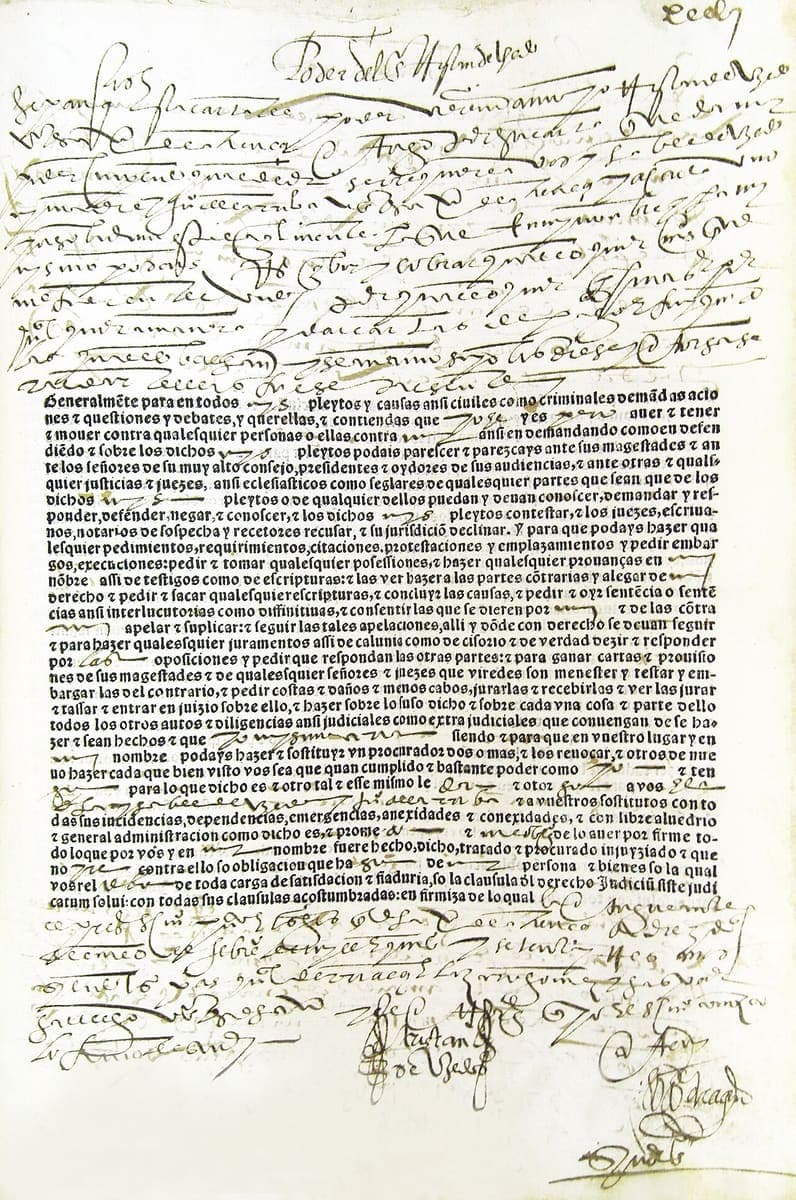
Evidano Transcription
[folio number, handwritten: illegible]
Poder del [illegible]
[handwritten opening of the act, about 12 lines: illegible]
Generalmẽte para en todos [handwritten] pleytos y causas ansi ciuiles como criminales demãdas acio
nes z questiones y debates, y querellas, z contiendas que [handwritten] auer z tener
z mouer contra qualesquier personas o ellas contra [handwritten] ansi en demandando como en defen
diẽdo z sobre los dichos [handwritten] pleytos podais parescer z parezcays ante sus magestades z an
te los señores de su muy alto consejo, presidentes z oydores de sus audiencias, z ante otras z quals
quier justicias z juezes, ansi eclesiasticos como seglares de qualesquier partes que sean que de los
dichos [handwritten] pleytos o de qualquier dellos puedan y deuan conoscer, demandar y res-
ponder, defender, negar, z conoscer, z los dichos [handwritten] pleytos contestar, z los juezes, escriua-
nos, notarios de sospecha y recetores recusar, z su jurisdiciõ declinar. Y para que podays hazer qua
lesquier pedimientos, requirimientos, citaciones. protestaciones y emplazamientos y pedir embar
gos, execuciones: pedir z tomar qualesquier possessiones, z hazer qualesquier prouanças en [handwritten]
nõbre assi de testigos como de escripturas: z las ver hazer a las partes cõtrarias y alegar de [handwritten]
derecho z pedir z sacar qualesquier escripturas, z concluyr las causas, z pedir z oyr sentẽcia o sentẽ
cias ansi interlucutorias como diffinitiuas, z consentir las que se dieren por [handwritten] z de las cõtra
[handwritten] apelar z suplicar: z seguir las tales apelaciones, alli y dõde con derecho se deuan seguir
z para hazer qualesquier juramentos assi de calunia como de cisorio z de verdad dezir z responder
por las oposiciones y pedir que respondan las otras partes: z para ganar cartas z prouisio
nes de sus magestades z de qualesquier señores z juezes que viredes son menester y testar y em-
bargar las del contrario, z pedir costas z daños z menos cabos, jurarlas z recebirlas z ver las jurar
z tassar z entrar en juizio sobre ello, z hazer sobre lo suso dicho z sobre cada vna cosa z parte dello
todos los otros autos z diligencias ansi judiciales como extra judiciales que conuengan de se ha-
zer z sean hechos z que [handwritten] siendo z para que en vuestro lugar y en
[handwritten] nombre podays hazer z sostituyr vn procurador dos o mas, z los reuocar, z otros de nue
uo hazer cada que bien visto vos sea que quan cumplido z bastante poder como [handwritten] z ten
[handwritten] para lo que dicho es z otro tal z esse mismo le [handwritten] z otor[handwritten] a vos [handwritten]
[handwritten] z a vuestros sostitutos con to
das sus incidencias, dependencias, emergencias, anexidades z conexidades, z con libre aluedrio
z general administracion como dicho es, z prome[handwritten] z [handwritten] de lo auer por firme to-
do lo que por vos y en [handwritten] nombre fuere hecho, dicho, tratado z procurado injuyziado z que
no [handwritten] contra ello so obligacion que ha[handwritten] de [handwritten] persona z bienes so la qual
vos rel[handwritten] de toda carga de satisdacion z fiaduria, so la clausula dl derecho Judiciũ siste judi
catum solui: con todas sus clausulas acostumbradas: en firmiza de lo qual [handwritten]
[handwritten closing lines with date and witnesses: illegible]
[signatures]
Generated by Evidano’s advanced model; not yet checked against a published edition.
Evidano Transcription
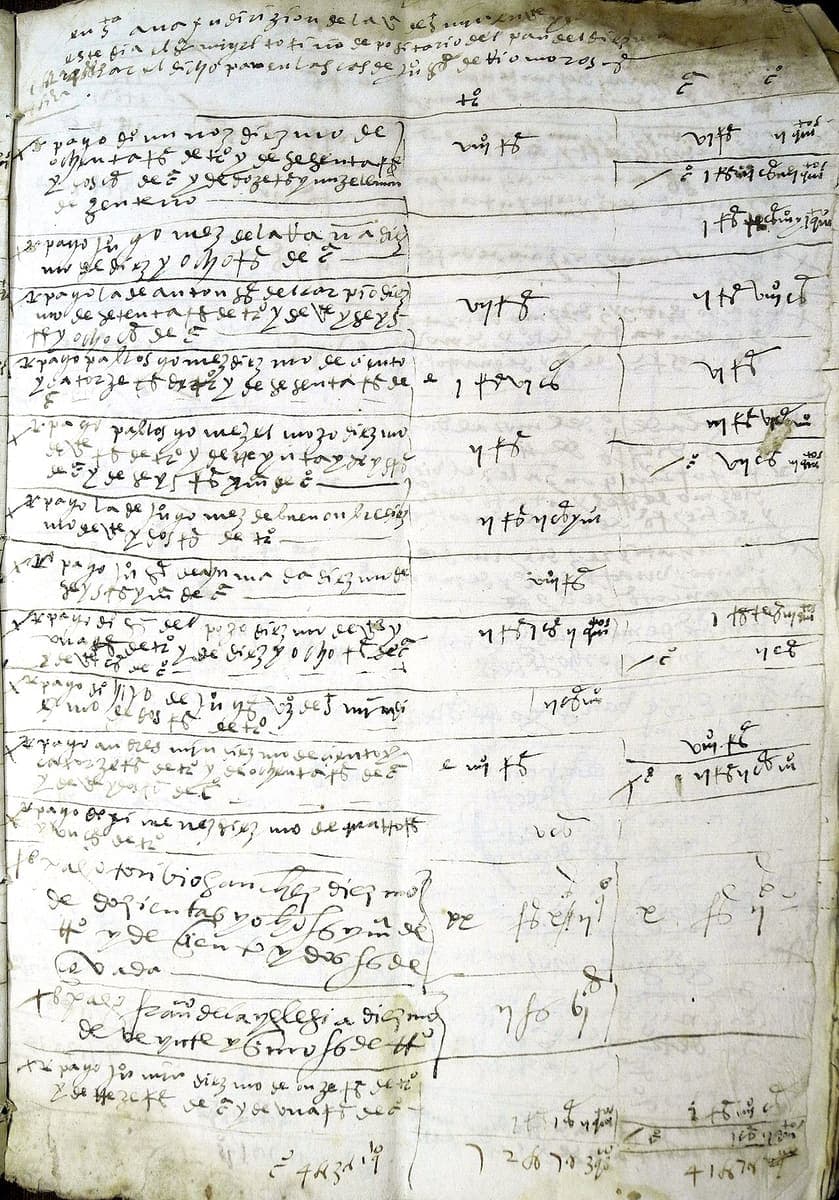
en q[uen]ta [illegible] jurediçion[?] de la v[ill]a [illegible]
este dia [illegible] myguel toledano[?] depositario del pan [illegible]
[illegible] el d[ic]ho pan en las casas de ju[an] g[arci]a de tiomozos[?] q[ue]
| t[rig]o | ç[ebad]a | |
|---|---|---|
| X pago di[eg]o muñoz diezmo de ochenta f[anega]s de t[rig]o y de sesenta f[anega]s y dos c[elemines] de ç[ebad]a y de doze f[anega]s y un zelemin de çenteno | viij f[anega]s | vj f[anega]s [illegible] |
| X pago ju[an] gomez de la banda diezmo de diez y ocho f[anega]s de ç[ebad]a | i f[anega] [illegible] | |
| X pago la de anton g[arci]a del carpio diezmo de setenta f[anega]s de t[rig]o y de treynta[?] y seys f[anega]s y ocho c[elemines] de ç[ebad]a | vij f[anega]s | iij f[anega]s viij c[elemines] |
| X pago pablos gomez diezmo de çiento y catorze f[anega]s de t[rig]o y de sesenta f[anega]s de ç[ebad]a | [illegible] | vj f[anega]s |
| X pago pablos gomez mozo diezmo de [illegible] f[anega]s de t[rig]o y de [illegible] de ç[ebad]a y de seys f[anega]s [illegible] | v f[anega]s | iij f[anega]s [illegible] |
| X pago la de ju[an] gomez de buenon[?] diezmo de veynte y dos f[anega]s de t[rig]o | ij f[anega]s [illegible] | |
| X pago ju[an] g[arci]a medina la diezma de seys f[anega]s y m[edi]a de ç[ebad]a | viij c[elemines] | |
| X pago di[eg]o g[arci]a del pozo diezmo de treynta y una f[anega]s de t[rig]o y de diez y ocho f[anega]s de ç[ebad]a | iij f[anega]s [illegible] | i f[anega] [illegible] |
| X pago di[eg]o [illegible] diezmo de [illegible] | [illegible] | |
| X pago andres m[artine]z diezmo de çiento y catorze f[anega]s de t[rig]o y de ochenta f[anega]s de ç[ebad]a y de doze[?] f[anega]s de ç[enteno] | [illegible] | viij f[anega]s |
| X pago di[eg]o [illegible] diezmo de q[uatr]o f[anega]s [illegible] de t[rig]o | v c[elemines] | |
| [illegible] toribio sanchez diezmo de dozientas y ocho f[anega]s [illegible] de t[rig]o y de çient [illegible] f[anega]s de çebada | xx f[anega]s [illegible] | x f[anega]s [illegible] |
| [illegible] fran[cis]co de la yglesia diezmo de veynte y çinco f[anega]s de t[rig]o | ij f[anega]s [illegible] | |
| X pago ju[an] m[artine]z diezmo de onze f[anega]s de t[rig]o y de treze f[anega]s de ç[ebad]a y de una f[anega] de ç[enteno][?] | [illegible] | [illegible] |
[totals illegible]
Generated by Evidano’s advanced model; not yet checked against a published edition.
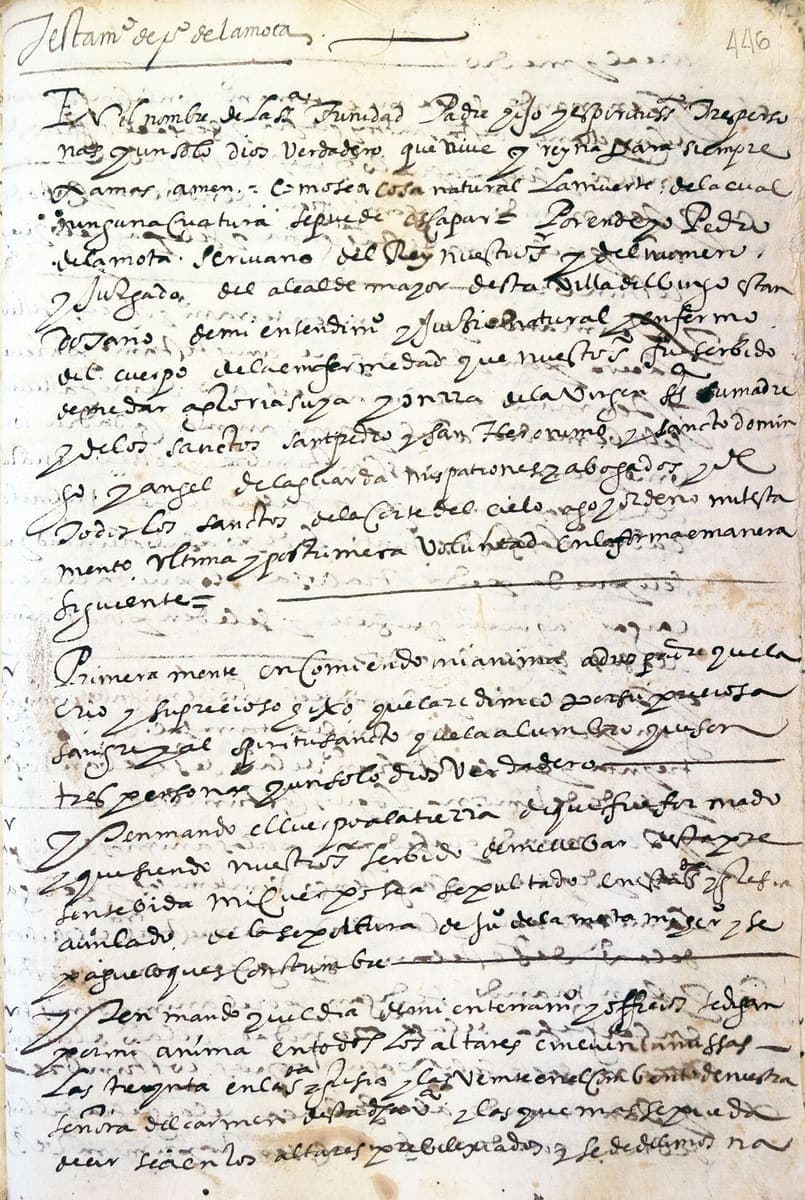
Evidano Transcription
446
Testam[ent]o de p[edr]o de la mota
En el nonbre de la s[ant]a trinidad Padre yjo y espiritus[ant]o tres perso
nas y un solo dios Verdadero que biue y reyna para sienpre
Jamas amen = Como sea cosa natural lamuerte delacual
ninguna criatura sepuede escapar = Porende yo Pedro
delamota scriuano del Rey nuestro s[eñor] y del numero
y Juzgado del alcalde mayor desta Villa del burgo estan
do sano demi entendim[ient]o y Juizio natural y enfermo
del cuerpo delaenfermedad que nuestro s[eñor] fueserbido
demedar a gloria suya y onrra dela Virgen s[ant]a sumadre
y delos sanctos santpedro y san Hieronimo y sancto domin
go y angel delaguarda mis patrones y abogados y de
todos los sanctos dela corte del cielo ago y ordeno mitesta
mento vltima y postrimera Voluntad enlaforma e manera
siguiente =
Primera mente encomiendo mianima adios p[adr]e quela
crio y su precioso yxo que laredimio porsupreciosa
sangre y al spiritusancto quela alunbro queson
tres personas y un solo dios Verdadero
Yten mando el cuerpo ala tierra de que fue formado
y que siendo nuestro s[eñor] serbido de me llebar deesta pre
sente bida micuerpo sea sepultado en esta s[ant]a yglesia
aun lado de la sepultura de Ju[an]a de la mota mi muger y se
pague lo que es costunbre
Yten mando que el dia demi enterram[ient]o y officios sedigan
por mi anima en todos los altares cincuenta missas
las treynta enla s[ant]a yglesia y las Veinte enel conbento de nuestra
señora del carmen desta d[ic]ha v[ill]a y las que mas se pue de
decir sea en los altares prebilegiados y se de de limosna
Generated by Evidano’s advanced model; not yet checked against a published edition.
Procesal, and why it became unreadable
Procesal grows out of cortesana around 1500 and dominates Spanish paperwork for a century and a half: notarial protocols, court files, Inquisition processes, town council books, tithe and parish registers. Scribes were paid by the sheet, so writing spread out; joins lengthened, letters flattened, and by the middle of the sixteenth century the extreme variety known as procesal encadenada could carry a line of text as one continuous chain. Royal legislation repeatedly ordered scriveners to put a set number of words in every line and to write clearly, which is the best evidence of how bad it had become. The hand fades after about 1650, as the round Italian-influenced letters spread through the offices, but it never disappears from the formularies.
What survives of the alphabet is mostly rhythm. Minim-like strokes stand for c, e, i, n, r, s, t and u alike, and only their joins and their height distinguish them; b, l, h and d carry tall looped ascenders that cross the line above, while g, j, q and the long ſ throw loops into the line below. Capitals are drawn as flourishes, so a word may begin with a shape three lines tall. Because word division disappears, the reader works from the formulae: en el nombre de la santísima Trinidad, sepan quantos esta carta vieren, ante mí el escrivano, doy fe. Contractions are those of legal Castilian — dho, dha, dhos for dicho and its forms, Vmd for vuestra merced, ss. for su señoría, escriv.º, test.º, mrs, rs for reales — and are usually written above the line with a curl.
The page is as formulaic as the sentence. A protocol book is foliated and carries a short heading in the margin for each instrument — Poder, Testamento, Venta, Obligación, Censo — with the notary’s rúbrica after every entry and, at the end of each act, the clause that validates crossings-out and interlineations: va enmendado, entre renglones, vala. Registers of tithes, taxes and parishioners are ruled into columns, with the payer on the left and quantities on the right, Roman numerals mixed with abbreviations for fanegas, celemines and reales, and sums added at the foot. Printed forms with blank spaces come into use for powers of attorney and other routine instruments, so one sheet can hold Gothic type and the loosest cursive at once.
Why ordinary OCR struggles here
A line with no gaps in it
When the pen never lifts, there is nothing for a recogniser to segment on. Word boundaries have to be inferred from formulae and grammar, which is exactly what character-level OCR cannot do; the output becomes an unbroken string of plausible letters that no one can search or check.
Formulae that carry no information
Nine tenths of a notarial act is boilerplate, and a model that has learned the boilerplate can reel it off. The names, places, dates and sums are the tenth that matters, and they are the parts a fluent guess is most likely to smooth over without any sign that something is wrong.
Quantities hidden in flourishes
Accounts mix Roman numerals, the U that marks thousands, and one-letter abbreviations for fanegas, celemines, reales and maravedís, all written into the same loops as the words. In a tazmía or a padrón the numbers are the record, so a misread column is not a typographical slip but a false result.
Everything that is not the main text
Marginal headings, interlineations, crossings-out with their validating clause, later archival foliation, and ink showing through thin paper from the other side all compete with the writing. A transcription that silently merges them loses the notary’s own record of what was corrected and when.
Who works with this material
Genealogists in notarial archives
Wills, dowries and powers of attorney name whole families, their neighbours and the priest who witnessed the act. What a researcher needs is every name caught in the spelling the notary used, with the folio and the date attached, so that one household can be followed through a run of protocol books.
Local and economic historians
Tithe accounts, padrones and repartimientos hold the harvests, the households and the tax burden of a village year by year. Only a transcription that keeps the columns intact turns them into a series that can be added up and compared.
Historians of law and of the Inquisition
Trial records and probanzas are built of questions, depositions and marginal rulings. Reading them means knowing who is speaking in each block, so the layout has to survive the transcription as clearly as the words do.
Teachers of early modern palaeography
Procesal is where most students give up. A transcription set beside a good photograph lets a class work out the formulae first, then the letters, and see how one scribe’s loops differ from another’s across a single protocol book.
Getting the best transcription
Give the document class and its formulae
Say that the page is a will, a power, a tithe account or a deposition, and list any local usages you know. The formulae are the only reliable frame for cutting the chain into words, so a model told what to expect gets the boundaries right far more often.
Ask for the margins and the correction clause separately
Marginal headings, interlineations, deletions and the closing va enmendado … vala should come back as their own labelled blocks. That keeps the notary’s corrections visible and stops a heading from being read as the first words of the act.
Set a rule for numbers before anything else
Ask for quantities exactly as written, Roman numerals and the abbreviations for fanegas, celemines and reales included, with a modern figure supplied beside them. Then check any column against the total, which the scribe himself has already computed for you.
Build a name list and feed it back
Transcribe two or three folios, collect the surnames, place names and the notary’s own signature forms, and pass that list back as context for the rest of the book. Recurring names are the fastest way to steady a hand that has almost no letter shapes left.
Further reading on this hand
The palaeography guides the in-app selector points to for this domain, if you want to check a transcription against the standard references.
- Spanish Handwriting History
This Brigham Young University guide describes Procesal as a Spanish documentary hand used from the late medieval into the early modern period. It distinguishes Procesal from Cortesana and notes the extreme connectedness associated with its encadenada form. The broader site provides alphabet charts and reading tools for comparing variant letters and recurrent record vocabulary. This material is especially useful for legal documents whose word boundaries are obscured by continuous chains of pen strokes.
Frequently asked questions
- What exactly is procesal encadenada?
- It is the extreme form of procesal in which the joins between letters become as long as the letters themselves, so a whole line is written as a single unbroken chain. Words are not separated at all, and the reader recovers them from the legal formula rather than from anything visible on the paper.
- Can words that were never separated be split?
- Yes, and that is most of the work. Division follows the formulae and the grammar of notarial Castilian, and the transcription can mark where a boundary is an editor’s judgement. If you prefer, the text can be returned exactly as written, with no spaces added.
- What happens with the printed forms that have handwritten gaps?
- The printed clauses and the handwritten insertions are transcribed as separate layers and then shown in reading order, so it is clear which words came from the press and which the notary added. That distinction matters, because only the insertions are specific to the act.
- Are the legal abbreviations expanded?
- By default dho, dha, Vmd, escriv.º, mrs and the rest are expanded and the supplied letters are marked, which makes the text searchable. For a diplomatic edition ask for them to stand as written; either rule is applied consistently across the whole run.
- How do I keep names consistent across a whole protocol book?
- Fix the spellings on the first folios, then supply that list with each batch. Names are the readings most often varied by a page or two of different ink, and giving the model the forms already agreed keeps one person from becoming three in the index.
Related scripts and pages
Transcribe your procesal protocols and court papers
Upload a protocol book, a probanza or a tithe register, choose Procesal and Procesal Encadenada Records, and settle the names and the numbers on the first folios.