
Thai
Thai text read the way it is actually written
Thai runs without spaces between words, hangs its vowels above, below, in front of and behind the consonant they follow in speech, and stacks a tone mark on top of that. Evidano transcribes photographs of Thai signs, forms, printed pages, handwriting and manuscripts, keeping the characters in the order the script requires rather than the order they appear on the line.
Sample pages
Source · CC BY-SA 3.0 · Takeaway
Evidano Transcription
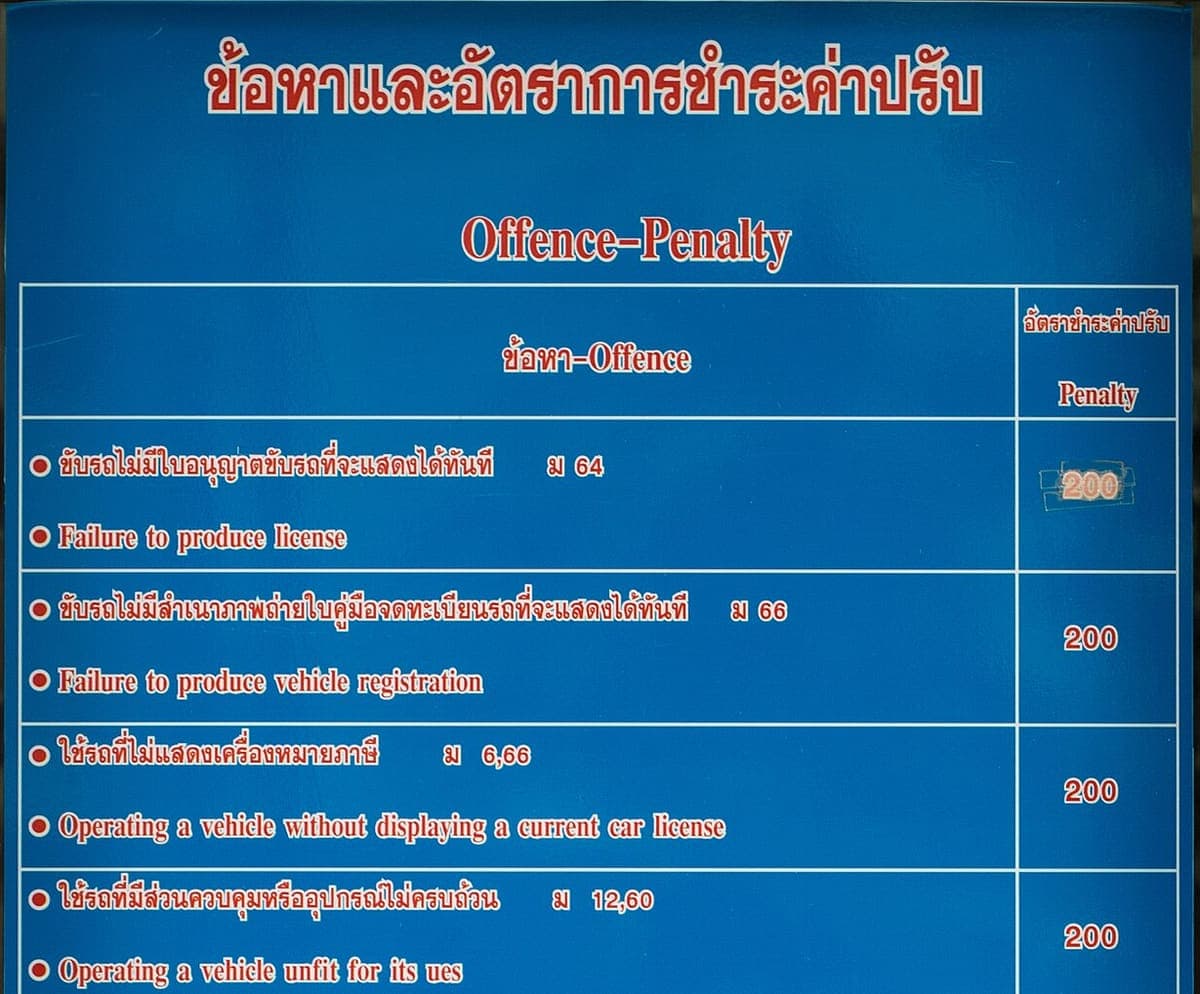
ข้อหาและอัตราการชำระค่าปรับ
Offence-Penalty
| ข้อหา-Offence | อัตราชำระค่าปรับ Penalty |
|---|---|
| ● ขับรถไม่มีใบอนุญาตขับรถที่จะแสดงได้ทันที ม 64 ● Failure to produce license | 200 |
| ● ขับรถไม่มีสำเนาภาพถ่ายใบคู่มือจดทะเบียนรถที่จะแสดงได้ทันที ม 66 ● Failure to produce vehicle registration | 200 |
| ● ใช้รถที่ไม่แสดงเครื่องหมายภาษี ม 6,66 ● Operating a vehicle without displaying a current car license | 200 |
| ● ใช้รถที่มีส่วนควบคุมหรืออุปกรณ์ไม่ครบถ้วน ม 12,60 ● Operating a vehicle unfit for its ues | 200 |
Generated by Evidano’s advanced model; not yet checked against a published edition.
Evidano Transcription
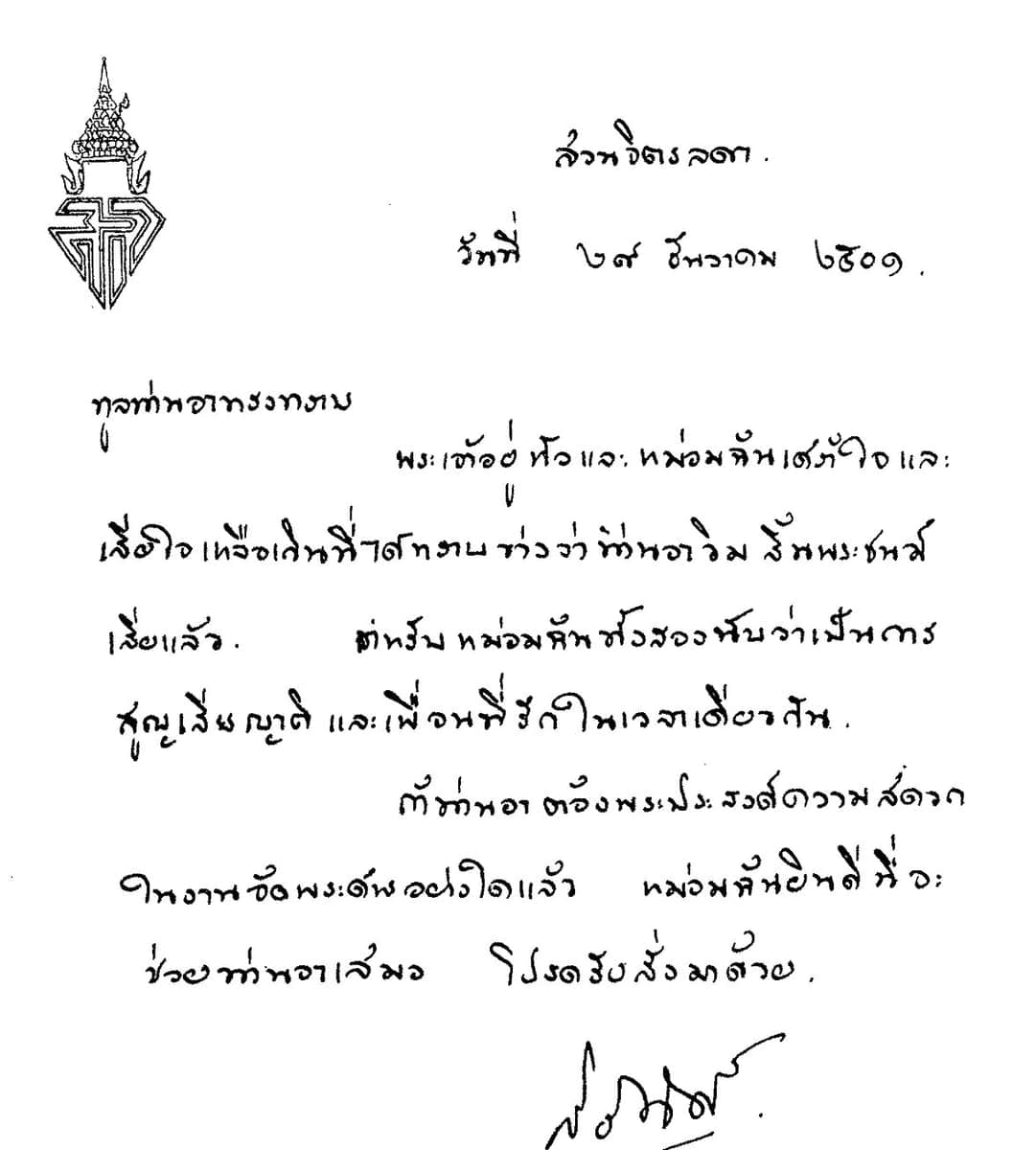
สวนจิตรลดา .
วันที่ ๒๙ ธันวาคม ๒๕๐๑ .
ทูลท่านอาทรงทราบ
พระเจ้าอยู่หัวและหม่อมฉันเศร้าใจและ
เสียใจเหลือเกินที่ได้ทราบข่าวว่าท่านอาวิมสิ้นพระชนม์
เสียแล้ว . สำหรับหม่อมฉันทั้งสองนับว่าเป็นการ
สูญเสียญาติและเพื่อนที่รักในเวลาเดียวกัน .
ถ้าท่านอาต้องพระประสงค์ความสะดวก
ในงานจัดพระศพอย่างใดแล้ว หม่อมฉันยินดีที่จะ
ช่วยท่านอาเสมอ โปรดรับสั่งมาด้วย .
สิริกิติ์ [signature]
Generated by Evidano’s advanced model; not yet checked against a published edition.
Evidano Transcription
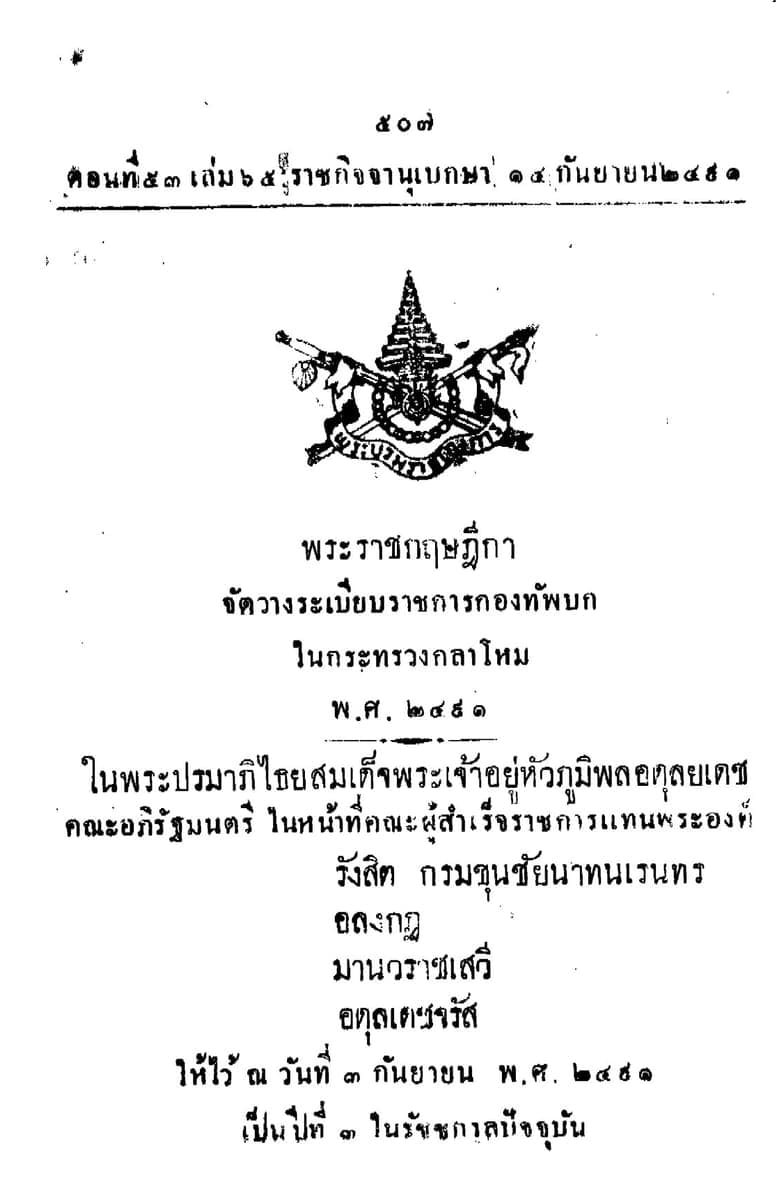
The whole page, from the Thai Wikisource proofread transcription of this scan. The header template has been flattened into the running head as it is printed, and the four names below the regency formula are given one per line as they stand on the page; the emblem is not described.
๕๐๗
ตอนที่ ๕๓ เล่ม ๖๕ ราชกิจจานุเบกษา ๑๔ กันยายน ๒๔๙๑
พระราชกฤษฎีกา
จัดวางระเบียบราชการกองทัพบกในกระทรวงกลาโหม
พ.ศ. ๒๔๙๑
ในพระปรมาภิไธยสมเด็จพระเจ้าอยู่หัวภูมิพลอดุลยเดช
คณะอภิรัฐมนตรี ในหน้าที่คณะผู้สำเร็จราชการแทนพระองค์
รังสิต กรมขุนชัยนาทนเรนทร
อลงกฏ
มานวราชเสวี
อดุลเดชจรัส
ให้ไว้ ณ วันที่ ๓ กันยายน พ.ศ. ๒๔๙๑
เป็นปีที่ ๓ ในรัชชกาลปัจจุบัน
Source: พระราชกฤษฎีกาจัดวางระเบียบราชการกองทัพบกในกระทรวงกลาโหม พ.ศ. ๒๔๙๑, proofread page 1, via Thai Wikisource (Public domain).
Chiang Mai University Library, MS 17075, c. 19th century · Source · Public domain
Evidano Transcription
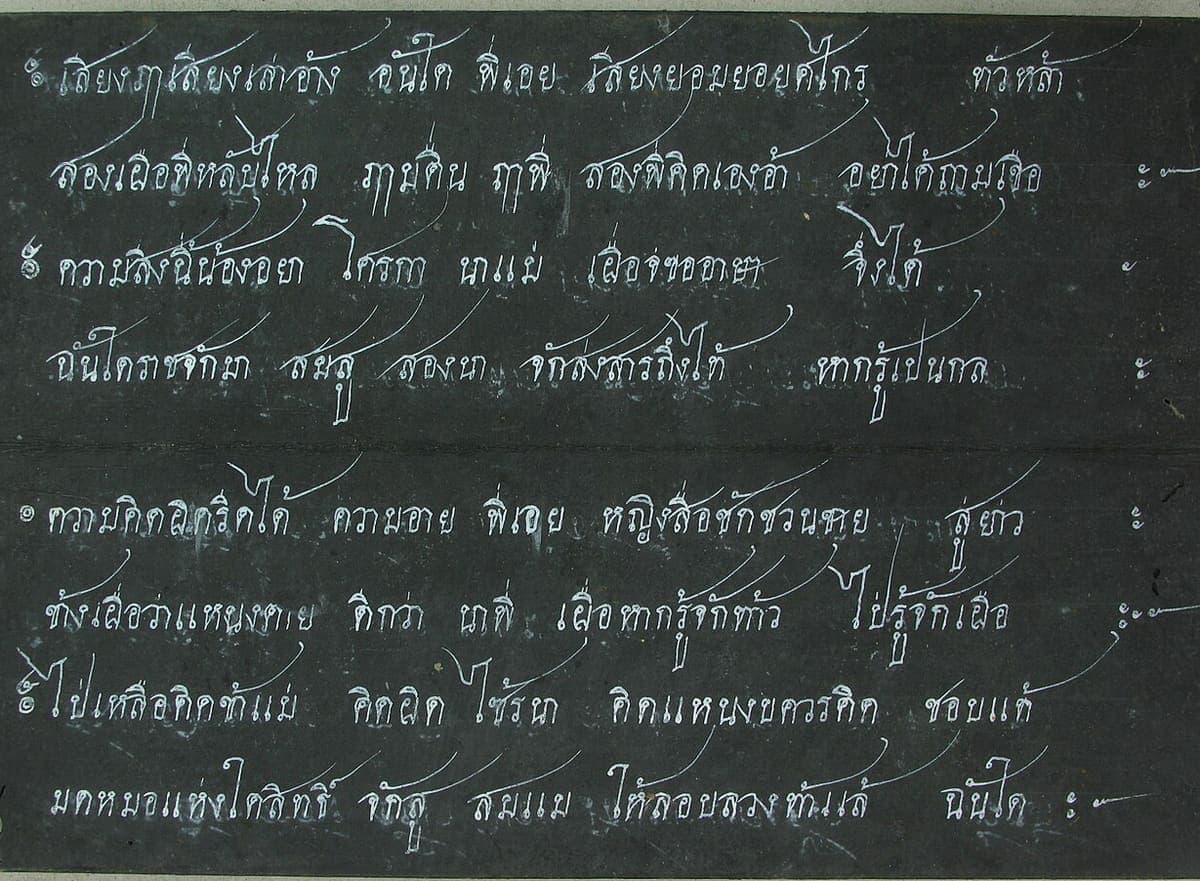
๏ เสียงฦๅเสียงเล่าอ้าง อันใด พี่เอย เสียงย่อมยอยศใคร ทั่วหล้า
สองเผือพี่หลับใหล ฤๅตื่น ฤๅพี่ สองพี่คิดเองอ้า อย่าได้ถามเผือ ๚ะ
๏ ความสิงฉี้ [?] น้องอยา โกรธา นาแม่ เผือจ่ขออาษา จึ่งได้
ฉันใดราชจักมา สมสู่ สองนา จักส่งสารถึงไท้ หากรู้เป็นกล ๚ะ
๏ ความคิดผิดคิดได้ ความอาย พี่เอย หญิงสือชักชวนชาย สู่ย่าว ๚ะ
ชั่งเผือว่าแหนงตาย ดีกว่า นาพี่ เผือหากรู้จักท้าว ไป่รู้จักเผือ ๚ะ
๏ ไป่เหลือคิดทำแม่ คิดผิด ไซ้รนา คิดแหนงบควรคิด ชอบแท้
มดหมอแห่งใดสิทธิ จักสู่ สมแม่ ให้ลอบลวงทำแล้ ฉันใด ๚ะ
Generated by Evidano’s advanced model; not yet checked against a published edition.
What Thai looks like on the page
Thai is written with forty-four consonant letters and a set of vowel signs that surround them. Some vowels follow the consonant (า, ะ), some sit above it (ิ, ี, ึ, ื) or below it (ุ, ู), and five — เ, แ, โ, ใ, ไ — are written to the left of the consonant they are pronounced after, so the visual order of a syllable is not its spoken or its encoded order. On top of that sits one of four tone marks, which may land above a vowel sign that is already above the consonant, giving a three-storey syllable. Nothing marks the end of a word: a space appears only at the end of a clause or a sentence, so a line of Thai is an unbroken ribbon that the reader segments as they go.
Two letters can differ by a single small loop at the start of the stroke — the head that separates ด from ค and ต, บ from ป, and ถ from ภ. Traditional typefaces and careful handwriting draw that head clearly; modern display faces on signs and packaging often leave it out altogether, and a hurried hand reduces it to a bump, so the same shape has to be read from context. Thai also keeps its own digits, ๐ ๑ ๒ ๓ ๔ ๕ ๖ ๗ ๘ ๙, which are standard in the Government Gazette, on official forms and in older printing, while Arabic digits are usual on street signs and receipts; years are commonly given in the Buddhist Era, 543 years ahead of the common era.
Older material looks different again. Before industrial printing, texts were written in folding books of blackened khoi paper with a white or yellow ink, or incised on palm leaves, and Pali was written in the Khom script rather than Thai letters. Manuscript orthography uses letters that have since dropped out of use, such as ฦ and ฦๅ, and spellings that no dictionary records; ฃ and ฅ survive in nineteenth-century print and disappear from the twentieth. A page of a nineteenth-century samut khoi and a laminated notice in a police station are both Thai, and neither reads like the other.
Why ordinary OCR struggles here
There are no spaces between words
Segmentation is a real task, not a formatting detail. A recogniser that returns a correct string of characters still leaves you with a ribbon that no search index or dictionary lookup can use, and a wrong guess at where one word ends changes the sentence. Decisions about whether to insert boundaries, and what to insert, belong in the transcription request rather than in a later clean-up.
Characters written out of order
Because เ, แ, โ, ใ and ไ are drawn before the consonant they follow, a system that reads strictly left to right produces text that looks right on screen but is encoded wrongly, and every comparison against a dictionary or another transcription then fails. The same applies to a vowel sign and tone mark stacked in one column: they have to come out in the order the encoding expects.
Letters that differ by one loop
The head of the stroke carries the identity of the letter. In a loopless display font on a shop sign, or in a fast hand where the loop is a dot, ด and ค, บ and ป, and ถ and ภ collapse into the same outline, and only the word decides which is meant. Generic OCR, which matches shapes rather than words, produces plausible-looking nonsense here.
Two numeral systems and two calendars
An official document numbers its pages and its clauses in Thai digits and dates itself in the Buddhist Era, while the table pinned beside it uses Arabic digits. A transcription has to keep both as they stand, mark clearly which is which, and leave the conversion to the reader, or a 2491 becomes a 1948 in a place where the original said neither.
Who works with this material
Public records and legal work
Gazette notices, land title deeds, court files and ministry circulars are scanned in bulk and consulted one clause at a time. What these users need is the clause numbering intact, Thai digits kept as digits rather than converted, and a text that can be searched despite having no word boundaries.
Temple libraries and manuscript projects
Folding books and palm-leaf bundles are being photographed faster than anyone can read them. A first-pass transcription that keeps the line breaks of the folio and marks the places where the ink has flaked lets a specialist work through a bundle instead of starting each folio from nothing.
Offices processing Thai paperwork
Invoices, delivery notes, identity documents and application forms arrive as photographs taken on a phone. The useful output keeps the table cells together, distinguishes the Thai and English lines of a bilingual form, and reports the Buddhist Era date exactly as printed.
Language technology and teaching
Corpus builders and teachers need text in correct encoding order, because a string that displays properly but stores the vowel after the consonant cannot be compared, sorted or searched. A transcription that is right at the character level is worth more than one that merely looks right.
Getting the best transcription
Say what to do about word boundaries
Decide in advance whether you want the text exactly as written, with spaces only where the page has them, or with word boundaries marked for indexing. Asking for the faithful version plus a segmented copy gives you something to cite and something to search, and keeps the two apart.
Ask for correct encoding order
State that leading vowels must be stored after the consonant they belong to and that stacked marks must come out in canonical order. It is worth checking one paragraph character by character at the start of a batch, because a systematic ordering fault is invisible on screen.
Fix the treatment of digits and dates
Tell the model to keep Thai numerals as Thai numerals and Buddhist Era years as printed, and to add a conversion in brackets only if you want one. On a bilingual sign, ask for the Thai and the English to be kept as separate lines so a fine, a section number and its gloss do not merge.
Test on a loopless sign and a manuscript folio
Run one photograph of a sign set in a loopless display face and one folio of handwriting before the rest. Those two show immediately whether the reading is coming from the words or only from the shapes, and how uncertain letters are reported.
Frequently asked questions
- Will the transcription add spaces between Thai words?
- Only if you ask. The default reproduces the spacing on the page, which in Thai means spaces at phrase and sentence ends. A segmented version can be produced alongside it for indexing, so the faithful text stays available for quotation.
- Are the leading vowels เ, แ, โ, ใ and ไ handled correctly?
- Yes. They are written before the consonant but transcribed after it, in the order Unicode expects, along with vowel signs above and below and any tone mark, so the output can be compared with other digital text rather than only looked at.
- Are Thai numerals and Buddhist Era dates preserved?
- They are kept as they appear, which matters for gazette and legal material where the digits are part of the citation. A converted equivalent can be added in brackets if you want both, but nothing is silently changed.
- Can it read handwriting and loopless display fonts?
- Both are read from the word rather than the isolated letter, which is what makes ด against ค or บ against ป decidable when the head loop has been reduced or dropped. Where the reading genuinely stays open, the alternatives are flagged instead of one being chosen quietly.
- What about samut khoi folding books and obsolete letters?
- White or yellow ink on blackened paper is transcribed line by line, with flaked passages marked rather than reconstructed. Letters no longer in use, such as ฦ and ฦๅ, and nineteenth-century spellings are kept as written; ask for a modernised version as well if you need one to search against.
Related scripts and pages
Transcribe your Thai documents
Upload a photograph of a sign, a form, a gazette page or a folding-book folio and see the Thai text with the marks and digits as written.