
Russian · c. 1500–1700
Read the chancery cursive of Muscovy
Skoropis hangs half its endings above the line and loops the rest across the lines above and below. The same clerk writes е three ways in a sentence, and a date arrives as letters under a titlo. Evidano reads the hand as the clerk wrote it and puts the raised letters back where they belong.
Sample pages
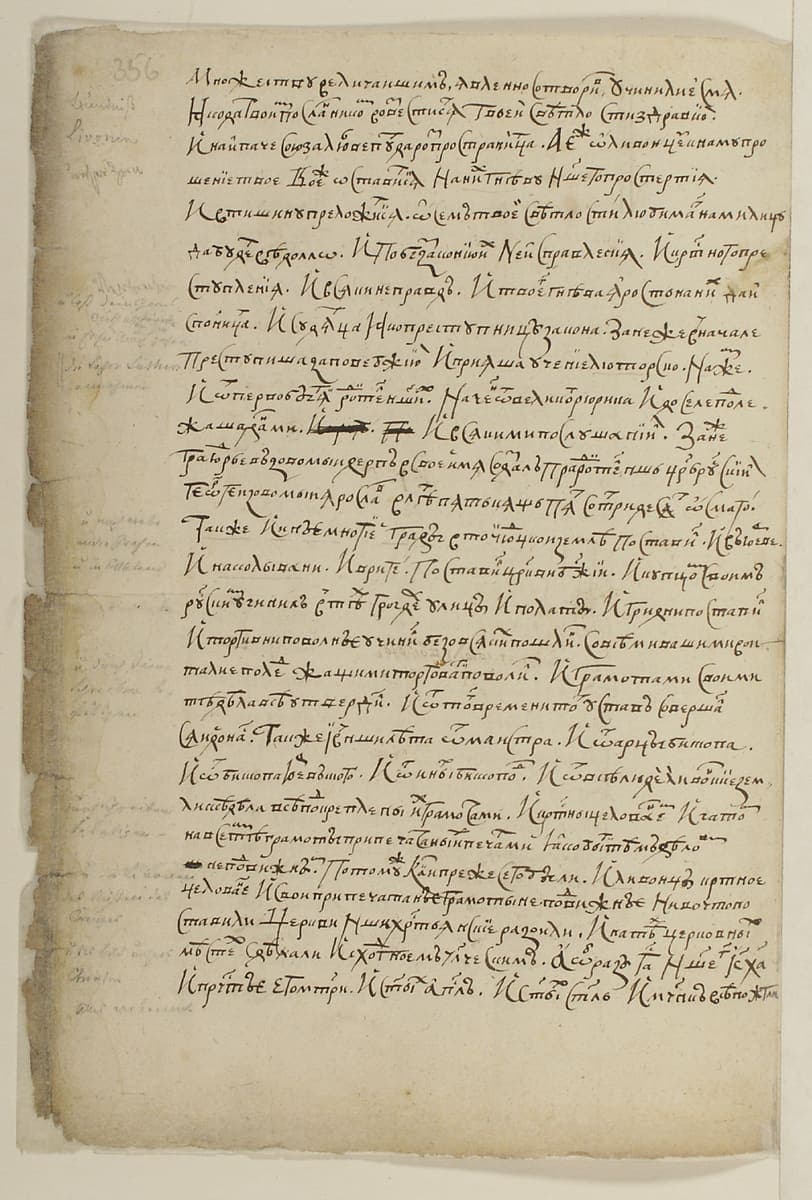
State Archive in Szczecin, Archiwum Książąt Szczecińskich I/866, 26 February 1560 · Source · Public domain · Archiwum Główne Akt Dawnych, via Wikimedia Commons
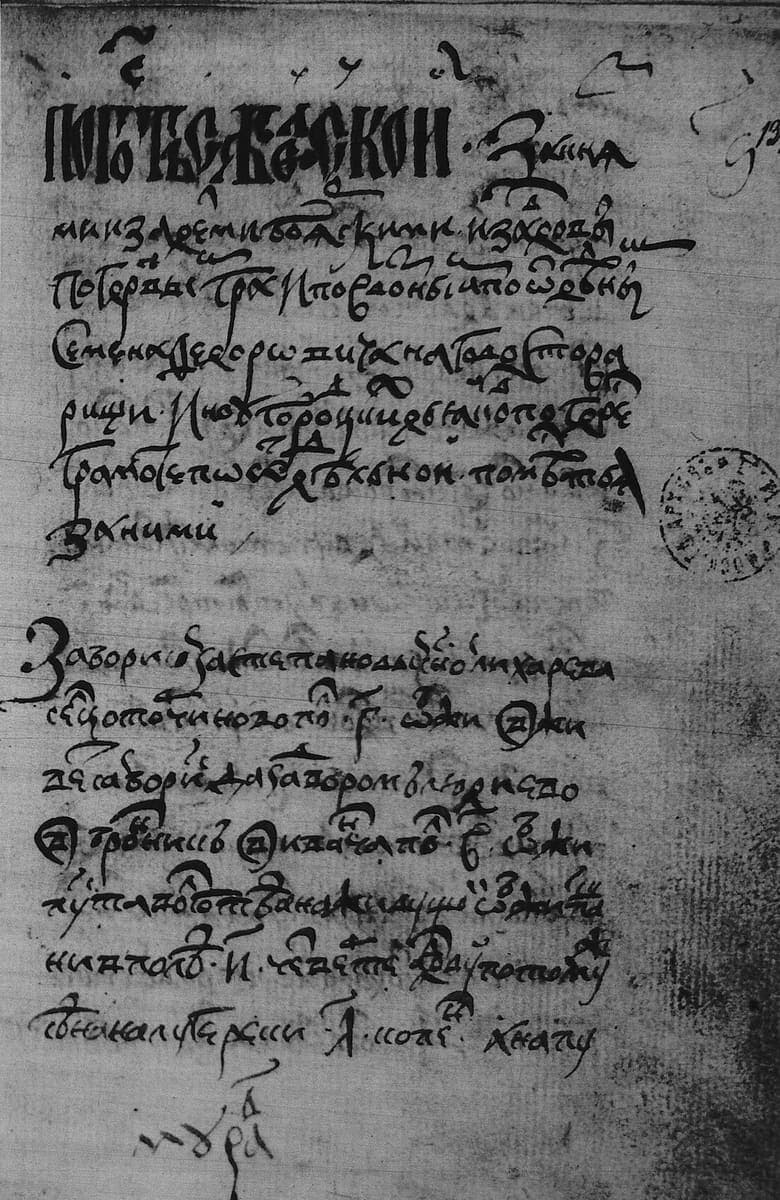
Evidano Transcription
ПОГОСТЪ [illegible]СКОИ · [illegible]
[illegible]
[illegible]
Семена Федоровича[?] [illegible]
[illegible]
[illegible]
За ними
За Борисом[?] [illegible]
с[е]л[ь]цо Починово по .г. обжи [illegible]
да Заборье да [illegible]
[remaining lines illegible]
Generated by Evidano’s advanced model; not yet checked against a published edition.
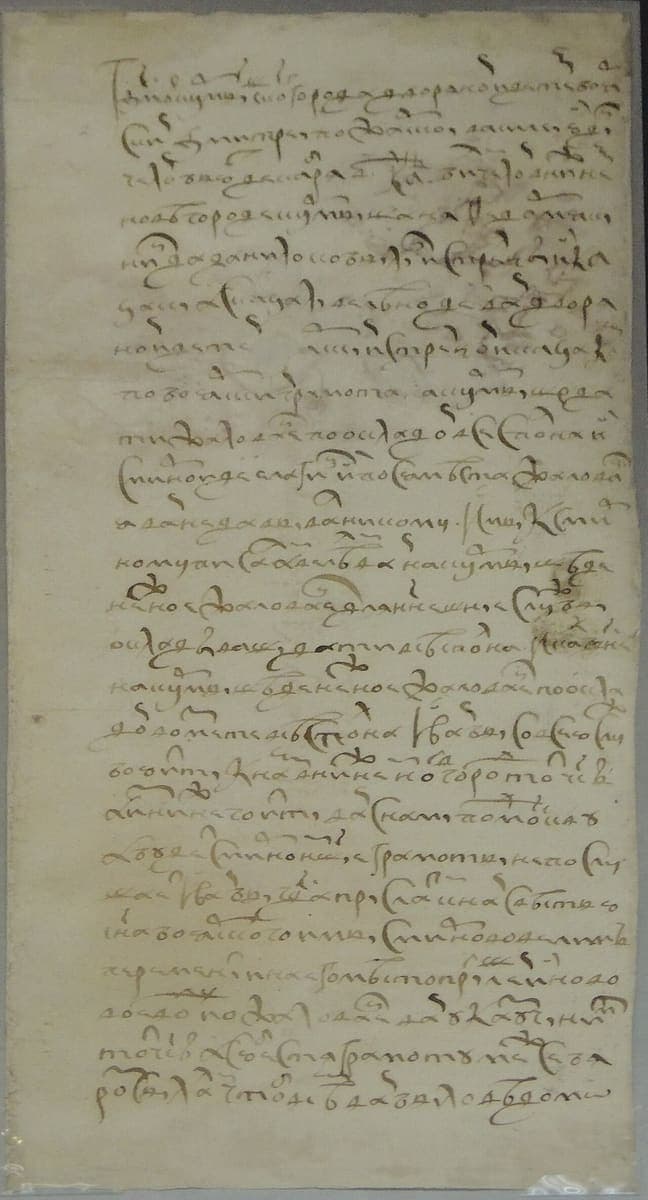
State Historical Museum, Moscow, 1611 · Source · CC BY-SA 3.0 · Shakko
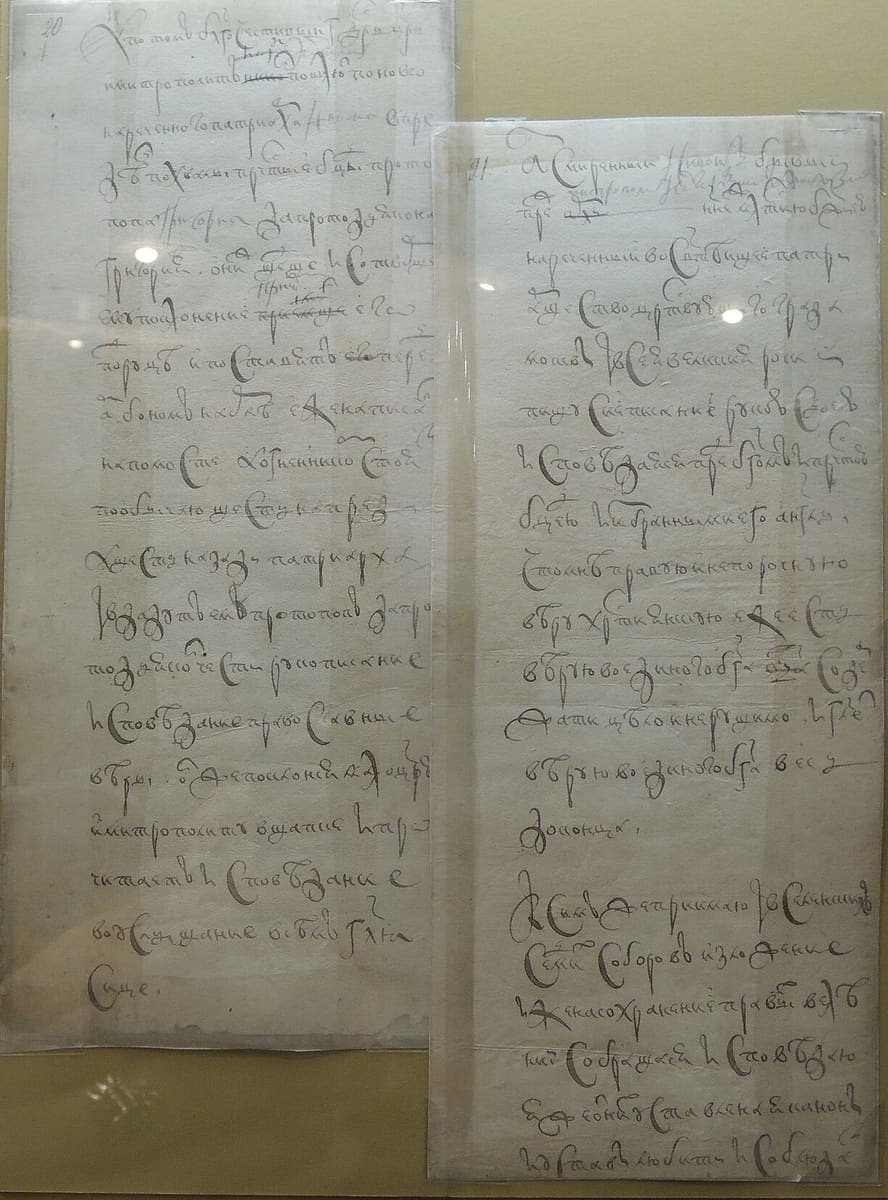
Russian State Archive of Ancient Acts, Moscow, f. 27, op. 1, d. 75, ll. 1–68, 1652 · Source · CC BY-SA 3.0 · Shakko
Evidano Transcription
20 Что по томъ бл[а]гочестивыи г[о]с[у]д[а]рь ц[а]рь [illegible]
и митрополитъ [cancelled: illegible] пошлють по ново
нареченного патриарха / [illegible]
з б[о]гомолцы[?] [illegible] б[о]яры прото
попа Григорья да протод[ья]кона
Григорья . они [illegible]
[lines illegible]
и исповѣдание право славные
вѣры . [illegible]
и митрополитъ [illegible]
читаетъ и исповѣдание
во услышание всѣмъ гл[агол]я
сице.
21 Аз[?] смиренныи Никонъ б[о]жиею м[илость]ю[?]
[illegible]
нареченныи во с[вя]тѣишаго патри
[illegible] ц[а]рствующаго града
Москвы и всеа великия Роси[и]
[remaining lines illegible]
Generated by Evidano’s advanced model; not yet checked against a published edition.
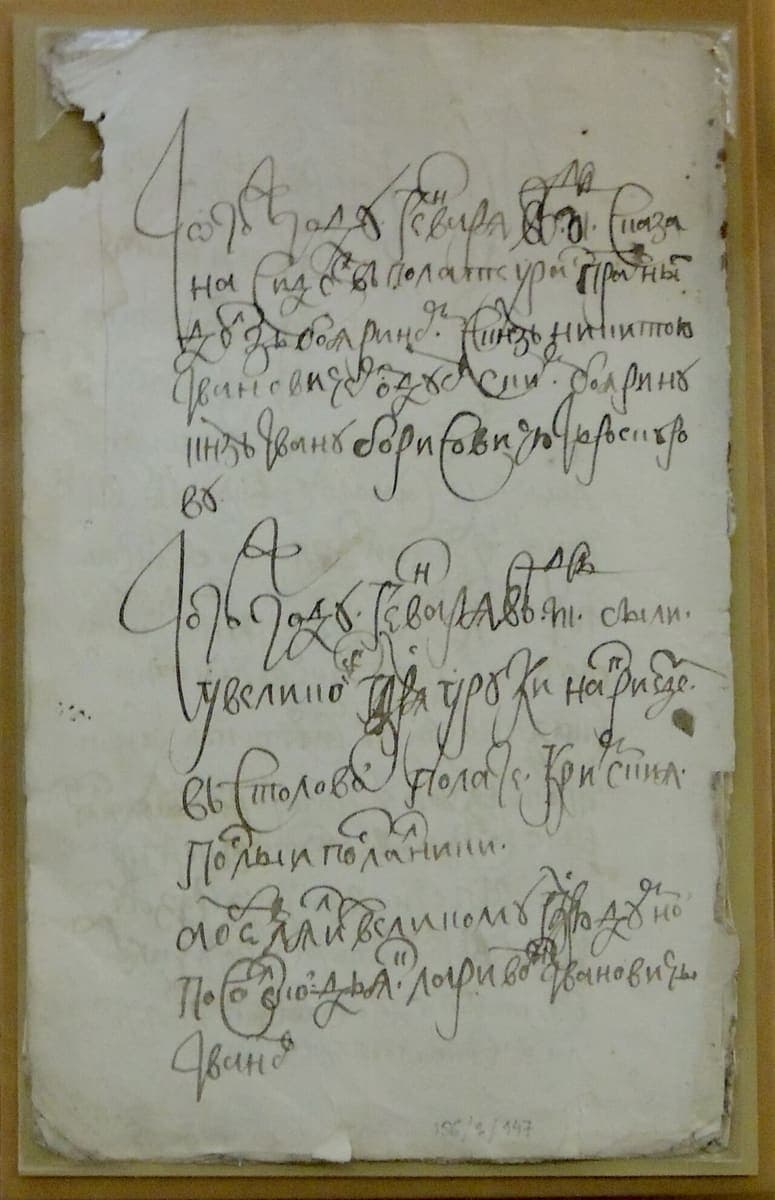
Russian State Archive of Ancient Acts, Moscow, 1682 · Source · CC BY-SA 3.0 · Shakko
Evidano Transcription
All three paragraphs on the sheet — the two dated entries and the note naming the clerk who presented the envoys — read out on the Commons file page with modern word division and with the raised letters restored to their words; the year is given there in both the era of Creation and the common era.
Тогож [7190=1682] году генваря въ 17 день сказана сидети въ полате у расправных дѣл зъ боярином с князь Никитою Івановичем Одоевским боярину князь Івану Борисовичю Търоекурову.
Тогож году генваря въ 18 день были у великого государя у руки на приезде въ Столовой полате кримския послы и послальники.
А объевлял их великому государю думной посольской дьяк Ларивон Івановичь Іванов.
Source: File description, “Fedor III’s law 1682 (RGADA) by shakko.jpg”, Wikimedia Commons (CC BY-SA 3.0).
How a Muscovite document is written
Skoropis is the working hand of the Muscovite chancelleries from about 1500 until the reforms of Peter I. It grew out of poluustav under the pressure of speed: the pen leaves the page less often, letters join, ascenders and descenders stretch, and many endings are lifted clear of the line and written small above their own word. Individual letters have several competing shapes — a т like three legs or like a modern m, a д whose tail sweeps far below the line, в as a loop or a triangle. By the mid-seventeenth century the display letters of a heading can be nearly as ornamental as vyaz while the body of the same document is a running scrawl.
The documents themselves have shapes of their own. A prikaz kept its files as stolbtsy, strips of paper glued end to end into a long column, with the joins signed across the back and notes of receipt written on the dorse. Surveys and censuses were bound as books: the pistsovye and perepisnye knigi that record households, fields and measurements, and the razryadnye knigi that record who was appointed to what. A petition opens with a fixed address to the tsar and a self-abasing formula from the petitioner; a charter of grant opens with the full imperial title, often in decorated letters and gold.
Numbers, dates and money keep the older habits. Years still run from the creation of the world and are written as letters under titla, so the reader subtracts 5508 or 5509 to reach a common-era date; sums are counted in roubles, altyns and dengas, and land in chetverti. Word division is unreliable and punctuation little more than an occasional point, so a clause is found by recognising the formula that carries it. Clerks add their справа signatures, seals are pressed into the paper, and later archivists write numbers and inventory notes across the same surface.
Why ordinary OCR struggles here
Half the letters are off the line
A superscript в, х, м, т or the sign for the reflexive ся belongs inside the word beneath it, not on a line of its own. Recognition that reads strictly by line discards them or emits them as a separate string, and the words below lose their case endings — fatal in a document full of names and titles.
One letter, many shapes
Skoropis offers several forms for е, с, о, т, в and д, and a fast writer mixes them within a sentence. Shape-based recognition cannot choose between them without knowing the word, and confusion of т with м or и with н turns a place name into a different place name.
Chancery formulae and vocabulary
Petitions, memoranda and grants are built from set phrases and a technical vocabulary of offices, ranks, taxes and land measures that a general Russian model has never seen. The opening of a petition is the most abbreviated part of it, and it is where recognition fails first.
Scrolls, dorse notes and damage
A stolbets is read down the face and then turned over for the signatures across the joins; a bound register carries later foliation, stamps and pencil. Ink corrosion, water stains and glue shadows sit over the text, and a photograph of a document under glass adds reflections to all of it.
Who works with this material
Genealogists and local historians
Surveys, census books and service lists are the earliest sources that name ordinary people. Getting a household or a village out of them depends on reading names and patronymics correctly, which in skoropis means resolving the raised endings that carry the grammar.
Archivists describing prikaz files
A fond of column scrolls cannot be catalogued without knowing what each strip contains. A first-pass reading of the opening formula and the date on every document turns an undescribed box into a searchable list of petitions, memoranda and replies.
Historians of law and administration
Working on the Muscovite state means quoting the documents it produced, with their offices, procedures and dates intact. Chancery vocabulary has to survive transcription unaltered, and a date in letters has to reach the footnote as the year the clerk actually wrote.
Lexicographers of older Russian
The dictionary of eleventh- to seventeenth-century Russian is built from citations, and most of the everyday vocabulary comes from documents rather than from books. A reading that keeps the spelling as written, including the raised letters, is what a citation slip needs.
Getting the best transcription
Give the model the formulae
Tell it that a petition begins with an address to the tsar and the phrase бьет челом холоп твой, that a memorandum opens with a date, and which offices and ranks appear in your material. Formulaic openings are the hardest part of the page and the easiest to supply in advance.
Ask for raised letters to be restored
Say explicitly that superscript letters should be returned to the words they belong to, and whether you want them marked when they are. Without that instruction they end up as a separate line of debris and the words below lose their endings.
Set a rule for dates and sums
Ask for the year to be given as written and then converted, and for roubles, altyns and dengas or land measures to be transcribed rather than turned into figures. Conversion errors are easy to spot afterwards only if the original notation is still there.
Test on a scroll with notes on the back
Choose a document with a glued join, a signature across it and a receipt note on the dorse. If those come back labelled and separate from the main text, the rest of the file will need only spot-checking.
Further reading on this hand
The palaeography guides the in-app selector points to for this domain, if you want to check a transcription against the standard references.
- Cyrillic Hands: A Translation of V. N. Shchepkin's Textbook of Russian Paleography
This scholarly translation contains dedicated discussion of skoropis as the cursive documentary script of Muscovite administration. It traces the script's development and illustrates its changing alphabet through manuscript and archival examples. The text treats connected letterforms, abbreviations, superscript signs, numerals, punctuation, and the contrast between formal and rapidly written hands. It is directly useful for sixteenth- and seventeenth-century charters, petitions, registers, and chancery documents.
Frequently asked questions
- What happens to letters written above the line?
- They are read as part of the word they sit over and put back into it. You can ask for them to be marked, which helps when the raised ending is the only evidence for a case or a tense.
- Can a date in the era of Creation be converted automatically?
- Yes. The letters are read as a number and the conversion offered alongside, with a note where the September or March start of the year allows two common-era dates. The written form is kept, so a doubtful conversion can be checked without the document.
- How well does it cope with a badly damaged column scroll?
- Ink corrosion, glue shadows and torn joins are marked as loss rather than guessed at. Where a formula makes the missing words predictable, a reconstruction can be offered separately, clearly labelled, for the archivist to accept or reject.
- Will proper names and place names be spelled as in the document?
- They are transcribed as written, without modernising. That matters because a village or a surname may appear in three spellings in one file, and normalising them silently destroys exactly the evidence a genealogist or a place-name historian is after.
- Can notes on the back and clerks’ signatures be kept separate?
- Yes, if you photograph them and say so. Dorse notes, the справа of a podyachy and later archival numbering each come back as their own block, so the document text stays clean while the administrative traces remain.
Related scripts and pages
Transcribe your Muscovite documents
Upload a scroll or a register page, choose Muscovite Skoropis Documents as the domain, and start with one dated document.