
English
Amounts that stay on the line they belong to
On a bill, the only thing joining a description to its figure is that they sit at the same height on the page. Lose that and you have a list of words and a list of numbers with no way back. Evidano reads financial paper as rows: quantity, description, unit price and amount together, subtotals and tax kept apart from the line items, and a note when the figures on the page do not add up to the total printed underneath them.
Sample pages
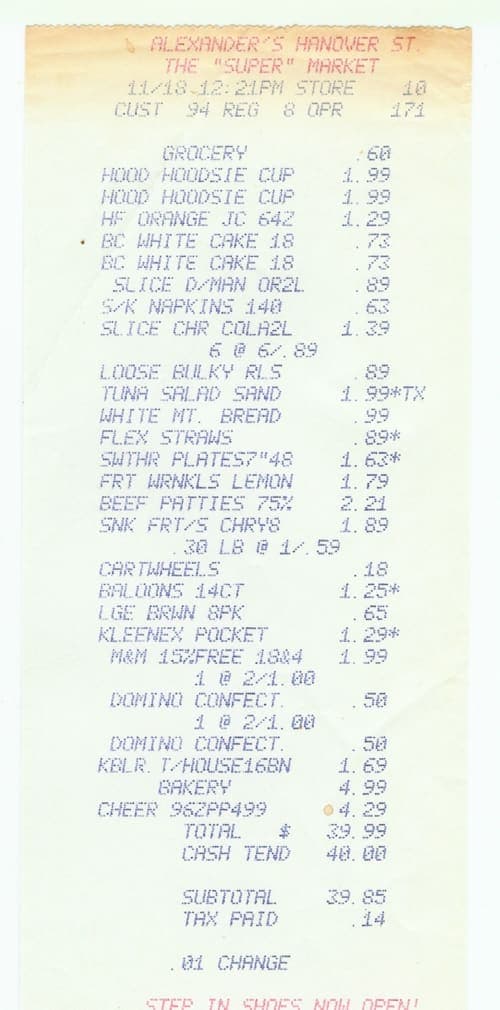
Evidano Transcription
ALEXANDER'S HANOVER ST.
THE "SUPER" MARKET
11/18 12:21PM STORE 10
CUST 94 REG 8 OPR 171
GROCERY .60
HOOD HOODSIE CUP 1.99
HOOD HOODSIE CUP 1.99
HF ORANGE JC 64Z 1.29
BC WHITE CAKE 18 .73
BC WHITE CAKE 18 .73
SLICE D/MAN OR2L .89
S/K NAPKINS 140 .63
SLICE CHR COLA2L 1.39
6 @ 6/.89
LOOSE BULKY RLS .89
TUNA SALAD SAND 1.99TX
WHITE MT. BREAD .99
FLEX STRAWS .89
SWTHR PLATES7"48 1.63*
FRT WRNKLS LEMON 1.79
BEEF PATTIES 75% 2.21
SNK FRT/S CHRY8 1.89
.30 LB @ 1/.59
CARTWHEELS .18
BALOONS 14CT 1.25*
LGE BRWN 8PK .65
KLEENEX POCKET 1.29*
M&M 15%FREE 18&4 1.99
1 @ 2/1.00
DOMINO CONFECT. .50
1 @ 2/1.00
DOMINO CONFECT. .50
KBLR. T/HOUSE16BN 1.69
BAKERY 4.99
CHEER 96ZPP499 4.29
TOTAL $ 39.99
CASH TEND 40.00
SUBTOTAL 39.85
TAX PAID .14
.01 CHANGE
STEP IN SHOES NOW OPEN!
Generated by Evidano’s advanced model; not yet checked against a published edition.
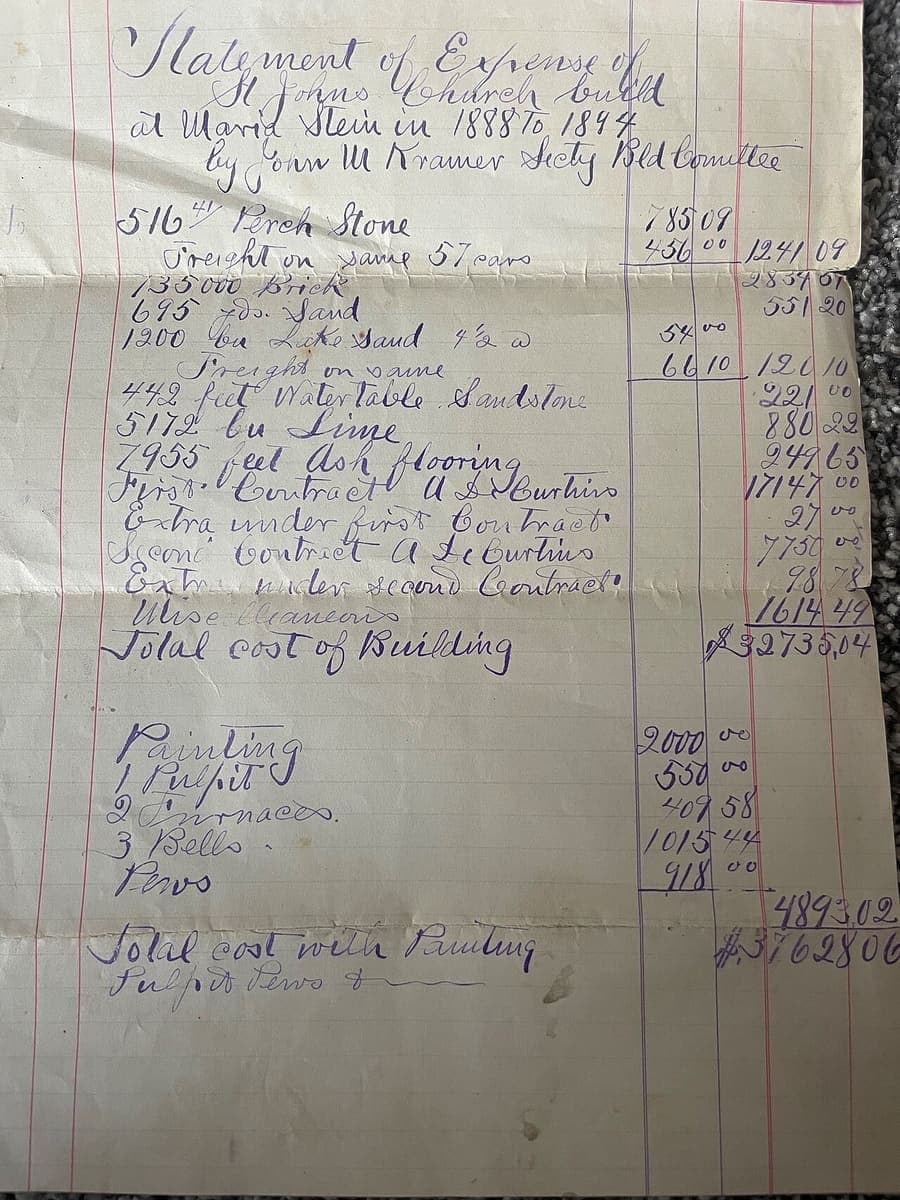
Source · CC BY-SA 4.0 · Photograph by MLB1834
Evidano Transcription
Statement of Expense of
St Johns Church build
at Maria Stein in 1888 to 1894
by John M Kramer Secty Bld Comittee
| 516 41/ Perch Stone | 785 09 | |
| Freight on same 57 cars | 456 00 | 1241 09 |
| 735000 Brick | 2834 07 | |
| 695 yds. Sand | 551 20 | |
| 1200 bu Lake Sand 4 1/2 c | 54 00 | |
| Freight on same | 66 10 | 120 10 |
| 442 feet Water table Sandstone | 221 00 | |
| 5172 bu Lime | 880 22 | |
| 7955 feet Ash flooring | 249 65 | |
| First Contract A DeCurtins | 17147 00 | |
| Extra under first Contract | 27 00 | |
| Second Contract A DeCurtins | 7750 00 | |
| Extra under second Contract | 98 78 | |
| Miscellaneous | 1614 49 | |
| Total cost of Building | $32735,04 | |
| Painting | 2000 00 | |
| 1 Pulpit | 550 00 | |
| 2 Furnaces. | 409 58 | |
| 3 Bells. | 1015 44 | |
| Pews | 918 00 | |
| 4893 02 | ||
| Total cost with Painting | $37628 06 | |
| Pulpit Pews & |
Generated by Evidano’s advanced model; not yet checked against a published edition.
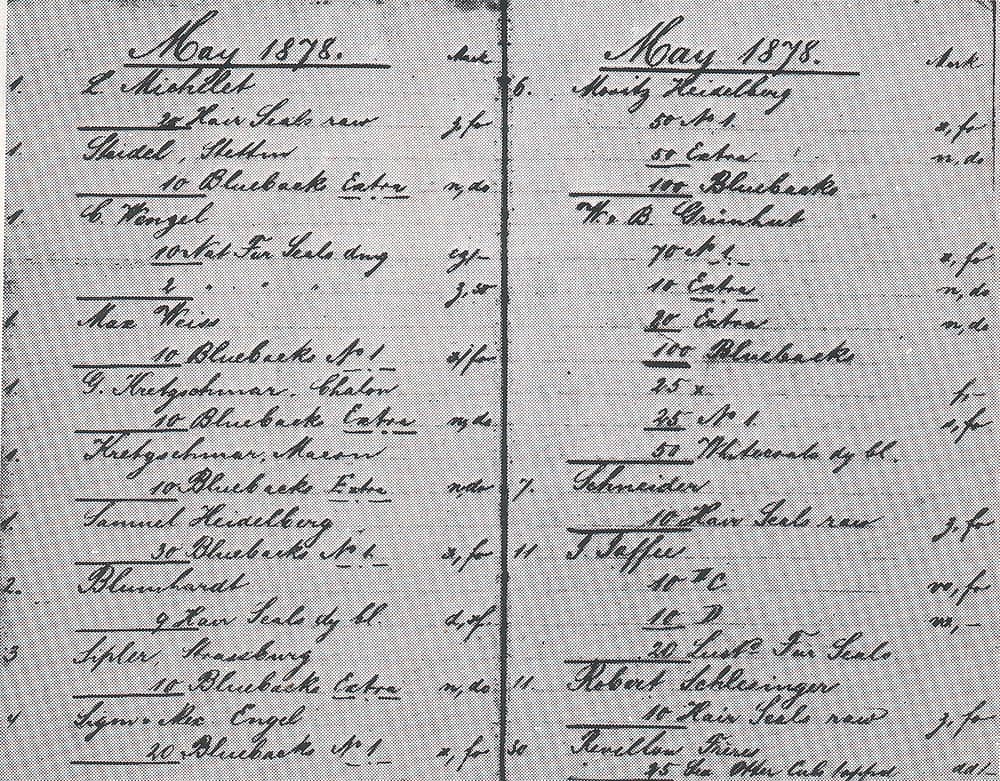
Evidano Transcription
| May 1878. | Mark | |
|---|---|---|
| 1. | L. Michelet | |
| 20 Hair Seals raw | z, fo | |
| 1. | Steidel, Stettin | |
| 10 Blueback Extra | n, do | |
| 1. | C. Wenzel | |
| 10 Nat Fur Seals dry | c, g/- | |
| 2 . . . | z, 50 | |
| 1. | Max Weiss | |
| 10 Bluebacks No 1 | a, fo | |
| 1. | G. Kretzschmar, Chalon | |
| 10 Blueback Extra | n, do | |
| 1. | Kretzschmar, Macon | |
| 10 Bluebacks Extra | n, do | |
| 1. | Samuel Heidelberg | |
| 30 Bluebacks No 1 | a, fo | |
| 2. | Blumhardt | |
| 9 Hair Seals dy bl. | d, of | |
| 3 | Sipler, Strassburg | |
| 10 Bluebacks Extra | n, do | |
| 4 | Sigm. & Mc. Engel | |
| 20 Bluebacks No 1 | a, fo |
| May 1878. | Mark | |
|---|---|---|
| 6. | Moritz Heidelberg | |
| 50 No 1. | a, fo | |
| 50 Extra | n, do | |
| 100 Bluebacks | ||
| W. & B. Grünhut | ||
| 70 No 1. | a, fo | |
| 10 Extra | n, do | |
| 20 Extra | n, do | |
| 100 Bluebacks | ||
| 25 x | f- | |
| 25 No 1. | a, fo | |
| 50 Whitecoats dy bl. | ||
| 7. | Schneider | |
| 10 Hair Seals raw | z, fo | |
| 11 | J. Jaffe | |
| 10 C | vo, fo | |
| 10 D | m, - | |
| 20 Lustre Fur Seals | ||
| 11. | Robert Schlesinger | |
| 10 Hair Seals raw | z, fo | |
| 30 | Revillon Frères | |
| 25 Sea Otter Cubs topped | [illegible] |
Generated by Evidano’s advanced model; not yet checked against a published edition.
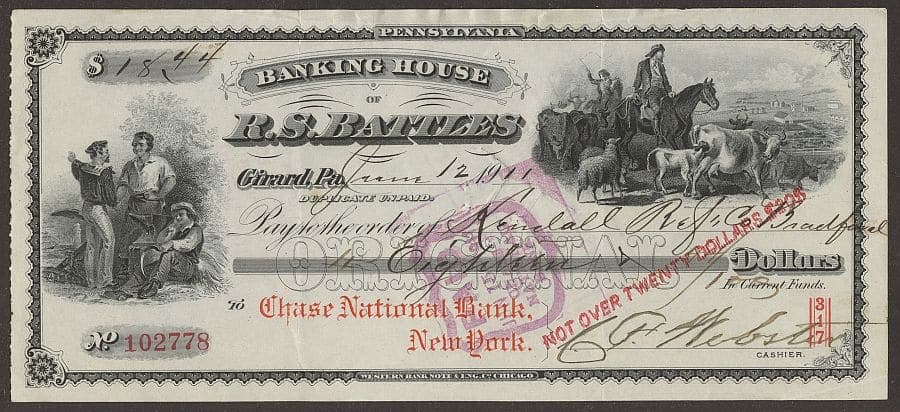
Source · Public domain · Printed by the Western Bank Note & Engraving Co., Chicago
Evidano Transcription
PENNSYLVANIA
$ 18.44 BANKING HOUSE
OF
R.S. BATTLES
Girard, Pa. June 12 1911
DUPLICATE UNPAID.
Pay to the order of Kendall Refg Co Bradford
ORIGINAL
Eighteen & 44/100 Dollars
[illegible] In Current Funds.
[stamp: illegible]
To Chase National Bank,
New York. NOT OVER TWENTY DOLLARS $20.00
8
1
No 102778 7
C. F. Webster
CASHIER.
WESTERN BANK NOTE & ENG. CO. CHICAGO
Generated by Evidano’s advanced model; not yet checked against a published edition.
How money is laid out on paper
Almost every financial document is a table pretending not to be one. Descriptions run down the left, quantities and unit prices sit in narrow middle columns, and amounts are set hard against the right-hand edge so the digits line up by place value. Older account books rule the money column into pounds, shillings and pence, or dollars and cents, with a printed vertical line where a decimal point would go, so the number has no separator at all; a figure like 12 10 6 is three columns, not one. Repetition is compressed with a ditto mark or the word “do”, both of which mean “as the line above” and both of which have to be resolved before a row means anything on its own.
Printed and machine-produced documents add their own conventions. A till receipt abbreviates item names to fit the paper width and flags taxable lines with an asterisk or a two-letter code; multi-buy pricing appears on its own line beneath the item as something like “6 @ 6/.89”, which is not a price but an explanation of one. Statements mark credits with a trailing CR or wrap negative amounts in parentheses rather than using a minus sign. Percentages, account numbers, invoice numbers, purchase-order references and stock codes all sit near the figures and none of them is money.
Then the document is worked on. A “PAID” stamp lands across the total; a cheque carries a protective overprint diagonally through the amount and a security tint under it; a clerk pencils a correction above a figure without crossing the old one out; a receipt is endorsed and signed on the back. The amount may be given twice, once in figures and once in words, and the two are not always the same — which is exactly the kind of discrepancy the transcription should surface rather than smooth over.
Why ordinary OCR struggles here
Alignment is the only relationship
There is rarely a line or a box joining “Freight on same” to the figure at the far right of the page. Software that reads a page as a stream of text puts the descriptions in one block and the numbers in another, and no amount of later processing can reliably put them back together. The pairing has to be made while the geometry is still available.
Money columns with no decimal point
In a ruled account book the separation between pounds and shillings, or dollars and cents, is a printed rule rather than a punctuation mark. Read naively, 785 and 09 in adjacent columns become 78509. The same page may also use a superscript fraction for a quantity, so 516 4/9 perch of stone is a measurement rather than a price.
Digits where a single character matters
In prose a misread letter is usually recoverable from the word around it. In a column of figures there is no context: a 1 read as a 7, a 3 as an 8, or a stray comma promoted to a decimal point changes the amount and nothing on the page contradicts it. Cross-footing the rows against the printed total is the only real check.
Ink on top of the figures
Stamps, protective overprints, security tints and handwritten adjustments are all designed to sit over the amount rather than beside it. A recogniser trained on clean type reads the overprint and the figure as one blurred shape, so the amount most worth getting right is the one most often wrong.
Who works with this material
Bookkeepers and accounts payable teams
Supplier invoices arrive as photographs, scans and PDFs in every layout there is. The useful output is not a wall of text but a header block — supplier, date, invoice number, currency — and a set of line rows that can be matched against a purchase order, with the tax and the total checked against the lines.
Economic and business historians
Price series, wage books and trade ledgers are the raw material of quantitative history, and they only become usable when each entry is a row with a date, a commodity and an amount. Ditto marks resolved consistently and pre-decimal currency kept in its original units matter more here than a tidy modern format.
Auditors and investigators
Working from copies of copies, an auditor needs the alterations as much as the figures: which amount was changed, what the stamp says, whether the sum in words matches the sum in figures. A transcription that reports the discrepancy is doing the job; one that silently prefers the neater number is not.
Small businesses and expense claims
A shoebox of till receipts photographed on a phone is the most common financial imaging task there is, and the hardest, because thermal paper fades and the roll curls. Getting merchant, date, total and tax off each one reliably is worth more than a perfect reading of every abbreviated item name.
Getting the best transcription
State the currency and the conventions
Say which currency you expect, whether a comma is a thousands separator or a decimal point, and whether the document uses pre-decimal columns. On a ledger, say that the money column is ruled rather than punctuated, so the parts are returned as separate values instead of run together.
Ask for rows, then a totals block
Request the line items as structured rows and the subtotal, discount, tax and grand total as a separate block. Keeping them apart stops a tax line being read as a purchase and makes it possible to check the arithmetic, which is the fastest way to find a misread digit.
Say what to do with ditto marks and carried figures
Decide whether “do”, a pair of inverted commas or a repeat mark should be expanded to the value above or left as written, and how “carried forward” and “brought forward” lines should be labelled. On a long account these decisions affect every second row.
Check the totals before you trust the lines
Add the transcribed rows and compare them with the total printed on the page. If they agree, the digits are almost certainly right; if they do not, the difference usually points straight at the misread figure. This is a better use of five minutes than reading every line against the image.
Frequently asked questions
- Will the line items come back as rows I can put in a spreadsheet?
- Yes. Each line is returned with its description, quantity, unit price and amount as separate values, and the header information — supplier, date, document number — is kept apart from the lines. That structure is what makes matching against an order or a bank feed possible.
- How are pounds, shillings and pence columns handled?
- They are read as the separate columns they are, so a figure ruled across three cells is returned as three values rather than one long number. You can ask for the original units to be preserved, for a decimal conversion, or for both, which is what most historical projects want.
- Are credits, minus figures and amounts in parentheses recognised?
- A trailing CR, a leading minus and an amount enclosed in brackets are all read as negative, and the convention used is reported so you can confirm it. Where a column mixes conventions, as statements sometimes do, the raw form is kept alongside the interpretation.
- What happens with ditto marks?
- They are recognised as repetition rather than as text. By default the value from the line above is filled in and the row is marked as having come from a ditto, so you can see which entries were written out and which were inherited. If you would rather keep the page as written, ask for the mark to be preserved.
- Can it read an amount underneath a stamp or an overprint?
- Usually, and where it cannot the amount is marked as uncertain rather than guessed. The stamp or overprint is transcribed as its own item, so a “PAID” impression, a protective overprint limiting the value, and the amount itself are three separate pieces of information rather than one smudge.
Related scripts and pages
Turn invoices and ledgers into rows
Upload a receipt, an invoice or an account page, choose Business and Financial Documents, and check the totals against the page before you import.