
English
Read the document, not the scan
Most scanned paper is legible to a person and confusing to software. Text shows through from the reverse of a thin sheet, a stamp lands across two lines of type, a word is split by a hyphen at the end of a line, and the running head repeats on every page. Evidano separates the document from the marks the scanner and the filing system left on it, and returns the text in the order a reader would take it.
Sample pages
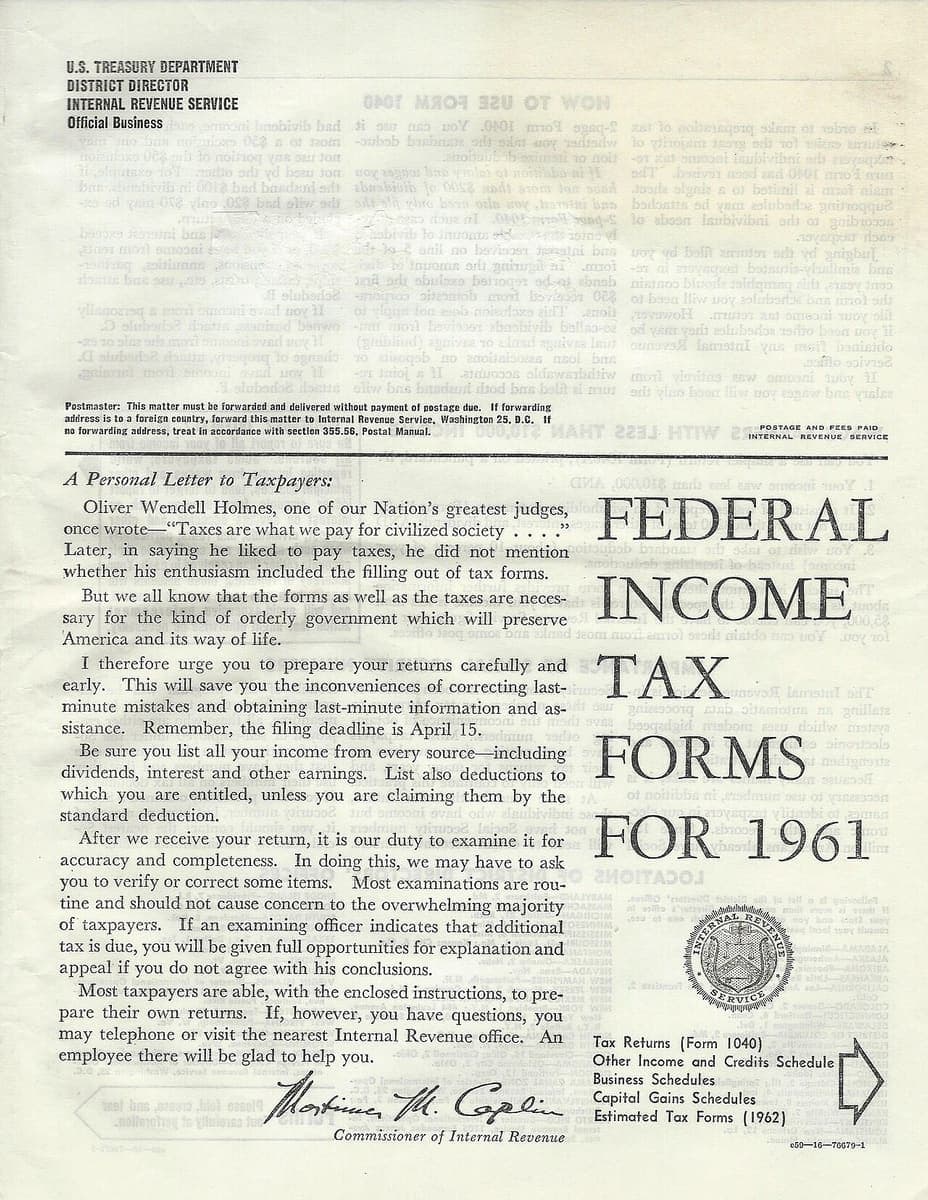
Internal Revenue Service, 1961 · Source · Public domain
Evidano Transcription
U.S. TREASURY DEPARTMENT
DISTRICT DIRECTOR
INTERNAL REVENUE SERVICE
Official Business
Postmaster: This matter must be forwarded and delivered without payment of postage due. If forwarding POSTAGE AND FEES PAID
address is to a foreign country, forward this matter to Internal Revenue Service, Washington 25, D.C. If INTERNAL REVENUE SERVICE
no forwarding address, treat in accordance with section 355.56, Postal Manual.
A Personal Letter to Taxpayers:
Oliver Wendell Holmes, one of our Nation's greatest judges,
once wrote—"Taxes are what we pay for civilized society . . . ."
Later, in saying he liked to pay taxes, he did not mention
whether his enthusiasm included the filling out of tax forms.
But we all know that the forms as well as the taxes are neces-
sary for the kind of orderly government which will preserve
America and its way of life.
I therefore urge you to prepare your returns carefully and
early. This will save you the inconveniences of correcting last-
minute mistakes and obtaining last-minute information and as-
sistance. Remember, the filing deadline is April 15.
Be sure you list all your income from every source—including
dividends, interest and other earnings. List also deductions to
which you are entitled, unless you are claiming them by the
standard deduction.
After we receive your return, it is our duty to examine it for
accuracy and completeness. In doing this, we may have to ask
you to verify or correct some items. Most examinations are rou-
tine and should not cause concern to the overwhelming majority
of taxpayers. If an examining officer indicates that additional
tax is due, you will be given full opportunities for explanation and
appeal if you do not agree with his conclusions.
Most taxpayers are able, with the enclosed instructions, to pre-
pare their own returns. If, however, you have questions, you
may telephone or visit the nearest Internal Revenue office. An
employee there will be glad to help you.
Mortimer M. Caplin
Commissioner of Internal Revenue
FEDERAL
INCOME
TAX
FORMS
FOR 1961
INTERNAL REVENUE SERVICE
Tax Returns (Form 1040)
Other Income and Credits Schedule
Business Schedules
Capital Gains Schedules
Estimated Tax Forms (1962)
c59-16-76679-1
Generated by Evidano’s advanced model; not yet checked against a published edition.
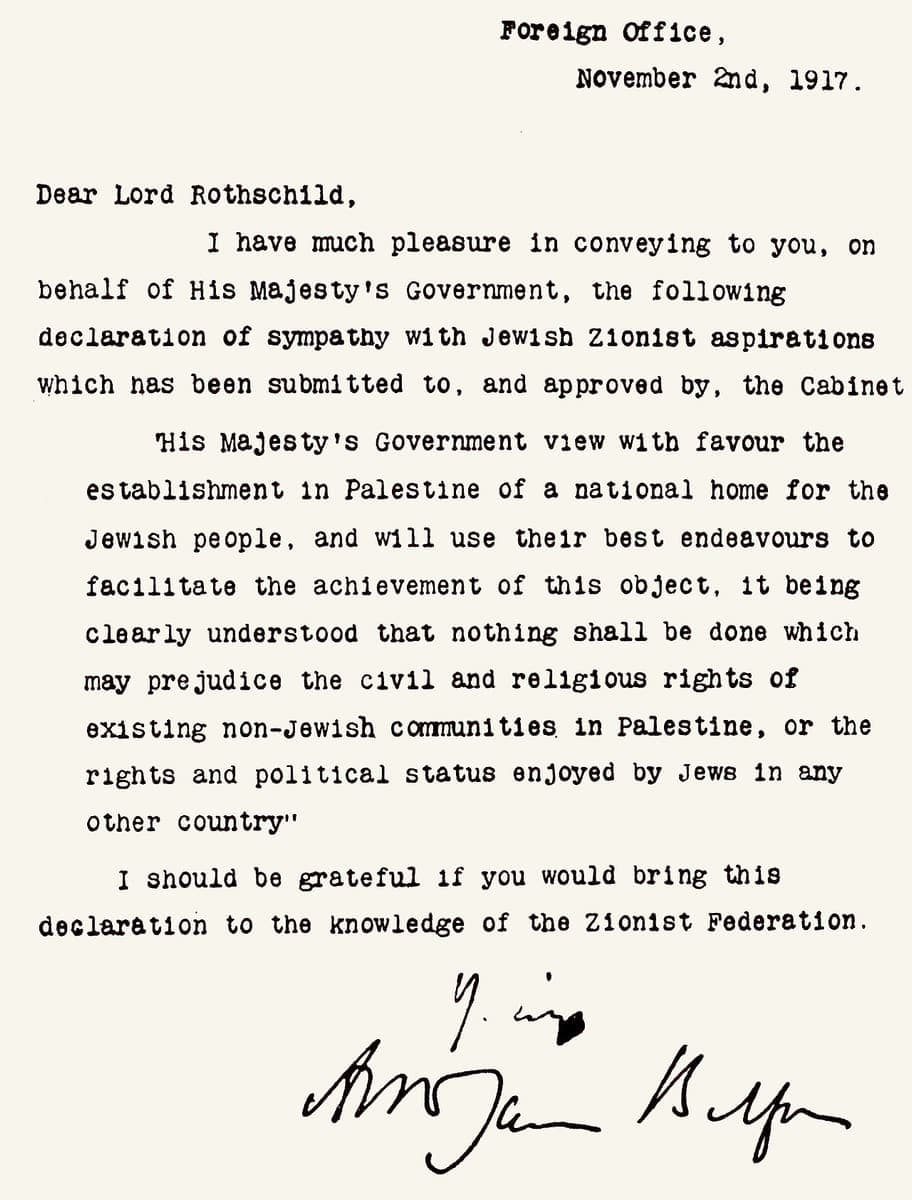
Evidano Transcription
The whole letter, from the English Wikisource proofread transcription of this image. The editors normalise the typescript’s punctuation and render the signature as text: the declaration is opened on the page with a single quotation mark and closed with a double one, and it is given matching double marks here, while the full stops the typist omitted at the end of the declaration and after “the Cabinet” are supplied. The layout of the date block is reproduced as printed.
Foreign Office
November 2nd, 1917

Dear Lord Rothschild,

I have much pleasure in conveying to you, on behalf of His Majesty’s Government, the following declaration of sympathy with Jewish Zionist aspirations which has been submitted to, and approved by, the Cabinet.

“His Majesty’s Government view with favour the establishment in Palestine of a national home for the Jewish people, and will use their best endeavours to facilitate the achievement of this object, it being clearly understood that nothing shall be done which may prejudice the civil and religious rights of existing non-Jewish communities in Palestine, or the rights and political status enjoyed by Jews in any other country.”

I should be grateful if you would bring this declaration to the knowledge of the Zionist Federation.

Yours,
Arthur James Balfour
Source: Balfour Declaration, proofread page, English Wikisource (Public domain).
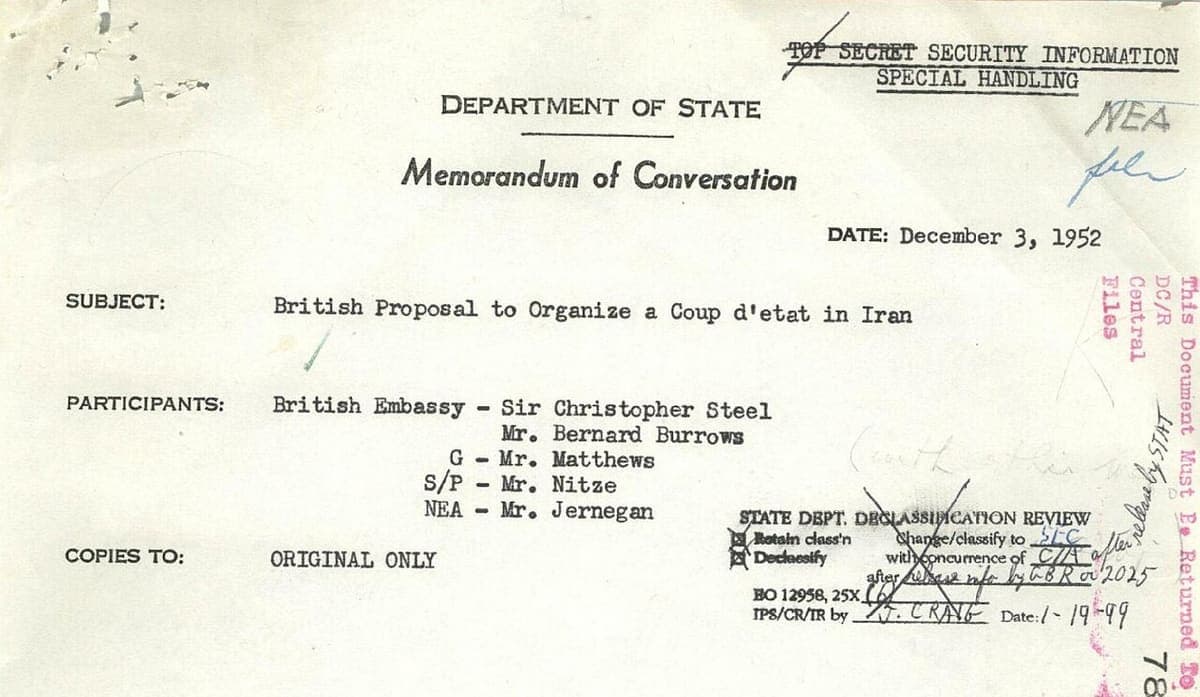
United States Department of State, 3 December 1952 · Source · Public domain
Evidano Transcription
[cancelled: TOP] SECRET SECURITY INFORMATION
SPECIAL HANDLING
NEA
file
DEPARTMENT OF STATE
Memorandum of Conversation
DATE: December 3, 1952
SUBJECT: British Proposal to Organize a Coup d'etat in Iran
PARTICIPANTS: British Embassy - Sir Christopher Steel
Mr. Bernard Burrows
G - Mr. Matthews
S/P - Mr. Nitze
NEA - Mr. Jernegan
COPIES TO: ORIGINAL ONLY
Marginalia
This Document Must Be Returned To
DC/R
Central
Files
78
(with this [illegible]
[cancelled: STATE DEPT. DECLASSIFICATION REVIEW
[x] Retain class'n Change/classify to SEC
[x] Declassify with concurrence of CIA after release by STAT
after release info by GBR or 2025
BO 12958, 25X (6)
IPS/CR/IR by J. CRANE Date: 1-19-99]
Generated by Evidano’s advanced model; not yet checked against a published edition.
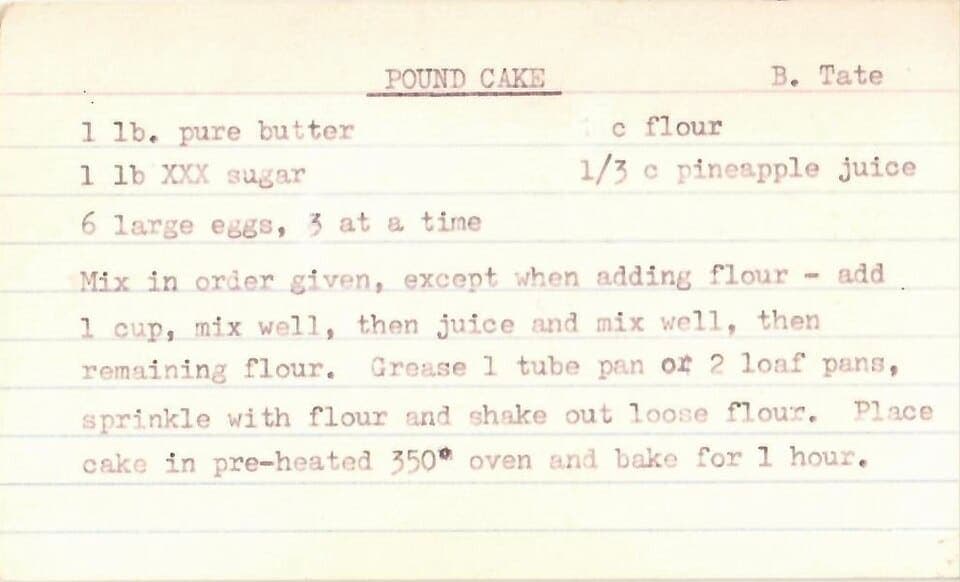
Source · CC BY-SA 4.0 · Photograph by SJGW
Evidano Transcription
POUND CAKE B. Tate
1 lb. pure butter [illegible] c flour
1 lb XXX sugar 1/3 c pineapple juice
6 large eggs, 3 at a time
Mix in order given, except when adding flour - add
1 cup, mix well, then juice and mix well, then
remaining flour. Grease 1 tube pan or 2 loaf pans,
sprinkle with flour and shake out loose flour. Place
cake in pre-heated 350* oven and bake for 1 hour.
Generated by Evidano’s advanced model; not yet checked against a published edition.
Three layers in every scan
The document itself is usually typed or printed, and its structure is conventional: a letterhead or a departmental banner, a subject line, numbered paragraphs, footnotes keyed by symbol or superscript, a running head and a page number that repeat on every leaf, sometimes two or three columns. Printed and typed English breaks words at the line end with a hyphen, so a paragraph read strictly line by line contains words that do not exist. Typewritten pages have their own habits: no proportional spacing, a comma serving as a full stop where the key was worn, an apostrophe made from a raised comma, a figure 1 typed as a lower-case l.
The second layer is what the scanner or the copier contributed. Skew from a sheet fed crooked; a dark band and lost characters where the page curved into the gutter of a bound volume; a clipped edge where the paper was larger than the platen; speckle and grain from a photocopy of a photocopy; a black rectangle where the lid did not close; moiré across a halftone illustration; and, on thin paper, a full mirror image of the reverse showing through the recto strongly enough to be read.
The third layer is administrative. Rubber stamps with dates and file references, some of them printed sideways up the margin; a classification banner at the head and foot; a declassification or review panel with its own tick boxes filled in by hand years later; initials in coloured pencil; a file number written diagonally across the top corner; staple and punch holes; and, on modern material, a redaction block covering text that is deliberately gone. None of this is part of what the author wrote, and all of it is worth keeping — just not in the middle of the sentence it happens to overlap.
Why ordinary OCR struggles here
Reading order is not top to bottom
A page with two columns, a boxed notice and a mailing panel has at least four reading orders, and only one of them is right. Software that returns text in raster order interleaves the columns line by line, producing paragraphs that alternate between two unrelated arguments. The order has to be worked out from the layout before a single word is emitted.
Text that is not on this side of the paper
Show-through from the reverse of a light sheet is real ink in the image, mirrored and slightly fainter. Character recognition sees plausible letters and adds them to the page, so a clean paragraph acquires nonsense words between its lines. Distinguishing show-through from faint but genuine text is a judgement about the page, not about the shapes.
Stamps, annotations and the sentence underneath
A stamp crossing a typed line leaves both readable to a person and neither reliable to a recogniser. The same goes for a handwritten correction over typing, an initial in the margin, and a reference number written across the header. Each needs to be captured as its own item, with the underlying text recovered rather than overwritten.
Furniture that repeats on every page
Running heads, page numbers, classification banners and footers are not part of the text, but they sit in the middle of the extracted stream and break paragraphs that run across a page turn. Removing them mechanically is risky, because a page number can look like a footnote marker and a footer can contain something you need.
Who works with this material
Litigation and compliance teams
Disclosure bundles arrive as thousands of scanned pages of correspondence, minutes and reports, often photocopied more than once. What matters is that every page becomes searchable text, that redactions are visible as redactions, and that a handwritten note in the margin of a memo is not lost in the body of it.
Archives and freedom-of-information units
Released government files carry classification banners, review panels and file references that are part of the record’s history. Capturing those separately from the document text lets a catalogue record the release history and still offer the full text for searching.
Libraries and publishers converting back-runs
Journals, reports and newsletters printed before typesetting went digital exist only as paper and film. Retro-conversion needs the columns read in order, the footnotes attached to the right passage, and hyphenated words rejoined, so the result can be re-flowed rather than merely searched.
Anyone emptying a filing cabinet
Small organisations digitise decades of paper with a sheet-feed scanner and no metadata at all. Getting reliable text off crooked, stapled, double-sided pages is the whole of the job; a transcription that flags the pages it struggled with saves rescanning the ones it did not.
Getting the best transcription
Scan once, properly
Three hundred dots per inch in greyscale reads better than the same page in bitonal black and white, which throws away the faint strokes first. Keep the whole sheet in frame including the margins, deskew if your scanner offers it, and photograph rather than force a tightly bound volume that will not lie flat.
Say what counts as the document
Decide whether running heads, page numbers, classification banners and mailing panels should appear in the output, be collected separately, or be dropped. Doing this in the prompt is safer than stripping them afterwards with a pattern, which will eventually remove a line you wanted.
Ask for the added marks as their own list
Request stamps, handwritten annotations, file references and redactions as separate entries with their position, rather than inline. You then have the typed text clean, and a record of everything the file added to it, without having to guess later which was which.
Set the rule for hyphens and paragraph breaks
State whether words broken at a line end should be rejoined, and whether lines within a paragraph should be merged. Rejoining is almost always what you want for prose and almost never what you want for a table or a form, so it is worth saying which kind of page you are sending.
Frequently asked questions
- Are words split by a hyphen at the end of a line put back together?
- Yes, when you ask for prose. A hyphen at a line break is treated as a break in a single word and the halves are rejoined, while a hyphen that belongs to the word — in a compound or a double-barrelled name — is kept. If you would rather see the page exactly as printed, ask for line-by-line output instead.
- What happens to running heads, page numbers and footers?
- They are recognised as page furniture rather than as sentences, so a paragraph that runs across a page turn is not interrupted by a title and a number. You can have them omitted, collected into a separate list, or kept in place, depending on whether you are rebuilding the document or indexing it.
- Will text showing through from the back of the sheet be transcribed by mistake?
- Mirrored show-through is identified as an artefact of the paper and left out of the text. Where a page is so thin that the reverse is genuinely ambiguous, the affected passage is flagged rather than filled in, which is the point at which rescanning the sheet on a dark backing usually solves it.
- Are stamps and handwritten annotations included?
- They are transcribed and labelled as stamps or annotations, with their position on the page, and the typed text they cross is recovered where it remains legible. A declassification panel with hand-filled boxes comes back as the panel’s printed wording plus what was written into it.
- How is a page with two or three columns handled?
- The columns are identified first and read one after another, not across the page. Boxed notices, side panels and captions are kept as their own blocks so they do not cut into the middle of a paragraph, and the sequence of blocks is reported so you can check it against the image.
Related scripts and pages
Make a filing cabinet searchable
Upload a scanned report, memo or typescript, choose Scanned Documents, and check the reading order on the most crowded page first.