
English · c. 1650–1800
Georgian paperwork, read as it was written
By 1700 English clerks had settled on one alphabet: the sloped, looped round hand that the writing masters engraved and every counting house copied. It is far easier on the eye than a Tudor hand, and yet the ordinary difficulties remain — a long ſ that looks like f, capitals whose entry strokes cut through the word in front, money set out in three unlabelled columns, and a date given by the year of the king. Evidano transcribes deeds, ledgers, registers and receipt books of this period and keeps the columns as columns.
Sample pages
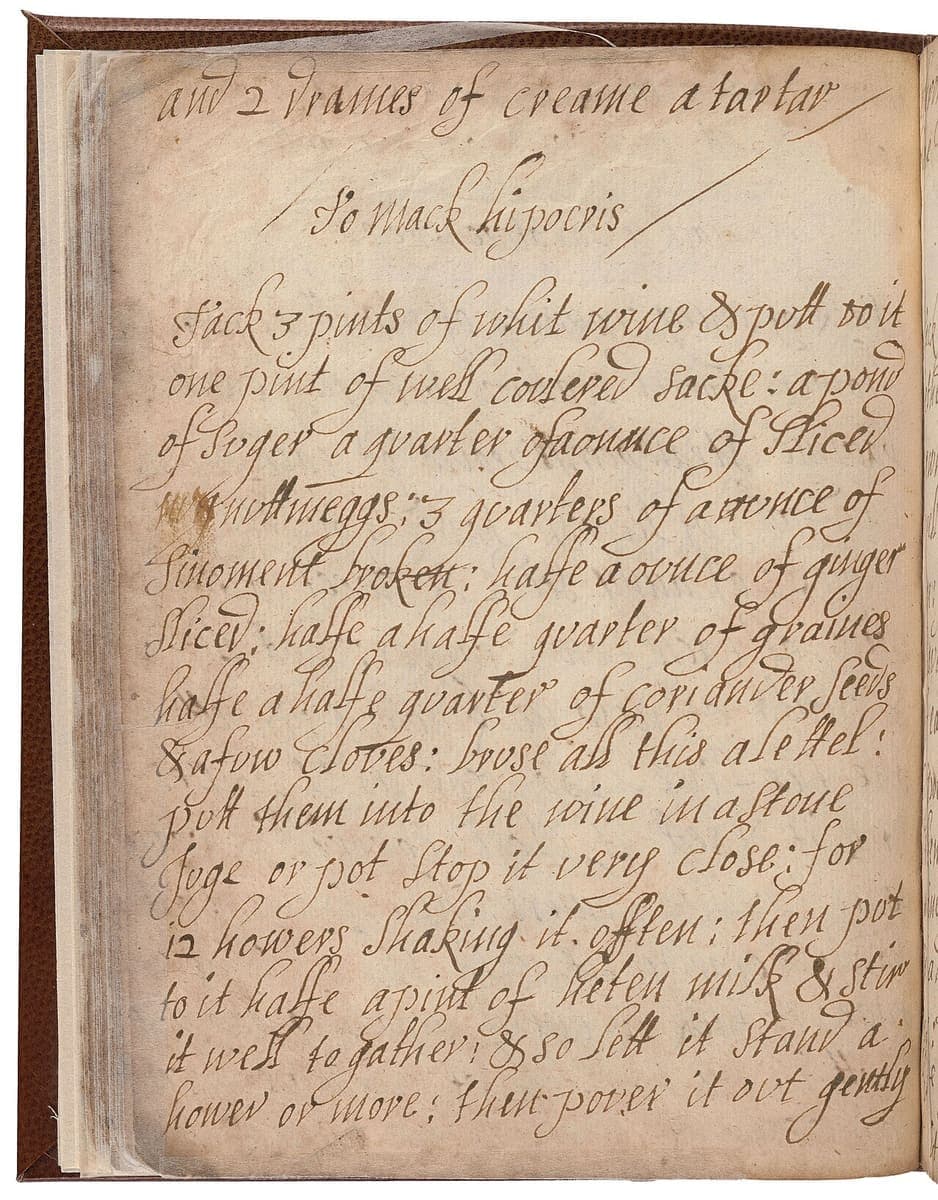
Folger Shakespeare Library, MS V.a.450, c. 1675 · Source · Public domain · Folger Shakespeare Library Digital Collections
Evidano Transcription
and 2 drames of creame a tartar
/ To mack hipocris /
Tack 3 pints of whit wine & putt to it
one pint of well coulered sacke: a pond
of Suger a quarter of a ounce of Sliced
[cancelled: w] nuttmeggs: 3 quarters of a ounce of
Sinoment broken: halfe a ounce of ginger
Sliced: halfe a halfe quarter of graines
halfe a halfe quarter of coriander seeds
& a fow cloves: brose all this a lettel:
putt them into the wine in a stone
Juge or pot Stop it very close: for
12 howers Shaking it often: then pot
to it halfe a pint of beten milk & stir
it well to gather: & so lett it stand a
hower or more: then pover it out gently
Generated by Evidano’s advanced model; not yet checked against a published edition.
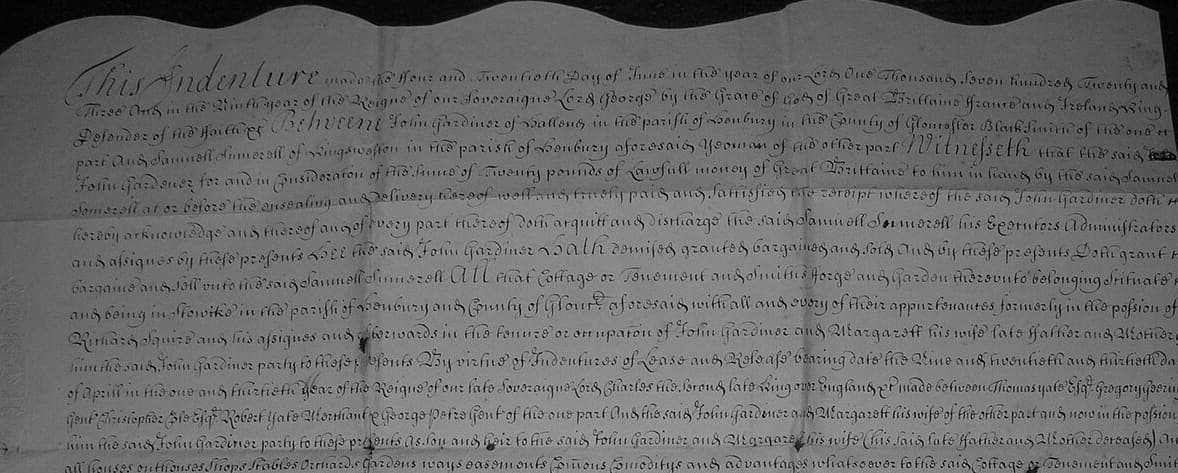
Source · CC BY-SA 3.0 · Photograph by Wikimedia Commons user Oosoom
Evidano Transcription
This Indenture made the ffour and Twentieth Day of June in the year of our Lord One Thousand Seven hundred Twenty and
Three And in the Ninth year of the Reigne of our Soveraigne Lord George by the Grace of God of Great Brittaine ffrance and Ireland King
Defender of the ffaith e[t]c Betweene John Gardiner of wallens in the parish of Henbury in the County of Gloucester Blacksmith of the one
part And Samuell Somerell of Kingsweston in the parish of Henbury aforesaid Yeoman of the other part Witnesseth that the said [cancelled: John]
John Gardiner for and in Considerac[i]on of the sume of Twenty pounds of Lawfull money of Great Brittaine to him in hand by the said Samuell
Somerell at or before the ensealing and delivery hereof well and truely paid and satisfied the receipt whereof the said John Gardiner doth
hereby acknowledge and thereof and of every part thereof doth acquitt and discharge the said Samuell Somerell his Executors Administrators
and assignes by these presents Hee the said John Gardiner Hath demised granted bargained and sold And by these presents Doth grant
bargaine and sell unto the said Samuell Somerell All that Cottage or Tenement and smiths fforge and Garden thereunto belonging scituate
and being in Stowick in the parish of Henbury and County of Glouc[este]r aforesaid with all and every of their appurtenances formerly in the poss[ess]ion of
Richard Squire and his assignes and afterwards in the tenure or occupac[i]on of John Gardiner and Margarett his wife late ffather and Mother
him the said John Gardiner party to these p[re]sents By virtue of Indentures of Lease and Release bearing date the Nine and twentieth and thirtieth da[yes]
of Aprill in the one and thirtieth year of the Reigne of our late Soveraigne Lord Charles the second late King over England e[t]c made between Thomas yate Esq[ui]r[e] Gregory Gearing
Gent[leman] Christopher Cole Esq[ui]r[e] Robert Yate Merchant & George petre Gent[leman] of the one part And the said John Gardiner and Margarett his wife of the other part and now in the poss[ess]ion
him the said John Gardiner party to these p[re]sents As son and heir to the said John Gardiner and Margarett his wife (his said late ffather and Mother deceased) An[d]
all houses outhouses shops stables Orchards Gardens ways easements Com[m]ons Comoditys and advantages whatsoever to the said Cottage or Tenement and smit[hs]
Generated by Evidano’s advanced model; not yet checked against a published edition.
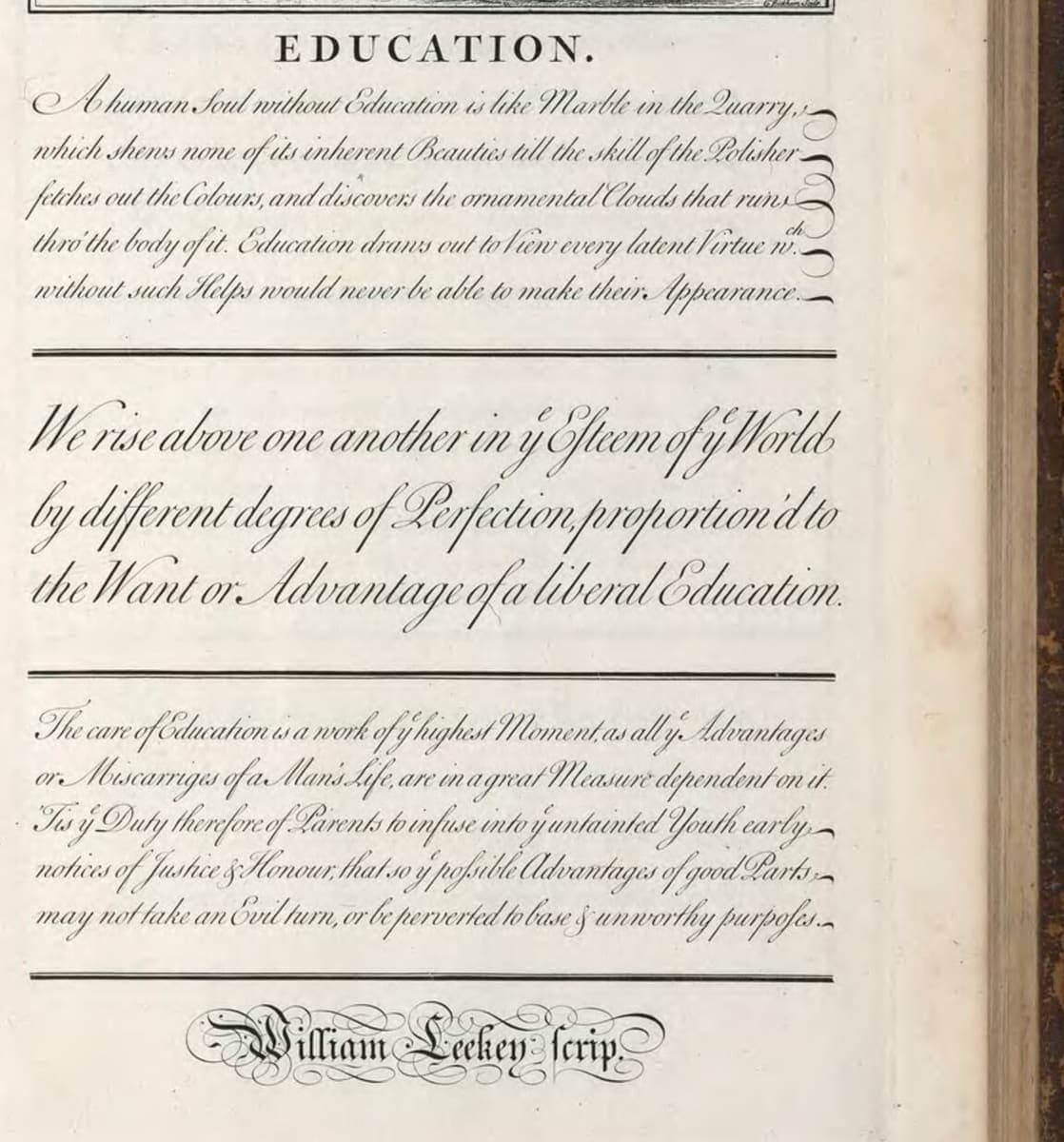
Source · Public domain · Getty Research Institute copy, digitised by the Internet Archive
Evidano Transcription
EDUCATION.
A human Soul without Education is like Marble in the Quarry,
which shews none of its inherent Beauties till the skill of the Polisher
fetches out the Colours, and discovers the ornamental Clouds that runs
thro' the body of it. Education draws out to View every latent Virtue w[hi]ch.
without such Helps would never be able to make their Appearance.
We rise above one another in y[e] Esteem of y[e] World
by different degrees of Perfection, proportion'd to
the Want or Advantage of a liberal Education.
The care of Education is a work of y[e] highest Moment, as all y[e] Advantages
or Miscariges of a Man's Life, are in a great Measure dependent on it.
'Tis y[e] Duty therefore of Parents to infuse into y[e] untainted Youth early
notices of Justice & Honour, that so y[e] poſsible Advantages of good Parts,
may not take an Evil turn, or be perverted to base & unworthy purposes.
William Leekey scrip.
Generated by Evidano’s advanced model; not yet checked against a published edition.
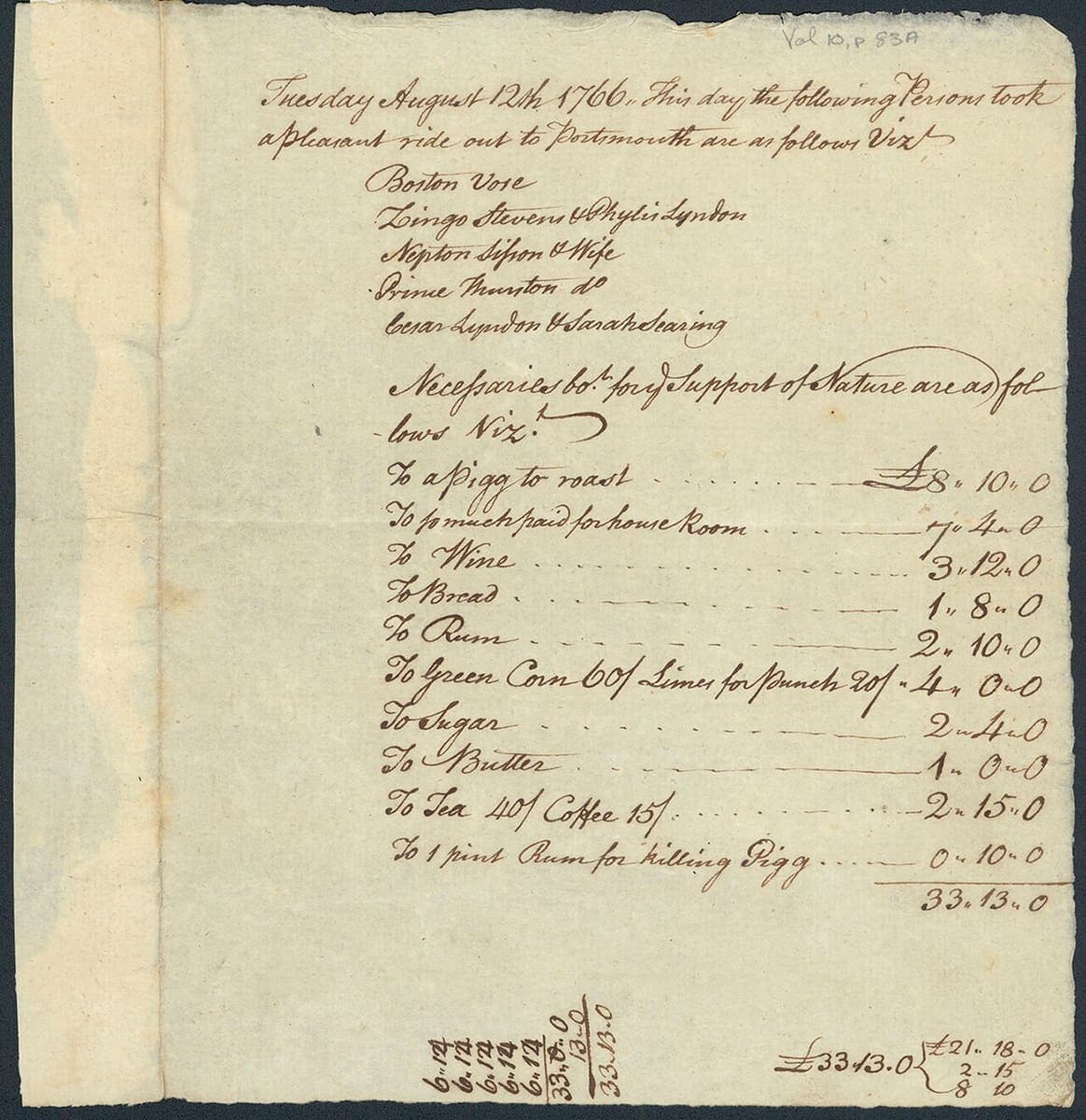
Rhode Island Historical Society, 12 August 1766 · Source · Public domain
Evidano Transcription
Vol 10, p 83A
Tuesday August 12th 1766. This day the following Persons took
a pleasant ride out to Portsmouth are as follows Viz[t]
Boston Vose
Zingo Stevens & Phylis Lyndon
Nepton Sisson & Wife
Prince Thurston d[itt]o
Cesar Lyndon & Sarah Searing
Necessaries bo[ugh]t for y[e] Support of Nature are as fol-
lows Viz[t]
| £ | s | d | |
|---|---|---|---|
| To a Pigg to roast | 8 | 10 | 0 |
| To so much paid for house Room | 7 | 4 | 0 |
| To Wine | 3 | 12 | 0 |
| To Bread | 1 | 8 | 0 |
| To Rum | 2 | 10 | 0 |
| To Green Corn 60/ Limes for punch 20/ | 4 | 0 | 0 |
| To Sugar | 2 | 4 | 0 |
| To Butter | 1 | 0 | 0 |
| To Tea 40/ Coffee 15/ | 2 | 15 | 0 |
| To 1 pint Rum for killing Pigg | 0 | 10 | 0 |
| 33 | 13 | 0 |
6 . 14
6 . 14
6 . 14
6 . 14
6 . 14
33 . 0 . 0
13 . 0
33 . 13 . 0
£33 . 13 . 0 { £21 . 18 . 0
2 . 15
8 . 10
Generated by Evidano’s advanced model; not yet checked against a published edition.
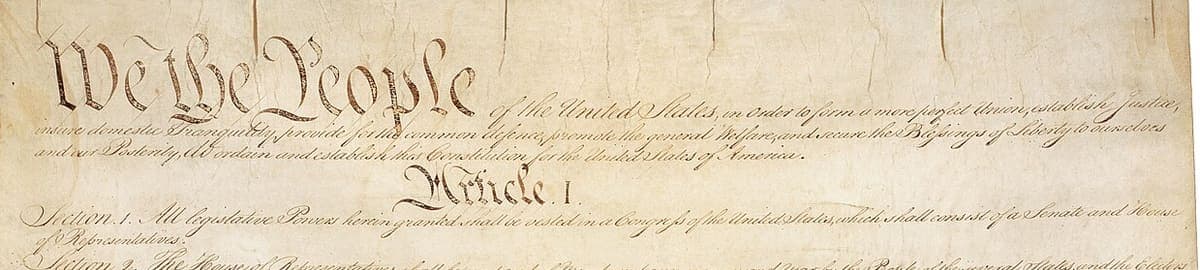
National Archives and Records Administration, Washington, 17 September 1787 · Source · Public domain
Evidano Transcription
The three blocks of writing in this band — the preamble, the heading Article. I. and Section. 1. — from the Wikisource proofread text of this sheet. The paragraphing is that edition’s; the parchment’s ruled lines run much wider. Section. 2., which begins on the last visible line, is not included, and the spellings Tranquility and defence are the engrosser’s own.
We the People of the United States, in Order to form a more perfect Union, establish Justice, insure domestic Tranquility, provide for the common defence, promote the general Welfare, and secure the Blessings of Liberty to ourselves and our Posterity, do ordain and establish this Constitution for the United States of America.
Article. I.
Section. 1. All legislative Powers herein granted shall be vested in a Congress of the United States, which shall consist of a Senate and House of Representatives.
Source: Constitution of the United States of America (1787), Page:COTUS (1787 Edition).pdf/1, via Wikisource (Public domain).
Round hand, engrossing hand and the writing masters
Round hand arrived with the copperplate copybooks of the later seventeenth century and was fixed for a century by George Bickham’s The Universal Penman, issued in parts between 1733 and 1741. Its letters slope to the right, join by looped hairlines, and alternate thick and thin strokes because they were cut with an engraver’s burin before they were written with a quill. A clerk learned it as a set of specimen pieces — a promissory note, a bill of exchange, a letter of business, a moral maxim — and the specimens are why so many eighteenth-century hands look alike. Beside it stood the engrossing hand of deeds and enrolments, larger, more upright and deliberately slow, with the opening words This Indenture or Know all Men drawn in black letter, and a residue of late secretary forms in the hands of older or provincial clerks.
Spelling is nearly modern but the abbreviations are not. The long ſ survives in the middle of words and in the doubled ſs until the end of the century. Superscript contractions carry over from the previous age: yᵉ, yᵗ, yᵒᵘʳ, wᶜʰ, agᵗ for against, Exᵒʳ for executor, Recᵈ for received, and Pᵈ for paid. Money is written as three figures separated by dots or ruled into three columns, with the pound sign at the head; a sum in a deed is also spelled out in words and then repeated in figures. Dates are given twice, by the year of grace and by the regnal year — the Ninth Year of the Reign of our Sovereign Lord George — and until 1752 the legal year began on 25 March, so January to March may carry a double year such as 1723/4.
The genres are those of a paper bureaucracy. Indentures and leases are engrossed on parchment with a wavy or indented top edge cut so that the two halves can be matched, and are signed, sealed and endorsed on the back. Parish registers and, after 1754, printed marriage registers with blanks record baptisms, marriages and burials in fixed columns. Overseers of the poor keep settlement examinations and removal orders; vestries, turnpike trusts and companies keep minute books; merchants and the East India Company keep waste books, journals and ledgers with folio references, ditto marks and money ruled into columns. Household receipt books, kept by women over several generations, mix cookery and medicine in the same volume, with later hands squeezed in around the earlier ones.
Why ordinary OCR struggles here
Long s, and the pairs it creates
A long ſ differs from f only by a nub on the left of the stem, and in a fast hand the nub is often missing. Succeſs, houſe and neceſsary come back as fucceff and haufe unless the letter is recognised for what it is, and the decision to keep or modernise it has to be made once for the whole document.
Money in columns without headings
Pounds, shillings and pence are set out as bare figures in three ruled columns, sometimes with the shilling stroke, sometimes only with dots. Read across the page as text they dissolve into a run of numbers, and a subtotal carried to the next folio looks exactly like an ordinary entry.
Ditto marks and empty cells
A register or a ledger repeats itself with do., dº, a pair of commas or a plain dash, and an empty cell can mean nothing to record, the same as above, or a column the clerk never used. Expanding a ditto silently changes the evidence; leaving it unmarked loses the entry altogether.
Flourishes, seals and endorsements
Engrossed deeds open with a display capital that runs the width of two words, close with paraph strokes under the signatures, and carry a docket, a schedule of witnesses and later archival numbers on the dorse. All of it is writing, none of it is the text of the deed, and each part needs to be reported for what it is.
Who works with this material
Genealogists and one-place studies
Parish registers, settlement examinations, removal orders and militia lists are the backbone of eighteenth-century family history. Names, ages, parishes of settlement and dates need to come out as fields, and a ditto has to be recorded as a ditto so that a chain of entries can be followed.
Economic and business historians
Ledgers, waste books, freight accounts and estate rentals are only useful as data. That means each entry with its date, its folio reference, its narrative and its three money columns kept apart, and totals transcribed rather than recalculated.
Solicitors and title researchers
Pre-registration deeds, mortgages and manorial copies still turn up in title investigations. What is needed is the parties, the parcels, the covenants and the endorsements read exactly, including the schedule on the back, which is often where a later assignment was written.
Museums and community archives
Receipt books, diaries, letters and minute books are the material of local exhibitions and school projects. A readable text beside the image is what makes a case display or a website usable by someone who has never met a long ſ.
Getting the best transcription
Fix the treatment of the long s and contractions
Say whether ſ should be transcribed as s or kept, and whether yᵉ, wᶜʰ, Recᵈ and Exᵒʳ are to stand or be expanded. In a volume written over fifty years the same rule must hold for the first page and the last, or the transcript cannot be searched consistently.
Ask for accounts as rows, not prose
Request each line of a ledger as a record with date, narrative, folio and separate pounds, shillings and pence fields, and say what to do with a blank column. A row-shaped result loads into a spreadsheet; a paragraph has to be taken apart by hand.
Say how dates should be reported
Ask for the date as written, with the regnal year kept and a double year such as 1723/4 preserved. Conversion to a modern calendar is a separate step, and doing it silently hides the eleven days lost in September 1752 and the change of year-start that came with them.
Photograph parchment flat and evenly
Deeds have been folded for two centuries and cockle when they relax. Weight the corners, light the membrane from two sides to kill the shine, and shoot the back as well: the endorsement usually carries the parties, the date and the reference in one line.
Further reading on this hand
The palaeography guides the in-app selector points to for this domain, if you want to check a transcription against the standard references.
- Palaeography: Reading Old Handwriting 1500–1800
This tutorial from The National Archives teaches the reading of English documents written between 1500 and 1800. Its exercises use authentic records and supply period alphabets, transcripts, and guidance on dates, money, spelling, and common abbreviations. The examples expose learners to changing secretary, italic, and later cursive letterforms as well as administrative vocabulary and document structure. Its later exercises are useful for Georgian round hands and for the numerical conventions found in legal and financial records.
Frequently asked questions
- Will pounds, shillings and pence come out in the right columns?
- They can be returned as three separate fields, with the pound sign and any shilling stroke kept, so that £33 13s 0d does not collapse into 33130. Totals are transcribed as they stand rather than recomputed, since a clerk’s arithmetic is part of the record.
- How are ditto marks handled?
- A do., a dº or a pair of commas can be kept as written, expanded to the repeated value, or both — the expansion supplied in brackets beside the mark. Blank cells are reported as blank rather than filled from the line above.
- Can it read the black letter on a deed or a charter?
- Yes. The display words at the head of an indenture are read alongside the round hand and can be flagged as a separate style, which helps when you are indexing documents by their opening formula.
- What about the endorsement on the back of a deed?
- Photograph it and send it as a second image. Dorse endorsements, memoranda of livery of seisin and later archival numbers are transcribed as their own block, attached to the deed but not mixed into its text.
- Is a copybook page any use as a test?
- It is an excellent one. A plate from The Universal Penman gives the same words in several sizes of one hand, so you can see whether the reading holds up as the writing gets smaller and whether the long ſ is being handled the way you asked.
Related scripts and pages
Transcribe your Georgian records
Upload a deed, a ledger, a register or a receipt book, choose Round Hand and Georgian Administrative Records, and set the rules for money and dates first.