
English
Get the text out of handouts, worksheets and textbooks
Teaching material is rarely one column of prose. A page carries a heading, a numbered exercise, an equation, a diagram with labels pointing into it, a box for the answer, and quite often a pupil’s working and a marker’s red pen on top of all that. Evidano reads the printed layer and the written one separately, keeps question numbers attached to their questions, and does not turn a subscript into an ordinary digit.
Sample pages
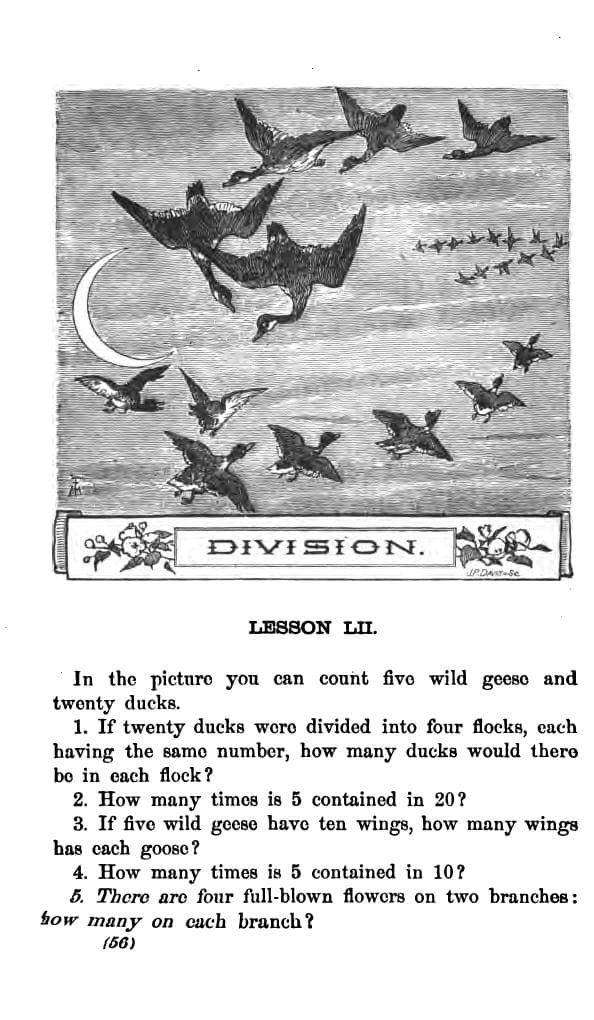
Source · Public domain · Digitised by Google, via the Internet Archive
Evidano Transcription
The lesson heading, the introductory sentence and all five questions, from the Wikisource transcription of this page; the caption inside the engraving reads DIVISION. and the bracketed page number at the foot is the book’s own.
DIVISION.
LESSON LII.
In the picture you can count five wild geese and twenty ducks.
1. If twenty ducks were divided into four flocks, each having the same number, how many ducks would there be in each flock?
2. How many times is 5 contained in 20?
3. If five wild geese have ten wings, how many wings has each goose?
4. How many times is 5 contained in 10?
5. There are four full-blown flowers on two branches: how many on each branch?
(56)
Source: Ray’s New Primary Arithmetic for Young Learners, page 56, via Wikisource (Public domain).
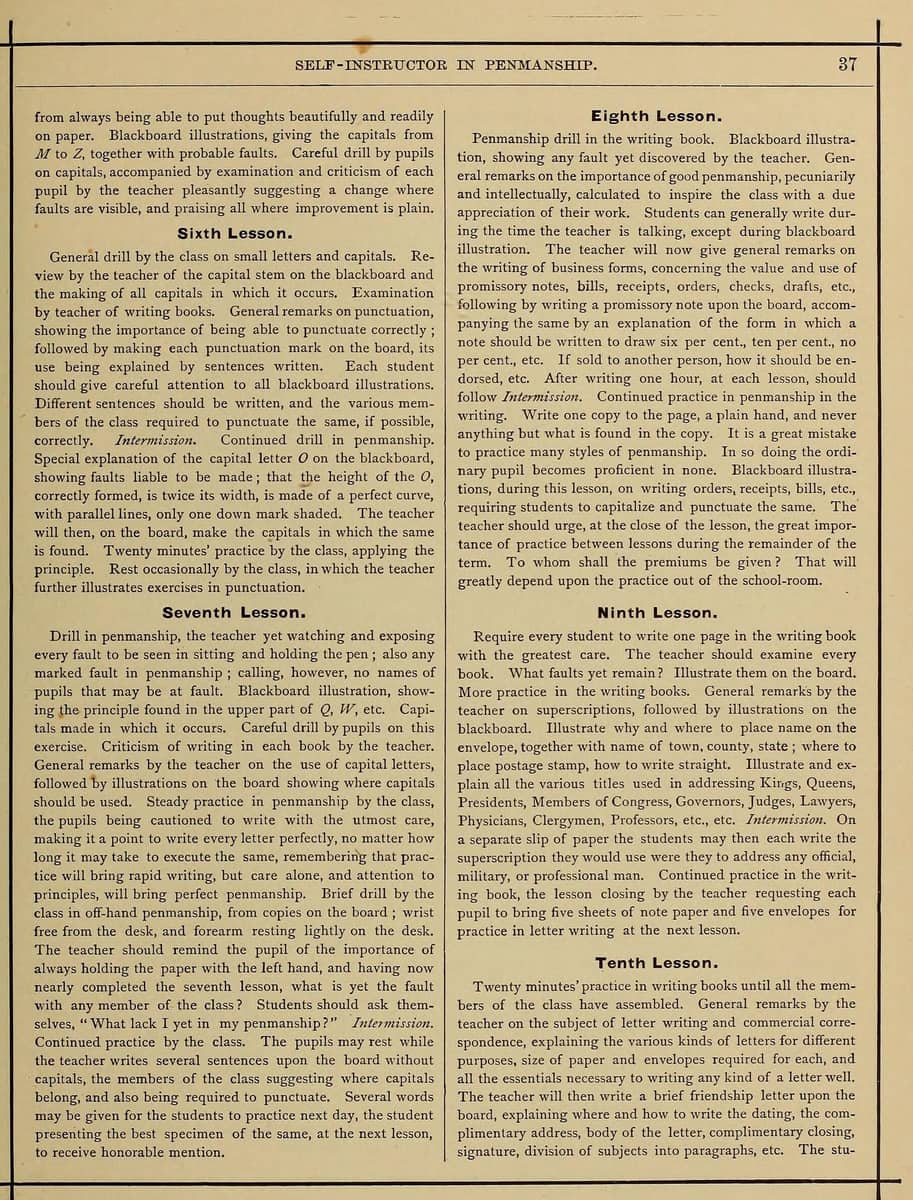
Evidano Transcription
SELF-INSTRUCTOR IN PENMANSHIP. 37
from always being able to put thoughts beautifully and readily
on paper. Blackboard illustrations, giving the capitals from
M to Z, together with probable faults. Careful drill by pupils
on capitals, accompanied by examination and criticism of each
pupil by the teacher pleasantly suggesting a change where
faults are visible, and praising all where improvement is plain.
Sixth Lesson.
General drill by the class on small letters and capitals. Re-
view by the teacher of the capital stem on the blackboard and
the making of all capitals in which it occurs. Examination
by teacher of writing books. General remarks on punctuation,
showing the importance of being able to punctuate correctly;
followed by making each punctuation mark on the board, its
use being explained by sentences written. Each student
should give careful attention to all blackboard illustrations.
Different sentences should be written, and the various mem-
bers of the class required to punctuate the same, if possible,
correctly. Intermission. Continued drill in penmanship.
Special explanation of the capital letter O on the blackboard,
showing faults liable to be made; that the height of the O,
correctly formed, is twice its width, is made of a perfect curve,
with parallel lines, only one down mark shaded. The teacher
will then, on the board, make the capitals in which the same
is found. Twenty minutes' practice by the class, applying the
principle. Rest occasionally by the class, in which the teacher
further illustrates exercises in punctuation.
Seventh Lesson.
Drill in penmanship, the teacher yet watching and exposing
every fault to be seen in sitting and holding the pen; also any
marked fault in penmanship; calling, however, no names of
pupils that may be at fault. Blackboard illustration, show-
ing the principle found in the upper part of Q, W, etc. Capi-
tals made in which it occurs. Careful drill by pupils on this
exercise. Criticism of writing in each book by the teacher.
General remarks by the teacher on the use of capital letters,
followed by illustrations on the board showing where capitals
should be used. Steady practice in penmanship by the class,
the pupils being cautioned to write with the utmost care,
making it a point to write every letter perfectly, no matter how
long it may take to execute the same, remembering that prac-
tice will bring rapid writing, but care alone, and attention to
principles, will bring perfect penmanship. Brief drill by the
class in off-hand penmanship, from copies on the board; wrist
free from the desk, and forearm resting lightly on the desk.
The teacher should remind the pupil of the importance of
always holding the paper with the left hand, and having now
nearly completed the seventh lesson, what is yet the fault
with any member of the class? Students should ask them-
selves, "What lack I yet in my penmanship?" Intermission.
Continued practice by the class. The pupils may rest while
the teacher writes several sentences upon the board without
capitals, the members of the class suggesting where capitals
belong, and also being required to punctuate. Several words
may be given for the students to practice next day, the student
presenting the best specimen of the same, at the next lesson,
to receive honorable mention.
Eighth Lesson.
Penmanship drill in the writing book. Blackboard illustra-
tion, showing any fault yet discovered by the teacher. Gen-
eral remarks on the importance of good penmanship, pecuniarily
and intellectually, calculated to inspire the class with a due
appreciation of their work. Students can generally write dur-
ing the time the teacher is talking, except during blackboard
illustration. The teacher will now give general remarks on
the writing of business forms, concerning the value and use of
promissory notes, bills, receipts, orders, checks, drafts, etc.,
following by writing a promissory note upon the board, accom-
panying the same by an explanation of the form in which a
note should be written to draw six per cent., ten per cent., no
per cent., etc. If sold to another person, how it should be en-
dorsed, etc. After writing one hour, at each lesson, should
follow Intermission. Continued practice in penmanship in the
writing. Write one copy to the page, a plain hand, and never
anything but what is found in the copy. It is a great mistake
to practice many styles of penmanship. In so doing the ordi-
nary pupil becomes proficient in none. Blackboard illustra-
tions, during this lesson, on writing orders, receipts, bills, etc.,
requiring students to capitalize and punctuate the same. The
teacher should urge, at the close of the lesson, the great impor-
tance of practice between lessons during the remainder of the
term. To whom shall the premiums be given? That will
greatly depend upon the practice out of the school-room.
Ninth Lesson.
Require every student to write one page in the writing book
with the greatest care. The teacher should examine every
book. What faults yet remain? Illustrate them on the board.
More practice in the writing books. General remarks by the
teacher on superscriptions, followed by illustrations on the
blackboard. Illustrate why and where to place name on the
envelope, together with name of town, county, state; where to
place postage stamp, how to write straight. Illustrate and ex-
plain all the various titles used in addressing Kings, Queens,
Presidents, Members of Congress, Governors, Judges, Lawyers,
Physicians, Clergymen, Professors, etc., etc. Intermission. On
a separate slip of paper the students may then each write the
superscription they would use were they to address any official,
military, or professional man. Continued practice in the writ-
ing book, the lesson closing by the teacher requesting each
pupil to bring five sheets of note paper and five envelopes for
practice in letter writing at the next lesson.
Tenth Lesson.
Twenty minutes' practice in writing books until all the mem-
bers of the class have assembled. General remarks by the
teacher on the subject of letter writing and commercial corre-
spondence, explaining the various kinds of letters for different
purposes, size of paper and envelopes required for each, and
all the essentials necessary to writing any kind of a letter well.
The teacher will then write a brief friendship letter upon the
board, explaining where and how to write the dating, the com-
plimentary address, body of the letter, complimentary closing,
signature, division of subjects into paragraphs, etc. The stu-
Generated by Evidano’s advanced model; not yet checked against a published edition.
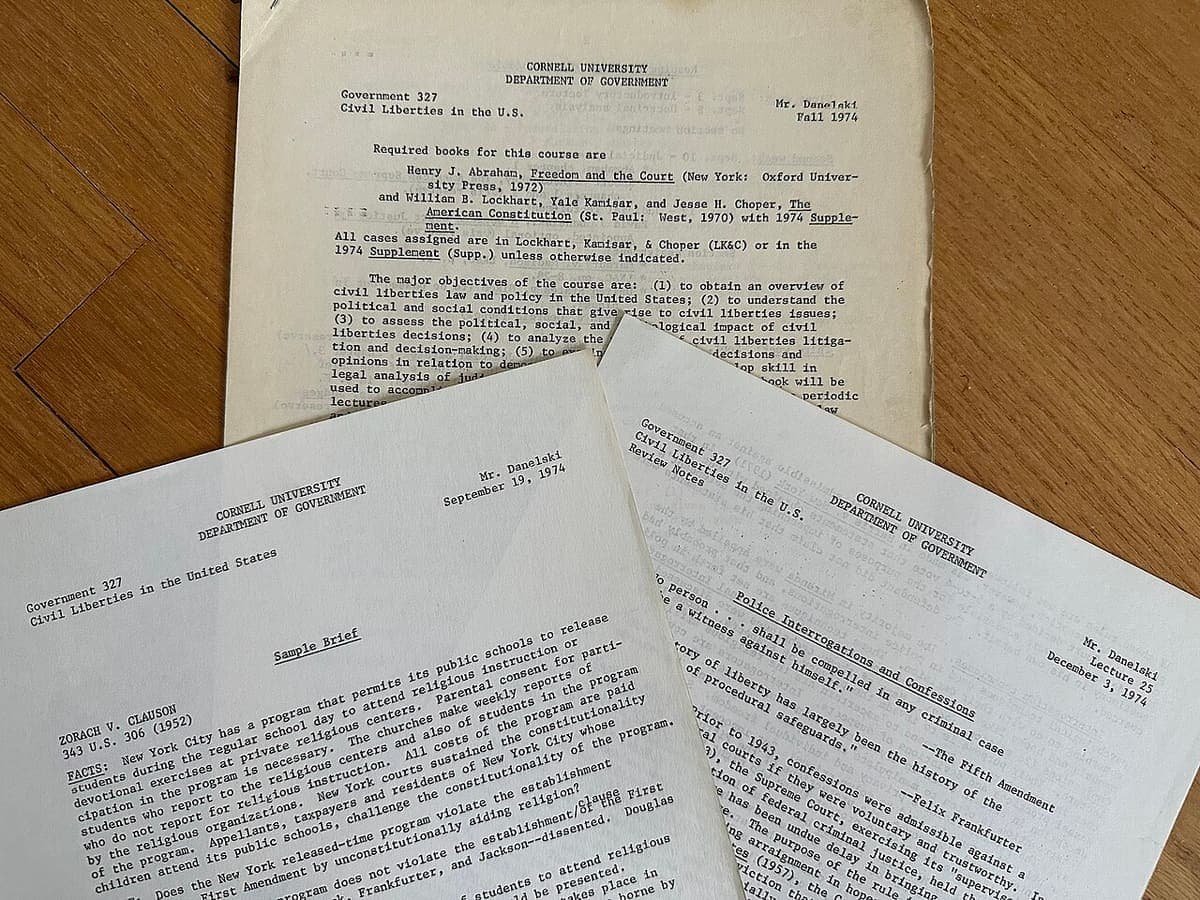
Source · CC BY-SA 4.0 · Photograph by Jonathan Schilling
Evidano Transcription
CORNELL UNIVERSITY
DEPARTMENT OF GOVERNMENT
Government 327 Mr. Danelski
Civil Liberties in the U.S. Fall 1974
Required books for this course are:
Henry J. Abraham, Freedom and the Court (New York: Oxford Univer-
sity Press, 1972)
and William B. Lockhart, Yale Kamisar, and Jesse H. Choper, The
American Constitution (St. Paul: West, 1970) with 1974 Supple-
ment.
All cases assigned are in Lockhart, Kamisar, & Choper (LK&C) or in the
1974 Supplement (Supp.) unless otherwise indicated.
The major objectives of the course are: (1) to obtain an overview of
civil liberties law and policy in the United States; (2) to understand the
political and social conditions that give rise to civil liberties issues;
(3) to assess the political, social, and [illegible]logical impact of civil
liberties decisions; (4) to analyze the [illegible] civil liberties litiga-
tion and decision-making; (5) to ev[illegible] decisions and
opinions in relation to dem[illegible]op skill in
legal analysis of jud[illegible]ook will be
used to accomp[illegible]periodic
lecture[illegible]aw
[illegible]
CORNELL UNIVERSITY
DEPARTMENT OF GOVERNMENT
Government 327 Mr. Danelski
Civil Liberties in the United States September 19, 1974
Sample Brief
ZORACH V. CLAUSON
343 U.S. 306 (1952)
FACTS: New York City has a program that permits its public schools to release
students during the regular school day to attend religious instruction or
devotional exercises at private religious centers. Parental consent for parti-
cipation in the program is necessary. The churches make weekly reports of
students who report to the religious centers and also of students in the program
who do not report for religious instruction. All costs of the program are paid
by the religious organizations. New York courts sustained the constitutionality
of the program. Appellants, taxpayers and residents of New York City whose
children attend its public schools, challenge the constitutionality of the program.
[illegible] Does the New York released-time program violate the establishment
[illegible] First Amendment by unconstitutionally aiding religion?
[illegible]rogram does not violate the establishment \clause/ of the First
[illegible]k, Frankfurter, and Jackson--dissented. Douglas
[illegible]f students to attend religious
[illegible]ld be presented.
[illegible]akes place in
[illegible]borne by
CORNELL UNIVERSITY
DEPARTMENT OF GOVERNMENT
Government 327 Mr. Danelski
Civil Liberties in the U.S. Lecture 25
Review Notes December 3, 1974
Police Interrogations and Confessions
"o person . . . shall be compelled in any criminal case
[illegible]e a witness against himself."
--The Fifth Amendment
[illegible]tory of liberty has largely been the history of the
[illegible] of procedural safeguards."
--Felix Frankfurter
[illegible]prior to 1943, confessions were admissible against a
[illegible]ral courts if they were voluntary and trustworthy. In
[illegible]3), the Supreme Court, exercising its "supervis[illegible]
[illegible]tion of federal criminal justice, held th[illegible]
[illegible]e has been undue delay in bringing
[illegible]e. The purpose of the rule [illegible]
[illegible]ing arraignment in hop[illegible]
[illegible]es (1957), the C[illegible]
[illegible]viction tha[illegible]
[illegible]tally [illegible]
Generated by Evidano’s advanced model; not yet checked against a published edition.
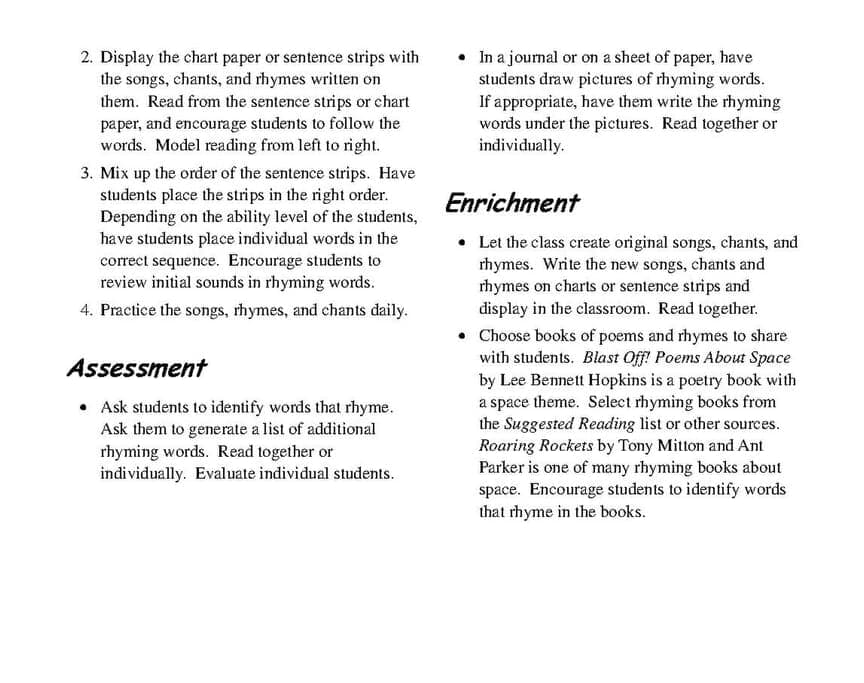
NASA Johnson Space Center, 2002 · Source · Public domain
Evidano Transcription
Display the chart paper or sentence strips with
the songs, chants, and rhymes written on
them. Read from the sentence strips or chart
paper, and encourage students to follow the
words. Model reading from left to right.Mix up the order of the sentence strips. Have
students place the strips in the right order.
Depending on the ability level of the students,
have students place individual words in the
correct sequence. Encourage students to
review initial sounds in rhyming words.Practice the songs, rhymes, and chants daily.
Assessment
• Ask students to identify words that rhyme.
Ask them to generate a list of additional
rhyming words. Read together or
individually. Evaluate individual students.
• In a journal or on a sheet of paper, have
students draw pictures of rhyming words.
If appropriate, have them write the rhyming
words under the pictures. Read together or
individually.
Enrichment
• Let the class create original songs, chants, and
rhymes. Write the new songs, chants and
rhymes on charts or sentence strips and
display in the classroom. Read together.
• Choose books of poems and rhymes to share
with students. Blast Off! Poems About Space
by Lee Bennett Hopkins is a poetry book with
a space theme. Select rhyming books from
the Suggested Reading list or other sources.
Roaring Rockets by Tony Mitton and Ant
Parker is one of many rhyming books about
space. Encourage students to identify words
that rhyme in the books.
Generated by Evidano’s advanced model; not yet checked against a published edition.
What a page of teaching material contains
The genre covers school textbooks and readers, workbooks and photocopied worksheets, lecture handouts and slide printouts, past papers and mark schemes, laboratory sheets, revision cards and the notes students take from all of them. What they have in common is structure that carries meaning. A number at the start of a line is a question number, not a bullet; an indented paragraph in smaller type is a worked solution; a rule across the page divides one exercise from the next; and a word in bold is usually the term the lesson is about. Older schoolbooks add a running head and a page number in brackets at the foot, and set their exercises in the same size as the explanation, so the two run together in a plain reading.
Then there is everything that is not prose. Mathematics brings fractions written on two lines, exponents, subscripts, roots and aligned equals signs, none of which survive a straight left-to-right reading. Science brings units, degree signs and formulae such as H₂SO₄ where the digits are part of the name. Diagrams carry labels connected by leader lines to the thing they name, and a labelling exercise may be nothing but blank rules waiting to be filled in. Language sheets use gapped sentences, tick boxes and matching columns joined by lines drawn across the page.
Most real pages are also layered. A worksheet is printed, filled in by a pupil in pencil, marked by a teacher in red, and then photocopied for a file, so three inks and a photocopier’s shadow arrive together. Handouts get stapled, folded, annotated in the margin, and photographed at an angle on a desk with a second sheet showing underneath. A slide deck printed six to a page shrinks every line to a few millimetres. Anything you send is likely to have at least two of these problems at once.
Why ordinary OCR struggles here
Printed text and pupil’s answers mixed together
A completed worksheet holds the question, the answer written into the gap and the marker’s comment on the same line. Read as one stream they become nonsense. They have to be separated by hand or by colour and shape, and each part labelled, before the sheet can be marked up or analysed.
Mathematics is not a line of characters
A fraction occupies two lines, an index sits half a line up, and a long division is a spatial arrangement. Flattened into a sentence, x² becomes x2 and ½ becomes 1 2. Getting this right means recognising the notation as notation and writing it out in a form — LaTeX, MathML or plain words — that can be read back.
Two columns, and the order they run in
Teacher’s guides and textbook pages are commonly set in two columns with headings inside them. A recogniser that reads straight across the page produces alternating half-sentences from the left column and the right, which is worse than useless for a lesson plan whose steps are numbered.
Photocopies, angles and show-through
Class material is copied until the small print greys out, the staple shadow falls across the first line, and the sheet is photographed on a desk where the page below shows at the edge of the frame. Text bleeding through thin paper is often as dark as the text on the front.
Who works with this material
Teachers rebuilding old resources
A worksheet that exists only as a photocopy of a photocopy cannot be edited, translated or made larger for a pupil who needs it. Getting the text back gives you something you can change, and the numbering and answer spaces come with it.
Accessibility and inclusion teams
A scanned handout is invisible to a screen reader. Converting it properly means reading order, headings, alternative text for diagrams and mathematics written so it can be spoken — not a picture of a page with a caption stuck under it.
Publishers and course teams
Moving a print course into a virtual learning environment means recovering thousands of exercises with their numbering and answers intact. A first pass that keeps question and answer keyed to each other saves most of the retyping.
Education researchers
Studies of curriculum change, marking practice or textbook language need the text of the materials, not scans. Where pupils’ work is involved, names and other identifying details are best removed or masked before the sheets go anywhere.
Getting the best transcription
Say which layer you want
Ask for the printed question paper, the handwritten answers, or both with each labelled. On a marked script, ask for the marker’s annotations and any grade as a separate field; it is the difference between a usable transcript and a tangle.
Choose a notation for mathematics
Name the format — LaTeX, MathML, Unicode or spoken words — before you start. LaTeX suits anything that will be typeset again, Unicode suits simple expressions in a word processor, and spoken forms suit accessibility work. Mixing them across a set of papers makes the results hard to use.
Flatten the sheet and shoot it square
Photograph one page at a time, from directly above, with the neighbouring sheet moved out of the frame. If a page is stapled, unfold it; if it curls, weight the corners. This costs seconds and removes most of the errors that come from a warped or skewed line.
Handle pupils’ names before you share
Class material often carries a child’s name, a class list or a candidate number in the header. Decide whether those fields should be dropped or replaced with a code as part of the transcription, so that what leaves your machine is already anonymous.
Frequently asked questions
- Can it keep question numbers with their questions?
- Yes. Numbered and lettered items — 1, 2, 3, then (a), (b), (c) and roman sub-parts — can be returned as a structure rather than as a run of text, which means a question and its parts stay together even when they break across a column or a page.
- How are equations returned?
- In the notation you ask for. LaTeX is the usual choice because it can be typeset or converted onward; simple expressions can come back as Unicode with proper superscripts and subscripts. Alignment of a multi-line calculation is preserved as far as the notation allows.
- What happens to a diagram with labels?
- The labels are transcribed and can be listed with the part of the figure each one points to, so a labelling exercise or a circuit diagram keeps its sense. The drawing itself is described briefly rather than redrawn.
- Can a printed answer key be matched to the questions?
- If the key is in the same image, the answers can be returned in the same numbering as the questions. If it is on a separate sheet, send both and say which is which; the numbering is what joins them.
- Is it safe to send marked work with pupils’ names on it?
- Treat it as personal data. The safest route is to crop or cover the name and any candidate number before uploading, or to ask for those fields to be replaced with a code in the output. Nothing on this page uses a real pupil’s work for that reason.
Related scripts and pages
Turn your teaching materials into text
Upload a worksheet, a past paper, a handout or a page of class notes, choose Educational Materials, and say whether you want the printed layer, the written one, or both.